Assessing the Quad: Prospects and Limitations of Quadrilateral Cooperation for Advancing Australia's Interests - ANALYSIS - Lowy Institute
←
→
Page content transcription
If your browser does not render page correctly, please read the page content below

ANALYSIS

Assessing the Quad:
Prospects and Limitations of
Quadrilateral Cooperation for
Advancing Australia’s Interests

LAVINA LEE
MAY 2020
Assessing the Quad: Prospects and Limitations of Quadrilateral
Cooperation for Advancing Australia’s Interests

The Lowy Institute is an independent policy think tank. Its mandate ranges
across all the dimensions of international policy debate in Australia —
economic, political and strategic — and it is not limited to a particular
geographic region. Its two core tasks are to:

• produce distinctive research and fresh policy options for Australia’s
  international policy and to contribute to the wider international debate

• promote discussion of Australia’s role in the world by providing an
  accessible and high-quality forum for discussion of Australian
  international relations through debates, seminars, lectures, dialogues
  and conferences.

Lowy Institute Analyses are short papers analysing recent international
trends and events and their policy implications.

The views expressed in this paper are entirely the authors’ own and not
those of the Lowy Institute.

                  ANALYSIS
Assessing the Quad: Prospects and Limitations of Quadrilateral Cooperation for
Advancing Australia’s Interests

EXECUTIVE SUMMARY
After a ten-year hiatus, the Australia-India-Japan-US Security
Quadrilateral Dialogue — informally known as the Quad — was
resurrected in 2017 with the aim to support a ‘free, open and inclusive
Indo-Pacific Region’. While there are important differences among the
four countries on threat perceptions, military capability, strategic
priority, capacity to bear the costs of potential retaliation, strategic
culture and constitutional imperatives, these differences place
limitations on Quadrilateral cooperation, but do not preclude it. All four
countries have common interests in maintaining a stable balance of
power in the region, freedom of the seas, an open rules-based
economic order, to counter ‘debt-trap’ diplomacy and to limit the use of
coercion by a state to assert territorial claims. Under the leadership of
President Xi Jinping, China has become more assertive and ambitious,
vigorously pressing its claims in the East and South China seas and
promoting its Belt and Road Initiative (BRI). Concerned to preserve the
existing liberal rules-based order, the Quad states have already
responded by increasing their cooperation. Despite the COVID-19
shock and the domestic upheavals and distractions it poses, this
cooperation will continue to deepen. While India is an outlier among the
four states because of different perceptions of the threat China poses,
this does not prevent the four states from cooperating more deeply on
standard setting, diplomatic messaging, practical economic measures,
and military cooperation, to sustain the liberal rules-based order which
has been beneficial to all of them.

                                                                    Analysis     1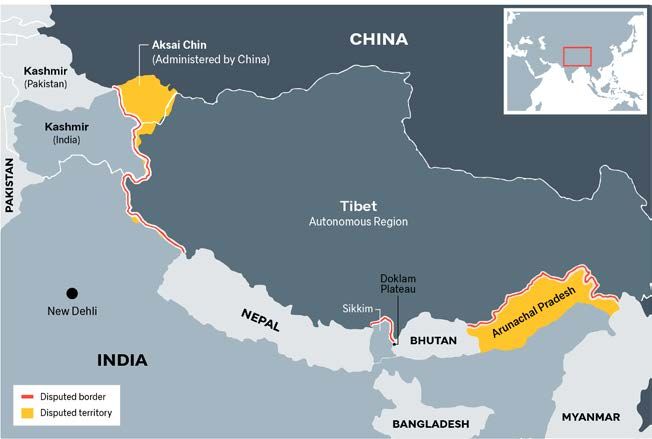
Assessing the Quad: Prospects and Limitations of Quadrilateral Cooperation
    for Advancing Australia’s Interests

    INTRODUCTION
    Over the past two years, there has been increasing agreement among
    the four most capable states in the Indo-Pacific that as China continues
    to rise, the rules and norms of the US-led order in Asia are steadily being
    eroded, and that action is needed to strengthen and defend it. While
    there are slight differences in emphasis, this sentiment was first
    reflected in Japan’s 2016 Free and Open Indo-Pacific Strategy, 1 and
    then in Australia’s 2016 Defence White Paper and 2017 Foreign Policy
    White Paper, a number of recent diplomatic statements by India’s Prime
    Minister and his foreign minister, 2 and most forthrightly in the US
    National Security Strategy of December 2017.

    To varying degrees, all four states have reacted to a more assertive
    China under the leadership of President Xi Jinping, who has discarded
    much of his predecessor’s ‘smile diplomacy’ approach. Events in the
    East and South China Seas and issues related to the geostrategic and
    economic implications of the BRI are seen to challenge key aspects of
    the existing order. After a ten-year hiatus, the revival of the Australia‒
    India‒Japan‒US security quadrilateral in November 2017 — informally
    known as the Quad — is an initiative which aims to support a “free,
    open, prosperous and inclusive Indo-Pacific region”. 3 The unstated
    assumption behind this development is that deeper cooperation
    among four highly capable countries sharing common interests, values
    and threat perceptions has a greater chance of creating a balance of
    power favourable to the preservation of the current rules-based order
    across the Indo-Pacific. This analysis will scrutinise this assumption.

    How much weight should one place on the Quad in advancing a free              While some view the
    and open Indo-Pacific? While some view the return of the Quad as the
    bulwark against further deterioration of the rules-based order, a deeper      return of the Quad as
    assessment is needed of how truly compatible all four countries are in        the bulwark against
    terms of their interests, values, threat perceptions, capabilities, and
    geostrategy. This compatibility, or lack of it, has clear implications for    further deterioration of
    the future of the Quad.                                                       the rules-based order, a
    The current COVID-19 crisis has already had an effect on the Quad by          deeper assessment is
    shifting the immediate agenda toward the management of the health             needed of how truly
    crisis and planning collectively for how to kick-start the economic
    recovery once the lock-downs ease. 4 All four countries will be               compatible all four
    preoccupied with these immediate priorities and predictably there will        countries are …
    be an impact on defence budgets as the extent of the economic shock
    unfolds.

2                      Analysis
Assessing the Quad: Prospects and Limitations of Quadrilateral Cooperation for
                       Advancing Australia’s Interests

                       Nevertheless, and even in the midst of the global health crisis, tensions
                       with China are deepening. Beijing has quickly resumed its coercive
                       behaviour toward Taiwan and against rival claimant states in the South
                       China Sea as the domestic coronavirus crisis has stabilised within
                       China. This has included the sailing of a naval battle group, including
                       China’s first aircraft carrier, around Taiwan’s east coast in April 2020,
                       and the deployment of an oil survey ship supported by a coast guard
                       vessel within waters contested by both Malaysia and Vietnam later the
                       same month. 5 On the economic front, the virus has exposed more than
                       ever the risks associated with over dependence by all four states on
                       trade with China and accelerated collective thinking and planning on
                       how to disentangle supply chains for strategic and critical sectors. The
                       devastating economic and health impacts from China’s lack of
                       transparency over the origins and lethality of the virus, and failure to
                       limit its spread beyond China’s borders, has reinforced the importance
                       of using the collective weight of the Quad countries to bolster a rules-
                       based order that has the best chance of holding Beijing to account. It
                       is with this in mind that Australia is taking the lead in demanding
                       greater powers for, and reform of, the World Health Organisation
                       (WHO) — an approach which might well be supported by other Quad
                       partners.

                       This analysis will argue that, despite the COVID-19 shock, Quadilateral
                       cooperation will continue to deepen. While there are important
                       differences between the four countries on threat perceptions, military
Together the four      capability, strategic priorities, capacity to bear the costs of potential
                       retaliation from China, strategic culture and constitutional imperatives,
states can cooperate
                       these differences place limitations on Quadrilateral cooperation, but do
more deeply on         not preclude it. Given the forward-leaning policies and mindsets of the
                       United States, Japan and Australia, the pace and extent of quadrilateral
standard-setting,
                       cooperation depends greatly on Indian will or alternatively, its
diplomatic             reluctance. Together the four states can cooperate more deeply on
                       standard-setting, diplomatic messaging, practical economic measures
messaging, practical
                       to sustain a liberal rules-based order, and incrementally build
economic measures      interoperability and other forms of military cooperation while bearing
                       these limitations in mind. Indeed, there is a case to be made that there
to sustain a liberal
                       is growing scope for India to view the Quad as enhancing rather than
rules-based order …    limiting its strategic autonomy.

                                                                                           Analysis     3
Assessing the Quad: Prospects and Limitations of Quadrilateral Cooperation
    for Advancing Australia’s Interests

    PROSPECTS AND LIMITATIONS OF THE QUAD AS
    PART OF THE FREE AND OPEN INDO-PACIFIC
    STRATEGY

    COMMON INTERESTS
    Assessing the prospects for the Quad starts with the common interests
    that have drawn the four countries together. These can be grouped into
    geostrategic interests and those concerning the nature of the
    international order. First, all four nations share a deep interest in
    maintaining a stable balance of power in the Indo-Pacific and
    preventing a regional state from becoming dominant. Such a state
    would have the capacity to establish a sphere of influence in the region,
    to construct rules that favour its own interests at the expense of smaller
    states, and to exclude or limit geographic, economic and political
    access to countries outside the region. This reasoning applied to
    Imperial Japan prior to the Second World War and now applies equally
    to a rising China. As a non-resident state, the US military pre-eminence
    in the Indo-Pacific has been viewed very differently because much of
    its power projection capabilities into the Western Pacific are dependent
    on the continued agreement of its alliance partners along the first
    island chain. 6

    Second, all four states share an interest in deterring the use of forceful
    or coercive practices to resolve political and territorial disputes in the
    region. This has come to the fore most obviously as a result of China’s
    coercive actions to assert its territorial claims in the South and East
    China Seas. An outbreak of conflict there would risk economic
    prosperity in a region that has largely thrived as a result of the US
    military’s historic role in suppressing strategic competition among
    regional states, and deterring outright conflict in the Taiwan Strait and
    Korean Peninsula.

    Third, as trading nations all Quad members share a deep interest in          … all Quad members
    maintaining a maritime order based on the free movement of goods and
    services across the world’s oceans. This is a public good underwritten
                                                                                 share a deep interest
    by US naval pre-eminence in both the Indian Ocean and Western Pacific        in maintaining a
    and has enabled the expansion of international trade. If China’s
    ambiguous nine-dash line claim to the South China Sea 7 were to be
                                                                                 maritime order based
    enforced, that jurisdictional claim over the maritime commons would          on the free movement
    severely impede access to what are now considered international
                                                                                 of goods and services
    waters under international law. This would affect not only free trade,
    but also the United States’s ability to militarily support its alliance      across the world’s
    partners or play a balancing role. The increased strength and frequency
                                                                                 oceans.
    of US freedom of navigation patrols in the South China Sea are as much

4                      Analysis
Assessing the Quad: Prospects and Limitations of Quadrilateral Cooperation for
Advancing Australia’s Interests
about defending the principle as they are about maintaining the
credibility of the US commitment to allies and partners.
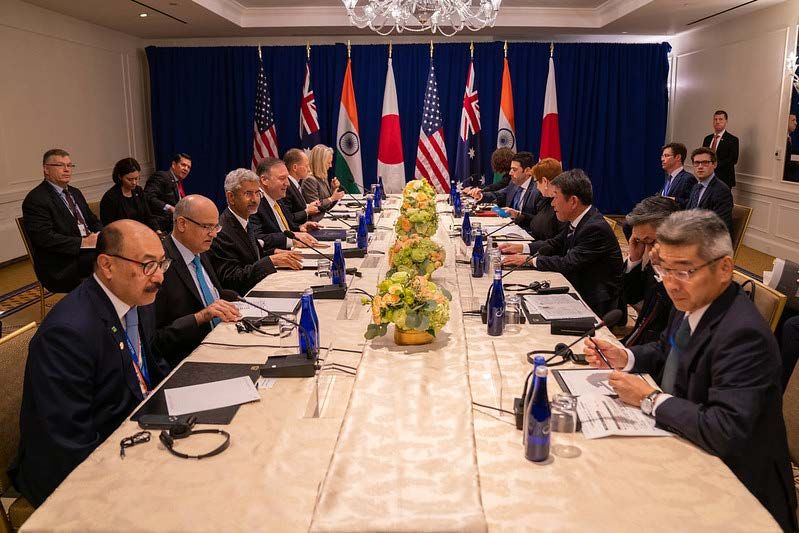
US Secretary of State Mike Pompeo hosts a Quad meeting with Australian Foreign
Minister Marise Payne, Indian External Affairs Minister Subrahmanyam Jaishankar,
and Japanese Foreign Minister Toshimitsu Motegi, at the Palace Hotel, New York, 26
September, 2019. Photograph courtesy Ron Przysucha/Flickr.
… China’s BRI is Fourth, all four states are committed to the current rules-based
economic order in the Indo-Pacific. This is based on free trade, open
increasingly understood investment environments, open competitive tendering, the rule of law,
as more than just a and standards of good governance from which all continue to benefit.
For all four countries, China’s BRI is increasingly understood as more
mutually beneficial than just a mutually beneficial connectivity and development project as
connectivity and Beijing claims, but also a means by which China is extending its sphere
of influence and undermining the current economic order as it does so. 8
development project … Thus far, BRI projects are structured to provide advantages for Chinese
but also a means by state-owned and private firms, leading to the creation of a separate and
closed economic ecosystem with a dominant China at the centre. Belt
which China is and Road Initiative infrastructure lending comes with strings attached
extending its sphere of including preferential treatment for Chinese consumer and high-end
industrial goods, professional service providers, telecommunications
influence and equipment and infrastructure providers, and creates markets for
undermining the current China’s surplus industrial production, all underwritten by Chinese
technical and engineering standards. 9 Preferential treatment for
economic order … Chinese state and non-state entities over foreign competitors is
achieved via a lack of open tendering for projects, and opaque lending
terms.
Analysis 5Assessing the Quad: Prospects and Limitations of Quadrilateral Cooperation
for Advancing Australia’s Interests
Further, the implications of the BRI for the strategic balance in the Indo-
Pacific are now unfolding. China has been accused of pursuing a
strategy of debt-trap diplomacy to achieve broader political and
strategic ends, by deliberately offering infrastructure lending for
strategically important but commercially unfeasible projects to
countries with an inability to repay. The most notable example is that of
Sri Lanka which was forced to give Beijing a 99-year lease on
Hambantota Port in partial repayment of its extensive debts. 10
Governments in Malaysia and the Maldives are now attempting to avoid
the same fate in response to infrastructure deals with Chinese state-
owned enterprises taken on by their predecessors.
On taking power in 2018, Malaysia’s Pakatan Harapan coalition China’s interest in
government cancelled two major oil and gas pipeline projects
developing maritime
contracted to be financed and constructed by Chinese state-owned
enterprises, and subsequently negotiated with Beijing to reduce the infrastructure —
cost of the East Coast Rail Project, reportedly by one third. 11 These
namely port facilities —
projects have been mired by accusations of inflated contract prices,
questionable national benefit or economic viability and large scale along the Indo-Pacific
corruption linked to the 1Malaysia Development Berhad (1MDB)
littoral as part of the
scandal. 12 In what is arguably a worse case, sovereign debts and
guarantees by the Maldives to Beijing could be as high as US$3 billion ‘maritime silk road’ …
in a country with a GDP of US$4.19 billion in 2017. 13 It remains to be
has raised the prospect
seen whether the new government is able to renegotiate existing loans
with Beijing in very similar circumstances to Malaysia. 14 China’s interest that such tactics could
in developing maritime infrastructure — namely port facilities — along be used elsewhere to
the Indo-Pacific littoral as part of the ‘maritime silk road’ at or near
Gwadar (Pakistan), Myanmar (Kyaukpyu), 15 and more recently the extend the ‘far seas’
South Pacific has raised the prospect that such tactics could be used capabilities of the
elsewhere to extend the ‘far seas’ capabilities of the People’s Liberation
Army Navy (PLAN). People’s Liberation
Army Navy (PLAN).
Fifth, a less emphasised (or recognised) common interest of all four
nations is that of supporting and strengthening liberal democratic
governance within the Indo-Pacific. A region that becomes inhospitable
to liberal democratic values at a domestic level is one that is much less
likely to support and reflect the principles of a free, open and inclusive
international order. The region has not been immune to the global
decline in observance of political rights and civil liberties for the
thirteenth year in a row recorded by Freedom House in its 2019
Freedom in the World report. 16 In recent years, notable democratic
declines were observed in countries such as Thailand, the Philippines,
Myanmar, Cambodia and the Maldives. According to a 2017 Pew
survey, only 15 per cent or fewer respondents from India, Indonesia, the
6 AnalysisAssessing the Quad: Prospects and Limitations of Quadrilateral Cooperation for
Advancing Australia’s Interests
Philippines and Vietnam were classified as “committed democrats” in
that they supported representative democracy to the exclusion of other
forms of government such as rule by the military, experts, or a strong
leader unconstrained by parliament or the courts. 17 Autocratic
alternatives to democratic rule gained relatively high support, with, for
example, 55, 52, 50 and 42 per cent respectively judging a “strong
leader” system as very or somewhat good. 18 In this context, President
Xi’s advocacy of China’s development model of authoritarian capitalism
as a superior alternative to liberal democracy in the pathway to
modernity could find receptive ground. 19 Further, China is actively
playing a role in supporting autocratic regimes to suppress internal
dissent and resist pressure to democratise by attaining a deeper level
of social control over their citizens. 20 The take-up of China’s artificial
intelligence surveillance technology such as facial recognition is one
example of China’s ‘authoritarian exports’ to the region. 21
There is a connection There is a connection between the BRI, weak democratic institutions,
and the extension of Chinese political, economic and strategic
between the BRI, influence in the region. Prominent cases of debt-trap diplomacy — such
weak democratic as Sri Lanka, the Maldives and Malaysia — have involved compromised
democracies with weak institutions. Their systems lacked robust
institutions, and the accountability mechanisms, and were unable to curb corruption among
extension of Chinese governing elites until they had already entered into large debt
commitments to Beijing that have proved to be unsustainable. This has
political, economic placed these countries in a weak position to refuse Chinese demands
and strategic as they have encountered difficulties in meeting future repayment
obligations. In this way, elites were able to potentially trade away the
influence in the national interest for self-interested gain. However, even these weak
region. democracies were subsequently able to expose, and in one case wind
back, the worst excesses of the BRI through elections. 22 Democracy
promotion could be a direct counter-strategy to prevent this
phenomenon occurring elsewhere in the Indo-Pacific, and is one that is
as yet underappreciated among the four countries. 23
DIVERGENCE ON ACCEPTABLE RISKS AND COSTS
All four of the Quad countries agree that recent Chinese policies and
actions are a threat to their common interests. However, there are clear
divergences between the Quad states and these are important for the
prospects of effective Quad cooperation. Principal among these
divergences are their differing threat perceptions — this is the core
hindrance to collective action and a key factor delimiting the scope of
any action the four countries might take together to defend their
common interests. This divergence in threat perceptions is based on a
range of factors, including the existence or absence of direct territorial
Analysis 7Assessing the Quad: Prospects and Limitations of Quadrilateral Cooperation
for Advancing Australia’s Interests
disputes with China, perceptions of the potential risks of retaliation by
Beijing, the economic and military capabilities that each state has to
bring to bear (alone and together with others) should retaliation occur,
other higher order national priorities and threats, and finally the
limitations of each nation’s strategic culture. While there are
divergences between Japan, the United States and Australia on these
issues, the clear outlier among the four is India.
JAPAN
Since mid-2012, Japan has faced a sustained challenge to its Since mid-2012,
sovereignty and control over the Senkaku/Diaoyu Islands that China
also claims as its own. Direct challenges both by land and sea increased
Japan has faced a
considerably after the Japanese government nationalised the Senkaku sustained challenge
Islands in 2012. Since then, Chinese fishing vessels, maritime militia
and maritime law enforcement vessels have regularly entered the
to its sovereignty and
territorial sea surrounding the islands and aggressively challenged control over the
Japanese coast guard vessels. 24 In addition, after China unilaterally
Senkaku/Diaoyu
declared an Air-Defence Identification Zone (ADIZ) over a large section
of the East China Sea in 2013, Japan has increasingly been forced to Islands that China
scramble jets to defend its airspace from unauthorised intrusions by
also claims as its
Chinese military aircraft. 25 The dramatic increase in military sea and air
operations around the Senkaku Islands has threatened to overwhelm own.
Japanese capabilities. 26
Japan has responded to this direct and sustained threat to its
sovereignty by taking purposeful measures toward bolstering its
capabilities to act alone and in concert with others. Tokyo has
significantly increased measures to defend the Senkaku Islands 27 (as
well as increasing measures to deal with threats from North Korea), and
in 2017 Prime Minister Abe declared that he had no intention of keeping
to the unofficial policy of restricting defence spending to 1 per cent of
GDP. 28 Japan’s latest defence plan includes significant outlays for
modernisation of weapons and defence equipment including the
upgrade of two self-defence force (SDF) ships to accommodate F-35B
stealth fighter jets on board. 29 Further, the Abe government’s
commitment that Japan should make a more “proactive contribution to
peace” has involved a cabinet level reinterpretation of article 9 of its
pacifist constitution to allow the SDF to undertake collective security
measures in aid of allies and security partners, as well new policies to
allow arms exports, joint weapons development and production to
allies and partners for the first time since 1967. 30 It has also
successfully pushed both the Obama and Trump administrations to
8 AnalysisAssessing the Quad: Prospects and Limitations of Quadrilateral Cooperation for
Advancing Australia’s Interests
affirm that territorial defence of the Senkaku Islands falls within article
5 of the US‒Japan Mutual Defence Treaty. 31
Japan has advocated Japan has advocated strongly for the re-establishment of the Quad and
this is directly attributable to Tokyo’s calculations of the risks and costs
strongly for the re- of failing to respond to Chinese assertiveness. Even prior to taking
establishment of the office for the second time in 2012, Shinzo Abe called for the formation
of a “democratic security diamond” between the four democracies in
Quad and this is the Indo-Pacific linking the shared consequences for all if China’s
directly attributable assertive territorial claims in both the East and South China Seas
remained unopposed. As Abe explained:
to Tokyo’s
calculations of the “If Japan were to yield [in its dispute over the Senkaku Islands], the
South China Sea would become even more fortified. Freedom of
risks and costs of navigation, vital for trading countries such as Japan and South Korea,
failing to respond to would be seriously hindered. The naval assets of the United States,
in addition to those of Japan, would find it difficult to enter the entire
Chinese area, though the majority of the two China seas is international water
assertiveness. [sic].”
He accused China of seeking to establish sea control over the South
China Sea to create a “Lake Beijing”, with Chinese forces able to use
their enhanced power projection capabilities to intimidate regional
states. 32
Japanese Prime Minister Shinzo Abe addressing the TICAD VI Summit, 2016.
Photo courtesy Prime Minister’s Office of Japan/Facebook.
Analysis 9Assessing the Quad: Prospects and Limitations of Quadrilateral Cooperation
for Advancing Australia’s Interests
While Japan has shown the resolve to bear the costs of defending its
sovereignty, and has the backing of the United States, drawing in
Australia and India into a common cause would help to compensate for
its still constitutionally limited capabilities to act militarily beyond the
East China Sea. The Abe government’s 2014 constitutional
reinterpretation of article 9 allows the SDF to engage in collective self-
defence where an armed attack occurs against a foreign state that is in
a “close relationship” with Japan, which threatens Japan’s survival and
endangers the “fundamental rights” of Japanese people to “life, liberty
and the pursuit of happiness”. 33 Such collective self-defence measures
would only occur as a last resort and involve the minimum use of force
necessary. 34
In assessing how this affects Japan’s ability to militarily assist Quad
countries who might come under attack, the government has ruled out
the use of force by the SDF on the territory of another state because it
would not comply with the requirement to use force to the minimum
extent necessary. 35 However, this would not bar the use of force by the
SDF for collective self-defence in areas of the global commons — such
as the high seas — where there would be no breach of sovereign
territory. It has been argued that an attack on allies and partners in the
South China Sea could be interpreted by Japan as an existential threat
which impedes freedom of navigation and undermines the rule of law
at sea, justifying the use of force. 36
While this interpretation has not yet been tested, there is a clear trend … bringing together other
under the Abe administration towards a more expansive view of what
might be classified as existential threats, as well as what can
like-minded states with
legitimately be viewed as measures in self-defence. Should Chinese formidable naval
assertiveness escalate, it is likely that these trends will accelerate. In
the meantime, bringing together other like-minded states with
capabilities in the Indian
formidable naval capabilities in the Indian Ocean and Western Pacific Ocean and Western Pacific
helps to compensate for Japan’s constrained abilities to militarily
prosecute its wider strategic interests in maintaining freedom of
helps to compensate for
navigation and a favourable strategic balance across the Indo-Pacific. Japan’s constrained
It also complicates China’s own two ocean strategy 37 by forcing it to
stretch its naval resources over a broader geographic area, and away
abilities to militarily
from the East China Sea. prosecute its wider
strategic interests …
INDIA
Japan and India are the only two Quad states with direct territorial
disputes with China. However, India is more vulnerable to Chinese
retaliation (directly and indirectly) and has less capacity to absorb that
10 AnalysisAssessing the Quad: Prospects and Limitations of Quadrilateral Cooperation for
Advancing Australia’s Interests
retaliation. The Indian government has regularly reported that Chinese
forces frequently cross into Indian-held territory to test the
undemarcated 3,488 km “Line of Actual Control” between the two
countries. 38 The major areas of dispute cover the Indian state of
Arunachal Pradesh, which China claims as part of ‘South Tibet’ 39, while
India claims Aksai Chin as properly part of the Indian state of Jammu
Kashmir. Since 1981 there have been 22 rounds of border demarcation
talks between the two countries with little progress made in resolving
their differences. 40 The latest and most serious incident between the
two countries since 1962 consisted of a 73-day standoff in the Doklam
Plateau — territory under dispute by China and Bhutan and close to
India’s north-eastern state of Sikkim. The standoff began in June 2017
when a Chinese platoon crossed into the plateau and was followed later
by a road construction crew and a larger military force. Bhutan called
on India to send troops to block the intended road construction, with
India’s main concern being to prevent territorial gains by China that
would threaten the security of the narrow Siliguri Corridor joining India
to its north eastern states. 41
On one interpretation,
India’s refusal to back
down during the The China‒India border region and disputed territory.
Doklam standoff was On one interpretation, India’s refusal to back down during the Doklam
standoff was a successful counter to Chinese land-based ‘salami-
a successful counter to slicing’ tactics. Such tactics involve stealthy incremental incursions —
Chinese land-based too minor to justify conventional military retaliation — to accumulate
substantial territorial gains over time. In taking a firm stand, however,
‘salami-slicing’ New Delhi will have also been reminded of its vulnerability to retaliation
tactics. along the border should the Quad take on a military dimension.
Analysis 11Assessing the Quad: Prospects and Limitations of Quadrilateral Cooperation
for Advancing Australia’s Interests
This fear of retribution has constrained India’s responses to Chinese
provocations in the past and persists for a number of reasons. While
India has improved border infrastructure and the high-altitude warfare
capabilities of its armed forces, China is still considered to have the
clear advantage, especially in view of the militarisation of Tibet. 42 China
could increase its already considerable support for Pakistan’s military,
and encourage the latter to challenge the Line of Control in Jammu
Kashmir directly, or through proxies. There is a risk that such activities
may escalate to a conventional war between the two countries, or in the
worst case, a nuclear exchange — a situation both sides have sought to
avoid. The danger for escalation was demonstrated in an incident in
February 2019, when at least 40 Indian security personnel were killed
in Kashmir by the Pakistani terrorist group Jaish-e-Muhammad. 43 India
responded with airstrikes aimed at the group’s base in Pakistan.
Pakistan retaliated with a counter airstrike, and in the subsequent air
battle an Indian MiG-21 was downed, and its pilot captured. Further
escalation was only avoided when Pakistan defused the crisis by
releasing the pilot as a gesture of goodwill. 44
India’s perceptions of the seaward threat from China have also India’s perceptions of
increased considerably, with the extension of PLAN power projection
capabilities into the Indian Ocean. Unsurprisingly, China seeks to
the seaward threat
bolster its capability to protect its seaborne trade and energy routes from China have also
over the vast reaches of the Indian Ocean, particularly at the
chokepoints of the Strait of Hormuz and the Malacca Strait. However,
increased
India views such moves as deliberately constricting its strategic space. considerably, with
Since the first appearance of a Chinese nuclear attack submarine in the
Indian Ocean in 2014, more submarines have followed (including visits
the extension of PLAN
to Sri Lanka and Pakistan) along with more frequent, sophisticated and power projection
longer PLAN deployments in the eastern and northern Indian Ocean. 45
Further enhancing the PLAN’s power projection capabilities, China
capabilities into the
established its first overseas naval base in Djibouti in August 2017, with Indian Ocean.
the Pentagon predicting that another will follow in Pakistan. 46
China has legitimate interests in the Indian Ocean. However, Indian
strategists have assessed its activities as part of a larger strategy
aimed at the strategic encirclement of India and “a desire to dominate
the Indian Ocean’s critical maritime spaces and lines of
communication”. 47 The PLAN’s increasing presence directly
undermines the Indian Navy’s aspirations for regional preeminence,
while its ready access to bases in Pakistan limits New Delhi’s options in
a crisis. 48 China’s BRI is also viewed as a tool to effect strategic and
political encirclement by exploiting the infrastructure deficits of India’s
neighbours — Pakistan, Bangladesh, the Maldives, and Sri Lanka. This
12 AnalysisAssessing the Quad: Prospects and Limitations of Quadrilateral Cooperation for
Advancing Australia’s Interests
would allow China to exercise greater geopolitical influence in these
countries, with the possibility that civilian control of deep-water ports
could eventually be transformed into access rights for the PLAN. China
has also been instrumental in Pakistan’s naval modernisation
programme, including its submarine capabilities, further eroding India’s
room for manoeuvre in its surrounding waters. 49
China’s ability to China’s ability to inflict direct costs on India — on its long land border,
by sea, as well as through its relationship with Pakistan — makes India
inflict direct costs on reticent to take actions that might provoke China into retaliation. This
India — on its long risk/cost calculation must be understood within the prism of India’s still
profound development needs which any government in New Delhi must
land border, by sea, prioritise, limiting the capacity of India to compete by building up its
as well as through its armed forces. India’s decision to refuse Australia’s request to join the
Malabar naval exercises in the last two years has been linked to New
relationship with Delhi’s desire to ‘reset’ relations with Beijing to de-escalate tensions
Pakistan — makes after the Doklam standoff. 50
India reticent to take Unlike Japan and Australia, India also does not have the luxury of a
actions that might formal alliance with the world’s pre-eminent military power, and for
reasons of strategic culture does not seek one. While it has discarded
provoke China into its former policy of non-alignment, it has replaced it with a strategy of
retaliation. multi-alignment as a means of preserving maximum strategic
autonomy. This is evident in its legacy relationship with Russia for
military procurement, and its pursuit of deeper relations with Iran. 51 A
negative consequence of this strategic autonomy is that New Delhi
cannot expect, nor does it appear to expect, the direct involvement of
the other Quad countries should China contest its land border. For
India, the reliability of ‘strategic partners’ — such as the United States
— in a crisis remains in question, with some in the strategic
establishment retaining long memories of US support for Pakistan
during the Cold War and its leadership role in the international nuclear
ostracism of India after its first nuclear test in 1974.
In summary, India shares some common interests with the other three
Quad countries but is less able to withstand the costs that could be
directed its way if it became a more active partner. This is due to internal
weakness, proximate adversaries, the lack of an external alliance
partner and a strategic culture which precludes the formation of formal
alliances. As its greatest threats are in its immediate region, New Delhi
has directed most of its defence resources toward countering these
threats first. As a result, the Indian Navy still has very limited power
projection capabilities in the South China Sea, and its potential
maritime contribution to any Quad operations would be restricted to
Analysis 13Assessing the Quad: Prospects and Limitations of Quadrilateral Cooperation
for Advancing Australia’s Interests
protecting its established position in the Bay of Bengal and Indian
Ocean as its primary theatres of operation. India’s reticence to agree to
joint patrolling with the United States in the South China Sea can be
attributed to these limitations in capability. It also seeks to avoid
provoking China in secondary theatres of concern that could lead to
direct consequences in its own neighbourhood.
AUSTRALIA
Australia is more secure in its immediate environment than either Japan Australia is more
or India, as it has no direct territorial disputes with China or with any of
secure in its
its neighbours. Its alliance with the United States adds another layer of
relative comfort. However, China’s rapid rise is changing the calculus immediate
for Canberra. Australia has relied on the United States to play the role
environment than
of external balancer in the region, a role which is coming under strain
as Chinese national power and assertiveness continues to grow. either Japan or India,
Further, as Australia’s 2017 Foreign Policy White Paper alludes to,
as it has no direct
Canberra regards China as actively undermining the post-war US-led
liberal rules-based order. 52 It is this order which has allowed middle territorial disputes
powers and small states to trade freely and maintain foreign policy
with China or with
autonomy relatively unfettered by outside coercion.
any of its neighbours.
Since around 2016 Canberra has more actively challenged Chinese
behaviour and action that threatens this order, leading to what some
describe as a ‘freeze’ in relations. Australia was one of the first countries
to publicly describe the 2016 Permanent Court of Arbitration decision
(which found in favour of the Philippines against China in the South
China Sea dispute) as legally binding and to call on China to abide by
it. 53 It was the first country in the world to bar Huawei from
participation in the roll-out of 5G networks citing national security
concerns, playing a leading role in characterising Huawei as an
instrument of a foreign government rather than an independent
commercial entity. 54 Even prior to this decision, in 2012 Australia
banned Huawei from tendering for contracts in the construction of the
country’s National Broadband Network based on concerns about the
risk of cyber attacks originating from China. Canberra has also raised
Beijing’s ire by enacting foreign interference laws in 2018 that China
views as being directed specifically towards it. This legislation was the
result of a report commissioned by then Prime Minister Malcolm
Turnbull which uncovered evidence of undeclared activities by Chinese
entities designed to influence public debate, educational institutions
and politicians from both major parties. 55 Canberra has faced down
considerable diplomatic pressure from Beijing at each of these decision
points, and has continued to do so in the name of protecting Australia’s
14 AnalysisAssessing the Quad: Prospects and Limitations of Quadrilateral Cooperation for
Advancing Australia’s Interests
national interests and values. Prime Minister Scott Morrison’s
statement that he encouraged Hong Kong’s Chief Executive “to be
listening carefully” to the people of Hong Kong while rejecting the
description of protestors as ‘terrorists’, is a recent demonstration of this
approach. 56
Canberra has long regarded Australia’s immediate neighbourhood, the
South Pacific, as a relatively benign region in which Australia has played
a leading role. Prime Minister Scott Morrison described it in late 2018
as “our patch … our part of the world … where we have special
responsibilities”. 57 Recent Chinese moves, however, have raised fears
of its increasing influence and the prospect China might attempt to
gain a military foothold in the South Pacific. Media reports in April 2018
claimed that China had approached the Vanuatu government about
building a permanent military base there — reports which were denied
by both parties. However, Vanuatu’s heavy indebtedness to Beijing has
raised the prospect that China is practising debt-trap diplomacy in
Australia’s backyard. 58 Canberra’s remarkably speedy negotiation of an
agreement with Papua New Guinea to redevelop the naval base at
Lombrum on Manus Island as a joint facility (with the United States also
joining subsequently) appears to have headed off potential Chinese
involvement in the development of a large multi-use port there. 59 A
Chinese base in Manus — or in other parts of the South Pacific — would
allow Beijing to project “military power north towards US forces in
Guam or south towards Australia”, upsetting US sea control in the
Pacific. 60 Australia’s effective gifting of an undersea
Recognising the telecommunications cable to Papua New Guinea and Solomon Islands
in July 2018, heading off a rival proposal by Huawei, again
attractiveness of demonstrates its resolve to counter China’s creeping influence. 61
China’s BRI funding to
Recognising the attractiveness of China’s BRI funding to Pacific Island
Pacific Island nations nations and their vulnerability to debt sustainability problems and
and their vulnerability potential debt-trap diplomacy, 62 Australia has re-doubled efforts to
promote itself as a historical friend and partner to Pacific Island nations,
… Australia has re- basing the relationship on “respect, equality and openness”. 63 The
doubled efforts to Morrison government’s ‘Pacific Step-up’ strategy includes a number of
new initiatives building on existing defence and security diplomacy,
promote itself as a funds an expanded diplomatic presence, a new AU$2 billion Australian
historical friend and Infrastructure Financing Facility for the Pacific and an extra AU$1 billion
to Australia’s export financing agency directed towards supporting
partner to Pacific small and medium investment in the South Pacific. 64 The success of
Island nations … this strategy remains to be seen.
Analysis 15Assessing the Quad: Prospects and Limitations of Quadrilateral Cooperation
for Advancing Australia’s Interests
Although Australia has shown a measure of resolve domestically and in Although Australia
its immediate neighbourhood, it too could be a target of China’s
economic retaliation — a point Beijing has bluntly emphasised in has shown a measure
response to Australia’s push for an independent COVID-19 inquiry. 65 of resolve
China is Australia’s major trading partner, and the primary immediate
deterrent to Australia’s military participation in the Quad is an
domestically and in
economic one. In 2019, total exports to China accounted for almost 7 its immediate
per cent of Australia’s GDP and 36 per cent of all exports, 69 per cent
of which were exports of iron ore, coal and gas. 66 In the services sector,
neighbourhood, it too
Australia enrolled the second highest number of Chinese tertiary could be a target of
students globally in 2019, 67 while Chinese tourists accounted for 27
per cent of international visitor spending. 68 In recent years, China has
China’s economic
retaliated economically against countries that have opposed China’s retaliation …
position on the South China Sea (for example, the 2012 ban on banana
exports from the Philippines 69); its position on the East China Sea
(banning Chinese rare earths exports to Japan 70); or where China has
considered its defences have been threatened (China imposed
unofficial sanctions against South Korea for its deployment of the anti-
ballistic missile system, THAAD 71). Australia has the potential to join
this list. Beijing’s ambassador to Australia, Cheng Jingye, implied that
Australian exports including tourism, education, wine and beef might
be subject to a boycott by the Chinese public in retaliation for
Australia's COVID-19 inquiry call. 72 This is not the first time such
punitive measures have been mooted: a 2018 editorial in China’s state-
run Global Times newspaper, for example, called for cuts to wine and
beef imports to “make Australia pay for its arrogant attitudes”. 73 China
appears to have made good its threats by announcing steep tariffs on
Australian barley and limiting meat imports in May 2020. 74
Australia’s vulnerability to economic retaliation might well be
exaggerated, however. 75 Australia’s resources are largely traded on
world markets and are fungible products for which there are markets
elsewhere. Restricting iron ore imports from Australia is also likely to be
an act of self-harm for Beijing. Australia supplies iron ore more reliably
and at a lower cost than its competitors, and there is demand for it from
China’s provinces for ongoing infrastructure projects. The same applies
to gas exports. That does not preclude short-term and ambiguous acts
of retaliation. In 2019, for example, delays were imposed specifically on
Australian coal by some Chinese ports for reasons yet to be articulated
by China, but presumably because of Australia’s enactment of foreign
interference laws in mid-2018. 76 While China can more easily replace
Australia’s exports of tourism and education, they represent less than 1
per cent of Australia’s GDP. 77 Further, a likely side-effect of the
coronavirus crisis will be immediate and concerted efforts toward
16 AnalysisAssessing the Quad: Prospects and Limitations of Quadrilateral Cooperation for
Advancing Australia’s Interests
market diversification by universities and businesses whose levels of
financial dependency on China have now been exposed.
Over the last three years Australia has actively sought to counter
Chinese behaviour by challenging Chinese policies that undermine the
liberal rules-based order or interfere with the integrity of Australia’s
democracy. Implicit or official Chinese threats of economic coercion
have not led to significant changes in government policy such as the
banning of Huawei from the 5G rollout, introduction of foreign
interference legislation, and determination to champion an
international investigation of the origins of COVID-19. Similarly, the fear
of economic coercion is unlikely to dim Australia’s resolve and
enthusiasm for advancing closer military cooperation with other
members of the Quad in trilateral formations. At the same time,
Canberra does not want to be a major focus of Chinese displeasure.
Working with other Quad countries on economic initiatives and
diplomatic positions where common values are threatened is
preferable to Canberra than acting alone. Similarly, while Australia has
been keen to add military cooperation to the Quad agenda, it will seek
to do so incrementally and in modes that are less overtly about military
conflict unless and until Chinese assertiveness escalates.
THE UNITED STATES
The US national interest in advancing a military dimension to the Quad
The United States is straightforward. The United States views itself as being in direct
competition with China which it describes as a “revisionist”
views itself as being
authoritarian state that seeks to erode and re-write the rules of the US-
in direct competition led post-war order “while exploiting its benefits”. 78 In response, the
2019 US Indo-Pacific Security Strategy Report makes clear that along
with China which it
with bolstering and reorientating its own forces toward the Indo-Pacific
describes as a region, Washington is looking to build consensus and deepen support
for US forward presence among existing allies and partners in defence
“revisionist”
of the current order. 79
authoritarian state
that seeks to erode However comprehensible that strategy is, the Trump administration
perceives that allies and partners have been free riding on US military
and re-write the rules power and has called on them to step up their own defence spending
of the US-led post- and military contributions. 80 It has strongly encouraged a deepening of
defence cooperation between allies and partners, with or without US
war order “while participation. 81 In this vein, Washington has been the strongest
exploiting its advocate for deeper military cooperation between the Quad countries
as a means of strengthening combined defence of the rules-based
benefits”. order, and of spreading the burden given its global responsibilities and
Analysis 17Assessing the Quad: Prospects and Limitations of Quadrilateral Cooperation
for Advancing Australia’s Interests
interests. At the strategic level, the US ‘free and open’ Indo-Pacific
strategy involves economics, governance and security, but in practice
the security pillar is the most developed thus far.
As the most militarily and economically capable of the four countries,
the United States has the greatest capacity to withstand Chinese
retaliation should the Quad become more robust in all senses. The
Trump administration’s trade war with Beijing has already
demonstrated its resolve to challenge China’s economic practices and
withstand economic blow-back. In the Indo-Pacific, however, the United
States is unable to achieve either its economic or strategic aims without
deepening existing partnerships and developing new ones with like-
minded countries. The US forward presence is dependent on existing
allies and partners valuing its balancing role, and Washington seems
aware that China is directly contesting the resolve of these countries to
continue their US defence relationships at the risk of limiting their
access to Chinese trade and investment. 82
Several recent studies, including by RAND, have indicated that US Several recent studies
military dominance is steadily receding in Asia, and that China is in a
“strong military position vis-à-vis the United States in areas close to its
… have indicated that
own territory” as a result of rapid military modernisation and the US military dominance
advantages of geography. 83 The RAND study predicted a tipping point
is steadily receding in
in the balance of forces in a Taiwan conflict as early as 2020, and the
same in a potential South China Sea conflict from 2030 onwards. 84 Asia, and that China is
Despite the Trump administration’s commitment to increase US
in a “strong military
defence spending to maintain a military advantage over Chinese forces,
US credibility as an alliance partner will soon be at risk without position vis-à-vis the
adjustments to military strategy and procurement, 85 combined with
United States in areas
deepening regional relationships and the ability to act jointly with allies
and partners. Greater cooperation among the four most militarily close to its own
capable states in the Indo-Pacific would enable burden-sharing
territory” …
geographically among the four, helping Washington to extend its
primacy.
As a consequence, Quadrilateral initiatives which directly counter
Chinese strategies to exert political, economic and military influence
are likely to be valued by the United States in its engagement with the
region.
OUTLOOK: DEEPENING THE AGENDA OF THE QUAD
This analysis has described the differences between the four Quad
countries in terms of military capability, strategic priorities, capacity to
18 AnalysisAssessing the Quad: Prospects and Limitations of Quadrilateral Cooperation for
Advancing Australia’s Interests
bear the costs of potential Chinese retaliation, strategic culture and
constitutional imperatives. These differences are important, and place
real limitations on Quadrilateral cooperation, but they do not preclude
it. There are a number of ways the four states can cooperate more
comprehensively in order to both advance their own interests and to
protect their shared interests in preserving the status quo rules-based
order in the Indo-Pacific. This includes Quadrilateral cooperation
between armed forces, on standard setting, diplomatic messaging, and
practical economic measures to sustain the current rules-based order.
A direct countering of Beijing’s ‘win-win’ BRI narrative — exposing the
economic and political risks and costs of accepting Chinese funds —
has already begun, but more can be done to shape the standards for
conducting BRI projects and provide a practical and genuinely
alternative source of infrastructure funding.
MILITARY/STRATEGIC COOPERATION
From a strategic From a strategic perspective, the primary value of the Quad is to signal
to Beijing that the four states share the intent to counter and thereby
perspective, the deter future Chinese actions to further change the status quo. The
primary value of the steady elevation of discussion of Quad matters to the foreign minister
level and the Quad’s expanding agenda introduces an element of
Quad is to signal to uncertainty in Beijing’s calculations as to the collective response the
Beijing that the four four countries are willing to contemplate to prevent further erosion of
the rules-based order. Bilateral and trilateral military cooperation have
states share the intent developed in earnest among the four countries, with only the Australia‒
to counter and India‒US combination thus far missing from the menu. 86 While these
trilateral formats do develop interoperability and habits of trust,
thereby deter future military cooperation among the four most capable Indo-Pacific nations
Chinese actions to would make the deterrent threat more credible.
further change the India appears to be the most reticent to take this step, but New Delhi
status quo. could consider two clear lessons from state responses to Chinese
‘salami-slicing’ tactics in the South China Sea and the Doklam crisis.
The first is that firm action must be taken to block Chinese activities
designed to change the territorial status quo while they are in progress.
Once a change has been effected, the outcome cannot be reversed
without outright war, a cost that no Quad state has indicated it is
currently prepared to bear. Second, it was the absence of a credible
countervailing force in the South China Sea that encouraged Chinese
assertiveness to achieve its territorial objectives. The dissolution of
Quad 1.0 — ostensibly to placate Chinese displeasure and concerns of
a ‘ganging up’ 87— had the opposite effect in that Beijing seemed
emboldened rather than mollified. New Delhi appears to have absorbed
these lessons in its firm response to Chinese provocations on its
Analysis 19Assessing the Quad: Prospects and Limitations of Quadrilateral Cooperation
for Advancing Australia’s Interests
border, but not in regard to Chinese maritime threats. Bearing these
strategic lessons in mind, the four countries should be able to take
incremental steps to deepen their military cooperation, in ways that do
not reasonably provoke an outsized reaction from Beijing, while
developing the capacity to act credibly together if the need arises.
GEOGRAPHY
The divergence in geographic areas of maritime priority among the four
states is sometimes viewed as an inherent weakness of the Quad. It
should instead be viewed more constructively as an opportunity to
capitalise on a natural maritime division of labour. While China can rely While China can rely
only on its own capabilities to project power across the Indo-Pacific, the
Quad countries in combination can maintain a more beneficial
only on its own
multipolar order by bolstering each other’s maritime capabilities in their capabilities to project
own respective geographic area of interest and advantage. India should
be supported to take greater responsibility for the Indian Ocean
power across the Indo-
(particularly the Bay of Bengal) where it has natural advantages, Pacific, the Quad
Australia the Eastern Indian Ocean, South China Sea and Pacific
Islands, Japan the East and South China Seas, with the United States
countries in combination
having broader capability over the whole of the Indo-Pacific. can maintain a more
ENHANCING JOINT CAPABILITIES
beneficial multipolar
There are a number of initial areas in which the four countries can order by bolstering each
augment their joint capabilities and complicate China’s two ocean other’s maritime
strategy: improving interoperability; enhancing intelligence,
surveillance and reconnaissance capabilities; shared logistics for capabilities …
power projection; and capability development.
Interoperability
Given the maritime threats and challenges the four countries jointly
face, enhancing the interoperability of maritime forces should be a
priority. As a first step, taking into account India’s (and to some extent
Australia’s) sensitivities, New Delhi should allow Australia to be an
official observer of the Malabar exercises, and consider progressing its
status to non-permanent participation. Exercises should first take place
in the Indian Ocean rather than the South China Sea so as to be less
overtly provocative to Beijing while still progressing interoperability.
For similar reasons, these exercises should focus cooperation and
coordination in the provision of public goods (disaster relief,
humanitarian assistance, anti-piracy and search and rescue) in the first
instance, with the implication being that the agenda could expand to
include specific military exercises depending on China’s behaviour.
Such exercises — amphibious warfare and anti-submarine warfare, for
20 AnalysisYou can also read


