Beznau Nuclear Power Plant - Decades of Safe, Environmentally Friendly Power Generation - KernD.de
←
→
Page content transcription
If your browser does not render page correctly, please read the page content below
40 A TL
L IRGI H
S I T E SEPDOI T O atw Vol. 66 (2021) | Issue 2 ı March
Beznau Nuclear Power Plant –
Decades of Safe, Environmentally
Friendly Power Generation
The Beznau nuclear power plant was the first commercial nuclear power plant in
Switzerland, and it can look back on more than five decades of safe, reliable, and
environmentally friendly electricity generation. Despite being operational for more
than 50 years – Unit 1 went into operation on December 9, 1969 – Beznau is one of
the safest nuclear power plants in the world. Its operator, Axpo, has undertaken
upgrades and modernization investments worth more than CHF 2.5 billion since
the plant was commissioned, thus ensuring that it is always state of the art and
complies with the regulatory standards. The nuclear power plant is a model for the
rest of the world. In line with Swiss law, Axpo plans to operate the power plant as
long as it is safe and economical to do so.
Facts & Figures
The Beznau nuclear power plant (KKB) with its two 300 million tonnes of CO2, the amount which would
units (Beznau Unit 1 and Beznau Unit 2) is located on have been produced if this power had been generated
Beznau Island (Switzerland) in the Lower Aare V alley by a coal-fired power plant.
and is operated by Axpo Power AG. The twin-unit
plant is supplemented by the on-site interim storage The Beznau Nuclear Power Plant generates valuable
facility for the storage of radioactive waste and spent baseload energy around the clock with the exception
fuel (Z WIBEZ). The ZWIBEZ will continue to exist as an of a few weeks in the year when fuel rods are replaced
independent nuclear facility even after both units or upgrades are carried out. The two units satisfy
have been completely decommissioned, and will conti- around 10% of Switzerland’s annual electricity
nue to be operated on the basis of the existing unlimi- requirements and thus make a significant contribution
ted operating license. to Switzerland’s electricity supply.
The Beznau nuclear power plant consists of two 2-loop Around 450 staff and 100 third-party employees work
Westinghouse pressurized water reactors of almost permanently at the power plant. These are engineers,
identical design, each with a thermal reactor power of chemists, technicians, radiation protection officers,
1,130 MW and a net electrical output of 365 MW. The electricians, administration staff and specialists, main-
total annual production of the plant is around tenance workers and cleaners, planners and security
6,000 giga watt hours, which is roughly twice the controllers, occupational security and QC staff, finance
amount of electricity consumed by the city of Zurich. specialists, and specialists for the treatment of nuclear
Since the plant was commissioned, more than waste.
270 terawatt hours of environmentally friendly power
have been generated in total, saving far in excess of
Site Spotlight
Beznau Nuclear Power Plant – Decades of Safe, Environmentally Friendly Power Generation
atw Vol. 66 (2021) | Issue 2 ı March
41 A TL
L IRGI H
S I T E SEPDOI T O
Technical Data
Beznau Unit 1 and 2 | 2-loop PWR
A team of security officers works in three shifts to
safeguard the plant. Six shift groups (plant and reactor
operators, shift managers) ensure that the plant is p Net power: 2 x 365 MWel
operating safely. p Production: > 270 TWh from start of operation
p Utilization factor: > 81 % Beznau Unit 1
When the annual u pgrades are being carried out, up > 88 % Beznau Unit 2
to 1,000 people are working on the site. This has a po-
p No. of employees: 450 permanent staff
sitive impact on the regional economy.
p Fuel elements in core: 121
Apart from producing power, the plant has been p Fuel elements per year: Approx. 20 per reactor
supplying hot water to the regional district heating → 320 kg U/fuel element
network (REFUNA) in the Lower Aare Valley since 1983. p Number of operating periods: 46 (Unit 1)
The thermal energy is supplied via heat exchangers, 47 (Unit 2)
which are supplied with steam from the high-pressure
and at the low-pressure section of the steam turbines. Source: IAEA
The thermal power provided for the district heating
supply reduces the electric power output of the
nuclear power plant by up to 7.5 MW.
Commissioning Beznau nuclear power plant
Operator: Axpo Power AG
On May 12, 1969, the Eidgenössisches Verkehrs- Milestones Unit 1 Unit 2
und Energiewirtschaftsdepartement, now the Eid Start of construction Sep. 1, 1965 Jan. 1, 1968
genössisches Departement für Umwelt, Verkehr,
Energie und Kommunikation (Federal Department of First criticality Jun. 30, 1969 Oct. 16, 1971
Environment, Transport, Energy, and Communications) First grid connection Jul. 17, 1969 Oct. 23, 1971
granted Axpo the start-up authorization for Unit 1.
Commercial operation began on December 9, 1969. Commercial operation Dec. 9, 1969 Mar. 4, 1972
Unit 2 was commercially commissioned on March 4, Cost of new build 750 million Swiss francs
1972. Units 1 and 2 each have an unlimited operating
Investments 2.5 billion Swiss francs
license.
Mode of operation
Both units of Beznau nuclear power plant were s team lines. In each steam turbine, the live steam is fed
planned and built by the Westinghouse and Brown, through the high-pressure turbine to the low-pressure
Boveri & Cie. (BBC) consortium. The thermal power of turbines. The generator converts the rotational energy
one reactor unit is 1,130 MWth and the gross electric of the steam turbines into electrical energy.
power is 380 MWel. The water in the primary loop
flows through the reactor core at high pressure On leaving the turbine, the steam condenses to water
(154 bar) and the heat generated in the reactor is in the condenser. This water, also known as conden
transferred to the secondary loop in the steam sate, is reheated in the secondary loop and pumped
generators. The pressure in the secondary loop is
back into the steam generators by the condensate and
lower, so live steam is generated there. This is fed to feedwater pumps. The condenser is cooled with river
the two turbines in the turbine building via the live water (from the River Aare) which flows through the
Site Spotlight
Beznau Nuclear Power Plant – Decades of Safe, Environmentally Friendly Power Generation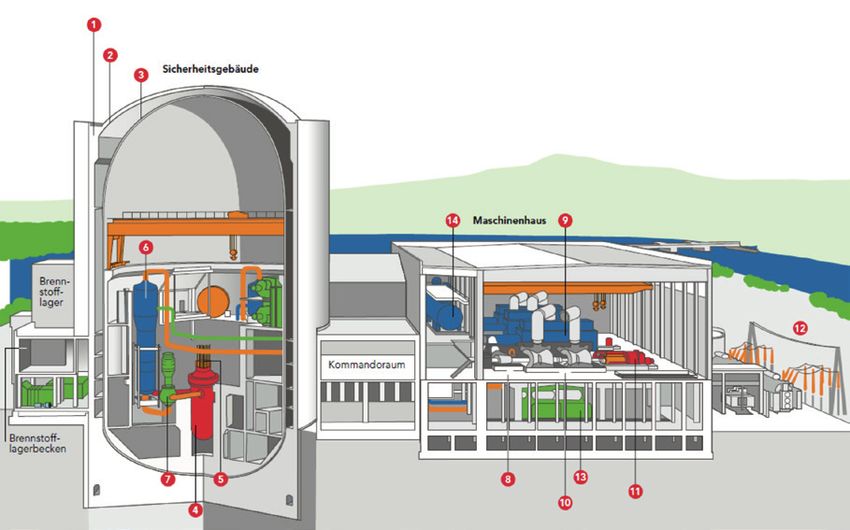
atw Vol. 66 (2021) | Issue 2 ı March
Figure 1: Overview primary and secondary loop with cooling.
1– Control rod drive
2 – Reactor pressure
42
vessel
3 – Pressurizer
4 – Control rods
5 – Fuel elements
6 – Main reactor pump
7 – Steam generator
A TL
8 – High-pressure
L IRGI H
economizer
9 – Feedwater tank
10 – Feedwater pump
S I T E SEPDOI T O
11 – Low-pressure
economizer
12 – Condensate pump
13 – Condenser
14 – High-pressure
turbine
15 – Low-pressure
turbines
16 – Generator
17 – Transformer
18 – Water separator,
reheater
19 – Refuna steam
extraction
20 – Refuna heat
exchanger
plant by virtue of the natural gradient between the at Beznau nuclear power plant uses two steam turbine-
headwater channel and the natural course of the Aare generator sets built by BBC. The gross electric power of
(approx. 6 meters) (Figure 1). The secondary loop is each unit amounts to 190 MWel. The steam to gene-
principally free from radioactivity, which means the rate the d
istrict heating for the R
EFUNA is also taken
maintenance of the steam turbines is much easier than from the steam turbines.
that of a boiling water r eactor, for example. Each unit
The plant
The illustration below (figure 2) shows a cross-section The containment of the Beznau nuclear power plant
through the containment building of Unit 1, the consists of
auxiliary building with the spent fuel pool, the inter-
mediate building with the main control room, and the P the primary containment (steel pressure shell
turbine building. with filtered pressure relief system, safety vessel,
containment) and
The two cylindrical containment buildings of Unit 1 P the secondary containment (cavity with liner,
and 2 are the landmark feature of Beznau nuclear separate ventilation system, and outer concrete
power plant. These twin-walled buildings are approx. containment).
67 meters high with a diameter of around 38 meters,
and they house the reactor cooling system (primary The primary containment consists of a gas-proof steel
loop) with the reactor pressure vessel, the main reactor pressure shell and forms the first safety barrier around
pumps, the pressurizer, and the steam generators. The the primary loop. Maintaining a low pressure in the
primary loop is enclosed by a gas-proof steel pressure cavity between primary and secondary containment
shell (3), which in turn is completely surrounded counteracts any escape of air-borne radioactivity.
by a concrete envelope (1) at a distance of 1.5 meters.
The space between the steel pressure shell and the In a beyond-design-basis accident, the formation of
concrete envelope is called the cavity. It has a gas- steam/gas can cause such a high pressure to develop
proof steel lining (2) on the inside of the concrete wall. inside the steel pressure shell that its integrity may be
compromised. Beznau has various security systems in
The fuel store for new and spent fuel elements is place to cope with such beyond-design-basis a ccidents.
adjacent to the containment building. The four steam They include a filtered pressure relief system and the
turbine-generator sets and the condensers and further hydrogen recombinators, for example. In the event of
components are housed in the turbine building. such a malfunction, the pressure relief system allows
the steam/air mixture to escape from inside the con-
tainment to the outside – after first being cleaned and
filtered to minimize the escape of air-borne contami-
nants. On the inside, the steel pressure shell is fitted
Site Spotlight
Beznau Nuclear Power Plant – Decades of Safe, Environmentally Friendly Power Generation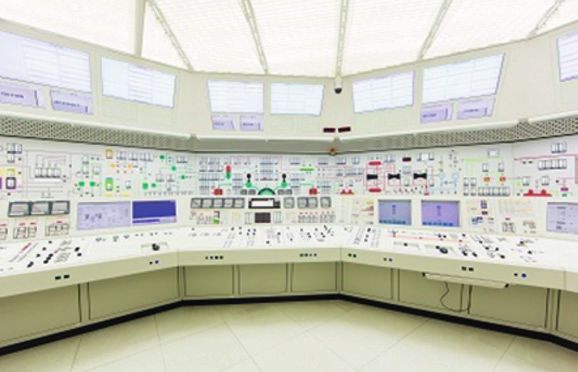
atw Vol. 66 (2021) | Issue 2 ı March
Figure 2: Schematic overview containment building and turbine building.
1 – Concrete envelope
2 – Steel liner
43
3 – Steel pressure shell
4 – Reactor pressure
vessel
5 – Control rod drive
6 – Steam generator
7 – Main reactor pump
A TL
8 – High-pressure
L IRGI H
turbine
9 – Water separator/
reheater
S I T E SEPDOI T O
10 – Low-pressure
turbine
11 – Generator
12 – Transformer
13 – Condenser
14 – Feedwater tank
out with a concrete lining, which extends to the level assemblies, control rods, the thermal shield, and the
of the polar crane; it fulfills an additional shielding incore instrumentation tubes.
function and serves to provide fragment protection.
Two inlet, two outlet, and two safety injection nozzles
The concrete shell of the secondary containment, are welded into the lower segment of the RPV. These
which completely encloses the primary containment, connections with the remaining components of the
serves as the second safety barrier. A differential primary loop are all at the same level. They are
pressure regime is maintained between the steel arranged above the reactor core so that the primary
pressure shell, the cavity, and the surroundings. The air water cannot drain down to the reactor core when a
pressure in the cavity between primary and secondary leak occurs in the main coolant pipes. The inlet nozzles
containment is lower than that in the primary con take the form of diffusers (conical). The ingoing
tainment and the surroundings. The cavity thus fulfils primary water flows downward along the vessel wall
a barrier function to prevent the escape of air-borne and thermal shield, then flows upwards through the
contaminants. The secondary containment is designed reactor core, absorbs heat, and leaves the RPV through
to prevent external man-induced events affecting the outlet nozzles towards the steam generator. The
the primary loop, and is equipped with a separate upper head of the RPV has feedthroughs for the
ventilation system. control rods and for instruments and measuring
equipment.
The concrete jacket of the secondary containment
consists of a foundation slab, a cylindrical concrete The RPV is made of a low-alloy carbon steel, which is
envelope, and a dome. A gas-proof steel liner seals the heatproof, tough, easily welded, and has low radiation
inside of the containment jacket. susceptibility. The cylindrical part was welded t ogether
from forged rings. The interior surfaces coming into
A thick, cylindrical, reinforced concrete jacket known contact with primary water are lined with a stainless-
as a biological shield surrounds the core of the reactor steel cladding.
pressure vessel (RPV). This biological shield acts as a
shield against the neutron and gamma radiation The steam generators serve as heat exchangers
emerging from the reactor pressure vessel when the between primary water and secondary water. The
plant is in operation. primary water enters the steam generators via an inlet
chamber, and flows from this inlet chamber through
The primary water circulating in the RPV and in the the U-tube heat exchangers, releasing the thermal
whole primary loop serves as the moderator and energy, before reaching the outlet chamber. From
coolant for the reactor core. The RPV consists of the here it is fed to the main reactor pump. In the secon
RPV upper head and RPV lower segment. The RPV dary section of the steam generator, the water/steam
lower segment consists of a cylindrical vessel with a mixture of the secondary water undergoes a two-
hemispherical lower head. The RPV contains the stage separation. The separated, dried live steam is fed
reactor core with the upper and lower reactor to the steam turbines.
Site Spotlight
Beznau Nuclear Power Plant – Decades of Safe, Environmentally Friendly Power Generation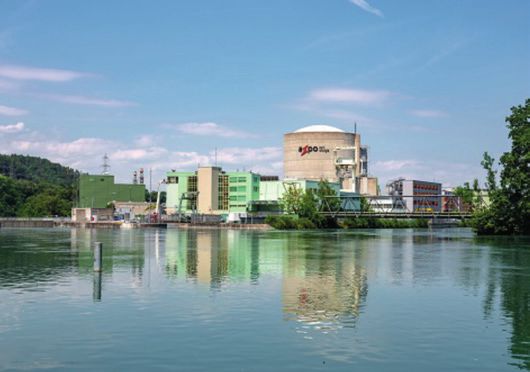
44 atw Vol. 66 (2021) | Issue 2 ı March
The main reactor pumps pump the primary water operating pressure in the reactor cooling system
A TL
which has been cooled in the steam generators back constant, and it is connected to the reactor cooling
L IRGI H
into the RPV. The pressurizer is a cylindrical vessel system via an equalizing pipe.
partially filled with water whose task is to keep the
S I T E SEPDOI T O
A twin-unit plant
Although the two units of the Beznau nuclear power however, security functions of the other power plant
plant are two independent power plants each with its unit can be accessed via interconnected security
own operating license, they are structurally inter systems. Interconnected operating systems which are
connected and from the outside they look as if they present in both units serve to enhance the availability
are a single building complex. Inside the parts of the or fl
exibilization of the operation.
building with a controlled zone, the two units are
spatially separate from each other and have their own The 3 nuclear units (Unit 1, Unit 2 and the interim
technical systems. Each has all the structures, systems, storage facility (ZWIBEZ)) on the site also share other
and components required to facilitate their indepen- infrastructural elements.
dent, safe, and economic operation.
They are surrounded by a shared security perimeter.
The two units share some facilities and the infra The nuclear facilities furthermore have access to
structures, and the organization in particular. These shared infrastructure facilities such as communication
shared facilities generate synergies when the plant is systems, conventional waste disposal facilities, labo
in operation, but will have to be taken into account asratories, workshops, office buildings, and the staff
necessary in the future shut down. restaurant. As Units 1 and 2 are being decommis
sioned, the technical systems and organization of
A distinction must be made between security systems Z WIBEZ will be made autonomous.
and operating systems. Some systems have mecha
nical and electrical interconnections which allow The two power plant units likewise share some aspects
system functions in one power plant unit to be of their organization. For organizational purposes, the
supported by the other unit. A small number of opera- operational staff are assigned to one of the two units,
ting systems are located in one unit and fulfill the although they can easily move between the two
functions for both units. units because the designs of the units are largely
identical and such swaps are also permissible under
The interconnections between the security systems of the terms of the license. The other departments
the two units are not required during normal power involved in the plant organization provide services for
generation. To control certain malfunctions events, both units.
Important upgrades and the most recent safety report
Ever since the two power plant units were first Three further major upgrade and replacement
constructed and commissioned, Axpo has continuously projects followed between 2010 and 2015. The upper
improved plant safety by upgrading its technical heads of the reactor pressure vessels in both units
safety. In 1992 and 1993, a separate, bunkerized
were replaced. In a further project, two emergency
emergency system was installed for each of the two diesel generator buildings each with two emergency
units. The emergency system is designed to switch off diesel generators were built on the site, and took
the reactor should an «external event» occur and over from the previous emergency power supply
remove the decay heat of the reactor core. The steam which had come from the nearby hydroelectric power
generators in Unit 1 were also replaced in the same plant in Beznau. In addition, the IT system for the
period. This led to an increase of around 2 % in the plant was completely renewed.
electric power output without any modifications to
the reactor design. The upgrade also encompassed the Of great strategic relevance was also the safety report
installation of the filtered pressure relief system in the for the Unit 1 reactor pressure vessel in 2016. In June
two containment buildings. The steam generators in 2015, findings made in the material of the reactor
Unit 2 were replaced in 1999. The reactor protection pressure vessels at the Doel 3 and Tihange 2 nuclear
and control system was replaced completely in 2000 power plants in Belgium led the Swiss Federal Nuclear
and 2001. Safety Inspectorate (ENSI) to demand that the two
reactor pressure vessels at the Beznau Nuclear Power
Site Spotlight
Beznau Nuclear Power Plant – Decades of Safe, Environmentally Friendly Power Generation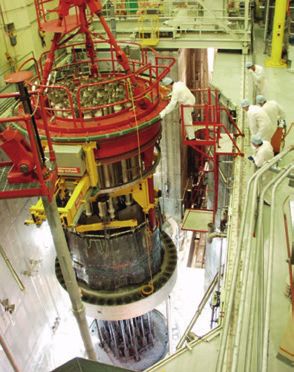
atw Vol. 66 (2021) | Issue 2 ı March
45 A TL
L IRGI H
S I T E SEPDOI T O
Contact
Plant be checked. The inspections carried out found Axpo Group
material inclusions in a small section of the RPV of Unit Parkstrasse 23
1, which had arisen d uring manufacture. 5401 Baden, Schweiz
info@axpo.com
On November 14, 2016, Axpo submitted the docu
www.axpo.com
mentation relating to the characterization and
assessment of the findings in the base material of the
@company/axpo-group
reactor pressure vessel of Beznau Unit 1 to ENSI. This
safety report proved that the safe operation of the @axpo
plant is guaranteed and that all safety objectives are @AxpoCH
met. Unit 1 was shutdown for a further two years
before ENSI issued a restart permit, and power genera-
tion recommenced on March 19, 2018. The Beznau
nuclear power plant set international standards
with what were probably the most comprehensive
inspections concerning the RPV. Experts of interna
tional renown were consulted, and specialist com
panies and organizations were involved in the
collaborations.
Beznau – a model plant for the whole world
In fall 2020, the Director General of the Internationalthe plant was thus brought up to that of a new plant
Atomic Energy Agency IAEA, Rafael Grossi, visited and aligned therewith. This was mirrored in Grossis’
Beznau nuclear power plant. He was informed about assessment, which was published on the website of
the continuous upgrades and nuclear safety improve- the Swiss Regulatory Authority ENSI: «The various
ments in the plant, a general requirement which had safety upgrades at the Beznau Nuclear Power Plant
been adopted in the Vienna Declaration on Nuclear reflect the longstanding Swiss safety culture enshrined
Safety of February 2015. in the principle of continuous improvement of nuclear
safety. We look forward to Switzerland continuing to
As has been explained above, Beznau nuclear power share this important experience with its international
plant has realized several major upgrade projects from partners.»
the 1990s to the present day. The safety standard of
About Axpo
The Beznau nuclear power plant is part of Axpo’s pool of power plants. Axpo is the largest Swiss producer of
renewable energy and an international leader in energy trading and the marketing of solar and wind power.
5,000 staff combine experience and expertise with a passion for innovation. Axpo develops innovative power
solutions based on state-of-the-art technology for its clients in 30 countries in Europe, North America and Asia.
Axpo has an environmentally friendly pool of power plants with largely CO2-free energy production.
Antonio Sommavilla, Sara Tania Mongelli and Daniele Dagani
Site Spotlight
Beznau Nuclear Power Plant – Decades of Safe, Environmentally Friendly Power Generation

You can also read


