Blockchain in air cargo: challenges of new World - MATEC ...
←
→
Page content transcription
If your browser does not render page correctly, please read the page content below

MATEC Web of Conferences 341, 00021 (2021)                               https://doi.org/10.1051/matecconf/202134100021
ITMTS 2021

         Blockchain in air cargo: challenges of new
         World
         Irina Poleshkina1*
         1Moscow    State Technical University of Civil Aviation, Kronshtadtskiy Blvd. 20, Moscow, Russia

                       Abstract. The last years’ experience of functioning during the COVID-19
                       pandemic has shown that digital solutions can significantly increase the
                       efficiency of business operational processes. This study focuses on the
                       implementation of digital technologies at the airports to optimize
                       information and financial flows, that are required for the air cargo
                       transportation. The study was carried out based on the analysis of
                       technological schedules of airports and airlines for cargo handling. As a
                       result of this study, we have identified the main problematic operations
                       leading to an increase in the time spent by cargo at the airports. The article
                       examines and summarizes the world practice of using blockchain
                       technology to manage information and financial flows in air cargo. The
                       article has developed a model for the implementation of these technologies
                       in the air cargo industry on the basis of a single blockchain platform. This
                       model allows making optimal use of available airport resources in order to
                       minimize service delays. It solves the main problem of creating the
                       transparency of the information exchange between all air cargo
                       transportation participants.

         Air transportation plays very important role in modern economy. According to IATA, about
         35% of the turnover of international supply chains in value terms and 1% in physical
         volume is carried out by air [1]. In 2019, worldwide airfreight traffic rose to 61,2 million
         metrics tons [2]. This is due to the high added value of goods, transported by air. For
         example, these are electronic devices, fashion clothes, jewelry, luxury cars, exotic fruits and
         vegetables, live animals, e-commerce goods, pharmaceuticals etc. The main advantage of
         air transport is the speed of delivery. Most of the time during air delivery, goods are at the
         airport of departure and destination. This is mainly caused by the need to follow the
         airport’s formalities, such as security inspection, registration and verification of documents,
         customs clearance of goods, veterinary and phytosanitary checks, packaging, labeling, etc.
         [3]. High costs and extended times are the crucial challenges for air freight [4]. To increase
         the attractiveness of air transport for the international supply chains, it is necessary to
         reduce the total delivery time. Since the flight time is a fixed value, the delivery time can be
         reduced by optimizing the time spent by cargo at the airports. Recommendations for
         facilitating airport formalities are spelled out in Annex 9 of the Convention on International
         Civil Aviation Doc. 7300. According to the convention, it is possible to achieve a reduction

         *   Corresponding author: ipoleshkina@mstuca.aero

   © The Authors, published by EDP Sciences. This is an open access article distributed under the terms of the Creative
   Commons Attribution License 4.0 (http://creativecommons.org/licenses/by/4.0/).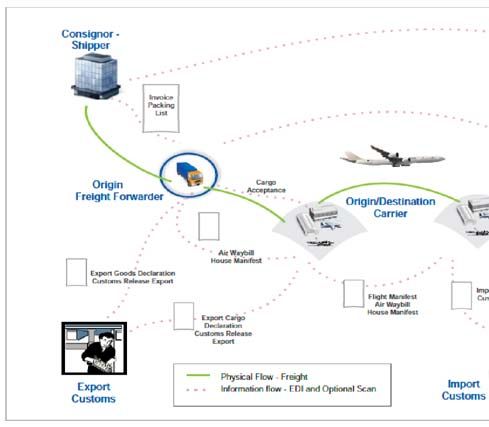
MATEC Web of Conferences 341, 00021 (2021)                       https://doi.org/10.1051/matecconf/202134100021
ITMTS 2021

        in the operational time for handling cargo at the airports by optimizing the processing,
        verification and exchange of documents. Digitalization on airfreight took place much later
        than that on the passenger’s side [2]. Last years’ experience of functioning in time of the
        COVID-19 pandemic has shown that digital solutions can significantly increase the
        efficiency of the business operational processes.
            This study focuses on the implementation of digital technologies at the airports to
        optimize information and financial flows, required for the transportation of goods.
            Currently, digital technologies are being implemented in all areas of the airport [5].
        Airports are working towards digitalization, launching dedicated apps (like Changi,
        Incheon, Schiphol, Heathrow, Frankfurt, Munich, Zurich or Copenhagen Airport) and
        covering key areas where digitalization has the greatest impact: operations, security,
        passengers and retail [6]. A digital solution to simplify the document flow at the airport is
        the E-Freight system. The E-Freight system is an international standard for paperless
        clearance and support of air cargo transportation, recommended by the International Air
        Transport Association (IATA) within the framework of the IATA international industry
        program "Simplifying the Business". The use of this digital solution has reduced the
        paperwork processing times for air cargo transportation by 50%. In 2019 IATA developed
        Smart Facility program to improve the transparency on service levels at cargo handling
        facilities. The program reduces audit frequency, complexity, and costs and makes
        information available on ONE Source, a new online platform. Through ONE Source,
        shippers can find business partners for their needs through full disclosure on everything
        from temperature-controlled rooms to IATA certifications [7]. A digital solution to simplify
        financial flows is the electronic settlement system.
            Verification whether the accompanying documents are correct and the goods are
        marked appropriately, however, as well as controlling the mutual settlements between the
        participants in the air transportation is still a problem. Case study of the use of the
        blockchain technology in the supply chain management has shown that the blockchain can
        be a digital solution to simplify these processes [8-10].

        1 Methods of the research
        The study was carried out based on the analysis of technological schedules of the airports
        and airlines for cargo handling. As a result of the study, we have identified the main
        problematic operations, leading to an increase in the time spent by cargo at the airports. For
        the study we used data from interviews with the representatives of the cargo terminals
        Moscow-Cargo, Tolmachevo in Novosibirsk and Pulkovo in St. Petersburg. We have also
        used data from IATA, ICAO (International Civil Aviation Organization), TIACA (The
        International Air Cargo Association), FIATA (International Federation of Freight
        Forwarder Association), WCO (World Customs Organisation), ACA (Airport Council
        Association), ACI (Airports Council International). The aim of this research is to find
        technologies to optimize the operations of processing information and financial flows.
            The article examines and summarizes the world practice of using the blockchain
        technology to manage information and financial flows in air cargo. It discusses the
        experience of the blockchain technology use for managing the supply chain of perishable
        goods, to control the maintenance operations and mutual settlements between the air cargo
        stakeholders. The article proposes a system for the introduction of the blockchain
        technology in combination with the Internet of Things and Smart Contracts technologies
        into the logistics operational processes of handling cargo of airlines and airports, based on
        the study of the best practices. The article depicts a scheme for the implementation of these
        technologies in the air cargo industry on the basis of a single blockchain platform.

                                                      2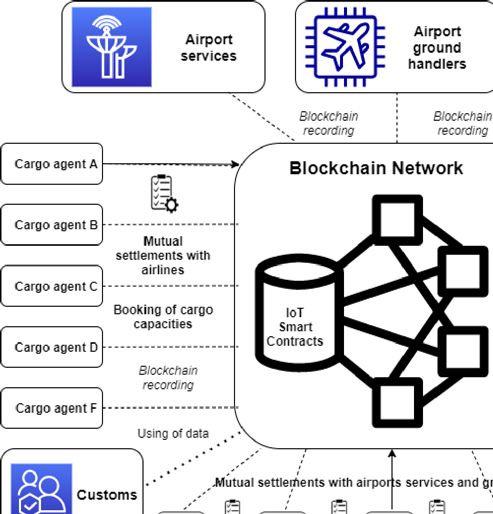
MATEC Web of Conferences 341, 00021 (2021)                            https://doi.org/10.1051/matecconf/202134100021
ITMTS 2021

        2 Information and financial flows of cargo transportation by air
        The air cargo industry includes large numbers of stakeholders, among them are airlines,
        airports, customs, ground and cargo handling companies, shippers and consignees.
        Airfreight shipments generate up to 30 different documents. Paperwork and documents`
        verification, booking, tracking and tracing is done with the involvement of manual
        verification. The use of the E-freight technology allows the reduction of the documents`
        exchange times between all stakeholders during the organization of the air cargo
        transportation.
            The most time-consuming operation with cargo when using E-Freight at the cargo
        terminal is checking the correctness of filling out documents especially electronic Air
        Waybills (eAWB), marking and certificates of origin and compliance. For example, the
        period for customs clearance and phytosanitary inspection of a consignment of fruit at the
        Moscow-Cargo terminal can be up to three days [8]. IATA standard defines a time limit for
        cargo handling at the airport within 48 hours [11].
            Organization of  E-freight documents flow between all participants in air cargo
        transportation
             p          is shown in the figure
                                          g    1.

        Fig. 1. Electronic workflow organization with synchronization of electronic freight and registration of
        import documents according to WCO recommendations
            Blockchain technology can be used to simplify the process of verifying certificates of
        origin and compliance. The use of this technology could reduce time required for
        verification, save money and prevent fraud. Blockchain is a multifunctional and multi-tier
        information technology that has distributed storage and facilitates the accounting of the
        various assets and transactions in a business network. The blockchain was created in 2008
        to support the Bitcoin cryptocurrency with a distributed ledger system that can be
        anonymous. Each deal or transaction is recorded and added to the distributed database
        chain as a new fragment, which is manually assigned a unique multivalued numeric cipher.
        Every transaction is verified by multiple users and their systems, every transaction is
        logged, and all activity is public. This makes certain the supply chain cannot be fraudulent
        because every step is verified by the entire ecosystem of checks and balances. The use of
        blockchain in aviation could make it possible to verify the origin and legitimacy of goods
        accepted for transportation. For example, Blockchain could check whether that particular
        mango, flying from Ecuador to Russia, is 100% certified. This technology with eAWB

                                                          3
MATEC Web of Conferences 341, 00021 (2021)                       https://doi.org/10.1051/matecconf/202134100021
ITMTS 2021

        allows Quick Drop Off, reduces waiting time for the customers and manual transactions at
        the counter. According to experts, in the near future, a typical supply chain will be
        controlled through the generation of 35 zeta-bytes of information [12]. Blockchain solves
        the problem of reducing the volume of information exchange due to distributed data storage
        and increases transparency of the shipments.
             Another important problem in airfreight is the electronic booking of carrying capacities
        and settlements. In airfreight the booking platform FGX was founded in 2000.
        Digitalization of booking passenger air tickets has occurred much faster than air cargo, as
        well as mutual settlements. The delay in digitalization of the air freight is explained by the
        complexity of this process and a large number of stakeholders. The enhancement of the
        transportation booking service for shippers can be achieved by the provision of the air
        freight booking through the backend system of the forwarders, faster acceptance and
        delivery process. It could be based on the automatically pre-checked data or the virtual
        integration of additional service from others providers like customs brokerage in one
        seamless booking flow [2]. Booking cargo capacity includes three steps:
            Reservation of the goods cargo capacity only after coordination with the carrier the
        possibility of this cargo type transportation (documents: air waybill, safety declaration);
            Passing through phytosanitary/veterinary control (documents: phytosanitary/veterinary
        certificate), if sending plants from the territory under quarantine, you must obtain a
        permission to send an individual shipment and quarantine documents;
            Obtaining Customs permit for cargo transportation (documents: customs declaration)
        [8].
             Acceleration of data verification in electronic booking can also be achieved through the
        use of the blockchain technology.
            Another labor-intensive process in the air cargo transportation is the mutual settlements
        among various entities in aviation industry. Air cargo transportation is accompanied by
        financial settlements between airports, airlines, aircraft ground handlers, airport cargo
        handlers, forwarders, logistics companies and general agents for the sale of freight. Agents
        collect freight charges from shippers to pay to the carriers. Carriers then produce invoices
        to their agents for these sales. Each carrier prepares an invoice to each agent individually.
        The sheer number of invoices and reports must be checked and consolidated, payments
        have to be made individually. To automate the mutual settlements of airlines Cargo
        Account Settlement System (CASS) was created by IATA. This system allows cargo agents
        to conclude a single contract with IATA as an authorized representative of all airlines
        instead of several contracts with different airlines. This system minimizes the need for
        multiple payments by consolidating them into a single transaction. Agents pay a single
        amount representing all payments due to all carriers, while carriers receive only one
        payment that consists of payments from all agents. Using blockchain in this system could
        enhance the transparency of the mutual settlements. Blockchain technology could generate
        a unique code for each transportation and the payment for it. Integrating blockchain with a
        single data platform for all air cargo stakeholders could increase the speed and transparency
        of all transactions. In the first phase it is important to introduce a blockchain-based bill of
        landing. A combination of the blockchain technology and smart contracts in a unified
        system of mutual settlements of air cargo participants could not only increase transparency,
        but also automate this process.
            During the organization of the air cargo transportation, in addition to the incoming
        financial flow from the airline's cargo sales agents, there is an outgoing financial flow from
        airlines to the airport ground and cargo handlers. Airport ground handlers in some cases
        perform operational maintenance of aircrafts. Airlines need not only to control the financial
        flows, but also have a transparent system for filling out the maintenance logbook in
        relations with the ground handlers. The transparency of the aircraft logbook helps federal

                                                      4
MATEC Web of Conferences 341, 00021 (2021) https://doi.org/10.1051/matecconf/202134100021
ITMTS 2021
agencies to assign an airworthiness score for the aircraft. Incomplete maintenance history
affects the aircraft’s safety rating and eventually decreases its market value [13]. Using
blockchain technology to register and store records of aircraft maintenance could make this
process more transparent and protect against loss and errors in records.
3 Case studies of using Blockchain in logistics
Blockchain technology is successfully applied in various areas of logistics. Maersk is
collaborating with IBM to create a unified supply chain service platform for maritime
transport. It reduced the administrative costs by 15% of the cost of goods shipped. At the
next stage, the system was integrated with the radio frequency identification system using
the Internet of Things (IoT) technology in order to generate a unified information database
of the logistics network. In addition, the company uses GPS container marking systems to
monitor and control their movement through transport hubs along the entire delivery route.
Blockchain is used in ports [14]. For example, the port of Hamburg obliges all
companies to connect to a single information system using blockchain. Singapore Maritime
and Port Authority launched Smart Port Challenge systems in 2017 to improve the
efficiency of maritime logistics of delivery goods to the Port of Rotterdam [15].
Blockchain technology is used to control food safety in the supply chain of perishable
products. Walmart, Unilever, Nestle and others are collaborating with IBM to develop a
traceability system across the entire supply chain and food disease control, based on
blockchain [16].
The blockchain technology is already widely used in aviation [17,18]. According to
Lufthansa, a promising area for using blockchain technology is tracking the supply of
aviation components. Samsung uses this technology to track its aviation supply chain. In
2017, British Airways collaborated with Heathrow, Miami and Geneva airports to study the
use of the Blockchain technology. This study demonstrates the effectiveness of this
technology in organizing the secure exchange of information [19]. Cathay Pacific uses
blockchain to control container freight traffic [20]. In 2018, SITA launched the Aviation
Blockchain Sandbox platform for Distributed Ledger Technology (DLT) application
development.
Blockchain has great potential for tracking multimodal shipments [21]. Thus,
blockchain technology allows to achieve trust between the participants of the aviation
market, to facilitate cooperation and collaboration among organizations and simplify many
data verification operations [22].
To work with a single blockchain platform, a system of "smart contracts" was
developed, which implies encoding of a transaction only if it is approved by all its
participants using a "signature share". To access the block, it is necessary to register all
designated keys that have “signature shares” of this transaction [23,24]. Smart contract is a
computer protocol designed to facilitate the verification negotiation or execution of
contracts digitally without the involvement of the third parties, such as a notary, a broker,
etc. Smart contract automatically ensures the fulfillment of the contractual obligations [25].
It can automatically send payment to the supplier as soon as the shipment is delivered.
Smart contracts have huge potential to efficiently maintain aircraft maintenance records,
validate crew certificates, and verify the ground handler operations at the airport [4].
4 Proposals for the use of blockchain in air cargo
Based on the results of the study, we propose the following directions for the
implementation of the blockchain technology in air cargo transportation: monitoring and
5MATEC Web of Conferences 341, 00021 (2021) https://doi.org/10.1051/matecconf/202134100021
ITMTS 2021
control supply chain logistic; electronic booking cargo capacities; mutual settlements
between all participants of the air cargo transportation and record of ground handler
operations, Figure 2.
Fig. 2. Opportunities of using blockchain technology in air cargo.
It is advisable to supplement the use of the blockchain technology for supply chain
management with sensors to monitor the location and condition of the transported cargo. To
process information coming from sensors for monitoring the location and condition of the
cargo, it is necessary to use the Internet of Things technology (IoT). The combination of
blockchain technology and the IoT allows not only to control supply chains but also to fully
manage them [26]. Sensors collect data such as the location, temperature, humidity and
condition of the items inside the shipping package of cargo at a particular point of time. The
collected data is stored on a server accessible at different stages. The blockchain technology
allows to fix information about every displacement of cargo in the cloud systems by means
of creating of a corresponding note [27,28]. A distributed ledger makes these recorders
safe. The availability of information on the origin of goods simplifies the procedure for
customs clearance of goods, verification of markings and other documents.
The system of the electronic air capacity booking, mutual settlements and control of
handling operations at the airports works in a similar way. The accuracy and reliability of
information guarantees the purity and correctness of the transaction in the implementation
of these operations. The simultaneous use of the blockchain technology, the Internet of
Things and the Smart Contracts on the same platform simplifies the procedure for making
managerial decisions and automates the fulfillment of the financial obligations. The model
of interaction between air cargo participants using the smart contract system is on Figure 3.
6MATEC Web of Conferences 341, 00021 (2021) https://doi.org/10.1051/matecconf/202134100021
ITMTS 2021
Fig. 3. Blockchain, Internet of Things and Smart contract technologies in air cargo industry
The use of the blockchain technology in combination with the IATA Cargo Account
Settlement System significantly reduces the time required for the implementation of
financial transactions between participants in air cargo. According to the estimates of the
IBM Corporation, as soon as the blockchain technology is implemented by the majority of
market participants, shippers should be able to reduce the actual costs of physical
transportation by about 20%. This can be achieved by filtering-out the unreliable carriers
and eliminating the risks of cargo damage throughout the supply chain [29], as well as the
abandonment of the insolvent shippers. In the face of increasing airport congestion, it is
very important to make an optimal use of the available airport resources in order to
minimize the service delays. Efficiency in the use of the airport resources depends on the
transparency of the information exchange between stakeholders in the aviation industry
such as ground services, air traffic control services dispatchers and airport operators [30].
References
1. Rodrigue J-P, The Geography of Transport Systems, 5 Ed.
(New York: Routledge) 456 p. (2020)
2. Wurst S, Graf L (eds.) Disruptings Logistics, Future of Bussiness and Finence
(Springer Naturel: Switzerland), (2021)
3. Tozi L A, Muller C The Viability of Air Transportation for Perishable Agricultural
Produce. Journal of the Brazilian Air Transportation Research Society, 2, 2, pp. 83-96.
(2006)
7MATEC Web of Conferences 341, 00021 (2021) https://doi.org/10.1051/matecconf/202134100021
ITMTS 2021
4. Raja W A, Khaled S, Raja J, Haya R H, Ibrar Y, Mohammed O. The Role of
Blockchain Technology in Aviation Industry IEEE Aerospace and Electronic Systems
Magazine
5. Zaharia S E, Pietrianu C V Challenges in airport digitl transformation Trans. Res.
Pros. 35, pp. 90-99. (2018)
6. Gardy A, Canada R Digital trends & opportunities for Airports, ACI-NA World
Annual Conference. (2016)
7. Juniac A Intarnational Air Transport Association Annual Review 76th Annual General
Meeting (Amsterdam). (2020)
8. Unny R B, Lal B Blockchain in supply chain management. IFIP AICT 617, pp. 149–
158. (2020)
9. Poleshkina I O Use of blockchain technology as supply chain management system
involving air transport Civil Aviation High Thechnologies (2020)
10. Poleshkina I O Transportation of perishable goods by air: handling problems at
Russian airports Civil Aviation High Thechnologies (2020)
11. Pelletier W, Chau K.V. and Bucklin R.A. Analysis of air cargo temperature during
transportation operations Transactions of the ASABE 61 (2), pp. 723–732. (2018)
12. Tien J M Internet of connected ServGoods: Considerations, consequences and
concerns J. Syst. Sci. Syst. Eng. 24, pp. 130–167.(2015)
13. Hasan H, AlHadhrami E, AlDhaheri A, Salah K, Jayaraman R Smart contract-based
approach for efficient shipment management Comp. & Ind. Eng. 136, pp. 149–159.
(2019)
14. Gausdal A H, Czachorowski K V, Solesvik M Z Applying Blockchain Technology:
Evidence from Norwegian Companies Sustainability, 10, (2018)
15. Lim J New opportunities for start-ups in the maritime sector. MPA’s Smart Port
Challenge. In Catalyses Maritime Industry towards Greater Innovation and
Digitalisation (Maritime and Port Authority of Singapore (MPA): Singapore). (2017)
16. Amin Md R, Zuhairi M F, Saadat Md N. Enhanced Blockchain Transaction: A Case of
Food Supply Chain Management J. of Engineering and Applied Sciences, 15, pp. 99-
106. (2020)
17. Hinsch M, Industrielles Luftfahrtmanagement: Technik und Organisation
luftfahrttechnischer Betriebe 3rd ed. (Berlin, Germany: Springer Vieweg). (2017)
18. Goudarzi H, Martin J, Warren S, IATA White paper: Blockchain in Aviation. (2018)
19. Schyga J, Hinckeldeyn J, Kreutzfeldt J. Prototype for a permissioned blockchain in
aircraft MRO Artificial Intelligence and Digital Transformation in Supply Chain
Management: Innovative Approaches for Supply Chains. Proceedings of the Hamburg
International Conference of Logistics (HICL), Vol. 27 (Berlin) pp. 469-505. (2019)
20. Madhwal Y, Panfilov P Blockchain And Supply Chain Management: Aircrafts’ Parts’
Business Case, Proceedings of the 28th DAAAM International Symposium (Vienna,
Austria: DAAAM International) pp.1051-1056, (2017)
21. Hasan H R Salah K Blockchain-Based Proof of Delivery of Physical Assets With Single
and Multiple Transporters IEEE Access, vol. 6, pp. 46781-46793. (2018)
22. Revin V, Shevcheko Y The opportunities and challenges of implementation of
blockchain in aviation industry 4 (2) pp. 206–209. (2019)
23. Stathakopoulous C, Cachin C Threshold Signatures for Blockchain Systems (Zurich,
Switzerland). (2017)
8MATEC Web of Conferences 341, 00021 (2021) https://doi.org/10.1051/matecconf/202134100021
ITMTS 2021
24. Christidis K, Devetsikiotis M Blockchains and smart contracts for the internet of
things Ieee Access, 4, 2292-2303. (2016)
25. Ream J, Chu Y, Schatsky D Upgrading blockchains: Smart contract use cases in
industry Deloltte Univercity Press, 02 (04), pp. (2016)
26. Xu L, Chen L, Gao Z, Chang Y, Iakovou E, Shi W Binding the Physical and Cyber
Worlds: A Blockchain Approach for Cargo Supply Chain Security Enhancement IEEE
Int. Symp. on Technologies for Homeland Security (Woburn, MA) pp. 1-5. (2018)
27. Dobrovnik M, Herold D M, Furst E Kummer S. Blockchain for and in logistics: what
to adopt and where to start Logistics, 2, issue 3, p. 18. (2018)
28. Hackius N, Petersen M Blockchain in logistics and supply chain : trick or treat?.Proc.
of the Hamburg International Conference of Logistics (HICL) 18 p. (2017)
29. Kshetri N Blockchain’s roles in meeting key supply chain management objectives
International Journal of Information Management, 39, pp. 80–89. (2018)
30. Erkan H, Erkip N K Collaborative decision making for air traffic management: A
generic mathematical program for the rescheduling problem Computers & Industrial
Engineering 137, p. 106016.A. Mecke, I. Lee, J.R. Baker jr., M.M. Banaszak Holl,
B.G. Orr, Eur. Phys. J. E 14, 7 (2019)
9You can also read


