DESIGN DISTINCTION AND THE POWER OF CONSTANT SCRUTINY 2021 - South African Institute of Architects
←
→
Page content transcription
If your browser does not render page correctly, please read the page content below
Issue

                                                       99
                                                       FEBRUARY/
                                                       M A R C H

JOURNAL OF THE SOUTH AFRICAN INSTITUTE OF ARCHITECTS   2021
                                                       ISSN: 1682-9387

DESIGN DISTINCTION
AND THE POWER OF CONSTANT SCRUTINY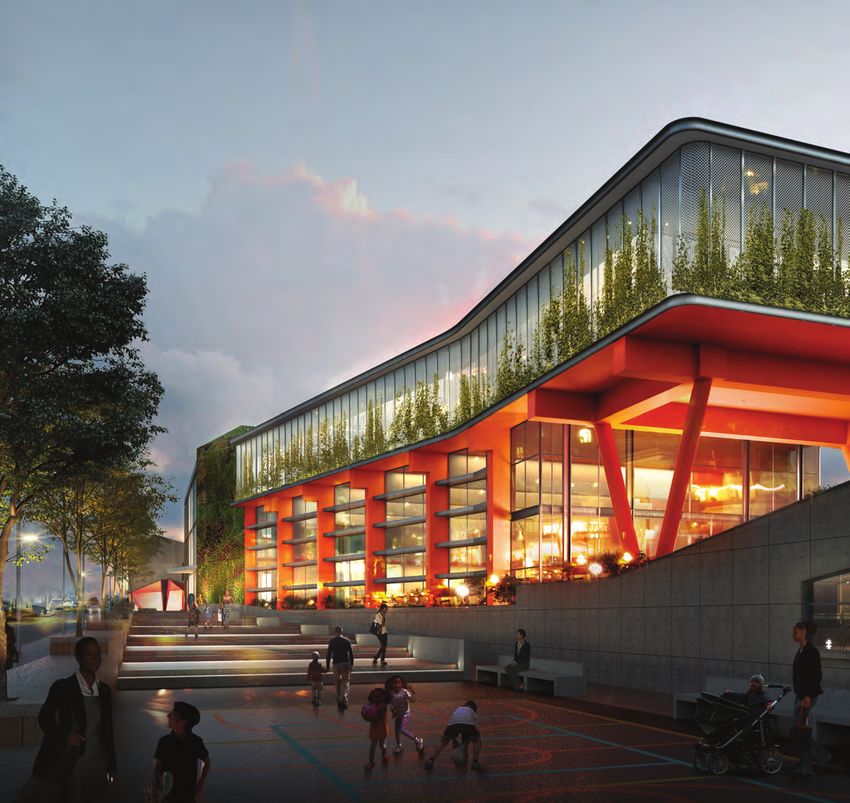

Quality is remembered long after the price is forgotten.
Swartland has been supplying the building trade with quality products since 1951. Our world-renowned
production excellence is applied to our vast range of products: wooden windows and doors, aluminium
windows, doors and showers, garage doors and automation, XPS insulation board, cornices, awnings
and manufactured products. ‘Experience Quality’ is not just a slogan. It’s our commitment to holding
ourselves to the highest standards and to ensuring that every experience with us is a quality one.

Call us on 086 110 2425 or visit swartland.co.za to view our ranges.
COMMERCIAL
PAGE INDEX:
1 Safal Steel
Websites: www.safalsteel.com
18 www.safalgroup.com
Linkedin: https://www.linkedin.com/company/
safal-steel
2 SWARTLAND
Website: www.swartland.co.za
Facebook: @theswartlandgroup
4 SAFINTRA
Website: www.safintra.co.za
Facebook: @SafintraSouthAfrica
Linkedin: https://www.linkedin.com/
12
company/safintra/
14 TILT DESIGN COLLECTIVE SA
Website: www.tiltscreens.co.za
Facebook: @tiltscreens
Twitter: @Tilt_Screens
Linkedin: https://www.linkedin.com/company/
tilt-design-collective/
Instagram: @tiltscreens
Pinterest: https://za.pinterest.com/tiltscreens/
16 ADA ARCHITECTS
Website: www.ada.co.za
26 Green Inc
Facebook: @GREENinc.LA
Instagram: @greeninc.la
Linkedin: http://www.linkedin.com/
29 42 company/greeninc/
Website: https://www.greeninc.co.za/
28 SIKA
CONTENTS
Website: www.zaf.sika.com
Facebook: @SikaSouthAfrica
Instagram: @sikasouthafrica
ISSUE 99 41 Wolkberg Casting Studio
Website: www.wolkberg.com
Facebook: @wolkbergcastingstudios
Instagram: @wolkberg_casting_studios
EDITOR’S NOTE REFEREED ARTICLE Pinterest: https://za.pinterest.com/
6 THE ARCHITECT AND 29 PRACTICES OF CULTURAL wolkbergcasting/
PUBLIC ACCOUNTABILTY REAPPROPRIATION
Dr. Magda Minguzzi 48 IID
Professor Paul Kotze Website: www.iidprofessions.org.za
Facebook: @iidprofessions
NOTES AND NEWS REFEREED ARTICLE Linkedin: https://www.linkedin.com/in/
42 BEYOND CONTINUITY AND iid-professions-6232b1a9/
8 SAIA NEWS CONTRAST PART 1 Twitter: @IIDProfessions
Mr. Mthembeni Mkhize Instagram: @iid_professions
Professor Arthur Barker
SA HOME OWNER
10 A TRIBUTE TO THE LIFE OF END NOTE Website: https://www.sahomeowner.co.za/
ERROL PIETERS Facebook: https://www.facebook.com/
49 JOHANNESBURG HERITAGE
sahomeowner
Mr. Siegfriedt Schmidt FOUNDATION PART 1 Twitter: https://twitter.com/SAHomeOwner
Mr. Wynand Dreyer Instagram: https://www.instagram.com/
12 INTERNATIONAL AWARD sahomeowner/
Youtube: https://www.youtube.com/channel/
Ms. Nadia Tromp UCjwSKyhy-mGYdXavil_URpg
Za.pinterest: https://za.pinterest.com/
sahomeowner/_created/
BOOK REVIEW
15 REVERSING URBAN INEQUALITY 51 SAWPA
IN JOHANNESBURG Website: www.sawpa.co.za
Ms. Athea Peacock
52 JAX OLEUM
Website: www.jaxoleum.co.za
PROJECT Facebook: @jaxoleum
10
Instagram: @jaxoleum
18 ARCHITECTURAL ALCHEMY Pinterest: https://za.pinterest.com/
Mr. Michael Louw jaxoleum/_created/
Twitter: @JaxOleum
ARCHITECTURE SA FEBRUARY/MARCH 2021 3
FROM T HE EDI TOR

    THE ARCHITECT AND
    PUBLIC ACCOUNTABILTY
             A
                           ll reflective and careful architects know that      the public reverence for the tomb of Mimar Sinan, the
                           every line they draw and every material             revered Turkish architect, in Istanbul and the public
                           and construction method they may use will           park in Philadelphia introducing the work of Prof. Louis
                           eventually be placed under public scrutiny.         Kahn to the public in the same area where he used to
                           This public evaluation of their work might not      live. It is not often that architects receive such public
             happen immediately, but it will happen and most probably          recognition of their work – which at the same time
             under very different circumstances under which the work           places them within the focus of public scrutiny of the
             has been produced.                                                possible value that they have brought about in their
                Here the words of Dr. Sylvia Bodei ring true when she          respective careers.
             said: “The built object survives longer than the political           Architectural expression, as we know so well, could
             era into which it was born – as it ages, it then becomes          also be how well-meaning, benign and inventive
             part of the social, political and physical landscape of           motions of a better future could be realised. The
             the city from which it cannot easily be unbundled.                opposite is also true, in the way that self-serving
             Architecture’s relationship to the political time of              despots and totalitarian rulers and their architects can
             its making does not have the same longevity as the                use architecture for the expression of their so-called
             enduring aspect of good architecture.”                            legitimacy and ultimate self-aggrandisement.
                This is not the last time that this thought has been              It is within this contrast that the idea and image
             expressed and it will appear in other forms in future.            of the pink seesaws gain another form of relevance.
             There are also many ways in which the talented                    Without this sense of responsibility towards public
             architect, with an equal measure of hindsight and                 accountability, the rot will eventually set in. Without
             foresight, can comment on the events of their immediate           our ability to interpret and reinterpret architectural
             timeframe to open up a debate or to steer events into,            expression for the profession and the public alike,
             possibly, a more positive outcome.                                stagnation will occur, which will prevent all new
                For example, recently the international digital and physical   means of being and doing. Such new ways of doing
             press was saturated with the news that the “Tatter Totter         might also be invalidated with fearmongery. When
             Wall”, a three-piece pink seesaw that was in place for 40         architecture only serves one “master” or if the
             minutes in 2019 was awarded the 2020 Design of the Year           individual architect appears as a “master”, it only
             award from the Design Museum in London. Placed on                 shows its own decadence and empty self-assurance.
             the controversial US/Mexico border wall, the seesaw was           However, when it takes on multiple causes and issues,
             designed by architect Prof Ronald Rael (UC Berkeley) and          its expression might be messier and contradictory,
             interior designer Prof Virginia San Fratello (San Jose State      but it will be healthier with much new optimism for
             University) and was more than ten years in the making. Here       a, mostly, uncertain future. All of these positions will,
             again, with some inventive and poetic thinking, architects        eventually, be revealed when done with the right
             could show that, that which divides humans could also unite       attitude towards public accountability and scrutiny.
             them with some joy. This critical thinking about a so-called         Issue 99 of Architecture SA is, like number 98, now
             insurmountable problem does offer a respectable way out of        in digital format. There has been a time gap between
             such situations. However, the key concepts remain: namely,        issue 97 (June/July 2019) and issue 98 (December
             respect, humility and a longer-term vision to deal with the       2020), due to conditions beyond the control of SAIA.
             immediate problems/potentials of the day.                         Thematically, this issue returns to a partial focus on the
                Another of these good examples of public                       pedagogic outcomes and processes of the Department
             accountability in a somewhat different format appears             of Architecture at the University of Pretoria, which
             in the permanent exhibition of the long design evolution          had its 75th anniversary in 2018 (see issues 95 and
             of the Kimbell Art Museum in Fort Worth, Texas, USA.              97). Furthermore, a brief introduction is made to the
             Prof Louis Kahn designed the older part of the Kimbell            international prize awarded to Ntsika Architects and
             and Mr. Renzo Piano the newer part of the building. In            the current debate of what Johannesburg could be all
             this exhibition, the public is taken step-by-step through         about through a review of a new publication on the
             the evolution of the design process to explain to them            city as well as a response to the current city planning
             the unique qualities of the combined building complex.            proposals to be implemented soon.
             The older building is called the “Kahn Building” and
             the newer building the “Piano Building”.This expression           1
                                                                                Horner, B. A review of Hans Hallen’s collective architecture in
             of simultaneous respect and accountability has, for               Durban. Journal of the SA Institute of Architects. March/April
             example, another iteration in the public monument                 2019. P 30-35.
             to the Dutch architect, Hendrik Petrus Berlage, in
             Amsterdam South (a part of the city that he designed),            Professor Paul Kotze, Editor

6                                        ARCHITECTURE SA         FEBRUARY/MARCH          2021
CON T RIBU TORS

CONTRIBUTORS
                                                                                                                DR MAGDA MINGUZZI
                                                                                                                is an architect/artist with a PhD
                                                                                                                in architecture composition from
                                                                                                                Luav University, Venice. She is
                                                                                                                a senior lecturer, responsible
                                                                                                                for the PhD programme at the
                                                                                                                Nelson Mandela University
                                                   MR MICHAEL LOUW                         School of Architecture. She began her research and
PROFESSOR ARTHUR BARKER
                                                   is a senior lecturer in the             collaboration with the First Indigenous People-KhoiSan
based in the Department of
                                                   Department of Architecture,             of South Africa in 2014.
Architecture at the University of
Pretoria, co-ordinates and lectures                Planning and Geomatics at
in the Professional Master’s                       the University of Cape Town.
programme while teaching aspects                   He holds a BArch from the
of architectural modernity in the                  University of Pretoria, and
undergraduate programme. He co-                    an MPhil from Stellenbosch
ordinates Design Teaching and the                  University. He is currently
Heritage and Cultural Landscapes                   registered for a PhD focusing
research field while chairing the                  on architectural technologies
Departmental Research Committee.                   in Africa.

   ISSN: 1682-9387
                                                      MANAGEMENT
   EDITORIAL                                          Management Accountant
   Editorial Board                                    Deidre Musha
   Prof. Roger Fisher                                 Business Manager
   Ms Wanda Verster Odendaal                          Lodewyk van der Walt
                                                      General Manager, Magazines
   Editor Prof. Paul Kotze                            Jocelyne Bayer
   Content Manager Raina Julies
   rainaj@picasso.co.za
   Copy Editor Brenda Bryden                          PUBLISHED BY
   Content Co-ordinator Vanessa Payne
   Digital Editor Stacey Visser
   vissers@businessmediamags.co.za

   DESIGN                                             A proud division of Arena Holdings
   Head of Design Jayne Macé-Ferguson                 Hill on Empire, 16 Empire Road
   Senior Designer Mfundo Archie Ndzo                 (cnr Hillside Road),
   Advert Designer Bulelwa Sotashe                    Parktown, Johannesburg, 2193
                                                      PO Box 12500, Mill Street,
   SALES                                              Cape Town, 8010
   Project Manager Merryl Klein                       Tel: +27 21 469 2400
   merrylk@picasso.co.za                              www.businessmediamags.co.za
   Tel +27 21 469 2446
   Cell +27 82 895 7260                               COVER IMAGE
                                                      Ntsika WTDC Project
   PRODUCTION                                         Image by Nadia Tromp
   Production Editor Shamiela Brenner
   Advertising Co-ordinator
   Johan Labuschagne
   Subscriptions and Distribution
   Fatima Dramat fatimad@picasso.co.za

  Copyright: Picasso Headline.
  No portion of this magazine may be reproduced in any form without written
  consent of the publisher. The publisher is not responsible for unsolicited material.
  Architecture SA is published by Picasso Headline. The opinions expressed are not
  necessarily those of Picasso Headline. All advertisements/advertorials have been
  paid for and therefore do not carry any endorsement by the publisher.

                                                            ARCHITECTURE SA              FEBRUARY/MARCH          2021                                         7
ARCHITECTURAL AWARDS
                        AND THE POWER OF CONSTANT SCRUTINY
                        A roundup of SAIA’s news and events, plus planned activities for the year ahead
                        By: Mr. Mthembeni Mkhize, CEO SAIA

                                                                          many voices
                                                                          transformation webinar series
                                                                          2021
                                                                                            webinar is FREE
                                                                                            and CPD accredited.
                                                                                            SACAP category one
                                                                                            with 0.25 credits.

                         1

                        ARCHITECTURAL AWARDS                                      GIVING MEANING TO “MANY VOICES”
                        Over the years, SAIA has placed importance on             In August 2020, SAIA president Ms. Kate Otten
                        showcasing the excellent work produced by our             introduced “many voices” as a strategy during her
                        architect members. These efforts would have not been      term of office. The strategy aims to listen to the many
                        realised without the long-term commitment to support      voices in the architectural profession that are often
                        by our sponsor partners.                                  marginalised and unheard. The SAIA Transformation
                          This year, SAIA will be awarding projects entered       Committee has aligned with this strategy and will be
                        into its two national awards programmes. COVID-19         hosting a transformation webinar and infographics
                        has forced SAIA to rethink and find creative ways         series in 2021.
                        to run the awards. As current level 3 lockdown              The purpose of the webinars is to start conversations
                        mandatory protocols restrict large social gatherings,     on difficult but necessary topics that SAIA has left
                        the awards will be packaged to allow access while still   unattended for too long. It is our hope that this
                        adhering to the regulations.                              series will kick-start and inspire SAIA to undertake a
                          Details of these awards events will be                  transformative journey; to be more representative,
                        communicated to members later.                            inclusive and aligned with the broader South African
                                                                                  architectural profession.
                                                                                    The webinars will be offered as a series under the
                                                                                  following topics:
                                                                                  • Race, Transformation and SAIA
    1. SAIA Transformation many voices webinar #1.                                • Decolonising Architectural Education

8                                                ARCHITECTURE SA     FEBRUARY/MARCH       2021
S AIA :NOT ES AND NE W S
save the date Free and CPD accredited
4 transformation 4 March 29 April 17 June
march webinar Race,
Transformation
Decolonising
Architectural
Generation
Dialogue
16:30 – 18:00 series and SAIA Education
2021 12 August 4 October 2 December
Why Architects No Borders Practicing…
many voices Should be
Feminists
2
• Generation Dialogue team of consultants is not required.
• Why Architects Should be Feminist • Letter as Contract: a straightforward proforma letter,
• No Borders which when signed by both parties will become the
• Practising. Agreement, will also be available online.
The social discourse and the pandemic has enabled • QMS Toolkit: this tool is intended to assist members
SAIA to participate in the broader discussions in maintaining and improving the management of
that are happening elsewhere in the world. We their practices and thereby improving the quality of
often find the profession avoiding being part of the their service to clients.
broader sociopolitical movements for change. Now • Fee Calculating Tool: members are encouraged to
is the time for the architectural profession to join in use this new improved free version published by
these discussions if we seek to remain relevant in Fresh Projects.
the industry. And then we hope to talk. We are compiling a series of
Friday afternoon online chats/presentations and plan
SAIA PRACTICE to kick this off on the first Friday in May, thereafter they
Having somehow survived the year of COVID and will be held on the first Friday of every month. Look
the resultant lockdowns, masks, mourning, remote out for SAIA Share | One:05, which will close off the
meetings, and never shaking hands or hugging a week in an inspiring, thought-provoking one hour and
friend, it is perhaps not amiss for us at the South five minutes of light and grey.
African Institute of Architects to look forward, with our
members, to a better future. IN CONCLUSION
And so, as we take stock of where we are and where The Institute finds itself having to constantly scrutinise
we want to be, the Practice Committee is pleased and how it plans and presents its activities for the benefit
proud to report that during 2020 excellent progress of its members. This year, we have packaged some
was made on a range of initiatives,, which will come to exciting offerings that are relevant to the spirit of the
Images: Supplied
fruition over the next few months. times. We look forward to member participation and
• Client-Architect Agreement: this revised digital constructive engagement.
version of the contract will be available online for
sale shortly. It is recommended for use on mainly
residential work and smaller projects where a full 2. Save the date.
ARCHITECTURE SA FEBRUARY/MARCH 2021 9A TRIBUTE TO
THE LIFE OF ERROL PIETERS
Friend, colleague, mentor and inspiration. 5 April 1951–18 April 2020
By: Mr. Siegfriedt Schmidt
”P
aul Klee took a line for a walk. It was an act of passion, love and creativity.
snaked, looped, wandered off, Friend, mentor, philanthropist and inspiration to a
and turned back on itself as it generation of the architectural fraternity through
made its fitful journey through whom his legacy will live in the work they do to
the worlds of his invention. A line make the world a better and more beautiful place for
can run dead straight, be wildly crooked, nervously others. And in their own lives.
wobbly, make sensuous curves or aggressive Few people outside our small group of friends
Errol Pieters, angles. It can meander, wander, track or trace. Be a who taught and lived through the era are aware of
Self-portrait Sketch scribble, doodle, scratch, hatched, dashed, dribbled his journey as head of department in attempting to
or trickled. It can be precise or fuzzy, hard or soft, firm create an opportunity for students who exhibited an
or gentle, thin or thick. It can be smudged, smeared, ability to make a successful career as an architect and
erased – or just fade away. You can push a line, drag a positive contribution to society, but were barred
it, manipulate and manoeuvre it, make it delineate, from doing so by some or other arbitrary obstacle
accentuate, attenuate, emphasise. A line may be stemming from administrative autocracy, prospectus
imperious or modest, authoritative or servile, brutal requirements or preconceived perceptions.
or seductive, passive or active, weak or strong, thick After exhausting all avenues of possible
or thin. A line is born, and dies, in a point.” collaboration with other schools, Errol pursued
The ability of a select few artists and architects to the only remaining route by initiating a process
see something ordinary from an angle that eludes of transforming the Department of Architecture at
most of us is what makes them unique. The art of Technikon Pretoria (now TUT) to create an opportunity
looking sideways. for commendable students to pursue a full career
Errol was one of those. Not only when looking at path in architecture.
objects as simple (and complex) as a flower, but in In the face of significant opposition from both
architecture, art, teaching, life and, most importantly, academia and the regulatory body, he succeeded
people. All people, from all walks of life. within an institutional academic structure that did not
His own life encapsulated in the line that Klee took allow for it. Or could not, at first, accommodate it. In
for a walk. seeking to get things done, it could only be realised
This is not an obituary. An obituary suggests that by crossing boundaries and putting himself at risk for
someone is gone, not with us anymore. For the the eventual benefit of the students.
many whose paths he crossed, there will never be an Students are relentless in their critical scrutiny of
absence of presence. those who teach them. When they make a concerted
Errol became a part of our thinking and living on effort, travelling from different parts of the country or
a multitude of different levels with a (sometimes the world, to visit a former lecturer at his home 10,
disarming and brutal) honesty, conviction of belief, 15 or 20 years after graduating, it is a testament in
and a passion for life and those around him. itself. As are their tributes on social media describing
However, you sometimes had to look beyond the experiences, awareness and emotions as a student
scowl to appreciate the intent. and as architect:
There are two things I remember from my early
SIMILAR TO HIS ARTIST, TEACHER AND FRIEND days as a student.
A true artist and teacher and a 1. The History of Architecture classes. How he
EXCEPTIONAL TALENT FOR caring human being, manifested in taught me that books are meant to be used.
COOKING AND PAINTING, a teaching career spanning almost Written in. Highlighted. Underlined. How later
the year he lifted up my scribbled-in, highlighted,
SHARED WITH UNSELFISH 30 years, leaving an indelible
impression on all his students. underlined textbook and showed the class ‘what
ENTHUSIASM, TEACHING Similar to his exceptional talent for a real textbook should look like’. I loved those
WAS AN ACT OF PASSION, cooking and painting, shared with history classes. He would get this smirk on
unselfish enthusiasm, teaching his face and impersonate a pharaoh or some
LOVE AND CREATIVITY.
10 ARCHITECTURE SA FEBRUARY/MARCH 2021L EGACY AND CEL EBR AT ION
architect. Highly entertaining. Always slipping in
a few fatherly life lessons.
2. There was one watercolour class he presented. I sat
next to him beside the drawing board. I was in awe
of how effortless he made it look. I was appalled by
how he sucked the brushes clean with his mouth
and how he didn’t miss the opportunity to tease
me about it. To this day I also suck the watercolour
brushes clean with my mouth.
Thys always says that you never experienced a crit
1
until you walked out of an Errol crit, ears bleeding.
The way he said Poephol. No one could say
Poephol with such gravitas. The way he loved his
family. How he spoke of his wife. How he spoke
of Arno. With adoration, amusement and pure
love. I remember a drawing of Arno and Saskia
he shared with us sometime during our studies.
How he captured Arno’s curly hair perfectly. How
he thought the world of them. I remember how he
made time for us. How I came over to his house
in my Master’s year in the evenings and how he
patiently helped me with my speech. How he
pushed us to rethink so many aspects of design
and life in general. The last time I saw him was just 2 3
before we moved to PE. He impersonated Francien,
much to her dismay ... he showed us his incredible
studio, his paintings, his plants. We talked about
how leaving architecture for a while is a good thing.
We talked about how commercial architecture
scarred us for life. I am sure feeble writings like
these will pop up in the near and far future. From
all the people who he inspired, moulded, scolded,
bitch-slapped, loved. I am not one of his sketch
protégés, in fact, I really don’t know what he saw in
this average small-town girl with very little natural
talent or design finesse.
– Riette (with her permission)
FOOTNOTE 4 5
In February last year during a dinner at his house for a small
group of friends called die games groep, Errol, in his unique take
on things, set up a projector and screen behind the table in his
studio. After the main course, he projected a YouTube video that
was the length of time he calculated it would take him to prepare
dessert, and had us watch it while he was busy in the kitchen.
He happened upon it when searching for something else
on the internet, and found it so beautiful that he just had to
share it with us. It was “Anthem”, from Leonard Cohen’s last
performance in London in 2008 when he was 73 years old.
The birds they sang
At the break of day
Start again
I heard them say
Don’t dwell on what
Has passed away
Or what is yet to be...
Ring the bells that still can ring 6
Forget your perfect offering
There is a crack in everything
1.Errol – portrait sketch and doodles on serap paper. 2.Oil on Canvas – wharf with
That is how the light gets in. bollard – Rab Croatia. 3.Sunnyside House Gable. 4.Study for abstracts Arathusa.
We watched it again on Saturday evening, 18 April 2020. 5. Bollard in Split, Croatia. 6.Sketch developing detail of own house.
ARCHITECTURE SA FEBRUARY/MARCH 2021 11TOP HONOURS
FOR NTSIKA ARCHITECTS
Johannesburg-based Ntsika Architects
received a World Architecture Forum
Master Prize in 2019
By: Ms. Nadia Tromp
1
T
he prestigious World Architecture Master Ntsika Architects is the only African architectural
Prize honours designs in the disciplines of practice to receive an award at the World Architecture
architecture, interior design, and landscape Master Prize 2019.
architecture with the aim of advancing the “I am honoured to receive this recognition for a
appreciation of architecture worldwide. project that is deeply meaningful to myself and my
Previous winners of the award include Aedas, Shop team. It was humbling for our project to be chosen
Architects, Zaha Hadid Architects and Skidmore, from among hundreds of inspiring projects submitted.
Owings and Merrill (SOM). And, it was an unforgettable experience to receive the
The winning design – conceptualised by Nadia award in the iconic Guggenheim Museum, Bilbao,”
Tromp of Ntsika Architects – for the Westbury said Tromp. “For Ntsika Architects to be named as a
Transformation Development Centre ensured the finalist for the Practice of the Year Award has also been
incorporation of local skills and innovative use of a huge honour for us. We believe strongly in the work
materials to create a building that has quickly become that we do and the power of architecture in society.”
a landmark in this derelict part of Johannesburg. The 2018/2019 year has been a whirlwind year for
The award builds on the World Architecture Festival Tromp who is a past president of the Gauteng Institute
(WAF) win for Ntsika in 2017, when Tromp became the for Architecture (GIfA) and also serves as the director of
first female architect from Africa to take home the top the International Union of Architects (UIA), Community
honours from these awards. Furthermore, Ntsika has Architecture & Human Rights work program (CA+HR).
gone on to win the Gauteng Institute for Architecture Ntsika Architects was also named for another award
(GiFA) Award in 2017, the South African Institute of at the AMP in 2019. The company was among four
Architects (SAIA) Award 2018 and the German Design finalists selected for the Multi-disciplinary Architecture
Prize in 2019 for various works. Practice of the Year Award.
12 ARCHITECTURE SA FEBRUARY/MARCH 2021IN T ERN AT ION AL AWARD
2
THE AWARD-WINNING PROJECT
The Westbury Transformation Development Centre
(WTDC) is a mixed-use public building. The project
focuses on developing an approach to engage with 3
communities in a meaningful and sustainable way. It
seeks to create an innovative, hybrid architecture from
a local palette of materials using local skills. “I AM HONOURED TO RECEIVE THIS RECOGNITION
The site skirts the edge of this marginalised
community, separated from other communities FOR A PROJECT THAT IS DEEPLY MEANINGFUL
by major arterial routes. Located at the gateway TO MYSELF AND MY TEAM. IT WAS HUMBLING
to Westbury, it offers a unique opportunity to shift
perceptions of the public and the community FOR OUR PROJECT TO BE CHOSEN FROM AMONG
regarding its worth. It alters the urban landscape and HUNDREDS OF INSPIRING PROJECTS SUBMITTED.
offers the prospect for spatial and social justice. It is
becoming somewhat of a landmark; creating a sense
AND, IT WAS AN UNFORGETTABLE EXPERIENCE
of pride among the previously invisible community, TO RECEIVE THE AWARD IN THE ICONIC
often made visible only through news reports of gang
shootings or associated social violence.
GUGGENHEIM MUSEUM, BILBAO.”
A complex project brief, with multiple end-user
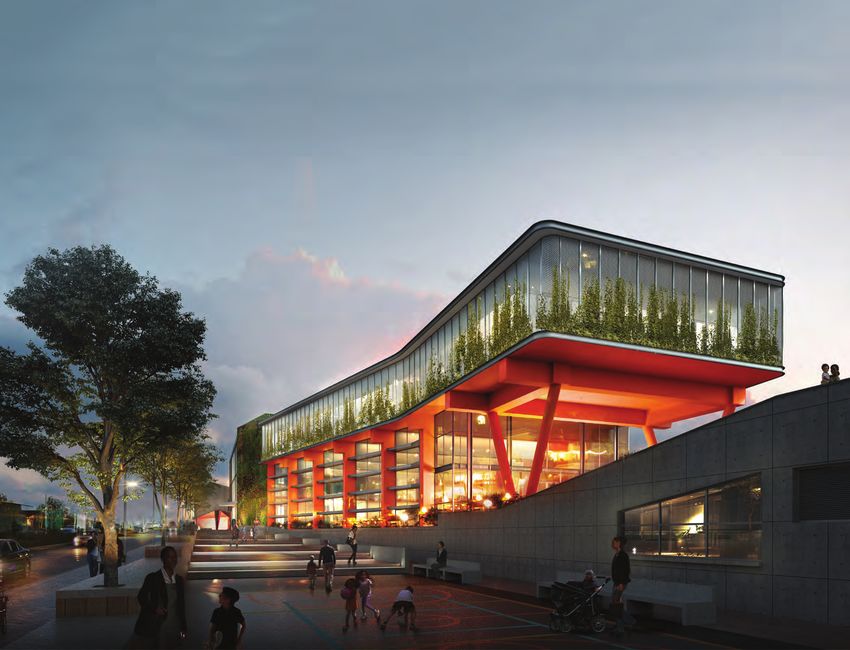
stakeholders, led to a surprising design response. The The long-built form is oriented along the north-south
project is centred around creating smaller safe spaces axis of the site, allowing the narrow floor plates to get
within a larger programme. The site is a long narrow maximum natural daylight deep into each floor. The
sliver of land. western and eastern facades are intentionally short, with
The only existing building that remained, is the minimal sun shading required. All services are located
old St. Barnabas School building, 1935. Although the along the southern facade.
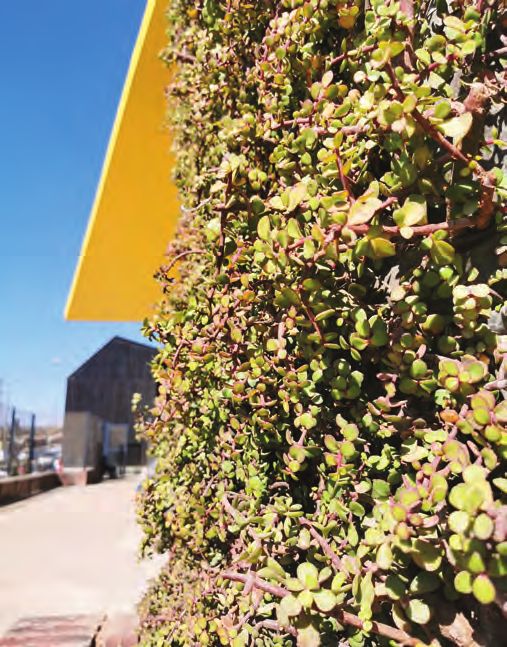
building has no architectural heritage value, it is an An integrated green approach has been taken towards
important part of the community’s collective memory the shading of the building. The northern facade has deep
of the space and has great cultural significance to the horizontal fins with a large concrete overhang on the first
people. This building becomes the anchoring point and second floors. A screen on the second floor is planted
of the site, around which the rest of the design has with indigenous creepers that flower during summer,
been hinged. It has been repurposed as the preschool creating natural shade, and lose leaves in winter, letting
classrooms for the Early Development Centre (ECD), in the winter sun. This living screen along the prominent
with the entrance located between the old and new facade of the building becomes an integral passive
structures, wrapping a defensive courtyard against the heating and cooling device, while colour and texture
Images: Nadia Tromp
busy corner of Perth Rd and Harmony St. differentiate each segment and create a link between the
The building envelops, restricted by a limited external public-facing form and the internal programme
buildable area, holding the corner and then steps far of each portion.
back off the main street edge. This creates a generous
public space in front of the building that can be used
by the community for various social activities. 1. Ntsika WTDC Project. 2. Courtyard. 3. Planter
ARCHITECTURE SA FEBRUARY/MARCH 2021 13BOOK RE VIE W
REVERSING URBAN INEQUALITY
IN JOHANNESBURG
By: Ms. Althea Peacock, LemonPebble Architects & Urban Designers, Johannesburg
R
eversing Urban1 Inequality in who speaks of the “commercialisation of
Johannesburg is edited by Dr Melissa our history” as something to collect and
Tandiwe Myambo. Instagram. Is it, no longer, the intense, ugly,
This collection of essays by spatial difficult and damaging phenomenon that
practitioners, historians, anthropologist, has left scars on the land and its people,
political economists and other researchers is both physical and psychological? But there
indicative of the multiple authorships of our physical is a silver lining it seems. By questioning our
sociopolitical, economic, historic landscape. elitism we are given agency, by being able
This review briefly reflects on some of these to interrogate from alternate perspectives
snapshots that consider the interconnectivity of the and acknowledgement that there are Others
disciplines weighing in on this examination of Joburg. to engage with to create full representation
The anecdotal and dramatic accounts, as in the and participation.
first paper, are endemic responses and reflective of That imperative towards representation or
engrained and pervasive attitudes of privilege that even acknowledgement of the people living
govern daily spatial practice. in our cities is expanded in “Life Behind the
There are descriptions of some of the city’s Shop”. It is these unseen, un[der]represented
initiatives for redressing spatial (in)equity and what and silenced stories that create, connect and
Reversing Urban
the implications of those initiatives have been or were constitute living in our cities. Inequality in
intended to generate. Understanding economies, informality, global Johannesburg is a
collection of essays.
The discussions presented here are those with effects on emerging markets, and historical and social
which spatial practitioners should be engaging. Some narratives as threads, which when woven together,
do and some refuse to, but seeing the ugly underbelly make this intensely dynamic and polymorphic city. It is
of spatial segregation is necessary. The forces and a reflection to and of the global attitudes to people and
decisions perpetuating that segregation must also be place, which is why we so often can recognise spatial
scrutinised, particularly as they have been amplified inequity in the world before other people do.
during the COVID-19 pandemic. The disturbing, These provocative essays are but a starting point
persistent legacy of Apartheid spatial planning for more spatial practitioners and other professions
still manifests as phenomena of restricted access, involved in the curating and decision-making that
dislocation and displacement of people and remains a forms our cities.
strategy for making “desirable” places in the city. Our current global context has given us trauma
Dr Myambo delivers a powerful critique on and tragedy. Consequently, we have been gifted
Gentrification as not merely sanitising and injecting vulnerability and the discomforting opportunities
capital into a degenerating environment. It is also wrought by resistance to change and anxious
erasure and forced removal. It is exclusion and necessity.
selection of who is [un]desirable, reinforcing the
enclave paradigm and fuelling xenophobia.
There is discussion on the commodification of our
THAT IMPERATIVE TOWARDS REPRESENTATION
past, and how this manifests spatially, with clear OR EVEN ACKNOWLEDGEMENT OF THE PEOPLE
disparities in the telling of which and whose history
by whoever is given the platform to do so. Thus, Other
LIVING IN OUR CITIES IS EXPANDED IN “LIFE
narratives are subverted and excluded or silenced BEHIND THE SHOP”. IT IS THESE UNSEEN,
in favour of the preferred, more popular narratives,
which are endorsed and marketed as the only version
UN[DER]REPRESENTED AND SILENCED STORIES
of the (palatable) truth that is relevant. This is an THAT CREATE, CONNECT AND CONSTITUTE
opportunity to question the value/authenticity of LIVING IN OUR CITIES.
history, its authors and the context of constructing
those retrospective narratives.
Image: Supplied
Dr Dondolo delivers a thought-provoking case for FOOTNOTE
examining our own perceptions of what we believe •
1
Mayambo, MT (Ed.) 2019. Reversing Urban Inequality
is the truer version of a [spatial] history. This theme in Johannesburg. London & New York: Routledge.
is expanded on in the next paper by Tanzeem Razak, ISBN 978 036 766 5074
ARCHITECTURE SA FEBRUARY/MARCH 2021 15ADVERTORIAL
ARCHITECTURAL FIRM
CELEBRATES 20 YEARS
Architectural Design Associates (ADA) specialises in
architecture and urban design and provides architectural
solutions to clients in both the public and private sectors
EXCELLENCE, INTEGRITY AND RESPECT
ADA’s vision is one of excellence, integrity and respect.
With a strong emphasis on quality design and service
delivery, ADA aims to exceed clients’ expectations
while remaining true to its core design philosophy.
ADA’s role within the built environment involves
providing responsible and sustainable architecture
that allows the practice to use innovative approaches
and express ideas to enrich people’s lives by creating
exceptional spaces.
ADA has a Level 1 B-BBEE accreditation and is
committed to recognising talent and skill in previously
disadvantaged groups to uplift the local community.
The company is 75 per cent owned and managed by
previously disadvantaged individuals (PDI), with a
staff complement that is 60 per cent PDI.
Staff development is an integral part of the growth
and future success of ADA. Its policy, from recruitment
through to skills transfer, is based on creating
meaningful participation in sustainable development.
1 Besides affording bursaries and technical training to
previously disadvantaged individuals, ADA provides
E
for further development by assisting with leadership
stablished in June 2000, Architectural and management skills, encouraging continued
Design Associates (ADA) has extensive academic education, promoting sound architectural
experience in architecture. Having just practices through the company’s practice manual, and
reached a milestone 20th anniversary, the supporting contract administration seminars.
company remains committed to its vision
and is looking forward to building on this solid KEY PROJECT EXPERIENCE
foundation for an exciting future. • Member of Lead Architect Team on the Nelson
Founding member Dhiroo Kalian Mandela Bay World Cup Stadium, Gqeberha
is still involved in the practice and (formerly Port Elizabeth)
WITH A STRONG lends his considerable experience • Gautrain Independent Certifier, Gauteng
EMPHASIS ON QUALITY to the management team of • Automotive Supplier Park, Rosslyn, Pretoria
four partners, Malcom Lazarus, • Nelson Mandela Bay Logistics Park, Gqeberha
DESIGN AND SERVICE Murray Field, Terence Naidoo • Botshabelo Mall, Bloemfontein
DELIVERY, ADA AIMS and Jason Visser, who effect a • MTN Switch Centres nationally
substantial combination of design • McDonald’s Stores nationally
TO EXCEED CLIENTS’ and technical skills and have • MTN Stores nationally
EXPECTATIONS WHILE almost 100 years of combined
industry experience. The team
• HLV Plant for Adcock Ingram in Gauteng
• PRASA Stations in KwaZulu-Natal
REMAINING TRUE is supported by a proficient and • JV Architects on Bridge City Mall, KwaZulu-Natal
TO ITS CORE DESIGN competent group of architects
and technologists, as well as
• JV Architects on Monte Casino East End
Development, Fourways
PHILOSOPHY. administrative staff. • JV Architects on Eastgate Shopping Centre
Redevelopment and
• Southgate Shopping Centre Redevelopment
1. From Left to right – Terence Naidoo, Malcom Lazarus, Murray Field, in Gauteng.
Dhiroo Kalian, Jason Visser
16 ARCHITECTURE SA MARCH 2021ADVERTORIAL
2. Jrej Tangawizi Motors
Location: John Ross Eco Junction,
Richards Bay, Kwazulu-Natal
Client: Stanlib Property Investments
3,4. 2010 World Cup Stadium
Location: Nelson Mandela Bay,
Gqeberha
Client: NMB Municipality
5. MTN Cable Landing Station
Location: Duynefontein,
Western Cape
Client: MTN SA
6. McDONALD’S RESTAURANTS
Location: National
Client: McDonald’s SA (Pty) Ltd
2 7. Automotive Supplier Park
Location: Rosslyn, Pretoria
Client: Blue IQ
8. Smart Factory
Location: Randfontein
9. Gautrain Independent Certifier
For Gauteng Province
Location: Gauteng
Client: ARUP SA
8
10. Jrej Tangawizi Motors
Location: John Ross Eco Junction,
3 Richards Bay, Kwazulu-Natal
Client: Stanlib Property Investments
11. ADA Offices
Location: Parkview, Johannesburg
Client: I4 Prop
9 12. VW Parts And Distribution Centre
Location: Midrand, Gauteng
Client: Volkswagen South Africa
4
13. Louis Mall
Location: Eastern Cape
Client: Luwie Properties
10 11
5
12
For more information:
011 880 0600
ada@ada.co.za
6 www.ada.co.za
Images: Photo Legend
ral Design Associates
7 13
ARCHITECTURE SA MARCH 2021 17ARCHITECTURAL
ALCHEMY
The work of Jaco Booyens (1969–), an observer of nature and materials
By: Mr. Michael Louw, School of Architecture, Planning & Geomatics, University of Cape Town.
J
aco Booyens was born in his first year of study, he attended Professor Roger
Pretoria on 17 April 1969. Fisher’s Omgewingsgeskiedenis5 course. He also met
He spent his early years several architecture students and remembers being
wandering in the veld on fascinated by a white-line drawing by Marcus Smit,
the eastern outskirts of and Pierre Swanepoel’s final-year project of a genetic
Pretoria near his parents’ home in research centre6. After completing his first year of
Constantia Park. It was here where landscape architecture, Booyens switched to
he first encountered structures study architecture.
made out of the surrounding He acknowledges the influence Professors Schalk
earth. Besides observing the le Roux, Roger Fisher and Joe Kemp (who he
extensive scattering of termite describes as a “technical guy with common sense”7)
mounds, a small number of had on his development. Le Roux encouraged him
modest man-made structures to take a year out between his third and fourth
also caught his attention1: He was years. During this time, he went to work for Erhard
surprised by their “stubbornness Roxin Architects in Swakopmund, Namibia8 before
to survive”2 and felt compelled
1 to attempt to repair one of these
dilapidated and abandoned clay
houses. Despite having to abandon this ambition
at the time due to technical difficulties3, little did he
suspect that later in his life he would become known
for his structural innovation and his knowledge of
natural earth construction.
EARLY INFLUENCES AND EDUCATION
Booyens’ mother married mathematician Professor
Niko Sauer when Booyens was four years old.
He describes his stepfather as an eccentric
mathematician, scientist, electronics expert, and
amateur botanist, acknowledging him as one of his
biggest influences4.
During his schooling at Hoërskool Waterkloof in
Pretoria, Booyens spent much of his time making
observational drawings of animals and plants, citing
the encouragement he received from his art teacher
Verona Higgs. He wished to be in nature, and he was
considering studies in nature conservation before
his stepfather informed him that the University
of Pretoria was offering a new programme called
Landscape Architecture under Professor Willem van
Riet. This, he felt, might offer him the opportunity
to combine his love of nature with that of design,
so Booyens enrolled for this programme. During
1. Jaco Booyens, 2019. (Photo by Hanneke Benade). 2. One of Booyens’
observational pencil drawings of an insect, accompanied by a Jacques Kerchache
text. Jaco Booyens, 2004. (Image by Jaco Booyens, 1996, modified by author, 2019). 2
18 ARCHITECTURE SA FEBRUARY/MARCH 2021PROJEC T
returning to his studies at the University of Pretoria.
He notes that he had some differences with the
then head of department Professor Dieter Holm, but
says that Holm’s course Gebouklimaat9 triggered
something in him: it made him realise that a building
can be made like an animal or a plant to fit into a
specific habitat[10].
This concept must have resonated with some
of his childhood experiences in the Richtersveld,
which is where Booyens suspects that his love of
the desert began11. Booyens’ mother’s family was
originally from Kakamas12, and the Sauer-Booyens
family often went to the Richtersveld from there to
look for plants. His stepfather’s botanical passion
centred on lithops (succulents also known as
living stones)12. The plants, which are endemic to
the Richtersveld, have adapted to survive in the
extremes of dry climates. They, typically, have two
bulbous leaves that, in form and colour, resemble
stones found in their natural environment. This
environmental mimicry reduces the likelihood
of the plants being eaten and gives them their
natural beauty. These tiny plants seem to personify 3
Booyens’ philosophy that only through immersion
into an extreme environment can an equally
heightened response be developed.
CONTEXTUAL CONFRONTATIONS
Booyens remarks that with his final year project he
“militantly” wanted to prove that a building should
fit into its context like an animal or a plant14. This
approach would be repeated in some of his later
projects, including the Vertical Village on the River
Tiber, which he designed during his time as a Rome
Scholar in Italy15. He says an extreme environment
elevates one’s response to an equally extreme
level and hence he worked on the possibility of an 3
apocalyptic event for his thesis. His final year project,
Noodsentrum vir Aardbewings16, was an earthquake-
resistant building situated on the San Andreas fault
in San Francisco. The building’s programme was industrial design and engineering”18, a description
an emergency hospital and logistics centre, and that is also applicable to much of his later work.
Booyens refers to it as a “hibernating robot”17: It After approaching the South African National
would harvest solar energy through photovoltaic Antarctic Expedition (SANAE) several times, Booyens
panels and store this energy in capacitors (which finally got the opportunity to go to Antarctica in
meant they could be charged slowly over time, and 2003. He designed a logistics centre for the Antarctic
that a large amount of energy could be released Logistics Company International (ALCI), which was
rapidly when needed). In the event of an earthquake, never built, but the experience served as a bridge
sensors would cause the hibernating building to between his thesis and his later work. He was struck
“wake up”, the capacitors would release their energy by the conditions in Antarctica, especially in terms
to activate large magnets that would essentially of the environment, which he experienced as having
allow the building to levitate just long enough to “completely different rules” to most other places.
survive the quake and its aftershocks. A system The equipment and structures there highlighted the
of hydraulics to adjust the building’s structure importance of engineering for him and demonstrate
depending on different frequencies and Teflon-coated how environmental circumstances can dictate the
slides below the building’s supports would further “look” of a building.
augment its responsiveness. It was an experiment in
self-sufficiency. Besides harvesting its own energy,
a natural wetland underneath the building would
act as a biofilter and water storage device. His 3. Above: The east/west elevation of the Emergency Centre for Earthquakes, Jaco
Booyens, 1996. (Drawing and photo by Jaco Booyens, 1996). Below: A partial photo
examiners described the project as “a technological of the building’s structural model, Jaco Booyens and Johan Bekker, 1996. (Image by
fantasy of a sophisticated nature bordering on Jaco Booyens, 1996, modified by author, 2019).
ARCHITECTURE SA FEBRUARY/MARCH 2021 19At the beginning of 1999, he returned to South
Africa where he was invited by Albrecht Holm and
Ferdinand Holm to participate in Project Phoenix for
Holm Jordaan and Partners21. This was a two-stage
design competition for new premises for the then
Pretoria Municipality22 after the Munitoria building
partly burnt down in 1997. They won the competition
with a building that was predominantly designed
with passive climate control in mind. Light-shelves,
large glass-roofed atrium spaces with delicate steel
structures and slim elevated water tanks stand out as
key features of the design, which was never built23.
Booyens then went to work in Knysna at Chris
Mulder and Associates Incorporated24 until 2001
when he entered and won the South African Institute
of Architects’ prestigious Rome Scholarship. He
4 spent nine months in Rome and while Bernini’s
sculptures and Caravaggio’s paintings made the
biggest impression on him during his stay there, the
buildings that fascinated him were the Pantheon and
the Colosseum. He remarks: “Rome displays to a
person what time is.”25 He believes that many modern
buildings are only made from hard materials and he
observed that older buildings and structures like the
Pantheon and Colosseum were made from hard and
soft materials that weather differently. He compares
their materiality to bone, tissue and skin. He carefully
studied the ancient Roman walls that were made
from layers of earth and inward-angling stone slabs.
This discovery, along with his childhood experience
with clay buildings, his love of the desert and the
onset of an opportune moment, eventually led him
5 back to Namibia where he would begin to experiment
with earth construction in earnest.
EARLY CAREER BUILDING WITH THE EARTH
After completing his BArch degree cum laude in 1996, Booyens claims that his passion for earthen
he did private work for a year before returning to construction is not because he is a hippie or has
Namibia to work for Bob Mould Architects19. His first any Bohemian tendencies [this is open to debate!],
project was the Namport Container Terminal Entrance but due to the abundance of earth, the low level of
in Walvis Bay, which he worked on with Conrad skill required in its construction, and its low carbon
Scheffer. Booyens proposed a steel-framed roof footprint. He cannot understand why, if earth is
covered with a stretched fabric. But, due to the highly such an obvious choice as a building material, it is
corrosive environment, the design was developed not being used more often. While he acknowledges
further to make use of a structurally efficient that building height and space constraints are
reinforced concrete roof20. The building received often problems with the use of thick earthen walls,
an Award of Merit from the Namibia Institute of
Architects in 1999.
He did some work for Knolles Green, a former
Roxin employee, before going to work as a carpenter
constructing film sets. During 1998, he worked on a
set in the desert east of Swakopmund near Rössing
that resembled a town during the First World War.
This experience led him to believe that construction
is easy, a belief that would be tested many times later
in his career.
4. Booyens in Antarctica in front of the Russian Soyuz aeroplane that the ALCI
used for transportation purposes. (Photographer unknown, 2003). 5. The Namport
Container Terminal Entrance, Walvis Bay, 1999, Jaco Booyens and Conrad Scheffer
for Bob Mould Architects. (Photo by author, 2006). 6. The Damaraland Clay Project,
Sorris Sorris Conservancy, Namibia, 2005, Jaco Booyens and Johannes Haasbroek.
(Drawing and photos by Jaco Booyens, 2006). 6
20 ARCHITECTURE SA FEBRUARY/MARCH 2021PROJEC T
7
he argues that one only has to understand earth’s of the site in the form of compactable soil that is
material properties and constraints – as with those of typically used as sub-base for road construction.
any other building material26 – as a material suitable This material was initially mixed with five per cent
for low-rise buildings within an appropriate context. cement, but it was found that the cement was not
Booyens saw vaults that the architect Frenus needed due to the natural clay content in the material
Rorich designed for his holiday accommodation and its inherent stability33. The roof is made of
establishment in Swakopmund, Namibia in 1994, 100mm thick ferro-cement vaults, while the Spanish
and he recalls that “toe ek daai goed sien is ek Oak columns are salvaged piles that washed ashore
verlief”.27 He also discovered other experiments with after an oyster platform was destroyed by a storm.
earthen construction in Namibia during his first stay Material properties and climate drove the design,
there in 1994 like the ones by Wiebke Volkmann in resulting in significant cost savings34. The house
Henties Bay28, and he eventually got his chance to is designed to be self-sufficient with photovoltaic
build with earth in northwestern Namibia in 2005. panels, a biogas digester, borehole, water treatment
The Damaraland Clay Project, in the Sorris Sorris facility, and an aquaponics system35.
Conservancy, was a project that he designed and Booyens’ desire to repair earth buildings came
built with long-time friend and collaborator Johannes full circle when he was invited to collaborate on
Haasbroek29. The buildings were built with sun-dried the renovation and repair of six modest buildings
clay bricks made on site with material obtained from on Greg Truen of SAOTA’s farm Buffelsdrift36 near
within a 30km radius. A free-vaulting technique Ladismith in 2019. After removing several different
was used without formwork and about 60 local layers of plaster, he discovered that many of the
community members were trained and employed damaged old structures on the farm were built using
during construction. Regrettably, the buildings did the poured earth method (as opposed to the more
not survive due to water damage at an unfortunate common practice of using sun-dried clay bricks).
time of unseasonal tropical monsoon rains that These were repaired using clay collected from the dry
had moved southwards, funding constraints, and irrigation dam, which seems to have been the source
unresolved political difficulties30. of the clay for the original buildings too37. Once the
Booyens collaborated with Haasbroek again on initial structural renovations were completed, he
the design and construction of Haasbroek’s own proceeded to design and build a staircase in the
house, suitably named Gaia31 (also referred to as Fort
Haasbroek32) near Swakopmund, Namibia. This time
they made use of 600mm thick-rammed earth walls. 7. Gaia, Swakopmund, Namibia, 2019–, Jaco Booyens and Johannes Haasbroek.
Suitable material was found within five kilometres (Photos by author, 2019).
ARCHITECTURE SA FEBRUARY/MARCH 2021 219
9. The newly inserted staircase made from steel and
American Oak that was CNC 38 cut. Buffelsdrift Farm,
Ladismith, South Africa, 2019–, Jaco Booyens and SAOTA.
(Photos by Jaco Booyens and Greg Truen, 2019).
vertical flanges that allow natural daylight to flood
into the space between the vaults, while the vaults
themselves will be covered with soil and planting.
Poured earth was used for the 1.2 metre-thick gable
walls and steel tension rods were used to counteract
8 the shallow vaults’ lateral thrust.
His professional influences are equally balanced:
On the stereotomic side, he mentions Hassan Fathy,
old tobacco store. This highly tectonic assemblage Félix Candela40 and Rafael Guastavino41; on the
(similar to several other tectonic assemblies that he tectonic side, he mentions Nicholas Grimshaw42
has designed and built) stands in stark contrast to the and Renzo Piano43. He notes that the common
stereotomic nature of the existing structures. It shows denominator between all of these architects’ work
that he is comfortable to design and make using both is an intensive investigation into material properties
of these modes of production. and possibilities. In Booyens’ opinion, material
suitability and efficiency is the key to any project.
STEREOTOMICS, TECTONICS AND If one material cannot do something, he uses a
MATERIAL EFFICIENCY different one. This requires some fleet-footedness,
Booyens’ ability to work both stereotomically but he states that, similar to those architects whose
and tectonically is evident in another project on work he admires, all of his projects are investigations
Buffelsdrift Farm, where he had the chance to design into what a specific material can do in a specific
and build experimental catenary shell structures application. He argues that if you can emphasise
made from sun-dried clay bricks on a new pump a material’s inherent properties by using it as
room. He admits that shell structures have become efficiently as possible, you do not have to bother too
an “obsessive interest”39 for him and he is convinced much with aesthetics as a pleasing appearance will
that they can be built cost-effectively using unskilled result naturally: the climate, structural properties,
labour. The shell structures on Buffelsdrift Farm and connections between materials become the
were combined with complex split steel beams with determinants of the building’s appearance. His
partner, the artist Hanneke Benade, often reminds
him that he cannot only be focused on utility, but he
insists that aesthetics lie in material efficiency44.
8. The new pump room that was built using 1.2 metre-wide poured earth gable walls, Since his thesis project, material efficiency has
sun-dried clay brick catenary arches and complex steel beams that also function as
roof lights. Buffelsdrift Farm, Ladismith, South Africa, 2019–, Jaco Booyens and Greg been combined with the notion of self-sufficiency.
Truen (SAOTA Architects) (Photos by Jaco Booyens and Greg Truen, 2019). The Oxford English dictionary describes efficiency
22 ARCHITECTURE SA FEBRUARY/MARCH 2021PROJEC T
as “the ratio of the useful work performed by a
machine or in a process to the total energy expended
or heat taken in”, while sufficiency is described as
“an adequate amount of something, especially of
something essential”. Alessi45 describes Booyens’
architecture as “the result of a series of careful
considerations regarding a self-sustainable use
of energy, the efficient functioning of the natural
systems of energy supply, the implications of low
impact technology on the environment”. Booyens
wanted to be autonomous and self-sufficient. His
search for the essential motivated him to purchase
land in the foothills of the Langeberg between
Montagu and Barrydale. It became a long-term
research and development project where he spends
a great deal of time researching various systems
and techniques on the internet before experimenting
further on his own46. He admits that he is a
“nuuskierige agie”47, that he becomes nervous or
fearful if he does not understand something, but that
trait always makes him even more determined in his
quest. He constantly challenges himself and admits
the struggle to establish his farm pushed him to his
limits: He once said: “Die volgende sukses is nie om 10
geld te hê nie, maar tyd48”, but sadly his efforts on the
farm deprived him of both for quite some time. He
says the experience made him feel like an artist and
an athlete49. He designed and built his wind turbine,
installed a ram-pump to get fresh water from a
nearby stream, implemented a series of permaculture
initiatives, and designed and built all of the structures
on the property. He refers to his own house as an
“architectural shack”50 and dryly remarks: “Dit is ‘n
maaksel. Dis nie regtig ‘n plek waar ordentlike mense
sal wil woon nie.”51
He designed and built this “shack” almost single-
handedly (except for three labourers who were
employed for three months only), using poured
earth walls in combination with delicate steel trusses
that support recycled roof sheets covered with 11
local stones52. A 1950s Lister engine, converted to
run on used vegetable oil, provided electricity until
photovoltaic panels could be installed. Fortunately, are sometimes marked by friction, he thrives on
the use of vegetable oil was not new to him: having them and seems to produce his most successful
converted his bakkie53 to run on used vegetable oil work through them. Besides the collaborations with
that he collected from restaurants in Cape Town, he Haasbroek, Holm, Holm, and SAOTA as mentioned
drove to Swakopmund in Namibia, not considering previously, he designed and installed a multistorey
the comparative lack of restaurants there. He had to shading system on the National Prosecuting
resort to using seal oil obtained from the culled seals Authority’s building in Buitengracht Street, Cape
at the Cape Cross seal colony north of the town to Town, for DHK Architects. He installed another
make the trip back to Cape Town. A a small leak in one on the Graça Machel Women’s Residence56
the 500-litre rooftop tanks left many people en route building at the University of Cape Town in 2007
puzzled by a curious fish smell that seemed to linger as a subcontractor to Gutco Manufacturing for
from Swakopmund to Cape Town54. KrugerRoos Architects. He also collaborated with
While his stepfather taught him the value of André Eksteen of Earthworld Architects and Interiors
struggling with problems, Booyens says the work on on the innovative plywood structure at the Future
Rysmierberg made him realise “daar is nie genoeg Africa Innovation Campus’ dining hall57 in 2018.
breins in een kop nie”55. There exists a tension
between Booyens’ desire to live autonomously and
not be reliant on others and the fact that he seems to 10.Sketch plans for subsistence farm Rysmierberg, Montagu/Barrydale, South
Africa, 2014, Jaco Booyens. 11. Booyens’ farmhouse with its shallow arched roof
gravitate towards collaborations with other architects covered with local stone. Subsistence farm Rysmierberg, Montagu/Barrydale,
and like-minded people. While these collaborations South Africa, 2014, Jaco Booyens. (Photo by Pierre Henry van der Spuy, 2014).
ARCHITECTURE SA FEBRUARY/MARCH 2021 23You can also read


