DOMESTIC AND COMMERCIAL HEATING & BATHING ROTORUA AREA
←
→
Page content transcription
If your browser does not render page correctly, please read the page content below
DOMESTIC AND COMMERCIAL HEATING & BATHING
                   ROTORUA AREA
                                                       Ross Anderson
                                                 Designated Project Manager
                                                   Kingston Morrison Ltd.

INTRODUCTION                                                      Millennium Hotel
          Geothermal resources in the Rotorua area have been                 Commercial use of geothermal occurs in a number of
put to a number of practical uses, many of which are described    hotels and motels, and other facilities. The Millennium Hotel
in this article.                                                  is a case in point. Here geothermal is used for space heating,
          The use of the geothermal resource in this region has   domestic hot water heating, pool heating (in this case, a
a long history, well and truly pre-dating European settlement.    medium-sized swimming pool and a number of spa pools, all
The earliest uses were for bathing, washing and cooking, these    using fresh water). High-temperature hot water is also gen-
being made possible by the existence of suitable natural          erated for cooling purposes and, perhaps the most interesting
features.                                                         of all, there is an absorption chiller for the air-conditioning.
          Today, geothermal is applied to a variety of domestic
and commercial heating and other purposes. It is used for         Aquatic Centre
both the heat it can provide and the “mineral” water content of             The Rotorua District Council’s Aquatic Centre is
the fluid; however, geothermal is not available over the whole    another good example of the use of geothermal on a relatively
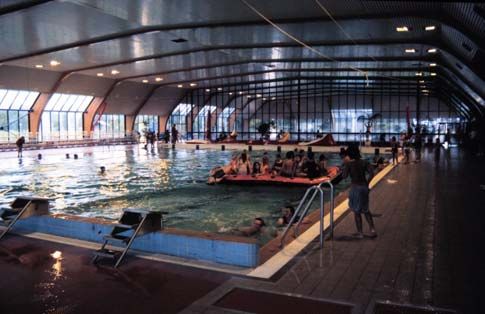
city.                                                             large scale. This complex has two indoor pools and a larger
          Increasing usage during the post-war decades was        outdoor pool. All three are heated. In addition, geothermal
linked to the apparent decline natural activity at                energy is used for space heating and for domestic hot water
Whakarewarewa. In the 1980s, the government implemented           heating.
a control program that, amid other things, resulted in the                  All of the geothermal fluid is passed through a single
closure of wells within 1.5 km of Pohutu geyser.                  plate-type heat exchanger, which heats the secondary water,
                                                                  which is a circulating system of town water. This, in turn,
CURRENT USES OF THE GEOTHERMAL RESOURCE                           supplies all the various heating services.
                                                                            In this case, because of the high capacity of the
Parklane                                                          geothermal heating system, the domestic hot water (DHW)
          This is a housing development with a geothermal         supply (used for showers and hand basins) is heated on an as-
group heating scheme. There are 13 units on this site, which      required basis, avoiding the cost of installing a large storage
share a well with six other dwellings on adjoining properties.    calorifier. The cold mains water feed is passed through a
Sixteen of the total are supplied with a circulating supply of    small heat exchanger fitted with an automatic temperature
hot water from a single heat exchanger. The other three           control. There is a small buffer tank in the circuit, sized to
receive geothermal fluid and have their own, smaller heat         absorb the swings in temperature in the hot water that occur
exchanger arrangements. This is a relatively early example of     when there is a big change in the demand.
a scheme that distributes secondary water rather than
recirculating geothermal fluid. The heat is used for space
heating, domestic hot water heating, and, in some cases,
heating small pools.
          This system is quite successful and relatively neat,
with much of its distribution piping underground. However,
there are a number of design weaknesses which have
contributed to piping corrosion, internal and external, and
difficulty in getting adequate circulation to some users.

Queen Elizabeth Hospital
          Queen Elizabeth Hospital is an example of
institutional use of geothermal. Geothermal fluid is used not
only for space heating and domestic hot water heating; but, the
water phase is taken for therapeutic purposes.                    Figure 1.         Aquatic Center indoor pool.

10                                                                                   GHC BULLETIN, SEPTEMBER 1998
The ventilation system for the pool building has been
designed to minimize chlorine odor and keep the internal
atmosphere as pleasant as possible. To achieve this, a
relatively high air flow rate, once-through system has been
provided. No air is recirculated. The incoming air is heated
to maintain the building’s internal temperature. A heat pipe,
heat recovery unit has been incorporated to significantly
reduce the high heat losses that would otherwise occur. The
hot, moist, chlorine-laden air being extracted gives up most of
its heat as it passes through the heat recovery unit, which uses
it to preheat the incoming air. This unit recovers about 75%
of the heat in the exhaust air. The heating of the fresh air is
completed by a heating coil through which low-temperature
hot water (LTHW) is circulated.
Figure 2. Polynesian Spa outdoor pools with
OTHER EXISTING USES temperatures from 34 - 44oC.
Space heating generally refers to the provision of Cooking has been a use of geothermal heat from pre-
comfort heating in an occupied building. Another variant is European times. There are still to be seen households with
in-building heating for commercial purposes such as small, enclosed steam boxes outdoors which are used for
glasshouse operations. The Rotorua District Council nursery steaming food.
in the Government Gardens is a case in point.
Space heating is virtually always accomplished by Therapeutic uses - the reputed therapeutic benefits
the use of a LTHW system. This is a system in which a heat for geothermal waters has long been exploited. In fact, it was
source–in this case hot geothermal fluid–is used to heat intended early in Rotorua’s existence that it should become a
“clean” secondary water. “Low” temperature in this context spa in the European fashion. The Bathhouse, opened in 1908
does not mean cold. It refers to a heating system operating at complete with the latest balneological equipment and related
a relatively low temperature, typically less than 100oC. The treatments then in vogue in Europe, was built for this purpose.
secondary water is circulated through a heat dissipating The Bathhouse is now the city museum; but,
device, usually flat panel-type radiators, but sometimes fan hydrotherapy still continues at Queen Elizabeth Hospital, to
coil units, unit heaters or bare pipes. which these treatments were transferred in the 1950s. At QE,
geothermal water is used for the usual space heating and
Domestic hot water (DHW) means hot tap water, DHW heating services. Part of the effluent (that is to say, the
used for normal washing and sanitary purposes, in dwellings partially cooled geothermal water) is collected and cooled
and other premises. DHW heating is a natural adjunct to further, and degassed in a concrete vat, and then piped to the
space heating where geothermal is employed as heat is Hydrotherapy Department.
normally available throughout the year. This is not always the
case with LTHW heating systems which are fueled by gas or
coal since they are often only put into service during the
heating season and the DHW is heated by electricity to assure
a year-round supply.
Pool heating is one of the major uses of geothermal.
Pools either contain town water which is heated by
geothermal, as at the Aquatic Centre, or geothermal water
(“mineral” pools).
The Polynesian Spa is no doubt the best known
example of direct mineral pools. The pools shown here are
built around natural springs with the inflow coming up
through the sandy bottom of the pools. Other pools in this
complex, use piped-in mineral water.
Figure 3. Rotorua Bathhouse, opened in 1910–now
a museum.
GHC BULLETIN, SEPTEMBER 1998 11SYSTEMS, PROCESSES AND EQUIPMENT The vast majority of wells in Rotorua have 100-mm
diameter production casings; although, sizes from 65 to 125
Wells mm do exist. The smaller sizes are often larger wells which
Two systems of heat extraction are used: have been repaired by fitting a sleeve inside the casing. Wells
in Rotorua are typically about 100 m deep, ranging from about
• fluid removal and re-injection 45 to 190 m. Aquifer temperatures vary from about 125 to
• downhole heat exchangers. 175oC.
The former are by far the more common, there being Distribution Systems
about 240 operative in this area, of which about 100 are for Distribution of the geothermal energy can be either
domestic systems. Wells of this type typically can have by piping the geothermal fluid to each user or by employing
maximum outputs of the order of 1 to 3 MW (thermal). a central heat exchanger and piping a circulating supply of
Referring to the extraction and re-injection system, low-temperature hot water (LTHW). Both types of systems
supply wells in Rotorua can be classified as self-starting, self- are used. Systems can be a hybrid of the two.
sustaining, and pumped. Figure 4 is a schematic diagram of a well conceived
Self-starting wells will, when shutdown, maintain a system of the second type (LTHW distribution), which is quite
pressure against the stop valve and will flow again when the close to the Parklane system referred to earlier.
valve is opened. The principal features are:
Self-sustaining wells do not maintain a positive well-
side pressure when shut down and do not flow of their own • A single heat exchanger supplies LTHW to a number
accord when the shutoff valve is opened. Flow is induced by of users,
introducing compressed air into the well. Once a flow has • The geothermal effluent goes to a deep injection
been established, it will then continue without further well,
assistance. The majority in Rotorua are of this type. • The flow of geothermal is controlled to maintain the
Pumped wells cannot be induced to flow without secondary water supply temperature constant,
assistance and have to be continuously pumped or air assisted. • The temperature control valve is on the outgoing side
The ususal process is to air lift the fluid. This is sensible in of the heat exchanger,
that the operating conditions of temperature and fluid con- • The isolation valves are fitted, to enable the user’s
tamination are very severe for mechanical pumps. However, system to be shutoff from the main system,
the continuous introduction of air into a well has long-term • Space heating is by radiators fitted with thermostatic
corrosion implications. valves,
Figure 4. Group heating scheme - based on the reticulation of low-temperature hot water.
12 GHC BULLETIN, SEPTEMBER 1998• The DHW cylinder has it own heat exchanger, or Pools using geothermal water direct need to be fitted
equivalent (such as pipe coil in hot water cylinder), with a gas separator to ensure most of it is removed before the
• The DHW system incorporates a mixing valve (not water gets to the pool. The pools enclosure also needs to be
shown) which limits the water supply to a safe thoroughly ventilated.
temperature, A particular problem was the use of uncontrolled
• The pool, if any, is heated by the lower temperature, domestic hot water systems. Systems delivering water at near
return side of the user’s systems; thus, lowering the to boiling point were not uncommon at one time and, again,
temperature of the return water and enabling more very unfortunate accidents have resulted. Fortunately, this is
heat to be extracted from each kilogram of primary now easily fixed as there are relatively simple and low-cost
fluid, and thermostatic mixing valves on the market which control the
• The pool has a thermostatic control valve to maintain water temperature to a safe level. These are mandatory in new
its temperature constant. installations.
A system may have more than one heat exchanger, Calcite Precipitation
each serving a proportion of the users. Calcite (calcium carbonate) precipitation is
What this type of system des not do, is provide frequently a feature in the operation of geothermal systems in
mineral water for pools or cooking. If raw geothermal fluid Rotorua. This phenomenon occurs where CO2 comes out of
is required, then there can be either a separate geothermal solution from the geothermal fluid. Precipitation, therefore,
fluid line to those users who want it or, alternatively, a tends to occur in production wells in the zone where the fluid
geothermal distribution-only type system adopted, with each flashes to steam. For the same reason, it is important that
user having his own heat exchanger and LTHW system. where a throttling device (such as a control valve) is installed
in the primary circuit, that it is fitted on the downstream side
Heat Exchangers of the heat exchanger. Not only should flashing not occur at
The heat exchangers used these days are commonly the lower temperatures prevailing there, but the solubility of
of the plate type. calcite is greater at lower temperature.
These heat exchangers have a very high capacity for Precipitation is sometimes suppressed by the dosing
their size. The main heat exchanger for the Aquatic Centre, the supply well with polyacrylate. Systems where this is done
for example, occupies less than one square meter of floor have a small bore stainless steel pipe inserted into the well, so
space, but can transfer several thousands kilowatts. They are that the liquid polyacrylate is injected in the boiling zone by
also relatively easy to disassemble and clean. means of a small dosing pump.
Not all plate heat exchangers are suitable for
geothermal duty and the manufacturer’s recommendations Costs
should be sought when specifying or procuring them. Fatigue Costs vary widely from installation to installation and
cracks have occurred in plates of an unsuitable design as a the following figures should be taken as a guide only
result of vibration induced by the two-phase geothermal flow.
The plate seals also need to be correctly chosen. High- Domestic group schemes - These figures refer to the
temperature seals are required for geothermal applications. installation of new heating schemes (NZ$ 1.00 = US$ 0.50).
The alternative is the shell-and-tube type. These
were once the standard, but are not now so common. For The typical costs of the elements of a group heating
households and small systems, these were generally very scheme are:
simple, fully welded units with only a small number of
internal tubes. Well - supply or re-injection NZ$ 24,000 each well
OTHER ISSUES Installation of household NZ$ 8,000 - 16,000 per household
heating system
Hazards Central distribution system NZ$ 2,000 - 4,000 per household
The first is the presence of hydrogen sulphide gas in
the geothermal fluid. H2S is what gives Rotorua its
characteristic smell. In small concentrations, it is easily smelt. Normally, two wells will be required for a group
In larger concentrations, it may not be detected and can be heating scheme: one for the supply and the other for
fatal. reinjection. Commercial or institutional systems may require
It is not permitted to use geothermal fluid in plant in more wells, to achieve the required capacity or for backup.
an enclosed space without ventilation or in a habitable space. For a group scheme, the cost of the wells will be shared
Hydrogen sulphide is heavier than air. A small leak in a among the users.
piping system will lead to the escape of gas and its Installation costs for individual dwellings will be less
accumulation at low levels in rooms, ducts, trenches, and the where LTHW is distributed from a central system than for
like. There have been fatalities as a result of H2S escape. those on a primary geothermal fluid supply, since individual
GHC BULLETIN, SEPTEMBER 1998 13heat exchangers and some control elements are not required. of the low- or medium-temperature hot water type, similar to
However, a connection charge, to the central system will be a geothermal system. In the one case, the secondary system
greater because of the greater complexity and cost of that will be heated by a boiler and the other with a heat exchanger;
system. but, the secondary circuit system will be the same.
For each user on a new scheme, the minimum cost The equipment costs will be of a similar order of
will be about NZ$ 12,000, covering a share of two wells, a cost, unless of course, boiler plant is also installed to provide
share of the distribution network, central heat exchanger and backup capacity.
related equipment, and the user’s own in-house equipment Apart from the plant maintenance costs and minor
costs. The cost could well be considerably greater. items such as bore inspections, the energy costs are zero.
Running costs are likely to be of the order of NZ$ 20 Of the large users in Rotorua, the Aquatic Centre has
- 40 per month, say $300 per year. annual maintenance costs for its geothermal system of NZ$
The monthly operating charge can vary significantly, 20,000. If natural gas were used to provide the energy, the
depending on how the operating syndicate structures its estimated gas cost would be around $150,000. Another major
charges and what items it covers. Charges need to recover user has heating plant maintenance costs of around $5,000 per
well clean outs (about NZ$ 1,000 a time) which may be year and achieves a similar energy cost savings,
required very few months or at intervals of several years, conservatively estimated at NZ$ 140,000 per annum.
general maintenance, well inspection costs and, if applicable,
doing chemical costs. In addition, charges may be levied for SUMMARY
long-term equipment replacement or for capital recovery.
• Geothermal has been successfully used in Rotorua
Comparison with electric heating - A comparison for many years,
with electricity, normally regarded as a high-running cost
option, is instructive. An all-electric home, operated modestly • Geothermal energy is principally used for heating:
and economically, is likely to spend NZ$ 1,200 per year on space heating, domestic hot water and fresh water
power, of which about $700 will be for water heating and pool heating.
space heating. On the (unlikely) basis that a geothermally-
heated home used the same amount of energy, then: • Mineral pools, using geothermal water direct, are
also a significant use,
Cost of geothermal system NZ$ 12,000
Annual running cost NZ$ 300 • Most systems obtain the energy by using a well to
Electricity cost NZ$ 700 extract geothermal fluid (water, steam and non-
Annual savings in operating cost NZ$ 400 condensable gases), which is passed through a heat
Rate of return 3.3% exchanger to heat fresh water and is then reinjected,
preferably to the geothermal aquifer.
Clearly, a geothermal user, not having to pay a unit
charge for geothermal heat, will consume more energy. • Historically, geothermal heating systems, small-scale
However, even if the consumption was four times that of the systems in particular, were simple and relatively
ordinary electricity user, the return on capital is still only primitive and had low-energy efficiency,
about 13%.
A geothermal system for domestic heating is not, • The use of geothermal is being greatly improved by
generally, a sound investment when the full cost of installing the use of appropriate designs and automatic
a new complete heating scheme has to be paid; although, it controls, both in terms of energy use efficiency and
should be noted that each situation needs to be judged on its the effectiveness, benefit and safety of the results,
own merits. If pool heating is required, for example, the
economics changes significantly. • For households and small installations, geothermal
The situation becomes less clear when considering a heating has a high capital cost and the economics are
property in which geothermal is already installed. In this case, poor, and
the premium, if any, that one pays for such a property,
becomes the capital cost element. Valuers will add about NZ$ • For large installations, the capital costs are more akin
2,500 to 3,000 to the value of a typical property, and up to to fueled heating systems. The unit incremental cost
$5,000 for a very large dwelling if geothermal heating is of the heat obtained (over and above the fixed costs)
installed. is very small. There is, therefore, little capital cost
penalty for using geothermal, but potentially major
Large-scale users - The economics can be very savings in running costs. The economics of large
different for large-scale users. In many cases, particularly systems can be excellent.
with institutional users, fossil fueled heating systems will be
14 GHC BULLETIN, SEPTEMBER 1998You can also read


