Energetic ions in the Venusian system: Insights from the first Solar Orbiter flyby - Astronomy & Astrophysics
←
→
Page content transcription
If your browser does not render page correctly, please read the page content below
Astronomy & Astrophysics manuscript no. output                                                                                      ©ESO 2021
May 3, 2021

Energetic ions in the Venusian system: Insights from the first Solar
                           Orbiter flyby
R. C. Allen1 , I. Cernuda2 , D. Pacheco3 , L. Berger3 , Z. G. Xu3 , J. L. Freiherr von Forstner3 , J. Rodríguez-Pacheco2 , R.
F. Wimmer-Schweingruber3 , G. C. Ho1 , G. M. Mason1 , S. K. Vines1 , Y. Khotyaintsev4 , T. Horbury5 , M. Maksimovic6 ,
L. Z. Hadid7 , M. Volwerk8 , A. P. Dimmock4 , L. Sorriso-Valvo4, 9 , K. Stergiopoulou4 , G. B. Andrews1 , V. Angelini5 , S.
   D. Bale10, 11 , S. Boden3, 12 , S. I. Böttcher3 , T. Chust7 , S. Eldrum3 , P. P. Espada2 , F. Espinosa Lara2 , V. Evans5 , R.
Gómez-Herrero2 , J. R. Hayes1 , A. M. Hellín2 , A. Kollhoff3 , V. Krasnoselskikh13 , M. Kretzschmar13, 14 , P. Kühl3 , S. R.
   Kulkarni3, 15 , W. J. Lees1 , E. Lorfèvre16 , C. Martin3, 17 , H. O’Brien5 , D. Plettemeier18 , O. R. Polo2 , M. Prieto2 , A.
Ravanbakhsh3, 19 , S. Sánchez-Prieto2 , C. E. Schlemm1 , H. Seifert1 , J. Souček20 , M. Steller8 , Š. Štverák21 , J. C. Terasa3 ,
                      P. Trávníček10, 21 , K. Tyagi1, 22 , A. Vaivads4, 23 , A. Vecchio6, 24 , and M. Yedla3, 19
                                                  (Affiliations can be found after the references)

                                                                     Received

                                                                   ABSTRACT

The Solar Orbiter flyby of Venus on 27 December 2020 allowed for an opportunity to measure the suprathermal to energetic ions in the Venusian
system over a large range of radial distances to better understand the acceleration processes within the system and provide a characterization
of galactic cosmic rays near the planet. Bursty suprathermal ion enhancements (up to ~10 keV) were observed as far as ~50 RV downtail. These
enhancements are likely related to a combination of acceleration mechanisms in regions of strong turbulence, current sheet crossings, and boundary
layer crossings, with a possible instance of ion heating due to ion cyclotron waves within the Venusian tail. Upstream of the planet, suprathermal
ions are observed that might be related to pick-up acceleration of photoionized exospheric populations as far as 5 RV upstream in the solar wind as
has been observed before by missions such as Pioneer Venus Orbiter and Venus Express. Near the closest approach of Solar Orbiter, the Galactic
cosmic ray (GCR) count rate was observed to decrease by approximately 5 percent, which is consistent with the amount of sky obscured by the
planet, suggesting a negligible abundance of GCR albedo particles at over 2 RV . Along with modulation of the GCR population very close to
Venus, the Solar Orbiter observations show that the Venusian system, even far from the planet, can be an effective accelerator of ions up to ~30
keV. This paper is part of a series of the first papers from the Solar Orbiter Venus flyby.
Key words. acceleration of particles – Planets and satellites: terrestrial planets – Planet-star interactions – Planetary systems – Turbulence –
Waves

1. Introduction                                                                As the interplanetary magnetic field (IMF) is carried towards
                                                                           the planet by the magnetosheath plasma, a pile-up region is
The interactions between planets and stellar winds from their              created along the dayside of Venus forming a magnetic barrier
host star are a fundamental aspect in space physics. Venus and             (Zhang et al. 2008; Bertucci et al. 2003) before draping around
Mars, as opposed to the other planets in our Solar System, do not          the planet and being carried downtail, creating an induced mag-
have intrinsic magnetic fields. Unlike Mars, Venus does have a             netotail consisting of two lobes (Luhmann & Cravens 1991).
substantial ionosphere, formed by the photoionization of its thick         Unlike at intrinsically magnetized planets, the plane of the plas-
atmosphere, that supports current systems generated by the vari-           masheet separating the two lobes is oriented perpendicular to
able solar wind. This induced magnetic field, in turn, acts to es-         the IMF direction, and so varies in its orientation as the IMF
tablish the near-Venus plasma environment (see reviews by Luh-             changes, rather than being fixed in a planet-based frame. Obser-
mann 1986; Phillips & McComas 1991; Bertucci et al. 2011;                  vations from Pioneer Venus, Venera 4, 9, and 10, and Mariner 5
Dubinin et al. 2011; Futaana et al. 2017).                                 were used by Saunders & Russell (1986) to study the location of
    The interaction between the solar wind and Venus estab-                the tail boundary out to 12 Venus radii (RV ) downtail. The more
lishes several distinct regions. The deflection of the supersonic          distant magnetotail region of the Venus system is not understood
and super-Alfvénic solar wind from the induced magnetosphere               as well, as previous mission orbits remained relatively close to
creates a bow shock that is about a tenth of the size of Earth’s           the planet.
bow shock (Slavin et al. 1979) and is far weaker than at Earth
(Russell et al. 1979; Lu et al. 2013). The shocked solar wind                  The ionopause, or the upper boundary of the ionosphere, is
then forms the magnetosheath, comprised of both solar wind-                located closer to Venus at an altitude of ~300 km at the subso-
originating ions as well as picked-up ions from the Venusian at-           lar point and ~1000 km at the dawn-dusk terminator (Phillips &
mosphere (Gröller et al. 2010). The magnetosheath is charac-               McComas 1991). The boundary between the magnetosheath and
terized by hot dense plasma (Phillips & McComas 1991) and a                the induced magnetosphere is called the upper mantle bound-
highly turbulent fluctuating magnetic field consisting of mirror-          ary, and is sometimes referred to as the induced magnetospheric
mode waves (Volwerk et al. 2008) with different spectral and               boundary. The boundary between the mantle and the ionosphere
scaling properties (Vörös et al. 2008).                                    is called the lower mantle boundary (see Phillips & McComas
                                                                                                                     Article number, page 1 of 12

  Article published by EDP Sciences, to be cited as https://doi.org/10.1051/0004-6361/202140803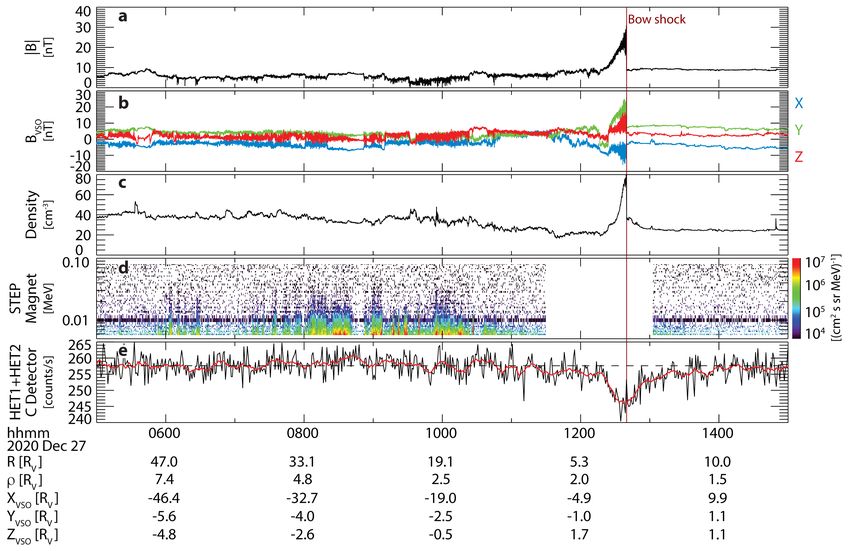
A&A proofs: manuscript no. output

1991, and references therein) and is also sometimes referred to        of sensors (Rodríguez-Pacheco et al. 2020), consisting of the
as the ionopause or the ion composition boundary. This mantle          Suprathermal Ion Spectrograph (SIS), the SupraThermal Elec-
region consists of plasma originating from both the solar wind         trons and Protons sensor (STEP), the Electron Proton Telescope
and Venus, but it typically has a higher magnetic field and lower      (EPT), and the High-Energy Telescope (HET). This study uses
plasma density than the magnetosheath, while plasma within             EPD observations from only STEP and the HET C detector, as
the lower mantle boundary is predominantly of planetary origin         SIS was powered down for instrument safety during the GAM
(Spenner et al. 1980).                                                 (see Wimmer-Schweingruber et al. 2021) and EPT and the other
     Atmospheric outflow and loss lead to the presence of low-         detectors of HET did not measure an appreciable signal. Mag-
energy (< 1 keV) H+ , He+ , and O+ ions within the Venusian            netic field observations are also a key part of the in situ suite
system. As with other planetary systems, energetic particles are       available during the Venus flyby (discussed in more detail later
observed within the Venusian system (see Dubinin et al. 2011,          in this section), as these observations provide insight into possi-
and references therein), requiring acceleration mechanisms to be       ble acceleration mechanisms and contextual information of the
present to energize or heat plasma originating from the Venu-          Solar Orbiter location within the Venusian system. More infor-
sian atmosphere. However, the dominant processes accelerating          mation about the magnetic field observations during this Venus
the thermal Venusian plasma populations up to the suprathermal         flyby is provided in Volwerk et al. (2021).
range (~10’s keV) are not fully understood, especially in the dis-          STEP measures both electron and the total ion populations
tant magnetotail and magnetosheath regions.                            (i.e., no species discrimination) in the suprathermal energy range
     While there have been several missions dedicated to the           and is mounted facing the sunward direction on the spacecraft.
study of Venus and its near-space environment, such as Vega,           The STEP observations used in this study are from the “magnet
Pioneer Venus Orbiter, and Venus Express (see Russell & Vais-          channel” of the sensor, in which electrons are rejected through
berg 1983; Futaana et al. 2017), the system has also been vis-         the use of a permanent magnet to allow for observations of all
ited by spacecraft executing gravity assist maneuvers (GAMs)           ions within the energy range 4 – 80 keV (Rodríguez-Pacheco et
while in route to their final destination. Despite not being out-      al. 2020). The energies associated with the total ion flux ob-
fitted with instruments geared towards the Venusian system as          served by STEP are calculated under the assumption that the
a prime science target, these flybys have provided additional in-      measured ions are all protons and have been adjusted to cor-
sight into the plasma populations and dynamics at Venus such as        respond to their primary energy (i.e., the energy before the ions
the following: observations of the Venusian foreshock by Galileo       lose energy in the dead layer of the STEP detector). Heavier ions
(Williams et al. 1991); detection of submicron radiation from          can contribute to this measurement in a disproportionate man-
the surface of Venus (Baines et al. 2000) and extreme ultra vi-        ner, depending on their flux and energy spectrum (see Wimmer-
olet spectral investigations of the Venus dayglow (Gérard et al.       Schweingruber et al. 2021, for an in-depth discussion of these
2011) by Cassini; detection of hot flow anomalies ahead of the         instrumental effects). A constant background signal at ~10 keV
Venusian bow shock by MESSENGER (Slavin et al. 2009); and,             in this study is a result of known instrumental background from
more recently, investigations of electric field double layers near     an X-ray line at 8 keV, which is mapped to ~10 keV by this pro-
the bow shock (Malaspina et al. 2020), subproton scale magnetic        cedure (see Rodríguez-Pacheco et al. 2020).
holes (Goodrich et al. 2021), and kinetic-scale turbulence in the           The HET C detector high-gain channel count-rate product
magnetosheath (Bowen et al. 2021) by Parker Solar Probe. As            detects energetic particles (e.g., >~4 MeV for protons), that are
such, with the successful first and future Venus GAMs of Solar         generally interpreted to be from GCRs during solar quiet peri-
Orbiter, there is a new opportunity to take measurements within        ods, with a roughly isotropic response (see Freiherr von Forstner
this planetary system.                                                 et al. 2021). For this study, the high-gain channels “C1H” and
     In this paper, we investigate the energetic particles observed    “C2H” count-rates are added for both HET sensors (see Freiherr
within and around the Venusian system during the first Solar Or-       von Forstner et al. 2021) for a lengthier discussion on HET and
biter Venus flyby. The following section (Section 2) discusses         the HET C detector count rates). Due to the possibility of a sin-
the datasets used in this study, and is followed by an overview of     gle particle being able to trigger a count on both HET C photo-
the Venus flyby (Section 3.1). A detailed investigation of various     diodes, estimates of the error associated with the count rates are
possible particle acceleration mechanisms in the Venusian tail is      not straightforward, and as such are not included in this study.
provided in Section 3.2, descriptions of the upstream suprather-       Comparisons between both HET detectors and the high-gain and
mal ion enhancement is given in Section 3.3, and an examina-           low-gain channels were all performed (not shown) without a sig-
tion of galactic cosmic rays (GCRs) near Venus is discussed in         nificant change to the qualitative variations throughout the Venus
section 3.4. Finally, a summary of these energetic particle obser-     flyby.
vations and conclusions are given in Section 4.                             This study also uses magnetic field data from the Solar Or-
                                                                       biter fluxgate vector magnetometer (MAG, Horbury et al. 2020)
2. Datasets                                                            at a sample cadence of 8 vectors/sec and an electron density esti-
                                                                       mate from the Radio and Plasma Waves instrument (RPW, Mak-
The Solar Orbiter mission (Müller et al. 2013, 2020) was               simovic et al. 2020), since direct bulk ion measurements were
launched in February 2020 to investigate the fundamental pro-          not available during the first Venus GAM. The magnetic field
cesses occurring on the Sun and in interplanetary space. To reach      is reported in the Venus Solar Orbital (VSO) coordinate system,
its final orbit, the spacecraft will execute seven Venus flybys to     in which the x-axis is pointed along the Venus-Sun line with
lower its perihelion and raise its inclination (Müller et al. 2020).   positive being toward the Sun, the z-axis is parallel to the nor-
Solar Orbiter consists of a wide array of in situ and remote sens-     mal of the Venus orbital plane with positive being northward,
ing instrumentation, but only a subset of the in situ instruments      and the y-axis completes the right-hand set (i.e., positive points
were operational during the first Venus GAM, which occurred            toward dusk). Electron density estimates were created by cali-
on 27 December 2020. Central to the study of the energetic             brating changes in the spacecraft potential (sampled at a high
particle environment encountered by the mission, Solar Orbiter         time resolution, up to 256 samples/sec) to the plasma frequency
is equipped with the Energetic Particle Detector (EPD) suite           observed in RPW measurements (sampled at a lower time reso-
Article number, page 2 of 12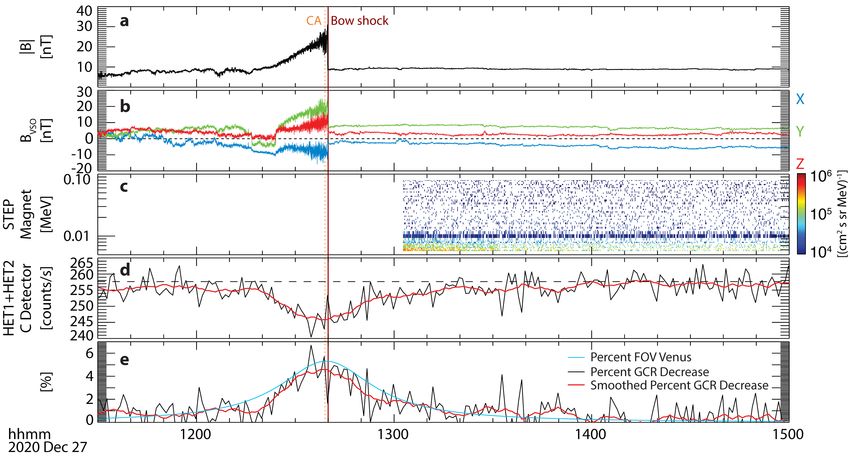
R. C. Allen et al.: Energetic ions in the Venusian system: Insights from the first Solar Orbiter flyby

lution which varies depending on signal strength). For more in-          3.2) and upstream regions (Section 3.3.), and the GCR obstruc-
formation on the derivation of the electron density estimate, see        tions from Venus measured by HET (Section 3.4.).
Khotyaintsev et al. (2021). This study uses a 10-sec resolution
electron density estimate.
                                                                         3.2. Suprathermal ion enhancements in the Venusian
                                                                              magnetotail region
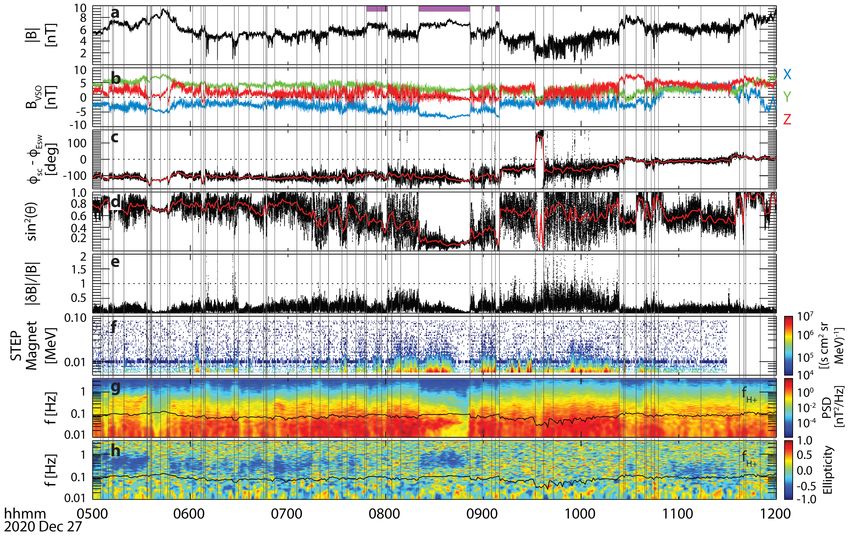
3. Observations of the Venusian system                                   Figure 4 focuses on Solar Orbiter’s observations during its
3.1. Venus flyby overview                                                traversal of the Venusian magnetotail from 05:00 – 12:00 UT. As
                                                                         also shown in Figure 2d and Figure 3a, multiple periods of bursty
The trajectory of Solar Orbiter through the Venusian system on           particle enhancements are observed during this time, with ener-
27 December 2020 is illustrated in Figure 1. As seen in Fig-             gies reaching slightly above 30 keV. While ions reaching the 1’s
ure 1a and 1b, Solar Orbiter approaches Venus from the dawn              keV energy range have been observed previously in the downtail
side, and traverses from beneath the orbital plane of Venus be-          region closer to the planet, the properties and potential accelera-
fore crossing the orbital plane and passing over the northern pole       tion mechanisms of these particles in the magnetotail region are
of the planet in the VSOqsystem. As viewed in cylindrical coor-          not fully understood. Various processes have been proposed to
dinates (with ρVS O = YVS                                                accelerate ions up to, or explain variations in the observations
                               O + ZVS O ) and based on empirical
                             2       2
                                                                         of ions in, the keV range including: (1) spatial asymmetries of
models of the Venus upper mantle boundary (Martinecz et al.              energetic outflow in the plasmasheet related to the solar wind
2009) and bow shock (Shan et al. 2015), Solar Orbiter is ex-             convective electric field, (2) pick-up ion acceleration, (3) accel-
pected to have skimmed the upper mantle boundary from ~8:00              eration from strong turbulence, (4) ion cyclotron waves, (5) tail
UT until ~12:00 UT before crossing the bow shock on ~12:40               boundary layer dynamics, (6) current sheet-related acceleration,
UT (Figure 1c). Just like with magnetotails in systems formed            and (7) acceleration at the bow shock. To understand the domi-
from global intrinsic magnetic fields, the Venusian magnetotail          nant acceleration processes at play in the Venusian system that
undergoes various motions due to variations in the solar wind            may have led to the STEP particle enhancements, each of these
(Zhang et al. 2009; Edberg et al. 2011; Rong et al. 2015). As            potential mechanisms are further explored in the following sub-
such, empirically derived boundary locations in the magnetotail          sections.
can only be used as an estimate of the average boundary location.
    Figure 2 provides an overview of the Solar Orbiter observa-
tions during this flyby. While this study focuses on the STEP            3.2.1. Asymmetries in ion outflow related to the solar wind
and HET C detector measurements, detailed overviews of the                      convective electric field
RPW and MAG observations are reported by Hadid et al. (2021)
and Volwerk et al. (2021), respectively. As seen in the magnetic         Observations from Venus Express have found that outflowing
field observations (Figure 2a and 2b), Solar Orbiter’s approach to       ions from Venus can escape the system through the plasma sheet
Venus is largely characterized by turbulent magnetosheath-like           of the induced magnetotail. Due to the absence of an intrinsic
signatures before crossing the quasi-perpendicular bow shock at          planetary magnetic field, the topology of the tail region of Venus
~12:40 UT (see Dimmock et al. 2021). The observed turbulence             is oriented along the plane containing the solar wind convective
signatures and bow shock crossing are studied in more detail             electric field (ES W = −VS W × B), unlike at magnetized plan-
by Sorriso-Valvo et al. (2021) and Dimmock et al. (2021), re-            ets where the plane of the plasmasheet is governed by topol-
spectively. The electron density estimate from RPW (Figure 2c)           ogy of the stretched nightside magnetic field. As the ions es-
shows a clear peak in density at the bow shock and a gradual rise        cape through the tail region, the ions fluxes are larger within the
in density with increasing radial distance from Venus downtail.          plasma sheet and become spatially separated by energy; higher
The relatively high electron density throughout the flyby is con-        energy ions (~keV range) are found only in the +ES W hemi-
sistent with Solar Orbiter largely traversing the magnetosheath.         sphere, while lower energy ions are found in the −ES W hemi-
A more in-depth comparison of the estimated electron density             sphere, possibly related to preferential ion escape on the side of
with simulations of the solar wind-Venus interaction is presented        the planet with ES W pointed away from the planet (e.g., Phillips
in Stergiopoulou et al. (2021). Through the magnetotail region,          et al. 1987; Slavin et al. 1989; Intriligator 1989; Luhmann et
the STEP sensor observes several bursty enhancements (Figure             al. 2006; Barabash et al. 2007; Jarvinen et al. 2013). Despite
2d). The data gap from ~11:45 - ~13:00 UT is due to instru-              most of the observations being within the magnetosheath region
ment operations (see Wimmer-Schweingruber et al. 2021). Af-              of Venus, ion populations are known to be able to both enter into,
ter being switched off for the closest approach of Venus, STEP           and leak out of, magnetospheres (e.g., Allen et al. 2017, 2018,
became operational again shortly after 13:00 UT to observe a             2019). In fact, Grünwaldt et al. (1995) reported possible evi-
period of decreasing flux until ~13:30 UT when the flux reached          dence of planetary ions from Venus being detected near Earth on
the background of the instrument (Figure 2d). Meanwhile, the             one occasion. As such, one potential explanation for the bursty
GCR count rate is observed to be steady throughout most of the           signatures observed in the STEP magnetotail observations is that
flyby with a notable decrease of ~5% near the planet.                    the spacecraft is skirting, or ions are leaking out of, the +ES W
    Summing the STEP observed flux across all energy chan-               hemisphere plasma sheet boundary. To test this, the clock an-
nels, Figure 3a illustrates the flux projected along the trajectory      gle of the spacecraft (φ sc = tan−1 (YVS O /ZVS O )) and solar wind
of Solar Orbiter in cylindrical coordinates. The STEP enhance-           electric field clock angle (φEsw = tan−1 (BY,VS O /BZ,VS O ) − 90◦ ) is
ments are seen to correspond both to times when Solar Orbiter            computed and the difference is shown in Figure 4c. Times when
was near the empirical upper mantle boundary, as well as a small         the spacecraft trajectory is directed nearly along +ES W (and so a
enhancement upstream of the bow shock. Meanwhile, the GCR                difference in clock angles near 0°) correspond to times when the
count rate decrease is centered around the closest approach to           spacecraft would be in regions of higher energy outflow.
Venus (Figure 3b). These observations will be discussed further              The difference in clock angles is large (~-100°) for most of
in three sections: STEP observations in the magnetotail (Section         the tail pass prior to ~9:00 UT, after which the spacecraft and
                                                                                                                     Article number, page 3 of 12
A&A proofs: manuscript no. output
ES W become co-aligned (after ~10:30 UT). Comparing this sys- and lower enhancement. As such, it is not possible to determine
tematic variation in ES W to the suprathermal ion enhancements if compositional variations could be playing a role in the STEP
observed by STEP, there is little agreement between the relative observations.
location of Solar Orbiter with the ES W . In fact, times when Solar
Orbiter becomes co-aligned with ES W correspond to times with
few to no enhancements, whereas the main STEP ion increases 3.2.3. Acceleration from strong turbulence
are seen at times when Solar Orbiter is ~100°away from the di- Strong turbulence (i.e., |δB|/|B| ∼ 1) can result in nonthermal
rection of ES W . As such, while the preferential location along acceleration (e.g., Ergun et al. 2020a,b). Magnetosheaths are
the plasmasheet of suprathermal ions reported by Barabash et al. turbulent regions, and as such parts of the magnetosheath region
(2007) is likely still occurring within the tail region, this mecha- may have strong enough turbulence to accelerate ions into the
nism is likely not responsible for the STEP observations. energy range of STEP. To investigate this, |δB| was computed
by subtracting the magnetic field magnitude from the 30-second
3.2.2. Pick-up ion acceleration box-car averaged background field (|B|), with the resulting ratio
shown Figure 4e. A more detailed investigation of the turbulence
It has been well established that newly ionized ions can be and intermittency across the Venus flyby is presented in Sorriso-
“picked-up” by the bulk flow of plasma with an embedded mag- Valvo et al. (2021), however this calculation reveals varying lev-
netic field. In a fixed inertial frame, the energy gain from this els of turbulence throughout the tail approach.
“pick-up” processes can vary from zero to four times the bulk Some of the periods with enhanced |δB|/|B| coincide with
plasma speed. The maximum energy gained by this process is times of enhanced suprathermal ion enhancements. Particularly
then the enhancement spanning from ~9:30 – 10:30 UT, which oc-
curs during the most intense magnetic fluctuations, shows good
agreement with enhancements in the suprathermal ion flux.
Emax = 2mv2bulk sin2 θ (1) While times of large |δB|/|B| correspond with times of elevated
suprathermal ion flux, not all of the suprathermal ion enhance-
where θ is the angle between the magnetic field and the bulk ments are concurrent with large |δB|/|B|, suggesting that while
flow. The limiting cases of pick-up ion acceleration would be strong turbulence is likely accelerating ions into the energy range
when the magnetic field is perpendicular to the bulk flow (maxi- of STEP, other processes are also contributing to the suprather-
mum energy gain) and when the magnetic field and bulk flow are mal ion abundance in the Venusian tail region. While the present
parallel to one another (zero energy gain). During the Solar Or- analysis considers the overall turbulence intensity, further anal-
biter Venus flyby, ion composition and bulk speed information ysis could help explore the possible role of intermittency and
is not available, and as such the value of Emax cannot be quan- small-scale magnetic structures (see Sorriso-Valvo et al. 2021).
titatively determined. However, previous investigations at Venus
have shown that the bulk flow in the magnetotail (> few RV ) is
roughly along the negative x-direction in VSO coordinates (e.g., 3.2.4. Ion cyclotron waves
Fedorov et al. 2011; Phillips & McComas 1991, and references
therein), and as such the sin2 θ term can be computed and com- Ion cyclotron waves (ICWs) are known to occur and heat or ac-
pared with the STEP enhancements. It should be noted that this celerate ions in many environments (e.g., Zhang et al. 2010,
proxy for pick-up ion acceleration is only able to investigate the 2011; Wei et al. 2011). To investigate if the enhancements in
possibility of local acceleration, and as such no conclusions are STEP are concurrent to ICWs, the magnetic field power spectral
being made with respect to pick-up ion processes and accelera- density (PSD) was generated from the Fast Fourier Transform
tion occurring remotely from Solar Orbiter (e.g., Jarvinen et al. of the magnetic field over a frequency range of 0.01 to 4 Hz
2020). (the Nyquist frequency of the normal magnetic field data product
Comparing the value of sin2 θ (Figure 4d) with the enhance- of Solar Orbiter). The ellipticity was computed from the ellipse
ments in STEP (Figure 4f) does not produce good agreement. transcribed by the field oscillations transverse to the background
While most of the magnetic field measurements during the mag- magnetic field (see Samson & Olson 1980; Means 1972) with
netotail pass result in sin2 θ ≈ 0.8, many of the STEP enhance- -1 (+1) signifying a left-hand (right-hand) circularly polarized
ments are observed during times of lower sin2 θ, that is, the en- wave and 0 representing a linearly polarized wave. The PSD and
hancements are often observed in times of more radial magnetic ellipticity are shown in Figures 4g and 4h, respectively. The local
field orientations (relative to the rough assumption of bulk flow proton cyclotron frequency is overplotted in black. While there
direction) when energy gain from the pick-up acceleration pro- is generally broadband emission present throughout the magne-
cess would be small. As such, variations in the pick-up ion ac- totail pass, left-hand circularly polarized waves are observed at
celeration due to variations in θ do not explain the bursty en- times with a high degree of polarization (not shown) above the
hancements in the suprathermal ions. It should be noted that local proton cyclotron frequency. As discussed in Volwerk et al.
variations in composition, thereby changing m, or changes in (2021), these waves are likely ICWs that are Doppler shifted to
the bulk speed could still change the maximum energy gain. appear above the local proton gyrofrequency in the observations.
The velocity in the downtail magnetosheath have not been ob- More in-depth analysis of the wave properties and discussion on
served to vary greatly (Phillips & McComas 1991, and refer- their generation is given in Volwerk et al. (2021).
ences therein), particularly within the relatively short timescales Investigating the timing of the ICW observations and the
relevant to the suprathermal ion enhancements observed by So- suprathermal ion enhancements do not generally show agree-
lar Orbiter. Therefore, variations in the bulk speed may not be ment. The main exception is the ICW observed from ~08:30
playing a large role in providing the time-dependent energization to ~08:50 UT, which is concurrent to a broad enhancement of
from pick-up acceleration for this interval. From the observa- suprathermal ions. The other ICW observations do not well align
tions available, it is not possible to determine if the composition with ion enhancements, and the other ion enhancements occur
is different between the times of suprathermal flux enhancement during times without ICW signatures. As such, with the excep-
Article number, page 4 of 12R. C. Allen et al.: Energetic ions in the Venusian system: Insights from the first Solar Orbiter flyby
tion of the ~08:30 to ~08:50 suprathermal ion enhancement, sheets (e.g., Drake et al. 2009a,b; Vines et al. 2017), and gyro-
which may be related to heating from ICW waves, the particle orbit effects (e.g., Speiser 1965; Chen & Palmadesso 1986;
enhancements are likely due to other processes. Additional fly- Cowley 1978). To investigate possible correlations between the
bys of Venus may be able to better constrain where (i.e., within suprathermal ion enhancements and current sheet-related accel-
the induced magnetotail versus the magnetosheath) ICWs may eration mechanisms, the magnetotail interval was inspected for
be heating the local plasma population. Beyond ICW waves, signatures of current sheet crossings (denoted by the vertical
high frequency electrostatic waves could also play a role in ac- lines in Figure 4). These crossings were identified as an abrupt
celerating particles (e.g., Szegö et al. 1991), and will be the and sustained change in the magnetic field direction (i.e., not in-
focus of future investigations. cluding spikes or oscillations in the data). Notably, the current
sheet identified at ~09:32 UT shows signs of possible magnetic
reconnection (see Volwerk et al. 2021, for more details of this
3.2.5. Magnetotail boundary layer processes event).
Often, but not always, the suprathermal ions are found to be
Previous observations from Venera 10 of the boundary layer
enhanced near the current sheet crossings (Figure 4). This in-
between the magnetosheath region and the magnetotail plasma
cludes some of the relatively small, short-lived enhancements
wake revealed bursty signatures in the ion temperatures (Ro-
early in the approach (i.e., before 08:00 UT) when Solar Orbiter
manov et al. 1978). Additionally, different processes such as
was further from the empirical upper mantle boundary. We note
differential streaming of electrons and ions, along with ions from
that, as mentioned before (Section 3.2.3), turbulence-generated
the solar wind versus the ionosphere, can setup differential elec-
small-scale current sheets may also contribute to particle accel-
tric fields as well as instabilities including ion-ion instabilities
eration (see, e.g., Tessein et al. 2013). The role of such structures
and modified two-stream instabilities (see Dubinin et al. 2011,
will be investigated in a future study based on conditional statis-
and references therein). As most of the STEP enhancements are
tical analysis. The fairly good correspondence between current
observed in close proximity to the empirically derived upper
sheet crossings and suprathermal ion enhancements suggests that
mantle boundary (Figure 3a), it is possible that the enhance-
current sheet-related acceleration in the Venus system is capable
ments are related to these temperature fluctuations in the bound-
of accelerating ions into the energy range of STEP.
ary layer between the magnetosheath and the upper mantle of
the tail. While Solar Orbiter did not have bulk plasma velocity
measurements during the Venus flyby, as was used to identify the 3.3. Suprathermal ion enhancement in the upstream dayside
boundary layer in Romanov et al. (1978), the magnetic field can region
still be used to differentiate regions. As discussed in Bertucci et
al. (2011), the magnetosheath is characterized as being signifi- Solar Orbiter crossed the quasi-perpendicular bow shock of
cantly more turbulent than the magnetotail region and the tail re- Venus at ~12:40 UT on 27 December 2020 (see Dimmock et
gion tends to have a higher magnetic field strength (by a factor of al. 2021, for a detailed analysis of the bow shock observations).
~2). Investigating the magnetic field fluctuations (Figure 4b and During the bow shock crossing, STEP was turned off due to risks
4e) as well as the magnetic field magnitude (Figure 4a), this cri- to the instrument related to reflected light from Venus. The STEP
terion identifies 3 likely excursions into the magnetotail region sensor became operable again shortly after 13:00 UT when it
(denoted by the purple bars at the top of Figure 4a). Boundary was ~2 RV upstream of the bow shock and observed an enhance-
layers should exist at the transitions into/out of these tail regions. ment in lower energy (< 10 keV) ions until about 13:30 UT (~5
However, there is not sufficient information to robustly assess RV from the bow shock; Figure 5c). The flux of this lower en-
how Solar Orbiter is traversing this boundary, the distance from ergy ion enhancement decreases over time to background levels
the boundary crossing, or the thickness of a boundary layer for as Solar Orbiter travels further upstream of the planet. Previ-
these crossings. ous observations have measured suprathermal ions upstream of
the bow shock at Venus and interpreted this as being from one
Comparing the suprathermal ion enhancements (Figure 4f)
of two sources: (1) newly picked up ions from the neutral ex-
to the locations of the possible boundary layers at the transitions
osphere extending into the solar wind (e.g., Brace et al. 1988;
between the magnetotail and magnetosheath regions reveals that
Frank et al. 1991) or (2) foreshock particles scattered off of the
the boundary layers are typically associated with enhancements
Venusian bow shock (e.g., Williams et al. 1991).
in the energetic particles, at least on one side of the crossing.
During the interval upstream of Venus, Solar Orbiter ob-
From the observations available, it is unclear which potential
served suprathermal ions ahead of the Venusian bow shock while
processes occurring within the boundary layer may be playing
the IMF was directed mostly in the +YVS O direction (Figure 5b).
a role in accelerating ions into the energy range of STEP during
The direction of the IMF would mean that the spacecraft would
these crossings, however the transitions from the sheath region
not be magnetically connected to any point along the empirically
into the boundary layer is found to always coincide with cur-
derived bow shock from Shan et al. (2015) within reasonable
rent sheet crossings (discussed in more detail in Section 3.2.6).
uncertainty. Additionally, STEP is mounted facing the sunward
Future flybys, when more measurements may be available, such
direction, thereby observing ions moving toward the bow shock,
as thermal plasma observations, may provide additional insights
rather than ion beams or reflected ions moving away from the
into the acceleration mechanisms occurring in the boundary lay-
bow shock. While foreshock ions have been observed at Venus
ers of the Venusian magnetotail.
before (e.g., Williams et al. 1991), this enhancement is not con-
sistent with beaming or reflected ions from the Venusian bow
3.2.6. Current sheet-related acceleration shock, and as such must be of some other source.
Another potential explanation would be newly ionized par-
Current sheets are known to be able to accelerate ions. This ticles, from the extended hot neutral exosphere, being picked
acceleration can result from several factors including: acceler- up by the solar wind. Observations from Pioneer Venus Orbiter
ation due to magnetic field tangential stresses (e.g., Dubinin et found ions upstream of the subsolar bow shock, which were in-
al. 1993, 2013), acceleration from actively reconnecting current terpreted as newly picked up ions from the exosphere (e.g., Brace
Article number, page 5 of 12A&A proofs: manuscript no. output
et al. 1988; Moore et al. 1990; Mihalov et al. 1995; Luhmann 4. Summary and conclusions
et al. 2006). Additionally, observations from the Galileo flyby
found evidence of pick-up ions in the solar wind upstream of the The first flyby of Venus by Solar Orbiter permitted a survey of
bow shock (Frank et al. 1991). During the time period of this the energetic particles within and around the Venusian system.
enhancement, the IMF direction (assuming radial solar wind ve- In this study, one of a series of overview papers from the first
locity) would give a value of sin2 θ ≥ 0.9. Assuming a nominal Venus GAM flyby (Hadid et al. 2021; Volwerk et al. 2021;
400 km/s solar wind speed with sin2 θ = 0.9, the maximum ex- Dimmock et al. 2021), we focused on the sources and modu-
pected energy for O+ (a major constituent of the extended Venu- lation of energetic particles observed by STEP and the HET C
sian exosphere) being picked up would be ~48 keV. As composi- detector high-gain channel counters. The main conclusions are:
tion information is not available during this time period, the pre- 1. Bursty suprathermal ion enhancements, with energies reach-
dominant species being observed is not known, but it is possible ing ~30 keV, were observed throughout the traversal of the
that these ions could be from fresh Venusian-originating pick-up Venusian magnetotail and downtail magnetosheath regions
ions. We cannot rule out, however, that these suprathermal ion at distances beyond those sampled by previous missions.
enhancements are not of solar wind origin, as is often observed 2. Asymmetries in energetic outflowing populations due to the
during the Solar Orbiter mission. Future flybys of the upstream solar wind convective electric field compared to the space-
region by Solar Orbiter and Parker Solar Probe may allow for a craft location do not explain the Solar Orbiter STEP observa-
better understanding of this potential upstream population. tions. As such, the suprathermal ion enhancements are likely
not an effect of the spacecraft moving into/out of regions that
are more aligned with the +ES W hemisphere plasmasheet.
3.4. Obstruction of galactic cosmic rays by Venus 3. Variations in local pick-up ion acceleration from changes in
On either end of the Venus encounter, the CGR count rate from the magnetic field direction do not explain the suprathermal
the high-gain HET C detector photodiodes was steady at ~258 ion enhancements observed during the Venus flyby, and so
counts/second (Figure 2e). This background rate was computed significant energy gain via the local pick-up process is not
using the average rate before 10:00 UT and after 14:00 UT on likely contributing to the observations.
27 December 2020. The GCR count rate near closest approach 4. Strong turbulence (i.e., |δB|/|B| ∼ 1) in the magnetosheath is
is shown in Figure 5d in black, with a 10-min box-car averaged likely accelerating ions into the energy range of STEP.
5. Ion cyclotron waves in the magnetosheath are not seen to be
count rate shown in red. The steady background count rate from
likely contributors of heating ions into the range of STEP,
the pre- and post-Venus observations is shown by the dashed
however, there is an instance of an ICW wave within the
line. As seen by comparing the profile of the GCR decrease to
magnetotail region of Venus that may be associated with a
the time of closest approach (vertical dotted orange line in Fig-
suprathermal ion enhancement. This may suggest ICWs play
ure 5), the smoothed GCR decrease is roughly symmetric about
a more important role in the mantle than in the sheath region.
closest approach. 6. Magnetotail boundary layer dynamics may be associated
Figure 5e shows the percent GCR decrease of both the raw with some of the suprathermal ion enhancements. The
1-min count rate (black) and 10-min smoothed GCR count rate boundaries between the magnetotail and magnetosheath
(red). The percent of the sky that is obscured by Venus is shown regions of the Venus system are often associated with
by the blue curve in Figure 5e. As the GCR count rate is taken suprathermal flux enhancements, and also found to coincide
from a data product with a roughly isotropic response, the field- with current sheet crossings.
of-view of the C detector counters generally covers the full sky. 7. Current sheet crossings are observed to often have an associ-
Comparing the high-gain channels of the C detector count rates ated increase in suprathermal ion flux. As such, current sheet
from HET1 and HET2 (not shown), both sensors show virtually processes, such as reconnection and gyroradius effects, are
the same percentage decrease during closest approach, further likely accelerating ions in the Venusian system. This is ob-
supporting the assumption that the spacecraft is not significantly served both in the magnetosheath away from the upper man-
affecting the look direction of the GCR count rate. Notably, the tle boundary, as well as near and at the boundary between the
smoothed fractional GCR decrease is only slightly lower than sheath and upper mantle.
that of the fraction of sky obscured by Venus (Figure 5e), al- 8. Suprathermal ion enhancements are observed as far as ~5
though the percent decrease using the 1-min count rate often RV upstream of the quasi-perpendicular bow shock crossing.
reaches up to values predicted from Venus occultation. Due to the orientation of the IMF (mostly in the +YVS O di-
While any difference between the fraction of sky obscured rection), it is unlikely that Solar Orbiter would have been
by Venus and the fractional decrease in GCR count rate is small magnetically connected to the bow shock. Additionally, as
enough to potentially be a result of instrumental uncertainty, it is STEP was observing particles traveling toward Venus, rather
possible that some of the discrepancy could be due to primary than beaming away, it is unlikely that this population was re-
GCRs interacting with the atmosphere and surface of Venus, lated to a foreshock. Previous studies (e.g., Brace et al. 1988;
leading to the production of secondary particles (i.e., albedo Frank et al. 1991; Jarvinen et al. 2020) have suggested that
particles) which are then detected by HET. Such albedo parti- exospheric neutrals may be photoionized upstream of the
cles have been measured at Mars with the RAD instrument on bow shock before being picked up into the solar wind flow,
Mars Science Laboratory (Appel et al. 2018) and at the Moon and so may be contributing to the suprathermal enhancement
with the CRaTER (Schwadron et al. 2016) and LND (Wimmer- measured by STEP. However, without composition or lower
Schweingruber et al. 2020) instruments. Measured fluxes are on energy measurements we are unable to determine if this pos-
the order of 10% of the downward flux in the case of Mars in the sibility fully explains the observations.
energy range that can be measured by the RAD instrument (Ap- 9. The GCR count rate decreases near the planet, associated
pel et al. 2018). If these albedo particles are being produced at with blockage of energetic particles by Venus. While GCR
Venus, it would seem that their flux at ~2 RV is small. Additional albedo particles have been observed at both Mars and the
Venus flybys by Solar Orbiter may help in gaining insight into Moon, there does not seem to be a significant effect of these
the possibility of GCR albedo production at Venus. ions on the HET GCR count rate near Venus.
Article number, page 6 of 12R. C. Allen et al.: Energetic ions in the Venusian system: Insights from the first Solar Orbiter flyby
The main processes leading to particle acceleration in the Drake, J. F., M. Swisdak, T. D. Phan, P. A. Cassak, M. A. Shay, et al. (2009b), J.
Venusian system inferred by observations in this study, as well Geophys. Res., 114, A05111, doi: 10.1029/2008JA013701.
Dubinin, E., R. Lundin, O. Norberg, & N. Pissarenko (1993), J. Geophys. Res.
as other previous works (e.g., Phillips & McComas 1991, and Space Physics, 98, A3, 3991-3997, doi: 10.1029/92JA02233.
references therein), are illustrated in Figure 6. These different Dubinin, E., M. Fraenz, A. Fedorov, R. Lundin, N. Edberg, F. Duru, & O. Vais-
processes, list them, have been observed to exist throughout berg (2011), Space Sci Rev., 162, 173-211, doi: 10.1007/s11214-011-9831-7.
the system, and are all likely to be contributing to the pres- Dubinin, E., M. Fraenz, T. L. Zhang, J. Woch, Y. Wei, et al. (2013), J. Geophys.
ence of suprathermal particles throughout the Venusian system. Res. Space Physics, 118, 7624-7634, doi: 10.1002/2013JA019164.
Edberg, N. J. T., H. Nilsson, Y. Futaana, G. Stenberg, M. Lestern et al. (2011),
The prevalence, effectiveness, and interplay between these dif- Atmospheric erosion of Venus during stormy space weather, J. Geophys. Res.,
ferent mechanisms warrant future investigations to better char- 116, A09308, doi:10.1029/2011JA016749.
acterize the dominant processes for, and impacts of, energetic Ergun, R. E., N. Ahmadi, L. Kromyda, S. J. Schwartz, A. Chasapis, et al. (2020a),
populations within the system. Future Venus flybys by Solar Or- ApJ, 898, 153, doi: 10.3847/1538-4357/ab9ab5.
Ergun, R. E., N. Ahmadi, L. Kromyda, S. J. Schwartz, A. Chasapis, et al.
biter will allow for continued investigation into the suprathermal (2020b), ApJ, 898, 154, doi: 10.3847/1538-4357/ab9ab6.
and energetic populations within the system. Different trajecto- Fedorov, A., S. Barabash, J.-A. Sauvaud, Y. Futaana, T. L. Zhang, et al. (2011),
ries, along with potentially additional datasets during the future J. Geophys. Res., 116, A07220, doi: 10.1029/2011JA016427.
Venus GAMs, will not only allow insight into how consistent Frank, L. A., W. R. Paterson, K. L. Ackerson, F. V. Coroniti, & V. M. Vasyliunas
(1991), Science, 253, 5027, doi: 10.1126/science.253.5027.1528.
these observations are from one encounter to the next, but also Freiherr von Forstner, J. L., M. Dumbović, C. Möstl, J. Guo, A. Papaioannoi, et
allow for deeper investigations into the various processes accel- al. (2021), Astron. & Astrophys., doi: 10.1051/0004-6361/202039848.
erating ions within the Venusian system. Futaana, Y., G. S. Wieser, S. Barabash, & J. G. Luhmann (2017), Space Sci Rev,
212, 1453-1509, doi: 10.1007/s11214-017-0362-8
Acknowledgements. Solar Orbiter is a mission of international cooperation Gérard, J.-C., B. Hubert, J. Gustin, V. I. Shematovich, D. Bisikalo, G.
between ESA and NASA, operated by ESA. We thank the many individu- R. Gladstone, & L. W. Esposito (2011), Icarus, 211, 70-80, doi:
als at ESA and within the Energetic Particle Detector team for their sup- 10.1016/j.icarus.2010.09.020.
port in its development. Work on this study was funded by NASA contract Goodrich, K. A., J. W. Bonnell, S. Curry, et al. (2021), Geophys. Res. Lett.,
NNN06AA01C, and we thank NASA headquarters and the NASA/GSFC So- submitted
lar Orbiter project office for their continuing support. The UAH team acknowl- Gröller, H., V. I. Shematovich, H. I. M. Lichtenegger, H. Lammer, M. Pfleger, et
edges the financial support by the Spanish Ministerio de Ciencia, Innovación al. (2010), 115, E12017, doi: 10.1029/2010JE003697.
y Universidades FEDER/MCIU/AEI Projects ESP2017-88436-R and PID2019- Grünwaldt, H., M. Neugebauer M. Hilchenbach P. Bochsler D. Hovestadt, et al.
104863RB-I00/AEI/10.13039/501100011033. The CAU Kiel team thanks the (1995), Geophys. Res. Lett., 24, 10, 1163-1166, doi: 10.1029/97GL01159.
German Federal Ministry for Economic Affairs and Energy and the German Hadid, L. Z., N. Edberg, et al. (2021), Astron & Astrophys., Submitted
Space Agency (Deutsches Zentrum für Luft- und Raumfahrt, e.V., (DLR)) Horbury, T. S., H. O’Brien, I. Carrasco Blazquez, M. Bendyk, P. Brown, et al.
for their unwavering support under grant numbers 50OT0901, 50OT1202, (2020), Astro & Astrophys., 642, A9, doi: 10.1051/0004-6361/201937257.
50OT1702 and 50OT2002; and ESA for supporting the build of SIS under Intriligator, D. S. (1989), Geophys. Res. Lett., 16, 167-170, doi:
contract number SOL.ASTR.CON.00004, and the University of Kiel and the 10.1029/GL016i002p00167.
Land Schleswig-Holstein for their support. The Solar Orbiter magnetometer Jarvinen, R., E. Kallio, & S. Dyadechkin (2013), J. Geophys. Res. Space Physics,
was funded by the UK Space Agency (grant ST/T001062/1). Additional sup- 118, 4551-4563, doi: 10.1002/jgra.50387.
port was provided from the Science Technology Facilities Council (STFC) Jarvinen, R., Alho, M., Kallio, E., & Pulkkinen, T. I. (2020) Geophysical Re-
grant ST/S000361/1. The RPW instrument has been designed and funded by search Letters, 47, e2020GL087462. doi: 10.1029/2020GL087462
CNES, CNRS, the Paris Observatory, The Swedish National Space Agency, Khotyaintsev, Y. V., D. B. Graham, et al. (2021), A&A, in prep.
ESA-PRODEX and all the participating institutes. APD received financial sup- Lu, Q. M., L. C. Shan, T. L. Zhang, G. P. Zank, Z. W. Yang, et al. (2013), Astro-
port from the Swedish National Space Agency (Grant #2020-00111). phys. J., 773, L24, doi:10.1088/2041-8205/773/L24.
Luhmann, J. G. & T. E. Cravens (1991), Space Sci Rev, 55, 201-274, doi:
10.1007/BF00177138.
Luhmann, J. G., W. T. Kasprzak, & C. T. Russell (2006), J. Geophys. Res., 112,
References E04S10, doi: 10.1029/2006JE002820.
Luhmann, J. G. (1986), Space Science Rev., 44, 241-306, doi:
Allen, R. C., S. A. Livi, S. K. Vines, J. Goldstein, I. Cohen, et al. (2017), J. 10.1007/BF00200818.
Geophys. Res. Space Physics, 122, 8353-8374, doi: 10.1002/2017JA024245. Maksimovic, M., S. D. Bale, T. Chust, Y. Khotyaintsev, V. Krasnoselskikh, et al.
Allen, R. C., D. G. Mitchell, C. P. Paranicas, D. C. Hamilton, G. Clark, (2020), Astro & Astrophys, 643, A12, doi: 10.1051/0004-6361/201936214.
et al. (2018), J. Geophys. Res. Space Physics, 123, 4712-4727, doi: Malaspina, D. M., K. Goodrich, R. Livi, J. Halekas, M. McManus, et al. (2020),
10.1029/2018JA025262. Geophys. Res. Lett., 47, e2020GL090115, doi: 10.1029/2020GL090115.
Allen R. C., C. P. Paranicas, F. Bagenal, S. K. Vines, D. C. Hamilton, et al. Martinecz, C., A. Boesswetter, M. Fränz, E. Roussos, J. Woch, et al. (2009), J.
(2019), Geophys. Res. Lett., 46, 11709-11717, doi: 10.1029/2019GL085185. Geophys. Res., 114, E00B30, doi: 10.1029/2008JE003174.
Appel, J. K., J. Köhler, J. Guo, B. Ehresmann, C. Zeitlin, et al. (2018), Earth and Means, J. D. (1972), J. Geophys. Res., 77, 5551-5559, doi:
Space Science, 5, 1, 2-18, doi: 10.1002/2016EA000240. 10.1029/JA077i028p05551.
Baines, K. H., G. Bellucci, J.-P Bibring, R. H. Brown, B. J. Buratti, et al. (2000), Mihalov, J. D., Russell, C. T., Kasprzak, W. T., and Knudsen, W. C. (1995), J.
Icarus, 148, 307-311, doi: 10.1006/icar.2000.6519. Geophys. Res., 100( A10), 19579– 19584, doi: 10.1029/95JA01342.
Barabash, S., A. Fedorov, J. J. Sauvaud, R. Lundin, C. T. Russell, et al. (2007), Moore, K. R., McComas, D. J., Russell, C. T., and Mihalov, J. D. (1990), J.
Nature, 450, 650-653, doi: 10.1038/nature06434. Geophys. Res., 95( A8), 12005– 12018, doi: 10.1029/JA095iA08p12005.
Müller, D., R. G. Marsden, O. C. St. Cyr, H. R. Gilbert, & The Solar Orbiter
Bertucci, C., C. Mazelle, J. A. Slavin, C. T. Russell, & M. H. Acuña (2003),
Team (2013), Solar Physics, 285, 25-70, doi: 10.1007/s11207-012-0085-7.
Geophys. Res. Lett., 30, 17, 1876, doi: 10.1029/2003GL017271.
Müller, D., O. C. St. Cyr, I. Zouganelis, H. E. Gilber, & R. Marsden (2020),
Bertucci, C., F. Duru, N. Edberg, M. Fraenz, C. Martinecz, K. Szego, & O. Vais-
Astron. & Astrophys. 642, A1, 1-31, doi: 10.1051/0004-6361/202038467.
berg (2011), Space Sci Rev., 162, 113-171, doi: 10.1007/s11214-011-9845-1. Phillips, J. L. & D. J. McComas (1991), Space Sci Rev., 55, 1-80, doi:
Bowen, T. A., S. D. Bale, R. Bandyopadhyay, J. W. Bonnell, A. 10.1007/BF00177135.
Case, et al. (2021), Geophys. Res. Lett., 48, e2020GL090783, doi: Phillips, J. L., J. G. Luhmann, C. T. Russell, & K. R. Moore (1987), J. Geophys.
10.1029/2020GL090783. Res., 92, 9920-9930, doi: 10.1029/JA092iA09p09920.
Brace, L. H., R. F. Theis, S. A. Curtis, & L. W. Parker (1988), J. Geophys. Res., Rodríguez-Pacheco, J., R. F. Wimmer-Schweingruber, G. M. Mason, G. C.
93, A11, doi: 10.1029/JA093iA11p12735. Ho, S. Sánchez-Prieto, et al. (2020), Astro & Astrophys., 642, A7, doi:
Chen, J. & P. J. Palmadesso (1986), J. Geophys. Res. Space Physics, 91, A2, 10.1051/0004-6361/201935287.
1499-1508, doi: 10.1029/JA091iA02p01499. Romanov, S. A., V. Smirnov, & O. Vaisberg (1978), Kosmich. Issled., 16, 5,
Cowley, S. W. H. (1978), Planetary and Space Science, 26, 1037-1061, doi: 746-756.
10.1016/0032-0633(78)90028-4. Rong, Z. J., S. Barabash, G. Stenberg, Y. Futaana, T. L. Zhang, et al. (2015), J.
Dimmock, A, et al. (2021), Astro & Astrophys., submitted. Geophys. Res. Space Physics, 120, 5593-5602, doi: 10.1002/2015JA021317.
Drake, J. F., P. A. Cassak, M. A. Shay, M. Swisdak, & E. Quataert (2009a), ApJ, Russell, C. T., R. C. Elphic, & J. A. Slaven (1979), Nature, 282, 815-816, doi:
700, L16, doi: 10.1088/0004-637X/700/1/L16. 10.1038/282815a0.
Article number, page 7 of 12A&A proofs: manuscript no. output
10
Russell, C. T. and Vaisberg, O., 1983, in D. M. Hunten, L. Colin, T. M. Donahue, Space Sciences Laboratory, University of California, Berkeley, CA,
and V. I. Moroz (eds.), Venus, Univ. of Arizona Press. Tucson, Arizona, p. USA
873. 11
Physics Department, University of California, Berkeley, CA, USA
Samson, J. C. & J. V. Olson (1980), Geophysical Journal of the Royal Astronom- 12
now at DSI Datensicherheit GmbH, Rodendamm 34, 28816 Stuhr
ical Society, 61, 115-129, doi: 10.1111/j.1365-246X.1980.tb04308.x. 13
LPC2E, CNRS, 3A avenue de la Recherche Scientifique, Orléans,
Saunders, M. A. & C. T. Russell (1986) J. Geophys. Res., 91, A5, 5589-5604,
France
doi: 10.1029/JA091iA05p05589. 14
Schwadron, N. A., J. K. Wilson, M. D. Looper, A. P. Jordan, H. E. Spence, et al. Université d’Orléans, Orléans, France
15
(2016), Icarus, 273, 25-35, doi: 10.1016/j.icarus.2015.12.003. now at Deutsches Elektronen-Synchrotron (DESY) Platanenallee 6,
Shan, L., Q. Lu, C. Mazelle, C. Haung, T. Zhang, et al. (2015), Planetary and 15738 Zeuthen, Germany
16
Space Science, 109-110, 32-37, doi: 10.1016/j.pss.2015.01.004. CNES, Toulouse, France
17
Slavin, J. A., R. C. Elphic, C. T. Russell, J. H. Wolfe, & D. S. Intriligator (1979), now at German Aerospace Center (DLR), Berlin, Germany Depart-
Geophys. Res. Lett., 6, 901-904, doi: 10.1029/GL006i011p00901. ment of Extrasolar Planets and Atmospheres
Slavin, J. A., D. S. Intriligator, & E. J. Smith (1989), J. Geophys. Res., 94, 2383- 18
Technische Universität Dresden, Dresden, Germany
2398, doi: 10.1029/JA094iA03p02383. 19
now at Max-Planck-Institute for Solar System Research, Göttingen,
Slavin, J. A., M. H. Acuña, B. J. Anderson, S. Barabash, M. Benna, et al. (2009), Germany
Geophys. Res. Lett., 36, L09106, doi:10.1029/2009GL037876. 20
Institute of Atmospheric Physics of the Czech Academy of Sciences,
Sorriso-Valvo, et al. (2021), in prep.
Speiser,T. W. (1965), J. Geophys. Res., 70, 4219-4226, doi:
Prague, Czechia
21
10.1029/JZ070i017p04219. Astronomical Institute of the Czech Academy of Sciences, Prague,
Spenner, K., W. C. Knudsen, K. L. Miller, V. Novak, C. T. Russell, & R. C. Elphic Czechia
22
(1980), J. Geophys. Res., 85, 7655- 7662, doi:10.1029/JA085iA13p07655. now at Univ. Colorado/LASP, Boulder, CO, USA
23
Stergiopoulou, K., et al. (2021), in prep. Department of Space and Plasma Physics, School of Electrical En-
Szegö, K., V. S. Shapiro, V. I. Schevchenko, R. Z. Sagdeev, W. T. Kasprzak, gineering and Computer Science, Royal Institute of Technology,
& A. F. Nagy (1991), Geophys. Res. Lett., 18, 12, 2305-2308, doi: Stockholm, Sweden
10.1029/91GL02086. 24
Research Institute for Mathematics, Astrophysics and Particle
Tessein, J. J., W. H. Mattaeus, M. Wan, K. T. Osman, D. Ruffolo, & J. Giacalone Physics Radboud University, Nijmegen, The Netherlands
(2013), ApJL, 776, L8, doi: 10.1088/2041-8205/776/1/L8.
Vines, S. K., S. A. Fuselier, K. J. Trattner, J. L. Burch, R. C. Allen,
et al. (2017), J. Geophys. Res. Space Physics, 122, 10247-10262, doi:
10.1002/2017JA024061.
Volwerk,M., T. L. Zhang, M. Delva, Z. Vörös, W. Baumjohann, & K.-H. Glass-
meier (2008), J. Geophys. Res., 113, E00B16, doi: 10.1029/2008JE003154.
Volwerk, M., T. Horbury, L. D. Woodham, S. D. Bale, W. Baumjohann, et al.
(2021), Aston. & Astrophys, submitted.
Vörös, Z., T. L. Zhang, M. P. Volwerk, M. Delva, et al. (2008), Geophys. Res.
Lett., 35, L11102, doi:10.1029/2008GL033879.
Wei, H. Y., C. T. Russell, T. L. Zhang, & X. Balanco-Cano (2011), Planetary and
Space Science, 59, 10, 1039-1047, doi: 10.1016/j.pss.2010.01.004.
Williams, D. J., R. W. McEntire, S. M. Krimigis, E. C. Roelof, S. Jaskulek, et al.
(1991), Science, 253, 1525-1528, doi: 10.1126/science.253.5027.1525.
Wimmer-Schweingruber, R. F., J. Yu, S. I. Böttcher, S. Zhang, S. Burmeister,
et al. (2020), Space Science Reviews, 216, 6, 104, doi: 10.1007/s11214-020-
00725-3.
Wimmer-Schweingruber, R. F., D. Pacheco, N. Janitzek, I. Cernuda, F. Espinosa
Lara, et al. (2021), Aston. & Astrophys, submitted.
Zhang, T. L., M. Delva, W. Baumjohann, M. Volwerk, C. T. Russell, et al. (2008),
J. Geophys. Res., 113, E00B20, doi:10.1029/2008JE003215.
Zhang, T. L., Du, J., Ma, Y. J., Lammer, H., Baumjohann, W., Wang,
C., and Russell, C. T. (2009), Geophys. Res. Lett., 36, L20203, doi:
10.1029/2009GL040515.
Zhang, J.-C., L. M. Kistler, C. G. Mouikis, M. W. Dunlop, B. Klecker,
& J.-A. Sauvaud (2010), J. Geophys. Res., 115, A06212, doi:
10.1029/2009JA014784.
Zhang, J.-C., L. M. Kistler, C. G. Mouikis, B. Klecker, J.-A. Sauvaud, & M. W.
Dunlop (2011), J. Geophys. Res., 116, A11201, doi:10.1029/2011JA016690.
1
Johns Hopkins Applied Physics Lab, Laurel, MD 20723, USA.
e-mail: Robert.Allen@jhuapl.edu
2
Space Research Group, Universidad de Alcalá, Alcalá de Henares,
Madrid, Spain
3
Institut für Experimentelle und Angewande Physik, Christian-
Albrechts-Universität zu Kiel, 24118 Kiel, Germany
4
Swedish Institute of Space Physics (IRF), Uppsala, Sweden
5
Imperial College, London, UK
6
LESIA, Observatoire de Paris, Université PSL, CNRS, Sorbonne
Université, Univ. Paris Diderot, Sorbonne Paris Cité, 5 place Jules
Janssen, 92195 Meudon, France
7
LPP, CNRS, Ecole Polytechnique, Sorbonne Université, Observa-
toire de Paris, Université Paris-Saclay, Palaiseau, Paris, France
8
Space Research Institute, Austrian Academy of Sciences, Graz,
Austria
9
CNR/ISTP – Istituto per la Scienza e Tecnologia dei Plasmi, Via
Amendola 122/D,70126 Bari, Italy
Article number, page 8 of 12You can also read


