Faculty of Health and Education PGCE Secondary Professional Mentor Handbook, 2021/22 - Manchester ...
←
→
Page content transcription
If your browser does not render page correctly, please read the page content below

Faculty of Health and Education
PGCE Secondary
Professional Mentor Handbook,
2021/22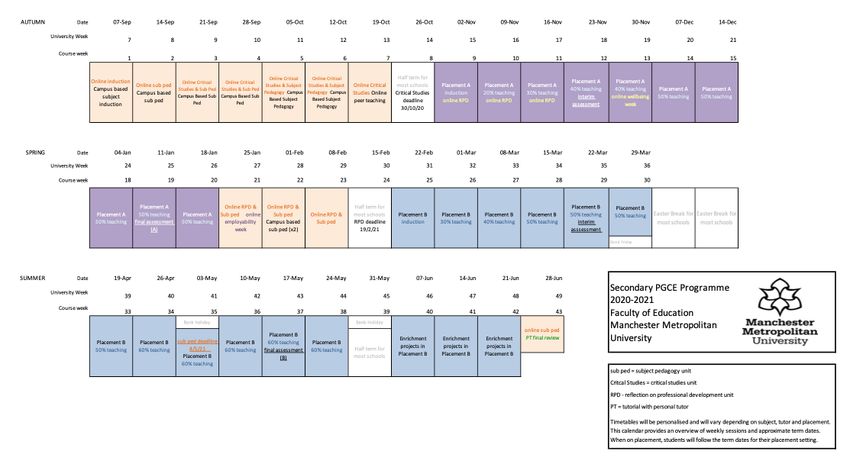
Professional Mentor Handbook, PGCE Secondary 2021/22
__________________________________________________________________________________
Contents
Welcome ................................................................................................................................................. 4
Key contacts ............................................................................................................................................ 5
Glossary of key acronyms and phrases ................................................................................................... 6
The ITT Core Content Framework (CCF) ................................................................................................. 7
The Manchester Metropolitan University Curriculum............................................................................ 8
   Intent................................................................................................................................................... 8
   Implementation .................................................................................................................................. 8
   Impact ................................................................................................................................................. 9
Guidance on completing the Progression and Achievement Document (PAD).................................... 10
The Teachers’ Standards ....................................................................................................................... 11
   Themes and dimensions for teaching and learning .......................................................................... 11
   SMSC: Social Moral Spiritual and Cultural and PREVENT.................................................................. 11
   British Values .................................................................................................................................... 11
   Safeguarding ..................................................................................................................................... 11
   Prevent .............................................................................................................................................. 11
Programme Outcomes .......................................................................................................................... 12
Roles and responsibilities for teaching experience .............................................................................. 13
Roles ...................................................................................................................................................... 14
MMU University Visiting Tutor (UVT) Purpose and Process Chart ....................................................... 15
Personal and Professional standards .................................................................................................... 16
The PGCE Secondary Programme calendar .......................................................................................... 17
Professional mentor roles and responsibilities..................................................................................... 18
Student teacher attendance and absence procedures......................................................................... 20
Student teacher well-being................................................................................................................... 22
Student teacher Personal Learning Plan ............................................................................................... 22
Student Teacher Entitlement ................................................................................................................ 23
Teaching experience and placements................................................................................................... 24
   i.      Allocation of placements .......................................................................................................... 24
   ii.     Suitable placements .................................................................................................................. 24
Data Protection whilst on placement ................................................................................................... 26
Disclosure and Barring .......................................................................................................................... 26
Timetables............................................................................................................................................. 28
Equality Statement and Religious Observance ..................................................................................... 31
MMU Secondary Partnership Mentor Training 2021- 22 ..................................................................... 33

School of Teacher Education & Professional Development, Faculty of Health & Education, Manchester Metropolitan University.                             Page 2
Professional Mentor Handbook, PGCE Secondary 2021/22
__________________________________________________________________________________
Induction for placements A and B ........................................................................................................ 36
   a.     The induction period in school: Placement A ........................................................................... 36
   b.     The induction period in school – Placement B ......................................................................... 37
   c. The latter of the ambition phase................................................................................................... 38
What if things don’t go to plan during placement? .............................................................................. 40
   Failure of a placement ...................................................................................................................... 40
   Student teachers facing difficulties .................................................................................................. 40
   Intervention and Support Plan (ISP) Procedure ................................................................................ 40
The role of the professional mentor in delivering school-based professional practice/development
programme in school ............................................................................................................................ 42
Student teacher reference for a teaching post..................................................................................... 43
Update on response to Covid-19 .......................................................................................................... 44

School of Teacher Education & Professional Development, Faculty of Health & Education, Manchester Metropolitan University.                  Page 3
Professional Mentor Handbook, PGCE Secondary 2021/22
__________________________________________________________________________________
Welcome
This handbook has been compiled by the Partnership team to assist students, professional
mentors, subject mentors and University Visiting Tutors in their support and assessment of
students on placement. We are committed to preparing students to become highly skilled
and reflective practitioners through inspiring professional development in creative school
partnerships, focusing on understanding and promoting effective learning and pupil
progress and developing professional expertise.

This guidance provides a summary of key processes and activities that take place during
Teaching Experience. For guidance on paired placements and details about requirements for
each individual placement, please refer to the Secondary Partnership website:
https://www.mmu.ac.uk/stepd/partnerships/

The National Standards for School-based Initial Teacher Training Mentors (July 2016), while
not currently statutory, play an important role in our work together. The standards aim to
strengthen the quality of support that students receive while on placements and to create
consistency within partnerships and across Initial Teacher education in England. The
standards can be found here:
https://www.gov.uk/government/uploads/system/uploads/attachment_data/file/536891/
Mentor_standards_report_Final.pdf

All our systems and processes are regularly reviewed in a constant drive for improvement. If
you have any suggestions to improve the quality of students’ Teaching Experience, please
contact the partnership coordinator who has responsibility for the placement. You can also
make suggestions and share ideas and feedback at the Partnership Strategic Development
Group (PSDG).

The focus of this handbook is on the role of the professional mentor, the tasks to be carried
out each week and the way in which you, work with mentors in your school and engage in
personal and professional development.

It is important that, as a Professional Mentor (PM), you are well trained and familiar with the
role and all its key elements. To help you with this the PM Handbook has been separated into
specific sections on each aspect of the role as well as providing you with a sense of the course
and key points in the student's year.

Professional Mentor training
We ask that as Professional Mentor, you attend at least one of the training events. For this
academic year, the training will be held virtually. These are held prior to the start of each
placement and towards the end of the summer term.

The purpose of the training is to provide you with confidence in carrying out the Professional
Mentor role effectively by ensuring familiarity with the requirements of the role and an
understanding of the student teacher entitlement. We also use these sessions to ensure that
we share good practice, address questions and concerns and look at ways of developing

School of Teacher Education & Professional Development, Faculty of Health & Education, Manchester Metropolitan University.   Page 4
Professional Mentor Handbook, PGCE Secondary 2021/22
__________________________________________________________________________________
within the role during the year. As always, if you require support during placement, please
contact the placement lead and we will be happy to help.

Key contacts

 Name                     Role                       Email address                Telephone
                                                                                  number
 Secondary                Partnership                Secondary.placements@mmu.ac. 0161 247 6422
 Placements               administration             uk
 Office
 School Direct            School Direct              schooldirect@mmu.ac.uk                                  0161 247 2383
 Administratio            administration
 n
 Karen Fuller             Head of ITE                karen.fuller@mmu.ac.uk                                  0161 247 1642
                          Partnership
 Louise Quinn             Placement A                TEA@mmu.ac.uk                                           0161 247 2304
                          Lead and
                          School Direct
                          Contact for
                          Placement A
 Majella                  Placement B                TEB@mmu.ac.uk                                           0161 247 2354
 Dalton-                  Lead
 Bartley                  School Direct
                          Contact for
                          Placement B
 Pete Baylis              Partnership                p.baylis@mmu.ac.uk
                          Tutor
 Gill Burgess             Partnership                g.burgess@mmu.ac.uk
                          Tutor
 Aileen Thom              Partnership                a.thom@mmu.ac.uk
                          Tutor
 Cheryl                   Partnership                c.wilberforce@mmu.ac.uk
 Wilberforce              Tutor

School of Teacher Education & Professional Development, Faculty of Health & Education, Manchester Metropolitan University.   Page 5
Professional Mentor Handbook, PGCE Secondary 2021/22
__________________________________________________________________________________
Glossary of key acronyms and phrases
CPD Continuing Professional Development
ECT Early Careers Teacher (replaces NQT)
ITT / ITE Initial Teacher Training / Initial Teacher Education
PMCPD Professional Mentor Continuing Professional Development
Partnership A member of university staff with partnership responsibilities,
Coordinator including as a Placement Unit Leader.
Partnership Tutor Support partnership development in a cluster schools and deliver
mentor training.
PGCE Post Graduate Certificate in Education
PGS Progress Board of Examiners
Placement A First teaching experience
Placement B Second teaching experience
PMT Professional Mentor Training
Professional Mentor The person in school who has responsibility for all student
teachers on placement and supporting subject mentors.
PT Personal Tutor
PTM Partnership Tutor Meeting (MMU Staff)
SEC Student Evaluation Committee
Senior Moderator University staff who quality assure placements (see further
guidance)
SMT Subject Mentor Training
SPSG Secondary Partnership Steering Group
ST Student Teacher
Subject Mentor Person responsible for supporting student teachers on a day-to-
day basis
TE Teaching Experience (guidance)
UPT University Personal Tutor
UVT University visiting tutor who visits the students during their
placement
School of Teacher Education & Professional Development, Faculty of Health & Education, Manchester Metropolitan University. Page 6Professional Mentor Handbook, PGCE Secondary 2021/22 __________________________________________________________________________________ The ITT Core Content Framework (CCF) From September 2020 all ITE providers started working with a new ITT Core Content Framework which builds on and replaces the Framework of Core Content for Initial Teacher Training (2016). The CCF is the minimum entitlement for all ITE courses. What is it? It is designed to emphasise the importance of high-quality teaching. The ITT Core Content Framework does not set out the full ITT curriculum for student teachers. The complexity of the process for becoming a teacher cannot be overestimated and it remains for individual providers to design curricula appropriate for the subject, phase, and age range that the student teachers will be teaching. The ITT Core Content Framework covers a range of key competencies – identifying what student teachers should know and what they should be able to do via a series of “Learn that …” and Learn How to …” statements. While the ITT Core Content Framework is presented around the Teachers’ Standards for clarity, the ITT Core Content Framework is not, and should not be used, as an assessment framework. Student teachers will not be expected to collect evidence against the ITT Core Content Framework. Student teachers will be assessed against the Teachers’ Standards at the end of their Initial Teacher Training where QTS will be awarded. The ITT Core Content Framework has been designed to support student teacher development in five core areas – behaviour management, pedagogy, curriculum, assessment, and professional behaviours. To ensure congruence with the eight Teachers’ Standards, the ITT Core Content Framework is presented in eight sections. In developing the framework, behaviour management is addressed in High Expectations and Managing Behaviour (S1 and S7); pedagogy is addressed in How Pupils Learn, Classroom Practice and Adaptive Teaching (S2, S4, S5); and curriculum, assessment and professional behaviours are addressed in S3, S6 and S8 respectively. Part 2 of the Teachers’ Standards Part Two of the Teachers’ Standards defines the behaviour and attitudes which set the required standard for conduct throughout a teacher’s career. These standards must always be met and stand alongside the ITT Core Content Framework, so are not referenced in detail. However, all student teachers should have a clear understanding of the expectations regarding personal and professional conduct of a teacher and the ethics of the teaching profession. This includes how Fundamental British Values can be upheld in schools and the importance of showing tolerance and respect for the rights of others. Why do we need it? The ITT Core Content Framework and the Early Career Framework establish a three-year structured package of support for future teachers. The DfE require all ITE providers to have an ambitious curriculum that includes all aspects of the ITT Core Content Framework as a minimum, but goes beyond it, providing content that stretches student teachers and reflects the partnership as well as local and regional need. In response to the ITT Core Content Framework, we have developed the Manchester Metropolitan Curriculum. School of Teacher Education & Professional Development, Faculty of Health & Education, Manchester Metropolitan University. Page 7
Professional Mentor Handbook, PGCE Secondary 2021/22
__________________________________________________________________________________

The Manchester Metropolitan University Curriculum
The PGCE Secondary Education programme has been designed carefully to guide students
towards meeting the Teachers’ Standards at the end of the programme.
Intent
For our student teachers, joining our PGCE Secondary Education programme is the first step
in a journey to becoming a teacher professional. They will engage with the Manchester Met.
Secondary Education curriculum throughout the programme, which incorporates all elements
of the Core Content Framework (CCF) https://www.gov.uk/government/publications/initial-
teacher-training-itt-core-content-framework, the minimum entitlement for all Initial Teacher
Education programmes.

We understand that becoming a secondary teacher is a complex process and our curriculum
responds to the ongoing development of the professional teacher identity through supporting
students to become responsible, independent learners who can explore their individual
interests and needs through a personalised academic programme involving increasing stages
of independence, research and choice of study.

Our curriculum will support students in key aspects, such as:
   • learning to teach (generic pedagogy, including adaptive teaching and classroom
       management)
   • learning to teach a subject (subject knowledge and pedagogy, curriculum design,
       planning and assessment).
   • learning to be a teacher (teacher identity, professional behaviours, developing
       reflective and reflexive practice, educational ideologies, and values).
   • learning to be a teacher-researcher (critical thinking, exploring research, evaluating
       the impact and effectiveness of research on teaching and learning).

Our curriculum takes varied, but equally valuable, forms across multiple sites and is planned
holistically and in responsive ways. It is co-designed and co-delivered across our partnership,
sharing a pedagogical approach with an agreed division of labour and expert knowledge
between our schools and university tutors.
The MMU Curriculum is made up of the placement periods and the University taught units
plus additionality and some optionality. Additional provision includes MOOCs, enrichment
projects, academic research, employability events and well-being conferences. Optionality
allows student teachers to tailor the programme to their own personal and professional
development priorities.
Implementation
The Manchester Met. curriculum offers students to engage through dialogic means, becoming
responsible for co-creating their degree programme with support and guidance from personal
tutors and provides the opportunity to take increasing responsibility for their own
professional development through building a culture of research, reflection, and enquiry.
Student choice and a personalised programme with well-considered sequencing of the
knowledge and skills to be learned across the theoretical and practical dimensions.

School of Teacher Education & Professional Development, Faculty of Health & Education, Manchester Metropolitan University.   Page 8
Professional Mentor Handbook, PGCE Secondary 2021/22
__________________________________________________________________________________
Delivery of the curriculum takes place in a ‘blended’ format, co-produced and delivered by
university tutors and school mentors. This means there is be a mixture of on-campus, in-
school and online learning. This includes seminars, webinars and workshops, Massive Open
Online Courses (MOOCs), pre-recorded content and tutorial sessions. Students collaborate
and contribute to work in groups of various sizes as well as independently.
Impact
The Manchester Met. curriculum is exciting, challenging and rewarding, creating excellent
teachers for the future. It is designed to enable students to make successful progress and
provide opportunities for them to gather the required evidence to demonstrate that the
Teacher Standards have been met. It is underpinned by a desire on the part of the schools
involved and all at Manchester Met, for students to develop as outstanding professional,
beginning teachers, well able to critically reflect on practice and aiming to achieve the best
for themselves and the children and young people that they teach.
The carefully planned sequencing of knowledge, skills and understanding supports the
development of practical application with pupils and learners and provides the necessary
tools to prepare students to be confident, innovative, inspirational practitioners, capable of
teaching in a variety of settings, in an increasingly diverse and ever-changing society.
The MMU curriculum is captured in the PAD (Progression and Achievement Document). The
PAD describes the activity undertaken and the progress that should be demonstrated in each
phase. It identifies learning outcomes for the four phases and allows progress to be measured
in a timely manner.
The phases of the MMU Curriculum
The MMU Curriculum is divided into four phases.
1. Induction Phase incorporates University teaching and early stages of placement A.
2. Development Phase incorporates later stage placement A
3. Achievement Phase incorporates University teaching and early stages of Placement
B.
4. Ambition Phase incorporates later stages of Placement B / PGF and Enrichment
Activity
At the end of each phase, all student teachers undergo an assessment of their progress
against the MMU Curriculum. This is carried out by subject mentors and subsequently,
University Tutors. Tutors and mentors should identify for each learning outcome whether a
student teacher is making sufficient progress against the MMU curriculum or not.
School of Teacher Education & Professional Development, Faculty of Health & Education, Manchester Metropolitan University. Page 9Professional Mentor Handbook, PGCE Secondary 2021/22 __________________________________________________________________________________ Guidance on completing the Progression and Achievement Document (PAD) The Progression and Achievement Document is a live document” which demonstrates the progress the student teacher is making throughout the academic year. The student teacher is ultimately responsible for this document, which is in their Teaching Experience File (online using the OneDrive). The student teacher and mentor must ensure all relevant sections are completed by the appropriate dates as identified in the academic calendar and teaching experience handbook. The evidence to support the PAD will be in the Student Teachers TEF. There are four placement reports: Interim and final report for placement A and Interim and final report for placement B. The professional mentor should have oversight of the PAD and this is particularly important at the four different assessment points during the year. Interim and final placement reports are in the PAD which are submitted by the student teacher via Moodle. School of Teacher Education & Professional Development, Faculty of Health & Education, Manchester Metropolitan University. Page 10
Professional Mentor Handbook, PGCE Secondary 2021/22
__________________________________________________________________________________
The Teachers’ Standards
The Teachers’ Standards are end-point statements which must be met to achieve Qualified
Teacher Status. It is important you familiarise yourself with these prior to beginning the
course. In progressing through the MMU curriculum student teachers are provided with the
teaching and learning opportunities and experiences that allow them to gain sufficient
evidence against the Teachers Standards by the end of their course. For more information
about the Teachers’ Standards:
https://assets.publishing.service.gov.uk/government/uploads/system/uploads/attachment_
data/file/665520/Teachers__Standards.pdf

Themes and dimensions for teaching and learning
These elements are those addressed across the course, both in schools and University; they
incorporate the aspects of education that extol the core values essential to all learning
communities and that promote community cohesion and help teachers prepare children for
life in a diverse, just, safe and equitable society.

SMSC: Social Moral Spiritual and Cultural and PREVENT
SMSC is a statutory, inspected, and value-laden aspect of being a teacher.

British Values
Within SMSC development, a duty is placed upon students to protect children from
extremism and to encourage them to uphold fundamental British values, mutual respect and
tolerance for different faiths and beliefs. Please read the Department for Education (DfE)
advice on this at:
https://www.gov.uk/government/publications/promoting-fundamental-british-values-
through-smsc

Safeguarding
Prior to placement, students are provided with a safeguarding briefing which builds on what
had been covered in the previous year. This is also undertaken in schools during the induction
period. These sessions are broadly equivalent to most ‘Level 1 Safeguarding training’. The
government requires that all teachers should read at least part 1 of the statutory guidance
‘Keeping Children Safe in Education’ (2016). This has been updated for September 2021 Read
it at:
https://www.gov.uk/government/publications/keeping-children-safe-in-education--2

Prevent
Part of the requirement of safeguarding as a teacher, is a student's duty to protect children
from extremism. Read the government requirements at:
https://www.gov.uk/government/uploads/system/uploads/attachment_data/file/439598/p
revent-duty-departmental-advice-v6.pdf

School of Teacher Education & Professional Development, Faculty of Health & Education, Manchester Metropolitan University.   Page 11
Professional Mentor Handbook, PGCE Secondary 2021/22
__________________________________________________________________________________
Programme Outcomes
The award of PGCE signifies that student teachers have met, and demonstrated evidence of
meeting, all of the Programme Outcomes that include the Standards for the Awards of
Qualified Teacher Status (i.e., the characteristics which must be demonstrated by all beginning
teachers).

The Secondary Programmes also prescribe other outcomes that refine the characteristics of
the beginning teacher to make the programmes’ outcomes compatible with the aims of
academic study at degree and master’s levels.

Academic Learning Outcomes of the Manchester Met. PGCE Programme
Evidence of the ability to:
    • deal with complex issues both systematically and creatively, make sound judgements
       in the absence of complete data, and communicate their conclusions clearly to
       specialist and non-specialist audiences.
    • demonstrate self-direction and originality in tackling and solving problems, and act
       autonomously in planning and implementing tasks at professionally.
    • continue to advance their knowledge and understanding, and to develop new skills to
       a high level.
    • formulate appropriate enquiries into classroom practice and carry them out, either
       individually and/or by contributing to an enquiry carried out by a group of practitioners
       (including peers, mentors, and tutors) and evidence of the qualities and transferable
       skills necessary for employment requiring:
            o the exercise of initiative and personal responsibility.
            o decision-making in complex and unpredictable situations.
            o independent learning ability required for continuing professional
                development.

This will be demonstrated by the student teachers’ professional engagement with the
programme at University, on placements and through:
    • Participation in practitioner enquiry (including collaborative enquiry with other
       student teachers, tutors and mentors)
    • Critical discourse on matters of education principle and policy (including professional
       discourse in the report process)
    • Formulation of thoughtful and critical written and spoken discourse to justify their own
       work as a practitioner
    • Production of written accounts based on enquiries which meet the needs and
       professional register of e.g., a partner school’s commissioned curriculum enquiry
       and/or the requirements and register of scholarly activity

School of Teacher Education & Professional Development, Faculty of Health & Education, Manchester Metropolitan University.   Page 12
Professional Mentor Handbook, PGCE Secondary 2021/22
__________________________________________________________________________________
Roles and responsibilities for teaching experience
The partnership should:
• acknowledge that the well-being and education of pupils in schools/settings takes
priority over all other considerations.
• exercise a duty of care for all student teachers, their personalised professional
development needs and their well-being.
• support student teachers with respect, being mindful of the stage of their training and
how this is impacting on the challenges they might be facing.
• ensure that student teachers are equipped to enjoy the rewards and challenges of the
teaching profession and recognising the need to nurture the next generation of
committed, resilient and high-quality teachers.
• support student teachers progress against the MMU curriculum.
Student teachers should:
• understand and take responsibility for the impact of their teaching on pupil progress
and learning over time.
• utilise all aspects of their learning, in school, in University and in independent study,
to support their progress as reflective practitioners, alongside their professional
development, towards achieving the professional standards for Qualified Teacher
Status.
School-based staff should:
• provide effective teaching experiences.
• support student teachers so that they have a positive impact on pupil progress and
learning from the outset.
• identify and address student teachers’ needs to support them in readiness for
becoming Early Career Teachers (ECT).
• support student teachers progress against the MMU curriculum at each relevant
phase.
University staff should:
• work with all members of the partnership to ensure that all student teachers make
progress against the MMU curriculum.
• utilise partnership data to inform mentor training that impacts positively on student
teacher outcomes and the progress of the pupils they teach.
School of Teacher Education & Professional Development, Faculty of Health & Education, Manchester Metropolitan University. Page 13Professional Mentor Handbook, PGCE Secondary 2021/22
__________________________________________________________________________________
Roles
There are several different people involved in teaching experience and supporting student
teachers in school.
Subject The subject mentor provides day-to-day support, training and feedback
Mentor for the student teacher. They are responsible for creating an appropriate
timetable and offering expert guidance to the student teacher and
ensuring they make sufficient progress against the learning outcomes for
the relevant phase of the MMU curriculum and set relevant targets.
Professional The professional mentor is the person within the school/setting with
Mentor overall designated responsibility for student teachers. The professional
mentor may be working with several student teachers at the same time,
in a co-ordinating / overseeing capacity. They monitor the training
process in different subjects within the school and moderate the
assessment outcomes for all student teachers and quality assure the
mentor support and training programme provided.
The professional mentor is responsible for attending training in advance
of undertaking their role, and ensuring subject mentors are appropriately
trained. The PM will provide effective teaching experiences for the
student teacher, support them so that they have a positive impact on
pupil progress and learning from the outset.
The PM will also identify and address student teachers’ needs to support
them in readiness for becoming EQTs. and support student teachers
progress against the relevant phase of the MMU curriculum.
University The university visiting tutor quality assures the teaching experience and
Visiting Tutor mentoring process and supports the school/setting and the student
(UVT) teacher throughout the placement. They visit the student teacher once
per each teaching experience.
Personal Tutor The university-based personal tutor will support student teachers before,
during and after the placement. They are the point of contact should any
problem arise. They are the next point of contact regarding queries after
the student teacher has contacted school-based colleagues and/or if the
issue is of a personal nature. The personal tutor will liaise with the
teaching experience unit leader if and where necessary.
Teaching This is the partnership coordinator responsible for a placement. Issues or
Experience concerns are referred to the partnership coordinators by university
Unit Leader visiting tutors, personal tutors or partnership tutors.
School of Teacher Education & Professional Development, Faculty of Health & Education, Manchester Metropolitan University. Page 14Professional Mentor Handbook, PGCE Secondary 2021/22
__________________________________________________________________________________
MMU University Visiting Tutor (UVT) Purpose and Process Chart
Purpose of the UVT visit is:
• To quality assure the teaching experience
• To quality assure the mentoring process
• To identify any areas for further development
• To provide evidence for the QD process
Process Chart UVT is allocated visits in their workload
UVT pre plans visits in their diaries
UVT contacts school and student to arrange visit.
Visit confirmed
Prior to visit: UVT sends Quality Assurance form to school
Student Teacher shares TEF with UVT
Visit takes place
Quality Assurance form is completed with inputs from both student and mentor
Step 2: Step 3:
Any Step 1: Quality Mentor
Student
concerns Assurance concerns
concerns
raised from form sent to
student, SM UVT UVT reports
the
and PM and immediately any areas for
class/subject
saved centrally reports any development
or
in share point concerns to Partnership
professional
within 5 days about the Coordinator
mentor will
of visit in student to responsible
instigate an
relevant year the personal for the
early visit
file e.g. 2021 tutor placement
School of Teacher Education & Professional Development, Faculty of Health & Education, Manchester Metropolitan University. Page 15Professional Mentor Handbook, PGCE Secondary 2021/22
__________________________________________________________________________________
Personal and Professional standards
All student teachers are expected to maintain very high standards of personal and
professional conduct by acting in an appropriate way as identified in the teachers’
standards.
The following statements define the behaviour and attitudes which set the required
standard for conduct throughout a teacher’s career. Teachers uphold public in the
profession and maintain high standards of ethics and behaviour, within and outside the
school, by:
• Treating pupils with dignity, building relationships rooted in mutual respect, and
always observing proper boundaries appropriate to a teacher`s professional position.
• Having regards for the need to safeguard pupils` well- being, in accordance with
statutory provisions.
• Showing tolerance of and respect for the rights of others.
• Not undermining fundamental British values, including democracy, the rule of the
law, individual liberty and mutual respect, and tolerance of those with different
faiths and beliefs
• Ensuring that personal beliefs are not expressed in ways which exploit pupils`
vulnerability or might lead them to break the law.
School of Teacher Education & Professional Development, Faculty of Health & Education, Manchester Metropolitan University. Page 16Professional Mentor Handbook, PGCE Secondary 2021/22 __________________________________________________________________________________ The PGCE Secondary Programme calendar School of Teacher Education & Professional Development, Faculty of Health & Education, Manchester Metropolitan University. Page 17
Professional Mentor Handbook, PGCE Secondary 2021/22
__________________________________________________________________________________

Professional mentor roles and responsibilities
The professional mentor (PM), after preparation and training, will assume responsibility for
all ITE matters in the school and for liaison/communication with the Faculty of Education
including a substantial responsibility for the quality assurance of the training provided by the
school. The PM will also liaise with the partnership team as necessary and appropriate.

In respect of the team of subject mentors (SM), the professional mentor will:
    • on an annual basis, identify for the Faculty of Education the subject departments in
       which placements will be offered in the next academic year.
    • Identify and support subject mentors and their training needs, ensuring they are
       adequately prepared for their role before receiving student teachers.
    • Monitor the training requirements of individual subject mentors and ensure they
       continue to meet the training entitlement of all student teachers and are familiar with
       the MMU Curriculum.
    • Provide an effective communication link between the Faculty of Education and subject
       mentors.
    • Monitor the quality and consistency of training provision for student teachers.
    • Monitor adherence to school ITE policy and the consistency of provision for student
       teachers.

In respect of the student teachers’ entitlement, the professional mentor will:
    • Provide a school-based induction programme for all student teachers including
       safeguarding, school policies, ethos and context of the school, curriculum, and
       introductions to key colleagues.
    • Provide a school-based programme of professional development including scheduled
       meetings to review their professional development (this should be shared on request
       with the Faculty of Education.
    • Ensure that policies, data and appropriate information (schemes of work/lesson
       planning documents) are available for the student teachers to carry out school-based
       training activities as part of their teaching experience and prepare for assignments as
       part of the MMU curriculum.
    • Monitor the student teachers’ teaching experience file (TEF).
    • Monitor workload for the student teacher and their well-being, reporting these
       concerns to the relevant university personal tutor.
    • Monitor the progress of individual student teachers against the relevant phase of the
       MMU Curriculum, via the PAD.
    • carry out at least one observation of classroom teaching for each student teachers
       and provide oral and written feedback of that observation, they should also carry out
       meetings with individuals to review their professional development, setting targets
       for future developments.
    • Review, quality assure and sign off interim and final reports within the PAD completed
       by subject mentors.
    • Engage with partnership surveys and evaluations from the Faculty of Education.
    • Complete and submit the Quality Development Document on behalf of the School.

School of Teacher Education & Professional Development, Faculty of Health & Education, Manchester Metropolitan University.   Page 18
Professional Mentor Handbook, PGCE Secondary 2021/22
__________________________________________________________________________________
The subject mentor, after preparation and training, will assume responsibility for ITE matters within
the subject department and for liaison/communication with the professional mentor and the
University Visiting Tutor.
Professional mentor: developing the quality assurance of Subject Mentors
• Ensuring the student teacher entitlement is met by checking that the weekly
lesson observations and mentor meetings take place.
• Checking and monitoring the well-being of student teacher and their management
of workload.
• Facilitating ongoing opportunities for the student teachers to observe excellent
practitioners outside their own subject departments.
• Ensuring the accuracy and consistency of assessment within the subject mentor
team.
• Re-affirming the need for mentors to have protected time to fulfil their mentoring
and tutorial responsibilities
• Emphasising the importance of mentor interaction with the student teacher’s
teaching experience file
• Conducting joint observations with tutors/mentors where possible
• Ensuring joint observations for mentors with university tutor
• Monitoring student’s well-being and management of workload.
• Contacting the student teachers’ university personal tutor at the earliest
opportunity if you or the SM has any concerns regarding the student.
• Organising collaborative mentor training session within schools
• Ensuring mentors are well trained and attend CPD and training opportunities
• Regular informal support of subject mentors
• Ensuring that mentors are kept up to date with deadlines
• Provide feedback from the strategic group and training sessions the subject
mentors, ensuring that subject mentors have up to date subject mentor guides
and proformas, ensuring that each student is attached to a form / tutor group.
School of Teacher Education & Professional Development, Faculty of Health & Education, Manchester Metropolitan University. Page 19Professional Mentor Handbook, PGCE Secondary 2021/22
__________________________________________________________________________________
Student teacher attendance and absence procedures
Attendance and punctuality are important professional requirements and expected by
schools and the university. Attendance is required at all school-based days and university
sessions in order to ensure optimal professional development and meet the Teachers’
Standards and university regulations. All student teachers are required to attend a
minimum of 120 days in school, as set out by the Department for Education statutory
guidance for initial teacher education.
Absence from a school placement may require an extra period of time in school in order to
satisfy the requirements of the Teachers’ Standards (May 2012). All cases will be considered
on an individual basis. Prolonged absence from a school placement due to ill health may
require student teachers to defer their placement to the following year.
Student teachers should attend placement on all days across the whole placement period,
arriving at the school in advance of 8.30am and alerting the school as soon as possible of
any likely late arrival. Repeated lateness should be reported to the Personal Tutor / UVT as a
matter of concern.
Pre-planned absences should be agreed in advance by the student teacher and their
personal tutor / UVT and leave of absence granted. The school or college must be made
aware of the leave of absence, its timing and length.
Extended periods of absence or repeated absence from placement may result in additional
placement time being required beyond the usual placement period or a deferred
placement, before the university will award Qualified Teacher Status (QTS)
Student teacher absence from placement due to illness
When a student teacher is unwell and not able to attend placement they should inform
their placement school, their personal tutor and the secondary placements team
(secondary.placements@mmu.ac.uk for CORE and schooldirect@mmu.ac.uk for SD) at the
earliest opportunity and in advance of 8.30am on the first day of their absence. The student
teacher should inform their placement school and personal tutor as soon as they are well
enough to return to school placement.
Unplanned student teacher absence from placement
When a student teacher fails to attend placement and fails to make contact with their
school the following procedures should be followed by the school or college -
In the morning of the first day of absence:
• The school or college should inform the placements team
(secondary.placements@mmu.ac.uk for CORE and schooldirect@mmu.ac.uk for SD)
and the student teacher’s personal tutor that the student teacher has not attended
School of Teacher Education & Professional Development, Faculty of Health & Education, Manchester Metropolitan University. Page 20Professional Mentor Handbook, PGCE Secondary 2021/22
__________________________________________________________________________________
placement and that this was not a planned absence. Please write student teacher
unplanned absence as the subject of the email so it can be seen quickly.
• The placements team should log the absence and immediately inform the partnership co-
ordinator with responsibility for the relevant placement.
• The Personal Tutor should try to contact the student teacher as soon as they are alerted to
the absence. They should keep the partnership co-ordinator informed of the response from
the student teacher and confirm this with the placement school.
• In the event of receiving no response from the students’ teacher’s known contact numbers
this should be reported directly to the Head of School who will review the activity to date
and confirm the need for a welfare visit to the student teacher’s term time address and / or
contact with the next of kin / police / other welfare services.
Concern about a Student Teacher attending placement
In the event of a school / college being concerned about the welfare of a student teacher
who is still attending placement then immediate contact should be made with the personal
tutor with a clear explanation of the nature of the concern and clarification as to whether
these concerns have already been raised with the Student Teacher directly.
Personal Tutors who are informed of a welfare concern by a placement school must contact
the Student Teacher at the earliest opportunity and arrange a meeting to discuss the
concerns. Additionally, the Personal Tutor should ensure that the Student Teacher has all of
the relevant contact details for the University support services and is encouraged this make
use of these.
School of Teacher Education & Professional Development, Faculty of Health & Education, Manchester Metropolitan University. Page 21Professional Mentor Handbook, PGCE Secondary 2021/22
__________________________________________________________________________________
Student teacher well-being
If you have concerns about your student teacher then please do contact their personal tutor
to alert them to your concerns. The university also has a number of options for students to
receive support. Our Counselling, Mental Health and Wellbeing Service is available Monday
– Friday 11:00am – 4:00pm, except on bank holidayshttps://www.mmu.ac.uk/student-
life/wellbeing/counselling-and-mental-health/
Student teachers can also access 24/7 virtual mental health and wellbeing support via our
Togetherall platform. Togetherall is an online community for people who are stressed,
anxious or feeling low. You can talk anonymously to other members and take part in group or
one-to-one therapy with therapists.
https://www.mmu.ac.uk/student-life/wellbeing/togetherall/
Student teacher can also contact these 24/7 support services:
· SHOUT – if you are feeling anxious, worried or finding things difficult to cope with,
text 'SHOUT' to 85258
· The Greater Manchester NHS Mental Health Helpline – call: 0800 953 0285
· NHS 111 – online at 111.nhs.uk or call: 111
· The Samaritans – call: 116 123
· SANEline – call: 0300 304 7000 (available 4:30pm – 10:30pm, every day).
· If you are concerned that you or others are at immediate risk of serious harm, please
call: 999
Student teacher Personal Learning Plan
Some student teachers may have a personal learning plan (PLP) which gives guidance on
their learning and/or health needs. As a university we cannot disclose this information to
schools and mentors, but we ask that you ask your student teacher if they have a PLP. The
university tutors also encourage student teachers to be open about their learning needs
and/or health needs and to have that dialogue. If you have any concerns about your
student teacher and how you might support their learning needs and/or health needs then
do contact their personal tutor in the first instance.
School of Teacher Education & Professional Development, Faculty of Health & Education, Manchester Metropolitan University. Page 22Professional Mentor Handbook, PGCE Secondary 2021/22
__________________________________________________________________________________
Student Teacher Entitlement
The Student Entitlement
It is vital that as a professional mentor, you familiarise yourself with all elements of the
student entitlement. The student entitlement ensures that all students receive the same, high
quality, basic entitlement.
All students must receive their entitlement in full during each of the school placement
periods.
What is the Entitlement?
• All student teachers must have a formal observation with written feedback every
week by their subject mentor
• All student teachers must have a mentor meeting every week with their subject
mentor during which targets are set to support progress against the MMU curriculum
• All student teachers are entitled to a formal observation by their professional mentor
during each of the placements (one for Placement A and one for Placement B)
Additional required Actions
• All student teachers are entitled to timetabled school based professional
development sessions in which they will work on generic themes alongside other
student teachers (this will be organised by the professional mentor on behalf of the
school). All student teachers must attend these sessions.
• All student teachers must have a gradualised timetable (see the calendar for guidance
on this)
• The timetable should support subject knowledge development and is personalised to
reflect the student teachers’ stage of development. This should be shared with the
professional mentor who will maintain an overview of all student timetables.
• All student teachers must have the opportunity to observe examples of good practice
in teaching and learning within and beyond their subject area. This will be monitored
by SMs in the weekly meetings.
• All student teachers are entitled to practical, professional support within the subject
department e.g., access to schemes of work, policies and practices and access to
supporting information such as SEN database.
School of Teacher Education & Professional Development, Faculty of Health & Education, Manchester Metropolitan University. Page 23Professional Mentor Handbook, PGCE Secondary 2021/22
__________________________________________________________________________________
Teaching experience and placements
Student teachers will undertake two placements during the PGCE.
i. Allocation of placements
All student teachers must have received a satisfactory enhanced DBS (Disclosure Barring
Service) check and health check prior to starting placement.
When arranging the two school placements, the main aim is to ensure that student teachers
have a suitable range of experience. The placement team will make the best possible
arrangement based upon available placement schools and the needs of all student teachers
in the subject group. They will consider:
1. prior teaching experience
2. specific individual personal circumstances
3. school size and type, provision for Post-16 teaching
4. anticipated travel time to placement
ii. Suitable placements
A suitable placement school will:
• Ensure an active and meaningful relationship between the student teacher and a
subject mentor who is a subject expert, and who holds a teaching qualification, as well
as having substantial teaching experience. The subject mentor must be able to
support the professional development of the student teacher, especially in relation to
subject specific knowledge and pedagogy. This will require regular meetings between
the student teacher and the subject mentor, and the subject mentor will be required
to complete written reports.
• Provide the student teacher with direct teaching time, additional professional
practice, including activities such as team/departmental meetings, interviewing, visits,
observation of teaching, discussion with subject mentors and other school activities.
• Ensure lesson observations by the subject mentor include verbal and written feedback
• Provide student teachers with opportunities to make progress against the relevant
phase of the MMU curriculum and student teachers must have opportunities to
engage in the full range of school assessment procedures and processes, and to take
part in curriculum planning.
• Provide the student teacher with a suitable physical environment in which to teach,
including the provision of appropriate resources, ICT and access to the internet.
• Give the student teacher support in accessing opportunities to extend their breadth
of practice in relation to subject specific knowledge and pedagogy beyond the
immediate range of curricula taught in the everyday context of the student teacher’s
working life.
• Fully induct student teachers into the placement school in the first week of their
teaching experience. The student teacher must also be given, or shown where to find,
any appropriate policies such as behaviour management, safeguarding children, ICT
usage, SEND policies etc.
• Provide quality assurance procedures to ensure high quality training.
School of Teacher Education & Professional Development, Faculty of Health & Education, Manchester Metropolitan University. Page 24Professional Mentor Handbook, PGCE Secondary 2021/22
__________________________________________________________________________________
• Provide an appropriate safeguarding policy for children, young people, and vulnerable
adults.
• Provide safer recruitment procedures and make sure that all appropriate checks are
carried out on staff, volunteers, and student teachers who work with children, young
people and vulnerable adults.
Manchester Metropolitan University will:
• Involve the placement school in all aspects of training.
• Support subject mentors and professional mentors through mentor training, meetings
and email communication.
• Facilitate the sharing of good practice across the partnership.
• Provide all documentation through the partnership website
https://www.mmu.ac.uk/stepd/partnerships/resources/secondary/
• Monitor and evaluate the quality of training and respond appropriately.
• Provide ongoing support and guidance.
• Provide student teachers with introductory training to safeguarding policy for
children, young people, and vulnerable adults.
• Provide safer recruitment procedures and make sure that all appropriate checks are
carried out on tutors, volunteers, and student teachers who work with children, young
people and vulnerable adults.
School of Teacher Education & Professional Development, Faculty of Health & Education, Manchester Metropolitan University. Page 25You can also read


