Monthly Regional Food Price Update Southern Africa
←
→
Page content transcription
If your browser does not render page correctly, please read the page content below
Monthly Regional Food Price Update
Southern Africa                                                                                               September 2018
Highlights
In the southern African region, maize prices are already beginning to show mixed trends. In South Africa and
Tanzania, maize prices remain below their respective 5 year average (5YA) levels, while in other countries,
such as Malawi and Mozambique, maize prices are on an upward trend and closing in on their 5YA levels.

A look at the Alert for Price Spikes (ALPS) shows that in both June and July, a few markets in Zambia were
already showing signs of stress.

Factors such as rising fuel costs are already pushing prices up, and as households deplete their stocks and
turn to markets, prices are expected to further rise. Although still too early to tell, this could be exacerbated
if an El Niño materializes and affects the next season crop. Close monitoring of the situation is needed.

                                                         International Staple Food Prices
              Figure 1: FAO Food Price Index and                        The FAO Food Price Index averaged 167.6 points in August
                 Food Commodity Price Index                             2018, virtually unchanged from its revised estimate for July
                                                                        but down 9.6 points (5.4 percent) from its level in the
                                                                        corresponding period last year. While cereals and, to a lesser
                                                                        extent, meat values were firmer in August, the values of the
                                                                        other sub-indices, namely sugar, vegetable oils and dairy
                                                                        products, dropped.
                                                                        The FAO Cereal Price Index averaged 168.4 points in August,
                                                                        representing a rebound of 6.5 points (4 percent) over July and
                                                                        of 15 points (10 percent) from August 2017. Wheat prices rose
                                                                        the most, largely on tighter export availabilities in view of
                                                                        deteriorating crop prospects, especially in the EU and the
                                                                        Russian Federation. International maize quotations also
                                                                        firmed, up by more than 3 percent from July, influenced by a
                                                                        slower pace in sales by Argentina and Brazil as well as the spill
Source: http://www.fao.org/worldfoodsituation/foodpricesindex/en/
                                                                        over from rising wheat values. By contrast, international rice
               Figure 2: South Africa Fuel Prices*                      prices eased, amid efforts to attract buyers and free space for
                                                                        new crop arrivals. (Figure 1).

                                                                                         South Africa Fuel Prices

                                                                        From July to September, petrol retail prices and diesel whole-
                                                                        sale prices increased to R16/liter and R14/liter respectively
                                                                        (Figure 2). Prices would have been higher had the
                                                                        government not intervened in September to absorb some of
                                                                        the fuel price increase.
                                                                        Over the past few months, the rapid depreciation of the rand
                                                                        against the USD (Figure 6) and high global oil prices have
                                                                        caused fuel prices to rise in South Africa. This negatively
                                                                        affects the cost of producing and transporting agricultural
 Source: Central Energy Fund; *Inland (Gauteng) prices                  commodities. We will continue to monitor fuel prices as we
 http://www.cefgroup.co.za/petrol-price/                                enter the 2018/19 production season.

                                                                                      Monthly Regional Food Price Update | September 2018
Regional Staple Food Price Trends and Outlook
The latest available price data from countries in the southern African region show mixed trends (Figure 3). In South Africa and
Tanzania, the two largest cereal producing countries in the region, maize prices remain below their respective 5 year average
(5YA) levels. However, South Africa’s national average maize price ticked upwards in August; this may in part be attributed to
the depreciation of the rand and market uncertainty surrounding the possibility of El Niño and its potential impact on the next
season crop.

In Malawi and Mozambique, maize prices are on an upward trend; in both countries, localized deficits could continue to push
prices further up. At 13.4 MZN/kg, Mozambique’s national average maize price in August was 30 percent higher than the same
time last year.

In Zambia and Zimbabwe, national average maize prices remain relatively stable and close to their respective 5YA levels. Yet, in
Zambia, where maize production is expected to be 30 percent lower than last year, there are already pockets of areas
experiencing high maize prices (Figure 4).

                                   Figure 3: Average Monthly Prices from Selected Countries

In Lesotho, the national average maize meal price remained stable at approximately 62 LSL/kg in July, which was below both
last year’s price and the 5YA.

In Madagascar, the national average price for local rice continued to decrease in July on account of a relatively good harvest.
However, prices are expected to follow an upward trend as traders begin to stock up ahead of the lean season.

                                                                                        Source: WFP and FAO (South Africa prices)
                                                                                        Note: Wholesale prices for South Africa and Tanzania

                                                                                Monthly Regional Food Price Update | September 2018
Alert for Price Spikes (ALPS)
 ALPS is an indicator that monitors local food commodity prices and measures the extent to which food commodities found on
 local markets experience unusually high food price levels for a specific month of the year. Figure 4 presents markets that meet
 the selection criteria for ALPS (and those for which data were available).

 Compared to June and July of last year, the market situation is overall better with most monitored markets in the region
 indicating normal maize price levels. In Zambia, however, a few markets are experiencing high maize prices; as of July,
 Luanshya and Mufulira were in the “Alert” phase, while Chingola, Kaoma, Mongu, Mungwi, Mwense were in “Stress.”

                        Figure 4: Status of Monitored Food Markets in Southern Africa: June and July - ALPS (Maize)

               June                                  July                         June                                    July

 Note that the markets depicted above are not necessarily identical from                                                     Source: ALPS WFP
 one month to the next and the number of markets depicted may differ
 from one month to the next because of data availability.
                                                                                            For more details on the ALPS indicator

                                         Regional Exchange Rate Patterns and Inflation Rates

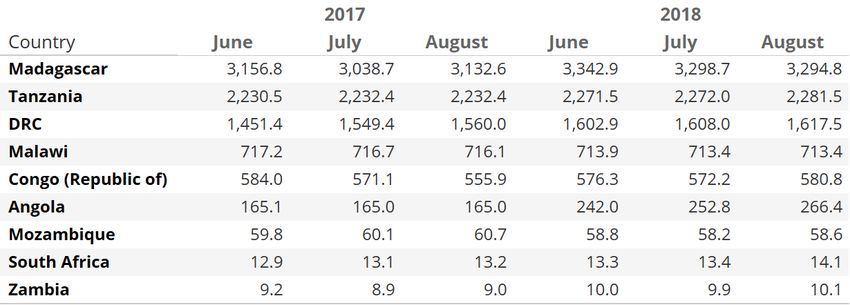
                                  Table 1: Exchange Rates (USD)                               Table 1 shows the exchange rates for
                                                                                              select countries from June to August in
                                                                                              both 2017 and 2018. The Lesotho loti,
                                                                                              Namibian dollar, and eSwatini lilangeni
                                                                                              are pegged to the South African Rand,
                                                                                              and thus show the same movement.

                                                                                              The Angolan kwanza, which was
                                                                                              unpegged from the USD in January this
                                                                                              year, has devalued rapidly; compared to
                                                                                              August of last year, the kwanza is down
                                                                                              by nearly 61 percent. The Zambian
                                                                                              kwacha has also depreciated by
                                                                                              approximately 12 percent year-on-year
                              Figure 5: Exchange Rate Movements                               (y-o-y) vis-à-vis the USD. Only Malawi and
                                                                                              Mozambique saw their currencies
                         5A: % Change (y-o-y)*, August 2017—August 2018
                                                                                              slightly appreciate y-o-y (Figure 5A).

                                                                                              In terms of month-on-month (m-o-m),
                                                                                              from July to August 2018, with the
                                                                                              exception of Madagascar, all countries
                                                                                              saw their currencies depreciate vis-à-vis
                                                                                              the USD. The South African rand
                                                                                              continued to depreciate rapidly at over 5
                                                                                              percent, as did the Angolan kwanza
                             5B: % Change (m-o-m)*, July - August 2018
                                                                                              (Figure 5B). Exchange rate trends of
                                                                                              select countries are shown in Figure 6
                                                                                              on the following page.

                                                                                              *M-o-m is comparison between the current
                                                                                              month and the previous month; y-o-y is compari-
                                                                                              son between the current month and the same
                                                                                              month of the previous year.
Data Source: http://www.tradingeconomics.com
                                                                                       Monthly Regional Food Price Update | September 2018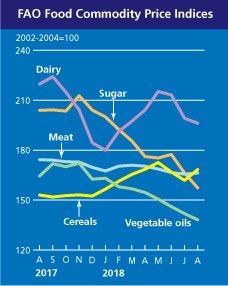
Figure 6: Exchange Rate Trends

Data Source: http://www.tradingeconomics.com
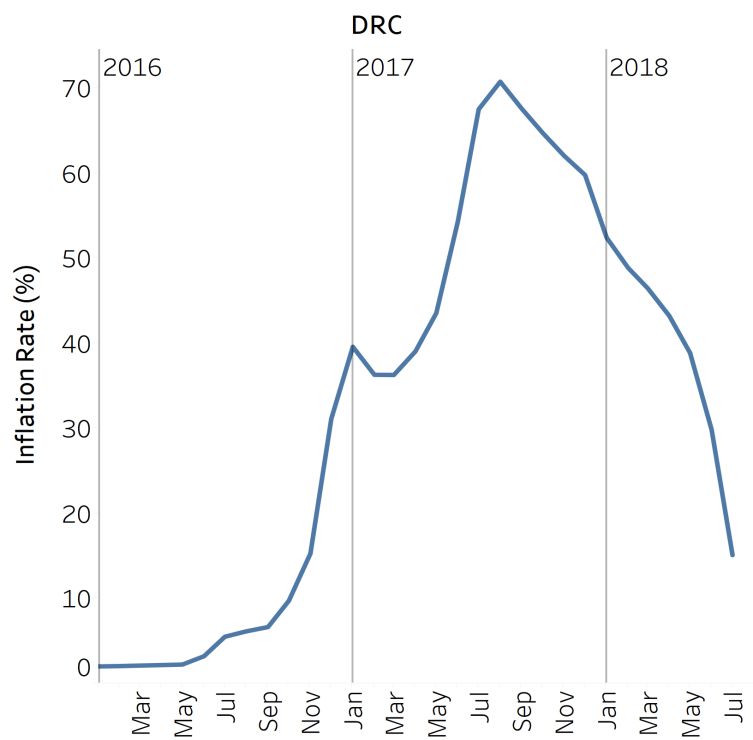
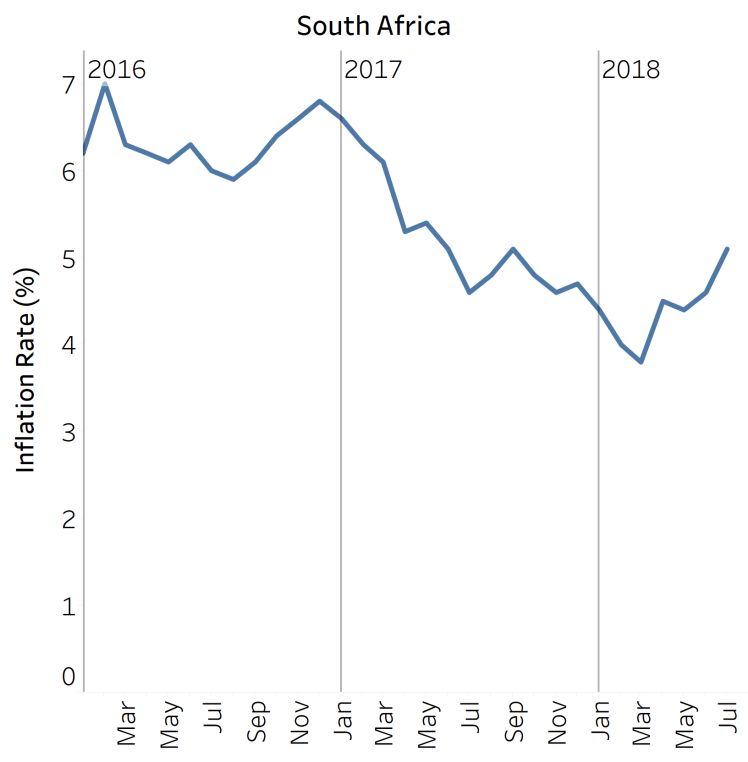
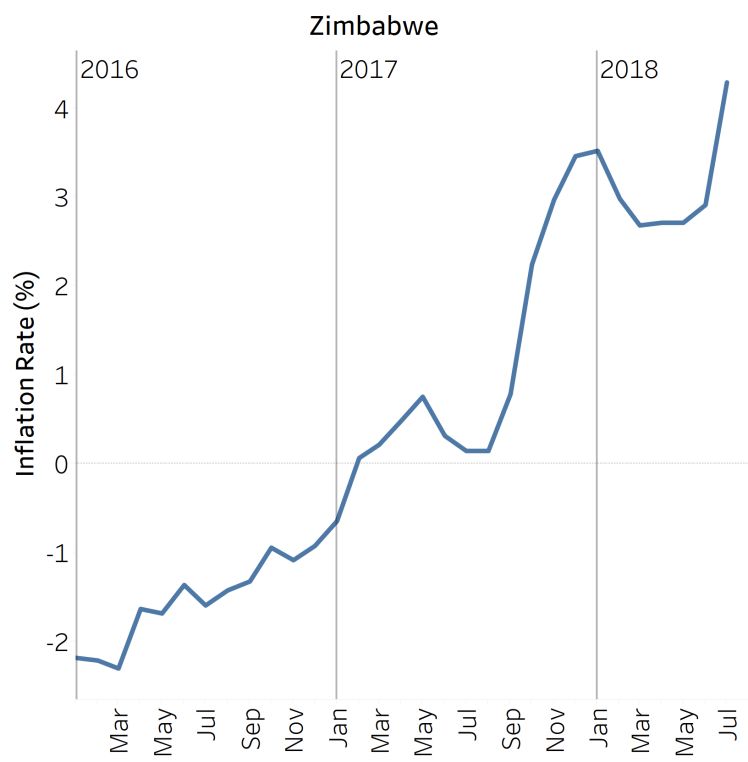
Inflation Rates for the past 12 months were approximately as follows (Figure 7): Angola, 19 percent (July); DRC, 15 percent
(July); Malawi, 9 percent (July); Zambia, 8 percent (August); South Africa, 5 percent (July); eSwatini, 5 percent (April);
Mozambique, 4.7 percent (July); Namibia, 4.5 percent (July); Zimbabwe, 4 percent (July); Lesotho, 4 percent (April); and
Tanzania 3 percent (July).

Although DRC and Angola have the highest inflation rates in the region, they have both been on a downward trend the past
couple of months; Angola’s has dropped by more than 50 percentage points since peaking in late 2016, and DRC’s has dropped
by nearly 80 percentage points since mid-2017.
                                                  Figure 7: Inflation Rates

                                                                              Monthly Regional Food Price Update | September 2018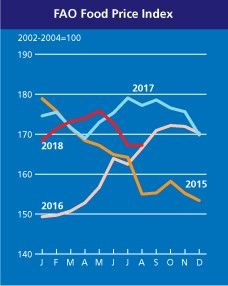
Malawi and Zambia have both seen a slight uptick in their inflation rates, while in Mozambique, Namibia, and South Africa,
inflation has been rising steadily over the past few months. This can be attributed to rising food and fuel prices, among others,
combined with weaker currencies (i.e. in the case of South Africa).

In Tanzania, the inflation rate continued to drop as food prices decreased with the ongoing harvest season. In July, Zimbabwe,
which continues to face liquidity challenges, recorded its highest level of inflation (4.3 percent) since 2012. Although its inflation
rate has been rising rapidly, it still remains relatively low compared to those of other countries in the region.

                                                                                             Data Source: http://www.tradingeconomics.com

                                                                                    Monthly Regional Food Price Update | September 2018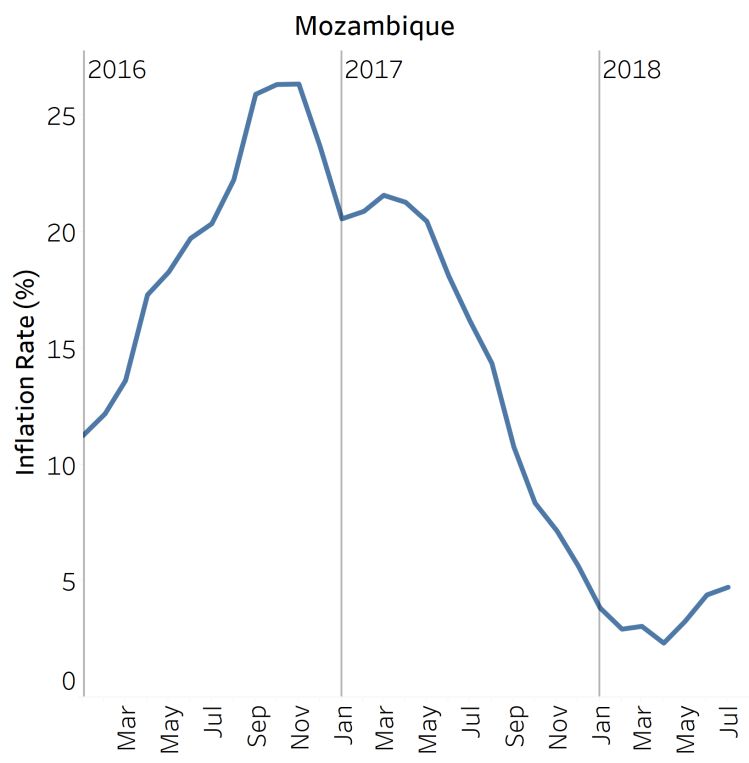
You can also read


