OECD Independent Fiscal Institutions Review - Lithuania's Independent Fiscal Institution
←
→
Page content transcription
If your browser does not render page correctly, please read the page content below

OECD Independent Fiscal Institutions Review

Lithuania’s Independent Fiscal Institution
Budget Policy Monitoring Department (BPMD) in the
National Audit Office of Lithuania
Organisation for Economic Co-operation and Development
                                                                                                         DOCUMENT CODE

      Unclassified                                                                                       English - Or. English
                                                                                                                   1 January 1990

      OECD Independent Fiscal Institutions Review
      OECD Review of the Budget Policy Monitoring Department in the Lithuanian
      National Audit Office

      Lisa.vontrapp@oecd.org and Scherie.nicol@oecd.org

This document, as well as any data and map included herein, are without prejudice to the status of or sovereignty over any territory, to the
delimitation of international frontiers and boundaries and to the name of any territory, city or area.
2│
│3

                                                           Table of Contents

Acronyms and Terms ............................................................................................................................ 5
Summary and Recommendations ........................................................................................................ 6
Introduction and Review Methodology ............................................................................................... 8
Chapter 1: Context ................................................................................................................................ 9
   1.1. Introduction................................................................................................................................... 9
   1.2. BPMD’s governance structure, accountability and stakeholder relations .................................. 10
   1.3. Mandate ...................................................................................................................................... 13
   1.4. Engagement with the global IFI community and adherence to international standards ............. 13
   1.5. Conclusions................................................................................................................................. 19
Chapter 2: Resources and independence .......................................................................................... 20
   2.1. Introduction................................................................................................................................. 20
   2.2. Funding ....................................................................................................................................... 20
   2.3. Human resources......................................................................................................................... 23
   2.4. Access to information ................................................................................................................. 28
   2.5. Independence .............................................................................................................................. 30
   2.6. Conclusions and recommendations............................................................................................. 32
Chapter 3: Outputs and methodologies ............................................................................................. 34
   3.1. Introduction................................................................................................................................. 34
   3.2. Outputs of the BPMD ................................................................................................................. 34
   3.3. Technical assessment of BPMD methodologies ......................................................................... 36
   3.4. Key issues for BPMD reports ..................................................................................................... 40
   3.5. Conclusions and recommendations............................................................................................. 47
Chapter 4: Impact ............................................................................................................................... 48
   4.1. Introduction................................................................................................................................. 48
   4.2. Influence on the public debate .................................................................................................... 48
   4.3. Improved financial management and transparency gains ........................................................... 54
   4.4. Conclusions and recommendations............................................................................................. 55
References ............................................................................................................................................ 56
Annex A. Review team and acknowledgements ................................................................................ 58
Annex B: Interview list ....................................................................................................................... 60

                                                                         Tables
4│
Table 1.1. Does the BPMD meet the OECD Principles for Independent Fiscal Institutions
(assessment of legislation and practice) ........................................................................................ 15
Table 2.1. Annual expenditure of NAO and BPMD 2015-2019 (EUR) ............................................... 21
Table 2.2. BPMD staffing levels 2015-2019 ......................................................................................... 26
Table 3.1. Assessment criteria ............................................................................................................... 36
Table 3.2. Assessment of BPMD’s methodological approaches ........................................................... 37
Table 3.3. Assessment of key outputs relative to peers ......................................................................... 46
Figures
Figure 1.1. OECD IFIs Institutional Models ......................................................................................... 11
Figure 2.1. Mandate and resources of EU IFIs with similar functions to the BPMD............................ 22
Figure 2.2. Organisational chart of the National Audit Office .............................................................. 23
Figure 2.3. Arrangements through which access to information is secured across OECD IFIs ............ 29
Figure 3.1. BPMD reports throughout the year ..................................................................................... 35
Figure 3.2. BPMD use of fan charts – Real GDP .................................................................................. 42
Figure 3.3. BPMD use of fan charts – General Government budget balance ....................................... 42
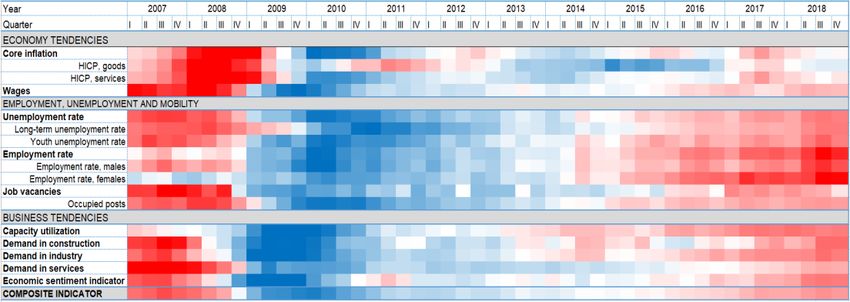
Figure 3.4. BPMD’s “heatmap” of the Lithuanian economy ................................................................ 44
Figure 4.1. BPMD media coverage and report publications 2015-2018 ............................................... 49
Figure 4.2. BPMD media mentions on Opinion on Draft Budget 2015-2018 ....................................... 50
Figure 4.3. Visits to BPMD Websites ................................................................................................... 51
Figure 4.4. BPMD and NAO web sessions and BPMD reports released 2016-2019 ............................ 51
Figure 4.5. Total appearances before parliamentary committees: Nov. 2014-Nov. 2018 ..................... 53
Boxes
Box 1.1. BPMD’s legislative framework .............................................................................................. 10
Box 1.2. The National Audit Office of Lithuania.................................................................................. 12
Box 2.1. Examples of IFIs in small countries that are led by a council ................................................ 25
Box 2.2. Central bank support for the Spanish IFI ................................................................................ 27
Box 2.3. Recruitment of non-nationals across OECD IFIs ................................................................... 27
Box 2.4. The UK OBR’s approach to regular updating its MoUs......................................................... 30
Box 2.5. Examples of Service Level Agreements across OECD IFIs ................................................... 31
Box 4.1. Converting analysis into content for different audiences on digital communications
channels: UK Office for Budget Responsibility ............................................................................ 52│5
Acronyms and Terms
AIReF Spain’s Independent Authority for Fiscal Responsibility
AG Auditor General
BPMD Budget Policy Monitoring Department
CBR Slovak Council for Budget Responsibility
CPI Consumer Price Index
EC European Commission
ECA European Court of Auditors
ESCB European System of Central Banks
EU European Union
EU-IFIs Network of EU Independent Fiscal Institutions
GDP Gross Domestic Product
ICT Information and Communications Technology
IFAC Irish Fiscal Advisory Council
IFI Independent Fiscal Institution
IMF International Monetary Fund
ISSAI International Standards of Supreme Audit Institutions
MIDAS Mixed-data sampling
MoU Memorandum of Understanding
MPs Members of Parliament
NAO National Audit Office
OBR UK Office for Budget Responsibility
OLS Ordinary least squares
PBO Parliamentary Budget Office
PBO Network OECD Network of Parliamentary Budget Officials and Independent Fiscal
Institutions
Seimas Lithuanian Parliament
SAI Supreme Audit Institution
UK United Kingdom
US United States
VAR Vector Autoregressive6│
Summary and Recommendations
The Lithuanian Budget Policy Monitoring Department (BPMD) was set up in 2015
as part of Lithuania’s commitment to sustainable fiscal policies under EU rules upon
joining the European Monetary Union. The BPMD has quickly built a reputation for solid
independent analysis. In a relatively short period, the institution has helped bring about
fiscal transparency gains for Lithuania and generated increased parliamentary and public
debate on fiscal issues.
Lithuania is a small country with a limited tradition of independent institutions.
This led the Government to propose that the independent fiscal institution function be set
up within the National Audit Office (NAO), rather than as a separate institution. The BPMD
is one of three institutions sitting under the NAO – the supreme audit institution, the EU
investment audit institution, and the independent fiscal institution (IFI) – a set-up unique
among its European peers.
The BPMD faces several challenges. The most prominent among them are:
a) The BPMD lacks a clear public identity and visibility, with many stakeholders
unable to distinguish between the work of the BPMD and the NAO. Similarly, the
leadership arrangements lack clarity for many stakeholders.
b) The BPMD lacks operational independence to ensure it can carry out its tasks
effectively over the long-term. The BPMD does not have autonomy over its reports
and operational decisions. Current institutional arrangements mean that the
BPMD’s budget is set at the discretion of the Auditor General.
c) The BPMD struggles to recruit and retain senior staff. This is exacerbated by
its inability to determine salary levels. The recruitment and other processes laid out
by the new Law on Civil Service do not appear to be appropriate for the BPMD or
the NAO in light of international standards related to independence for independent
fiscal institutions and supreme audit institutions.
Given the challenges around resourcing, in the short-term, the BPMD should continue
to invest in strengthening its capacity to deliver its existing mandate. While its self-initiated
work on long-term sustainability has been well-received, more resource intensive functions
such as policy costings should only be considered in the longer term should additional
resources become available. The BPMD could also look for opportunities to leverage
cooperation with others around policy costings.
To enhance the independence of the BPMD and bring it in line with the OECD Principles
for Independent Fiscal Institutions, the review recommends the following:│7 1. The BPMD has benefitted from the strong leadership and support of the Auditor General in its early formative years but the current institutional arrangements for the BPMD do not offer sufficient guarantees of its ability to operate as a sustainable, autonomous and independent institution into the future. To solidify the BPMD’s independence and to clarify its operational arrangements, the BPMD should become a separate institution with its own leadership. An arrangement that has worked well for many small OECD IFIs, has been to enter into a service level agreement with a larger institution, buying back office services. One option, should the BPMD become a standalone institution, would be for the BPMD and the NAO to build on their good relationship, by setting up a service level agreement between the BPMD and the NAO. Alternatively, a standalone BPMD could seek to enter into a service level agreement with another independent institution such as the Bank of Lithuania, as is the case, for example, for the fiscal council in Estonia. 2. In line with OECD Principle 2.5, the BPMD should have the autonomy to make its own hiring decisions (including setting competitive salary levels and being able to hire from international markets). The recruitment process laid out by the new Law on Civil Service does not appear to be appropriate for the BPMD. Given the BPMD’s small size, any loss of staff or delays in recruitment have an outsized impact on the institution. 3. To reinforce its budgetary independence, the BPMD should be able to set its own budget, subject to parliamentary approval. OECD Principle 4.1 states that the appropriations for IFIs should be published and treated in the same manner as the budgets of other independent bodies. 4. Consistent with OECD Principle 7.4, the BPMD should develop a clearer branding in its communications, including considering changing its name to more clearly identify it as Lithuania’s independent fiscal institution. The BPMD should be represented publicly by its own leadership and its reports should be published under its own name. The BPMD communications strategy could also benefit from developing and better tracking and analysing communications-related performance indicators, as well as other measures to assess the BPMD’s impact. 5. To further enhance its transparency and credibility, the BPMD should publish its macroeconomic forecasts, as well as details on its methodology in technical notes, staff working papers, and other types of publications. In line with good practice, the BPMD should also assess and publish its forecasting record over time and as compared with other institutions. Given its current level of resources, the BPMD should focus on strengthening its capacity to deliver its existing mandate.
8│
Introduction and Review Methodology
1. In line with internationally agreed best practice, the Auditor General and the
Director of the BPMD committed to undertaking an independent external evaluation of the
BPMD. The NAO will also be undergoing another peer review by the European Court of
Auditors (ECA) and the Supreme Audit Institutions (SAIs) of Poland and the United
Kingdom.
2. The methodology for this review is anchored in the OECD Principles for
Independent Fiscal Institutions (OECD, 2014) and a subsequent evaluation framework
elaborated within the OECD Network of Parliamentary Budget Officials and Independent
Fiscal Institutions (PBO Network). Principle 9.1 of the OECD Principles for Independent
Fiscal Institutions states that:
“IFIs should develop a mechanism for external evaluation of their work – to be
conducted by local or international experts. This may take several forms: review of
selected pieces of work; annual evaluation of the quality of analysis; a permanent
advisory panel or board; or peer review by an IFI in another country.”
3. The Network of EU Independent Fiscal Institutions (EU-IFIs) reaffirmed this
OECD Principle in their document Defining and Enforcing Minimum Standards for
Independent Fiscal Institutions (2016).
4. The evaluation framework takes as a starting point internationally agreed standards
(e.g. the OECD Principles). As such, the review assesses the BPMD against these
standards, benchmarks it against peer institutions in OECD countries and, where possible,
identifies the difference it has made. The framework covers four main elements:
Context, the institutional setting and mandate of the BPMD
Resources and independence, human and financial resources, access to
information and independence
Outputs, the BPMD’s core products, including effectiveness of the methodology
Impact, of the BPMD’s work, including effectiveness of communications and
stakeholder confidence
5. The evaluation framework follows a performance framework approach used by
governments globally and leverages conventional evaluation tools such as stakeholder
interviews and peer review.
6. The OECD will publish the final report in English and Lithuanian, and make it
available electronically on the OECD’s website. The OECD PBO Network will discuss the
findings of the review at a peer review session during its 2020 Annual Meeting.
The review team
7. The review team included two members of the OECD Secretariat’s Budgeting and
Public Expenditures Division in the Directorate for Public Governance, two international
peers from the United Kingdom (UK) and Ireland, and one local peer. The review also
draws upon contributions from other relevant members of the OECD Secretariat and peers
within the PBO Network. A mission to Vilnius, Lithuania, for stakeholder interviews was
undertaken in April 2019 (see Annex B for more information).│9
Chapter 1: Context
1.1. Introduction
8. Lithuania’s independent fiscal institution, the Budget Policy Monitoring
Department (BPMD) was set up as part of Lithuania’s commitment to sustainable fiscal
policies under EU rules upon Lithuania joining the European Monetary Union. It was
established1 as part of a 2014 legislative package implementing the European Fiscal
Compact and became operational on 1 January 2015 as a department within the National
Audit Office (NAO). Parliament discussed the establishment of the BPMD within the
debate on the larger reform package, however stakeholders noted that little particular
attention was paid to the IFI function apart from a discussion on whether to place the IFI
in the Bank of Lithuania or NAO.
9. Although the BPMD was not directly established in response to the financial crisis,
the crisis did have severe repercussions on Lithuania’s public finances. At the height of the
crisis the total budget deficit rose from .8% of GDP in 2007 to 9.1% in 2009, despite
substantial consolidation measures. Lithuania continued to pursue consolidation measures
(mainly on the expenditure side) until it narrowed to 3.1% of GDP in 2012 (still short of
reaching the target of 3.0% of GDP as set in the 2012 convergence programme).2 More
recently, Lithuania’s economic growth has been relatively robust, mainly fuelled by
domestic demand, particularly household consumption.3
10. Lithuania is a small country relative to other EU and OECD members with a limited
tradition of independent institutions and almost no tradition of think tanks or institutes
working on public finances. These considerations led to the BPMD being set up within the
NAO, an institution which already had a strong reputation for independence. The
alternative of hosting the IFI at the Bank of Lithuania, which arguably enjoys even more
independence and autonomy given the independence of its budget and staffing
arrangements, and the backing of the European System of Central Banks (ESCB), was ruled
out according to stakeholders as potentially violating ESCB rules and deviating too much
from the Bank’s main activities, despite this arrangement being in place in other EU
countries.4
11. Since its establishment, the BPMD has enjoyed broad cross-party support. It has
already experienced one change of government in 20165. Parliamentary elections to form
1
Constitutional Law on the Implementation of the Fiscal Treaty of the Republic of Lithuania, 6 Nov.
2014: https://e-seimas.lrs.lt/portal/legalAct/lt/TAD/c4be7b32bb6b11e4a939cd67303e5a1f
2
Source for figures, Statistics Lithuania.
3
According to the Bank of Lithuania Lithuanian Economic Review (March 2019), see:
https://www.lb.lt/uploads/documents/files/musu-veikla/ekonomikos-analize-
prognozes/lietuvos_ekonomikos_apzvalga_2019-03_en.pdf
4
For example, Lithuania’s close neighbour, Estonia, has a Fiscal Council that works under the
auspices of Estonian central bank.
5
Government changed from a Social Democratic Prime Minister supported by a coalition of several
parties to an Independent prime minister supported by a coalition of the Lithuanian Farmers and10 │
a new government will take place in 2020. A new president – who is independent from any
political party, as was the previous president – was elected in 2019. At present, the BPMD
does not consider there to be an existential threat to its existence from any political party
or major interest group. It should be noted that the President will have to ratify amendments
to the NAO’s legislation if passed in parliament. As a candidate he criticised attacks on the
NAO and the Bank of Lithuania and publicly supported the changes proposed on the new
Law on the National Audit Office.6 The new Auditor General (AG) for the NAO will also
be appointed by the Seimas on the recommendation of the President when the current AG’s
term ends in April 2020.
Box 1.1. BPMD’s legislative framework
The Constitutional Law on the Implementation of the Fiscal Treaty (2014) established the
BPMD to monitor Lithuania’s commitments to sustainable fiscal policies under the
European fiscal framework and sets out the duties of the BPMD. The Law underpins the
BPMD’s independence, stating that “the head of the monitoring authority, his deputies,
civil servants and other officials of the monitoring authority working under employment
contracts must not accept instructions from any other institution and person”.
The Law on National Audit Office (2002) sets out specific protections to ensure that both the
Auditor General and the BPMD Director are independent and non-partisan. However,
concerns have been raised that the 2002 law is insufficient and new legislation has been
submitted to parliament that aims to reinforce the independence of the NAO.
Changes to the Law on Civil Service (1999, amended in 2002 and 2019) adopted in 2019 mean
that the HR recruitment function and performance assessments for civil servants –
including the Director and staff of the BPMD and staff of the NAO – is now centralised
within the Government. These changes have been strongly opposed by the current Auditor
General as limiting the NAO’s functional independence and ability to carry out its duties.
In addition to its enabling legislation, the BPMD has developed its own internal regulations
covering their tasks, functions, rights and organisation of activities.7
Source: Authors, based on public information.
1.2. BPMD’s governance structure, accountability and stakeholder relations
12. As noted above, the BPMD sits in Lithuania’s NAO. The NAO is unique in the
European context in that it comprises three institutions, the Supreme Audit Institution, the
European Union Investment Audit Department and the Budget Policy Monitoring
Department (Lithuania’s independent fiscal institution). Only two other OECD IFIs, France
and Finland, have chosen a similar model placing the IFI function in the supreme audit
Greens Union (currently the largest party in parliament) and the Social Democratic Party of
Lithuania.
6
See article on DELFI, a major internet news portal for Estonia, Latvia and Lithuania:
https://www.delfi.lt/news/daily/lithuania/gitanas-nauseda-kas-vyksta-musu-
valstybeje.d?id=80807061https://www.lrytas.lt/lietuvosdiena/aktualijos/2019/04/04/news/preziden
to-posto-siekiantis-g-nauseda-nepriklausomos-institucijos-yra-torpeduojamos--9841810/
7
Internal regulations are available in Lithuanian at: http://www.ifi.lt/puslapis.aspx?id=2│ 11
institution, although Finland has now also established a separate Economic Policy Council.
In the Finnish case independent monitoring and evaluation is assigned to the institution
within the audit institution and the Economic Policy Council now gives ex ante advice.
Figure 1.1. OECD IFIs Institutional Models
3
11
22
Legislative budget office Fiscal council Audit institution
Note: The data includes 36 OECD IFIs, including three subnational IFIs in Australia (Victoria), Canada
(Ontario) and the United Kingdom (Scotland) and one supra-national IFI, the European Fiscal Board. The data
includes two IFIs for Austria, Finland, Greece, and Ireland. IFIs in non-OECD countries are excluded.
Source: (OECD, 2019).12 │
Box 1.2. The National Audit Office of Lithuania
The NAO has as its mission to “help the State in managing public funds and property
wisely”. Although legally a single institution headed by the Auditor General, the NAO
performs the functions of three independent institutions:
1. The Supreme Audit Institution undertakes financial (compliance) audits and
performance audits.
2. The European Union Investment Audit Department evaluates implementation of
European Funds.
3. The Budget Policy Monitoring Department endorses the macroeconomic forecasts
used for fiscal planning; assesses budgetary forecasts, assesses ex ante and ex post
fiscal rules, assesses draft annual budgets, and monitors fiscal policy and budgetary
execution.
Source: Authors, based on public information from the National Audit Office.
13. Placing the independent fiscal institution function within the NAO has allowed the
BPMD to benefit from the NAO’s already well-established reputation for independence
and credible analysis. It is also able to draw upon shared administrative and financial
services. However this arrangement also poses certain risks to its independence,
particularly around budget and staffing, which will be discussed in more detail in
subsequent chapters. Stakeholders also noted that the BPMD has struggled to establish a
distinct public identity among stakeholders and the public. Finally, while the BPMD
benefits from support services, there is little overlap in terms of the technical skills that can
be fruitfully shared.
14. The BPMD is headed by Lithuania’s AG who has overall responsibility for its
management decisions and, along with the BPMD Director and senior BPMD staff,
represents the BPMD publicly. The AG is nominated by the President and approved by the
parliament for a term of five years, renewable once. The AG is responsible for hiring the
BPMD Director. In practice, day to day management is carried out by the BPMD Director.
The Deputy AGs are consulted on the BPMD’s reports and reports are reviewed signed off
by the AG.
15. In line with the OECD Principles, in April 2016 the BPMD established a three-
member Advisory Panel of international experts. The Advisory Panel provides advice on a
range of issues, as well as methodological assistance. While the BPMD does not officially
subject its work to other sorts of peer review, it may receive comments from the Bank of
Lithuania and it benchmarks its reports against the reports of other IFIs. The BPMD has
enjoyed support from professional partners nationally and internationally (see also section
1.4).
16. As a part of the NAO, the BPMD is accountable to the Seimas. As noted above the
appointment of the AG must be approved by parliament. The Seimas – in particular the
Committee on Audit and the Committee on Budget and Finance – regularly uses BPMD
analysis and the AG, the Director of the BPMD and other senior BPMD staff regularly go
before parliamentary committees to give evidence. Despite being a young and small
institution, the BPMD is well received at the parliament, but its work is not always
distinguished from that of the other functions of the NAO. The parliament does not have
independent budgetary analysis capacity of its own.│ 13
17. The Government is not formally required to respond to reports and
recommendations from the BPMD, although in practice they have commented in
committee meetings or in the media. The BPMD may hold informal talks with the Ministry
of Finance and Bank of Lithuania before an official issuance of the IFI opinion. The BPMD
has a close working relationship with the Bank of Lithuania in general and frequently
exchanges views on economic development and public finances. Apart from
macroeconomic forecasting done by private banks, there are no other institutions providing
similar or complementary analysis.
1.3. Mandate
18. The BPMD has a fairly broad mandate to promote sustainable public finances and
stable economic development. The BPMD endorses the macroeconomic forecasts used for
fiscal planning; assesses budgetary forecasts, assesses ex ante and ex post fiscal rules,
assesses draft annual budgets, and monitors fiscal policy and budgetary execution. As such,
the BPMD is legally mandated to submit five opinions to Parliament each year (see Chapter
3 for details).
19. In the case of exceptional circumstances, the BPMD is mandated to give its opinion
on the situation of the economy once per quarter. Until now, there has been no unusual
fiscal event and the BPMD has not had to issue any opinion in this regard. Should this
change, it will be a significant test of the BPMD as real resistance to the IFI function may
only become apparent when risks of non-compliance or substantial disagreements with
government arise.
20. BPMD analysis covers the general government sector. In accordance with the
Constitutional Law on the Implementation of the Fiscal Treaty the BPMD began
monitoring compliance of municipalities with fiscal rules on 1 January 2016 for
municipalities where planned appropriations did not exceed 0.3 % of the previous GDP and
on 1 January 2018 for municipalities where planned appropriations exceeded 0.3 % of the
previous GDP.
21. The BPMD may undertake work at its own initiative. In 2016 and 2017, the BPMD
took the initiative to publish an assessment of long-term fiscal sustainability. In 2018, the
BPMD published an assessment of the Stability Programme; this will be an annual report
coming out in May.
22. The policy costing function across government ministries is very weak. Some
stakeholders expressed interest in the BPMD undertaking a role in policy costings.
However, OECD IFIs generally find that this is a resource intensive function and at present
the BPMD lacks the necessary capacity.
1.4. Engagement with the global IFI community and adherence to international
standards
23. Article 9 of the Constitutional Law on the Implementation of the Fiscal Treaty
states that “the monitoring authority shall have the right to involve independent Lithuanian
and foreign experts”. From the outset, the BPMD has made a concerted effort to learn from
the experience of more established IFIs and to share good practice. The BPMD is an active
participant in the regional Baltic-Nordic IFI Network, as well as the EU IFI Network and
the OECD’s PBO Network. Outside of the IFI community, international organisations, such
as the European Commission, the OECD and the IMF, engage with the BPMD and its work
when carrying out assessments in Lithuania.14 │
24. Standards developed by the OECD and EU IFI communities, as well as the rich
literature on independence for other independent institutions such as central banks and
supreme audit institutions, provide a useful comparative context in which to evaluate the
BPMD. The BPMD stands apart from the majority of its peers in that it is located within
the National Audit Office. As such, any impediments to the independence and good
functioning of Lithuania’s NAO, also impact upon the BPMD. The review team supports
efforts by the NAO to review and strengthen the mechanisms for its independence in line
with good international practice for SAIs.
25. Analysis demonstrates that the BPMD globally meets the OECD Principles many
of which are reaffirmed by the EU-IFI Minimum Standards (see Table 1 below). This
adherence to defined global standards provides the BPMD with legitimacy among peer
institutions and should provide confidence to its stakeholders in Lithuania. Nevertheless,
the review identifies risks inherent to the BPMD’s current institutional arrangements and
areas where the BPMD’s functional independence could be reinforced.│ 15
Table 1.1. Does the BPMD meet the OECD Principles for Independent Fiscal Institutions (assessment of legislation and practice)?
Key: =yes; =partial; = no
OECD Principle Is there Assessment Notes
related EU-
IFI
Principle
1. LOCAL OWNERSHIP
1.1 Broad national ownership, commitment, and In preamble
consensus across the political spectrum. Models from
abroad should not be artificially copied or imposed.
1.2 Local needs and the local institutional In preamble The institutional model selected for the BPMD reflects
environment should determine options for the role and Lithuania’s institutional landscape, however stakeholders do not
structure of the IFI. always distinguish the work of the BPMD from that of the other
functions of the NAO.
2. INDEPENDENCE AND NON-PARTISANSHIP
2.1 Does not present its analysis from a political Although it is not legally prohibited from doing so, the BPMD
perspective; strives to demonstrate objectivity and refrains from providing normative advice or specific
professional excellence, and serves all parties. IFIs recommendations on policy issues.
should be precluded from any normative policy-
making responsibilities to avoid even the perception
of partisanship.
2.2 The leadership of an IFI should be selected on the Although this has been the case to date, should the NAO (and
basis of merit and technical competence, without therefore the BPMD) continue to be subject to the new Law on
reference to political affiliation. The qualifications Civil Service, the recruitment process and performance
should be made explicit. assessments for the BPMD Director would be centralised within
the Government presenting a potential risk to this principle.
2.3 Term lengths & number of terms that the The Auditor General holds a five-year term renewable once.
leadership of the IFI may serve should be clearly Legislation sets out six criteria for the AG’s dismissal. In
specified in legislation along with dismissal criteria & accordance to the Constitution, the Seimas, by a majority vote of
process. all of its Members, may dismiss the Auditor General from office
following a loss of confidence. This provision generates a risk to16 │
the independence of the Auditor General and is not in line with the
International Standards of Supreme Audit Institutions (ISSAI).
The BPMD Director is a permanent position subject to the Law on
Civil Service.
2.3 The leadership’s term should optimally be The AG has a five-year term of office, delinked from the political
independent of the electoral cycle. cycles of the President and Parliament. The BPMD Director is not
subject to term limits.
2.4 The position of head of the IFI should be a This applies to both the AG and the Director of the BPMD.
remunerated and preferably full-time position. Strict
conflict-of-interest standards should be applied.
2.5 The leadership of the IFI should have full freedom The new Law on Civil Service limits independence. It centralises
to hire and dismiss staff in accordance with applicable recruitment and performance assessments for NAO and BPMD
labour laws. staff within the Government and defines salary bands and job
titles among other things.
2.6 Staff should be selected through open competition See above.
based on merit & technical competence, without
reference to political affiliation, in line with civil
service conditions.
3. MANDATE
3.1 The mandate should be defined in legislation,
including types of reports and analysis they are to
produce, who may request them and timelines for
release.
3.2 IFIs should have the scope to produce reports and BPMD publications are reviewed by the AG and signed off by the
analysis at their own initiative and autonomy to AG. Deputy AGs are consulted on BPMD publications.
determine their own work programme within their
mandate.
3.3. Clear links to the budget process should be
established within the mandate.
4. RESOURCES
4.1 The resources allocated to IFIs must be In general, the BPMD’s level of funding is similar to what was
commensurate with their mandate. anticipated when established.
4.1 The appropriations for IFIs should be published The BPMD’s budget allocation is part of the NAO budget.
and treated in the same manner as the budgets of other According to the Law on the Budget Structure the NAO is an
independent bodies. “appropriation manager” and the AG is Head of the “appropriation│ 17
manager”. As such the BPMD’s budget at the discretion of the
Auditor General. Although the BPMD has its own budget line
within the NAO’s budget, “For the implementation of the budget
policy monitoring functions”, these resources are not ring-fenced
and may be adjusted. It should also be noted that there are potential
concerns around the independence of the NAOs budget which will
be covered in a forthcoming review. To align with ISSAI-10.8, the
NAO should be free to propose its budget to the Parliament
without interference from the executive; moreover, it should have
the right of direct appeal to the Legislature if resources provided
are insufficient.
4.1 Multiannual funding commitments may further The BPMD’s budget is set by the Auditor General on an annual
enhance IFIs independence and provide additional basis along with provisional information on allocations for the
protection from political pressure. subsequent two years.
5. RELATIONSHIP WITH THE LEGISLATURE
5.1 Mechanisms should be put in place to encourage The Auditor General is appointed by Parliament, and the NAO
appropriate accountability to the legislature. submits its annual work program and its annual report to
Parliament’s Audit Committee. The BPMD’s work programme
and annual report are an integral part of these. The BPMD submits
its reports and opinions to parliament. NAO leadership and BPMD
senior staff appear before parliamentary committees.
5.1 The budgetary calendar should allow sufficient
time for the IFI to carry out analysis necessary for
parliamentary work.
5.2 The role of the IFI vis-a-vis the parliament’s While the Law does not clearly lay out how BPMD should
budget committee (or equivalent), other committees, respond to parliamentarians’ requests for analysis, in practice, the
and individual members in terms of requests for few requests that the BPMD has received have been in relation to
analysis should be clearly established in legislation. compliance with the fiscal rules and so were related to BPMD core
analysis. Answers to such requests are provided through an
official letter from the AG drawing on the official reports of the
BPMD.
6. ACCESS TO INFORMATION
6.1 IFI should have full access to all relevant In practice, the BPMD tends to be given access to relevant
information in a timely manner. government information in a timely manner. Access to18 │
information is supported by MoUs signed between the BPMD and
government stakeholders.
6.2 Any restrictions on access to government
information should be clearly defined in legislation.
7. TRANSPARENCY
7.1 IFI should act as transparently as possible, The BPMD has its own website detailing its work and operations.
including full transparency in their work and
operations.
7.2 IFI reports and analysis (including underlying data All opinions and reports are published and made available on the
and methodology) should be published, made freely BPMD’s website, however due to resource constraints the BPMD
available to all and sent to parliament. has not published macroeconomic forecasts and underlying
methodologies.
7.3 The release dates of major reports and analysis Although not specified in legislation, the publication dates of each
should be formally established, especially in order to of the BPMD’s reports are formally established in a calendar made
coordinate them with the release of relevant public on its website.
government reports and analysis.
7.4 IFIs should release their reports and analysis, on Under the current institutional arrangements, BPMD reports are
matters relating to their core mandate on economic signed by the AG and released under the logo of the NAO.
and fiscal issues, in their own name.
8. COMMUNICATIONS
8.1 IFIs should develop effective communication Although the BPMD relates with the media, its institutional
channels from the outset. arrangements mean that even the specialist media do not always
distinguish the BPMD’s functions from that of the NAO.
9. EXTERNAL EVALUATION
9.1 IFIs should develop a mechanism for external Advisory board established (2016) and first external evaluation
evaluation of their work. conducted by international experts (2019).│ 19
1.5. Conclusions
26. Although it is still a young and small organisation, the BPMD has quickly built a
reputation for solid independent analysis among stakeholders. The BPMD has also been
proactive in sharing experiences and learning from counterparts in the Bank of Lithuania
and peer institutions internationally.
27. The BPMD’s legal framework, governance, mandate and institutional landscape
inform and affect its operations. The choice to place the IFI function in the NAO reflects
the fact that Lithuania is a small country with a limited tradition of independent institutions
and think tanks or institutes working on the public finances.
28. This institutional set up is rare among OECD IFIs. It has brought both advantages
and challenges to how the BPMD operates as an IFI, in particular in relation to budget,
staffing, as well as visibility of the BPMD with stakeholders. Due to the current institutional
arrangements, any impediments to the independence and good-functioning of Lithuania’s
NAO also impact directly upon the BPMD. The review team supports efforts by the NAO
to review and strengthen the mechanisms for its independence in line with good
international practice for SAIs.20 │
2. Chapter 2: Resources and independence
2.1. Introduction
29. This chapter looks at the extent to which the BPMD has sufficient resources and
independence to deliver its mandate. This includes human and budgetary resources, but
also access to information. The extent to which these resources are predictable and
sustainable impacts whether the IFI has the necessary level of independence to carry out its
work. According to the OECD Principles, an IFI must have resources commensurate with
its mandate to fulfil it in a credible manner and mechanisms in place to prevent pressure
being placed on the institution through the budget (Principle 4.1). An IFI must also have
access to all relevant information in a timely manner, including methodology and
assumptions underlying the budget and other fiscal proposals (Principle 6.1). Finally, non-
partisanship and independence are pre-requisites for any successful IFI (Principle 2.1).
30. Analysis indicates that the BPMD has received resources commensurate with its
mandate. However, it lacks budgetary independence as compared to peer IFIs and does not
align with the OECD Principles in this regard. The BPMD cited the general shortage of
economists and public finance experts in Lithuania, together with the BPMD’s low salary
levels and some restrictions on hiring non-nationals, among reasons they have struggled to
recruit and retain the skilled staff necessary to deliver its work. Although the BPMD has a
Director who leads its day to day operations, the post holder reports to the Auditor General
who takes key decisions such as funding for the institution and signs all of the BPMD’s
publications. While the BPMD’s positioning within the NAO has served it well in its initial
years, it also raises questions as to how to strengthen the institution’s visibility,
independence and sustainability in the longer term. The BPMD has had relatively good
access to information, although at times it has experienced problems with the quality and
timing of responses.
2.2. Funding
31. The BPMD is funded through the budget of NAO. In general, the BPMD’s current
level of funding is similar to what was anticipated by stakeholders in Lithuania at the time
of its creation, and its resources are viewed as commensurate with the scope of its mandate.
Its budget is set by the Auditor General on an annual basis along with provisional
information on allocations for the subsequent two years. Although the BPMD has its own
budget line within the NAO’s budget, “For the implementation of the budget policy
monitoring functions”, these resources are not ring-fenced and can be adjusted.
32. The NAO is funded by the State budget, with the exception of the European Union
Investment Audit Department function which is financed from the EU structural funds. At
present its budget is set by the Ministry of Finance. The Seimas approves the State budget
and supervises its execution. However, there are moves to strengthen the independence of
the NAO and its accountability to parliament. In particular, a draft law currently under
consideration by parliament proposes to amend the Statute of the Seimas of the Republic
of Lithuania so that the NAO’s budget allocation be subject to the consideration of the
Audit Committee.
33. In 2019, the allocation for the BPMD accounted for just under 3% of the NAO’s
budget. However, this does not take into consideration certain costs, in particular the costs│ 21
related to NAO support staff that also support the BPMD, or NAO management support to
the BPMD. The NAO has indicated that should these costs be taken into consideration the
budget would increase considerably.
34. While the budget allocation for the NAO has remained stable over the period 2015
to 2019 (with increases only from restoration of unlawfully reduced salaries for civil
servants8), the budget allocation of the BPMD has increased 73%. This has been driven by
growing payroll costs as the BPMD sought to hire its full staff complement. Staff costs
made up 82% of BPMD expenditure in 2018. The remainder of the BPMD’s costs are
overheads (e.g. rent of tangible and intangible assets, communal services, business trips,
training courses, the purchase of other goods and services, etc.).
Table 2.1. Annual expenditure of NAO and BPMD 2015-2019 (EUR)
2015 2016 2017 2018 2019 Compound
average
growth rate
2015-2019
NAO 8,475,000 8,662,000 8,674000 8,662,000 9,272,000 2.3%
BPMD 141,985 203,703 194,944 242,820 245,000 14.6%
BPMD as a
1.7% 2.4% 2.2% 2.8% 2.6% N/A
% of NAO
Note: Figures for the BPMD do not include costs related to support provided by NAO staff. Figures for 2019
are indicative. The BPMD figure for 2019 has been adjusted to remove the exceptional costs associated with
this OECD Review.
Source: Authors, based on information provided by the BPMD.
35. Although the financial resources available to the BPMD have significantly
increased in recent years, its resourcing remains lower than that of peer institutions with
similar functions (see Figure 2.1 below). This may partly be explained by Lithuania being
a small country relative to EU peers, as well as having lower labour costs.
8
The NAO was allocated additional funds following the ruling of the Constitutional Court on the
restoration of unlawfully reduced salaries for civil servants during the economic crisis (2009-2013).22 │
Figure 2.1. Mandate and resources of EU IFIs with similar functions to the BPMD
Note: The Spanish IFI has a broader mandate additional responsibility for sub-national fiscal oversight and
spending review which partly explains its additional resourcing. Data on the budget for Austria are not
available. Staff includes council members.
Source: (OECD, 2019).
36. The current Auditor General has been receptive to the growing funding needs of
the BPMD. The BPMD has never been threatened with budget cuts or similar action when
perceived as critical by the Government. Nevertheless, the BPMD’s budget stands at the
entire discretion of the Auditor General and there is the risk that a future Auditor General
may not view the BPMD as favourably when it comes to the allocation of resources across
the three institutions within the NAO.
37. A number of stakeholders expressed a preference for increased budgetary
protections for the BPMD, and in particular, the BPMD having the ability to set its own
budget subject to approval by the Audit Committee at the Seimas. This would also bring
the BPMD in line with the existing practices of many OECD IFIs and Supreme Audit
Institutions (SAIs), along with the OECD Principles (Principle 4.1), which state that:
“the appropriations for IFIs should be published and treated in the same manner
as the budgets of independent bodies, such as audit offices, in order to ensure their
independence” (OECD, 2014).
38. Alternatively, it would be beneficial for the BPMD to have its own budget line
within the State budget document. This would provide greater transparency on the level of
resourcing given to the BPMD. This good practice of having a separate budget line has
already been adopted in almost half of OECD countries with an IFI (OECD, 2019).
39. It should also be noted that there are potential concerns around the independence
of the NAOs budget which will be covered in a forthcoming review. To align with ISSAI-
10.8, the NAO should be free to propose its budget to the Parliament without interference
from the executive; moreover, it should have the right of direct appeal to the Legislature if
resources provided are insufficient.│ 23
2.3. Human resources
2.3.1. Leadership
40. As the BPMD is part of the NAO, the head of the BPMD is the Auditor General.
The Director of the BPMD sits below the Auditor General, as shown in Figure 2.2. The
Director of the BPMD directly reports to the Auditor General. The Deputy AGs also
comment on all of the BPMD’s reports.
Figure 2.2. Organisational chart of the National Audit Office
Note: Organisational chart as of January 2019.
Source: https://www.vkontrole.lt/page_en.aspx?id=217
41. The Auditor General is appointed by Parliament on the recommendation of the
President of the Republic for a five-year term, renewable once. This is the same term length
as the presidential term (although not necessarily concurrent) and longer than the legislative
term of four years. The Law on the National Audit Office sets out that the Auditor General
can be any citizen of the Republic of Lithuania who has an impeccable reputation, is not
older than 65 years old, and has a higher university education. It also sets out six criteria
for dismissal. The Auditor General may be dismissed: i) when they resign, ii) when their
term expires, iii) in the case of a no-confidence vote, iv) due to illness, v) in case of a court
decision where they are found guilty and vi) in the case of them losing their Lithuanian
citizenship. Regarding the third provision, in accordance to the Constitution, the Seimas,
by a majority vote of all of its Members, may dismiss the Auditor General from office
following a loss of confidence. This provision generates a risk to the independence of the
Auditor General and is not in line with the International Standards of Supreme Audit
Institutions (ISSAI).24 │
42. By contrast, the appointment and dismissal of the director of the BPMD is subject
to different legal procedures. While the Law on National Audit Office sets out that the
NAO can select requirements for, and restrictions on, the Director’s recruitment, it is the
Law on Civil Service that defines responsibilities, remuneration and also the procedure for
their recruitment. Changes to the Law on Civil Service that came into force in January 2019
mean that the HR recruitment function for civil servants – including the Director of the
BPMD and other staff at the NAO – is now centralised within the Government. This could
diminish the independence of the BPMD given that the Ministry of the Interior, which will
become responsible for the recruitment of BPMD staff, is accountable to the Ministry of
Finance, the BPMD’s main governmental interlocutor. It could cause recruitment
difficulties for the BPMD due to creating a more lengthy recruitment process and being
insufficiently flexible for the institution’s needs (for example, “economist” is not a
profession listed in the recruitment categories). In general, the new process is inappropriate
for an institution as small and unique as BPMD.
43. The Auditor General strongly opposes these changes and has written a letter to the
Speaker of the Seimas explaining that “Such a system will hamper impartiality,
independence and autonomy of the National Audit Office performance and my capacity, as
the head of the supreme audit institution, to independently and autonomously select civil
servants for the National Audit Office”. It is interesting to note that other institutions have
also expressed concerns for their own functioning.
44. These changes are one of the reasons why a number of stakeholders have raised
concerns that the enabling legislation for the NAO – passed in 2002 – has become obsolete,
with insufficient provisions guaranteeing the independence and non-partisanship of the
Auditor General and the Director of the BPMD. A draft law amending the Law on the
National Audit Office aims to reinforce the independence of the institution and has been
under examination by Parliament for over a year. Among other things, the Auditor General
is seeking amendments to the Law on the National Audit Office to exclude the NAO and
the BPMD from centralised recruitment procedures and performance assessments.
45. The delay to the amendment of the Law on the National Audit Office poses risks
for both the NAO and the BPMD in terms of both institutions being under-resourced. The
significant concerns that the Auditor General has regarding the new recruitment procedures
for NAO and BPMD staff prevent him from replacing staff that have recently left the
institution. The BPMD’s first Director resigned in May 2019 to take on a position as Deputy
Governor of the Bank of Lithuania. Having key positions unfilled for extended periods
poses a significant risk to its ability to function effectively.
46. As a part of the NAO that reports to the Auditor General – both in a financial and
decision-making capacity – the BPMD is not functionally independent as compared to most
peer OECD IFIs. To date, the good working relationship between the NAO and the BPMD
has been underpinned by positive personal relationships between the Auditor General and
the first Director of the BPMD. However, there is no guarantee that this positive
relationship will continue with the advent of new leadership. Should the NAO and the
BPMD move to reinforce the BPMD’s independence, mechanisms should be put in place
to give the Director greater decision-making autonomy.
47. It was suggested by some stakeholders that the BPMD could evolve to be a separate
institution led by a small council of independent experts. A council could provide strategic
leadership, quality assurance, and serve as a public face to further engage stakeholders and
communicate the BPMD’s outputs. A key concern however, is the very small pool of
national independent experts available to sit on such a council. Similar concerns have│ 25
existed in other small OECD countries looking to establish fiscal councils. However, in
practice these institutions have managed to find sufficient suitable candidates. One strategy
has been to recruit nationals living abroad or, in some cases, non-nationals (for example,
in Ireland, Portugal and Sweden) although in the case of Lithuania there are naturally
concerns about the ability to work in the local language. Box 2.1 outlines the cases of
Estonia and Latvia, which are both countries that are smaller than Lithuania but that have
an IFI led by a small council of independent experts.
Box 2.1. Examples of IFIs in small countries that are led by a council
Estonia
Estonia has a population of 1.3 million. When the Estonian Fiscal Council was first
established, there were some concerns about the ability to find suitable candidates for its
six member council. The statute of the Estonian Fiscal Council requires the central bank’s
Supervisory Board to nominate the Fiscal Council’s Chair, Vice-Chair and four members
for a period of office of five years at the proposal of the Governor of the central bank.
However, through looking for experts across academia, the private sector and the central
bank, on 14 May 2014 the Supervisory Board was able to appoint the first membership of
the Fiscal Council. In March 2019, the Supervisory Board of the central bank approved the
proposal of the Governor of the central bank that the same experts should remain in post
for the next five years. This decision was taken because the current council members work
very well together, and not because of a lack of alternative candidates.
Latvia
Latvia has a population of 1.95 million. When the Latvian Fiscal Discipline Council was
being established, the Ministry of Finance had concerns about being able to source experts
for its six-member Council. Council members are put forward by the Saeima (parliament),
the President of the Bank of Latvia and the Minister of Finance and have six year terms. In
order to boost the potential pool of candidates, some members of the council have been
sourced from outside Latvia. The council currently includes two foreign experts (one
Danish academic and the Deputy Governor of the Central Bank of Estonia) in addition to
four Latvian nationals. It is anticipated that future council members might be former staff
members of the Ministry of Finance, the Central Bank, commercial banks, the European
Commission or peer IFIs with an expertise in macroeconomic or fiscal issues.
Source: Authors, based on information provided by the Estonian Fiscal Council and Latvian Fiscal
Discipline Council.
2.3.2. Staffing
48. Fully staffed, the BPMD should have around ten staff members to enable it to
deliver its mandate of endorsing the official macroeconomic forecasts, assessing
compliance with fiscal rules, and budget analysis. At the time of this review it only has six
staff members, with four vacant positions, including vacancies in key leadership positions
(see Table 2.2). Of these, five staff are women. Staff have an educational background in
economics, econometrics and mathematics, and typically hold a master’s degrees. The
professional background of staff tends to be either public policy, statistics, or economics.
One staff member was hired straight out of university, one came from the Ministry of
Finance, two from Statistics Lithuania, one from a non-governmental organisation, and one
from the private sector. The average age is 34 years old.You can also read


