Roadmap towards a Competitive European Energy Market - World Energy Council
←
→
Page content transcription
If your browser does not render page correctly, please read the page content below
Roadmap towards
a Competitive
European Energy
Market

World Energy Council

For sustainable energy.

Roadmap towards a
Competitive European
Energy Market
Roadmap towards a Competitive European Energy Market                  Published 2010 by:

                                                                      World Energy Council
                                                                      Regency House 1-4 Warwick Street
Copyright © 2010 World Energy Council                                 London W1B 5LT United Kingdom

                                                                      ISBN: 0 946121 38 9
All rights reserved. All or part of this publication may be used or
reproduced as long as the following citation is included on each
copy or transmission: ‘Used by permission of the World Energy         Disclaimer:
Council, London, www.worldenergy.org’                                 This report reflects the views of WEC European Members and
                                                                      does not necessarily represent the view of all WEC members.
Roadmap towards a Competitive European Energy Market World Energy Council 2010

Study Group Members

Bulgaria                                   Stefan Kanchovski, NEK EAD
                                           Dimcho Kanev, NEK EAD
Czech Republic                             Pavel Solc, CEPS a.s.
France                                     Michel Matheu, EdF
                                           Florence Fouquet, GdF
Germany                                    Henning Rentz, RWE
                                           Stefan Ulreich, E.ON AG
Italy                                      Alessandro Clerici, ABB SpA
                                           Bruno Cova, CESI
                                           Francescs Massara, TERNA
                                           Massimo Ceccariglia, TERNA
The Netherlands                            Theo W. Fens, UCpartners
Poland                                     Dr. Pawel Kuraszkiewicz
Romania                                    Roxana Palade, OPCOM
                                           Victor Ionescu, OPCOM
Serbia                                     Dejan Mandic, Energoprojekt Entel
Spain                                      Helena Nosei, Union Fenosa
                                           Sergio Auffray, Union Fenosa
                                           José Antonio García Merino, Union Fenosa
Sweden                                     Gunnar Lundberg, Vattenfall AB (Chair)
Switzerland                                Niklaus Zepf, AXPO

WEC                                        Slav Slavov, Regional Manager for Europe
                                           Jean-Eudes Moncomble, Observateur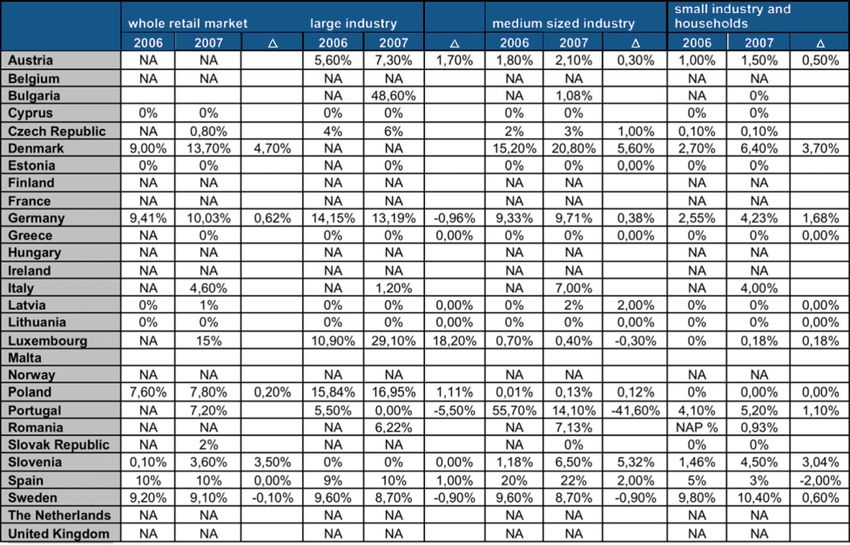
Roadmap towards a Competitive European Energy Market World Energy Council 2010

Contents

Introduction                                                                                      1

Electricity Market Description                                                                    2

Definition of Goals for the Power Market                                                          10
      Efficiency and Competitiveness                                                              10
      Supply Security                                                                             10
      The Environment                                                                             11
      Conclusions                                                                                 12
Status in the European Power Markets                                                              14
      From National Markets to Regional Markets                                                   14
      Common Misperceptions about Competition                                                     19
      Prerequisites for Competition                                                               22
      Deficits in the Current European System                                                     25
Regional and National Electricity Markets: An Overview                                            26
      Introduction and an Overview of Europe’s Current Electricity Demand                         26
      Regional European Energy Markets                                                            28
      Conclusions                                                                                 60
Renewable Energy                                                                                  61
      Introduction                                                                                61
      Why Encourage the Increase of RES-E in the Generation Mix?                                  61
      What Are the Available Mechanisms to Promote RES-E?                                         63
      Which of these Mechanisms Are the Most Effective and Efficient?                             65
      What Are the Technical Issues Surrounding Integration
      of the RES-E Grid into Europe’s Generation Mix?                                             67
      What Are the Current Status and the Future Goals for RES-E in Europe?                       74
      Conclusions                                                                                 74
Obstacles                                                                                         76
      Political Obstacles                                                                         76
      Technical Obstacles                                                                         76
      Market Obstacles                                                                            77
Roadmap and Recommendations                                                                       78
      Annex 1                                                                                     82
      Annex 2                                                                                     85
      Annex 3                                                                                     87
      References                                                                                  89
Roadmap towards a Competitive European Energy Market World Energy Council 2010

                                                                                                                   1

Introduction

With the financial crisis evolving into a severe,        up this process will result in lost momentum and
global economic recession, there have been               then inertia. One possible solution to this challenge
growing doubts over whether energy markets can           would be to define a core-European region as a
continue to operate efficiently under present            model region for competitive markets. To this end,
conditions or whether the shift to non-market            policymakers and European market players should
mechanisms would be a better choice. This                better co-ordinate their efforts to attract the
question remains an ongoing source of debate in          necessary investments and to implement updated
the recently liberalised electricity sector.             regulations and smart market solutions.

Textbook wisdom says that the market is the most         This report focuses primarily on the electricity
efficient place to allocate financial means for          market. Though the EU-directive for liberalisation of
investments. Therefore, during a period of a crisis,     European electricity and gas markets (February
it should follow that we actually need more market       1996) and subsequent provisions have addressed
mechanisms, not fewer, if we want to stimulate           electricity and gas under the same heading, the
investments in an economically efficient way.            authors of this report maintain that these markets
Regulated electricity prices and nationalistic           are actually quite different in nature and deserve to
thinking will not help to solve Europe’s electricity     be studied independently. Carrying out another
challenges with regards to either the generation or      report focused specifically on the gas market would
the transportation of electricity.                       be desirable and would have a complementary
                                                         value to this study.
For the electricity market, the central danger of the
current recession is that countries will revert to       Renewable energies are playing an increasing role
national thinking and protectionism to the detriment     in power generation, and they are a valuable
of Europe as a whole. Increased protectionism will       contribution to Europe’s energy security and
almost certainly stop further investments into the       Europe’s sustainable energy development. The
European grid infrastructure, and it will slow the       recent EU-Energy Climate Package has fixed
exchanges between different national markets that        ambitious targets to integrate renewable energy
Europe so desperately needs. Grid improvements           sources into Europe’s energy mix, and those
are the core challenge for the European electricity      targets are being encouraged by a number of
sector, and the successful completion of these           policy incentives. However, many economic and
improvements is necessary if regional markets are        operational problems still exist. Renewables are
going to take the next steps towards a truly             not yet competitive, and the existing large grids still
common European market.                                  need to adapt to and ease the access of smaller,
                                                         decentralised RES-electricity producers without
This report describes the current situation of           causing operational failures to the system. The
European electricity markets. It clearly shows that      study broadly considers all of these issues and
the various European markets are still in different      recommends some market–based solutions to
stages of development and in opening themselves          solve them.
up to fair market competition. The process of
integration must be accelerated. Failure to speed
Roadmap towards a Competitive European Energy Market World Energy Council 2010

2

    Electricity Market
    Description

    Prior to liberalisation, all EU countries had           countries, liberalisation was not necessarily
    vertically-integrated utilities. In some countries      coupled with privatisation. That was the case in
    there were also local distribution companies, all       Scandinavia where the focus was primarily on
    with a local monopoly over their service territory.     ensuring a sufficient number of market actors
                                                            rather than on who was the owner of those
    Electricity prices in Europe varied considerably        companies. Several economists (for example
    depending on generation mix. Countries with large       Joskow, Dec 2008) argued that the important thing
    hydro capabilities had the lowest prices followed by    was “to create hard budget constraints and high-
    countries that depended on nuclear facilities as        powered incentives for performance improvements
    their primary generating source. When low-cost          and to make it more difficult for the state to use
    gas fired generation became available, the              these enterprises to pursue costly political
    pressure on high-cost coal plants increased. Pre-       agendas.” The question of whether it mattered if
    liberalisation, the consumer shouldered the risks:      the state acted as a professional owner or if the
    cost overruns and operational mistakes made by          state never can nor will act commercially remained
    the supplier resulted in higher prices for the          a topic of debate.
    consumer.
                                                            The European Union presented its first electricity
    Liberalisation of energy markets was first              market directive in 1996 (Directive 96/92/EC).
    discussed in the 1980s. The debate was mainly           Because the EU’s mandate does not allow it to
    driven by economists and was focused on the need        prescribe the form of ownership, the EU’s goal was
    to improve the overall efficiency in the systems.       focused entirely on the liberalisation of the
    Because of the fundamentals of monopoly markets,        electricity sector, not privatisation. From the
    large surplus capacities had emerged in all             beginning, the basic element of the EU
    countries. Making matters worse, utility companies      liberalisation was the freedom of customers to
    constantly over-invested in capacity. Even though       choose their electricity supplier based on the three
    economic models existed that would show how to          pillars identified in the European Treaty: free
    optimize the systems from social and economic           movement of capital, goods, and people. This
    points of view, there was a general consensus           model implicitly directed Europe into a retail
    among electricity producers that it was better “to be   competition model of liberalisation. By comparison,
    on the safe side” than to risk a shortage. Since all    in the United States, liberalisation started with
    costs of these overestimations could be passed to       electricity generators, resulting in wholesale
    the consumers, there was little motivation for the      competition. It was then left open to each individual
    producers to do anything differently.                   state whether or not to introduce retail competition
                                                            as well. Thus, we see two fundamentally different
    In England, the shift towards liberalisation started    models: the European model focused on retail
    in earnest in 1990. There, the goal was both            competition and, by extension, wholesale
    privatisation and liberalisation, but in other          competition, and the US model focused strictly on
Roadmap towards a Competitive European Energy Market World Energy Council 2010

                                                                                                                  3
Figure 1
The value chain of the electricity market from generation to the end-customer.

wholesale competition. Economists differ                 networks, unbundling of ownership has not been
dramatically in their assessments of these models.       implemented. Instead, in several parts of the
One school says that wholesale competition is the        United States, Independent System Operators
important step and that once it is properly in place,    (ISOs) have been created. These ISOs are
regulation of retail prices can very well remain         responsible for system planning and system
because retail margins make up a very small              operation. The owner of the transmission system
percentage in that part of the value chain. Other        gets a fair return on assets but has no influence on
economists maintain that customer choice and             the operation. The ISOs are normally regional and
retail competition is necessary in order to              examples include PJM (Pennsylvania-New Jersey-
guarantee competitive behaviour in wholesale             Maryland Interconnection), NE (New England),
markets.                                                 NYISO (New York Independent System Operator),
                                                         and MISO (Midwest Independent System
One of the most important prerequisites for a            Operator). This has created larger regional markets
liberalised market is the “unbundling” of the value      with a larger number of actors, high liquidity on the
chain. This is because direct access to the              market, and, consequently, improved competition.
networks is necessary in order for generators to
compete and for customers to choose suppliers.           There is another fundamental difference between
Because transmission and distribution are natural        the European model and the US model. In Europe
monopolies, they need to be regulated in order to        the basic element in the market is the day-ahead
ensure competition. Generation, sales, and trading       market. In this situation, market price is set day-
are naturally more open to competition and thus do       ahead at the point where supply meets demand.
not need to be regulated more than the free market       This price is normally a reference price for financial
already dictates.                                        products like futures and forwards. Trade is done
                                                         via both Power Exchanges and OTC (over-the-
How far unbundling will go has been the big debate       counter).
in Europe over the last 10 years. Because
transmission plays such an essential role in system      In the United States wholesale markets use
operation and system planning, many argue that it        Locational Marginal Pricing (LMP). The price is
is important for distribution to be strictly separated   calculated in real time for every node in the
between generation and sales on one side and             transmission system. Nodes with surplus of
transmission on the other. From a distribution           generation will show a lower price than nodes with
perspective, it is sufficient to legally and             less generation, thus giving locational signals to
functionally separate distribution from generation       consumers, generators, and transmitters. Financial
and sales.                                               trade is operated over NYMEX or other platforms
                                                         using the LMP as reference prices. In combination
In the United States, where privately listed             with this energy-related market, there have been
companies own the majority of transmission               markets for capacity introduced.
Roadmap towards a Competitive European Energy Market World Energy Council 2010

4
    Figure 2
    This report mainly focuses on the wholesale market. Other parts of the market (e.g. the retail market) that
    also shape competition are not considered because they still show large discrepancies between nations.

    Since liberalisation began, the structure of the         its unique market design fundamentals. The Nordic
    market has changed considerably. Some countries          market is an advanced Regional Market with one
    like the United Kingdom started by splitting up and      regional Power Exchange and TSO cooperation
    privatising what had been entirely state-owned           above the European standard. The Central
    monopolies. Meanwhile, other countries have              Western European Market (CWE), which includes
    privatised the incumbent state-owned company.            France, Luxembourg, Belgium, the Netherlands,
                                                             and Germany, is, by volume, the largest regional
     In any case, before liberalisation, no pan-             market in Europe. The CWE Market has shown
    European electric companies existed. Today,              progress, but there is still a lot of work to do if it is
    however, there are a number of companies which           going to achieve the kinds of harmonisation
    are active in countries beyond their home country.       present in the Nordic market.
    In countries where there are many distribution
    companies, mergers have taken place, creating            Other markets in the south of Europe function fairly
    fewer but larger distribution companies.                 well on the wholesale level, but when it comes to
                                                             the retail market (the market important for the
    The restructuring process continues and will             customers), the systems begin to break down. For
    continue indefinitely; the overall goal of a fully       example, in Spain price regulation totally distorts
    compatible European Electricity Market is far from       the market and makes competition impossible. The
    being completed.                                         same problem exists in Eastern Europe where the
                                                             old state-dominated system has not yet been
    Liberalisation has gone much slower than                 replaced by a competitive market.
    anticipated in original proposals because of political
    resistance in many countries. Moreover, the EU           In the Nordic market there is a trend towards more
    has now been enlarged by 12 countries, none of           spot market-oriented contracts also among
    which boast strong, competitive markets.                 households’ customers. In Norway this has been in
                                                             place many years, and it has been shown to
    By the middle of 2009, there were three fairly well      improve customers’ response to prices. In
    developed European markets. The UK market is             combination with advanced metering, spot market
    the frontrunner, functioning well today but having       contracts are able to increase demand response.
    difficulties merging with other markets because of
Roadmap towards a Competitive European Energy Market World Energy Council 2010

                                                                                                                       5
Figure 3
Wholesale Market Structure: The structure of the wholesale market: the market splits into a part with
physical delivery and a part with financial settlement. Additionally, we have different marketplaces with
exchanges and OTC-market.
PX = power exchange; TSO = transmission service operator; OTC = over the counter

As noted earlier, the main objective of liberalisation         or decrease in consumption. The model also gives
is to improve the efficiency of the system and thus            information on what the customer is prepared to
to create socio-economic benefits. Central to the              pay for additional supply. This demonstrates that it
discussion on efficiency is the pricing methodology.           would be very difficult to talk about energy
In old monopoly markets the price was regulated                efficiency without first having market-based pricing.
based on the average costs for the whole system.               One of the reasons for Demand Side Management
The newest generation units normally have above                Programs or State Subsidies for Energy Efficiency
average costs. Thus, the regulated average price               in monopoly markets was to overcome the
stimulated a higher use of electricity than there              difference between the regulated price and the
would have been if the marginal cost for the last              marginal cost of last produced kWh.
unit had set the price. For a generator it was
necessary to know that he could include the cost of            Liberalisation of many markets started when there
the new generation unit in his total cost since this           was a substantial surplus of capacity. Following
last unit could not be motivated by the price                  economic theory, when markets opened (or, in
allowed by the policymakers.                                   some instances, even before markets opened)
                                                               prices immediately started to fall towards short-
In a competitive market, the market sets the price             term marginal costs. When old capacity was
so that supply meets demand, normally called                   phased out and demand increased, prices also
marginal cost pricing. This pricing model gives the            started to increase, again in line with economic
customer information about the cost of an increase             theory.
Roadmap towards a Competitive European Energy Market World Energy Council 2010

6
    Figure 4
    The retail market has a different market structure.

    The period between 2005 and 2008 saw increasing              another issue.
    fuel prices, which was reflected in higher electricity
    prices. When fuel prices went down again in the              What can be learned from liberalisation processes
    end of 2008 and when overall demand went down                around the world?
    as a result of the financial crisis, electricity prices
    also went down.                                              The first lesson is that liberalisation will not
                                                                 necessarily lower electricity prices as initially
    Going forward, climate change will have an impact            announced. If liberalisation is started when there is
    on electricity prices in liberalised markets. This is        surplus of capacity, prices will fall. This has been
    true regardless of the methods chosen to reduce              demonstrated in many parts of Europe. However,
    CO2 emissions. For example, if an Emission                   when there is no surplus, market prices will have to
    Trading System sets a price for CO2, this price will         adjust so that supply meets demand. Otherwise,
    essentially be a cost for a generation unit based on         someone will have to pay for this additional
    fossil fuels. If that generation unit sets the market        consumption and supply. In some countries,
    price on electricity, the CO2 price will, by extension,      taxpayers indirectly shoulder this burden. Thus, the
    have an impact on the electricity price. The same            conclusion is that liberalisation will result in more
    would happen with a tax on CO2. In a regulated               efficient but not necessarily lower prices.
    electricity market, like the ones that exist in some
    parts of the United States, the situation would be           The second lesson is that liberalisation leads to
    different. In these situations, the regulator can            efficient investments. In a market with regulated
    accept the total CO2 cost, whether it comes from             prices, investors speculate in including the
    auctioning of CO2 allowances or from a tax for the           investment cost in the regulated cost base so that
    generator, and include that cost in the regulated            prices will increase but not reach the full cost of the
    costs that the electricity price is based upon. The          new capacity. Although the new generation
    regulator cannot include so-called opportunity costs         capacity alone will not be profitable, the entire
    if there is free allocation of CO2 allowances.               generation portfolio can be. This price below where
    Therefore, a cap and trade system with free                  supply meets demand will stimulate a higher use of
    allowances would result in much lower electricity            electricity compared to the cost of new generation
    prices in those US states with regulated markets             capacity.
    compared to those states with liberalised markets.
    This lower electricity price would give the wrong            In a liberalised market, the generators have to
    signal to customers to reduce CO2 emissions                  match new investments to the point in time where
    and/or to increase energy efficiency. The aim of             the price is equal to or higher than the cost of the
    liberalisation is not lower prices per se. It is efficient   generator to be built. This is, of course, a very
    prices contributing to socio-economic efficiency.            challenging exercise, which will become even more
    The distribution of producer or consumer surplus is          difficult if the European Trading System (ETS) or
                                                                 another carbon market sets an accepted price for
Roadmap towards a Competitive European Energy Market World Energy Council 2010
7
Figure 5
European wholesale electricity prices between 1995 and 2006. Evolution of end-user prices for industrial users (24 GWh
without VAT) and evolution of oil and coal prices (1995-2006) based on nominal prices in Euros. The difference in the price
increases is notable: whereas heavy fuel oil almost tripled in nominal terms between 1995 and 2006, electricity increased
by 25% in nominal terms, and in real terms it even decreased slightly.
Source: Benefits from Liberalisation: Update to EURELECTRIC-KEMA report confirms price reductions for customers, July 2007.
CO2. If a European or global carbon market does politician’s point of view, it can be frustrating to not
become established, it should be obvious that have authority beyond setting the rules of the
electricity prices will be better set by a market market. On the other hand, it should be quite
model where supply and demand set the price than convenient for politicians to not be obligated to act
by a regulated system. when there are problems, as was the case in the
old days.
The third lesson is that when liberalisation is
finished, the scope of political interventions in the Mostly because of the sensitive pricing issues
electricity supply business diminishes. This alone described above, liberalisation is a vulnerable
probably contributes quite considerably to the process. During the transition from monopolies to
overall efficiency of the electricity market. From a competitive markets, many countries haveRoadmap towards a Competitive European Energy Market World Energy Council 2010
8
implemented various forms of price regulation. In The European Commission and the European
some cases, governments and regulators cite lack regulators (ERGEG) have set up seven regional
of competition or to the desire to simply avoid rapid initiatives to better structure regional markets.
price increases for customers. However, in the long These initiatives have had varying degrees of
run competition is likely to help reduce prices and success. In some of these cases, national
improve quality. governments have not done enough to advance
the development of regional markets. Whether it is
The sentiment of the old expression “you cannot be because of national rules governing the handling of
half pregnant” could easily be applied to energy CO2 costs, moving congestions to the country
markets. Once a liberalised European Energy borders instead of dealing with them where they
Market has been agreed upon, it is necessary to physically are located, or introducing export fees,
push that market to develop as quickly as possible these examples of nationalism (Track 3) result in
and to allow it to be as close to perfect competition the short term protection of the national consumer
as possible. Any errors or missteps during the and undermine the broader goal of having an
process could provoke political interventions, Internal Electricity Market (IEM) in Europe.
possibly halting the liberalisation process to the
detriment of the society. This potential outcome is It is unlikely that the system of having very different
depicted in Figure 6. market rules governing different EU countries will
be viable for much longer, but the question
Through three different directives, (96/92/EC, remains: are European directives to be followed or
2003/54/EC, and the 3rd energy package with the is it acceptable that countries continue
relevant directive 2009/72/EC for the electricity sidestepping them? If repeated national
market), the liberalisation process in Europe has interventions are taken to the extreme, the IEM will
largely followed the first track identified in Figure 6. be dead on arrival, and countries will have no
However, the Nordic market is currently the only choice but to go back to national monopolies
organised market. The CWE market has made (Track 4).
progress in the last two years but is in a vulnerable
stage. Other markets are still in the process of
liberalising on the national level or are just
beginning to have price convergence on a regional
level. Throughout these processes, we can
observe several instances where national political
opportunism has led to regulations that push
electricity prices below market levels (indicated by
track 2 in Figure 6), thus hindering development
towards a truly competitive market.Roadmap towards a Competitive European Energy Market World Energy Council 2010
9
Figure 6
Possible types of developments: The market could evolve into a fully integrated European market;
however, national interventions could also undermine this, thus leading back to regulated national
markets.
NOTE: This chart has been purposefully simplified in order to generalise the possible developments.
In short, there are three potential outcomes that
could result from the liberalisation of European
electricity markets:
f The continued integration of regional
markets, ultimately resulting in a European-
wide market
f Certain regions - most likely the northern
and north western regions—will develop
their own functional markets. The other
regions of Europe will develop more slowly,
and there will be repeated infringement
procedures from the European Commission
against these countries
f The liberalisation efforts in Europe will
collapse. National monopolies or more
regulated markets will be reintroducedRoadmap towards a Competitive European Energy Market World Energy Council 2010
10
Definition of Goals
for the Power
Market
From a long-term perspective, three goals should capacity than all single markets combined. This will
drive the European electricity market. further reduce cost. Fortunately, most European
politicians accept these core principles of electricity
f 1. The electricity market should be as liberalisation.
competitive as possible. This is a
reasonable aspiration as it supports the To ensure true competition, a pan-European
overall European target to make Europe a market will require that electricity can be
leader in global competitiveness (i.e. Lisbon exchanged across-borders. The current market
target for the EU). rules ensure that the electricity can be transported
on the highest grid level at the same price
f 2. In order to meet the overall independent of the distance. This principle best
competitiveness target, electricity supply supports the development of a competitive
security should be improved, and Europe electricity market.
must reduce its dependency on non-
European countries.
Supply Security
f 3. The electricity market must strive to be
more environmentally friendly in support of Europe’s energy dependency is high and is likely to
the Kyoto Protocol targets. continue increasing. Meanwhile, Europe’s own oil
and gas reserves are steadily decreasing, and the
These three objectives are, in principle, supported continent’s overall energy demand continues to
grow. Currently, 50% of all European energy
by a large majority of politicians in Europe (both EU
and non-EU members alike). In addition to these supply comes from outside Europe. This will
targets, the electricity market must ensure the increase to nearly 70% by 2030. Politically, Europe
is becoming more and more vulnerable to foreign
overall justice for all European inhabitants.
energy suppliers, thus undermining its economic
independence. Making matters worse, a significant
Efficiency and Competitiveness amount of Europe’s money will be transferred
annually to countries outside Europe, reducing
One of Europe’s top priorities is the establishment
Europe’s trade balance.
of a truly competitive electricity market in Europe.
This will enable a substantially larger market By reducing energy consumption and electricity
compared to what could exist in individual demand, Europe can support its goals of reducing
countries, and thus, optimisation will occur over a its energy dependency. Improving energy efficiency
bigger volume. The new European market will have will play a fundamental role in this process, while
more players, which will increase competition and also helping the European electricity market to
reduce unit cost. A unified European market will become even more competitive. Possible steps to
also have the advantage of requiring less reserve improve energy efficiency include laws (maximumRoadmap towards a Competitive European Energy Market World Energy Council 2010
11
Figure 7
The EU-25’s dependency on imports from non-European suppliers.
Source: EU Commission 2004
energy consumption by application) or a true effectively, a Regional System Operator (RSO)
market (white certificate). may be the next alternative.
In the short term, a legal approach is likely to bring The Environment
the best efficiency results. In the long term,
however, it is expected that the market approach Compared to ten years ago, concerns over the
will bring better results, as it will ensure higher environment are playing a much more central role
levels of efficiency at lower costs. (See the in the debate over European energy markets. Over
arguments related to the CO2 market). the last decade, a European carbon market has
been successfully established. This market has
Diversification is another core component of supply had a significant impact on the electricity market. In
security. Diversification can be achieved with
addition to the carbon market, all EU countries
regard to prime energy, locations, and production have their own national targets for increasing their
methods. use of renewable energy resources.
As noted in Chapter 2.1, security of supply requires
For citizens and politicians alike, the common
that generators be in geographical proximity to perception is that the EU’s carbon-reduction goals
consumers. The wider the distance between and its renewable energy targets are working hand-
generators and consumers, the higher the reliance
in-hand to reduce CO2 emissions, but it is worth
is. The development of the generation capacity challenging these assumptions. For a given period,
depends on the free market, but the development the EU defines the maximum legal amount of CO2
of the high voltage grid depends on the
emissions. The market then finds those production
transmission system operator (TSO) of each plants and processes which can reduce CO2 to
country. This creates a challenge because the targeted amounts with the least cost. The most
generation market has a European perspective, but
expensive of emissions-reducing methods
the TSOs will have a harder time getting together effectively defines the price of the CO2. Politicians
to develop a common European strategy and to play an indirect role in setting the price of carbon
give the generation market a clear and binding
through legislating emissions caps and defining the
framework. If the TSOs are unable to cooperate total amount of permissible CO2 emissions. TheRoadmap towards a Competitive European Energy Market World Energy Council 2010
12
Figure 8
Typical range of abatement costs for various technologies. The different technologies show a wide range of
abatement costs. Nuclear (EPR) and improved insulation of homes in particular are projects that would be
profitable even without a carbon price.
Source: Fahl 2006.
larger the carbon market is and the more CO2 even when the price of carbon is included in the
emitters there are in this market, the better the cost of conventional electricity production.
overall carbon market system works.
The current carbon market in Europe is working.
The financial incentives to promote renewable Going forward, it will be necessary to ensure that
energy can also help reduce carbon emissions. as many industries and carbon emitters as possible
However, the RES-E targets are national, and free participate in this carbon market and that the
trade of RES-E across-borders is not allowed. number of exceptions is reduced to an absolute
These national systems have an impact on the minimum. This will help to minimise distortions. In
global carbon market – depending strongly on the the long run, subsidy systems for renewables
carbon intensity of the existing generation mix and should converge with the market price of carbon to
the degree of penetration of renewables in a achieve the most environmental benefits at the
country. Still, the market price of carbon alone lowest possible costs.
would not be sufficient to promote investments in
renewables since the difference between the costs
to produce renewable electricity and the market
price for electricity is larger than the market price
for carbon (RES costs – Market price for electricity
> CO2 -price).
Figure 8 shows that the abatement costs of various
technologies are very different. These costs now
have to be compared to the market price of carbon.
The chart shows that the cost of electricity
production from most renewable technologies is
often significantly higher than the costs for
conventional electricity generation. This is trueRoadmap towards a Competitive European Energy Market World Energy Council 2010
13
Overall, what Europe wants and what is feasible are not
entirely compatible. The multidimensional optimisation
process is very demanding. For this reason, we are
confronted with patchwork markets that fall short of the
optimal outcome. It is not only essential to achieve the best
overall solution; people must also understand and trust this
solution. Today, we are far away from our key objectives. It
is up to politicians and the electricity sector at large to
improve consumer confidence in the system.
people must also understand and trust this
solution.
Conclusions
The goal of the liberalised market is to achieve
competitive price position. However, this economic Today, we are far away from our key objectives. It
is up to politicians and the electricity sector at large
goal is not necessarily shared by society as a
whole, and society may have other, conflicting to improve consumer confidence in the system.
priorities. It often seems that consumers want it all:
the lowest possible energy price, low price
variation, security of energy supply, high
environmental standards, energy infrastructures
that do not alter or damage the landscape, and
independence from foreign suppliers.
Today, we have with a European-wide carbon
market and many variations of national laws and
regulations. It will be difficult in the long run to
combine a European electricity market and a global
carbon market with national support systems for
RES-E. Currently, we have a conflict of systems
with regulated RES energy and un-regulated parts
of the generation market. It is very demanding to
optimise this, as Europe is in between national
markets and a European market. In the words of
Michael Porter, Europe is “stuck in the middle.” It
suffers from the disadvantages of both extremes,
and it cannot take the necessary steps to achieve
the ideal system.
Overall, what Europe wants and what is feasible
are not entirely compatible. The multidimensional
optimisation process is very demanding. For this
reason, we are confronted with patchwork markets
that fall short of the optimal outcome. It is not only
essential to achieve the best overall solution;Roadmap towards a Competitive European Energy Market World Energy Council 2010
14
Status in the
European Power
Markets
From National Markets to cheapest sites, and the old power stations have
been completely replaced.
Regional Markets
This simple example explains some critical
Increasingly, the liberalisation of the European timescales and issues:
electricity markets is being driven by an
international perspective. In the past, electricity
f Time to improve the grids for international
markets were primarily defined on a national scale,
electricity transport
and it was often the case that a monopoly-holding
incumbent controlled the entire national market. f Time to build new generation capacity in
While some cross-border exchanges did take place order to increase competition
(for example, during times of seasonal shortages or
unexpected power plant outages), generation f Accepting dependence on neighbour
portfolios and transmission grids were really countries electricity generation is necessary
designed to meet the needs of their respective
nations. With the introduction of a liberalised Achieving a truly competitive market takes time,
electricity market, cross-border exchanges of typically at least the magnitude of order of an
electricity increased. This was due to the fact that
investment cycle in the generation, and in the
consumers were looking for the cheapest sources transmission sector. Additionally, a substantial
of electricity available. amount of new transmission capacity and new
generation capacity is necessary to enter into a
Toy model as an introduction:
competitive market. This is a strong difference in
Four countries form a regional market
comparison to other markets with short investment
cycles.
In this example, we consider four countries;
A, B, C and D; and their respective national
The minimum time it will take to achieve
electricity markets. In case of no connection
competitiveness will be defined by the lead and
between these countries, there will be no increase
construction time of the assets. Additional time may
of competition at the time of liberalisation.
also be necessary to develop a harmonised
However, the situation changes when the
framework for the affected countries. Several
transmission system is modified towards cross-
approaches are possible, for example, one
border exchange and when the regulatory
regulator and one TSO per country or one regulator
framework is more or less identical. Both
and one TSO per region. Certainly the one
prerequisites are necessary to build new power
regulator and one TSO per region approach could
plants at the lowest possible costs. In the final
speed up the liberalisation process tremendously.
state, all new power stations have been built at the
A country-by-country approach could also deliver
the same results, provided there is effectiveRoadmap towards a Competitive European Energy Market World Energy Council 2010
15
Table 1
The Key parameters of the national generation markets within the EU-27.
The key parameters of the national generation markets still show the strong legacy of monopolies. That said, it is
questionable to use national borders for the calculation of these parameters. The alternative is to use regional
markets, which would reflect the integration of formerly national markets into an international market.
Source: EU Commission, COM (2009) 115 final, March 11, 2009,
Report on Progress in Creating the Internal Gas and Electricity Market
Number of companies with more than Share of 3 biggest companies (%)
5% share of generation capacity (%)
2006 2007 2006 2007
Austria 5 5 52.2 52
Belgium 2 2 93 99.9
Bulgaria 6 6 56.4 56.4
Cyprus 1 1 100 100
Czech Republic 1 1 73.54 76.85
Denmark 2 2 75 75
Estonia 1 1 99 99
Finland 4 4 67 68
France 1 1 93 93
Germany 5 4 68.52 85.4
Greece 1 1 99
Hungary 6 5 67 67
Ireland 4 72
Italy 5 5 66.3 61.2
Latvia 1 1 95 93
Lithuania 3 3 84 84
Luxembourg 3 3 74.8 80
Malta
Norway 5 6 43.7 40
Poland 6 5 62.8 50.9
Portugal 3 2 75 72.5
Romania 5 5 65.1 63.7
Slovak Republic 1 1 84.8 85.2
Slovenia 3 3 89.8 92.7
Spain 4 5 60.3 76
Sweden 3 3 79 78
The Netherlands 4 6 62 61
United Kingdom 6 8 37.5 41
cooperation between each nation’s regulator and One famous example in Europe is the Nordic
TSO. market, composed of Finland, Sweden, Norway,
and Denmark. The three largest generators in this
Generation Market region have a market share of about 40%. That is a
clear contrast to the national shares of 75% in
Table 1 shows the market shares of generation Denmark, 68% in Finland, and 78% in Sweden.
companies in various European countries. This This indicates that integrating national markets into
table specifically ignores the question of regional ones is an effective way to reduce market
international competition. Therefore, the values share of the most dominant companies.
overestimate the market power of the companies in
question and are only relevant in case of broadly
hypothetical discussions. It is important to stress
that when the cross-border exchange of electricity
is taken into account, it may lead to a very different
picture of market power.Roadmap towards a Competitive European Energy Market World Energy Council 2010
16
National markets should fulfil some basic criteria in The task of minimising bottlenecks is more difficult
order to be included in a regional market: than it may originally seem. Most TSOs operate in
a regulated environment, and the regulator defines
f Liquid day-ahead and forward markets and the income of the TSOs. By and large, regulators
open balancing and intra-day markets with have a very nationalistic point of view. Therefore, it
trustworthy prices; is questionable, whether they will create the right
incentives for increasing interconnectivity.
f A sufficient number of market participants,
energy suppliers, and large consumers; TSOs should also strive for cooperation with
generators, as this will help grid development to
f Transparent access to market information; occur simultaneously with the development of
generation infrastructure. A special focus here is on
f Congestion management in the regional renewable generation and the challenges posed by
market based on market rules. its wide fluctuations in generation.
The TSOs play a crucial role in the emergence of The current state of transmission in the European
regional markets (see following section). market still reflects the old national infrastructure,
where the main focus was to distribute electricity
Transmission within one country. Only in rare cases was a cross-
border exchange of electricity necessary. With the
Often, discussions about electricity transmission liberalisation of the electricity markets, however,
centre on ownership issues. With this focus, topics the weak international connections are increasingly
such as developing a regional framework for TSOs evident, and the necessity for further international
and identifying the tasks of TSOs in the context of development is even more pressing.
a regional electricity market often get neglected.
In order to allow cross-border trading on all
markets, the TSO rules need to be better
harmonised. Possible steps in this direction include
defining gate closures, nomination procedures, and
balancing rules. Furthermore, the congestion
management of bottlenecks must be co-ordinated
and market-based. If it can be done in an
economically feasible way, the development of
interconnection capacity will help reduce these
bottlenecks and facilitate market integration.Roadmap towards a Competitive European Energy Market World Energy Council 2010
17
Table 2
Indicative values for Net Transfer Capacities (NTC) in Europe, Winter 2008-2009, working day, peak hours,
non-binding values.
Source: European Network of Transmission System Operators for Electricity (ENTSO-E)
From To MW Provided Comments From To MW Provided Comments
Both Both
PT ES 1200 ES PT 1300
countries countries
Both Both
FR ES 1400 ES FR 500
countries countries
Both Both
FR IT 2650 IT FR 995
countries countries
Both Both
FR CH 3200 CH FR 2300
countries countries
Both Both
DE FR 2750 FR DE 2900
countries countries
Both Both
BE FR 2200 FR BE 3200
countries countries
FR GB 2000 GB GB FR 2000 GB
Both Both
CH IT 4240 IT CH 1810
countries countries
Both Both
AT IT 220 IT AT 85
countries countries
Both Both
IT SI 160 SI IT 430
countries countries
Both Both
DE CH 1500 CH DE 3200
countries countries
Both Both
DE LU 980 LU DE NRL
countries countries
Both Both
NL BE 2400 NL BE 2400
countries countries
Both Both
NL DE 3000 DE NL 3850
countries countries
Both Both
DE AT 2000 AT DE 1800
countries countries
Depending on
Both Both
DE CZ 800 CZ DE 2250 wind situation
countries countries
in Germany
Depending on
wind situation
in Germany;
Because of the
meshed
PL DE 1100 DE DE PL 1200 DE system in the
region, PL only
provides
values in the
Interdependent
NTC Matrix
Both Both
DK_E DE 550 DE DK_E 550
countries countries
Depending on
Both Both
DK_W DE 1500 DE DK_W 950 wind situation
countries countries
in Germany
Both
NL NO NRL NO NL 700 NL
countries
Both Both
NO DK_W 950 DK_W NO 950
countries countries
Both Both
NO SE 2200 SE NO 2300
countries countries
Both Both
SE FI 2050 FI SE 1650
countries countriesRoadmap towards a Competitive European Energy Market World Energy Council 2010
18
Table 2 (cont.)
From To MW Provided Comments From To MW Provided Comments
Both Both
FI RU 0 RU FI 1300
countries countries
Both Both
FI EE 350 EE FI 350
countries countries
Both Both
EE RU 1000 RU EE 1000
countries countries
Both Both
LV EE 750 EE LV 750
countries countries
Both Both
LV RU 600 RU LV 400
countries countries
Both Both
LV LT 1300 LT LV 1500
countries countries
Both Both
LT BY 2200 BY LT 1400
countries countries
Both Both
LT RU 680 RU LT 680
countries countries
Both
SE PL 600 SE PL SE 100 PL
countries
PL CZ 1750 CZ CZ PL 800 CZ
PL SK 500 SK SK PL 500 SK
SK UA 400 SK UA SK 400 SK
CZ
Both
CZ SK 1200 SK provided SK CZ 1000
countries
2000 MW
HU SK
SK HU 1200 SK provided HU SK 400 SK provided
1500 MW 600 MW
HU UA 300 HU UA HU 800 HU
HU
Both
RO HU 800 RO HU RO 600 provided
countries
900 MW
RO UA 400 RO UA RO 400 RO
Both Both
HU RS 600 RS HU 600
countries countries
Both Both
RS HR 420 HR RS 430
countries countries
HU HU
AT HU 500 AT provided HU AT 350 AT provided
700 MW 600 MW
RO
Both
RO RS 450 RS provided RS RO 500
countries
650 MW
Both Both
RO BG 750 BG RO 750
countries countries
BG BG
GR BG 300 GR provided BG GR 500 GR provided
500 MW 600 MW
Both Both
GR MK 300 MK GR 70
countries countries
Both Both
GR AL 300 AL GR 30
countries countries
Both Both
RS AL 250 AL RS 250
countries countries
Both Both
ME AL 200 AL ME 100
countries countries
Both Both
BA ME 400 ME BA 480
countries countries
Both Both
RS BA 350 BA RS 430
countries countries
Both Both
HR BA 630 BA HR 600
countries countriesRoadmap towards a Competitive European Energy Market World Energy Council 2010
19
Table 2 (cont.)
From To MW Provided Comments From To MW Provided Comments
Both Both
RS BA 350 BA RS 430
countries countries
Both Both
HR BA 630 BA HR 600
countries countries
Both Both
HU HR 1000 HR HU 400
countries countries
Both Both
SI HR 900 HR SI 900
countries countries
AT CZ
AT CZ CZ CZ provided CZ AT 700 AT provided
900 MW 1900 MW
Customers Consequently, services of a utility play a major role
or also other reasons, e.g. security of supply. For
Table 3 shows the switch rates in the different households, the relative share of taxes in the
sectors (large industry, medium-sized industry, overall electricity price is higher than it is for
small industry, and households). From this table it industrial users, thus the competitive share of the
is clear that large industry greatly benefits from customer prices is less important for household
liberalised electricity markets. Smaller companies customers than it is for industry.
are usually less energy intensive and are therefore
less affected by the electricity prices. The Regulators
discrepancy between small and large countries can
also be attributed to the fact that the small and As noted earlier, regulators have a strong national
medium-sized companies still have to educate focus. If liberalisation is to be successful, regulators
themselves more about the opportunities of the will need to work closely together to transition
market. national regulatory frameworks to a common
European one. The electricity sector is
characterised by long-term investments. Therefore,
Households are less active when it comes to
creating a stable and predictable framework is a
switching to a new supplier. When households
do switch suppliers, it is often because these top priority.
households want a special energy mix, for
example, 100% renewables. The European Regulators Group for Electricity and
Gas (ERGEG) was established in 2003 by the
European Commission as an advisory group on
In general, personal preferences, and not price, are internal market issues in Europe. It can be seen as
the driving factors behind household decisions to a foundation for harmonised rules in Europe. As a
switch electricity suppliers. Experience also shows result of the Third Energy Package, the Agency for
that there is often a lag between the time new the Cooperation of European Regulators (ACER)
suppliers become available and the time will become operational in January 2011.
households actually make a switch. Households
will switch suppliers for economic reasons, but this
usually only happens when the new electricity bill is
Common Misperceptions about
dramatically cheaper than the current one. This Competition
presents yet another challenge to European
liberalisation. In some EU member states, a Unfortunately, much of the public debate over
household’s total electricity bill will be determined European electricity liberalisation is based on
primarily by grid tariffs and taxes. Therefore, if a misinformation and misconstrued facts. This
company wants to gain a substantial economic section will dispel some of the most common
advantage over its competitors, that advantage will myths.
be difficult to achieve on a purely economic basis.Roadmap towards a Competitive European Energy Market World Energy Council 2010
20
Table 3
Switch rates in the different sectors in the electricity market. Usually, large, industrial companies show a
much higher tendency to switch the supplier because their economic interest is much more pronounced.
Source: Regulators data.
Often, a strong correlation is drawn between an Yet another market misconception is that a high
enterprise’s high operative earnings and low switch rate is considered as proof of high
competition. However, this is not necessarily the competition. If this were the case, then the market
case. An enterprise’s operative earnings depend for gasoline would be almost perfect, since there
on many factors including the development of are few drivers who are loyal to just one brand. The
innovation and the pace of investment. Moreover, beer market, by contrast, would be rather
even in markets with low competition, companies imperfect, since most people do prefer a certain
working in highly regulated and risk-free markets brand. Similarly, retail banking shows an extremely
can endanger the existence of their company. low switch rate, again leading to the question of
how to measure market integration and
Another misconception is that markets with a competition. Of course, none of these comparisons
limited number of players experience minimal are serious or perfect analogies, but in a way, that
competition. As the European mobile phone market is exactly the point. We must think carefully about
indicates, this is not the case. This industry is a how to define competition and how to measure it.
more or less structured as an oligopoly with only The popular myths will not really help in finding the
four or five dominant companies. Nonetheless, right answers.
customers benefit from a high degree of
competition. Similarly, a variety of small boutiques
offering their services is not a guarantee of fair
market prices, especially when the diversity leads
to a difficult comparison of the prices, as might be
the case with real estate agents.Roadmap towards a Competitive European Energy Market World Energy Council 2010
21
Figures 9 (top) and 10 (bottom)
Figure 9: Evolution of prices and share of taxes (excl. VAT) for industrial users (24GWH, 1995-2006)
Figure 10: Evolution of prices and share of taxes (incl. VAT) for households (3,500 kWH, 1995-2006)
Source: EURELECTRIC 2007Roadmap towards a Competitive European Energy Market World Energy Council 2010
22
Prerequisites for Competition
Neutrality
Competition needs a reliable framework that f The varying interests of different
stimulates market forces to do their work. For this, stakeholders must be balanced against
each other. The temptation to focus on
there are several necessary prerequisites.
short-term targets rather than the long-term
sustainable welfare of both industry and
Legal Prerequisites
consumers must be avoided.
To encourage competition in the electricity market,
a few legal prerequisites should be in place. Transparency
Following ERGEG, it is clear that the way to a f Legislation must guarantee an open and
single European market is via regional markets. accessible regulatory process. All
Ideally, these regional markets should all have the stakeholders should be informed of
same legislation to ensure a level playing field. As regulatory proposals and invited to make
long as there are differences in national legislation their own submissions. These submissions
along with the final decision and the
and regulation, the regional market will be
justification of that decision should be clearly
somewhat distorted. To get rid of these possible
communicated to all affected stakeholders;
distortions, legislation and regulation has to be
harmonised across Europe. Some characteristics f All relevant documentation must be publicly
of good regulation include: available in both the country’s native
language and English;
Clarity f Regulatory objectives and procedures must
f The regulator must clearly establish long- be clear and enduring. They should provide
term targets; certainty over the long-term;
f The responsibilities of regulatory authorities f Predictable and consistent regulatory
must be clearly defined in legislation; requirements will ensure that the level of
regulatory risk is low.
f Regulatory requirements must be easily
understandable;
Efficiency
f Stakeholders’ rights, obligations, and f Permitting returns that are adequate to give
penalties must also be clearly established. incentives for new investments, hence
ensuring security of supply;
f Incentives to reduce cost should be
provided.Roadmap towards a Competitive European Energy Market World Energy Council 2010
23
Independent of the investor, generation markets. This can be easily achieved through
investments must receive the same treatment integrating national markets into regional ones. The
under legislation. A level playing field will result in a regional energy market will automatically have an
larger number of generation companies in a region, increased number of independent players, thus
since it will make it easier for non-incumbents to increasing the competition and reducing
enter the region. The concentration will effectively concentration.
be reduced on both a national and regional level.
Some existing legislation could favour incumbent Educational Prerequisites
companies, thus making it very difficult to reduce
market concentration. The non-discriminatory third Liberalised markets mean more freedoms for the
party access (TPA) is also fundamental for customer, such as the right to choose a provider.
generation investments, which should be realisable However, the customer can only appreciate this
without administrative hurdles. market offer if the customer is educated about the
options. In other words, the customer has the
To achieve a level playing field in a regional obligation to learn since it is now his responsibility
market, it is also necessary to have harmonised to decide which electricity supplier is the optimal
rules for the transmission system operators choice.
(TSOs). Like generation investments by non-
incumbents, this will lead to a reduction of market The bigger a customer’s electricity bill, the more
concentration but with one striking difference: likely that customer is to spend time educating
Whereas generation investments need roughly one himself about the different options of the
investment cycle to become effective, the TSO- electricity markets.
harmonisation will be effective immediately.
Provided sufficient grid capabilities are available,
They have an enormous economic pressure and
taking together the incumbents of their former their competitors can reach a substantial
monopolistic region to one region will reduce the competitive advantage by better energy
concentration in the region immediately provided
procurement. The best example of this is primary
sufficient grid capacities are available. If the grid aluminium production. Because the aluminium
capacities are not sufficient to transport the market is international, European companies are
electricity in the region without bottlenecks, the
participants in a global competition. Sometimes
TSO-harmonisation will help provide the right markets have very attractive prices for special
incentives for the needed grid investments. customers thanks to low production costs or a
customer’s political influence. Competition in the
Economic Prerequisites
electricity market may result in a fair price for the
region, but that does not necessarily mean
Having enough independent players on the market
matching the cheapest price available globally.
is the main economic prerequisite of liberalised
Interestingly enough, the metal sector also createsYou can also read


