Taxon Plan for Western Brown Kiwi (Apteryx mantelli) - Strategic Plan for the recovery of western brown kiwi for the period 2011 - 2021 and ...
←
→
Page content transcription
If your browser does not render page correctly, please read the page content below
Taxon Plan for
Western Brown Kiwi
(Apteryx mantelli)
Strategic Plan for the recovery of western brown
kiwi for the period 2011 – 2021 and beyond,
including key actions required for their recovery
Author: Jessica Scrimgeour and Alison J Pickett

© Copyright September 2011, New Zealand Department of Conservation

ISBN    978-0-478-14923-4

Published by
Department of Conservation
Tongariro Whanganui Taranaki Conservancy
Private Bag 3016
Whanganui
New Zealand

In the interest of forest conservation, we support paperless electronic publishing.
Preface
     The 2008-2018 Kiwi Recovery Plan (Holzapfel et al. 2008) provides strategic direction, at a
     national level, to ensure the long term viability of all kiwi taxa1. The Kiwi Recovery Group
     is responsible for the implementation and review of this national plan.
     Because the Kiwi Recovery Plan provides general national strategic level advice for many
     taxa over many regions, it can not practicably spell out management for each individual
     taxon to the level of detail required to guide work plans and thus implement successful
     recovery. This is the role of taxon plans.
     Taxon plans translate the relevant goals, objectives and actions of the Kiwi Recovery Plan
     into a local context for individual taxa at a level of detail sufficient to guide operational
     plans. They are ‘best advice’ for all stakeholders regarding goals, objectives and actions,
     priorities and opportunities, for the management of individual taxa. As such, taxon plans
     are key documents for the implementation of the Kiwi Recovery Plan.
     Although taxon plans are more operationally-focused than the Kiwi Recovery Plan, they
     do not provide the level of detail of a work plan. Nor do taxon plans provide details of best
     practice information which is instead provided at a national level by the Kiwi Best Practice
     Manual (Robertson et al. 2003).
     The accountability for each taxon plan rests with a lead conservancy, in consultation and
     guidance with the Kiwi Recovery Group. In some cases the implementation and review
     of taxon plans will be supported by a ‘taxon group’, including key stakeholders and
     participants in the recovery of that taxon.
     Taxon plans have been developed in collaboration with key stakeholders for the taxon,
     including iwi, landowners, community-led kiwi projects and other conservancies involved in
     its recovery. Individual taxon plans have been peer-reviewed by the Kiwi Recovery Group
     to ensure that they fulfil their role as integral parts of the Kiwi Recovery Plan.
     Taxon plans have a 10 year term (staggered by one year from the recovery plan). They
     receive a progress review annually.

     1   Species – a formally described (i.e. published in the scientific literature), base unit of taxonomic rank usually applied to groups
         of organisms capable of interbreeding and producing fertile off spring. Five species of kiwi are described; North Island brown
         kiwi, rowi, tokoeka, great spotted and little spotted kiwi.
         Taxa – Inclusive of any level of taxonomic rank. In this context it includes the five described species and four genetically
         distinct provenances of kiwi currently recognised but not formally described, within each of the species NI brown (Northland,
         Coromandel, eastern and western) and tokoeka (Haast, Northern and Southern Fiordland and Stewart Island).
         Taxon – Singular, referring to single taxa.
Contents

Summary		                                                         4

1   Introduction                                                   5

    1.1   Western brown kiwi                                       5
    1.2   Scope of the taxon plan                                  5

2   Plan term                                                     6

3   Context                                                       6

    3.1   Taxonomy                                                6
    3.2   Biology and ecology                                      7
    3.3   Past and present distribution and population trends      7
    3.4   Threat status                                           9
    3.5   Agents of decline and current threats                   9
    3.6   Past and current management                             10
          3.6.1   Maungatautari Predator Proof Enclosure          10
          3.6.2   Tongariro Forest Kiwi Sanctuary                 10
          3.6.3   Karioi Rahui and Waimarino Forest               10
          3.6.4   Kia Wharite Biodiversity Project                12
          3.6.5   Taranaki                                        12
          3.6.6   Mixed provenance populations                    12
          3.6.7   Incubation and crèche facilities                13
          3.6.8   Captive breeding                                13
    3.7   Cultural importance                                     13
    3.8   Public awareness                                        14
    3.9   Recovery principles and preferred option for recovery   14

4   Goals		                                                       15

    4.1   Long term recovery goal                                 15
    4.2   Goals for the term of this taxon plan                   15

5   Implementation                                                16

    5.1   Management                                              17
          5.1.1  Implementation of taxon plan                     17
          5.1.2  Minimum secure populations                       18
          5.1.3  Unmanaged populations                            19
          5.1.4  Tongariro Forest Kiwi Sanctuary                  20
          5.1.5  Kohanga kiwi                                     21
          5.1.6  BNZ Operation Nest Egg (ONE) and kiwi crèches    22
          5.1.7  Captive management                               23
          5.1.8  Genetic diversity                                24
          5.1.9  Mixed provenance populations                     25
          5.1.10 Information sharing                              26
5.2 Community 27
5.2.1 Advocacy 27
5.2.2 Tangata whenua 28
5.2.3 Community-led initiatives 29
5.2.4 Statutory planning 30
5.2.5 Development of environmental standards 31
5.3 Research 32
5.3.1 Genetics and taxonomy 32
5.3.2 Autecology and population dynamics 33
5.3.3 Predator management 34
5.3.4 Monitoring 35
6 Acknowledgements 36
7 References 36
8 Appendices 38
Appendix 1: Actions for recovery 38
Appendix 2: Western brown kiwi advocacy plan 44Summary
Western brown kiwi are one of four taxa of brown kiwi, which as a species occurred
naturally throughout the North Island, north of the Ruahine Range in the prehistoric past.
Like the other eleven recognized kiwi taxa, western brown kiwi have declined in number,
predominantly due to introduced predators such as mustelids, dogs and cats. There are
an estimated 8,000 western brown kiwi left in the wild (Holzapfel et al. 2008), which are
continuing to decline in unmanaged populations. The purpose of this document is to
outline existing programmes and the priorities to focus on in order to secure and recover
western brown kiwi. For the purposes of this plan, this includes the eastern/western mixed
provenance populations. The plan sets out priority sites, performance targets and tactical
actions for delivering the plan’s objectives.
The overall aim of this document is to restore western brown kiwi as a functioning part of
natural and managed ecosystems throughout their natural range. It covers 19 topics with
85 actions, with the primary objective of having 2500 pairs of kiwi protected from predators,
predominantly stoats. This is already close to being achieved with an estimated 2000 pairs
currently under management, either by application of aerial 1080 or large scale trapping.
The priority actions are to maintain predator control at currently managed kiwi
populations, and to seek and support new initiatives for predator control to achieve the
2500 pair target by 2020. Increasing the number of pairs present at predator controlled
sites through Bank of New Zealand Operation Nest Egg (ONE) and releases from kohanga
kiwi sites will hasten the achievement of the stated goal. One of the key features of the
plan is forming a western brown kiwi steering group that will be responsible for strategic
direction for recovery of western brown kiwi.
It is recognized that community involvement and engagement is an essential component
for kiwi conservation. Supporting existing community efforts is vital in reaching the
2500 pair target, and opportunities for new community initiatives need to be encouraged.
Tangata whenua are identified as important partners in the management of kiwi and their
involvement, while strong in some areas, could be increased. Other gains can be made
through advocacy for improved environmental standards on private land.
The main research effort for western brown kiwi is currently at Tongariro Forest Kiwi
Sanctuary. The research determining the benefits of aerial 1080 on kiwi chick survival has
national importance, and is essential to complete. Other research on sub-adult survival,
dispersal, territoriality and age-to-first-breeding is due to be completed in 2012. Further
clarification is required of the taxonomic status of the Hauturu kiwi and kiwi found at
distribution boundaries between eastern and western brown kiwi.
Maintaining genetic diversity is an important consideration. The mixed provenance
populations based at Hauturu/Little Barrier Island, Pukaha Mount Bruce and Rimutakas are
covered within this plan.
4 Taxon Plan for Western Brown Kiwi (Apteryx mantelli)1 Introduction
1.1 Western brown kiwi
There are currently five kiwi species recognized and eleven kiwi taxa, which includes brown
kiwi Apteryx mantelli. Brown kiwi are comprised of four taxa – Northland, Coromandel,
western and eastern brown kiwi – whose taxonomic status has yet to be formally determined
(Holzapfel et al. 2008). Brown kiwi occurred naturally throughout the central and northern
North Island in the prehistoric past (Gill et al. 2010), where it evolved into the four taxa
listed above.
The brown kiwi species as a whole is classified as nationally vulnerable (Miskelly et al.
2008). Brown kiwi are in the recovery phase of species conservation because they are
secure from extinction over the short-term, and the key threats to kiwi and management
required to protect them are known. The Kiwi Recovery Group’s objective of securing
a minimum 500 pairs of western brown kiwi (Holzapfel et al. 2008) has already been
achieved. However, western brown kiwi continue to decline throughout their range where
they are unmanaged, predominantly due to predation by introduced mammals. They
are now absent or reduced to low numbers over large areas of their former distribution.
Coordinated recovery is still essential.
The purpose of this document is to outline existing programmes and the priorities to
focus on in order to secure and recover western brown kiwi. The plan sets out priority
sites, performance targets and tactical actions for delivering the plans objectives, and
also co-ordinates the work being undertaken by community groups, the Department of
Conservation and other agencies. It does not prevent kiwi protection being initiated in new
areas in the future by community groups or other agencies.
1.2 Scope of the taxon plan
This is the first western brown kiwi taxon management plan. It outlines the actions to be
undertaken to achieve recovery of this kiwi taxon, based on recovery goals and objectives
developed with stakeholders or taken from the national Kiwi Recovery Plan (Holzapfel et al.
2008).
This taxon plan supersedes a draft regional western brown kiwi management plan compiled
by Whanganui Conservancy in 2007 (DOC 2007a). Material and consultation feedback
from that draft have been incorporated into the current plan. The plan also draws on
recommendations and analyses from John McLennan’s (2006) technical report “Western
North Island brown kiwi (Apteryx mantelli): pathways to conservation and recovery”,
and an interconservancy agreement between Waikato, Tongariro-Taupo and Whanganui
Conservancies regarding regional management of western brown kiwi (DOC 2007b).
The natural range of western brown kiwi includes Tongariro Whanganui Taranaki and
Waikato Conservancies. Two mixed provenance western/eastern brown kiwi populations
established at Pukaha Mount Bruce and in the Rimutaka Ranges will be integrated with
both western and eastern brown kiwi taxon plans. These areas have been designated
mixed provenance zones and are part of the national recovery framework for kiwi. A
mixed provenance western/Northland brown kiwi population developed through mixed
translocations to Pounui Island, Auckland, will be managed under the Northland brown
kiwi taxon plan.
Taxon Plan for Western Brown Kiwi (Apteryx mantelli) 52 Plan term
Term of the plan: 10 years, from 2011 to 2021.
3 Context
3.1 Taxonomy
Western brown kiwi were formerly considered part of a single brown kiwi species thought
to occur in both the North and South Islands. The former South Island brown kiwi are now
recognised as two separate species, the rowi Apteryx rowi near Okarito, and tokoeka A.
australis near Haast, in Fiordland and on Stewart Island (Burbidge et al. 2003, Tennyson
et al. 2003; Gill et al. 2010). The North Island brown kiwi can now be referred to simply as
brown kiwi.
Brown kiwi originated in the South Island, and diverged after entering the North Island
some 500 000 years ago when the two land masses were connected during glaciation in
the late Pleistocene (Baker et al. 1995). Western brown kiwi are the ancestral stock of all
North Island brown kiwi. The birds initially established in the Whanganui/Taranaki region,
then fanned out eastwards and northwards. Mixing of populations across the central North
Island was then restricted by recurrent volcanic activity and so they appear to have been
effectively isolated from each other for at least 200,000 - 300,000 years.
Genetic differences between western brown kiwi in Tongariro, Whanganui, Taranaki and
the King Country regions are thought to be insignificant. The genetic status of some
populations however, is different or unclear. These are:
•• Kaimanawa Ranges – unknown whether kiwi are western or eastern brown kiwi, or a
mixed provenance zone. This population is near extinction, and was noted for its high
incidence of albinism (Buller 1877).
•• Rangitikei – unknown whether small remnant populations are western or eastern
brown kiwi. Small numbers of eastern brown kiwi occur nearby in the northern
Ruahine Ranges, and western brown kiwi toward Whanganui.
•• King Country – very few remaining, possibly some mixing between taxa through
translocation of c.50 Northland kiwi rescued from land clearance and released near
the headwaters of the Waipa River during the mid 1970s (R. Dench, pers. comm.).
•• Wellington ‘mixed provenance zone’ – mixed provenance western/eastern brown kiwi
originating from captive populations have been released at Pukaha Mount Bruce and
the Rimutaka Ranges.
•• Hauturu – unclear whether residual kiwi remained and interbred with western brown
kiwi introduced in the early 1900s to create the current population (Cowan 1939; H.
Robertson, pers. com.).
•• Pounui Island – mixed provenance western/Northland brown kiwi population
established using birds from Hauturu and Northland (Holzapfel et al. 2008:35;
managed under Northland brown kiwi taxon plan – Craig et al. in prep).
6 Taxon Plan for Western Brown Kiwi (Apteryx mantelli)3.2 Biology and ecology
This information is taken from the Kiwi Best Practice Manual (Robertson et al. 2003) and
Heather and Robertson (2005), unless otherwise indicated.
At Tongariro Forest, (H. Robertson, unpubl.) found that western brown kiwi females were
30-40% larger and heavier than males. Between 1992 and 2011, 28 adult females weighed
2215-3800 g (mean 2681 g) and 40 adult males weighed 1450-2750 g (mean 1932 g). The
sexes could be differentiated by the longer bill length of the female compared to the male
(109-132 mm, mean 124 mm, compared with 87-102 mm, mean 94 mm). Although the bill
length will likely vary within the region, the differences between sexes should be clear
within populations.
These kiwi are most vocal in winter and spring. The single drawn-out ascending whistle
note of the male is repeated usually 15-20 times; the hoary guttural sound in the female
usually repeated 10-20 times. The male call is often answered by its mate. They feed
separately at night and spend around 20% of the days together, more when mating.
Pairs are mostly monogamous and are stable through and between years. The female
produces one to two eggs (around 20 days apart) per clutch, and between one to two
clutches (occasionally three) through the May to February laying season. Most are laid
between June and December. The male alone incubates them for 75-90 days, and develops
a brood patch.
Western brown kiwi have low natural hatch rates in the wild of around 40-52%, compared
to 60-90% through BNZ Operation Nest Egg at specialist captive facilities (e.g. Hood et al.
2010). Chicks are fully feathered when they hatch and leave the nest at around one to two
weeks, after which they may remain in the parental territory or disperse from it. They grow
to a size where they can defend themselves against stoats (over 1000 g) at around 180 days,
and continue to grow until adulthood at around four and a half years old. Breeding occurs
first at between one and eight years old. They have been recorded living to 30 years old in
the wild, and can probably live to 60 years.
Adult brown kiwi territories range from 30 to 91 ha in size (Miles 1997). They nest and
shelter in burrows, under vegetation, and in hollow logs in indigenous forest, scrubland,
rough farmland and exotic forest. Their diet is mainly invertebrates including insect larvae,
weta and crickets, cicadas, centipedes, moths, earthworms, spiders, and some fruits and
occasional leaves. Food is taken from soil, rotten logs, or the substrate surface. The kiwi
uses its bill to reach prey in the soil and rotting logs, leaving characteristic probe holes with
their bill, occasionally scraping these out to 10 cm wide and 15 cm deep.
3.3 Past and present distribution and population trends
Brown and little spotted kiwi were both once widespread in the North Island, but the latter
had died out by the late 1800s. In 1985, the western taxon was the most widespread of the
four provenances of North Island brown kiwi, extending south from Kawhia Harbour to
the southern boundary of its range along the Whangaehu River to the coast (Bull et al.
1985; Butler and McLennan 1991), and westwards to Tongariro and the western bays of
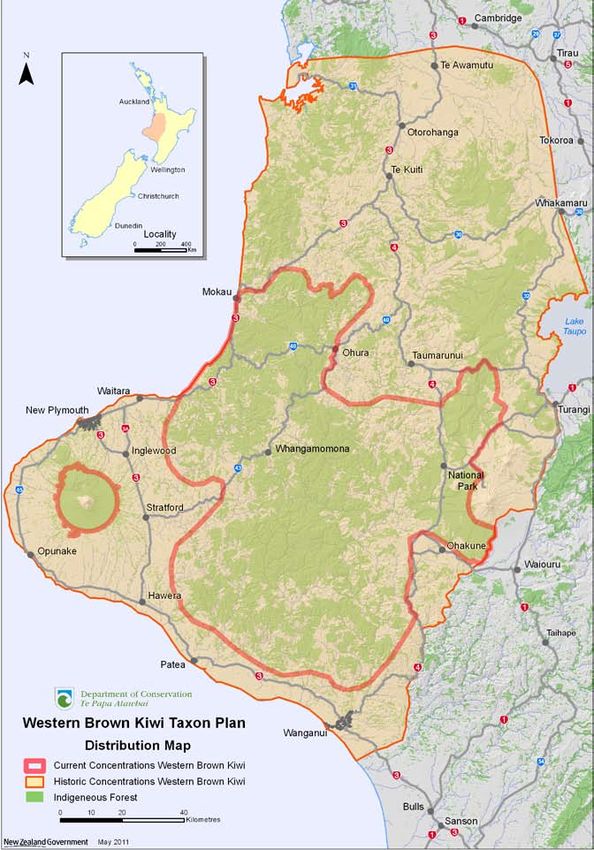
Lake Taupo. A declining population occurred in the King Country. Kiwi were widespread
in Pureora Forest Park and present in almost all parts of inland Taranaki and Whanganui,
including Egmont National Park (Figure 1).
Taxon Plan for Western Brown Kiwi (Apteryx mantelli) 7F i g u re 1 : P a s t a n d p re s e n t d i s t r i b u t i o n o f w e s t e r n b ro w n k i w i . 8 Taxon Plan for Western Brown Kiwi (Apteryx mantelli)
Western brown kiwi are still fairly widespread today but their range has contracted in the
      north, particularly along its eastern fringes (Robertson et al. 2007). The population in
      Pureora Forest Park seems to have collapsed, reducing the total distribution by as much
      as 20%. There are few recent records from Kawhia Harbour and almost none from the King
      Country. A steady trickle of records from the Taumarunui area throughout the 1990s has
      almost totally faded away (N. Peet, DOC, pers. comm.). Call rates in Tongariro Forest
      suggest a decline of around 26% between the early-1990s and 2001, although call rates
      have increased since predator control began there. Kiwi populations are holding on better
      on the southern edge of their range, which appears to have changed little since 1985. The
      Matemateaonga Ecological District continues to be their stronghold.
      Campbell and Dijkgraaf (2001) estimated the Matemateaonga Ecological District supported
      about 6000 – 11,000 adults, some 60% of which were on lands administered by DOC
      (170,000 ha), at densities around 2.5 - 4 adults/km². A conservative estimate of 1500 pairs
      is currently used. The population in northern Taranaki also seems substantial; perhaps
      in the vicinity of 2000 individuals, with probably another 500-1000 individuals scattered
      around the core areas. The Tongariro population is around 200 individuals within the
      Kiwi Sanctuary, with approximately 100 more on the southern slopes of Mt. Ruapehu, and
      unknown numbers scattered throughout the central North Island. Therefore the total
      population of the western taxon is probably at least 8000 - 10,000 birds (McLennan 2006,
      Holzapfel et al. 2008). Around 2000 pairs of kiwi are estimated to be protected (to varying
      degrees) by existing kiwi programmes according to 2010 estimates.2

3.4   Threat status
      Brown kiwi, on the species level, are considered nationally vulnerable under the revised
      New Zealand Threat Classification system (Miskelly et al. 2008; Townsend et al. 2008).
      They are dependent on conservation to alleviate their partial decline and recruitment
      failure. Brown kiwi were previously in the ‘serious decline’ category in the 2005 species
      threat classification rankings (Hitchmough et al. 2007). While not listed to taxon level,
      western brown kiwi are considered, for the purpose of this plan, to be in the same threat
      category as the species (nationally vulnerable).

3.5   Agents of decline and current threats
      Human-induced decline began with the arrival of Maori in New Zealand more than 700
      years ago. The main causes of decline were probably habitat loss as a result of extensive
      burning and clearing of forest in the drier eastern parts of New Zealand, harvest by Maori,
      predation by dogs, and possibly competition with kiore (Rattus exulans). Together these
      led to extensive range reductions of kiwi. The rate and intensity of habitat destruction
      increased rapidly with European arrival in the mid-1800s and a new suite of efficient
      mammalian predators and competitors was introduced (McLennan et al. 1996).
      Today, the rate of habitat loss has been greatly reduced but western brown kiwi are
      declining in all ‘unmanaged’ parts of their current range, even though most of them live
      in extensive tracts of indigenous forest that are legally protected and have high ecological
      integrity. Habitat protection alone is not sufficient for kiwi recovery. McLennan et al. (1996)
      estimated initially an average 5.8% population decline per annum across all North Island
      sites, though this figure has been revised to around 3 % per annum (Holzapfel et al. 2008).
      The decline is generally slower in extensive forest tracts with few predators of adult kiwi,
      and faster in small forest patches surrounded by farmland.
      2   based on 2010 estimates – c.1500 at Whanganui National Park, 350 at Purangi/Matau/ Pouiatoa, 50 at Taranaki National Park,
          10 at Karioi Rahui, 100 at Tongariro Forest and 10 at Maungatautari respectively

      Taxon Plan for Western Brown Kiwi (Apteryx mantelli)                                                                             9
Currently, mammalian predators are the key agent of decline, particularly dogs (Canis
familiaris), ferrets (M. furo), and stoats (Mustela erminea). Dogs and ferrets kill mainly
adult and subadult kiwi, but stoats cause chronic population recruitment failure in
unprotected populations by killing most kiwi chicks before they reach a body weight of 800-
1100g (McLennan et al. 1996). For example, 87% of monitored first clutch chicks were killed
by mustelids in 2008/09 at Tongariro Forest (Hood et al. 2009). Feral cats (Felis catus)
can also be significant predators of kiwi chicks. Typically an unmanaged kiwi population
suffers gradual decline through recruitment failure with intermittent, abrupt reductions
caused by loss of adult kiwi to dog or ferret predation (e.g. Taborsky 1988; Pierce & Sporle
1997, Robertson et al. 2011). For instance, Tongariro Forest lost 24 transmittered adults
across 3 years, predominantly due to ferret attacks (Sutton et al. 2011).
Adult kiwi can approach their natural life span of 50 years or more if risks to adults are
reduced to very low levels. Consequently, populations can appear stable for years despite
failure to recruit, until an eventual, and often quick, collapse.
3.6 Past and current management
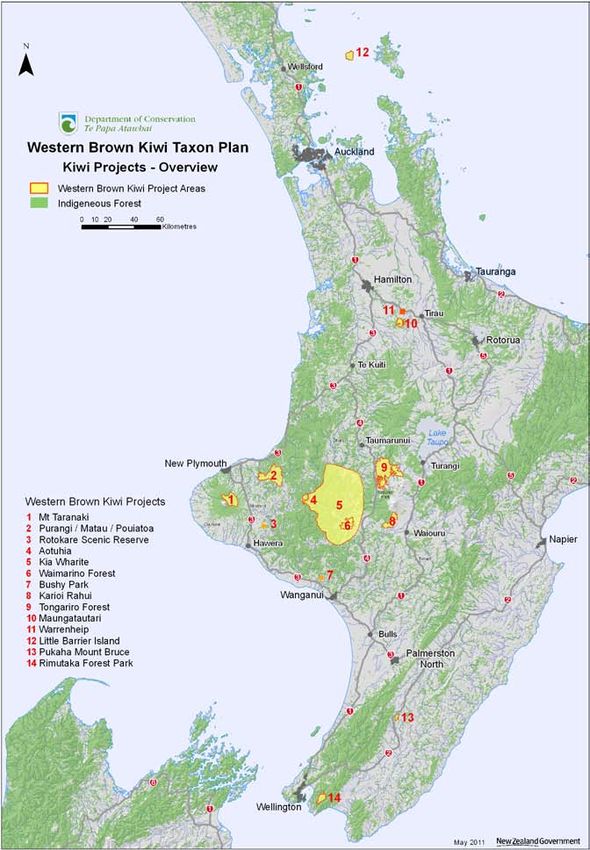
The following sites and projects continue to facilitate the security and recovery of western
brown kiwi, described from East to West (Figure 2).
3.6.1 Maungatautari Predator Proof Enclosure
Maungatautari Ecological Island is a 3,400 ha predator proof enclosure in the Waikato. It
is the only fenced site large enough to hold a substantial self-sustaining kiwi population.
For the last 10 years work has focused towards introducing 40 - 50 unrelated kiwi onto
the mountain from which to found a permanent population of close to 300 kiwi. Once
this population reaches carrying capacity on the mountain, chicks over 1 kg would be
transferred to sustain populations in the wild, acting as ‘kohanga kiwi’ (source sites). Pairs
have already begun breeding before the 50 founders have been released, and therefore
chicks have been exported to wild populations since 2010 to prevent genetic over-
representation of the original founders.
3.6.2 Tongariro Forest Kiwi Sanctuary
Tongariro Forest Kiwi Sanctuary is one of five kiwi sanctuaries established nationally in
2000 to develop and improve techniques in kiwi protection, specifically aiming to increase
the survivorship of young kiwi. Tongariro Forest is unique from the other sanctuaries as it
is researching the benefits to kiwi of aerial 1080 when used as the principal management
method. This 20,000 ha Conservation Area contains an estimated 200 birds. The trials
have revealed that pre-fed aerial 1080 significantly increased kiwi chick survival for two
years post-operation. Another cycle of 1080 will be undertaken in 2011 with pre and post
chick survival recorded. Further research is focussed on sub-adult survival rates, dispersal
and territoriality/breeding age.
3.6.3 Karioi Rahui and Waimarino Forest
Karioi Rahui is part of a 10,000 ha Conservation Area on the southern slopes of Mt Ruapehu,
with stoat traps covering 3500 ha. Between 2000 and 2009, 30 BNZ Operation Nest Egg
(ONE) chicks from Waimarino Forest (a 13,500 ha block consisting predominantly of exotic
forest, with some intact native stands) were returned to Waimarino Forest to restore the
remnant population, and 37 ONE chicks were released at Karioi Rahui. Since 2009, ONE has
occurred at each site independently (i.e. birds returned to source site). It is estimated that
there are now about 100 birds around Karioi Rahui and 200 birds in Waimarino Forest.
10 Taxon Plan for Western Brown Kiwi (Apteryx mantelli)F i g u re 2 : L o c a t i o n o f w e s t e r n b ro w n k i w i p ro j e c t s a s d e s c r i b e d i n t h i s p l a n . Taxon Plan for Western Brown Kiwi (Apteryx mantelli) 11
3.6.4    Kia Wharite Biodiversity Project
               The Kia Wharite Biodiversity Project comprises of a partnership between Horizons
               Regional Council, Department of Conservation, landowners and iwi. The overarching
               goal is to manage and improve close to 180,000 ha of public conservation and private land
               to manage biodiversity at a landscape scale. This is achieved primarily through 3-yearly
               cycles of aerial 1080. This work includes the Matemateaonga Ecological District thought to
               support about 1500 pairs of kiwi. One of the primary goals of the project is to grow the kiwi
               population by 10% every 3 years.

      3.6.5    Taranaki

     3.6.5.1   Taranaki Kiwi Trust
               Aotuhia (Whangamomona Conservation Area) provides a donor kiwi population for a ONE
               project run by the Taranaki Kiwi Trust. A proportion of juveniles produced from here (13 in
               total) have gone to Maungatautari to help establish their founder population. Since 2009
               50% of juveniles sourced from 8 - 10 pairs are released back at the source site at Aotuhia,
               and the others supply the Egmont National Park remnant kiwi population (thought to be
               about 40 pairs in 2003 – Peet 2003). There is no predator control at Aotuhia, but ground-
               based mustelid control covers 7500 ha of Egmont National Park, including the majority of
               known kiwi habitat. Predator trapping is supplemented by infrequent aerial 1080 drops.
               Chicks have also been released on the mountain sourced from Purangi (private land),
               although this no longer occurs.

     3.6.5.2   East Taranaki Environment Trust (ETET)
               ‘Saving kiwi in Taranaki” is a project based in East Taranaki and includes the areas of
               Purangi, Matau and Pouiatoa. The project is a partnership between ETET, Taranaki
               Regional Council and Waitara Maori Women’s Welfare League, and has support from
               private landowners and iwi. Predator control is ground based with trapping and poison.
               The project area is currently 13,000 ha. Baseline kiwi call surveys have started with an
               estimate of 350 pairs within the area. The project has a landscape management approach.

     3.6.5.3   South Taranaki
               South Taranaki Forest and Bird volunteers undertake predator control on 450 ha of privately
               owned, mainly regenerating native vegetation in the Totaras with a small kiwi population
               managed in situ through predator trapping. They also do predator trapping across 400 ha
               of the Collier-Dixon Covenant block, a privately owned covenanted area of mature native
               forest bordering Lake Rotorangi.
               Lake Rotokare Scenic Reserve in Southern Taranaki is a 230 ha forest wetland and lake
               reserve surrounded by a predator-proof fence. This site is currently being used as a crèche
               supporting the Taranaki ONE projects, and may evolve into a kohanga kiwi site.

      3.6.6    Mixed provenance populations
               There are approximately 500 pairs of mixed provenance kiwi on Hauturu/Little Barrier
               Island. Western brown kiwi were first introduced before 1903 and again in 1919, and
               may have interbred with resident kiwi who are assumed to have remained present on
               the island throughout its history. The offspring of these kiwi are an important source
               for reintroductions into Pukaha/Mount Bruce and the Rimutaka Range, two localities
               where brown kiwi are being re-established in the Wellington region. Pukaha Mount
               Bruce protects about 30 kiwi over 950 ha through intensive trapping. Situated in the
               Rimutaka Forest Park (RFP), and now spreading into the Wainuiomata/Orongorongo

12             Taxon Plan for Western Brown Kiwi (Apteryx mantelli)
Water Collection Area (Greater Wellington Regional Council), the Rimutaka kiwi project
is managed by the Rimutaka Forest Park Trust. Over 1000 ha is currently being trapped,
protecting about 50 kiwi (January 2011). These populations are incorporated in the western
brown kiwi taxon plan.
3.6.7 Incubation and crèche facilities
Rainbow Springs Kiwi Encounter hatches most western brown kiwi eggs from ONE
projects. This captive incubation, hatching, and rearing facility operates within a tourist
wildlife complex in Rotorua, and their staff are experts in incubating and hatching kiwi
eggs. Chicks from Rainbow Springs were usually crèched in smaller predator-fenced areas
such as Bushy Park (96 ha enclosure outside Whanganui) and Warrenheip (16 ha enclosure
outside Cambridge) where the chicks grow and benefited from wild conditioning in safety.
However, at time of writing both these enclosures are not in use.
Lake Rotokare Scenic Reserve is currently the only available crèche site, although Wairakei
Golf and Sanctuary, a 150 ha predator proof enclosure based in Taupo, was at time of
writing obtaining approval to act as a crèche.
3.6.8 Captive breeding
Around 25 western brown kiwi are currently part of a captive breeding programme directed
by a national coordinator. The programme has required occasional additions from wild
populations to maintain genetic health among the breeding birds, so kiwi produced through
the programme are suitable for release to the wild. More information is available through
the Captive Management Plan for kiwi (Barlow 2011). A few individuals held for advocacy
or held temporarily for rehabilitation currently fall outside the Captive Management Plan,
but are subject to the Brown Kiwi Husbandry Manual, and to DOC’s captive management
policy and standard operating procedure which stipulate requirements for holding them.
3.7 Cultural importance
Kiwi have a special significance to all New Zealanders. They have become a prominent and
distinctive national icon, cherished by all cultures. Kiwi are a symbol of the uniqueness of
New Zealand and the value of our natural heritage. Most New Zealanders have an interest
in the protection of kiwi, and many are willing to become actively involved in this work.
Tangata whenua also have a strong cultural, spiritual and historical association with
the bird. They regard kiwi as taonga, and generally wish to exercise the principle of
kaitiakitanga (guardianship) in decisions about the care and protection of kiwi and their
habitats. This interest is recognised through the Treaty of Waitangi, and has been included
in the legislation that binds the Crown.
The Department of Conservation will give effect to the principles of the Treaty of Waitangi
in decisions about the management of kiwi. This obligation is more clearly laid out in
Conservation General Policy, which describes the relationship between conservation
legislation such as the Conservation Act 1987 or the Wildlife Act 1953 and the Treaty of
Waitangi. As part of its strategic direction DOC will work with tangata whenua to identify
mutual interests and ways of working together in the interests of conservation (DOC 2008).
Taxon Plan for Western Brown Kiwi (Apteryx mantelli) 133.8 Public awareness
Kiwi are an inspiring and iconic species for most New Zealanders. They provide a rallying
point for a range of advocacy tools that help to reach a wide audience, such as regular
media items on kiwi releases and other community protection initiatives, face to face talks,
interpretive displays, and publications. Targeted tools are used for more specific audiences
such as avian aversion training to advocate for dog control, and co-operative projects where
kiwi protection is the common ground that unites different parties and interest groups.
A critical part of DOC’s role is to encourage community initiatives and empower groups
promoting the protection of kiwi and their habitat, by providing technical advice on kiwi
conservation work. DOC is the co-ordinating and authorising agency for work on kiwi,
which includes assessing and managing permits to catch, handle, and transfer kiwi, and to
keep kiwi in captivity.
3.9 Recovery principles and preferred option for recovery
The selection of goals, objectives and actions in this plan have been directed by the
following underlying recovery principles and preferred option of recovery contained in the
Kiwi Recovery Plan (2008-2018):
•• prevention of extinction of any species of kiwi as the highest priority;
•• intraspecific genetic variation and distribution to be maintained or enhanced as much
as is feasible within the core areas of distribution of each taxon;
•• where possible, kiwi to be managed within their natural (prehistoric or historic) range
or, if outside the range, with the overall aim of restoring them to such sites;
•• mixed-provenance populations form an integral part of recovery planning outside the
core areas of distribution for each taxon;
•• kiwi recovery to, wherever possible, focus on gaining maximum benefits to the wider
ecosystem.
The preferred option for recovery is to sustainably manage kiwi in their natural range by
reducing their exposure to predators.
Western brown kiwi
The following principles are specific to this taxon:
•• The best approach for western brown kiwi is to protect a range of self sustaining wild
populations over their natural range through predator control. This will also benefit
the wider ecosystem.
•• Securing support for predator control in existing kiwi populations is the key to
security from extinction and to recovery for western brown kiwi.
•• The involvement of an array of agencies and groups will be needed to achieve
security for western brown kiwi.
•• Cooperation between individually managed populations is essential to protect and
recover western brown kiwi.
14 Taxon Plan for Western Brown Kiwi (Apteryx mantelli)4 Goals
4.1 Long term recovery goal
Long-term goal of the national recovery plan
To restore, and wherever possible enhance the abundance, distribution and genetic
diversity of all kiwi taxa.
Long-term goal of the Western Brown kiwi taxon plan
To restore western brown kiwi as a functioning part of natural and managed ecosystems
throughout their natural range.
4.2 Goals for the term of this taxon plan
Management
Goal 1 To halt the overall decline of western brown kiwi (in relation to baseline estimates
from the 2008 population size and distribution) (cf. Recovery Plan Goal 1.2)
Goal 2 To achieve population growth within managed populations by protecting at least
2500 pairs in a range of self-sustaining populations by 2019
Goal 3 To minimise the loss of genetic diversity of populations in the wild (cf. Recovery
Plan Goal 1.3)
The minimum goal is to protect 2500 pairs of western brown kiwi, as recommended by
technical review and draft management plans for this taxon (McLennan 2006, DOC 2007a).
One objective in the Kiwi Recovery Plan of securing a minimum of 500 pairs (Holzapfel et
al. 2008: Objective 9.1) has already been achieved by recent initiatives.
Community Relations and Engagement
Goal 4 To increase and strengthen support for western brown kiwi recovery across a broad
range of sectors of New Zealand society (cf. Recovery Plan Goal 2.1).
Goal 5 To facilitate education and advocacy opportunities associated with western brown
kiwi.
Goal 6 Support community-led projects in kiwi recovery by sharing best practice and
technical knowledge to optimize recovery efforts.
Goal 7 To ensure tangata whenua are involved in management of kiwi populations within
their rohe.3
Research and Innovation
Goal 8 To clarify the taxonomy of western brown kiwi, especially the provenance of the
Hauturu/Little Barrier Island population (cf. Recovery Plan Goal 3.1).
Goal 9 Investigate gene flow and genetic diversity between populations throughout
western brown kiwi range (with emphasis on populations predominantly restored
through ONE).
Goal 10 To undertake robust population modeling for western brown kiwi to determine
overall status of the taxon (cf. Recovery Plan Goal 3.2).
Goal 11 To undertake or support research into tools for sustainable landscape scale
predator management (cf. Recovery Plan Goal 3.3).
Goal 12 To improve western brown kiwi population status and trend monitoring.
3 Rohe is the word used by Maori to describe the territory or boundaries of tribal groups.
Taxon Plan for Western Brown Kiwi (Apteryx mantelli) 155 Implementation
The following section outlines the objectives and actions required to achieve the above
goals. Relevant objectives and actions from the national Kiwi Recovery Plan have been
included with any additional objectives specific to western brown kiwi. A range of actions
required to meet these have been developed, then numbered, prioritised, and given a time-
frame for completion. A summary table of actions is provided as Appendix 1.
The priority for each action was determined using these criteria:
•• Essential: needs to be carried out within the timeframe and/or at the frequency
specified to achieve the goals for kiwi recovery over the term of this plan. Highest
risk for kiwi recovery if not carried out within the timeframe and/or at the frequency
specified.
•• High: necessary to achieve long-term goals. To be progressed and ideally completed
within the term of the plan, with moderate risk if not carried out within the timeframe
and/or at the frequency specified.
•• Medium: necessary to achieve long-term goals. To be progressed within the term
of the plan, but least risk if not completed within the term of the plan or within the
timeframe and/or at the frequency specified.
No actions are ‘extras’; a medium priority does not mean that there are no reasons to do it.
Priorities are given to assist with choice if required.
Actions are predominantly time lined until 2015 except those relevant throughout the plan-
period. This reflects the increasing uncertainty in assigning timeframes beyond 5 years,
and the need to review progress for all actions by 2015.
Abbreviations used are:
•• BNZSKT – BNZ Save the Kiwi Trust
•• CO – Department of Conservation conservancy
•• CSM – DOC conservation support manager
•• DOC – Department of Conservation
•• ETET – East Taranaki Environment Group
•• HRC – Horizons Regional Council
•• ONE – BNZ Operation Nest Egg
•• KRG – Kiwi Recovery Group
•• R&D – Department of Conservation Research and Development Group
•• RPA – Recovery Plan action taken from the Kiwi Recovery Plan
•• RPO – Recovery Plan objective taken from the Kiwi Recovery Plan
•• TKT – Taranaki Kiwi Trust
•• TRC – Taranaki Regional Council
•• TWT – Tongariro Whanganui Taranaki Conservancy
•• WBKG – western brown kiwi group
16 Taxon Plan for Western Brown Kiwi (Apteryx mantelli)5.1 Management
Extensive in situ predator control over extant western brown kiwi populations is a key tool
for recovery of western brown kiwi. Several management projects are required to maintain
them across their natural range. While any kiwi or restoration project can be good for
conservation, finite resources mean that recognising and prioritising key western brown
kiwi populations is part of the strategy to secure this taxon. Criteria which suggest a
population is a high priority are:
•• Large numbers of kiwi present (e.g. 100 pairs or more), with the potential for
population growth
•• Security of habitat (land use and land tenure).
•• Predators (stoats, ferrets, cats, dogs) managed on a large scale (e.g. 10,000 ha).
•• Security of resourcing for ongoing site management.
•• Concurrent protection of other rare or threatened species or ecosystems.
•• Clear, achievable objectives and strong project planning.
•• Support from community.
•• Support or management from tangata whenua.
•• Investigation of key research questions.
Currently the populations which are a priority for securing and recovering western brown
kiwi are the large Matemateonga population recently protected in the Tautea Kia Wharite
(Whanganui National Park), and the large Purangi/Matau/Pouiatoa population recently
protected in Taranaki. The next largest populations currently under management are at
Tongariro Forest Kiwi Sanctuary (which also conducts essential research) and Egmont
National Park. In terms of a secure protected habitat, large carrying capacity, and range
extension, Maungatautari Ecological Island (Maungatautari Mountain Scenic Reserve,
Waikato Conservancy) is a priority site.
The criteria above will help determine how new kiwi projects are integrated into western
brown kiwi recovery. They provide an objective framework to help guide the allocation of
scarce resources.
5.1.1 Implementation of taxon plan
The function of the taxon plan is to translate the broad strategies of the Kiwi Recovery Plan
into deliverable, specific actions to guide local operational and work planning for western
brown kiwi. It needs to provide clear, long-term strategic conservation targets on which all
interested parties can focus their efforts. The process of developing the plan has assisted
in communicating and achieving recovery goals, and subsequent regular reviews should
ensure the goals in the taxon plan remain relevant and useful.
Issues
•• The national recovery plan does not provide sufficient detail to guide implementation
for individual taxa.
•• Taxon plans need to be consistent with the national recovery plan while stating local
solutions.
•• Western brown kiwi recovery involves many stakeholders across several
conservancies.
•• The level of DOC resourcing available for western brown kiwi protection is limited.
Although it is an iconic species, it is currently secure. Achieving the recovery goals in
this plan is strongly dependant on community involvement.
Taxon Plan for Western Brown Kiwi (Apteryx mantelli) 17Objectives and Actions
Objective
1. The western brown kiwi taxon plan remains relevant and provides effective guidance for annual work plans.
Actions
Action Timeframe Priority Accountability
1.1 Develop a western brown kiwi group (WBKG) to By 2011 Essential Conservators
assist with implementation and regular reviews of
the taxon plan, and co-ordinate/ communicate/
resolve issues for this taxon.
1.2 WBKG to meet if required after every second Biennial Medium WBKG / Conservators
breeding season, or more frequently when required.
Review progress of taxon plan at this time
1.3 WBKG to consult and involve the Kiwi Recovery Ongoing High Conservators / Project
Group in strategic and management decision making. managers
5.1.2 Minimum secure populations
Some large populations remain in extensive areas of kiwi habitat, even though the taxon is
still declining in unmanaged areas. Suitable populations, sites, and methods, are available
to meet the goal of securing at least 2500 pairs of western brown kiwi during the term of
this plan. This will involve various projects spread through the taxon’s natural geographic
range and include community, tangata whenua, and DOC initiatives. There may already be
nearly 2000 pairs of kiwi protected, primarily through the new large Tautea Kia Wharite
and Purangi/Matau/Pouiatoa projects in Whanganui and Taranaki. The Kiwi Recovery Plan
objective (cf. RPO 9.1) of securing a minimum 500 pairs of brown kiwi has been achieved
for the western brown kiwi taxon, at least in the short-term.
Issues
•• Predation from stoats remains the key agent of decline for western brown kiwi
populations. Predation from ferrets and dogs is also significant.
•• Predator control is expensive and sites are subject to constant reinvasion pressure.
•• Juvenile kiwi can disperse great distances from their natal area and can move from
protected areas into areas of high predator densities.
•• Securing funding for predator control is the key issue for securing western brown kiwi
in the long-term.
•• Currently an estimated 2000 pairs are protected through predator control. This makes
the 2500 pair objective realistic and achievable.
Objectives and Actions
Objectives
2.1 A minimum of 2500 pairs of western brown kiwi are secure from key agents of decline during the term of this plan.
2.2 Increase the population in Whanganui National Park by 10% every three years.
2.3 Secure 500 pairs of kiwi at Purangi/Matau/Pouiatoa by 2015.
2.4 Protect 200 pairs of kiwi at Tongariro Forest by 2017.
2.5 Western brown kiwi are managed over as large a part of their historical range as possible (cf. RPO 13.1).
18 Taxon Plan for Western Brown Kiwi (Apteryx mantelli)Actions
Action Timeframe Priority Accountability
2.1 Protect the large population of around 1500 kiwi Ongoing, Essential TWTConservator/HRC
pairs† at Tautea Kia Wharite (Whanganui National 3 yearly 1080§
Park) by controlling relevant predators with
broadscale aerial 1080§.
2.2 Protect the large population of around 350 kiwi Ongoing Essential ETET/TRC
pairs† at Purangi/Matau/Pouiatoa (Taranaki) by trapping
controlling relevant predators.
Protect the population of around 100 kiwi pairs†
2.3 Ongoing, High TWT Conservator
in the Tongariro Forest Kiwi Sanctuary (central regular aerial
North Island) by controlling relevant predators 1080
and supplementing the population with ONE.
Protect the population of around 60-70 kiwi pairs†
2.4 Ongoing, High TWT Conservator/TKT
in Egmont National Park (Mt Taranaki) by controlling trapping
relevant predators, supplementing the population supplemented
with ONE, and examining options for sustainable or replaced
predator management and funding for Egmont with aerial 1080
National Park kiwi project.
2.5 Explore options for fully protecting the population of Throughout Medium TWT Conservator
20-30 pairs of kiwi at Rangataua Conservation Area, term of plan
and implement if appropriate.
2.6 Explore options for implementing predator control at Throughout High TWT Conservator,
Waimarino Forest to protect approximately 100 pairs term of plan Earnslaw One Ltd
of kiwi.
§ or at suitable intervals for kiwi protection determined by evolving research on broad scale 1080 for kiwi protection.
† estimated, as at 2010
The managed population at Maungatautari is covered under section 5.1.5 Kohanga kiwi.
5.1.3 Unmanaged populations
Until 2008 no large populations of western brown kiwi were protected from predators; this
has changed rapidly with the initiation of both the Tautea Kia Wharite and Purangi/Matau/
Pouiatoa projects in Whanganui and Taranaki. However, western brown kiwi continue to
decline by an estimated 3% in areas where their threats are not managed (Holzapfel et al.
2008) and local extinctions similar to what occurred in Pureora are likely to continue. There
may be opportunities to establish additional protected populations within the historic
range of each kiwi taxon, ideally by stoat, ferret, cat and dog control over at least 10,000 ha
of suitable kiwi habitat.
Issues
•• Despite local population stability or increases at managed sites, brown kiwi are still
declining overall.
•• Local extinctions are likely to continue throughout the western brown kiwi range.
•• The current distribution of western brown kiwi within their historical range is unclear.
Objectives and Actions
Objective
3.1 Manage a sufficient proportion of the population of western brown kiwi to ensure that the net rate of loss over the
whole taxon is zero (cf. RPO 10.1).
Taxon Plan for Western Brown Kiwi (Apteryx mantelli) 19Actions
Action Timeframe Priority Accountability
3.1 Provide technical advice and encouragement to new Ongoing Essential Area managers/
kiwi programmes as appropriate, placing a higher Programme managers
priority on any initiative which will secure a large
population kiwi.
3.2 Investigate the feasibility of controlling predators at By 2011 High WBKG
sites with populations of 50-200 pairs (e.g. Northern
Taranaki forests) where management does not
currently occur. Implement findings where appropriate.
3.3 Continue to determine the distribution and relative By 2018 Medium DOC/Community groups
abundance of remnant kiwi populations in unmanaged
areas.
3.4 Create a centralized database of western brown kiwi By 2012 and Medium Technical Support
distribution data collated from past work, and add ongoing
future survey data throughout the term of the plan.
5.1.4 Tongariro Forest Kiwi Sanctuary
Tongariro Forest is one of five kiwi sanctuaries established in 2000 by DOC to develop
successful management prescriptions for kiwi protection at key sites, and for fundamental
kiwi ecology research (DOC & MfE 2000). They remain a key component of kiwi recovery
(Holzapfel et al. 2008). The focus for Tongariro Forest sanctuary has been to determine
whether 1080 is an effective management tool for protecting kiwi. Work at Tongariro shows
the local kiwi population increased at 6% per year in the 1080 and immediate post-1080
years through reduced predation (de Monchy et al. 2009). However, in recent years ferrets
have killed a third of the male population under surveillance and have posed a serious
threat not only to the study, but also to the population as a whole. This suggests that both
stoats and predators of adult kiwi need to be managed to secure remnant populations.
Issues
•• Sanctuary findings are not always published in peer-reviewed literature.
•• The Tongariro 1080 experiment requires repetition and replication to confirm the
outcomes for kiwi.
•• Adult losses due to ferrets threaten the sanctuary’s ability to obtain robust sample
sizes for the experiment.
•• Adult losses due to ferrets threaten the sanctuary’s ability to reach their goal of 200
pairs by 2017.
•• There is a perception of ‘sacrificing’ chicks during non-treatment years which reduces
support within the community.
Objectives and Actions
Objectives
4.1 Tongariro Forest Kiwi Sanctuary is an integral part of kiwi recovery as a site of successful management and
learning (cf. RPO 3.1).
4.2 Investigation of 1080 as a management tool for kiwi populations over large areas provides information for kiwi
management on a national scale.
4.3 Key research findings and management results are communicated widely to other sanctuaries and kiwi projects
to inform their management, planning and advocacy.
4.4 Community support for the research and use of 1080 as a tool for kiwi recovery is obtained.
20 Taxon Plan for Western Brown Kiwi (Apteryx mantelli)Actions
Action Timeframe Priority Accountability
4.1 Control predators in Tongariro Forest Kiwi Sanctuary 2011 and Essential TWT Conservator
with broadscale 1080 in conjunction with AHB. ongoing
4.2 Robustly monitor kiwi chick survival and mustelid Until 2013 Essential Programme Manager
tracking rates pre- and post-1080 operation.
4.3 Monitor sub-adult survival, dispersal and territory/ Until 2012 Essential Programme Manager
breeding age.
4.4 Communicate key findings of 1080 experiment to Annually Essential Programme Manager/
other sanctuaries and kiwi projects, kiwi recovery Technical Support
group, stakeholders and community.
4.5 In conjunction with the KRG, review the focus of the 2013 Essential Programme Manager/
Tongariro Forest Kiwi Sanctuary after the completion Technical Support/KRG
of the 1080 experiment.
4.6 Use the kiwi sanctuary network for dialogue, Ongoing Medium Sanctuary Programme
information and staff exchange. Managers
5.1.5 Kohanga kiwi
Kiwi populations under sustained management are considered to be in the recovery phase
as numbers increase towards carrying capacity. Eventually surrounding unprotected areas
will become a sink for dispersing juveniles. These juveniles could be used to contribute
birds to other protected populations, or to re-establish kiwi within their former range where
protection is available. These source areas have been coined as ‘kohanga kiwi’ (‘kiwi nest’,
i.e., source population) sites. Predator proof enclosures have the potential to be highly
effective kohanga kiwi sites since the kiwi are protected and as closed populations, kiwi will
need to be released to avoid crowding.
At the time of writing Maungatautari Ecological Island predator proof enclosure is being
developed as a kohanga kiwi site. A founding population of at least 40 unrelated founders
is needed to establish the site. Eventually juveniles can be removed once the population
reaches carrying capacity (estimated to be around 300 birds) and released back into
the wild to supplement kiwi populations. The Lake Rotokare Trust is also exploring the
possibility of becoming a kohanga kiwi site.
Issues
•• Obtaining sufficient kiwi to establish a founder population within a predator proof
enclosure is difficult.
•• It is difficult to assess when a population is near or has reached carrying capacity.
•• Translocations of kiwi are dependant on successful consultation with stakeholders.
Objectives and Actions
Objectives
5. Kohanga kiwi sites are regularly supplementing other populations in the wild and are used as an effective kiwi
recovery tool.
Taxon Plan for Western Brown Kiwi (Apteryx mantelli) 21Actions
Action Timeframe Priority Accountability
5.1 Enhance existing projects to increase local Ongoing High Conservators
population abundance to the point where the
population can be used as kohanga kiwi, a source
for other sites (cf. RPA 10.2).
5.2 Establish a founder population of at least 40 kiwi Stock by 2015; Essential Conservators/MEIT/
related) into Maungatautari predator proof enclosure maintenance tangata whenua
(not closely to establish a population of close to ongoing
300 kiwi, to be used as a kohanga kiwi.
5.3 Investigate the potential for new kohanga kiwi sites Ongoing Medium Conservators/ WBKG
within western brown kiwi range.
5.1.6 BNZ Operation Nest Egg (ONE) and kiwi crèches
ONE is a widely used technique for supplementing kiwi populations in the wild. Eggs
taken from the wild are incubated and hatched in captivity and chicks are reared in crèche
facilities, most commonly predator proof enclosures. Juveniles are then released back into
the wild where they are likely to grow and breed successfully once they have reached weight
of c. 1000-1200g. Genetic diversity needs careful consideration because of a tendency to
focus on a few productive parents when sourcing eggs. Ensuring the donor population’s
juvenile recruitment rates are not unacceptably reduced is also important, and may involve
predator control or returning some ONE juveniles to the source.
Individuals throughout the range of western brown kiwi are hosted at ONE and crèche
facilities, so there is the potential to swap individuals at these sites as part of the genetic
management of small populations, provided the source sites are prepared to collaborate.
Issues
•• ONE for western brown kiwi lacks coordination.
•• Institutions and facilities for incubation, hatching and crèching are essential for ONE,
but their funding and capacity is frequently uncertain.
•• There are currently a very limited number of crèching sites available. At time of
writing only Rotokare is established as a crèche for Taranaki kiwi chicks.
•• There is often no clear monitoring or reporting structure in place for crèche facilities.
•• Extensive use of limited numbers of parent birds is common in ONE and can affect
genetic diversity in the resulting population.
•• Sites with predator proof fences are under constant threat of predator incursions,
which can impact on the young kiwi held at the site.
Objectives and Actions
Objectives
6.1 The use of BNZ Operation Nest Egg is effective and undertaken to a high standard (cf. RPO 17.1).
6.2 Communication between kiwi projects, DOC managers, captive institutions and crèche facilities involved with
western brown kiwi is undertaken on a regular basis.
6.3 There are enough crèche facilities to meet the demand of priority ONE operations undertaken.
6.4 Crèche facilities operate at a consistently high standard, with appropriate monitoring and incursion plans in place.
22 Taxon Plan for Western Brown Kiwi (Apteryx mantelli)You can also read


