Temporary Closure of Free-Standing Midwife-led Birthing Services - 9th August 2021
←
→
Page content transcription
If your browser does not render page correctly, please read the page content below
Temporary Closure of Free-Standing
Midwife-led Birthing Services
9th August 2021

Continuing our ongoing conversation

Over the past few years, we have been working to make                 We want to hear from:
Staffordshire and Stoke-on-Trent the healthiest places to live and
                                                                      • People who have had a
work.
                                                                        baby in the last three years
• Summer 2019: public conversation to understand what is working
                                                                        or are currently expecting
   well and what could be improved in health and care services.
• Jan/Feb 2020: focus groups to talk in more detail about maternity   • People who are thinking of
   services.
                                                                        starting or expanding their
                                                                        family in the next few years
• March 2020: involvement work paused to allow partners to respond
   to COVID-19.                                                       • Anyone working in
• Summer 2021: with COVID-19 cases reducing, now is the right time      maternity services and
   for this transformation programme to progress.                       organisations that support
                                                                        people who access
                                                                        maternity services.
            We recognise the world has changed –
    and we need to sense-check our work before progressing
Maternity services
Each year, there are over 11,000 births in Staffordshire and Stoke-on-Trent. Our midwives and
obstetricians do an amazing job supporting parents and families along every step of their journey.
Current location Suitable for high- Other benefits
risk pregnancy
Consultant-led • Royal Stoke University Yes ✓ • Doctors and specialists will be on-hand for you
Units Hospital and baby
• Queen’s Hospital, Burton • An epidural (pain relief injection) can be given
Midwife-led • Royal Stoke University No • Non-clinical environment
Units/ service Hospital • Low-risk births only
• Queen’s Hospital, Burton • Less likely to need intervention
• Close to Consultant-led Unit for ease of transfer
Midwife- • County Hospital, Stafford No • Non-clinical environment
led Birth Units • Samuel Johnson • Low-risk births only
(temporarily Community Hospital, • Less likely to need intervention
suspended) Lichfield
Homebirths At patients’ homes No • Familiar environment, with family around you
throughout Staffordshire • Less likely to need intervention – especially if
and Stoke-on-Trent. have had a baby beforeMaternity care during COVID-19
How services changed during COVID-19

Our maternity staff worked in small teams across several sites –
gave little flexibility to manage self-isolation and sickness.            Thank you to our amazing
                                                                         staff who have continued to
• In March 2020, low-risk births were temporarily suspended at
                                                                           deliver safe and quality
   Samuel Johnson and County Hospital. During the closures, there
                                                                           services in the toughest
   have been no quality and safety issues.                                      circumstances.
• Antenatal and postnatal clinics continued at the County and Samuel
   Johnson hospitals during the pandemic.
• The consultant and midwife-led units at Royal Stoke University          Thank you to the families
                                                                           and women, who have
   Hospital and Queen’s Hospital in Burton remained open.
                                                                          shown their support and
• Homebirth services were also suspended, but we are pleased to say
                                                                         understanding through this
   they are available once again.                                                  time.
• Improvements in how we use senior staff to better co-ordinate care –
   opportunity to take this forward for long-term.
When will we be able to reopen services?
• COVID-19 is still with us, and we are having to work differently.
• Staff sickness and self-isolation are increasing in the NHS.
• The core staff from the southern midwife-led units are still needed in the larger units/community
teams – as the majority of births are delivered there.
• We’re confident our services are safe, but this is because we are working differently.
If we reintroduce additional sites, we will need to adapt.
• Our workforce has changed, with staff taking on new roles, retirements, and the usual
vacancies/turnover –we will need to train and restructure our midwife-led teams to restore
services.
• We’re exploring ways to improve care, including offering low-risk births at County Hospital and
Lichfield, and we want to discuss these with you today.
• Given the workforce challenges, we are hoping to restore services by late autumn/winter 2021.Maternity care following COVID-19 and the future
The Ockenden review

The high profile Ockenden review into maternity services at Shrewsbury and Telford Hospital NHS
Trust resulted in an interim report published in December 2020.
It sets out clear recommendations which maternity services elsewhere must consider and implement,
including:
• Enhancing patient safety
• Better listening to women and families
• Developing more effective staff training and ways of working
• Managing complex pregnancies and risk assessments throughout pregnancies
• Monitoring fetal wellbeing
• Ensuring patients have enough information to make informed consent.

To deliver best practice and more personalised care, we will need to
support more visits in the community and deliver continuity of carer
Long-term why do we need to work differently?
•   National best practice – Better Births and NHS Long Term Plan.                   In 2019/20:
•   There is a national shortage of midwives.
•   Higher numbers of stillbirths and infant mortality.                           93 women (8 per
•   Most babies are born in the Royal Stoke Hospital or Queen’s Hospital         month) gave birth at
    Burton, because they are high risk births or the person chooses to give      County Hospital in
    birth there                                                                       Stafford
•   Not enough babies being born at County and Samuel Johnson to
    support midwives to maintain their skills and to have staff waiting 24/7.    252 women (21 per
                                                                                 month) gave birth at
•   Not enough midwives to support all midwife-led units, without working
                                                                                  Samuel Johnson
    differently.
                                                                                Community Hospital in
•   To provide personal care - we need to build a team of midwives around             Lichfield
    the woman (continuity of care).
•   Building relationships helps to reduce the loss of babies, identify risks
    and offer mental health support.
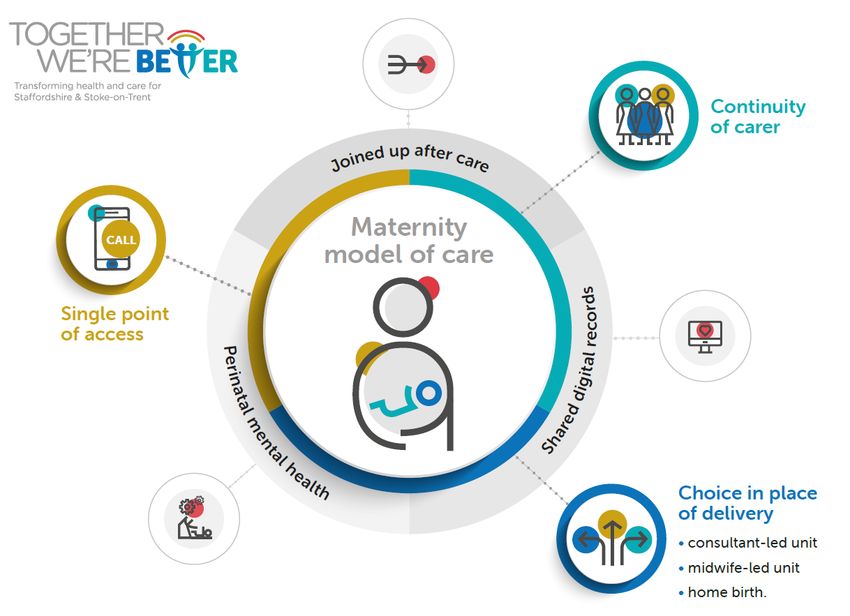
Our vision We want to: • Empower women, and their partners, by putting them at the centre of their care so they have the best support. • Provide a network of places where women can choose to give birth, that are high quality and safe, have the right staff skill-mix and also represent value for money. • Design a service that supports women to access a ‘team of midwives’, who have worked with them to develop a birth plan to provide continuity of carer during pregnancy, birth and beyond. • Make the best use of our staff who can work more flexibly and really get to know the women and families in their local communities. • Develop two-way digital records which both women and staff can update. • Connect services, including health visitors, social care, mental health support, housing and voluntary services to help families after the birth.
Community-led maternity care
Maternity clinical model

The maternity clinical model aims to improve outcomes and benefits for women and their babies

• No change to the provision of consultant-led services – therefore these would
  remain in place (Stoke, Burton)
• Midwife-led units would continue to be offered alongside consultant-led units at
  Stoke and Burton
• ‘On-demand midwife-led units’ at County Hospital and Samuel Johnson to
  allow low risk women a choice of the equivalent of a home birth in a different setting
• Over time, as the continuity of carer rota develops – all midwife-led units would
  become ‘on-demand’
• Enhance the homebirth model – potentially a joint Staffordshire / Derby
  homebirths team
• Antenatal and postnatal care continue at the midwife-led units, including County
  and Samuel Johnson.

                                                                       12
Continuity of carer
National ambition for all births to be supported by continuity of carer model – April 2023
Now: In the future:
• The community midwife that develops • Team of midwives (usually 6-8) on a rota, that
your plan might not be with you when you together manage caseloads.
give birth in hospital. • 2-3 midwives involved throughout pregnancy –
• Different teams of midwives work in units allows for leave/sickness.
or in the community. • Midwifes follow the pregnant woman – deliver
• Midwives are in fixed locations, which the birth in hospital or at home.
means they can’t support the rota. • Builds trust.
• Safer for the mother and baby – midwife can
spot early signs when something may be wrong.
To support this model of care, we will need our midwives to be
out in the community rather than waiting in empty wardsChoice of birth locations
We want to build a network of locations where you can give birth:
Stoke-on-Trent and Burton
• Access to obstetricians
• Access to neonatal, anaesthetics /
Consultant- epidural / surgery
led unit • 24/7
• After care in hospital
Stoke-on-Trent, Burton
Countywide Stafford, Lichfield
• Midwife-led • Same as a homebirth
Midwife-led
• No travel • Midwife-led
Homebirth unit/
• In your own home service • Birthing rooms and pools
• 24/7 • Discharge within 3 hours
• 24/7What does choice mean?
• Your midwife will work with you to develop a Who is low-risk?
personal birth plan.
If you’re expecting a baby, you are
• At 36/37 weeks you will be assessed whether considered to have a low risk of
you are still low-risk.
complications if you are healthy and you
• If you are high-risk, you will need to give birth at have had a straightforward pregnancy, or
a consultant-led unit. if you’ve had a baby before with no
• If you are low-risk, you can choose either: complications (such as a Caesarean birth
• Consultant-led unit or heavy bleeding after birth).
• Midwife-led unit If this is your first baby, your midwife will
• Homebirth. discuss if you are able to give birth at a
midwife-led unit.New ways of working: on-demand service Current challenges: Future opportunities: • Not enough births – most people are not able • Low-risk births still offered at County and to, or choose to use the larger units. Best Samuel Johnson 24/7 practice is to see 350 births a year so • As now, you ring your midwife when in midwives maintain skills and value for money labour – if no risks, you come into the unit • Skilled midwives are in high demand – before • Birthing rooms and pools will be ready and COVID, spending time on admin, cleaning and waiting mandatory training, whilst waiting for a birth • Midwives travel to the unit to support birth • Different teams to support wards 24/7 – only • Midwives from the community team limited opportunities to use midwives for other supporting the continuity of carer rota clinics • Midwives maintain their skills – delivering • Lack of flexibility and unable to support out of more births at home and midwife-led units hours rota – staff present in units 24/7, which • Improved staff morale means midwives can’t support births at home or • Improved relationships with women and other midwife-led units families with personal birth plans for all. • Lack of relationships – midwives do not have caseloads, which means they don’t have relationships with women and families Our future aspiration is for all midwife-led units to work • Low staff morale. as an on-demand service, to support continuity of carer
What will be different?
                                                                                               Why are we having
•   More personalised care, with a team of midwives and birth plans in place                   a discussion?
•   You recognise and trust your midwives at the birth                                         • We want to be
•   Increased confidence in having a homebirth                                                    open and
•   Safer care – helping midwives to spot any early warning signs at the birth                    transparent
                                                                                               • Changes are
•   Highly skilled midwives, delivering better care through job satisfaction.
                                                                                                  small, but
What can I expect?                                                           Pre                  important
                                                                             COVID-   Future   • Birthing rooms
                                                                             19                   available 24/7
I can give birth 24/7 at County or Samuel Johnson                            Yes ✓    Yes ✓    • Midwives travel to
I need to ring my midwife as I go into labour, she will check that nothing
                                                                                                  the units, rather
has changed in my risk level and will agree whether I need a home            Yes ✓    Yes ✓       than waiting 24/7
assessment or if I go straight to the unit
                                                                                               • As now, midwives
If I am able to give birth at the on-demand unit, I will be met by two                            develop birth
                                                                             Yes ✓    Yes ✓
midwives who are expecting me
                                                                                                  plans so people
The birthing rooms will be clean and ready for use                           Yes ✓    Yes ✓       know to ring their
I can use the birthing pools/baths (as long as they are not already in
                                                                             Yes ✓    Yes ✓       midwife at the
use)
                                                                                                  point of labour.
I will be discharged when it is safe, and usually home after birth           Yes ✓    Yes ✓
How do you plan for the unexpected?
• Giving birth is natural and our midwives are highly trained
• Through your birth plan, we prepare you for what will happen
• You ring us when you go into labour, so we can assess your progress and get ready for your arrival
• We help you to plan your journey/transport in advance – as most babies are delivered in our larger
units, our midwives can help advise on how much time you should leave
• We only support low-risk births at the midwife-led units.
However, babies arrive when they want to, and we have processes to manage this:
• A small number of babies arrive in car parks/ambulances or on the way. Our midwives are trained for
this – by phoning the midwife, we can plan and support you through the labour
• Some women may not know they are pregnant and go to A&E or a walk-in clinic. This would be a
high-risk pregnancy so will be transferred to a consultant-led unit (potentially by ambulance)
• A midwife-led unit gives the same level of care as a homebirth. If you develop complications or need
to be admitted to hospital after the birth, we have tested pathways to transfer you (this is rarely blue-
lighted, because only low-risk births are supported in these units).Next steps
• Our clinicians and staff are working to develop proposals to support
an on-demand model – this includes exploring how we can restore
births at County and Samuel Johnson
• There is more work for us to do, behind the scenes before we can
confirm this model will happen
You can also share your views
• We will need to listen to our staff as we look to develop a continuity through a survey which is available
of carer rota on our website and closes at midnight
• We will need to train and recruit new midwives to support this on the 8 August 2021. You can view
community model the survey online at:
https://www.twbstaffsandstoke.org.uk/
• We hope that by autumn/winter 2021 we will be able to offer this
get-involved/maternity-services-
model – subject to the COVID-19 situation transformation
• We will continue to work with people using maternity services, to
develop birth plans and offer advice on their options.
We will aim to keep you informed and involved as we develop our proposals. The feedback from this
event and the survey will be considered by the hospital trusts and the CCGs and will be published on
our website.Get involved in our work
If you have any feedback you would like to share regarding your
• Visit our website: experiences of Maternity Services you can contact the
www.twbstaffsandstoke.org.uk
Maternity and Neonatal Voices Partnership (MVP).
• Phone: 0333 150 2155
How to get involved
• Email: twb.comms@nhs.net
• Email us: sasot.mvp@nhs.net
• Follow us on Facebook: TWBStaffsandStoke • Contact the Project Support Officer/MVP Lead – Helen Carr:
• Tweet us: @TWBstaffsstoke 07928 525377
• Share your views through the survey which is • For more information Visit our website:
www.twbstaffsandstoke.org.uk
closes at midnight on the 8 August 2021. You
can view the survey online at: • Follow us on Twitter: @SaSoTVOICES
https://www.twbstaffsandstoke.org.uk/get- • Follow us on Instagram: mvp_staffs_stokeontrent
involved/maternity-services-transformation
If you need printed copies of the documents,
need documents in different formats or
languages or need help to complete the
survey, please call us.You can also read


