THE ACCESSIBLE BEAUTY OF ADA-COMPLIANT RESTROOMS
←
→
Page content transcription
If your browser does not render page correctly, please read the page content below
THE ACCESSIBLE BEAUTY OF ADA-COMPLIANT
 RESTROOMS
 EXECUTIVE SUMMARY
 Imagine an individual with a disability entering a public bathroom only to find that the stall is too
 small to maneuver a wheelchair or the toilet flush handle is not within reach. This situation is far
 too common for the 56.7 million Americans who live with a physical or intellectual disability1.
 Architects, interior designers and plumbing engineers can help alleviate this source of frustration
 and embarrassment by designing restrooms that accommodate users of all ability levels.

 However, it is a common misconception that complying with the Americans with Disabilities Act
 (ADA) means that a commercial restroom has to look utilitarian. The restroom experience can be
 elevated with stylish fixtures that accommodate ADA requirements, as well as water efficiency.
 Balancing these design elements creates an aesthetically pleasing bathroom that ensures visitors
 are comfortable and safe. The key is using proper layout planning and user-friendly products to
 create an intuitive bathroom design where ADA compliance is all but invisible.

The ladies room in a Chicago hotel lobby features hands-free faucets, which are accented with soft mirror lighting
and louvered lavatory doors to enhance the décor.

 THE AESTHETICS OF ADA COMPLIANCE
 Public restrooms are one of the few spaces in a building that virtually every guest and
 employee will use at some point. While practical in function, a bathroom's design provides the
 opportunity to make a lasting impression on users. This highly visible area can enhance the
 guest experience and create a sense of pride among building occupants. However, a poorly
 designed restroom that ignores the basic needs of users with disabilities is more than an
 inconvenience—it’s a violation of civil rights law.

                                                                                                      americanstandard.com I 1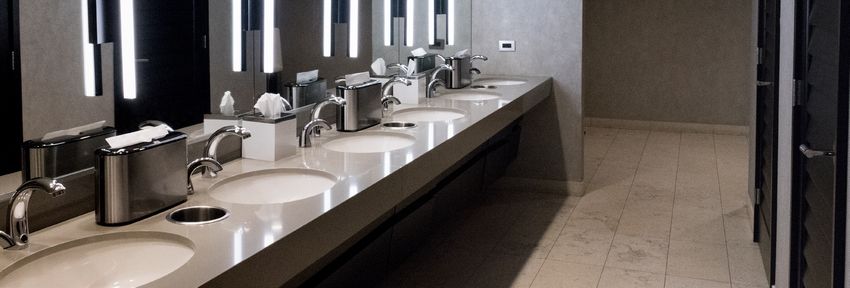
Consider that even the simplest bathroom activities are dependent on a combination of
senses: vision, touch and hearing. Sight and physical coordination are needed to avoid a
slippery spot. Manual dexterity and depth perception work together so a faucet handle,
flush valve, or stall latch can be grasped. Signs and icons are read and understood using
intellectual abilities. A welcoming design ensures each of these actions is easy to
perform for all individuals, no matter their capabilities.

An inclusive restroom design is not only beautiful in intention, but attractive in looks as well.
Designers do not have to compromise their design vision to create an inclusive restroom.
Attractive bathrooms can seamlessly blend ADA compliance with modern, classic, or
transitional aesthetics. There are many products that range from traditional and elegant to
sleek and compact that will satisfy accessibility needs while complementing building design
requirements and vision.

                     WE ARE ALL AT RISK OF HAVING A DISABILITY
                                AT SOME POINT IN OUR LIFETIME.
         — TOM FRIEDEN, DIRECTOR OF CENTERS FOR DISEASE CONTROL (CDC)2

  Industrial colors, touches of metal, and stone tile are popular design choices for hotel guest rooms. Every fixture in this
  luxury bathroom fulfills ADA compliance while creating a relaxing ambiance.

                                                                                                            americanstandard.com I 2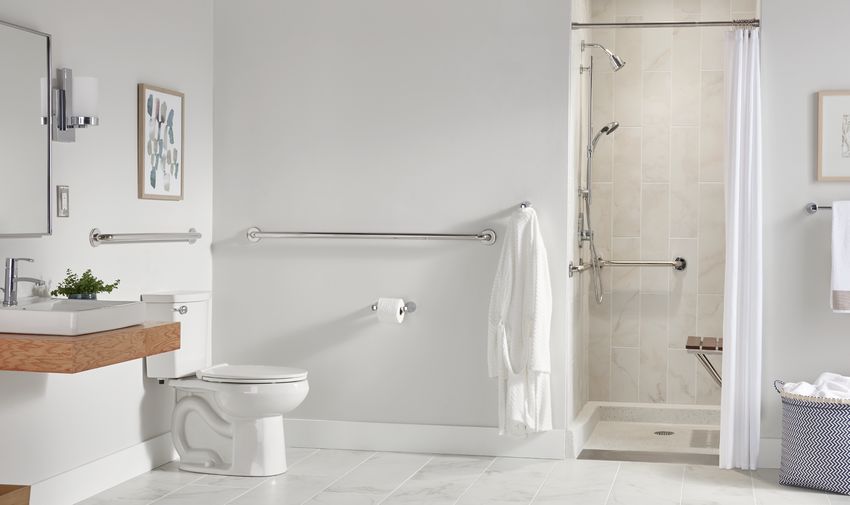
This lobby restroom
                                                                                        in a sports stadium
                                                                                        exhibits ADA-
                                                                                        compliant fixtures,
                                                                                        faucets and
                                                                                        accessories in a
                                                                                        design highlighting
                                                                                        popular gray tones
                                                                                        with its stone wall
                                                                                        and floor tiles,
                                                                                        showcasing a
                                                                                        contemporary vibe
                                                                                        for fans.

MARRYING WATER CONSERVATION WITH ADA
Goals to satisfy accessibility regulations and conserve water are not mutually exclusive. By giving
these objectives equal weight in the design, architects and interior designers can create a restroom
that is respectful of its users and the environment. No matter whether a project is pursuing a green
certification like LEED or the Living Building Challenge, or the client wants to protect natural
resources, there are many choices that will fulfill aesthetic and functional requirements.

                    PUTTING A FACE ON AMERICANS WITH DISABILITIES

 There are close to 57 million Americans who       • Individuals with impaired vision, including those
 have a disability, according to the U.S. Census     who use Braille.
 Bureau3. Globally, the World Health               • Those with wheelchairs, walkers, scooters
 Organization estimates that one billion people      and canes.
 live with some form of disability4. As the vast
 majority of these individuals will need to        • People with temporary disabilities, such as
 navigate a public restroom, architects and          recovering from an accident or surgery.
 designers can use their ingenuity to create a     • Individuals suffering from stability and balance
 positive restroom experience.                       complications.
 A restroom design should not only satisfy ADA     • Parents with small children or infants.
 requirements but also be universally              • Children and adults of varying heights.
 accommodating for users of all backgrounds,
 including those who could benefit from            • Users with medical equipment, such as ostomy
 additional assistance:                              bags, gastric feeding tubes or chemotherapy ports.

                                                                                          americanstandard.com I 3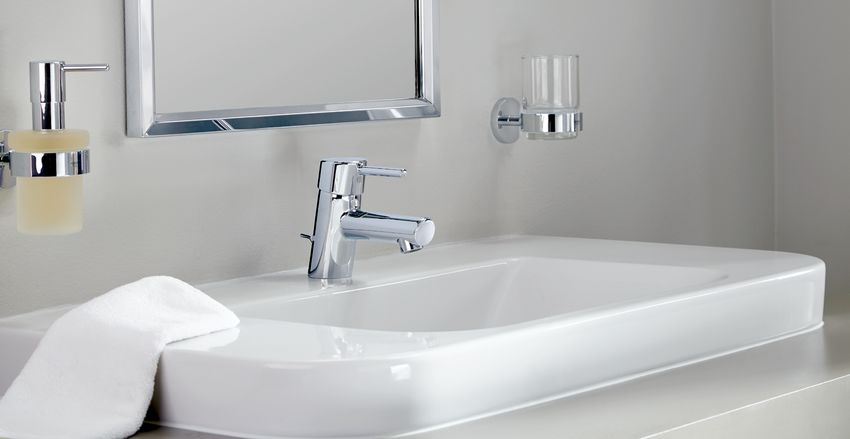
Smartly designed products can satisfy both water efficiency and ADA compliance. Look
for high-efficiency fixtures that are WaterSense-certified, which means they save a minimum of 20
percent over the federal standard5, or ultra-high-efficiency models that can conserve even more.

BRING PROJECTS INTO THE
21ST CENTURY

While it’s easier for new construction projects to adhere to ADA standards, existing buildings are far
from exempt. When renovating a facility constructed before 1993, it is the responsibility of the
property owner to bring the restroom into compliance where feasible. The act specifically states that
“a public accommodation shall remove architectural barriers in existing facilities, including
communication barriers that are structural in nature, where such removal is readily achievable, i.e.,
easily accomplishable and able to be carried out without much difficulty or expense.”

The 2010 ADA Standards for Accessible Design identify a number of alterations that will bring
commercial restrooms into compliance:

   • Install accessible door hardware.                          • Offer a raised toilet seat.
   • Add grab bars in toilet stalls.                            • Include a full-length bathroom mirror.
   • Rearrange toilet partitions to increase                    • Reposition the paper towel dispenser.
      maneuvering space.                                        • Incorporate accessible signage.
   • Insulate lavatory pipes under sinks to
      prevent burns.

                   ADA REQUIREMENTS AND COMMERCIAL RESTROOMS
 TOILET SEAT HEIGHT                                              GRAB BARS
 To provide an easier transition from wheelchairs, there         These fixtures ensure a person with mobility limitations has
 should be 17-19 inches from the base of the floor to the top    extra support. The top of the grab bar must be between
 of the seat height.                                             33-36 inches high.

 RIGHT/LEFT TOILET LEVERS                                        LOW THRESHOLD SHOWERS
 Manual flush levers (if present) must be placed on the          These showers offer a low (max ½ inches) curb ledge that
 open or accessible side of the toilet, which may be on the      takes little effort to step over. For optimal accessibility,
 left or right, depending on the stall design. Center, push      roll-in showers provide a barrier-free entrance for users
 button, trip levers are not ADA-compliant.                      with wheelchairs. Transfer showers must have walls that are
                                                                 exactly 36 inches apart.
 WALL MOUNT SINKS AND WATER CLOSETS (TOILETS)                    MIRROR PLACEMENT
 Sinks and water closets (toilets) that are mounted on           Mirrors must be mounted with the bottom edge of
 the wall offer better toe and knee clearance because            the reflecting surface no higher than 40 inches above
 they don’t occupy floor space. Supply lines and drains          the floor.
 must be insulated.
 TOUCHLESS FIXTURES                                              SHOWERHEAD PAUSE FEATURE
 Motion-activated flush valves, faucets, hand dryers, and        A type of safety feature, a non-positive shut-off button on a
 paper towel dispensers are simpler to operate for users         hand-held shower handle reduces flow to a trickle if a user
 with physical disabilities.                                     releases the button.
 LEVER HANDLE FAUCETS
 Faucets should be lever-operated, push, touch, or electronically controlled. They should be usable with one hand
 without the need to tightly grasp, pinch, or twist the wrist. Users should be able to turn the lever with no more than
 5 pounds of force.

*All measurements and fixture requirements sourced from the 2010 ADA Standards for Accessible Design6

                                                                                                              americanstandard.com I 4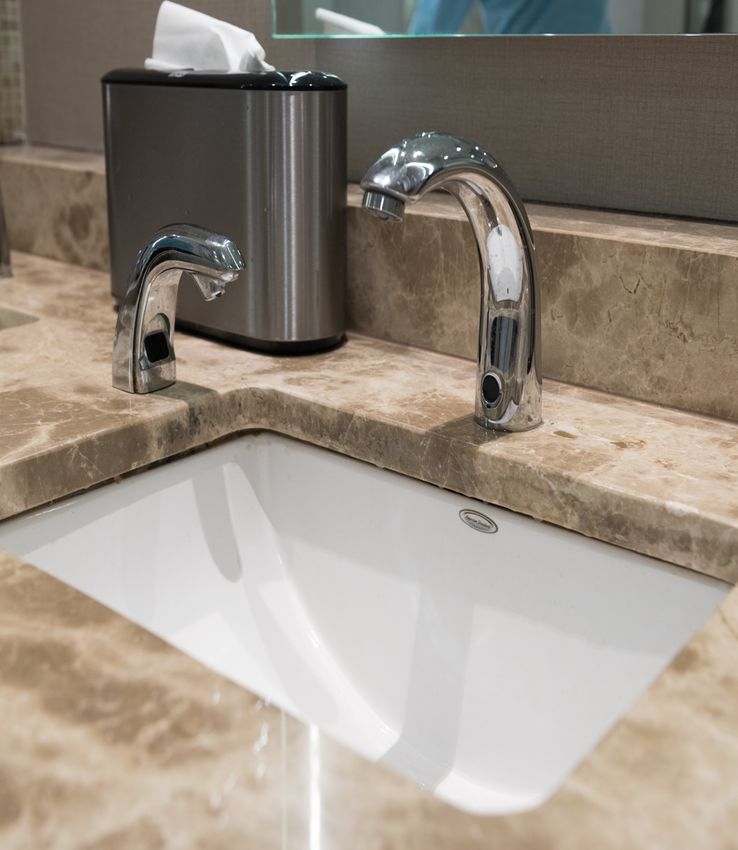
While this may seem extensive, designers don’t have to gut a restroom or upgrade every stall or
fixture to satisfy ADA — only one of each fixture type needs to satisfy accessibility requirements. No
matter how large a public bathroom is, a minimum of one stall, toilet or urinal, lavatory sink, and
mirror must be ADA compliant.7

ADA-compliant fixtures are available in a variety of styles, shapes, and finishes that will create
an inviting design. Strong geometric lines and industrial finishes are a bold touch in modern
restrooms. Traditional bathrooms can be paired with brushed nickel fixtures and circular
elements for a time-honored look. Contemporary touches can span both styles for restrooms
that have an updated feel with the latest trends.

   THE DIFFERENCE BETWEEN ADA AND
           UNIVERSAL DESIGN
  While the term “universal design” is often
  associated with the Americans with
  Disabilities Act (ADA), it is a separate method
  used to incorporate accessible features.
  Architects and interior designers should
  always start with the requirements outlined in
  ADA and then adhere to the principles of
  universal design as budget allows.

  Americans with Disabilities Act is an
  enforceable mandate that addresses the needs
  of only a portion of the population. This legal
  requirement applies to all public facilities,
  though there are specific guidelines as to the
  extent that a building must comply and
  exceptions for structural impracticability.
  Under ADA, only a portion of a property must
  be welcoming to guests with disabilities. For
  restrooms, ADA requires “at least one
  accessible restroom for each sex or a single
  unisex restroom.”8

  Universal design is an approach coined by the
  late architect Ronald Mace9. Mace’s voluntary
  set of principles aims to create both products
  and spaces that are “usable by all people, to
  the greatest extent possible, without the need
  for adaptation or specialized design.”
  It also seeks to “avoid segregating or
  stigmatizing any users” based on ability level.
  Under this philosophy, accessibility is not an
  accommodation but an intrinsic part of the
                                                        This sleek, angular faucet complements any
  overall design. For example, a unisex family          restroom design and pairs well with natural stone
  restroom would be the preference because it           and cool neutrals. The touchless sensor makes it
  accommodates users with strollers and                 easier for an individual with mobility or vision issues
  wheelchairs, as well as caregivers assisting          to operate the faucet.
  another adult.

                                                                                              americanstandard.com I 5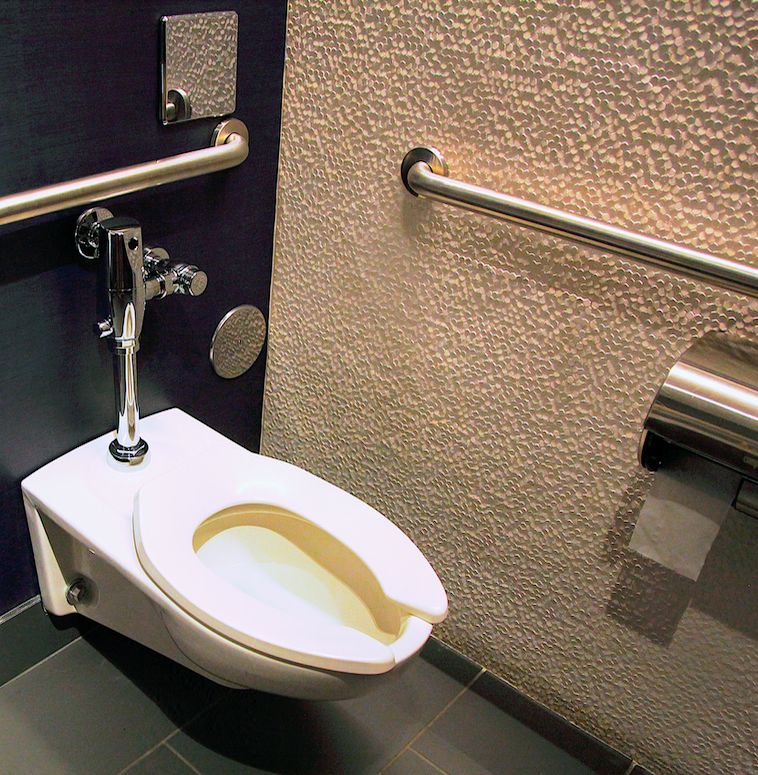
A REFRESHER ON THE AMERICANS WITH DISABILITIES ACT

   Since 1990, the goal of the Americans with                walking, standing, lifting, bending, speaking,
   Disabilities Act (ADA) has been to protect                breathing, learning, reading, concentrating,
   individuals with a physical or cognitive limitation       thinking, communicating and working.”
   from discrimination. Approximately 19% of the
   U.S. population — or 1 in 5 people — have a               While not a building code, this piece of civil
   disability that affects mobility, vision or               rights legislation covers accessibility in public
   cognitive function. Over 50 percent categorize            spaces. The 2010 ADA Standards for Accessible
   their disability as “severe,” and 9.4 million             Design clarify requirements for removing
   individuals have a limitation that affects their          architectural barriers, including those in
   daily living10. As the population continues to age,       restrooms11. The guidelines also address specific
   those in their elder years also face a growing risk       measurements that should be incorporated into
   of becoming disabled.                                     accessible bathrooms: toe clearance, side and
                                                             forward reach ranges, turning space radius,
   ADA defines a disability as “a physical or mental         maximums for protruding objects, door clearance
   impairment that substantially limits one or more of       widths, centerline positioning for water closets,
   the major life activities of such individual, including   seat height, grab bar length and placement,
   but not limited to caring for oneself, performing         dispenser position, height and depths for urinals
   manual tasks, seeing, hearing, eating, sleeping,          and surface height for lavatories and sinks.

Restrooms in public spaces are an ideal opportunity to marry an aesthetically pleasing design
with accessible features. With thoughtful product selection, beautiful fixtures will add to the
ambiance of a commercial restroom, while meeting the needs of users with all ability
backgrounds. Whether a restroom uses traditional or modern faucets and fixtures, or a
transitionally styled combination of the two, accessibility has a place at the heart of its design,
making it beautiful for all to use.

ADA requires that faucets with a lever should be operable with only one hand.

                                                                                                    americanstandard.com I 6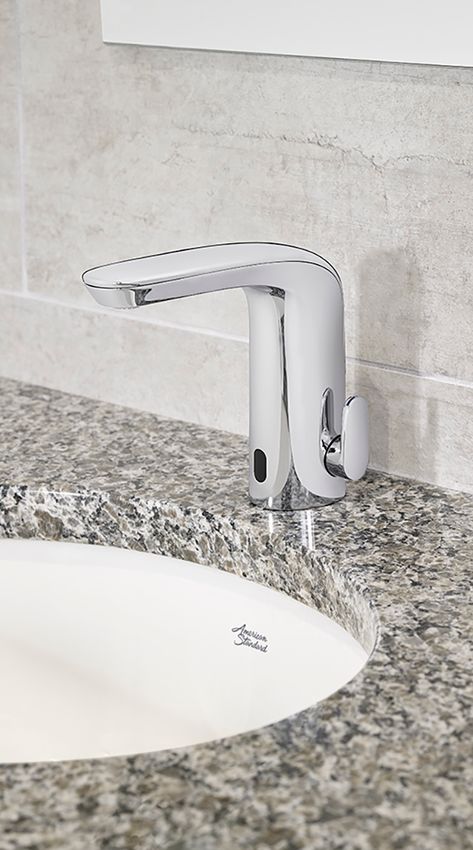
DESIGN OBLIGATIONS BEYOND ADA
 When designing a building, ADA is just the
 beginning — there are specific building codes
 that apply to accessible design as well. Though
 these standards closely mirror the 2010 ADA
 updates, they include additional requirements
 and technical considerations. Individual states
 may also have building codes with
 supplemental accessibility provisions.
 Architects and designers should take note if
 these regulations apply to their project, as
 code adoption varies by regions in the U.S.

 Click here for International Building Code ICC/
 ANSI A117.1

 Click here for Architectural Barriers Act
 (ABA) Accessibility Standards: Applies to
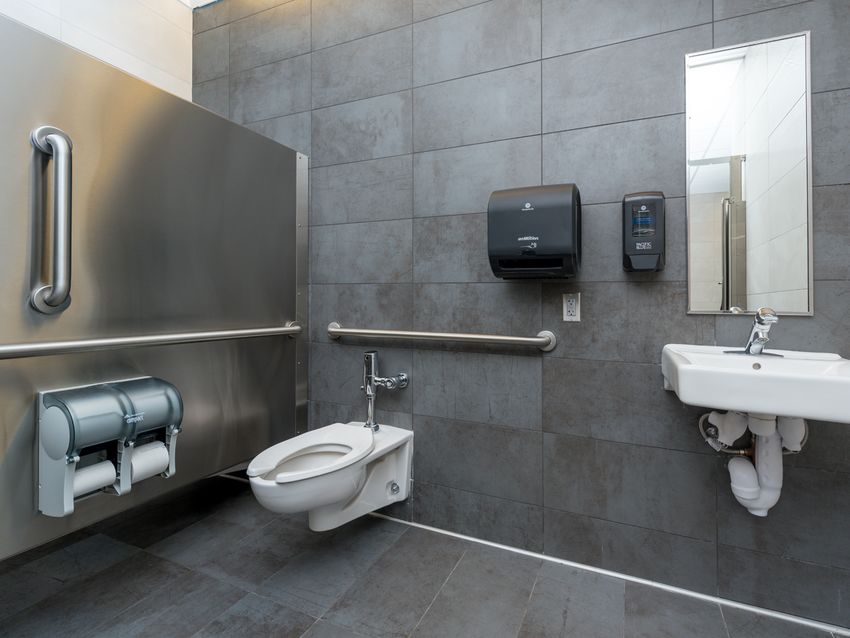
 facilities built, renovated, or leased with             Amenities at this sports stadium provide a modern,
 certain federal funds, such as GSA (General             comfortable experience for their ticket holders. This ADA-
 Services Administration), DOD (Department               compliant stall includes grab bars on the side and back
 of Defense), and DOJ (Department of Justice)            walls around the high efficiency toilet and flush valve,
 properties.                                             which consume only 1.28 gpf.

Grab bars are an important component of ADA because they help users maintain balance while sitting or standing.
The polished chrome finish here blends in with the décor, while supporting up to 250 pounds of pull.

                                                                                                   americanstandard.com I 7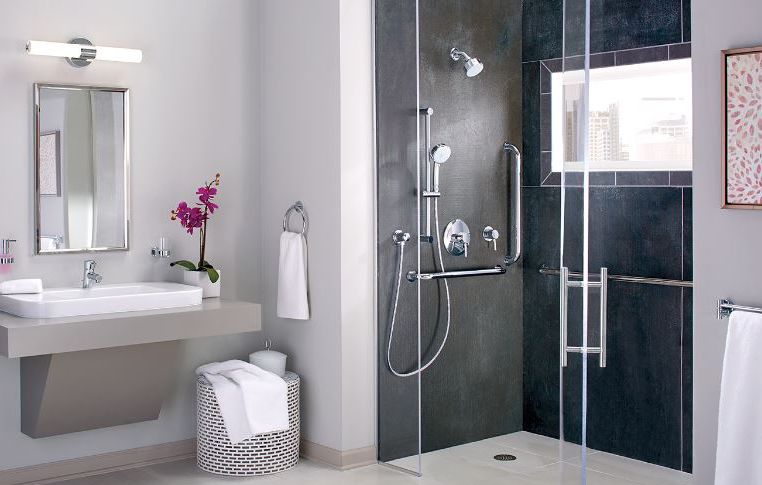
In this high-style walk-in shower, the hand-held                 The curved hands-free bathroom faucet and soap dispenser
 showerhead contains a non-positive shut-off                      complement the rectangular sink and sleek marble
 button that slows water to a drip when released.                 countertop in this hotel lobby restroom.
 If a person were to fall in the shower or experience
 a medical emergency, the shut-off button ensures
 their breathing will be free of water. Additionally,
 the barrier-free entrance makes this shower
 accessible for wheelchair users and reduces the
 risk of a tripping hazard for all individuals.

American Standard, part of the global LIXIL Corporation, offers specifiers, facility managers and
 contractors a wide assortment of ADA-compliant plumbing products that include: commercial
and residential toilets, sensor and manual operated faucets, low/no threshold shower bases and
            accessible shower systems. To learn more, visit: americanstandard.com.

References:
1,3,10. US Census Bureau 2. Centers for Disease Control and Prevention
4. World Heath Organization 5. Environmental Protection Agency
6-8,11. Americans with Disabilites Act
9. The Center for Universal Design

                                                                 One Centennial Avenue, Piscataway, NJ 08854 I americanstandard.com I 8
You can also read


