The Challenge of Urban Heat Exposure under Climate Change: An Analysis of Cities in the Sustainable Healthy Urban Environments (SHUE) Database
←
→
Page content transcription
If your browser does not render page correctly, please read the page content below
climate
Article
The Challenge of Urban Heat Exposure under Climate
Change: An Analysis of Cities in the Sustainable
Healthy Urban Environments (SHUE) Database
James Milner 1, *, Colin Harpham 2 , Jonathon Taylor 3        ID
                                                                   , Mike Davies 3 , Corinne Le Quéré 4 ,
Andy Haines 1 ID and Paul Wilkinson 1,†
 1    Department of Social & Environmental Health Research, London School of Hygiene & Tropical Medicine,
      15-17 Tavistock Place, London WC1H 9SH, UK; andy.haines@lshtm.ac.uk (A.H.);
      paul.wilkinson@lshtm.ac.uk (P.W.)
 2    Climatic Research Unit, School of Environmental Sciences, University of East Anglia, Norwich Research
      Park, Norwich NR4 7TJ, UK; c.harpham@uea.ac.uk
 3    UCL Institute for Environmental Design & Engineering, University College London, Central House,
      14 Upper Woburn Place, London WC1H 0NN, UK; j.g.taylor@ucl.ac.uk (J.T.);
      michael.davies@ucl.ac.uk (M.D.)
 4    Tyndall Centre for Climate Change Research, School of Environmental Sciences, University of East Anglia,
      Norwich Research Park, Norwich NR4 7TJ, UK; c.lequere@uea.ac.uk
 *    Correspondence: james.milner@lshtm.ac.uk; Tel.: +44-020-7927-2510
 †    On behalf of the SHUE project partners.

 Received: 31 July 2017; Accepted: 8 December 2017; Published: 13 December 2017

 Abstract: The so far largely unabated emissions of greenhouse gases (GHGs) are expected to increase
 global temperatures substantially over this century. We quantify the patterns of increases for
 246 globally-representative cities in the Sustainable Healthy Urban Environments (SHUE) database.
 We used an ensemble of 18 global climate models (GCMs) run under a low (RCP2.6) and high (RCP8.5)
 emissions scenario to estimate the increase in monthly mean temperatures by 2050 and 2100 based on
 30-year averages. Model simulations were from the Coupled Model Inter-comparison Project Phase 5
 (CMIP5). Annual mean temperature increases were 0.93 degrees Celsius by 2050 and 1.10 degrees
 Celsius by 2100 under RCP2.6, and 1.27 and 4.15 degrees Celsius under RCP8.5, but with substantial
 city-to-city variation. By 2100, under RCP2.6 no city exceeds an increase in Tmean > 2 degrees Celsius
 (relative to a 2017 baseline), while all do under RCP8.5, some with increases in Tmean close to, or even
 greater than, 7 degrees Celsius. The increases were greatest in cities of mid to high latitude, in humid
 temperate and dry climate regions, and with large seasonal variation in temperature. Cities are
 likely to experience large increases in hottest month mean temperatures under high GHG emissions
 trajectories, which will often present substantial challenges to adaptation and health protection.

 Keywords: climate change; urban heat; temperature; sustainability; urban health

1. Introduction
     The world is becoming increasingly urbanized. Cities are already home to more than half of the
world’s population [1], they generate around 85% of global GDP and are responsible for up to 76%
of energy-related greenhouse gas (GHG) emissions [2]. They are therefore a key focus for actions
to help mitigate climate change—actions that have the potential for appreciable ancillary benefits to
public health through reduction of harmful exposures (e.g., air pollution) and promotion of healthier
behaviours in such areas as diet and physical activity [3].
     However, the populations of cities are also potentially vulnerable to the consequences of climate
change, including the direct effects of increased heat [4]. Some degree of global warming is inevitable

Climate 2017, 5, 93; doi:10.3390/cli5040093                                       www.mdpi.com/journal/climate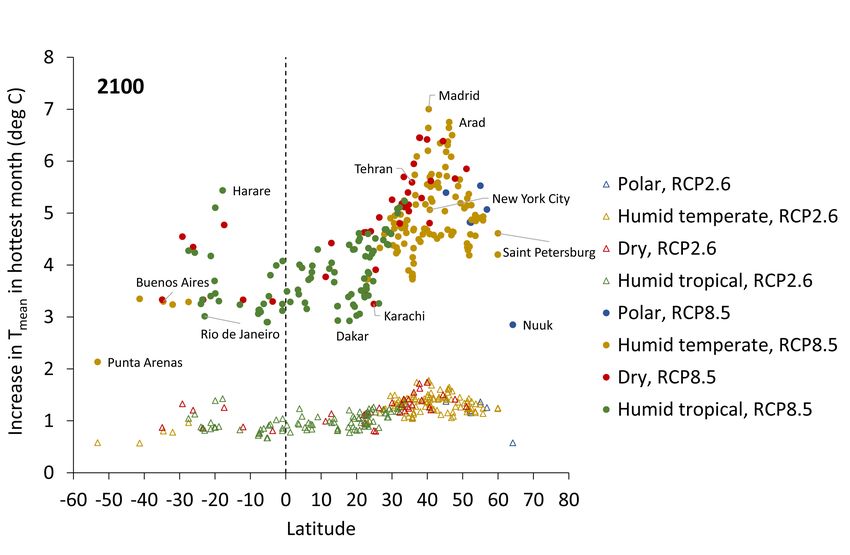
Climate 2017, 5, 93                                                                                                       2 of 15

from the GHGs that anthropogenic activity has already contributed to atmospheric concentrations of
GHGs [5]. A key question and challenge for society is the extent to which future emissions can be
reduced in order to contain global warming to less damaging limits.
     For assessing climate change impacts and adaptation responses at fine spatial scales, such as those
of regions and cities, dynamical downscaling techniques can be applied to regional climate models
(RCMs), driven by global climate models (GCMs) [6]. However, the available ensemble of outputs from
downscaling initiatives, such as CORDEX [7], is not yet consistent from region to region. There remains
a need for more consistent estimates of future temperatures in order to perform assessments across
large numbers of globally-distributed cities.
     In this paper, we use a large ensemble of GCMs to examine the patterns of temperature rise
that may be expected in cities across the globe under a high and a low GHG emissions trajectory.
The analysis is based on data from the Sustainable Health Urban Environments (SHUE) project, which
has developed a database of information on a globally-distributed sample of cities [8]. The broad aim
of the SHUE project is to support research on the responses to environmental risks to health and the
potential impacts for health of strategies for sustainable urban development. The database contains
a wide range of information on city characteristics, environmental risks (such as air pollution), and
markers of urban form and energy use. This paper describes the climate change data held in the
database and demonstrates its application to improving understanding of the benefits of strong climate
change mitigation efforts.

2. Materials and Methods
      The SHUE database includes information on a random sample of 246 global cities with populations
over 15,000 obtained from GeoNames [9], stratified by national wealth in terms of Gross National
Income (GNI) per capita (US$12,746) [10], population
size (5 M), and Bailey’s ecoregion ‘domain’ (dry, humid
temperate, humid tropical, polar) [11]. The sample size of 246 was based on calculations of statistical
power appropriate for comparative analyses of variables across cities in the database. A further 63 cities
were added to this sample, primarily to include cities with specific characteristics and/or policies
related to environmental sustainability. Here, we focus only on the 246 randomly-selected cities in the
database (Table 1).

                      Table 1. List of SHUE cities by WHO region and Bailey’s ecoregion domain.

            WHO Region 1       Ecoregion Domain                                   Cities
                Africa               Polar        (none)
                                Humid temperate   Algiers, Didouche Mourad
                                      Dry         Benoni, Thaba Nchu, Toliara
                                                  Abobo, Addis Ababa, Antananarivo, Dakar, Ekangala, Harare,
                                 Humid tropical   Hawassa, Ikerre, Kinshasa, Lagos, Ntungamo, Pointe-Noire, Usagara,
                                                  Vavoua, Yaoundé
               Americas              Polar        Saint John
                                                  Alpharetta, Augusta, Benicia, Buenos Aires, Calumet City, Carmel,
                                Humid temperate   Chicago, Coon Rapids, Corcoran, Fort Worth, Grand Rapids, Hamilton,
                                                  Montréal, Murray, New York City, Plano, Punta Arenas, Richmond
                                                  Calgary, Cochabamba, Emporia, Fortaleza, Jerez de García Salinas,
                                      Dry
                                                  Lima, Lubbock, San Luis Potosí, Tucson, Victoria de Durango
                                                  Álvaro Obregón, Barbacena, Belo Horizonte, Bogotá, Cali, Conceição
                                                  das Alagoas, Corrientes, Deerfield Beach, Divinópolis, El Cerrito,
                                                  Guadalajara, Holguín, Ibarra, João Pessoa, Kingston, Manta, Mexico
                                 Humid tropical
                                                  City, Puebla, Ribeirão Preto, Rio de Janeiro, Salvador, San Salvador,
                                                  Santiago de Cuba, Santiago de los Caballeros, Santiago de Querétaro,
                                                  Santos, São Paulo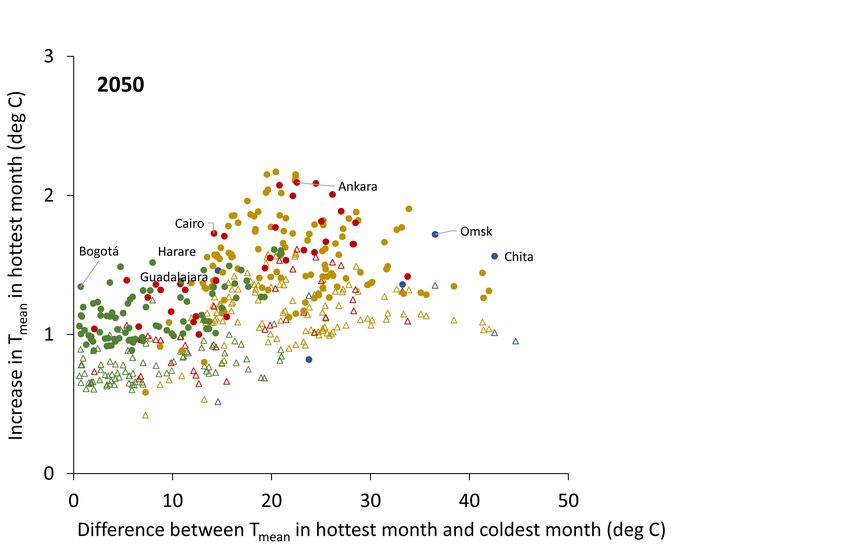
Climate 2017, 5, 93                                                                                                            3 of 15

                                                         Table 1. Cont.

              WHO Region 1       Ecoregion Domain                                    Cities
                 Eastern
                                       Polar          (none)
               Mediterranean
                                  Humid temperate     Damascus, Marrakesh, Qatana
                                                      Baghdad, Bosaso, Cairo, Dammam, Erbil, Homs, Hyderabad, Kabul,
                                        Dry
                                                      Karachi, Mingora, Sabratah, Tehran, Zalingei
                                   Humid tropical     Gujranwala, Kohat, Lahore
                  Europe               Polar          Chita, Izhevsk, Nuuk, Omsk
                                                      Adana, Arad, Berlin, Bressanone, Brunoy, Cava Dè Tirreni, Düsseldorf,
                                                      Farnborough, Gloucester, Gomel, Hadera, Hamburg, Hrodna, Istanbul,
                                                      Karabük, Kateríni, Kazan, Leczna, Le Grand-Quevilly, Le Mans, Lódz,
                                  Humid temperate     London, Lyepyel, Lyon, Madrid, Marseille, Mezotúr, Montpellier,
                                                      Moscow, Namur, Nantes, Napoli, Oostend, Oslo, Rotterdam, Saint
                                                      Petersburg, Sant Vicenç dels Horts, Simferopol, Subotica, Tolyatti,
                                                      Valencia, Vercelli, Voorst, Yerevan, Zagreb
                                        Dry           Ankara, Bucharest, Denizli, Konya, Namangan, Zaporizhzhya
                                   Humid tropical     (none)
              South-East Asia          Polar          (none)
                                  Humid temperate     Hamhung, Songnim
                                        Dry           Rajkot
                                                      Amravati, Amritsar, Bahraich, Bangalore, Bangkok, Bareilly, Bhopal,
                                                      Bidar, Budaun, Buduran, Chaibasa, Delhi, Dhaka, Durgapur, Galesong,
                                                      Hailakandi, Haldwani, Hisua, Jakarta, Laksar, Makassar, Matara,
                                   Humid tropical
                                                      Meerut, Mojokerto, Mumbai, Mysore, Padang, Pasuruan, Pune,
                                                      Rajshahi, Ranchi, Shantipur, Shrirampur, Varanasi, Visakhapatnam,
                                                      Yogyakarta
              Western Pacific          Polar          Tahe
                                                      Beijing, Brisbane, Changchun, Changzhou, Chengdu, Chongqing,
                                                      Daegu, Dongguan, Foshan, Guangzhou, Guankou, Guiyang,
                                                      Hangzhou, Harbin, Hegang, Ikoma, Jiamusi, Langfang, Longjing,
                                  Humid temperate     Nagareyama, Nanchong, Nanjing, Narita, Ome, Perth, Pingdingshan,
                                                      Qingdao, Seoul, Shanghai, Shenyang, Suzhou, Tai’an, Takayama,
                                                      Tianjin, Tokyo, Wellington, Wuhan, Xi’an, Xiangtan, Xianyang, Yingkou,
                                                      Zhoukou, Zhumadian,
                                        Dry           Adelaide, Baotou
                                                      Danshui, Hong Kong, Macau, Manila, Shantou, Shenzhen, Singapore,
                                   Humid tropical
                                                      Quezon City, Yashan, Zhanjiang
          1   Janin (Palestine) not formally included in any WHO Region (though likely to be Eastern Mediterranean).

2.1. Temperature-Related Climate Change Risk
    Monthly simulated climate data was estimated for SHUE cities using 18 GCMs under a low GHG
emissions scenario, Representative Concentration Pathway (RCP) 2.6, and a high emissions scenario,
RCP8.5 [12–15]. RCP2.6 gives a global average temperature change consistent with the 2015 Paris
Agreement (i.e., a change in global temperature of less than 2 ◦ C relative to a pre-industrial baseline),
while RCP8.5 is broadly representative of business-as-usual.
    The model simulations were from Coupled Model Intercomparison Project Phase 5 (CMPI5) [16],
which provided major input to the Fifth Assessment Report of the Intergovernmental Panel on Climate
Change (IPCC) [17]. Mean monthly temperature data for 1901–2100 was downloaded from the
main CMIP5 data repository (via the Earth System Grid Federation (ESGF)–http://pcmdi9.llnl.gov).
18 GCMs were available for this variable (Table 2). Since each model has a different grid resolution, all
models were interpolated to a standard 0.5 degrees latitude × 0.5 degrees longitude grid.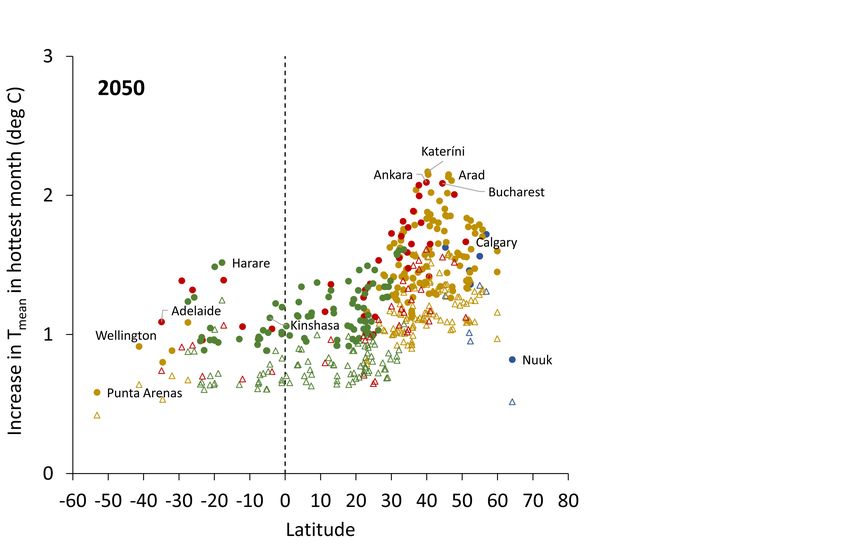
Climate 2017, 5, 93                                                                                       4 of 15

                      Table 2. Grid resolution of 18 global climate models used in analysis.

         Global Climate Model Acronym       Original Model Resolution (Number of Latitude × Longitude Cells)
                     CCSM4                                              192 × 288
                   CNRM-CM5                                             128 × 256
                 CSIRO-Mk3-6-0                                           96 × 192
                    CanESM2                                              64 × 128
                   GFDL-CM3                                              90 × 144
                  GFDL-ESM2G                                             90 × 144
                  HadGEM2-ES                                            145 × 192
                 IPSL-CM5A-LR                                             96 × 96
                IPSL-CM5A-MR                                            143 × 144
                  MIROC-ESM                                              64 × 128
               MIROC-ESM-CHEM                                            64 × 128
                     MIROC5                                             128 × 256
                  MPI-ESM-LR                                             96 × 192
                  MPI-ESM-MR                                             96 × 192
                  MRI-CGCM3                                             160 × 320
                   NorESM1-M                                            96 × 144
                    bcc-csm1-1                                           64 × 128
                  bcc-csm1-1-m                                          160 × 320

     A simple bias adjustment was performed at the grid box level for each GCM in order to improve
agreement with observations, in this case the CRU-TSv3.22 dataset (which is provided on the same
0.5 degree grid) [18]. In this simple approach, the difference was calculated between the observed
and simulated long-term average for 1961–1990. Offset or adjustment factors were calculated for each
month and model and then applied in an additive way to the entire simulated series. The assumption
underlying any bias adjustment approach is that model biases are stationary.
     The final step in pre-processing the GCM data was to take the set of latitude and longitude
coordinates for the 246 SHUE cities and to extract the data for the grid box in which each city is located.
In coastal areas, the nearest land grid box was used.

2.2. City-Level Characteristics
    The climate data were combined with the following information on the characteristics of each city,
where available:

•     Location: the coordinates (latitude and longitude) of each city obtained from GeoNames [9].
•     Population size: estimates of city populations obtained from GeoNames.
•     Ecoregion: the Bailey’s ecoregion in which the city is located (Figure 1). The ecoregion is a
      hierarchical system based on climate, vegetation, geomorphology, and soil characteristics [11].
      We used only the upper ‘domain’ level of classification.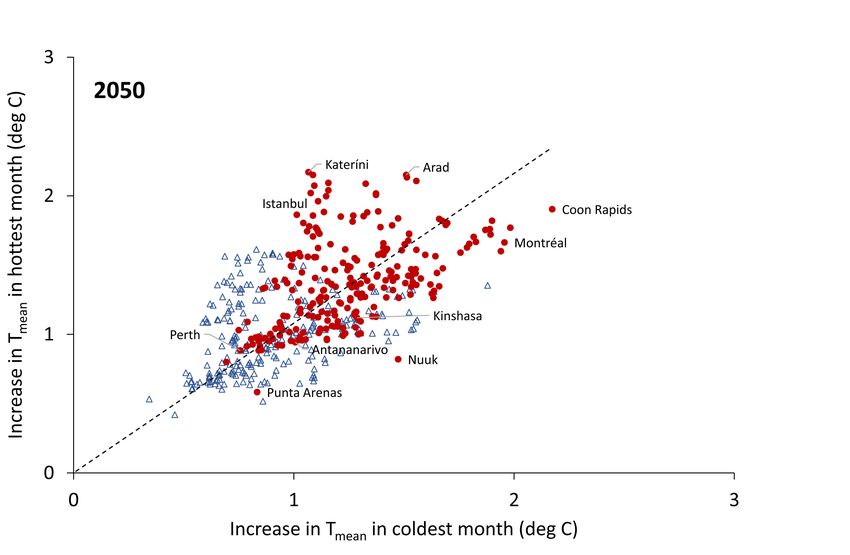
Climate 2017, 5, 93 5 of 15
Climate 2017, 5, 93 5 of 15
Figure
Figure 1.1. Geographical distribution
Geographical of SHUE
distribution cities and
of SHUE citiestheir
andclassification with regard
their classification withto regard
ecoregion
to
domain.
ecoregion domain.
2.3.
2.3. Analyses
Analyses
For each city,
For each city, we
we calculated
calculated 30-year
30-year averages
averages of of monthly
monthly TTmean for a baseline period (1988–2017,
mean for a baseline period (1988–2017,
referred
referred to as 2017),
to as 2017), aa near-future
near-future period
period (2021–2050,
(2021–2050, referred
referred to to as 2050), and
as 2050), and a far-future period
a far-future period
(2071–2100, referred to as 2100). The ensemble mean (mean of all 18 GCMs)
(2071–2100, referred to as 2100). The ensemble mean (mean of all 18 GCMs) was calculated, together was calculated, together
with the
with theannual
annualmeanmeanfor forallall series
series (mean
(mean of 12
of all allmonthly
12 monthly values).
values). Analyses
Analyses presented
presented here
here are are
based
based on changes
on changes in the annual
in the annual average average
of Tmeanof T
andmean and for the hottest and coldest months of the year in
for the hottest and coldest months of the year in 2050
2050 and 2100 compared with 2017.
and 2100 compared with 2017. The model outputs The model outputs are presented
are presented as changes
as changes from the from the baseline
baseline period,
period, rather than as absolute values. The focus on changes in temperature
rather than as absolute values. The focus on changes in temperature (together with the bias adjustment (together with the bias
adjustment described above) should help to reduce, though not eliminate,
described above) should help to reduce, though not eliminate, the impact on the analysis of model the impact on the analysis
of model
biases andbiases and shortcomings,
shortcomings, including someincluding some
of those of those
related related
to the to thecoarse
relatively relatively coarse
spatial scalespatial
of the
scale of
GCMs [19].the GCMs [19].
Changes
Changes in in temperatures
temperatures for forSHUE
SHUEcitiescitiesestimated
estimatedbybythe theGCMs
GCMs were
wereanalysed
analysed in in
relation to
relation
markers of their geographical location, including their coordinates (latitude/longitude),
to markers of their geographical location, including their coordinates (latitude/longitude), Bailey’s Bailey’s
ecoregion domain, and
ecoregion domain, and WHO
WHO region
region (Africa,
(Africa, Americas,
Americas, Eastern
Eastern Mediterranean,
Mediterranean, Europe,
Europe, South-East
South-East
Asia, Western Pacific). We also analysed the results in relation to city population
Asia, Western Pacific). We also analysed the results in relation to city population size. The analyses size. The analyses
were performed
were performedusing usingsimple
simple tabulation
tabulation andand graphical
graphical methods,
methods, including
including analyses
analyses of both ofuni-variate
both uni-
variate and bi-variate distributions. Where there was no data on city-level characteristics
and bi-variate distributions. Where there was no data on city-level characteristics for a given city, for a given
the
city, the city was excluded from that
city was excluded from that part of the analysis. part of the analysis.
3.
3. Results
Results
3.1. Temperature Changes
Changes by
by 2050
2050 and
and 2100
2100
Based ononthethesimple
simpleaverage
average across
across thethe 18 GCMs,
18 GCMs, the mean
the mean annual
annual temperature
temperature increase
increase in SHUE in
SHUE cities (relative
cities (relative to 2017)towas 2017) was estimated
estimated to be 0.93todegrees
be 0.93Celsius
degreesbyCelsius
2050 andby 1.10
2050degrees
and 1.10 degrees
Celsius by
Celsius
2100 underby 2100 under
RCP2.6, andRCP2.6, and 1.27
1.27 degrees degrees
Celsius Celsius
by 2050 by 2050
and 4.15 andCelsius
degrees 4.15 degrees
by 2100Celsius
underby 2100
RCP8.5
under RCP8.5
(Table 3). The (Table 3). The corresponding
corresponding figures for thefigures
hottestfor the hottest
month of the month of the
year were year
1.01 andwere
1.17 1.01 and
degrees
1.17 degrees
Celsius Celsius
by 2050 by 2050
and 2100, and 2100, under
respectively, respectively,
RCP2.6,under RCP2.6,
and 1.38 anddegrees
and 4.48 1.38 andCelsius
4.48 degrees Celsius
under RCP8.5.
under
This RCP8.5. This
emphasizes theemphasizes the relatively
relatively modest modest
increases increases inby
in temperature temperature
mid-century byunder
mid-century
each ofunder
these
each
GHGof these GHG
emissions emissions
pathways, butpathways, but thechanges
the much greater much greater
by the changes
end of thebycentury
the endunless
of thethere
century
is a
unless there is a rapid reduction of GHG emissions to bring the pathway
rapid reduction of GHG emissions to bring the pathway much closer to that of RCP2.6. much closer to that of
RCP2.6.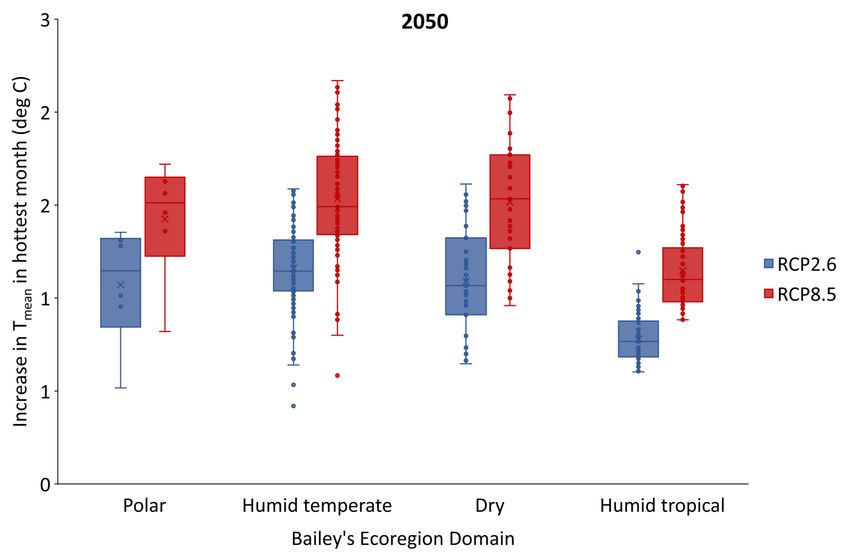
Climate 2017, 5, 93                                                                                                                                                                           6 of 15

                                             Table 3. Average of GCM estimates of changes in Tmean by 2050 and 2100 (relative to 2017).

                                                                            2050                                                                       2100
     WHO              Ecoregion
     Region                        Cities              RCP2.6                                 RCP8.5                              RCP2.6                                 RCP8.5
                       Domain
                                            Mean     Coldest       Hottest         Mean     Coldest       Hottest      Mean     Coldest       Hottest         Mean     Coldest       Hottest
                                            (◦ C)   Month (◦ C)   Month (◦ C)      (◦ C)   Month (◦ C)   Month (◦ C)   (◦ C)   Month (◦ C)   Month (◦ C)      (◦ C)   Month (◦ C)   Month (◦ C)
                     Polar          0         -          -             -             -          -             -          -          -             -             -          -             -
                 Humid temperate     2      0.95       0.70          1.24          1.32       1.08          1.72       1.09       0.82          1.36          4.23       3.27          5.45
      Africa
                      Dry            3      0.87       0.86          0.84          1.26       1.27          1.22       1.04       0.97          1.13          4.23       4.01          4.08
                  Humid tropical    15      0.80       0.79          0.82          1.15       1.14          1.16       0.94       0.89          1.00          3.79       3.74          3.87
                     Polar          1       1.26       1.49          1.28          1.59       1.79          1.63       1.50       1.96          1.37          5.03       5.78          5.39
                 Humid temperate    18      1.05       1.04          1.14          1.42       1.48          1.54       1.25       1.39          1.26          4.44       4.41          4.90
    Americas
                      Dry           10      0.97       0.91          1.01          1.35       1.33          1.41       1.12       1.17          1.14          4.36       4.11          4.64
                  Humid tropical    27      0.77       0.74          0.76          1.10       1.02          1.09       0.92       0.87          0.94          3.61       3.41          3.65
                     Polar          0         -          -             -             -          -             -          -          -             -             -          -             -
    Eastern      Humid temperate    3       0.97       0.75          1.18          1.35       1.16          1.58       1.12       0.92          1.33          4.30       3.52          4.87
   Mediterranean      Dry           13      0.99       0.98          1.08          1.37       1.30          1.52       1.17       1.15          1.22          4.54       4.27          4.89
                  Humid tropical    3       0.94       1.13          0.94          1.49       1.46          1.60       1.24       1.28          1.28          5.06       5.07          5.14
                     Polar          4       1.25       1.46          1.05          1.64       1.61          1.39       1.41       1.76          1.10          5.37       6.49          4.57
                 Humid temperate    45      0.99       0.85          1.31          1.34       1.24          1.72       1.16       1.14          1.38          4.20       3.99          5.35
     Europe
                      Dry           6       1.08       0.91          1.48          1.48       1.27          1.98       1.27       1.27          1.54          4.75       4.10          6.17
                  Humid tropical    0         -          -             -             -          -             -          -          -             -             -          -             -
                     Polar          0         -          -             -             -          -             -          -          -             -             -          -             -
   South-East    Humid temperate     2      1.13       1.28          1.13          1.44       1.50          1.48       1.28       1.40          1.38          4.64       5.15          4.63
     Asia             Dry            1      0.77       1.09          0.71          1.15       1.36          1.13       0.95       1.20          0.96          3.83       4.70          3.47
                  Humid tropical    36      0.73       0.82          0.78          1.10       1.16          1.18       0.95       1.03          1.02          3.81       4.04          3.91
                     Polar          1       1.23       1.43          0.95          1.65       1.62          1.36       1.36       1.44          1.15          5.39       6.33          4.82
     Western     Humid temperate    43      1.05       1.13          1.01          1.35       1.38          1.32       1.22       1.26          1.22          4.38       4.53          4.36
     Pacific          Dry            2      0.94       0.94          0.92          1.25       1.16          1.25       1.04       0.96          1.07          4.04       3.93          4.07
                  Humid tropical    10      0.76       0.74          0.73          1.05       1.10          1.04       0.97       1.03          0.89          3.41       3.38          3.42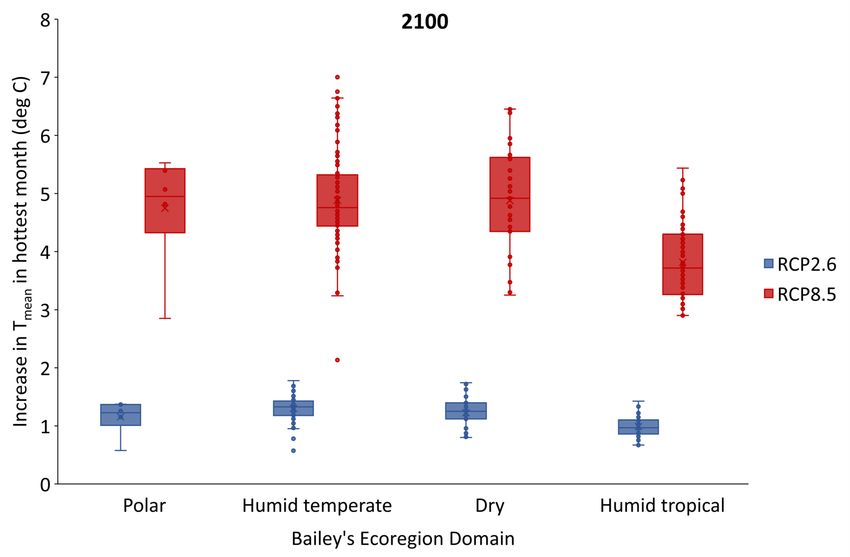
Climate 2017, 5, 93                                                                                                  7 of 15
Climate 2017, 5, 93                                                                                                  7 of 15

       By 2050, there was considerable overlap in the temperature increases experienced in SHUE cities
 under
     ByRCP2.6       and RCP8.5
          2050, there             (Figure 2).overlap
                         was considerable       There was    however
                                                         in the         substantial
                                                                 temperature           city-to-city
                                                                                 increases           variation
                                                                                             experienced        in the cities
                                                                                                            in SHUE     GCM
 resultsRCP2.6
under     (see Supplementary
                   and RCP8.5 (FigureMaterials).   By was
                                           2). There  2050,however
                                                               only a few    cities (Adana,
                                                                        substantial            Ankara,
                                                                                      city-to-city       Arad,inBucharest,
                                                                                                    variation     the GCM
 Denizli,   Karabük,      Katerini,   Madrid,     Mezotúr,     Subotica,    Zagreb,    and   Zaporizhzhya)
results (see Supplementary Materials). By 2050, only a few cities (Adana, Ankara, Arad, Bucharest,              showed     an
 increase   in T mean for the  hottest  month    of the  year  of greater   than  2 degrees    Celsius,
Denizli, Karabük, Katerini, Madrid, Mezotúr, Subotica, Zagreb, and Zaporizhzhya) showed an increase     all  under  RCP8.5.
 However,
in Tmean forby the2100,  all cities
                     hottest month  exceeded    2 degrees
                                      of the year           Celsius
                                                   of greater   than increase
                                                                      2 degreesfor   the hottest
                                                                                  Celsius,         month,
                                                                                             all under     with the
                                                                                                       RCP8.5.        largest
                                                                                                                  However,
 increases   close   to (and  in one   case, Madrid,   exceeding)    7  degrees    Celsius.   Under   RCP8.5,
by 2100, all cities exceeded 2 degrees Celsius increase for the hottest month, with the largest increases       by 2100,  the
 Tmean to
close   in(and
           the hottest     month
                 in one case,       will on
                                 Madrid,      average exceed
                                           exceeding)     7 degrees40 Celsius.
                                                                       °C in three
                                                                                 Under cities (Dammam,
                                                                                          RCP8.5,   by 2100,Baghdad,
                                                                                                               the Tmeanandin
 Amravati).                                             ◦
the hottest month will on average exceed 40 C in three cities (Dammam, Baghdad, and Amravati).
       Cities with
     Cities    with large
                       large increases
                              increases for
                                          for the
                                               the hottest
                                                    hottest month
                                                              month of of the
                                                                           theyear
                                                                                yeargenerally
                                                                                      generallyhad hadcomparably
                                                                                                        comparably largelarge
 increases for
increases    forthethecoldest
                        coldestmonth.
                                 month. However,
                                           However, somesome more
                                                                more northerly
                                                                        northerly cities
                                                                                     cities with
                                                                                            with colder
                                                                                                   colderwinter
                                                                                                          winterclimates
                                                                                                                    climates
 (Montreal,    Moscow,     Nuuk,    Omsk,    and  Saint Petersburg)     had  relatively   larger  increases
(Montreal, Moscow, Nuuk, Omsk, and Saint Petersburg) had relatively larger increases for the coldest         for the coldest
 month    by  comparison      with   the hottest  month     of the year,   while  southern     European
month by comparison with the hottest month of the year, while southern European cities, including         cities, including
 Madridand
Madrid     andKaterini,
                 Katerini,hadhadrelatively
                                  relativelylarge
                                               largeincreases
                                                     increasesininTT   mean for the hottest month compared with the
                                                                     mean for the hottest month compared with the
 increases   for  the  coldest
increases for the coldest month.month.

                                                             (a)

                                                             (b)
      Figure
       Figure2.  Increase in
              2. Increase  inTTmean
                                meanin in
                                       thethe hottest
                                           hottest    month
                                                   month       vs.theincoldest
                                                          vs. in        the coldest
                                                                               monthmonth    (relative
                                                                                      (relative        tounder
                                                                                                to 2017)  2017) RCP2.6
                                                                                                                under
      RCP2.6  (blue open   triangles)   and RCP8.5  (red dots)  by:   (a) the year 2050 and  (b)
       (blue open triangles) and RCP8.5 (red dots) by: (a) the year 2050 and (b) the year 2100.  the year 2100.
Climate 2017, 5, 93 8 of 15
Climate 2017, 5, 93 8 of 15
3.2. Variations
3.2. Variationsin
inTemperature
TemperatureChange
Changeby
byLatitude,
Latitude,Ecoregion
EcoregionDomain,
Domain,and
andCity
CitySize
Size
The magnitude
The magnitude of of the
the temperature
temperature increases
increases for
for the
the hottest
hottest month
month in in relation
relation to
to latitude
latitude and
and
ecoregiondomain
ecoregion domainareareshown
shownin inFigures
Figures33andand4.4.Figure
Figure33shows
showsthe thewell-documented
well-documentedamplification
amplification
of warming at high-latitudes. The smallest temperature increases are estimated
of warming at high-latitudes. The smallest temperature increases are estimated to be those for to be those forcities
cities
close to the equator, and the largest in cities at latitudes around 40 to 50 degrees north,
close to the equator, and the largest in cities at latitudes around 40 to 50 degrees north, with somewhat with somewhat
smaller increases
smaller increasesatatlatitudes
latitudesabove
abovethis.
this. Corresponding
Corresponding to tothe
thelatitudinal
latitudinalpatterns,
patterns,the
thetemperature
temperature
increases for the hottest month were generally largest for (humid) temperate
increases for the hottest month were generally largest for (humid) temperate and dry regions, and and dry regions, and
somewhatlower
somewhat lowerfor
forhumid
humid tropical
tropical climates,
climates, although
although therethere
waswas overlap
overlap in theinincrease
the increase
acrossacross all
all these
these categories.
categories. ClimateClimate differences
differences across ecoregions
across ecoregions may affect maytheaffect
abilitythe abilitytoof
of cities citiestoto
adapt adapt to
increasing
increasing temperatures—for
temperatures—for example, the example,
ability tothe abilitygreening
provide to provide forgreening for urban cooling.
urban cooling.
(a)
(b)
Figure3.3.Increase
Figure Increasein
inTTmean
mean under RCP2.6 (open triangles) and RCP8.5
RCP8.5 (dots)
(dots) relative
relative to
to 2017
2017 for
forthe
the
hottest month against latitude by: (a) the year 2050 and (b) the year 2100. Colouring indicates Bailey’s
hottest month against latitude by: (a) the year 2050 and (b) the year 2100. Colouring indicates Bailey’s
ecoregion
ecoregiondomains.
domains.
The differences in temperature changes in the hottest and coldest months by ecoregion domain
(Figure 4) are potentially important because of differences in diurnal and seasonal temperatureClimate 2017, 5, 93 9 of 15
The
Climate differences
2017, 5, 93 in temperature changes in the hottest and coldest months by ecoregion domain 9 of 15
(Figure 4) are potentially important because of differences in diurnal and seasonal temperature
variations in
variations in each
each region.
region. Although
Althoughthe theincrement
incrementininTT mean forfor
mean thethe hottest month
hottest monthwaswas
smallest for
smallest
humid
for humidtropical regions,
tropical cities
regions, in these
cities regions
in these tendtend
regions to have highhigh
to have relative and and
relative absolute humidity,
absolute and
humidity,
small
and diurnal
small diurnalandandseasonal
seasonal variation
variationin in
ambient
ambienttemperatures.
temperatures.Cities
Citiesininthe
the temperate and dry
temperate and dry
regions, however, with the largest temperature increments for the T of the
regions, however, with the largest temperature increments for the Tmean of the hottest month according
mean hottest month
according
to to ourtend
our estimates, estimates,
to havetend to have
generally generally
lower lower
relative relative
humidity andhumidity and greater
appreciably appreciably greater
diurnal and
diurnal and seasonal
seasonal variation. variation.
(a)
(b)
Figure4. 4. Increases
IncreasesininTTmean in the hottest month under RCP2.6 (blue) and RCP8.5 (red) relative to 2017
Figure mean in the hottest month under RCP2.6 (blue) and RCP8.5 (red) relative to 2017
forcities
for citiesinindifferent
differentBailey’s
Bailey’secoregion
ecoregiondomains
domainsby:
by:(a)
(a)the
theyear
year2050
2050and
and(b)
(b)the
theyear
year2100.
2100.
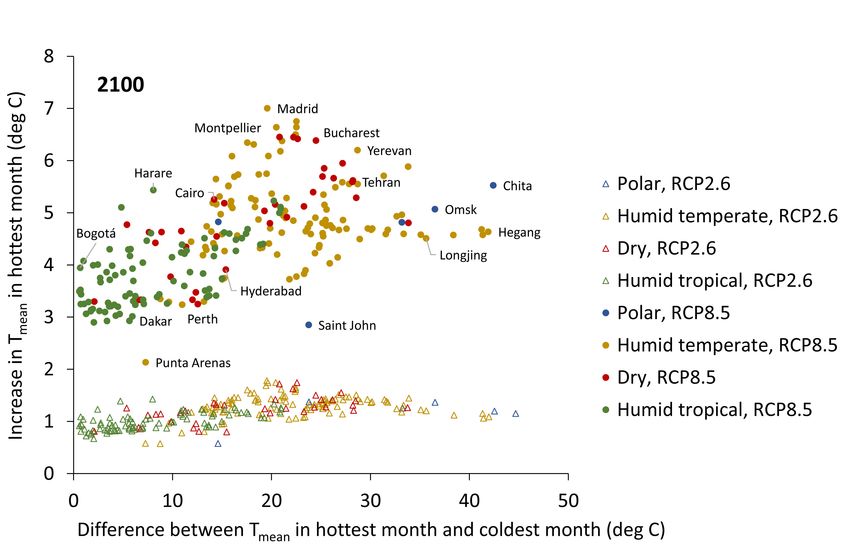
Figure 5 shows the generally inverse relationship between the increase in Tmean and the winter–
Figure 5 shows the generally inverse relationship between the increase in Tmean and the
summer differences in temperature as reflected by the difference in Tmean of the hottest and coldest
winter–summer differences in temperature as reflected by the difference in Tmean of the hottest and
months of the year. The figure demonstrates the considerable challenges for adaptation faced by cities
coldest months of the year. The figure demonstrates the considerable challenges for adaptation faced
that experience substantial warming during the hottest month of the year yet also extremely cold
by cities that experience substantial warming during the hottest month of the year yet also extremely
wintertime conditions.
cold wintertime conditions.Climate 2017, 5, 93 10 of 15
Climate 2017, 5, 93 10 of 15
(a)
(b)
Figure 5.5. Increases
Increases in
in TTmean for the hottest month relative to 2017: relationship to the seasonal variation
Figure mean for the hottest month relative to 2017: relationship to the seasonal variation
in temperature as represented byby
in temperature as represented the
the difference
difference between
between thethe
Tmean forfor
Tmean thethe hottest
hottest andand coldest
coldest month
month by
by (a) the year 2050 and (b) the year 2100. Colouring indicates Bailey’s ecoregion
(a) the year 2050 and (b) the year 2100. Colouring indicates Bailey’s ecoregion domain. domain.
There was no clear pattern of association between the temperature increase for the hottest month
There was no clear pattern of association between the temperature increase for the hottest month
and city size (population) (Figure 6). The temperature increases for SHUE ‘Megacities’ over 10 million
and city size (population) (Figure 6). The temperature increases for SHUE ‘Megacities’ over 10 million
in population (n = 16) are in the range of 3 degrees Celsius to just over 5 degrees Celsius. It is worth
in population (n = 16) are in the range of 3 degrees Celsius to just over 5 degrees Celsius. It is
noting that Figure 6 represents only present day populations; these populations are likely to increase
worth noting that Figure 6 represents only present day populations; these populations are likely to
considerably over the century, especially in Asia and Africa. The ability of cities to adapt may vary
increase considerably over the century, especially in Asia and Africa. The ability of cities to adapt
depending on their size, with smaller but growing cities better able to implement the necessary heat
may vary depending on their size, with smaller but growing cities better able to implement the
adaptation infrastructure, and on their wealth, with richer cities better able to afford mitigation
necessary heat adaptation infrastructure, and on their wealth, with richer cities better able to afford
measures.
mitigation measures.Climate 2017, 5, 93 11 of 15
Climate 2017, 5, 93 11 of 15
(a)
(b)
Figure 6.6. Increase
Increase in
in TTmean in the hottest month by 2100 (relative to 2017) under RCP8.5 vs. city
Figure mean in the hottest month by 2100 (relative to 2017) under RCP8.5 vs. city
population size (log scale) by (a)
population size (log scale) by (a) the theyear
year2050
2050and
and(b)
(b)the
theyear
year2100.
2100.Colouring
Colouringindicates
indicatesBailey’s
Bailey’s
ecoregiondomain.
ecoregion domain.
4. Discussion
4. Discussion
Theresults
The resultsof
ofthese
theseanalysis
analysisprovide
provideananinsight
insightinto
intothe
thetemperature
temperatureincreases
increasesthat
thatmay
mayoccur
occurinin
cities over this century under high and low GHG emissions trajectories. The results
cities over this century under high and low GHG emissions trajectories. The results confirm substantial confirm
substantial
increases in increases in hottest
hottest month month temperatures
temperatures in all RCP8.5
in all cities under cities under
by theRCP8.5
end of by
thethe end of
century, the
with
century, with many likely to experience increases of 4 to 7 degrees Celsius, especially
many likely to experience increases of 4 to 7 degrees Celsius, especially in cities at higher latitudes in cities at
higher latitudes with temperate or dry climates. More generally, the work demonstrates
with temperate or dry climates. More generally, the work demonstrates the desirability of having the
desirability
consistent of on
data having consistent
a large data on a large andsample
and globally-representative globally-representative sample ofcan
of cities. Such information cities. Such
enable a
information can enable a better understanding of interactions between climate change
better understanding of interactions between climate change and other environmental health issues, and other
environmental health issues, including the potential to achieve co-benefits across multiple risks
through actions to improve urban sustainability [8].Climate 2017, 5, 93 12 of 15
including the potential to achieve co-benefits across multiple risks through actions to improve urban
sustainability [8].
Although we do not here attempt to quantify the health and social impacts of these temperature
rises, in a recent multi-country analysis of temperature-related mortality, the ‘optimum temperature’
(i.e., the point of minimum mortality in relation to daily temperature), was found to vary from around
the 60th percentile of the daily distribution in tropical areas to around the 80–90th percentile in
temperate regions [20]. Hence, a 4 to 7 degrees Celsius rise in Tmean for the hottest month would
usually represent an appreciable increase above the threshold for heat deaths [20–23], and often
to temperatures that are well beyond the current distribution. Such increases are likely to present
considerable challenges to adaptation and health protection, especially for cities where the mean
temperature (i.e., calculated using both day and night temperatures) for the whole month rises above
core body temperature of 37 degrees Celsius—as it does in several locations in our analysis.
However, the variation in temperature increases with regard to latitude and ecoregion domain
may also indicate different implications for adaptation responses. Although cities in low latitude
tropical climates generally had more modest increases in Tmean for the hottest month, these cities also
tend to have high humidity and small diurnal and seasonal variations in temperature. The combination
of heat and humidity (as reflected by high wet bulb globe temperatures and similar indices) presents
a particular physiological stress [24,25] that may be greater than that generated by higher but drier
ambient temperatures. Also, in tropical climates there is usually limited nocturnal relief. In contrast,
the cities in temperate and dry climates with larger potential temperature increases have much greater
diurnal and seasonal variation in both temperatures and humidity, which offer potential options to
help control indoor environments through the buffering effect of thermal mass [26], or to differentiate
activities across the year to reduce exposure to the harshest temperatures for outdoor workers [27].
The data we present do not provide information on future changes in extremes of temperature.
However, the fact that the temperature increases for the hottest month were generally similar to the
temperature increase for the whole year (Table 3) suggests that most of the increase in exposure to the
highest temperatures may occur because of the upward shift in the mean temperature distribution
rather than by increasing the frequency of temperature extremes by spreading the distribution at a
given mean. We acknowledge, however, that these monthly means are not necessarily very sensitive
to changes at the tails of the temperature distribution. Moreover, this conclusion of course depends
on the ability of current GCMs to capture distributional shifts accurately. In any event, an upward
shift in the mean temperature for the year or the hottest month would lead to exposures that are very
rare or non-existent under the current climate conditions—and hence by definition present extreme
challenges for current heat adaptation strategies.
Among the main strengths of our study is the fact that the analysis was of a globally representative
sample of cities and so reflects variation of urban populations with regard to region, city size, and
economic development. Its results were also based on an ensemble of 18 global climate models,
though here we show only mean values rather than presenting the suite of individual model results
to show the diversity of their results. On the other hand, the analysis was of change in (dry bulb)
temperatures alone, taking no account humidity, or evidence on the precise form of the distribution
of daily temperatures. Moreover, the analyses did not attempt to incorporate the urban heat island
(UHI) effect—the name given to the occurrence of higher outdoor temperatures in metropolitan
areas compared with those of the surrounding countryside caused by the thermal properties (heat
absorption, capacity, conductance, and albedo) of the surfaces and materials found in urban landscapes,
the reduced evapotranspiration from reduced natural vegetation, and the waste heat production from
anthropogenic activities [28–30]. The UHI effect may add to the more general effect of increasing
temperatures, especially in larger cities, though the implications for personal exposure and health are
more complex [31,32] and surface temperature effects may in part be offset by overshadowing by high
rise buildings in urban centres [33]. A further limitation was the relatively coarse resolution of the
GCMs, resulting in an inability to distinguish some cities from neighbouring cities and potential biasesClimate 2017, 5, 93 13 of 15
for coastal cities. However, our focus on changes in temperatures (rather than absolute values) should
have minimized these effects.
Combined assessment of temperature and humidity, UHI effects, and more detailed assessment
of the implications for health are all important steps for further research, therefore. However, the main
policy implications are clear. The first is the importance of aggressive reduction in GHG emissions in
order to help reduce the more extreme temperature rises for urban populations that could be expected
from emissions trajectories similar to that represented by RCP8.5. The second is to ensure adaptation
planning takes account of the likelihood of very sizeable temperature increases in urban centres around
the globe that will lead many populations to be exposed to temperatures well beyond those of their
current experience.
Supplementary Materials: The following are available online at www.mdpi.com/2225-1154/5/4/93/s1. Table S1:
Minimum of GCM estimates of changes in Tmean by 2050 and 2100 (relative to 2017) and Table S2: Maximum of
GCM estimates of changes in Tmean by 2050 and 2100 (relative to 2017).
Acknowledgments: This study forms part of the Sustainable Healthy Urban Environments (SHUE) project
supported by the Wellcome Trust “Our Planet, Our Health” programme (Grant number 103908). The authors
would also like to thank Dr. Clare Goodess (Climatic Research Unit, University of East Anglia) for provision of
the GCM data.
Author Contributions: James Milner and Paul Wilkinson conceived the paper and wrote the first draft.
Colin Harpham, under the supervision of Corinne Le Quéré, processed the Global Climate Model data.
James Milner and James Milner, with input from Mike Davies, Andy Haines and Paul Wilkinson, assembled and
analysed the SHUE data. All authors contributed to the editing of the paper and approved the final draft.
Conflicts of Interest: The authors declare no conflict of interest. The funding sponsors had no role in the design
of the study; in the collection, analyses, or interpretation of data; in the writing of the manuscript, and in the
decision to publish the results.
References
1. United Nations. World Urbanization Prospects. The 2014 Revision; UN Department of Economic and Social
Affairs: New York, NY, USA, 2014.
2. New Climate Economy. Seizing the Global Opportunity: Partnerships for Better Growth and a Better Climate;
New Climate Economy: Washington, DC, USA, 2015.
3. Haines, A.; McMichael, A.J.; Smith, K.R.; Roberts, I.; Woodcock, J.; Markandya, A.; Armstrong, B.G.;
Campbell-Lendrum, D.; Dangour, A.D.; Davies, M.; et al. Public health benefits of strategies to reduce
greenhouse-gas emissions: Overview and implications for policy makers. Lancet 2009, 374, 2104–2114.
[CrossRef]
4. Hajat, S.; Vardoulakis, S.; Heaviside, C.; Eggen, B. Climate change effects on human health: Projections of
temperature-related mortality for the UK during the 2020s, 2050s and 2080s. J. Epidemiol. Commun. Health
2014, 68, 595–596. [CrossRef] [PubMed]
5. IPCC. Climate Change 2013: The Physical Science Basis. Contribution of Working Group I to the Fifth Assessment
Report of the Intergovernmental Panel on Climate Change; Cambridge University Press: Cambridge, UK;
New York, NY, USA, 2014.
6. Ekström, E.; Grose, M.R.; Whetton, P.H. An appraisal of downscaling methods used in climate change
research. Wiley Interdiscip. Rev. Clim. Chang. 2015, 6, 301–319. [CrossRef]
7. Giorgi, F.; Gutowski, W.J. Regional dynamical downscaling and the CORDEX initiative. Ann. Rev. Environ. Resour.
2015, 40, 467–490. [CrossRef]
8. Milner, J.; Taylor, J.; Barreto, M.L.; Davies, M.; Haines, A.; Harpham, C.; Sehgal, M.; Wilkinson, P.; on behalf of
the SHUE project partners. Environmental risks of cities in the European Region: Analyses of the Sustainable
Healthy Urban Environments (SHUE) database. Public Health Panor. 2017, 3, 141–356.
9. GeoNames. The GeoNames Geographical Database. Available online: http://www.geonames.org/
(accessed on 1 March 2017).
10. World Bank. GNI Per Capita. Available online: http://data.worldbank.org/indicator/NY.GNP.PCAP.PP.CD
(accessed on 1 March 2017).Climate 2017, 5, 93 14 of 15
11. Bailey, R.G. Ecoregions: The Ecosystem Geography of the Oceans and Continents; Springer: New York, NY,
USA, 1998.
12. Van Vuuren, D.P.; Edmonds, J.; Kainuma, M.; Riahi, K.; Thomson, A.; Hibbard, K.; Hurtt, G.C.; Kram, T.;
Krey, V.; Lamarque, J.-F.; et al. The representative concentration pathways: An overview. Clim. Chang. 2011,
109, 5. [CrossRef]
13. Meinshausen, M.; Smith, S.J.; Calvin, K.; Daniel, J.S.; Kainuma, M.L.T.; Lamarque, J.-F.; Matsumoto, K.;
Montzka, S.A.; Raper, S.C.B.; Riahi, K.; et al. The RCP greenhouse gas concentrations and their extensions
from 1765 to 2300. Clim. Chang. 2011, 109, 213. [CrossRef]
14. International Institute for Applied Systems Research (IIASA). RCP Database (version 2.0). Available
online: http://tntcat.iiasa.ac.at:8787/RcpDb/dsd?Action=htmlpage&page=welcome (accessed on
1 September 2016).
15. Riahi, K.; Gruebler, A.; Nakicenovic, N. Scenarios of long-term socio-economic and environmental
development under climate stabilization. Technol. Forecast. Soc. Chang. 2007, 74, 887–935. [CrossRef]
16. Taylor, K.; Stouffer, R.; Meehl, G. An overview of CMIP5 and the experiment design. Bull. Am. Meteorol. Soc.
2012, 93, 485–498. [CrossRef]
17. Collins, M.; Knutti, R.; Arblaster, J.; Dufresne, J.-L.; Fichefet, T.; Friedlingstein, P.; Gao, X.; Gutowski, W.J.;
Johns, T.; Krinner, G.; et al. Long-term climate change: Projections, commitments and irreversibility.
In Climate Change 2013: The Physical Science Basis. Contribution of Working Group I to the Fifth Assessment Report
of the Intergovernmental Panel on Climate Change; Stocker, T.F., Qin, D., Plattner, G.-K., Tignor, M., Allen, S.K.,
Boschung, J., Nauels, A., Xia, Y., Bex, V., Midgley, P.M., Eds.; Cambridge University Press: Cambridge, UK;
New York, NY, USA, 2013.
18. Harris, I.; Jones, P.D.; Osborn, T.J.; Lister, D.H. Updated high-resolution grids of monthly climatic
observations—The CRU TS3.10 Dataset. Int. J. Climatol. 2014, 34, 623–642. [CrossRef]
19. Flato, G.; Marotzke, J.; Abiodun, B.; Braconnot, P.; Chou, S.C.; Collins, W.; Cox, P.; Driouech, F.; Emori, S.;
Eyring, V.; et al. Evaluation of climate models. In Climate Change 2013: The Physical Science Basis. Contribution
of Working Group I to the Fifth Assessment Report of the Intergovernmental Panel on Climate Change; Stocker, T.F.,
Qin, D., Plattner, G.-K., Tignor, M., Allen, S.K., Boschung, J., Nauels, A., Xia, Y., Bex, V., Midgley, P.M., Eds.;
Cambridge University Press: Cambridge, UK; New York, NY, USA, 2013.
20. Gasparrini, A.; Guo, Y.; Hashizume, M.; Lavigne, E.; Zanobetti, A.; Schwartz, J.; Tobias, A.; Tong, S.;
Rocklov, J.; Forsberg, B.; et al. Mortality risk attributable to high and low ambient temperature: A
multicountry observational study. Lancet 2015, 386, 369–375. [CrossRef]
21. McMichael, A.J.; Wilkinson, P.; Kovats, R.S.; Pattenden, S.; Hajat, S.; Armstrong, B.; Vajanapoom, N.;
Niciu, E.M.; Mahomed, H.; Kingkeow, C.; et al. International study of temperature, heat and urban mortality:
The “ISOTHURM” project. Int. J. Epidemiol. 2008, 37, 1121–1131. [CrossRef] [PubMed]
22. Medina-Ramon, M.; Schwartz, J. Temperature, temperature extremes, and mortality: A study of
acclimatisation and effect modification in 50 US cities. Occup. Environ. Med. 2007, 64, 827–833. [CrossRef]
[PubMed]
23. Bunker, A.; Wildenhain, J.; Vandenbergh, A.; Henschke, N.; Rocklov, J.; Hajat, S.; Sauerborn, R. Effects of air
temperature on climate-sensitive mortality and morbidity outcomes in the elderly; a systematic review and
meta-analysis of epidemiological evidence. EBioMedicine 2016, 6, 258–268. [CrossRef] [PubMed]
24. Brode, P.; Fiala, D.; Lemke, B.; Kjellstrom, T. Estimated work ability in warm outdoor environments depends
on the chosen heat stress assessment metric. Int. J. Biometeorol. 2017. [CrossRef] [PubMed]
25. Gao, C.; Kuklane, K.; Ostergren, P.O.; Kjellstrom, T. Occupational heat stress assessment and protective
strategies in the context of climate change. Int. J. Biometeorol. 2017. [CrossRef] [PubMed]
26. Lomas, K.J.; Porritt, S.M. Overheating in buildings: Lessons from research. Build. Res. Inf. 2017, 45, 1–18.
[CrossRef]
27. Nilsson, M.; Kjellstrom, T. Climate change impacts on working people: How to develop prevention policies.
Glob. Health Action 2010, 3, 5774. [CrossRef] [PubMed]
28. Ward, K.; Lauf, S.; Kleinschmit, B.; Endlicher, W. Heat waves and urban heat islands in Europe: A review of
relevant drivers. Sci. Total Environ. 2016, 569–570, 527–539. [CrossRef] [PubMed]
29. Estoque, R.C.; Murayama, Y.; Myint, S.W. Effects of landscape composition and pattern on land surface
temperature: An urban heat island study in the megacities of Southeast Asia. Sci. Total Environ. 2017, 577,
349–359. [CrossRef] [PubMed]Climate 2017, 5, 93 15 of 15
30. Zhou, B.; Rybski, D.; Kropp, J.P. The role of city size and urban form in the surface urban heat island. Sci. Rep.
2017, 7. [CrossRef] [PubMed]
31. Heaviside, C.; Macintyre, H.; Vardoulakis, S. The urban heat island: Implications for health in a changing
environment. Curr. Environ. Health Rep. 2017, 4, 296–305. [CrossRef] [PubMed]
32. Milojevic, A.; Armstrong, B.G.; Gasparrini, A.; Bohnenstengel, S.I.; Barratt, B.; Wilkinson, P. Methods to
estimate acclimatization to urban heat island effects on heat- and cold-related mortality. Environ. Health
Perspect. 2016, 124, 1016–1022. [CrossRef] [PubMed]
33. Lindberg, F.; Holmer, B.; Thorsson, S.; Rayner, D. Characteristics of the mean radiant temperature in high
latitude cities—Implications for sensitive climate planning applications. Int. J. Biometeorol. 2014, 58, 613–627.
[CrossRef] [PubMed]
© 2017 by the authors. Licensee MDPI, Basel, Switzerland. This article is an open access
article distributed under the terms and conditions of the Creative Commons Attribution
(CC BY) license (http://creativecommons.org/licenses/by/4.0/).You can also read


