The pH dependency of the boron isotopic composition of diatom opal (Thalassiosira weissflogii)
←
→
Page content transcription
If your browser does not render page correctly, please read the page content below
Biogeosciences, 17, 2825–2837, 2020
https://doi.org/10.5194/bg-17-2825-2020
© Author(s) 2020. This work is distributed under
the Creative Commons Attribution 4.0 License.

The pH dependency of the boron isotopic composition of diatom
opal (Thalassiosira weissflogii)
Hannah K. Donald1 , Gavin L. Foster1 , Nico Fröhberg1 , George E. A. Swann2 , Alex J. Poulton3,4 , C. Mark Moore1 ,
and Matthew P. Humphreys5
1 School of Ocean and Earth Science, National Oceanography Centre Southampton, University of Southampton,
Southampton, SO14 3ZH, UK
2 School of Geography, University of Nottingham, University Park, Nottingham, NG7 2RD, UK
3 Ocean Biogeochemistry and Ecosystems, National Oceanography Centre, Southampton, SO14 3ZH, UK
4 The Lyell Centre, Heriot-Watt University, Edinburgh, EH14 4AS, UK
5 NIOZ Royal Netherlands Institute for Sea Research, Department of Ocean Systems (OCS), and Utrecht University,

P.O. Box 59, 1790 AB Den Burg (Texel), the Netherlands

Correspondence: Gavin L. Foster (gavin.foster@noc.soton.ac.uk)

Received: 9 May 2019 – Discussion started: 23 May 2019
Revised: 25 March 2020 – Accepted: 21 April 2020 – Published: 27 May 2020

Abstract. The high-latitude oceans are key areas of carbon         construction in high-latitude marine sediments that have, up
and heat exchange between the atmosphere and the ocean.            until now, eluded study due to the lack of suitable carbonate
As such, they are a focus of both modern oceanographic and         material.
palaeoclimate research. However, most palaeoclimate prox-
ies that could provide a long-term perspective are based on
calcareous organisms, such as foraminifera, that are scarce
or entirely absent in deep-sea sediments south of 50◦ S in the     1   Introduction
Southern Ocean and north of 40◦ N in the North Pacific. As
a result, proxies need to be developed for the opal-based or-      The high-latitude regions, such as the Southern Ocean and
ganisms (e.g. diatoms) found at these high latitudes, which        the subarctic North Pacific Ocean, exert key controls on
dominate the biogenic sediments recovered from these re-           atmospheric carbon dioxide (CO2 ) content. Both areas are
gions. Here we present a method for the analysis of the boron      where upwelling of deep carbon- and nutrient-rich water oc-
(B) content and isotopic composition (δ 11 B) of diatom opal.      curs, which promotes outgassing of previously stored carbon
We apply it for the first time to evaluate the relationship be-    to the atmosphere and nutrient fertilisation of primary pro-
tween seawater pH, δ 11 B and B concentration ([B]) in the         ductivity, in turn drawing down CO2 . The balance of pro-
frustules of the diatom Thalassiosira weissflogii, cultured        cesses involved in determining whether these oceanic regions
across a range of carbon dioxide partial pressure (pCO2 ) and      are a source or sink of CO2 is poorly understood, to the ex-
pH values. In agreement with existing data, we find that the       tent that the oceanic controls on glacial–interglacial pH and
[B] of the cultured diatom frustules increases with increas-       pCO2 changes remain a subject of vigorous debate (e.g. Mar-
ing pH (Mejía et al., 2013). δ 11 B shows a relatively well        tin, 1990; Sigman and Boyle, 2000). Recently, several stud-
defined negative trend with increasing pH, completely dis-         ies have shown how the boron isotope pH proxy applied to
tinct from any other biomineral previously measured. This          calcitic foraminifera successfully tracks surface water CO2
relationship not only has implications for the magnitude of        content, thus documenting changes in air–sea CO2 flux along
the isotopic fractionation that occurs during boron incorpo-       the margins of these regions (e.g. Martínez-Botí et al., 2015;
ration into opal, but also allows us to explore the potential of   Gray et al. 2018). However, the lack of preserved marine car-
the boron-based proxies for palaeo-pH and palaeo-CO2 re-           bonates in areas that are thought to be key in terms of glacial–
                                                                   interglacial CO2 change (e.g. the polar Antarctic zone; Sig-

Published by Copernicus Publications on behalf of the European Geosciences Union.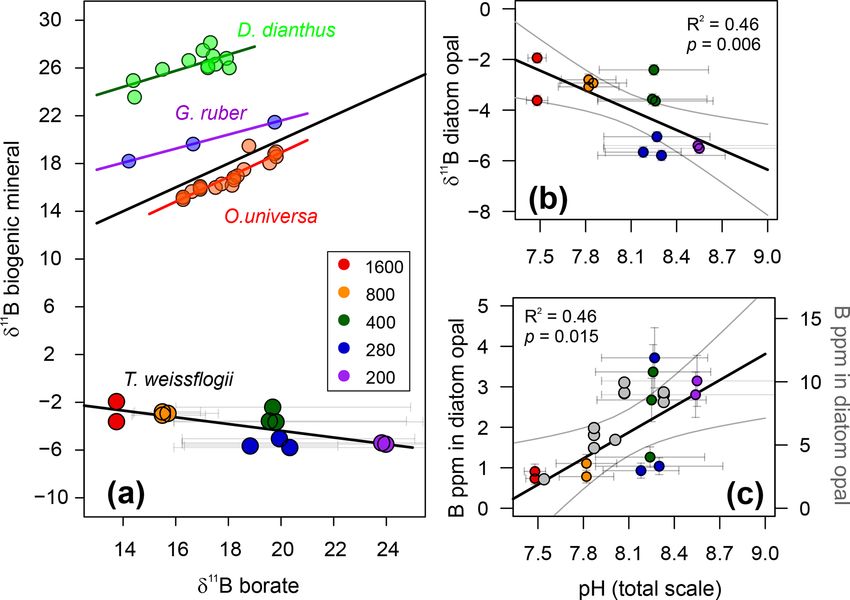
2826                                                       H. K. Donald et al.: The boron isotopic composition of diatom opal

man et al., 2010) represents a currently insurmountable prob-          Here, the relationship between δ 11 B of the frustules of
lem, preventing the determination of air–sea CO2 flux using         the diatom T. weissflogii and seawater pH is investigated for
boron-based proxies in regions that are likely to play the most     the first time using a batch culturing technique and differ-
important role in glacial–interglacial CO2 change. There is         ent air–CO2 mixtures to explore a range of pH (8.53 ± 0.73
therefore a clear need for the boron isotope palaeo-pH proxy        to 7.48 ± 0.08). The aim of this study was also to develop a
to be developed in biogenic silica (diatom frustules, radio-        methodology for measuring the boron isotopic composition
larian shells), which is preserved in high-latitude settings, to    of biogenic silica by MC-ICP-MS (multicollector inductively
better understand these key regions and their role in natural       coupled plasma mass spectrometry) and apply this method
climate change.                                                     to explore the response of the boron-based proxies ([B] and
   The boron isotopic system has been used extensively in           δ 11 B) in diatom frustules to changing pH. Ultimately, we
marine carbonates for the reconstruction of past ocean pH           show how boron isotopes measured in diatom frustules may
and past atmospheric pCO2 (e.g. Hemming and Hanson,                 provide further insight into boron uptake and physiological
1992; Pearson and Palmer, 2000; Hönisch and Hemming,                activity within diatoms and test the potential of δ 11 B and
2005; Foster, 2008; Henehan et al., 2013; Chalk et al., 2017;       boron content in diatoms as proxies for the ocean carbonate
Sosdian et al., 2018). Comprehensive calibration work has           system.
been completed for numerous species of foraminifera that
are currently used in palaeoceanographic reconstruction (e.g.
Henehan et al., 2016; Rae et al., 2011). From this it has           2     Methods
been shown that while δ 11 B compositions are fairly similar
                                                                    2.1    Experimental setup
among carbonates, species-specific differences exist in the
relationship between the δ 11 B of dissolved borate and that of     The centric diatom T. weissflogii (Grunow in van Heurck,
foraminifera. Once this relationship is known, this δ 11 B–pH       PCC 541, CCAP 1085/1; Hasle and Fryxell, 1977) was
calibration can be applied to fossils found in deep-sea sedi-       grown in triplicate in enriched sterile and filtered seawater
ment cores, reliably reconstructing past ocean pH and pCO2          (K/1; 0.2 µm; seawater sourced from Labrador Sea; Keller
(e.g. Hönisch and Hemming, 2005; Foster, 2008; Hönisch et           et al., 1987) in 3 L glass Erlenmeyer flasks for a maxi-
al., 2009; Chalk et al., 2017). However, thus far the boron iso-    mum of 1 week for each experiment. Initial nutrient con-
topic composition (expressed as δ 11 B) and B concentration         centrations within the seawater before enrichment were as-
([B]) of the siliceous fraction of deep-sea sediments remain        sessed on a SEAL Analytical QuAAtro analyser with a
poorly studied.                                                     UV–Vis spectrometer and ranged from 23.3 to 27.5 µM
   Early exploratory work by Ishikawa and Nakamura (1993)           for nitrate (+ nitrite), 4.3 to 5.4 µM for silicic acid and
showed that biogenic silica and diatom ooze collected from          1.4 to 1.6 µM for phosphate. The culture experiments were
modern deep-sea sediments in the North Pacific and equa-            bubbled with air–CO2 mixtures in different concentrations
torial Pacific had relatively high boron contents (70–80 ppm)       (sourced from BOC; https://www.boconline.co.uk, last ac-
but a very light isotope ratio. For example, a diatom ooze was      cess: 24 March 2020) to provide a pH range at constant bub-
shown to have a δ 11 B of −1.1 ‰ whilst radiolarian shells          ble rates, and every flask was agitated by hand twice daily
had a δ 11 B of +4.5 ‰. While some of this light δ 11 B may         to limit algal settling and aggregation. The monocultures
have partly arisen due to clay contamination (reducing the          were grown in nutrient-replete conditions at constant tem-
diatom ooze sample by up to 3 ‰; Ishikawa and Nakamura,             perature (20 ◦ C) and on a 12 h : 12 h light–dark cycle (with
1993), it also likely reflects an opal : seawater isotopic frac-    192 µE m−2 s−1 , or 8.3 E m−2 d−1 during the photoperiod).
tionation arising from the substitution of borate for silicate in   The diatoms were acclimated to each pCO2 treatment for
tetrahedral sites in the opal (Ishikawa and Nakamura, 1993).        at least 10 generations before inoculating the culture exper-
A similarly light δ 11 B was also observed in marine cherts         iment flasks. All culture handling was completed within a
from deep-sea sediments by Kolodny and Chaussidon (2004;            laminar flow hood to ensure sterility. The flow hood surfaces
−9.3 to +8 ‰), but these are likely diagenetic and there-           were cleaned with 90 % ethanol before and after handling, as
fore unlikely to be primary seawater precipitates. A recent         well as the outer surface of all autoclaved labware entering
culture study of the diatoms Thalassiosira weissflogii and T.       the laminar flow hood such as bottles and pipettes.
pseudonana showed that the boron content of cultured opal              The cultured diatom samples were collected by centrifuga-
was significantly lower than suggested by the bulk sampling         tion at 96 h, during the exponential growth phase. Each flask
of Ishikawa and Nakamura (1993) at around 5–10 ppm, in-             was simultaneously disconnected from the gas supply with
creasing as pH increased from 7.6 to 8.7 (Mejía et al., 2013).      the culture immediately centrifuged at 3700 rpm for 30 min
This suggests the seawater tetrahydroxyborate anion (borate;        into a pellet, rinsed with Milli-Q and frozen at −20 ◦ C in ster-
B(OH)−  4 ) is predominantly incorporated into the diatom frus-     ile plastic 50 mL centrifuge tubes. Around 10 mg of diatom
tule rather than boric acid (B(OH)3 ), and it implies there is      biomass was harvested in each experiment.
potential for the boron content of diatom opal to trace pH in
the past (Mejía et al., 2013).

Biogeosciences, 17, 2825–2837, 2020                                                    https://doi.org/10.5194/bg-17-2825-2020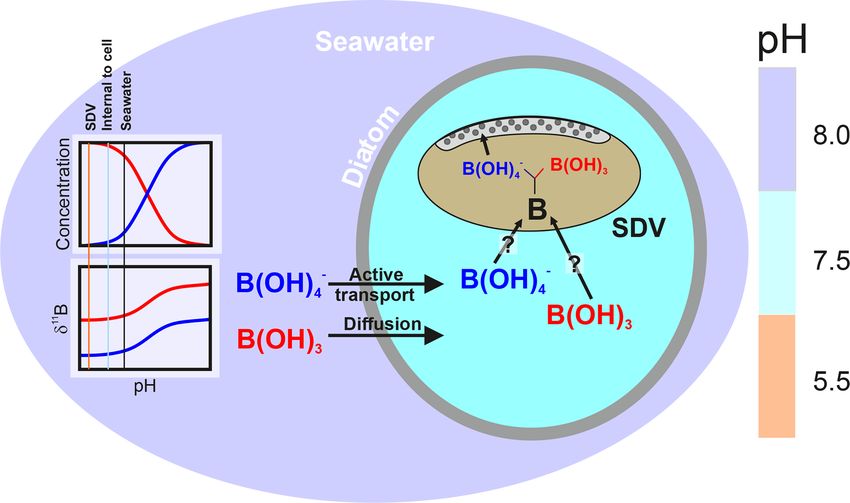
H. K. Donald et al.: The boron isotopic composition of diatom opal                                                           2827

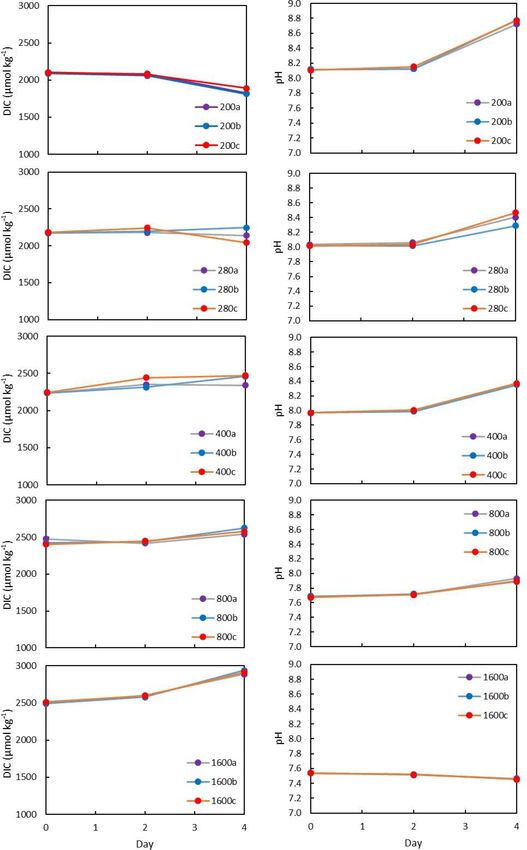
2.2   Growth rate and cell size                                     ments held relatively constant DIC and pH until the final 24 h
                                                                    of the experiment, when marked changes in DIC and pH in
A 5 mL subsample was taken from each culture flask through          all culture treatments were observed (Fig. 2), which in most
sterilised Nalgene tubing into sterile syringes and sealed in       cases was likely due to the growth of diatoms and an asso-
sterile 15 mL centrifuge tubes. Triplicate cell counts using a      ciated net removal of DIC, despite the constant addition of
Coulter Multisizer™ 3 (Beckman Coulter) were performed              pCO2 . In order to account for these non-steady-state con-
daily on each experimental flask. Growth rates were calcu-          ditions of the carbonate system, the mean pH and pCO2 of
lated using Eq. (1):                                                each treatment were calculated based on the number of cells
                                                                    grown per 24 h along with the pH/pCO2 measured in that
µ = (ln Nt − ln Ni )/(t − ti ),                              (1)    24 h, thus adjusting for the observed exponential growth rate
where Ni is the initial cell density at the start of the exper-     of T. weissflogii (Table 1).
iment (ti ) and Nt is the cell density at time t. Triplicate es-       The boron concentration of the culture media was not de-
timates of cell size were also determined using the Coulter         termined but is assumed to be the same as Labrador seawater
Multisizer™ 3 to determine the mean cell size over time in          (∼ 4.5 ppm; Lee et al., 2010). The boron isotopic composi-
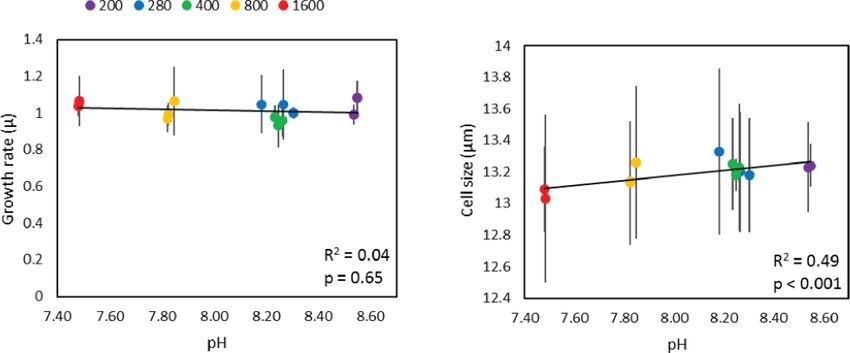
each flask. Figure 1 shows that although there is no statisti-      tion of the culture media was determined using standard ap-
cally significant relationship between pH and diatom growth         proaches (Foster et al., 2010) to be 38.8 ± 0.19 ‰ (2 SD).
rate, cell size does show a small, but statistically significant,
positive slope.                                                     2.4   Preparing cultured diatoms for δ 11 B and B/Si
                                                                          analysis
2.3   pH, DIC and δ 11 B of the culture media

A pH meter (Orion 410A) calibrated using standard National          In order to examine reproducibility and accuracy of our
Bureau of Standards (NBS) buffers prior to sample extraction        boron measurements, an in-house diatom reference material
was used to monitor the evolution of pH through the experi-         was used to develop a method for measuring boron isotopes
ment on a daily basis. For fully quantitative constraints on the    and boron concentration in biogenic silica. A British Antarc-
carbonate system of the culture media, dissolved inorganic          tic Survey core catcher sample (TC460) from core TC460
carbon (DIC) was measured in triplicate, every other day,           in the Southern Ocean (−60.81534◦ N, −50.9851◦ E; water
for each pH treatment (i.e. once per experiment flask). The         depth 2594 m) was used for this purpose (supplied by Claus-
100 mL sample bottles were filled to overflowing and imme-          Dieter Hillenbrand, British Antarctic Survey). Although the
diately closed with ground glass stoppers, then uncapped to         diatom assemblage was not characterised in the core catcher,
be poisoned with 20 µL saturated mercuric chloride solution         the nearest sediment sample in the core is dominated by
(HgCl2 ) to prevent any further biologically induced changes        Hyalochaete Chaetoceros resting spores, representing circa
in DIC, before being sealed with a 1 mL air headspace and           70 % of the total diatom content, with sea ice and cool open
Apiezon L grease, and stored in complete darkness until anal-       water species making up the bulk of the remaining 30 % (e.g.
ysis (Dickson et al., 2007). Analysis of DIC was performed          Actinocyclus actinochilus, Fragilariopsis curta, F. cylindrus,
by acidification with excess 10 % phosphoric acid and CO2           F. obliquecostata, Odontella weissflogii and Thalassiosira
transfer in a nitrogen gas stream to an infrared detector us-       antarctica). A pure diatom sample of mixed species was
ing a DIC analyser AS-C3 (Apollo SciTech, DE, USA) at               separated from this bulk sediment and cleaned of clay con-
the University of Southampton. The DIC results were cali-           tamination at the University of Nottingham following an es-
brated using measurements of batch 151 certified reference          tablished diatom separation technique (Swann et al., 2013).
material obtained from A. G. Dickson (Scripps Institution of        Briefly, the bulk sample underwent organic removal and car-
Oceanography, CA, USA). The accuracy of the DIC analysis            bonate dissolution (using 30 % H2 O2 and 5 % HCl), heavy
was ca. 3 µmol kg−1 . Carbonate system parameters, includ-          liquid separation in several steps at different specific gravi-
ing seawater pCO2 , were calculated using measured pHNBS            ties using sodium polytungstate (SPT) and visual monitoring
and DIC values, temperature, salinity, and nutrients with the       throughout the process to ensure the sample was free from
CO2 SYS v1.1 program (van Heuven et al., 2011; using con-           non-diatom material, such as clay particulates. After the final
stants from Dickson, 1990; Lueker et al., 2000; Lee et al.,         SPT separation, samples were rinsed thoroughly with Milli-
2010), which was also used to convert pH meter readings             Q and sieved at 10 µm to remove all SPT traces.
from the NBS to the total scale (used throughout).                     The culture samples and the diatom fraction from TC460
   All flasks were initially filled with media from the same        were first acidified (H2 SO4 ), and organics were oxidised us-
large batch, and all culture treatments therefore started with      ing potassium permanganate and oxalic acid (following Horn
the same initial pH. The pH for all treatments was then al-         et al., 2011, and Mejía et al., 2013). The samples were rinsed
tered by bubbling through the different air–CO2 mixtures,           thoroughly using Milli-Q water via centrifugation and trans-
ranging from low pH (target = 1600 ppm, high pCO2 ) to              ferred to acid-cleaned Teflon beakers. A secondary oxidation
high pH (target = 200 ppm, low pCO2 ). Almost all treat-            was completed under heat using perchloric acid. Finally, the

https://doi.org/10.5194/bg-17-2825-2020                                                    Biogeosciences, 17, 2825–2837, 2020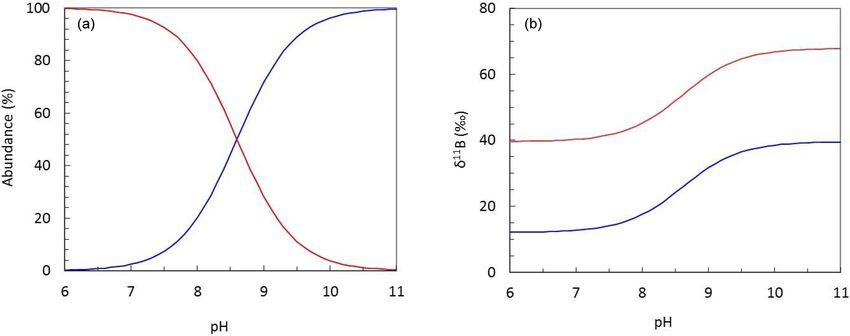
2828                                                        H. K. Donald et al.: The boron isotopic composition of diatom opal

Figure 1. Diatom growth rate and cell size as a function of pH labelled according to CO2 treatment. Linear-least-squares regressions,
including R 2 and p values are also shown.

Table 1. Mean carbonate system parameters experienced under the average growth conditions as calculated for each culture treatment on the
basis of the number of cells grown in each 24 h period of the batch experiment.

                        Treatment    pCO2      2σ     pH      2σ     DIC     2σ    HCO−3       2σ   Growth rate
                                     (ppm)                          (µM)            (µM)                 (d−1 )
                        200             125     8    8.53   0.73    1925     61      1091      59           1.03
                        280             244    73    8.25   0.41    2165    113      1521     260           1.03
                        400             267    28    8.25   0.44    2400    115      1728     107           0.96
                        800             809    62    7.83   0.24    2525     56      2206      69           1.01
                        1600           2117    40    7.48   0.08    2791     21      2628      22           1.01

organic-free samples were rinsed thoroughly with Milli-Q                  Prior to isotope analysis, all boron fractions were collected
via filtration.                                                        in pre-weighed acid-cleaned Teflon beakers, and their mass
   In the boron-free HEPA-filtered clean laboratory at the             was recorded using a Precisa balance. A 10 µL aliquot was
University of Southampton, each sample was dissolved com-              taken and diluted with 490 µL 0.5 M HNO3 in acid-cleaned
pletely in a gravimetrically known amount of NaOH (0.5 M               plastic centrifuge tubes (2 mL). This was then analysed us-
from 10 M concentrated stock supplied by Fluka) at 140 ◦ C             ing a Thermo Fisher Scientific Element 2XR ICP-MS at the
for 6 to 12 h and briefly centrifuged prior to boron separa-           University of Southampton, with boron concentration deter-
tion to ensure no insoluble particles were loaded onto the             mined using standard approaches and a gravimetric standard
boron column. Anion exchange columns containing Am-                    containing boron, silicon, sodium and aluminium. In order to
berlite IRA 743 resin were then used to separate the ma-               determine the B/Si ratio and hence the B concentration of the
trix from the boron fraction of each sample following Fos-             opal, the Si concentration must also be quantitatively mea-
ter (2008). Briefly, the dissolved opal was loaded directly            sured. This is achieved here by using a known concentration
onto the column without buffering and the matrix removed               and mass of NaOH to dissolve each sample; by measuring
with 9 × 200 µL washes of Milli-Q. This was collected for              the Si/Na ratio the Si concentration of each opal sample can
subsequent analysis, and the pure boron fraction was then              be determined. From this, assuming a chemical formula of
eluted and collected in 550 µL of 0.5 M HNO3 acid. The level           SiO2 qH2 O and a H2 O content of 8 % (Hendry and Anderson,
of potential contamination was frequently monitored us-                2013), the B content of the opal in parts per million can be
ing total procedural blanks (TPBs) measured in every batch             estimated. As detailed above, during the purification proce-
of columns. The TPBs comprised an equivalent volume of                 dure, sample matrix was washed off the column using Milli-
sodium hydroxide (NaOH, 0.5 M) as used in the samples of               Q and collected in pre-weighed acid-cleaned Teflon beakers.
each batch (ca. 0.2–4 mL). This was analysed following the             These samples were then diluted with 3 % HNO3 enriched
sample analysis protocols detailed below; typically the TPBs           with Be, In and Re for the internal standardisation and mea-
for this work contained less than 40 pg of boron. This equates         sured on the Thermo Scientific XSeries ICP-MS. The stan-
to a typical blank contribution of ca. 0.015 %, which results          dards run on the XSeries consisted of varied concentrations
in a negligible correction and is therefore ignored here.              of the gravimetric standard also used on the Element 2XR
                                                                       ICP-MS, containing B, Si, Na and Al.

Biogeosciences, 17, 2825–2837, 2020                                                         https://doi.org/10.5194/bg-17-2825-2020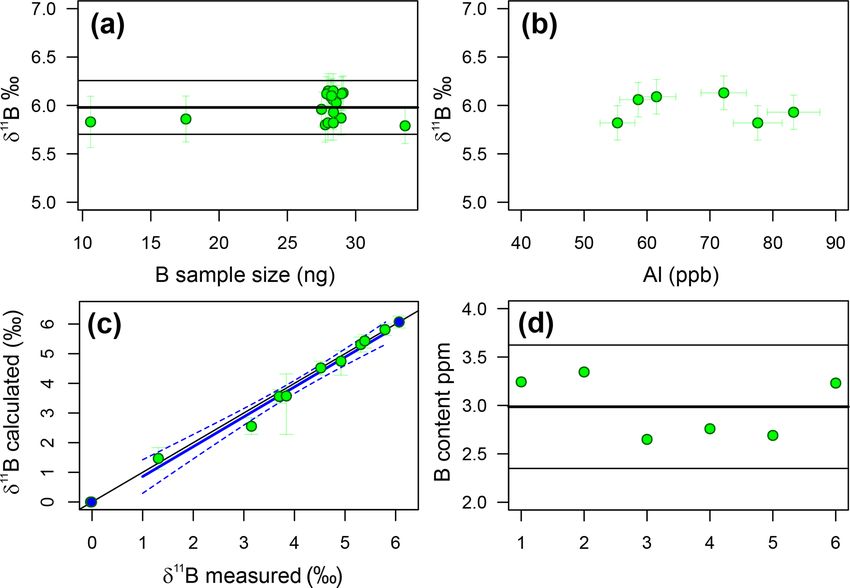
H. K. Donald et al.: The boron isotopic composition of diatom opal                                                                 2829

Figure 2. Each culture treatment labelled according to target pCO2 and showing the evolution in the culture media through the experiment.
All treatments exhibit changes in DIC due to diatom growth balanced with the input of CO2 . The higher pCO2 , the more DIC increases
towards the end of the experiment.

https://doi.org/10.5194/bg-17-2825-2020                                                        Biogeosciences, 17, 2825–2837, 2020
2830                                                      H. K. Donald et al.: The boron isotopic composition of diatom opal

   The boron isotopic composition of the biogenic silica sam-
ples was determined on a Thermo Scientific Neptune MC-
ICP-MS, also situated in a boron-free HEPA-filtered lab-
oratory at the University of Southampton, following Fos-
ter (2008). Instrument-induced fractionation of the 11 B/10 B
ratio was corrected using a sample-standard bracketing rou-
tine with NIST SRM 951, following Foster (2008). This
allows a direct determination of δ 11 B without recourse to
an absolute value for NIST SRM 951 (Foster, 2008) using
the following equation, where 11 B/10 Bstandard is the mean
11 B/10 B ratio of the standards bracketing the sample of in-

terest.
         "                     !    #
             11 B/10 B
  11                   sample
δ B=        11 B/10 B
                                 − 1 × 1000                (2)
                      standard

The reported δ 11 B is an average of the two analyses, with
each representing a fully independent measurement (i.e.
the two measurements did not share blanks or bracketing
standards). Machine stability and accuracy was monitored
throughout the analytical session using repeats of NIST SRM
951, as well as boric acid reference materials AE120, AE121
and AE122 that gave δ 11 B (±2 SD) of −20.19 ± 0.20 ‰,
19.60 ± 0.28 ‰ and 39.31 ± 0.28 ‰, which are within the
error of the gravimetric values from Vogl and Rosner (2012).       Figure 3. (a–d) Concentration of Na, Si, Al and B in the matrix
   The reproducibilities of the δ 11 B and [B] measurements        fraction by ICP-MS. These analyses suggest blank levels of B are
were assessed by repeat measurements of TC460 of different         present in the matrix washed off the Amberlite IRA 743 resin-based
total B concentration (11 to 34 ng of B). In order to assess the   column. (e–f) Concentration of the Na, Si and Al in the boron frac-
accuracy of this method, we follow Tipper et al. (2008) and        tion indicating blank levels of Na (ca. 1.7 ppb) and Si (ca. 1.9 ppb)
Ni et al. (2010) and use standard addition. To this end, known     and a higher concentration of Al (ca. 68 ppb) are present.
amounts of NIST SRM 951 standard were mixed with known
quantities of TC460. All mixtures were passed through the
entire separation and analytical procedure, including aliquots     in Fig. 3a–d. Prior to purification, Na and Si concentra-
of pure standard and sample. A sodium acetate–acetic acid          tions were consistently around 265 and 114 ppm respectively,
buffer was added to all 951 boric acid used prior to mixing, to    whereas Al was more variable at 5–25 ppb. The boron con-
ensure the pH was sufficiently elevated for the column sep-        tent of these matrix samples in all cases was at the blank
aration procedure (following Foster, 2008). The amount of          level. The concentration of these elements in the boron frac-
biogenic silica matrix added to the columns for each mixture       tion is shown in Fig. 3e–g, highlighting that the column pro-
was kept constant, so the volume added to the column was           cedure was sufficient to concentrate boron and remove Na
altered for each mixture accordingly. Uncertainty in the δ 11 B    and Si, which are both present at the sub-5 ppb level (i.e. at
calculated for each mixture was determined using a Monte           less than 0.002 % of matrix concentration). The Al is likely
Carlo procedure (n = 1000) in R (R Core Team, 2019) prop-          present in the diatom frustule (e.g. Koning et al., 2007) and
agating uncertainties, at 95 % confidence, in known isotopes       is elevated in the boron fraction compared to the matrix frac-
ratios (±0.2 ‰), sample concentration (±6 %) and measured          tion (Fig. 3). Diatom-bound Al is likely present as the anion
masses (±0.5 %).                                                   Al(OH)−  4 , hence its elevation in the boron fraction. Although
                                                                   this is a detectable level of Al, it is unlikely that this level of
                                                                   contamination will influence the mass fractionation of these
3     Results and discussion                                       samples when measured by MC-ICP-MS (Foster et al., 2008;
                                                                   Guerrot et al., 2010).
3.1     Analytical technique
                                                                   3.1.2   Accuracy and reproducibility
3.1.1    Purification
                                                                   Throughout the duration of this study, a single dissolution of
The Na, Si and Al concentrations of the matrix fraction of         the diatom fraction of TC460 was measured 18 times in sepa-
several replicates of the diatom fraction of TC460 are shown       rate analyses at various concentrations, in order to assess ex-

Biogeosciences, 17, 2825–2837, 2020                                                    https://doi.org/10.5194/bg-17-2825-2020
H. K. Donald et al.: The boron isotopic composition of diatom opal 2831
ternal reproducibility of this method. Carbonates generally observed in each treatment due to the growth of the diatoms
have a reproducibility of ±0.20 ‰ (2σ ) at an analyte con- in our batch culture setup (Fig. 2).
centration of 50 ppb boron using the MC-ICP-MS methods Boron is an essential nutrient for diatoms (Lewin, 1966),
at the University of Southampton (e.g. Chalk et al., 2017). and it is likely that boric acid passively diffuses across the
The repeated measurements of TC460 gave a reproducibility cell wall to ensure the diatom cell has sufficient boron to
of ±0.28 ‰ (2σ ) over 18 samples, ranging from 19 to 61 ppb meet its biological needs. However, if boric acid were the
(11 to 34 ng) boron (Fig. 4). The insensitivity of δ 11 B to the sole source of boron for the diatoms measured here, we might
boron concentration analysed confirms that blank contamina- expect a decrease in boron content as pH increases and ex-
tion during purification is not significant. Figure 4 shows that ternal dissolved boric acid concentration declines (Fig. 6).
there is also no correlation between Al content of the boron Several studies note that a number of higher plants have
fraction and measured δ 11 B, confirming that Al contamina- mechanisms for also actively taking up boron, leading to
tion does not influence mass fractionation. large variations in internal boron concentrations (Pfeffer et
Figure 4 shows the results of the standard addition experi- al., 2001; Dordas and Brown, 2000; Brown et al., 2002). In-
ment, and when the uncertainty in the δ 11 B of the mixture is deed, on the basis of a similar dataset to that collected here,
considered, it is clear that nearly all the mixtures lie within Mejía et al. (2013) suggested that borate is likely transported
error of the 1 : 1 line, indicating that there is a lack of a sig- across the cell wall of T. weissflogii as some function of exter-
nificant matrix effect when analysing the δ 11 B of biogenic nal borate concentration, which shows a positive relationship
silica as described herein. A linear-least-squares regression with external pH (Fig. 6). This hypothesis is developed and
of the mixtures has a slope of 1.01 ± 0.07 and an intercept discussed further in the next section.
of −0.15 ± 0.29 ‰, implying the approach is accurate to
±0.29 ‰, which is remarkably similar to the stated repro- 3.2.2 Frustule δ 11 B of T. weissflogii
ducibility of TC460 (±0.28 ‰ at 2σ ).
B and Si content were determined separately and com- The δ 11 B of T. weissflogii is isotopically light compared to
bined post-analysis in order to estimate the B/Si ratio for seawater (39.6 ‰; Foster et al., 2010), with an average value
each sample and hence the B concentration. The repro- across all treatments of −3.95 ‰ (Table 2). Despite the scat-
ducibility of this method was tested using six repeats of the ter between treatments, similar to the [B] data, Fig. 5 shows
diatom fraction of TC460. The mean of all six measurements that there is a clear relationship between the δ 11 B of the di-
is 2.99 ± 0.64 ppm; (2σ ; Fig. 4), implying this multistage atom frustule and pH (R 2 = 0.46, p < 0.01), albeit with a
method of determining the B content of diatoms is precise negative and relatively shallow slope (y = −2.61x + 17.12).
to ±20 % at 95 % confidence. These results confirm that biogenic silica, free from clay
contamination, has a very light boron isotopic composition
3.2 Diatom cultures (Ishikawa and Nakamura, 1993). However, the observed re-
lationship between δ 11 B in T. weissflogii and pH is radically
different to that which is observed in carbonates (Fig. 5), im-
3.2.1 Boron content of the frustule of T. weissflogii plying a distinctive incorporation mechanism for boron into
diatom opal. Much work has been carried out in recent years
The boron content of T. weissflogii increases as a function of to show that boron is incorporated in carbonates predomi-
pH from around ∼ 1 to ∼ 4 ppm over a range of average cul- nantly as the borate ion with minor, if any, isotopic fraction-
ture pH from 7.5 to 8.6 (Fig. 5; Table 2). While this is lower ation (e.g. see Branson, 2018 for a review). It is similarly
by an order of magnitude than the limited previous studies thought that the borate ion is incorporated into opal in an
of boron in sedimentary diatoms (Ishikawa and Nakamura, analogous fashion to its incorporation into clays (Ishikawa
1993), it is similar to boron concentration in the bulk diatom and Nakamura, 1993; Kolodny and Chaussidon, 2004). How-
fraction of TC460 (Fig. 4d) and to that observed in previous ever, such a mechanism in isolation would only be able to
culturing studies of this diatom species (Fig. 5; Mejía et al., generate δ 11 B in opal of ∼ 13 ‰ (at the lowest pH). Given
2013). In detail, however, our concentrations are around 2–3 the preponderance of isotopically light diatoms, radiolaria
times lower than Mejía et al. (2013), perhaps due to (i) the and chert δ 11 B in the literature (including this study; Kolodny
different analytical methods used (laser ablation ICP-MS vs. and Chaussidon, 2004; Ishikawa and Nakamura, 1993), it is
solution here), (ii) differences in cleaning methods and/or therefore likely that there is an additional light isotopic frac-
(iii) differences in culturing methodology. Despite the scat- tionation of boron on its incorporation into opal, although
ter between our treatments (also seen in Mejía et al., 2013; its absolute magnitude is currently unknown (Kolodny and
Fig. 5), a least-squares regression through the treatments is Chaussidon, 2004).
significant at the 95 % confidence level (y = 2.15x − 15.56, To make their frustules out of biogenic silica, aqueous
R 2 = 0.46, p = 0.015; Fig. 5). The cause of this scatter be- Si(OH)4 is taken up by the diatom cell via active transport
tween treatments is not known but a likely contributor is the by silicon transporter proteins (Amo and Brzezinski, 1999).
relatively high variability in the carbonate system which was Once Si(OH)4 has entered the cell, it accumulates in vac-
https://doi.org/10.5194/bg-17-2825-2020 Biogeosciences, 17, 2825–2837, 20202832 H. K. Donald et al.: The boron isotopic composition of diatom opal
Figure 4. (a) The reproducibility of the TC460 diatom core catcher in-house standard. Samples of different concentration (∼ 10 to ∼ 30 ng B)
lie within error of the mean (5.98 ‰ ± 0.28 ‰, 2σ ). This compares well to carbonates (2σ = 0.20 ‰). (b) Aluminium concentration of the
B fraction from TC460 (as ppb of the solution analysed for δ 11 B) shows no correlation with δ 11 B, likely suggesting there is no significant
effect on mass fractionation for this level of Al. (c) The results of the standard addition experiment. The blue line is a least-squares regres-
sion between the measured δ 11 B of each mixture (green circles) and the calculated δ 11 B of that mixture given known endmember values
(endmembers shown as blue circles). R 2 = 0.97, p < 0.0001, slope = 1.01 ± 0.07 and intercept = −0.15 ± 0.29. The 1 : 1 line is shown as a
black line, and dotted blue lines show the 95 % confidence limit of the regression. Note that the endmembers were not used in the regression.
(d) B content in parts per million of six repeat samples of the diatom fraction of TC460. The black line indicates the mean value, and the
grey lines show 2σ of 2.99 ± 0.64 ppm.
Table 2. Treatment name and pH with δ 11 B and [B] for cultured T. weissflogii.
Treatment pH (total scale) pH 2σ δ 11 B δ 11 B 2σ δ 11 B sw borate [B] ppm
200 8.55 0.63 −5.51 0.21 24.20 3.15
200 8.54 0.62 −5.40 0.21 24.00 2.81
280 8.27 0.35 −5.05 0.20 20.00 3.72
280 8.18 0.25 −5.66 0.21 18.80 0.93
280 8.30 0.42 −5.79 0.21 20.50 1.04
400 8.26 0.38 −3.64 0.20 19.90 3.37
400 8.24 0.36 −3.57 0.21 19.60 1.26
400 8.25 0.36 −2.41 0.21 19.70 2.68
800 7.85 0.22 −2.93 0.19 15.40 NA
800 7.82 0.18 −2.80 0.22 15.20 0.78
800 7.82 0.20 −3.08 0.21 15.20 1.11
1600 7.48 0.06 −1.94 0.20 13.30 0.74
1600 7.48 0.07 −3.62 0.21 13.30 0.91
NA – not available.
uoles that tend to have a high pH in order to prevent polycon- and the construction of the frustule occurs. Without knowl-
densation of Si(OH)4 at its higher concentration in the vac- edge of the isotopic fractionation of boron on incorporation
uole (Vrieling et al., 1999). The accumulated Si(OH)4 is then into biogenic silica, the interpretation of our new δ 11 B data is
transported to the silicon deposition vesicle (SDV), which is challenging. This difficulty is further increased given that the
an acidic compartment where the formation of biogenic silica fluid in the SDV is unlikely to have the same δ 11 B as exter-
Biogeosciences, 17, 2825–2837, 2020 https://doi.org/10.5194/bg-17-2825-2020H. K. Donald et al.: The boron isotopic composition of diatom opal 2833
Figure 5. (a) δ 11 B of T. weissflogii diatom opal plotted against aqueous borate, labelled according to pCO2 treatment. Also shown are
published deep-sea coral Desmophyllum dianthus (Anagnostou et al., 2012) and foraminifera δ 11 B (Globigerinoides ruber and Orbulina
universa; Henehan et al., 2013, 2016, respectively). Least-squares regression lines are also shown. Error bars on δ 11 B borate are shown
at the 95 % confidence level and relate to the drift in experimental conditions. (b) T. weissflogii opal δ 11 B against pH of each treatment
demonstrating a statistically significant negative relationship. Diatom data are labelled according to pCO2 treatment. (c) Boron content of
cultured T. weissflogii diatom opal as a function of pH (using the left y axis), labelled according to pCO2 . A least-squares regression with
a 95 % confidence interval is also shown. In grey (and using the right y axis) are data for T. weissflogii from Mejía et al. (2013). Note how
both studies show an increase in boron content with increasing pH, but absolute values differ by a factor of 2–3. Uncertainty in all points is
shown at the 95 % confidence level. In some cases, the error bars are smaller than the symbols.
Figure 6. Plots describing (a) the pH-dependent relationship between the abundance of aqueous boron species and (b) the isotopic fraction-
ation observed between boric acid (B(OH)3 ; red) and borate (B(OH)− ◦
4 ; blue) at T = 25 C and S = 35.
nal seawater, and its relatively acidic pH (∼ 5.5; Mejía et al., the light isotopic composition of biogenic silica is driven by
2013; Vrieling et al., 1999) is likely to promote polymerisa- the isotopic fractionation on incorporation rather than “vi-
tion of Si(OH)4 . Nonetheless, the broad similarity between tal effects” relating to the δ 11 B and pH of the SDV in the
the δ 11 B of our cultured T. weissflogii with the bulk diatom different species and organisms. That being said, the > 3 ‰
fraction measured here from sample TC460 and the bulk di- range between different pH treatments in T. weissflogii and
atom fraction and radiolarian skeleton measured by Ishikawa the > 10 ‰ difference between our Chaetoceros-dominated
and Nakamura (1993; ∼ 3 ‰) suggests that a large part of bulk diatom fraction from TC460 and the cultured T. weiss-
https://doi.org/10.5194/bg-17-2825-2020 Biogeosciences, 17, 2825–2837, 20202834 H. K. Donald et al.: The boron isotopic composition of diatom opal
While this finding is entirely compatible with the trend of
increasing boron content of T. weissflogii observed as pH in-
creases (Fig. 5), an added complication is that at pH ∼ 5.5
the concentration of borate ion in the SDV is likely to be
relatively low (Fig. 6). However, the timescales required to
reach equilibrium in the boron system are short (e.g. around
95 µs; Zeebe et al., 2001), meaning that any aqueous borate
incorporated into the frustule would be immediately replen-
ished to its equilibrium value by conversion from the more
abundant boric acid. Although relevant partition coefficients
Figure 7. (a) Back-calculated δ 11 B of the silica deposition vesicle are likely to be different, a similar process ensures the quan-
(SDV), and (b) the fraction of boron in the SDV that is derived titative removal of boron from pH < 7 solutions by the Am-
from external borate. In (a) the diatom δ 11 B data are shown as grey berlite 743 anion exchange resin used for boron purification
circles and the calculated δ 11 B of the SDV as blue circles. Included prior to analysis by MC-ICP-MS (see above; Lemarchand et
in this model is an arbitrary −10 ‰ fractionation between the δ 11 B al., 2002).
of the SDV and the opal precipitated. The fraction of borate in the Active bicarbonate ion uptake accounts for a substantial
SDV in (b) is a function of this assumption, so these absolute values amount of the carbon fixed by phytoplankton (e.g. Tortell et
should be taken as illustrative only. al., 2006). As a result, Mejía et al. (2013) proposed that the
enrichment of borate ion into the SDV of T. weissflogii and
T. pseudonana was the result of the active co-transport of bo-
flogii, as well as the negative relationship between pH and
rate ion with bicarbonate ion by bicarbonate transporter pro-
diatom δ 11 B (Fig. 5), argue against a simple two-step model
teins. Borate is transported because of its similar charge and
involving borate ion incorporation from seawater with a fixed
size to HCO− 3 and the phylogenetic similarity between bi-
isotopic fractionation.
carbonate and borate transporters (Mejía et al., 2013). In our
The δ 11 B of the fluid from which our T. weissflogii precip-
model, as external borate ion concentration increases, the bo-
itated their frustules can be calculated if we assume the pH in
rate leak into the diatom cell is also increased. An additional
the SDV of our T. weissflogii is 5.5 across all our treatments
factor is HCO− 3 transport, which may be proportionally up-
(Mejía et al., 2013). Given that at this pH the δ 11 B of borate
regulated as external CO2 content decreases (and external pH
is ∼ 13 ‰, the isotopic composition of this fluid is lighter
increases) in order to provide the diatom cell with sufficient
than seawater, even if we assume an arbitrary −10 ‰ iso-
carbon (Mejía et al., 2013). This may therefore offer a way
topic fractionation on incorporation (blue circles in Fig. 7a).
of driving an elevation of the borate content of the SDV as
Furthermore, the δ 11 B of the SDV fluid is inversely corre-
pH increases (Mejía et al., 2013). Regardless of the exact
lated with the δ 11 B of either dissolved borate or dissolved
mechanism, an SDV fluid with an inverse relationship be-
boric acid (Fig. 7a).
tween δ 11 B and pH is required to explain the δ 11 B of the T.
As discussed above and illustrated schematically in Fig. 8,
weissflogii frustule measured here. A simple model whereby
Mejía et al. (2013) suggested that there are two sources of
external borate ion is an increasingly important contributor
boron in a diatom cell: (i) passively diffused and isotopi-
to the boron in the SDV as pH increases is able to explain
cally heavy boric acid and (ii) actively transported isotopi-
the observed dependency of boron content and δ 11 B on pH.
cally light borate ion (see Fig. 8). Assuming that (a) no ad-
However, a more complete model of the boron systematics in
ditional fractionation occurs during uptake and diffusion and
diatom opal requires a better understanding of isotopic frac-
(b) only the borate ion is incorporated into the frustule, we
tionation on incorporation of boron into biogenic silica, the
can calculate the relative contribution of these two sources of
environmental controls on this fractionation, and the nature
boron as a function of external pH (Fig. 7b). This treatment
of the partitioning of boron within the diatom cell and into
shows that the relative concentration of borate-derived boron
biogenic silica.
in the SDV fluid increases as external pH increases, though
the absolute values here are a function of the magnitude of
3.2.3 Boron-based pH proxies in diatom opal
the isotopic fractionation on incorporation, so we only have
confidence in the trends shown in Fig. 7b. Nonetheless, given
The δ 11 B–pH and B–pH relationships derived here for T.
that the dissolved boric acid concentration decreases and dis-
weissflogii potentially offer two independent means to re-
solved borate increases as pH is increased (Fig. 6), this is
construct the past pH of seawater, particularly in those re-
perhaps not surprising.
gions key for CO2 and heat exchange where foraminifera
are largely absent (e.g. at high latitudes). However, the cur-
rent calibrations (Fig. 5) are relatively uncertain, which may
preclude their application to some situations. For instance,
recasting the δ 11 B–pH relationship in terms of δ 11 B as the
Biogeosciences, 17, 2825–2837, 2020 https://doi.org/10.5194/bg-17-2825-2020H. K. Donald et al.: The boron isotopic composition of diatom opal 2835
Figure 8. Schematic of the model described herein for boron uptake by T. weissflogii. The speciation behaviour and isotopic composition of
boron is also shown in the insert, with the aqueous species colour coded (red represents boric acid, and blue represents borate ion). Seawater
boric acid diffuses into the diatom cell, and the borate ion is actively transported, with HCO− 3 . While it remains unclear how boron enters
the silica deposition vesicle, once inside it respeciates into borate ion and boric acid, with the borate ion being incorporated into the frustule.
The isotopic composition of internal boron is a function of external pH, which sets the isotopic composition of the incoming species, as
well as the balance between active borate ion transport and passive boric acid diffusion. The compartments are colour coded according to
approximate pH (scale on the right).
dependent variable and using a regression method that ac- 2013). This suggests that more borate is incorporated into
counts for uncertainty in X and Y variables (SIMEX; Carroll the diatom frustule as the dissolved borate abundance in-
et al., 1996) gives the calculated residual pH of the regres- creases with external pH. A simple model is presented, based
sion as ±0.28 pH units. For the [B] vs. pH relationship, this on Mejía et al. (2013), which implies both of these findings
uncertainty is ±0.36 pH units. At typical surface ocean con- could be due to there being two distinct sources of the boron
ditions, such a variability in pH would translate to seawater in the SDV: external boric acid and external borate ion, with
pCO2 variability of up to ca. ±250 ppm. Although encour- the balance of each source changing with external pH. While
aging, this treatment suggests that additional work is needed these results are encouraging, suggesting that the boron prox-
before the relationship between δ 11 B and boron content of ies in diatom opal may hold considerable promise as a tracer
diatom opal and seawater pH is a sufficiently precise proxy of past ocean pH, more work is needed to fully understand
for a fully quantitative past ocean pH. In particular, future the boron systematics of diatom opal. In particular, there is
culturing efforts should aim to more carefully control the pH an urgent need to place boron in opal on firmer ground with
of the culture media. This could be achieved by either us- precipitation experiments in the laboratory at controlled pH
ing larger volume dilute batch cultures, by harvesting the di- to determine the magnitude of boron isotopic fractionation
atoms earlier in the experiment prior to any significant drift in on boron incorporation into opal as well as the dependence
the carbonate system and/or by using a more robust steady- of this fractionation on other environmental factors.
state chemostat method (e.g. Leonardos and Geider, 2005).
Data availability. The data generated in this study are tabulated
4 Conclusions herein. For any additional data please contact the corresponding au-
thor.
In the first study of its kind, we use a modified version of
the carbonate boron purification technique of Foster (2008)
to show that the δ 11 B of T. weissflogii opal is pH sensitive Author contributions. GLF, HKD, AJP and CMM conceived and
but isotopically light (−3.95 ‰ on average) and has an in- designed the study, and it was carried by HKD and NF (aided by
verse relationship with external seawater pH. Using a novel AJP, CMM and GLF). GEAS aided HKD in sample preparation,
and MPH carried out the carbonate system measurements of the
ICP-MS method we also show that the boron content of T.
culture media. GLF and HKD produced the first draft and all authors
weissflogii opal increases with increasing pH, supporting the contributed to the writing of the study.
only other study investigating boron in diatoms (Mejía et al.,
https://doi.org/10.5194/bg-17-2825-2020 Biogeosciences, 17, 2825–2837, 20202836 H. K. Donald et al.: The boron isotopic composition of diatom opal
Competing interests. The authors declare that they have no conflict Foster, G. L.: Seawater pH, pCO2 and [CO2− 3 ] variations in the
of interest. Caribbean Sea over the last 130 kyr: A boron isotope and B/Ca
study of planktic foraminifera, Earth Planet. Sc. Lett., 271, 254–
266, 2008.
Acknowledgements. We wish to thank Claus-Dieter Hillenbrand for Foster, G. L., Pogge von Strandmann, P. A. E., and Rae,
supplying the diatom-rich sediment sample TC460. John Gittins, J. W. B.: Boron and magnesium isotopic composition
Mark Stinchcombe, Chris Daniels and Lucie Daniels are acknowl- of seawater, Geochem. Geophy. Geosys., 11, Q08015,
edged for their help during the culturing and subsequent nutrient https://doi.org/10.1029/2010GC003201, 2010.
and carbonate system analysis. Heather Stoll is also thanked for her Gray, W. R., Rae, J. W. B., Wills, R. C. J., Shevenell, A. E., Taylor,
useful discussions on this topic. B., Burke, A., Foster, G. L., and Lear, C. H.: Deglacial upwelling,
productivity and CO2 outgassing in the North Pacific Ocean, Nat.
Geosci., 11, 340–344, https://doi.org/10.1038/s41561-018-0108-
Financial support. This research has been supported by the Natural 6, 2018.
Environmental Research Council (NERC, UK) (grant nos. 1362080 Guerrot, C., Milot, R., Robert, M., and Negrel, P.: Accurate and
and NE/J021075/1). high-precision determination of boron isotopic ratios at low con-
centration by MC-ICP-MS (Neptune), Geostandards and Geoan-
laytical Research, 35, 275–284, 2010.
Hasle, G. R. and Fryxell, G. A.: The genus Thalassiosira: some
Review statement. This paper was edited by Aldo Shemesh and re-
species with a linear areola array, in: Proceedings of the Fourth
viewed by Jan Fietzke and Joji Uchikawa.
Symposium on Recent and Fossil Marine Diatoms, Oslo, 1976,
edited by: Simonsen, R., Beihefte zur Nova Hedwigia 54, 15–66,
1977.
Hemming, N. G. and Hanson, G. N.: Boron isotopic composition
References and concentration in modern marine carbonates, Geochim. Cos-
mochim. Ac., 56, 537–543, 1992.
Amo, Y. D. and Brzezinski, M. A.: The chemical form of dis- Hendry, K. R. and Andersen, M. B.: The zinc isotopic composi-
solved Si taken up by marine diatoms, J. Phycol., 35, 1162–1170, tion of siliceous marine sponges: Investigating nature’s sediment
https://doi.org/10.1046/j.1529-8817.1999.3561162.x, 1999. traps, Chem. Geol., 354, 33–41, 2013.
Anagnostou, E., Huang, K.-F., You, C.-F., Sikes, E. L., and Sherrell, Henehan, M. J., Rae, J. W. B., Foster, G. L., Erez, J., Pren-
R. M.: Evaluation of boron isotope ratio as a pH proxy in teh tice, K. C., Kurcera, M., Bostock, H. C., Martinez-Boti, M.
deep sea coral Desmophyllum dianthus: Evidence of physiolog- A., Milton, J. A., Wilson, P. A., Marshall, B., and Elliott,
ical pH adjustment, Earth Planet. Sc. Lett., 349–350, 251–260, T.: Calibration of the boron isotope proxy in the plank-
https://doi.org/10.1016/j.epsl.2012.07.006, 2012. tonic foraminifera Globigerinoides ruber for use in palaeo-
Branson, O.: Boron Incorporation into Marine CaCO3 , in: Boron CO2 reconstruction, Earth Planet. Sc. Lett., 364, 111–122,
Isotopes: The Fifth Element, edited by: Marschall, H. and Foster, https://doi.org/10.1016/j.epsl.2012.12.029, 2013.
G., Springer International Publishing, Cham, 71–105, 2018. Henehan, M. J., Foster, G. L., Bostock, H. C., Greenop, R., Mar-
Brown, P. H., Bellaloui, N., Wimmer, M. A., Bassil, E. S., Ruiz, J., shall, B., and Wilson, P. A.: A new boron isotope-pH calibration
Hu, H., Pfeffer, H., Dannel, F., and Romheld, V.: Boron in plant for Orbulina universa, with implications for understanding and
biology, Plant Biol., 4, 205–223, 2002. accounting for vital effects, Earth Planet. Sc. Lett., 454, 282–
Carroll, R. L., Kuchenhoff, H., Lombard, F., and Stefanski, L. A.: 292, https://doi.org/10.1016/j.epsl.2016.09.024, 2016.
Asymptotics for the SIMEX Estimator in Nonlinear Measure- Hönisch, B. and Hemming, N. G.: Surface ocean pH response
ment Error Models, J. Am. Stat. Assoc., 91, 242–250, 1996. to variations in pCO2 through two full glacial cycles, Earth
Chalk, T. B., Hain, M. P., Foster, G. L., Rohling, E. J., Sexton, P. Planet. Sc. Lett., 236, 305–314, 2005. Hönisch, B., Hemming,
F., Badger, M. P. S., Cherry, S. G., Hasenfratz, A. P., Haug, G. G., Archer, D., Siddal, M., and McManus, J.: Atmospheric car-
H., Jaccard, S. L., Martínez-García, A., Pälike, H., Pancost, R. bon dioxide concentration across the Mid-Pleistocene Transition,
D., and Wilson, P. A.: Causes of ice age intensification across Science, 324, 1551–1554, 2009.
the Mid-Pleistocene Transition, P. Natl. Acad. Sci. USA, 114, Horn, M. G., Robinson, R. S., Rynearson, T., and Sigman, D. M.:
13114–13119, https://doi.org/10.1073/pnas.1702143114, 2017. Nitrogen isotopic relationship between diatom-bound and bulk
Dickson, A. G.: Thermodynamics of the dissociation of boric acid organic matter of cultured polar diatoms, Paleoceanography, 26,
in synthetic seawater from 273.15 to 318.15 K, Deep-Sea Res. Pt. 1–12, 2011.
A, 37, 755–766, https://doi.org/10.1016/0198-0149(90)90004-F, Ishikawa, T. and Nakamura, E.: Boron isotope systematics of ma-
1990. rine sediments, Earth Planet. Sc. Lett., 117, 567–580, 1993.
Dickson, A. G., Sabine, C. L., and Christian, J. R. (Eds.): SOP 1: Keller, M. D., Selvin, R. C., Claus, W., and Guillard, R. R. L.: Media
Water sampling for the parameters of the oceanic carbon diox- for the culture of oceanic ultraplankton, J. Phycol., 23, 633–638,
ide system, in Guide to Best Practices for Ocean CO2 Measure- 1987.
ments, PICES Special Publication 3, chap. 4, North Pacific Ma- Kolodny, Y. and Chaussidon, M.: Boron isotopes in DSDP cherts:
rine Science Organization, Sidney, BC, Canada, 2007. Fractionation and diagenesis, Geol. Soc. S. P., 9, 1–14, 2004.
Dordas, C. and Brown, P. H.: Permeability of boric acid across lipid Koning, E., Gehlen, M., Flank, A.-M., Calas, G., and
bilayers and factors affecting it, J. Membrane Biol., 175, 95–105, Epping, E.: Rapid post-mortem incorporation of alu-
2000.
Biogeosciences, 17, 2825–2837, 2020 https://doi.org/10.5194/bg-17-2825-2020H. K. Donald et al.: The boron isotopic composition of diatom opal 2837 minium in diatom frustules: evidence from chemi- R Core Team: R: A language and environment for statistical cal and strutural analyses, Mar. Chem., 106, 208–222, computing, R Foundation for Statistical Computing, Vienna, https://doi.org/10.1016/j.marchem.2006.06.009, 2007. Austria, available at: https://www.R-project.org/ (last access: Lee, K., Kim, T.-W., Byrne, R. H., Millero, F. J., Feely, R. A., 24 March 2020), 2018. and Liu, Y.-M.: The universal ratio of boron to chlorinity for the Sigman, D. M. and Boyle, E. A.: Glacial/Interglacial variations in North Pacific and North Atlantic oceans, Geochim. Cosmochim. atmospheric carbon dioxide, Nature, 407, 859–869, 2000. Ac., 74, 1801–1811, https://doi.org/10.1016/j.gca.2009.12.027, Sigman, D. M., Hain, M. P., and Haug, G. H.: The polar ocean and 2010. glacial cycles in atmospheric CO2 concentration, Nature, 466, Lemarchand, D., Gaillardet, J., Gopel, C., and Manhes, G.: An op- 47–55, https://doi.org/10.1038/nature09149, 2010. timized procedure for boron separation and mass spectrometry Sosdian, S. M., Greenop, R., Hain, M. P., Foster, G. L., analysis for river samples, Chem. Geol., 182, 323–334, 2002. Pearson, P. N., and Lear, C. H.: Constraining the evolu- Leonardos, N. and Geider, R. J.: Elevated atmospheric car- tion of Neogene ocean carbonate chemistry using the boron bon dioxide increases organic carbon fixation by Emiliania isotope pH proxy, Earth Planet. Sc. Lett., 248, 362–376, huxleyi (haptophyta), under nutrient-limited high-light condi- https://doi.org/10.1016/j.epsl.2018.06.017, 2018. tions, J. Phycol., 41, 1196–1203, https://doi.org/10.1111/j.1529- Swann, G. E. A., Pike, J., Snelling, A. M., Leng, M. J., 8817.2005.00152.x, 2005. and Williams, M. C.: Seasonally resolved diatom δ 18 O Lewin, J.: Boron as a growth requirement for diatoms, J. Phycol., 2, records from the West Antarctic Peninsula over the 160–163, https://doi.org/10.1111/j.1529-8817.1966.tb04616.x, last deglaciation, Earth Planet. Sc. Lett., 364, 12–23, 1966. https://doi.org/10.1016/j.epsl.2012.12.016, 2013. Lueker, T. J., Dickson, A. G., and Keeling, C. D.: Ocean pCO2 Tipper, E. T., Galy, A., and Bickle, M.: Calcium and magnesium iso- calculated from dissolved inorganic carbon, alkalinity, and equa- tope systematics in rivers draining the Himalaya-Tibetan-Plateau tions for K1 and K2: validation based on laboratory measure- region: Lithological or fractionation control?, Geochm. Cos- ments of CO2 gas and seawater at equilibrium, Mar. Chem., mochi. Ac., 72, 1057–1075, 2008. 70, 105–119, https://doi.org/10.1016/S0304-4203(00)00022-0, Tortell, P. D., Martin, C. L., and Corkum, M. E.: Inorganic car- 2000. bon uptake and intracellular assimilation by subarctic Pacific Martin, J.: Glacial-interglacial CO2 change: The iron hypothesis, phytoplankton assemblages, Limnol. Oceanogr., 51, 2102–2110, Paleoceanography, 5, 1–13, 1990. https://doi.org/10.4319/lo.2006.51.5.2102, 2006. Martínez-Botí, M. A., Marino, G., Foster, G. L., Ziveri, P., van Heuven, S., Pierrot, D., Rae, J. W. B., Lewis, E., and Henehan, M. J., Rae, J. W. B., Mortyn, P. G., and Vance, Wallace, D. W. R.: MATLAB Program Developed for D.: Boron isotope evidence for oceanic carbon dioxide leak- CO2 System Calculations, Carbon Dioxide Informa- age during the last deglaciation, Nature, 518, 219–222, tion Analysis Center, Oak Ridge National Laboratory, https://doi.org/10.1038/nature14155, 2015. U.S. Department of Energy, Oak Ridge, Tennessee, USA, Mejía, L. M., Isensee, K., Menendez-Vicente, A., Pisonero, J., https://doi.org/10.3334/CDIAC/otg.CO2SYS_MATLAB_v1.1, Shimizu, N., Gonzalez, C., Monteleone, B. D., and Stoll, H.: 2011. B content and Si/C ratios from cultured diatoms (Thalassiosira Vogl, J. and Rosner, M.: Production and certificaiton of a unique set pseudonana and Thalassiosira weissflogii): Relationship to sea- of isotope and delta reference materials for boron isotope deter- water pH and diatom carbon acquisition, Geochim. Cosmochim. mination in geochemical, environmental and industrial materials, Ac., 123, 322–337, https://doi.org/10.1016/j.gca.2013.06.011, Geostandards and Geoanlaytical Research, 36, 161–175, 2012. 2013. Vrieling, E. G., Gieskes, W. W. C., and Beelen, T. P. M.: Silicon Ni, Y., Foster, G. L., and Elliott, T.: The accuraccy of d11B mea- deposition in diatoms: control by pH inside the silicon deposition surements of foraminifers, Chem. Geol., 274, 187–195, 2010. vesicle, J. Phycol., 35, 548–559, https://doi.org/10.1046/j.1529- Pearson, P. N. and Palmer, M. R.: Atmospheric carbon dioxide con- 8817.1999.3530548.x, 1999. centrations over the past 60 million years, Nature, 406, 695–699, Zeebe, R. E., Sanyal, A., Ortiz, J. D., and Wolf-Gladrow, D. A.: A 2000. theoretical study of the kinetics of the boric acid-borate equilib- Pfeffer, H., Daniel, F., and Romheld, V.: Boron compartmentation rium in seawater, Mar. Chem., 73, 113–124, 2001. in roots of sunflower plants of different boron status: A study using the stable isotopes 10 B and 11 B adopting two independent approaches, Physiol. Plant., 113, 346–351, 2001. Rae, J. W. B., Foster, G. L., Schmidt, D. N., and Elliott, T.: Boron isotopes and B/Ca in benthic foraminifera: proxies for the deep ocean carbonate system, Earth Planet. Sc. Lett., 302, 403–413, 2011. https://doi.org/10.5194/bg-17-2825-2020 Biogeosciences, 17, 2825–2837, 2020
You can also read


