Updated 3/4/2021 - Nebraska Department of Education
←
→
Page content transcription
If your browser does not render page correctly, please read the page content below
Updated 3/4/2021
Nebraska Health Education Standards

                             Table of Contents

 Introduction……………………………………………………………………………………………..3
 Content Standards Overview………………………………………………………………………..3
 Organization and Structure…………………………………………………………………………..3
 Kindergarten…………………………………………………………………………………………….7
 Grade 1 Standards……………………………………………………………………………………10

 Grade 2 Standards……………………………………………………………………………………14

 Grade 3 Standards……………………………………………………………………………………18

 Grade 4 Standards……………………………………………………………………………………23

 Grade 5 Standards……………………………………………………………………………………29

 Grade 6 Standards……………………………………………………………………………………34

 Grade 7 Standards……………………………………………………………………………………39

 Grade 8 Standards……………………………………………………………………………………44

 High School: Foundations of Health Education…………………………………………………50

 High School: Fundamentals of Community and Public Health………………………………56

Updated 3/4/2021
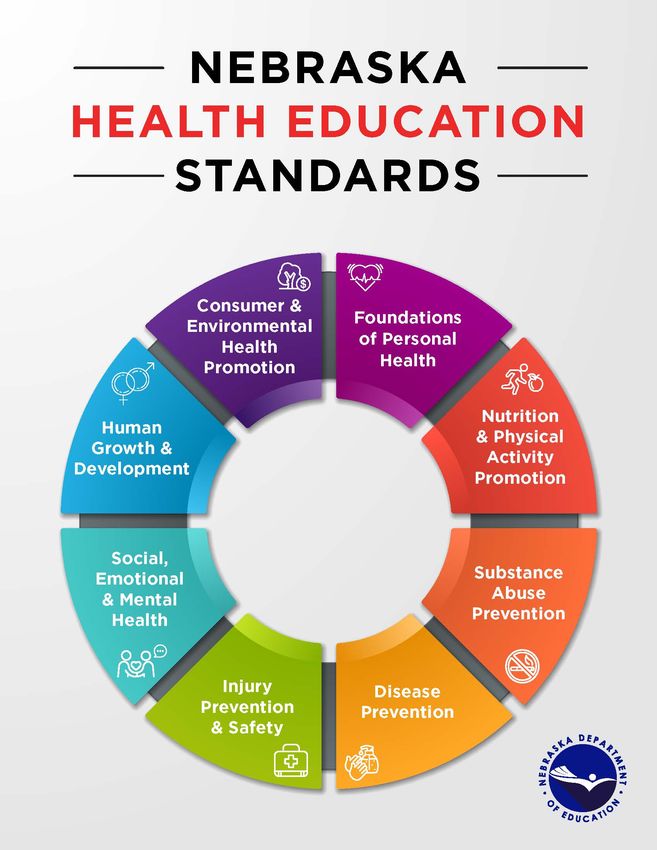
Introduction Health literacy is the ability to access, understand, appraise, apply and advocate for health information and services in order to maintain or enhance one's own health and the health of others (SHAPE America). Comprehensive skills-based Health Education is a planned sequential standards based curriculum presented by qualified professionals to promote the development of health knowledge, health related skills, and positive attitudes toward health and wellbeing for students preschool through grade 12. The comprehensive health education program motivates students to maintain and improve their health; advocate for self and others; prevent disease; form healthy relationships; and avoid or reduce health-related risk behaviors. The Nebraska Health Education Standards identify the following 8 content strands for skill development for students in Kindergarten through grade 12: foundations of personal health; nutrition & physical activity promotion; substance abuse prevention; disease prevention; injury prevention & safety; social, emotional & mental health; human growth & development; and consumer & environmental health. Content Area Standards Overview The Nebraska Health Education Standards guide the knowledge and skills that students should learn, practice and demonstrate, but they do not prescribe particular curriculum, lessons, teaching techniques, or activities. These standards create a framework for teaching, learning and assessment, and they articulate a trajectory for knowledge and skill acquisition across all grade levels. This ensures that student learning builds on prior knowledge and skills and becomes more in-depth over time. Standards describe what students are expected to know and be able to do, while locally defined curriculum and instructional materials are used to help students master the standards. The Nebraska Department of Education does not mandate the curriculum or instructional materials used within a local school. Organization and Structure of Health Education Standards The overall structure of Nebraska’s Health Education Standards reflects the two-tier structure common across all Nebraska content area standards. The two levels include standards and indicators. Standards include broad, overarching content-based statements that describe the basic cognitive, affective, or psychomotor expectations of student learning. The standards, across all grade levels, reflect long-term goals for learning. Indicators further describe what students must know and be able to do to meet the standard and provide guidance related to classroom instruction. In addition to standards and indicators, the Nebraska Health Education Standards provide examples. The “e.g.…” statements provide guidance relative to topics that may be included in the locally determined curriculum. These suggestions may be used to meet equitable learning expectations of the standards and indicators. The Nebraska Health Education Standards are organized by grade level for grades K-8 and course-based for high school. The K-8 standards and indicators are organized within eight strands, which are essential components for health literacy. Updated 3/4/2021
The eight content strands are described below:
    • Foundations of Personal Health: Foundations of Personal Health will assist students
        with acquiring basic health concepts and functional health knowledge and skills
        providing a foundation for promoting health-enhancing behaviors. This strand
        includes essential concepts that are based on established health behavior
        theories and models. These concepts focus on both health promotion and risk
        reduction. Through the development of the foundational skills and knowledge
        (e.g. communication skills, resiliency skills, protective factors, goal setting,
        decision making), the subsequent content strands will build upon and further
        cultivate these skills for student health literacy.
    • Nutrition & Physical Activity Promotion: The nutrition and physical activity strand
        promotes healthy lifestyle choices through knowledge and skills development to
        properly fuel the body. Students will learn the importance of movement and
        dietary choices along with their effects on the body, academics and overall
        health. The link between nutrition and physical activity and learning is well
        documented. Healthy eating patterns and physical activity are essential for
        students to achieve their full academic potential, full physical and mental
        growth, and lifelong health and well-being. Proper nutrition and adequate
        physical activity significantly reduce risk factors for obesity and other chronic
        diseases, such as type 2 diabetes, heart disease, stroke, certain cancers, and
        depression (CDC).
    • Substance Abuse Prevention: The substance abuse prevention strand provides
        students with knowledge and skills to make healthy choices to avoid or reduce
        their risk of substance abuse (e.g. alcohol, tobacco, nicotine-delivery devices,
        and other drugs both legal and illegal). Students will learn the difference
        between harmful and helpful drugs and medication along with short and long
        term consequences of use, misuse, and abuse on overall health. Substance
        abuse and misuse potentially has the ability to negatively impact every aspect
        of an individual's life at home, school or community.
    • Disease Prevention: The disease prevention strand promotes hygiene and safety
        practices to prevent and reduce the risk of diseases and conditions. By
        understanding what a disease is and how they are transmitted and acquired,
        students will learn and adopt behaviors which will maintain and enhance their
        overall health. Six in ten Americans live with at least one chronic disease, like
        heart disease and stroke, cancer, or diabetes. These and other chronic diseases
        are the leading causes of death and disability in America, and they are also a
        leading driver of healthcare costs (CDC, 2020).
    • Injury Prevention & Safety: The injury prevention and safety strand will assist
        students in understanding their role in protecting themselves and others from
        unintentional danger, risk, or injury. Additionally, students will develop skills to
        recognize and appropriately respond to injuries or emergency situations. In the
        United States, Injuries are the leading cause of death in children ages 19 and
        younger. Injuries affect everyone—regardless of age, race, or economic status
        (CDC, 2020).
    • Social, Emotional & Mental Health: The social, emotional, and mental health
        strand will help students understand diverse cultural experiences that impact
        mental, emotional, and social health. Students will learn strategies to help
Updated 3/4/2021
manage their thoughts, feelings, emotions, and behaviors. Learning how to cope
with change and stressors and recognize when support is needed for self or
others is a key component of this strand. Students will develop positive social
behaviors that provide them with the skills to get along with and assist others.
Social, emotional, and mental wellness are key elements to one’s overall health
and well-being. Understanding individual abilities to manage emotions can assist
in coping with the typical stresses of life, increasing productivity, building stronger
relationships and lead to happier, healthier more fulfilling lives.
• Human Growth & Development: The human growth & development strand
teaches students the structures and functions of the body systems and how to
recognize and manage the physical and psychological changes that occur
during development and maturation experienced throughout the
lifespan. Students will recognize characteristics relating to identity, sexuality and
healthy relationships and identify the fundamental components of sexual
health. It is recommended that comprehensive human growth and
development education begins in kindergarten and occurs sequentially for all
students grades K-12. Human growth and development programs that are
developmentally, culturally, age appropriate, medically accurate, and unbiased
have been proven to prevent or reduce risky behaviors.
• Consumer & Environmental Health: The consumer & environmental health strand
will teach students how to identify and access valid consumer products, services
and resources for a healthy lifestyle and recognize how the environment plays a
major factor in one’s overall well-being. Students will develop an understanding
and health enhancing behaviors for community engagement and utilizing
supports within their community. School-based consumer health education is
necessary to prepare current and future consumers to safely and efficiently
advocate for oneself and utilize the medical marketplace (i.e. consumer
products, services, and resources) to ensure a healthy lifestyle. Maintaining a
healthy environment is central to increasing quality of life and years of healthy
life. Therefore, environmental health must address the societal and environmental
factors that increase the likelihood of exposure and disease (Healthy People 2020).
In addition to a common structure for content area standards, a consistent numbering
system is used. The Health Education standards numbering system is as follows:
Strand Course
Indicator Indicator
HE.K.1.1.a HE.HS.1.1.a
Content Content
Area Area
Grade Standard Grade Standard
Level Level
• The first set of letters represent the content area, Health Education.
• The second letter(s) or number represents the grade level.
Updated 3/4/2021• The third is a number, for K-8 it represents the content strand and for high school
it represents the course name.
• The fourth is a number to represent the standard within the strand or course.
• Last, is a letter representing the indicator for that standard.
Updated 3/4/2021Kindergarten
HE.K.1. Foundations of Personal Health
HE.K.1.1. Students will recognize the relationship between the physical,
mental/emotional and social aspects of a healthy individual.
HE.K.1.1.a: Explain the difference between healthy and unhealthy behaviors.
HE.K.1.2. Students will exhibit knowledge for decision-making while analyzing the
influences and potential outcomes of the decision.
HE.K.1.2.a: Identify how family can help make healthy decisions.
HE.K.1.2.b: Identify how the school can help make healthy decisions. (e.g. healthy
food in cafeteria, rules, practices and procedures).
HE.K.1.2.c: Explain the relationship between a decision and an outcome.
HE.K.1.3. Students will focus on personal development and growth.
HE.K.1.3.a: Demonstrate effective communication skills when expressing needs,
wants, and feelings.
HE.K.1.3.b: Define goals and explain why setting goals is important.
HE.K.1.3.c: Identify examples of things that make you feel frustrated, angry and
nervous.
HE.K.1.3.d: Demonstrate what one could do when feeling frustrated, angry and
nervous.
HE.K.2. Nutrition & Physical Activity Promotion
HE.K.2.1. Students will be able to make healthy food choices based on dietary
recommendations.
HE.K.2.1.a: Identify nutrient-rich and less nutrient-rich food choices.
HE.K.2.1.b: Identify the importance of eating a nutrient-rich breakfast every day.
HE.K.2.1.c: Describe how much water someone should drink in a day.
HE.K.2.1.d: Set a goal to eat breakfast every day.
HE.K.2.2. Students will exhibit the knowledge to achieve and maintain a health
enhancing level of physical fitness.
HE.K.2.2.a: Describe how being physically active helps a person stay healthy.
HE.K.2.2.b: Define physical activity and identify examples of active play
opportunities outside of physical education.
HE.K.2.3. Students will recognize the effects of nutritional and physical activity
choices on overall health.
HE.K.2.3.a: State how food gives us energy and helps us grow.
HE.K.3. Substance Abuse Prevention
HE.K.3.1. Students will understand the differences between harmful and helpful use
of drugs and medication.
HE.K.3.1.a: Explain why taking medications under the care of a trusted adults is
important.
HE.K.4. Disease Prevention
HE.K.4.1. Students will recognize what a disease is and how it is spread or acquired.
HE.K.4.1.a: State examples of a healthy/well and unhealthy/ill person (e.g. fever,
coughing, physically active, doctor visits, good hygiene).
HE.K.4.1.b: Explain that germs can cause diseases.
HE.K.4.1.c: Identify ways germs are spread from one person to another (e.g.
contact with eyes, nose, mouth, skin, breathing, blood).
Updated 3/4/2021HE.K.4.2. Students will identify ways to protect from and reduce the risk of diseases
and conditions.
HE.K.4.2.a: State the importance of hand washing, mask wearing, coughing and
sneezing etiquette to prevent the spread of germs.
HE.K.4.2.b: Demonstrate how to properly wash one’s hands.
HE.K.4.2.c: Demonstrate how to properly cover one’s cough or sneeze.
HE.K.4.2.d: Describe ways to protect one’s vision and hearing (e.g. routine exams,
volume, sunglasses, hats, earbud use).
HE.K.5. Injury Prevention & Safety
HE.K.5.1. Students will recognize and respond to an injury or emergency situation.
HE.K.5.1.a: Describe a trusted adult and the characteristics that make them
trusted and safe.
HE.K.5.1.b: Identify fire exits, and how to safely evacuate a building in multiple
situations.
HE.K.5.1.c: Demonstrate safe practices (tornado/fire drills) with adults.
HE.K.5.1.d: Identify injury and/or emergency situations (e.g. tornadoes, lightening,
fire, accident, poisoning, medical emergency, bug bites or stings).
HE.K.5.1.e: Demonstrate stop, drop and roll.
HE.K.5.2. Student will understand and learn specific behaviors that promote injury
prevention and personal safety.
HE.K.5.2.a: Identify behaviors or activities that could lead to harm (e.g.
trampolines, swimming pools, sun safety, bicycling, riding in a car, crossing the
street).
HE.K.5.2.b: Explain how proper use of safety equipment (e.g. helmets, sports
equipment, seat belt, booster seats, crosswalks) helps protect from injury.
HE.K.5.2.c: Describe safety precautions when in, on, or near water (e.g. lifejacket,
water current, swimming with an adult, lifeguards).
HE.K.5.2.d: Identify how to stay safe around things that might cause harm (e.g.
guns, knives, chemicals, syringes).
HE.K.5.2.e: Identify safety rules for home, school and community and describe
why those rules are in place.
HE.K.6. Social, Emotional & Mental Health
HE.K.6.1. Students will develop social skills and understand how to positively interact
with others.
HE.K.6.1.a: Describe qualities of being a good friend.
HE.K.6.1.b: Practice using "please", "thank you", "excuse me", and "I am sorry" in
different scenarios.
HE.K.6.1.c: Demonstrate personal responsibility for actions and possessions.
HE.K.6.2. Students will identify and manage feelings, emotions, and behaviors in a
healthy manner.
HE.K.6.2.a: Practice methods to regulate emotions (e.g. deep breathing, counting
to 10, mindfulness).
HE.K.6.2.b: Identify how different emotions feel and how the body reacts to those
emotions (e.g. tantrum, sweaty palms, heart rate, breathing).
HE.K.6.3. Students will identify signs and symptoms of mental health conditions and
where to access support.
HE.K.6.3.a: Discuss various emotions (e.g. confident, worry, happy, lonely,
frustrated) and how people might respond to them (e.g. cry, not play with others,
tantrum, cheer).
Updated 3/4/2021HE.K.6.4. Students will learn and discuss cultural issues that impact mental,
emotional, and social health.
HE.4.6.4.a: Practice what to say when talking to a trusted adult to manage
feelings.
HE.K.6.4.b: Analyze how different events impact how people feel (e.g. pandemic,
sports, protests, leadership, peer interactions).
HE.K.7. Human Growth & Development
HE.K.7.1. Students will learn the fundamental components of Sexual Health.
HE.K.7.1.a: State medically accurate names for body parts including genitalia.
HE.K.7.2. Students will learn characteristics relating to identity, sexuality and healthy
relationships.
HE.K.7.2.a: Discuss different kinds of family structures. (e.g. single parent, blended,
intergenerational, cohabitating, adoptive, foster, same-gender, interracial).
HE.K.7.2.b: Distinguish between safe and unsafe touch.
HE.K.7.2.c: Define consent and identify how to clearly say no.
HE.K.7.3. Students will recognize and manage the changes during development
and maturation.
HE.K.7.3.a: Discuss that healthy bodies come in different shapes, sizes, and
abilities.
HE.K.7.3.b: Explain that living things grow and mature.
HE.K.7.4. Students will understand the structure and functions of body systems.
HE.K.7.4.a: Name and describe the five senses.
HE.K.8. Consumer & Environmental Health
HE.K.8.1. Students will identify and access valid consumer products, services and
resources for a healthy lifestyle.
HE.K.8.1.a: Classify products as harmful or safe (e.g. household products, food,
pesticides, gardening/yard products, health products).
HE.K.8.2. Students will recognize how the environment affects health.
HE.K.8.2.a: Explain why seeking shelter during a storm (e.g. lightening, hail,
tornado) is important.
HE.K.8.2.b: Identify places to seek shelter during a storm at school, home and in
the community.
HE.K.8.2.c: Identify common weather related warning signs and signals (e.g.
tornado sirens, dark sky).
Updated 3/4/2021Updated: 2/20/2021
Grade 1
HE.1.1. Foundations of Personal Health
HE.1.1.1. Students will recognize the relationship between the physical,
mental/emotional and social aspects of a healthy individual.
HE.1.1.1.a: Identify how healthy behaviors (e.g. brushing teeth, using crosswalk,
physical activity) affect personal health.
HE.1.1.1.b: Identify the multiple dimensions of health.
HE.1.1.2. Students will exhibit knowledge for decision-making while analyzing the
influences and potential outcomes of the decision.
HE.1.1.2.a: Identify trusted adults who can help make healthy decisions.
HE.1.1.2.b: Explain how to make good, health-related decisions and how all
decisions can affect self or others.
HE.1.1.3. Students will focus on personal development and growth.
HE.1.1.3.a: Demonstrate effective communication skills when expressing gratitude,
treating others with kindness, and respecting differences.
HE.1.1.3.b: Describe personal health goals and determine who can assist in
achieving them.
HE.1.1.3.c: Identify how frustration, anger and nervousness makes one feel
emotionally and physically.
HE.1.1.3.d: Demonstrate how to manage frustration, anger and nervousness.
HE.1.2. Nutrition & Physical Activity Promotion
HE.1.2.1. Students will be able to make healthy food choices based on dietary
recommendations.
HE.1.2.1.a: Identify foods from each food group.
HE.1.2.1.b: Describe health benefits of water, compared to other beverages.
HE.1.2.1.c: Describe the benefits of eating nutrient-rich snacks and breakfast every
day.
HE.1.2.1.d: Recognize that family and culture influence food choices.
HE.1.2.2. Students will exhibit the knowledge to achieve and maintain a health
enhancing level of physical fitness.
HE.1.2.2.a: Identify examples of physical activities that are personally enjoyable.
HE.1.2.2.b: Identify the heart as a muscle that grows stronger with exercise, active
play, and physical activity.
HE.1.2.3. Students will recognize the effects of nutritional and physical activity
choices on overall health.
HE.1.2.3.a: Describe the benefits of being physically active (e.g. academics, social
interactions, mental wellbeing, physical wellbeing).
HE.1.2.3.b: Explain why nutrient-rich foods are necessary for overall health.
HE.1.3. Substance Abuse Prevention
HE.1.3.1. Students will understand the differences between harmful and helpful use
of drugs and medication.
HE.1.3.1.a: Identify trustworthy adults who can help make healthy decisions about
potentially harmful substances.
HE.1.3.2. Students will recognize positive and negative influences and effects of
substance use, misuse and abuse.
HE.1.3.2.a: Demonstrate an understanding of rules for proper handling of
medicines and household products like cleaners.
- 10 -Updated: 2/20/2021
HE.1.3.2.b: Identify healthy alternatives (e.g. physical activity, healthy eating,
reading, recreation) to alcohol, tobacco, nicotine, and other harmful substances.
HE.1.3.3. Students will identify short and long term consequences of substance use,
misuse and abuse in relation to the health triangle.
HE.1.3.3.a: Identify the short-and long-term physical effects of tobacco smoke (first
and second hand smoke).
HE.1.3.3.b: Set a goal to be tobacco free.
HE.1.4. Disease Prevention
HE.1.4.1. Students will recognize what a disease is and how it is spread or acquired.
HE.1.4.1.a: Classify diseases into 3 categories: “easy to pass”, “hard to pass”, and
“cannot pass”.
HE.1.4.2. Students will identify ways to protect from and reduce the risk of diseases
and conditions.
HE.1.4.2.a: Describe when one should wash their hands.
HE.1.4.2.b: Explain why proper hygiene (e.g. oral, washing body, clean clothes) is
important to stay healthy.
HE.1.4.2.c: Demonstrate how to properly brush and floss one’s teeth.
HE.1.4.2.d: Set a goal to brush one’s teeth twice a day.
HE.1.4.2.e: Recognize the importance of never touching another person's blood or
other bodily fluids.
HE.1.5. Injury Prevention & Safety
HE.1.5.1. Students will recognize and respond to an injury or emergency situation.
HE.1.5.1.a: Demonstrate ways to ask a trusted adult (e.g. parent, guardian,
relative, teacher, police officer, firefighter, spiritual leader, neighbor) for help
when an emergency or injury occurs.
HE.1.5.1.b: Describe situations that may be uncomfortable or unsafe that need to
be reported to a trusted adult (e.g. weapons, harmful substances, abuse, injury,
strangers).
HE.1.5.1.c: Demonstrate the procedure for calling 911 and when it is appropriate
to do so.
HE.1.5.1.d: Demonstrate appropriate responses to injury and/or emergency
situations (e.g. tornadoes, lightening, fire, accident, poisoning, medical
emergency, bug bites or stings).
HE.1.5.2 Student will understand and learn specific behaviors that promote injury
prevention and personal safety.
HE.1.5.2.a: Demonstrate examples of how to pay attention to one’s surroundings
to prevent dangerous situations and injuries (e.g. falls, burns, poisoning, drowning,
crossing the street, strangers).
HE.1.5.2.b: Demonstrate proper use of safety equipment (e.g. helmets, sports
equipment, seat belt, booster seats, ear plugs) to help protect from injury.
HE.1.5.2.c: Explain the importance of adult supervision when safely using
electronic devices (e.g. night-time use, child locks, etiquette).
HE.1.5.2.d: Identify items that can cause burns (e.g. fire, stoves, fireworks).
HE.1.5.2.e: Apply strategies to prevent fires and burns.
HE.1.5.2.f: Identify what to do when a dangerous object or weapon is discovered.
HE.1.6. Social, Emotional & Mental Health
HE.1.6.1. Students will develop social skills and understand how to positively interact
with others.
- 11 -Updated: 2/20/2021
HE.1.6.1.a: Explain the role of listening and paying attention in building and
maintaining friendships or interacting with others.
HE.1.6.1.b: Explain importance of demonstrating respect for the personal space
and boundaries of others.
HE.1.6.1.c: Practice telling someone they are entering one's personal space and
identify when to ask an adult for help.
HE.1.6.1.d: Define bullying and teasing and why it is wrong to bully or tease others.
HE.1.6.1.e: Explain the difference between tattling and reporting and why it is
important to tell a trusted adult when they or someone they know is feeling
threatened or harmed.
HE.1.6.1.f: Identify bullying, teasing, and aggressive behaviors.
HE.1.6.2. Students will identify and manage feelings, emotions, and behaviors in a
healthy manner.
HE.1.6.2.a: Identify the causes of different feelings and emotions.
HE.1.6.2.b: Define the influence of peers, the media, and the family on feelings
and emotions.
HE.1.6.2.c: Demonstrate healthy ways to express needs, wants, and feelings.
HE.1.6.3. Students will identify signs and symptoms of mental health conditions and
where to access support.
HE.1.6.3.a: Identify who to talk to when feeling sad or having strong emotions.
(e.g. spiritual leader, counselor, medical professional, parent/guardian, teacher).
HE.1.6.3.b: Discuss the emotions of loneliness and worry and how it may make one
feel.
HE.1.6.3.c: Apply communication skills to find out how others are feeling.
HE.1.6.4. Students will learn and discuss cultural issues that impact mental,
emotional, and social health.
HE.1.6.4.a: Demonstrate what to say when showing respect and acceptance of
differences in others.
HE.1.6.4.b: Explain the influence of self-concept with performance in daily life.
HE.1.7. Human Growth & Development
HE.1.7.1. Students will learn the fundamental components of Sexual Health.
HE.1.7.1.a: Recall medically accurate names for body parts, including genitalia.
HE.1.7.2. Students will learn characteristics relating to identity, sexuality and healthy
relationships.
HE.1.7.2.a: Demonstrate ways to show respect for different types of family
structures.
HE.1.7.2.b: Explain that everyone has the right to tell others not to touch their
body.
HE.1.7.2.c: Discuss ways to respond if someone is touching them in a way that
makes them feel uncomfortable.
HE.1.7.2.d: Define gender, gender identity, and gender-role stereotypes.
HE.1.7.3. Students will recognize and manage the changes during development
and maturation.
HE.1.7.3.a: Explain why sleep and rest are important for proper growth and good
health.
HE.1.7.3.b: Discuss the importance of talking to a trusted adult about growth and
development.
HE.1.7.4. Students will understand the structure and functions of body systems.
HE.1.7.4.a: Explain how the heart and lungs work.
- 12 -Updated: 2/20/2021
HE.1.8. Consumer & Environmental Health
HE.1.8.1. Students will identify and access valid consumer products, services and
resources for a healthy lifestyle.
HE.1.8.1.a: Discuss that not all products advertised or sold are good for them.
HE.1.8.2. Students will recognize how the environment affects health.
HE.1.8.2.a: Explain various rules, signs and signals (e.g. crosswalks, traffic lights,
pedestrian signs, sidewalk) necessary for staying safe around traffic.
HE.1.8.2.b: Demonstrate how to safely cross the street.
HE.1.8.2.c: List common sun safety precautions (e.g. sun screen, clothing, hats,
duration in sun, sunglasses).
HE.1.8.2.d: Demonstrate ways to prevent damage from the sun.
- 13 -Updated: 2/20/2021
Grade 2
HE.2.1. Foundations of Personal Health
HE.2.1.1. Students will recognize the relationship between the physical,
mental/emotional and social aspects of a healthy individual.
HE.2.1.1.a: Identify healthy behaviors necessary for the development of the
multiple dimensions of health.
HE.2.1.2. Students will exhibit knowledge for decision-making while analyzing the
influences and potential outcomes of the decision.
HE.2.1.2.a: Demonstrate the steps of the decision-making process.
HE.2.1.2.b: Recognize when help is needed in making a decision.
HE.2.1.3. Students will focus on personal development and growth.
HE.2.1.3.a: Examine positive health choices (e.g. eating habits, physical activity,
hygiene, sleeping habits).
HE.2.1.3.b: Describe ways they are different and special.
HE.2.1.3.c: Explain why it is important to accept differences in people.
HE.2.2. Nutrition & Physical Activity Promotion
HE.2.2.1. Students will be able to make healthy food choices based on dietary
recommendations.
HE.2.2.1.a: Classify various foods into the correct food groups according to dietary
recommendations.
HE.2.2.1.b: Explain the importance of eating a variety of foods from all food
groups.
HE.2.2.1.c: Set a goal to drink enough water each day.
HE.2.2.1.d: Identify the variety of foods of plant and animal origins.
HE.2.2.1.e: Demonstrate making nutrient-rich snack choices at school and at
home.
HE.2.2.2. Students will exhibit the knowledge to achieve and maintain a health
enhancing level of physical fitness.
HE.2.2.2.a: Identify physical activities that provide self-expression and promotes
confidence.
HE.2.2.2.b: State the purpose of a warm-up and cool down when performing
physical activities.
HE.2.2.2.c: Identify ways to meet national physical activity guidelines of 60 minutes
per day.
HE.2.2.2.d: Set a goal to be physically active at least 60 minutes each day.
HE.2.2.3. Students will recognize the effects of nutritional and physical activity
choices on overall health.
HE.2.2.3.a: Recognize the impact of nutrition on physical activity.
HE.2.2.3.b: Discuss how physically activity can make one feel better.
HE.2.2.3.c: Identify things they like about themselves to help build a positive body
image.
HE.2.3. Substance Abuse Prevention
HE.2.3.1. Students will understand the differences between harmful and helpful use
of drugs and medication.
HE.2.3.1.a: Describe what over-the-counter and prescription medications are and
how to safely use them (e.g. only take with adult supervision, use according to
the label, use only when necessary).
- 14 -Updated: 2/20/2021
HE.2.3.1.b: Demonstrate how to effectively tell a trusted adult when feeling
threatened or harmed when offered medicine or other drugs by someone other
than a trusted adult.
HE.2.3.1.c: Identify a variety of tobacco products.
HE.2.3.2. Students will recognize positive and negative influences and effects of
substance use, misuse and abuse.
HE.2.3.2.a: Demonstrate effective refusal skills when offered medicine or other
drugs by someone other than a trusted adult. (e.g. firmly saying no and walking
away).
HE.2.3.2.b: Identify healthy alternatives (e.g. physical activity, healthy eating,
reading, recreation) to alcohol, tobacco, nicotine, and other harmful substances.
HE.2.3.2.c: Encourage peers to be tobacco free.
HE.2.3.3. Students will identify short and long term consequences of substance use,
misuse and abuse in relation to the health triangle.
HE.2.3.3.a: Describe the short and long term effects of using tobacco, including
addiction.
HE.2.3.3.b: Demonstrate strategies to avoid exposure to secondhand smoke.
HE.2.3.3.c: Describe the consequences of experimenting with tobacco.
HE.2.4. Disease Prevention
HE.2.4.1. Students will understand the differences between harmful and helpful use
of drugs and medication.
HE.2.4.1.a: Describe how health behaviors affect the spreading or acquiring of
diseases.
HE.2.4.1.b: Recognize bacteria and viruses are types of germs.
HE.2.4.2. Students will identify ways to protect from and reduce the risk of diseases
and conditions.
HE.2.4.2.a: Describe ways to prevent communicable (infectious) and non-
communicable (non-infectious) diseases.
HE.2.4.2.b: State reasons why people visit a healthcare provider (e.g. dentist,
doctor, counselor, eye dr.).
HE.2.4.2.c: Make a pledge to effectively wash hands when appropriate and
cover one's cough or sneeze.
HE.2.4.2.d: Cite the role of physical activity and healthy eating in prevention of
chronic disease.
HE.2.4.2.e: Seek help from a trusted adult when not feeling well.
HE.2.5. Injury Prevention & Safety
HE.2.5.1. Students will recognize and respond to an injury or emergency situation.
HE.2.5.1.a: Explain protective behaviors to use when approached personally by
strangers or on the internet.
HE.2.5.1.b: Differentiate between situations when an injury or emergency situation
can be handled individually or when assistance is needed from an adult.
HE.2.5.1.c: Demonstrate how to communicate proper information with a 911
operator in an emergency situation.
HE.2.5.1.d: State when to evacuate a building and when to seek shelter at home,
school, and in the community.
HE.2.5.1.e: Generate examples of safe places one might go if feeling personally
threatened.
HE.2.5.2. Student will understand and learn specific behaviors that promote injury
prevention and personal safety.
- 15 -Updated: 2/20/2021
HE.2.5.2.a: Describe how to cross the street safely.
HE.2.5.2.b: State how emotions can influence safety-related behaviors.
HE.2.5.2.c: Discuss the meaning of basic safety-related signs, symbols and labels
(e.g. poison, stop, warning, shelter, evacuate).
HE.2.5.2.d: List personal behaviors that contribute to safe or unsafe use of
technology.
HE.2.5.2.e: Define child abuse (sexual, physical, and emotional) and identify
behaviors that would be considered abusive.
HE.2.6. Social, Emotional & Mental Health
HE.2.6.1. Students will develop social skills and understand how to positively interact
with others.
HE.2.6.1.a: Demonstrate an ability to listen to others (e.g. making eye contact,
nodding, asking clarifying questions, appropriate body language, level of
attentiveness).
HE.2.6.1.b: Demonstrate ways to set, recognize, respect, and communicate
personal boundaries.
HE.2.6.1.c: Identify strategies to respond to bullying, teasing and aggressive
behaviors.
HE.2.6.1.d: Explain behaviors that promote friendships at school, home, and
community.
HE.2.6.1.e: Demonstrate responsibility for one's own actions and possessions and
the possessions of others.
HE.2.6.2. Students will identify and manage feelings, emotions, and behaviors in a
healthy manner.
HE.2.6.2.a: Identify situations that trigger various emotions (e.g. listening to music,
talking to a friend, taking a test, being scolded).
HE.2.6.2.b: Practice appropriate ways to respond to uncomfortable expressions of
emotions or situations.
HE.2.6.2.c: Explain the influence of peers, the media, technology, and family on
feelings and emotions.
HE.2.6.2.d: Practice the use of self talk to regulate emotions.
HE.2.6.2.e: Explain the importance of talking with a trusted adult about feelings
and emotions.
HE.2.6.2.f: Generate examples of safe places one might go if feeling emotionally
vulnerable.
HE.2.6.3. Students will identify signs and symptoms of mental health conditions and
where to access support.
HE.2.6.3.a: Discuss how various support systems for personal mental health needs
could be used. (e.g. spiritual leader, counselor, medical professional,
parent/guardian, teacher).
HE.2.6.3.b: Discuss the influence of loneliness and worry on one's personal mental
health.
HE.2.6.3.c: Identify feelings associated with disappointment, loss and grief and
how to express the feeling in a healthy way.
HE.2.6.4. Students will learn and discuss cultural issues that impact mental,
emotional, and social health.
HE.2.6.4.a: Model ways to treat all people with dignity and respect.
HE.2.6.4.b: Discuss how media influences thoughts, feelings, and beliefs (e.g. bias,
perceptions, social norms, spirituality, gender roles).
- 16 -Updated: 2/20/2021
HE.2.6.4.c: Define and discuss examples of bias (e.g. stereotype, prejudice,
stigma).
HE.2.7. Human Growth & Development
HE.2.7.1. Students will learn the fundamental components of Sexual Health.
HE.2.7.1.a: Recognize genitalia differences.
HE.2.7.2. Students will learn characteristics relating to identity, sexuality and healthy
relationships.
HE.2.7.2.a: Demonstrate how to clearly say no, leave a situation, and talk with a
trusted adult when feeling uncomfortable, afraid, or unsafe.
HE.2.7.2.b: Identify healthy ways for friends to express feelings for each other, both
physically and verbally.
HE.2.7.2.c: Explain that if someone touches them in an unsafe way it is not their
fault and they are not to blame.
HE.2.7.2.d: Explain that all people, including children, have the right to tell others
not to touch their body when they do not want to be touched.
HE.2.7.3. Students will recognize and manage the changes during development
and maturation.
HE.2.7.3.a: Explain that healthy bodies come in different shapes, sizes, and
abilities.
HE.2.7.3.b: Demonstrate healthy practices and behaviors (e.g. sleep, cleaning
body, nutrition, physical activity) that maintain or improve healthy growth and
development.
HE.2.7.3.c: Discuss the human cycle of birth, aging, and death.
HE.2.7.4. Students will understand the structure and functions of body systems.
HE.2.7.4.a: Identify the major bones in the body and their location.
HE.2.8. Consumer & Environmental Health
HE.2.8.1. Students will identify and access valid consumer products, services and
resources for a healthy lifestyle.
HE.2.8.1.a: List common health products (e.g. deodorant, medication, band aids,
toothpaste, tooth brush, soap, comb).
HE.2.8.2. Students will recognize how the environment affects health.
HE.2.8.2.a: Demonstrate appropriate responses to warning sounds and signals
(e.g. tornado sirens, smoke and CO2 detectors, weather alarms).
HE.2.8.2.b: Identify environmental factors that can affect your hearing (e.g. loud
music, lawnmowers, construction equipment, sirens or alarms).
HE.2.8.2.c: Identify ways to protect ones hearing (e.g. ear plugs, protective ear
covering, reduced volume).
- 17 -Updated: 2/20/2021
Grade 3
HE.3.1. Foundations of Personal Health
HE.3.1.1. Students will recognize the relationship between the physical,
mental/emotional and social aspects of a healthy individual.
HE.3.1.1.a: Describe how healthy behaviors affect the multiple dimensions of
health.
HE.3.1.1.b: Define hygiene and identify ways to practice good hygiene.
HE.3.1.1.c: Explain the importance of practicing good hygiene.
HE.3.1.2. Students will exhibit knowledge for decision-making while analyzing the
influences and potential outcomes of the decision.
HE.3.1.2.a: Identify internal and external factors that influence decisions regarding
health. (e.g. culture, family, biases, values, peers, community views).
HE.3.1.2.b: Describe how choices can have positive and negative consequences.
HE.3.1.2.c: Describe how the media and technology can positively and
negatively influence decisions.
HE.3.1.3. Students will focus on personal development and growth.
HE.3.1.3.a: Describe ways some people are believed to be different and
demonstrate ways to show dignity and respect while interacting with others.
HE.3.1.3.b: Identify strategies for handling pressure situations (e.g. taking a test,
participating in a competitive activity).
HE.3.1.3.c: Demonstrate effective peer resistance skills to avoid or reduce
participating in behaviors that can negatively affect personal health and
wellness.
HE.3.1.3.d: Demonstrate the use of "I-statements" to express one's feelings or
thoughts.
HE.3.1.3.e: Respond positively to constructive criticism.
HE.3.2. Nutrition & Physical Activity Promotion
HE.3.2.1. Students will be able to make healthy food choices based on dietary
recommendations.
HE.3.2.1.a: Identify and separate foods that belong to multiple food groups (e.g.
enchilada, pizza, Biryani, gumbo, Succotash, sandwich, lasagna).
HE.3.2.1.b: Identify the recommended serving sizes for each food group.
HE.3.2.1.c: Explain what food-borne illness is and how those illnesses can spread.
HE.3.2.1.d: Explain the benefits of eating fruits, vegetables, and whole grains.
HE.3.2.1.e: Discuss how family, friends, and media influence food choices.
HE.3.2.2. Students will exhibit the knowledge to achieve and maintain a health
enhancing level of physical fitness.
HE.3.2.2.a: Describe the concept of fitness and provide examples of physical
activity to enhance fitness.
HE.3.2.2.b: Explain the importance of warm-up and cool-down for vigorous
physical activity.
HE.3.2.2.c: Discuss the importance of the muscular system on movement.
HE.3.2.2.d: Explain the influence family, friends, and media have on physical
activity.
HE.3.2.3. Students will recognize the effects of nutritional and physical activity
choices on overall health.
- 18 -Updated: 2/20/2021
HE.3.2.3.a: Explain how physical activity, water and food intake can affect a
person’s health.
HE.3.2.3.b: Identify foods that are beneficial before and after physical activity.
HE.3.2.3.c: Define nutrients and their role within the body.
HE.3.2.3.d: Identify strategies for taking personal responsibility for eating healthy
foods and being physically active.
HE.3.3. Substance Abuse Prevention
HE.3.3.1. Students will understand the differences between harmful and helpful use
of drugs and medication.
HE.3.3.1.a: Explain rules for safe use of medicines and household products.
HE.3.3.1.b: Explain the differences between medications (over the counter and
prescription) and drugs (legal or illegal).
HE.3.3.2. Students will recognize positive and negative influences and effects of
substance use, misuse and abuse.
HE.3.3.2.a: Identify family, school and community rules about substance use.
HE.3.3.2.b: Explain how culture, family, peers and media can influence decisions
related to alcohol, tobacco and other drugs use.
HE.3.3.2.c: Demonstrate effective refusal skills, including verbal and non-verbal
ways to refuse alcohol, tobacco and other drugs when offered by someone
other than a trusted adult.
HE.3.3.2.d: Describe how to locate sources of accurate information for alcohol- &
tobacco-use prevention.
HE.3.3.2.e: Encourage peers to be alcohol and tobacco free.
HE.3.3.3. Students will identify short and long term consequences of substance use,
misuse and abuse in relation to the health triangle.
HE.3.3.3.a: Describe the short and long term effects of alcohol use, including
addiction.
HE.3.3.3.b: Describe the impact of using alcohol, including that it changes how a
person feels, thinks, and acts.
HE.3.3.3.c: Explain the dangers of riding in a motor vehicle with a driver who is
under the influence of alcohol.
HE.3.3.3.d: Demonstrate strategies, including persuading others, to avoid riding in
a motor vehicle with a driver who is under the influence of alcohol.
HE.3.3.3.e: Set a goal to be alcohol free.
HE.3.4. Disease Prevention
HE.3.4.1. Students will understand the differences between harmful and helpful use
of drugs and medication.
HE.3.4.1.a: Explain the difference between communicable (infectious) diseases
and non-communicable (non-infectious) diseases.
HE.3.4.1.b: Identify common childhood chronic diseases or conditions such as
asthma, allergies, diabetes, and epilepsy.
HE.3.4.1.c: Describe symptoms that occur when a person is sick.
HE.3.4.2. Students will identify ways to protect from and reduce the risk of diseases
and conditions.
HE.3.4.2.a: Explain how common childhood illnesses are treated (e.g. medication,
rest, staying home, hydration, seek medical attention).
HE.3.4.2.b: Demonstrate skills throughout the day to reduce the spread of germs.
HE.3.4.2.c: Articulate the importance of seeking help and treatment for common
infectious (communicable) and non-infectious (non-communicable) diseases.
- 19 -Updated: 2/20/2021
HE.3.4.2.d: Summarize the benefits of personal health care practices such as tooth
brushing and flossing, skin care and bathing regularly.
HE.3.4.2.e: Identify procedures to follow when encountering another person's
blood or other bodily fluids.
HE.3.4.2.f: Demonstrate ways people can avoid coming in contact with another
person's blood and bodily fluids.
HE.3.5. Injury Prevention & Safety
HE.3.5.1. Students will recognize and respond to an injury or emergency situation.
HE.3.5.1.a: Identify and describe situations that may be uncomfortable or unsafe
(e.g. weapons, harmful substances, abuse, injury, crosswalks, strangers).
HE.3.5.1.b: Locate fire exits, and demonstrate how to safely evacuate a building.
HE.3.5.1.c: Locate the safest places to take cover when seeking shelter (e.g.
tornado, earthquake, lockout, lockdown).
HE.3.5.1.d: Illustrate how to react to an injury or emergency situation and promptly
report to a trusted adult or emergency service.
HE.3.5.1.e: Describe actions necessary to avoid accidental poisoning by
household cleaning and paint products.
HE.3.5.1.f: Describe actions to take in a poison emergency.
HE.3.5.2. Student will understand and learn specific behaviors that promote injury
prevention and personal safety.
HE.3.5.2.a: Identify at-risk situations that may require a decision making process
and distinguish when assistance is necessary from an adult.
HE.3.5.2.b: Illustrate how to safely ride a bike, skateboard, scooter, recreational
motorized vehicles, and/or inline skate.
HE.3.5.2.c: Identify ways to reduce risk of injuries while riding in a motor vehicle
(e.g. riding in the backseat of a vehicle equipped with air bags, booster seats,
safety belts, safe behaviors as a passenger).
HE.3.5.2.d: Identify personal behaviors that contribute to safe or unsafe
environments and discuss safety rules at home, school, and in the community.
HE.3.5.2.e: Identify ways to reduce risk of injuries in, on or around water.
HE.3.5.2.f: Analyze environments to determine whether they are safe places.
HE.3.5.2.g: Describe safety guidelines for internet and social media use.
HE.3.5.2.h: Describe various ways the media can influence thoughts and feelings
that may lead one to take unnecessary risks (e.g. dangerous activities, unsafe
challenges, purchasing choices).
HE.3.6. Social, Emotional & Mental Health
HE.3.6.1. Students will develop social skills and understand how to positively interact
with others.
HE.3.6.1.a: Demonstrate effective verbal and nonverbal communication skills
(including setting personal boundaries).
HE.3.6.1.b Define conflicts and identify strategies for conflict resolution.
HE.3.6.1.c: Role play how to respond appropriately to bullying, teasing or
aggressive behavior.
HE.3.6.1.d: Demonstrate how to support students who are left out.
HE.3.6.1.e: Discuss what is positive and negative peer pressure.
HE.3.6.1.f: Identify characteristics of those involved in a bullying situation (e.g. the
child who bullied, the child who was bullied, the child who was both bullied and
bullied others, and bystanders).
- 20 -Updated: 2/20/2021
HE.3.6.1.g: Demonstrate reflective listening skills (e.g. paraphrasing, re-phrasing,
summarizing).
HE.3.6.1.h: Identify benefits of intervening and disadvantages of being a
spectator.
HE.3.6.1.i: Explain why it is wrong to tease or bully others based on personal
characteristics (e.g. body type, gender, appearance, mannerisms, and the way
one dresses or acts).
HE.3.6.2. Students will identify and manage feelings, emotions, and behaviors in a
healthy manner.
HE.3.6.2.a: Identify examples of self-control during situations that trigger various
emotions. (e.g. listening to music, talking to a friend, taking a test, being scolded).
HE.3.6.2.b: Identify strategies for coping with upsetting situations (e.g.
disappointment, loss, separation, being told no), including talking with a trusted
adult.
HE.3.6.2.c: Demonstrate ways to regulate emotions (e.g. deep breathing, self
talk).
HE.3.6.2.d: Identify the spectrum of emotions (lack of emotion to intense emotion)
and demonstrate the ability to manage each.
HE.3.6.2.e: State that sharing feelings is a healthy action.
HE.3.6.2.f: Explain that anger is a normal emotion and identify nonviolent ways to
manage anger.
HE.3.6.3. Students will identify signs and symptoms of mental health conditions and
where to access support.
HE.3.6.3.a: Explain how positive and negative factors can cause stress and
possibly impact mental health.
HE.3.6.3.b: Identify strategies and resources, including understanding the role of
school counselors, psychologists, and social workers, to manage feelings (e.g.
loss, grief, loneliness, disappointment, worry).
HE.3.6.3.c: Examine cultural and media factors that promote the stigma of mental
health conditions.
HE.3.6.4. Students will learn and discuss cultural issues that impact mental,
emotional, and social health.
HE.3.6.4.a: Display being open minded to the perspective of others.
HE.3.6.4.b: Examine various cultural practices and beliefs (e.g. holidays, foods,
music, and customs).
HE.3.6.4.c: Define prejudice and discrimination.
HE.3.6.4.d: Discuss stereotypes and racial bias in media and books (e.g. heros,
"bad guys", characteristics, roles).
HE.3.7. Human Growth & Development
HE.3.7.1. Students will learn the fundamental components of Sexual Health.
HE.3.7.1.a: Describe the functions of basic reproductive body parts.
HE.3.7.1.b: Explain reproduction and why all living things may have the capacity
to reproduce.
HE.3.7.2. Students will learn characteristics relating to identity, sexuality and healthy
relationships.
HE.3.7.2.a: Demonstrate ways to promote dignity and respect for people of all
genders, gender expressions, and gender identities, including other students, their
family members, and members of the school community.
HE.3.7.2.b: Describe the characteristics of healthy relationships.
- 21 -Updated: 2/20/2021
HE.3.7.2.c: Discuss the range of ways people express their gender and how
gender-role stereotypes may influence behavior.
HE.3.7.2.d: Explain the relationship between consent, personal boundaries, and
bodily autonomy.
HE.3.7.2.e: Define sexual orientation.
HE.3.7.2.f: Explain that inappropriate touches should be reported to a trusted
adult.
HE.3.7.2.g: Identify trusted adults, including parents and caregivers, whom
students can ask questions about gender identity and sexual orientation.
HE.3.7.3. Students will recognize and manage the changes during development
and maturation.
HE.3.7.3.a: Explain how puberty and development can vary greatly and still be
normal.
HE.3.7.3.b: Describe physical changes that occur during development (e.g. body
hair, body odor, body shape).
HE.3.7.3.c: Describe how puberty prepares human bodies for the potential to
reproduce.
HE.3.7.3.d: Identify potential resources (for example: parents, caregivers, health
care professionals, websites) that can provide accurate information about
puberty.
HE.3.7.3.e: Discuss good hygiene practices and their importance for growth and
development.
HE.3.7.3.f: Define body image and discuss that healthy bodies come in different
shapes, sizes, and abilities.
HE.3.7.4. Students will understand the structure and functions of body systems.
HE.3.7.4.a: Describe the muscular system and its basic functions.
HE.3.8. Consumer & Environmental Health
HE.3.8.1. Students will identify and access valid consumer products, services and
resources for a healthy lifestyle.
HE.3.8.1.a: Describe how family, community, peers, and media can influence
consumer health practices and behaviors (e.g. nutritional choices, hygiene,
community opportunities).
HE.3.8.1.b: Identify the benefits of common health products (e.g. deodorant,
medication, band aids, toothpaste, tooth brush, soap, comb).
HE.3.8.2. Students will recognize how the environment affects health.
HE.3.8.2.a: Explain the dangers associated with excessive sun exposure (e.g. sun
burns, damage to eyes, skin cancer) and methods for protecting oneself from
these dangers.
HE.3.8.2.b: Explain how hearing can be damaged by loud sounds and identify
common sources of noise.
HE.3.8.2.c: Practice ways to protect ones hearing.
HE.3.8.2.d: Discuss how family, community, peers, and media can influence
personal environmental health practices and behaviors.
- 22 -Updated: 2/20/2021
Grade 4
HE.4.1. Foundations of Personal Health
HE.4.1.1. Students will recognize the relationship between the physical,
mental/emotional and social aspects of a healthy individual.
HE.4.1.1.a: Define health literacy and how it relates to the dimensions of health.
HE.4.1.1.b: Identify prevention strategies related to the dimensions of health.
HE.4.1.1.c: Describe values that promote personal health (e.g. self-efficacy, family
beliefs).
HE.4.1.2. Students will exhibit knowledge for decision-making while analyzing the
influences and potential outcomes of the decision.
HE.4.1.2.a: Locate medically-accurate resources from home, school, and
community that can influence one's decision making.
HE.4.1.2.b: Provide examples of how a person’s decisions can be positively or
negatively influenced by others, including peers.
HE.4.1.2.c: Recognize negative and positive peer pressure and its influence on
health promotion and risk reduction.
HE.4.1.3. Students will focus on personal development and growth.
HE.4.1.3.a: Recognize and accept that reasonable people can have differing
opinions.
HE.4.1.3.b: Prioritize healthy choices for self while being influenced by others.
HE.4.1.3.c: Set a specific and measurable short-term health-related goal and
track the progress.
HE.4.1.3.d: Define stress and identify what causes or triggers stress in oneself and
others.
HE.4.1.3.e: Discuss strategies to manage stress triggers.
HE.4.1.3.f: Identify physical and emotional reactions to stress.
HE.4.1.3.g: Demonstrate ways to promote dignity and respect for all people (e.g.
race, ethnicity, socio-economic status, differing abilities, immigration status, family
configuration).
HE.4.1.3.h: Examine your interests and get involved within your school community
(e.g. tutor, student council, clubs, mentoring new students).
HE.4.2. Nutrition & Physical Activity Promotion
HE.4.2.1. Students will be able to make healthy food choices based on dietary
recommendations.
HE.4.2.1.a: Associate recommended food servings to the sizes of common food
items/packages.
HE.4.2.1.b: Set a short-term goal to choose healthy foods for snacks and meals.
HE.4.2.1.c: Differentiate between portions and servings sizes.
HE.4.2.1.d: Identify foods with labels and locate key nutrition items on those labels.
HE.4.2.1.e: Identify foods that are grown and produced in Nebraska.
HE.4.2.1.f: Describe safe food handling and preparation practices.
HE.4.2.1.g: Practice asking family members for nutrient-rich food options.
HE.4.2.2. Students will exhibit the knowledge to achieve and maintain a health
enhancing level of physical fitness.
HE.4.2.2.a: Identify the components of health-related fitness (cardiovascular
endurance, muscular endurance, flexibility, body composition, muscular strength)
and example activities of each.
- 23 -You can also read


