CALIFORNIA CODE ADOPTION - FOR LOCAL JURISDICTIONS Presented by Mia Marvelli, California Building Standards Commission
←
→
Page content transcription
If your browser does not render page correctly, please read the page content below
CALIFORNIA CODE ADOPTION
   FOR LOCAL JURISDICTIONS

                         Presented by
   Mia Marvelli, California Building Standards Commission
                   Stuart Tom, JAS Pacific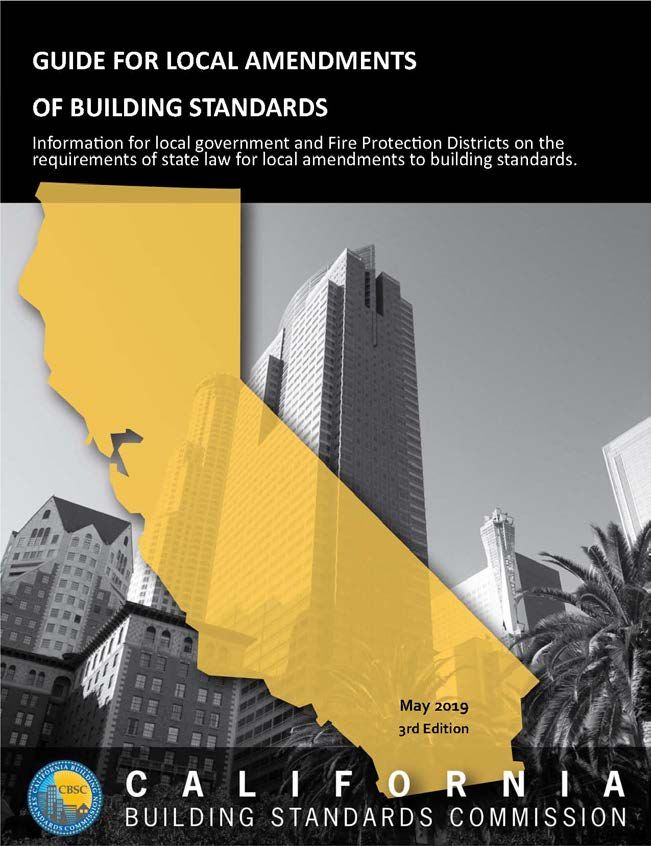
The International Code Council
               (ICC) develops model codes that are
               utilized throughout the world.
INTRODUCTION    The California Building Standards
               Commission (CBSC) establishes a
               state-wide Building Standards Code
               for use throughout California.
                Local jurisdictions may adopt local
               amendments to the California
               Building Standards Code in order to
               provide adequate protection to the
               communities they serve.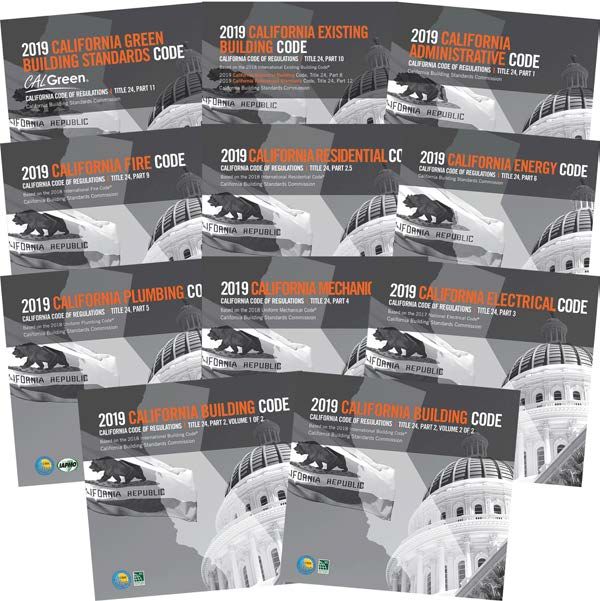
PRESENTERS
 Mia Marvelli
 Executive Director
 CA Building Standards Commission

Bio:
https://www.dgs.ca.gov/BSC/About/C
BSC-Staff/Mia-Marvelli
PRESENTERS
              Stuart Tom, P.E., CBO, FIAE
              JAS Pacific, President
PRESENTERS    ICC Board of Directors

             Bio:
             https://www.iasonline.org/team/stuart-
             tom/?back=7332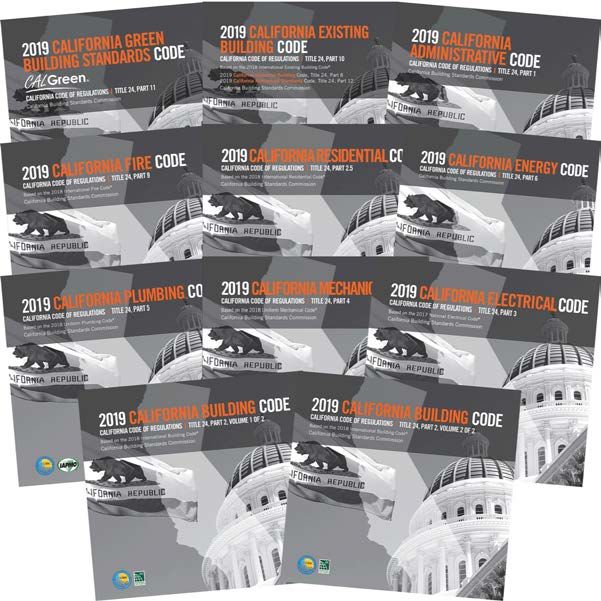
Description
This webinar addresses the local code adoption
process in California. With the new codes being
adopted and published for California, local
jurisdictions have an opportunity to complete local
adoption ordinances and file them with the California
Building Standards Commission.
10-Minute Q & A
 At any time during the
 presentation, please
 type your questions
 into the Q & A portion
 of the Adobe Connect
 Box.                      Type your        Then hit enter
 The facilitator/speaker   questions into   or the send
 will respond to your      here.            button.
 questions at the end of
 the webinar.
Objectives
 Upon completion, participants will be better able to:
   Identify the California codes in Title 24, California Building
   Standards Code.
   Describe the local code adoption process and legal authorities
   relating to the process.
   Describe the California code adoption timeline including local
   adoption time frame.
   Describe the common mistakes frequently made with local code
   adoption.
Introduction
 So is it really time to adopt another code?
 Haven’t things settled down since we’ve been using the I-Codes for
 a while now?
 Is California proposing many changes to the model codes?
 How much of my current locally adopted code will be reusable?

 … I think I know what I’m doing, have I been doing it right?
T O D AY ’ S T O P I C S

   List of codes we will be adopting
   Local adoption process & legal authorities
   Timeline
      Where are we?
      Where do we need to be?
      How do we get there?
   What’s new for 2019?

   Frequent mistakes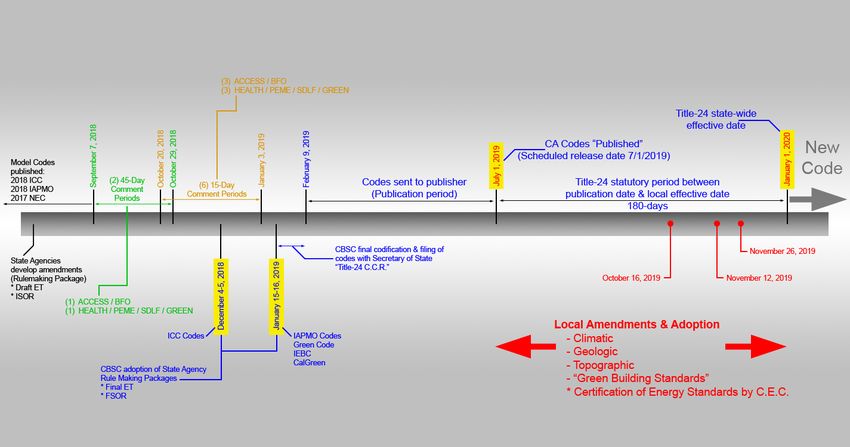
CALIFORNIA CODES

  What is Title 24, C. C. R.?
     “California Building Standards Code”
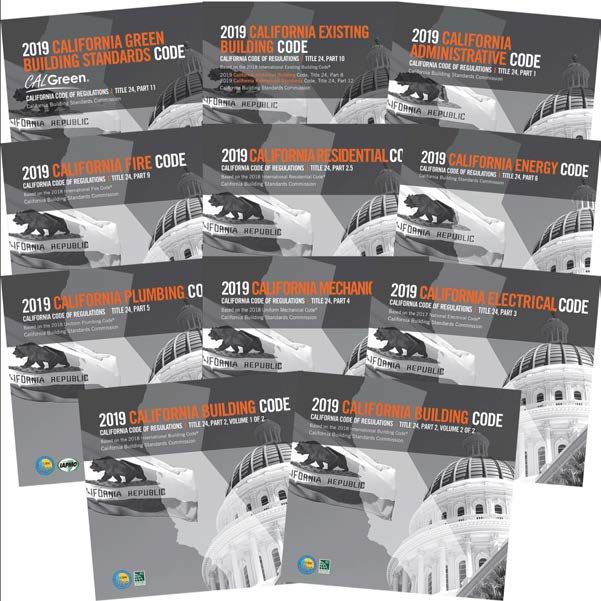
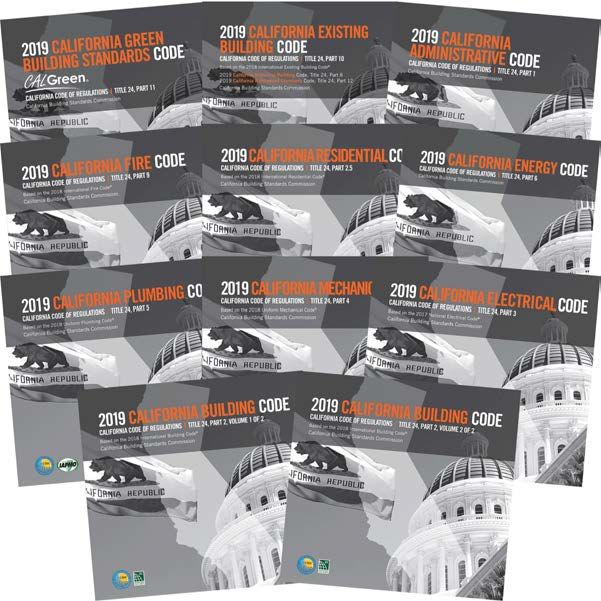
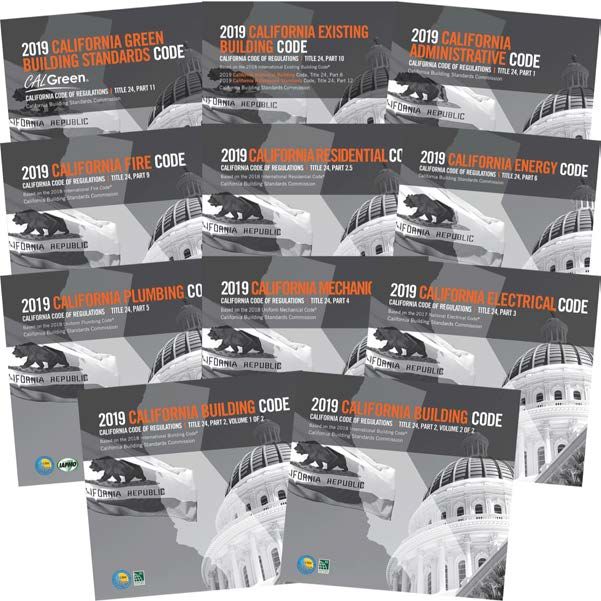
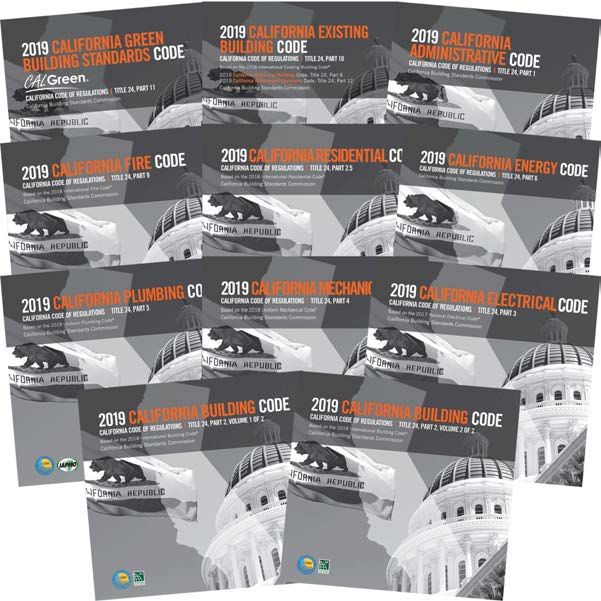
     Organized into 13 separate parts:
CA Administrative Code                      CA Energy Code
CA Building Code                            CA State Historical Building Code
CA Residential Code                         CA Fire Code
CA Electrical Code                          CA Existing Building Code
CA Mechanical Code                          CA Green Building Code
CA Plumbing Code                            CA Reference Standards Code
LOCAL CODES & LOCAL AMENDMENTS
Where is my authority to adopt & amend a local code legally
established?
HSC 18941.5 (Building Standards Law)
HSC 17958 (State Housing Law)
HSC 13869 (Fire Protection Districts)
Local jurisdictions shall adopt the CA Building Standards Code for local enforcement
within 180 days after Title 24. C.C.R. is published.
In adopting Title 24 for local enforcement, the jurisdiction may amend the standards
if such amendments are necessary to address a local geologic, topographic or
climatic condition.LOCAL CODES & LOCAL AMENDMENTS
Additional authority to adopt & amend a local code.
HSC 17959 (Universal Design in State Housing Law)
Gov. Code 65852.2 (Accessory Dwelling Units)
Gov. Code 8698.4 (Homeless Shelters and Emergency Housing)
Pub. Resources Code 25402 (Energy Code amendments)
HSC 18959 (Historical Building Code)
HSC 19100 (Earthquake Protection Law)
For a complete list and local ordinance filing requirements, refer to CBSC’s Guide for
Local Amendments of Building Standards
www.dgs.ca.gov/BSC > Resources > Guidebooks for Local JurisdictionsHSC 18941.5; HSC 17958; HSC 13869 Administrative Stds. vs. Building Stds. Only changes to Building Standards need to be justified on the basis of a local geologic, topographic, or climatic condition. Establishment of Administrative Standards does not require justification pursuant to HSC 18941.5, HSC 17958, or HSC 13869. Matrix Adoption Tables Appendices
WHEN TO ADOPT A LOCAL CODE

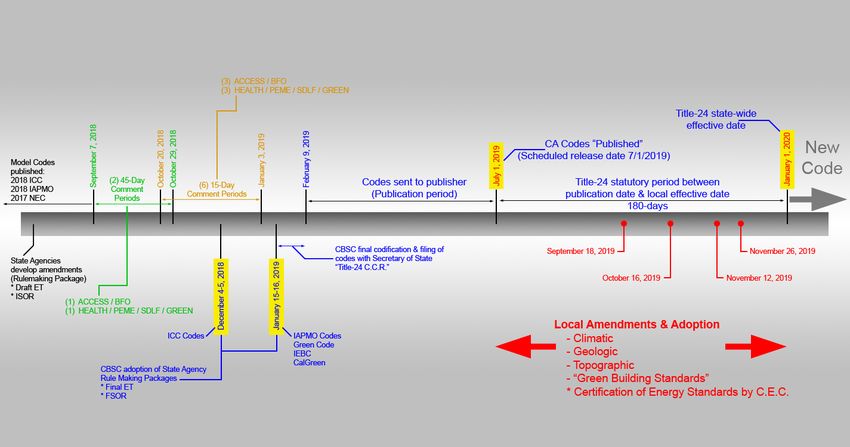
 Within 180-days of Title 24 publication.
   Most jurisdictions deliberately time their adoption ordinance to become effective
   exactly 180 days after T-24 publication (or upon the “established effective date”).
   May be adopted later than 180 days after T-24 publication, but during the interim
   period of time, the unamended T-24 standards must be enforced.
   Note: This occurs VERY frequently as a result of delayed adoption of Green Building
   Standards, especially if C.E.C. Certification is required.
   May not be effective before effective date of Title 24.
 When does your governing body meet?
   Do local ordinances typically require two (2) public readings?
   Does your city hold preliminary meetings for “outreach” or “public comments”?
CALIFORNIA RULEMAKING TIMELINE & PROCESS

International Code
Council
International Association
of Plumbing and
Mechanical Officials
National Fire Protection
Association
CALIFORNIA RULEMAKING TIMELINE & PROCESS

 Rulemaking Phases                Rulemaking Documents
    Model Codes                        Express Terms
    Workshops                          Initial Statement of Reasons
    Initial submittal                  Notice of Proposed Action
    Code Advisory Committees           Nine-Point Criteria
    Public comment period              Form 399 (Economic and Fiscal)
    Commission action
    Codification/Publication   For a more detail refer to CBSC’s Public Guide
    180-day wait period        to the Building Standards Adoption Process
    Effective date             www.dgs.ca.gov/BSC > Resources >
    Errata/Supplements         Guidebooks on Rulemaking
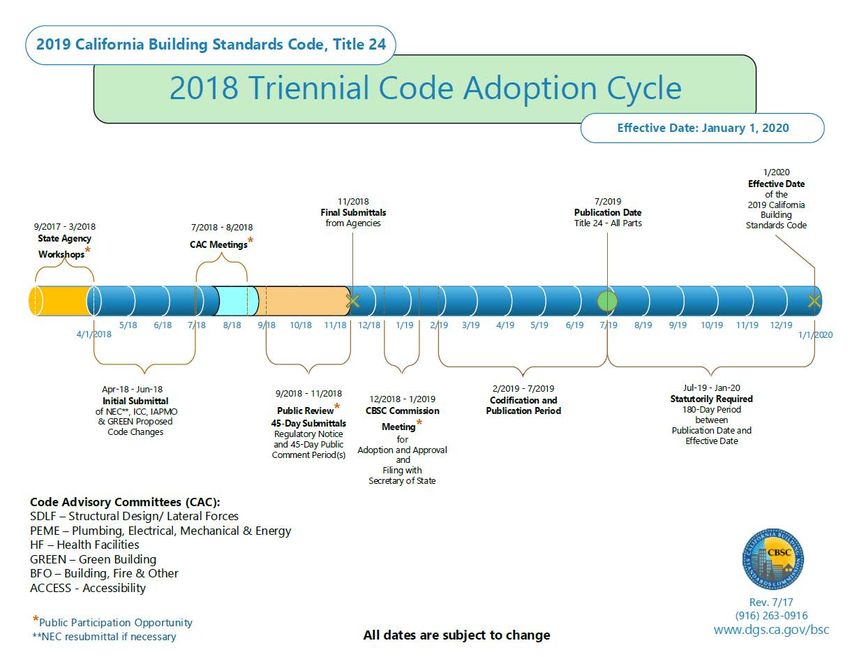
LOCAL CODE ADOPTION TIMELINE
LOCAL CODE ADOPTION TIMELINE
LOCAL CODE ADOPTION TIMELINE
LOCAL CODE ADOPTION TIMELINE
LOCAL CODE ADOPTION TIMELINE
LOCAL CODE ADOPTION TIMELINE
LOCAL CODE ADOPTION TIMELINE
LOCAL CODE ADOPTION TIMELINE
LOCAL CODE ADOPTION TIMELINE
H O W M U C H T I M E D O W E H AV E ?

  July 1, 2019 à January 1, 2020         184 days
     Minus weekends/holidays             126 days
H O W M U C H T I M E D O W E H AV E ?
July 1, 2019 à January 1, 2020 184 days
Minus weekends/holidays 126 days
July 1, 2019 à November 12, 2019 134 days
Minus weekends/holidays 92 daysH O W M U C H T I M E D O W E H AV E ?
July 1, 2019 à January 1, 2020 184 days
Minus weekends/holidays 126 days
July 1, 2019 à November 12, 2019 134 days
Minus weekends/holidays 92 days
July 1, 2019 à September 18, 2019 79 days
Minus weekends/holidays 55 daysW H AT D O L O C A L A M E N D M E N T S L O O K L I K E ?
Follow the same format as T-24
Best to use the same section numbering scheme and sequence
But it is not necessary, and some jurisdictions renumber all of the code sections to
fit within their own municipal code.
Amendments to “Building Standards” may not be less protective
than T-24
More flexibility when amending non-building standards and
administrative standards
ExamplesW H AT D O J U S T I F I C AT I O N S L O O K L I K E ?
Generally, the best format is to utilize clear text that simply explains that an
amendment is necessary to adequately protect the community on the basis of
a specific local geologic, topographic or climatic condition.
It is not acceptable to merely state that an amendment is necessary due to “…
a local geologic condition …”
Must identify what the local condition is.
Each local amendment requires justification.
A particular justification may be used repeatedly.
A justification does not need to be unique to a particular jurisdiction.
ExamplesS TAT E A G E N C Y A M E N D M E N T S
Which state agencies will affect you the most?
HCD-1
HCD-2
SFM
DSA/AC
OSHPD3
For a detailed list of state agencies authorized to promulgate regulations in Title 24, refer
to CBSC’s Guide to Title 24 and Code Book Fundamentals
www.dgs.ca.gov/BSC > Resources > Guidebooks on Title 24S TAT E A G E N C Y A M E N D M E N T S
Which state agencies will affect you the most?
BSC-CG (non-residential green building standards)
HCD-1 (Hotel, Apartment, Condominium, SFD)
HCD-2 (Mobile Home Parks)
SFM (A, C, E, H, I, L, R, Highrise, “Other”)
DSA/AC (Accessibility)
OSHPD3 (Licensed Clinics and Outpatient Svcs)ADOPTION ORDINANCE What are the key elements of a local code adoption ordinance? Is there a particular format that must be followed? Can all the codes be adopted in a single ordinance, or is a separate ordinance required for each code? CBC, CRC, CFC, CPC, CMC, CEC, CEBC, etc.
ADOPTION ORDINANCE

 How important is it that local jurisdictions adopt similar codes?
 Is bigger and stronger always better?
   Do local codes always have to be “better”, “greener”, or “more energy efficient”
   than codes from neighboring jurisdictions?
   How does the increased cost of compliance fit into code adoption decisions?
   What is “balanced code adoption”, and what should I consider when developing the
   local code for my community?
ADOPTION ORDINANCE

 Does code adoption present an opportunity to improve your local
 codes?
 Should you improve your local codes?
   WUI Standards
   Grading & Drainage Standards
   Prescriptive simplification of the code
   Adoption of appendices
   Adoption of specialty codes (e.g. ISPSC)
ELEMENTS OF ADOPTION

 Must be adopted by the governing body
    All amendments must be adopted by ordinance; a “department policy” is not sufficient
    “Contract Cities” must adopt their own code, even if adoption is “by reference”
 Must include each standard that will be amended
 AB 210 allows “Green Building Standards” to be locally amended as Building
 Standards
    Special attention must be afforded to Green Building Standards which also influence Energy
    Standards
 Amendments must be “… reasonably necessary because of local climatic,
 geological or topographical conditions.”
 Appendices
ELEMENTS OF ADOPTION
APPENDICES EXAMPLES
CALIFORNIA BUILDING CODE – MATRIX ADOPTION TABLE
APPENDIX G – FLOOD-RESISTANT CONSTRUCTION
Appendices BSC-
(Not adopted by state agencies)
HCD DSA OSHPD
Not a part of Title Adopting agency
Adopt entire chapter
BSC
CG
SFM
1 2 1/AC AC SS SS/CC 1 2 3 4
BSCC DPH AGR DWR CEC CA SL SLC
24 unless Adopt entire chapter as
amended (amended
adopted by a sections listed below)
Adopt only those sections
state agency or that are listed below
Chapter / Section
local jurisdiction
APPENDIX G
FLOOD-RESISTANT CONSTRUCTION
The provisions contained in this appendix are not mandatory unless
specifically adopted by a state agency, or referenced in the adopting ordinance.
SECTION G101 G101.3 Scope. The provisions of this appendix shall apply to
ADMINISTRATION all proposed development in a flood hazard area established in
Section 1612 of this code, including certain building work
G101.1 Purpose. The purpose of this appendix is to promote
exempt from permit under Section 105.2.
the public health, safety and general welfare and to minimize
G101.4 Violations. Any violation of a provision of thisEXAMPLE 1
APPENDIX CHAPTER
CALIFORNIA BUILDING CODE – MATRIX ADOPTION TABLE
APPENDIX C – GROUP U – AGRICULTURAL BUILDINGS
Appendices (Matrix Adoption Tables are non-regulatory, intended only as an aid to the user.
See Chapter 1 for state agency authority and building applications.)
Not mandatory Adopting agency BSC
BSC-
CG
SFM
1
HCD
2 1/AC AC
DSA
SS SS/CC 1
OSHPD
2 3 4
BSCC DPH AGR DWR CEC CA SL SLC
unless specifically Adopt entire chapter
Adopt entire chapter as
X
referenced in the amended (amended
sections listed below)
adopting
Adopt only those sections
that are listed below
ordinance
Chapter / Section
APPENDIX C
GROUP U—AGRICULTURAL BUILDINGS
The provisions contained in this appendix are not mandatory unless specifically referenced in the adopting ordinance.
SECTION C101 SECTION C102
GENERAL ALLOWABLE HEIGHT AND AREA
C101.1 Scope. The provisions of this appendix shall apply C102.1 General. Buildings classified as Group U Agricul-
exclusively to agricultural buildings. Such buildings shall be tural shall not exceed the area or height limits specified in
classified as Group U and shall include the following uses: Table C102.1.ELEMENTS OF ADOPTION
APPENDICES EXAMPLES
CALIFORNIA BUILDING CODE – MATRIX ADOPTION TABLE
APPENDIX I – PATIO COVERS
Appendices (Matrix Adoption Tables are non-regulatory, intended only as an aid to the user.
See Chapter 1 for state agency authority and building applications.)
Not mandatory Adopting agency BSC
BSC-
CG
SFM
1
HCD
2 1/AC AC
DSA
SS SS/CC 1
OSHPD
2 3 4
BSCC DPH AGR DWR CEC CA SL SLC
unless specifically Adopt entire chapter
Adopt entire chapter as
X
adopted by a amended (amended
sections listed below)
state agency or Adopt only those sections
that are listed below
X
Chapter / Section
referenced in the I101 X
adopting
I102 X
I103 X
ordinance
NOTE: HCD APPENDIX I
adopts entire PATIO COVERS
chapter.
SFM adopts The provisions contained in this appendix are not mandatory unless
specifically adopted by a state agency, or referenced in the adopting ordinance.
specific sections
SECTION I101 approved translucent or transparent plastic not more than
GENERAL 0.125 inch (3.2 mm) in thickness, glass conforming to the
I101.1 General. Patio covers shall be permitted to be provisions of Chapter 24 or any combination of the forego-
detached from or attached to dwelling units. Patio covers ing.ELEMENTS OF ADOPTION
APPENDICES EXAMPLES
CALIFORNIA RESIDENTIAL CODE – MATRIX ADOPTION TABLE
APPENDIX X – EMERGENCY HOUSING
Appendices (Matrix Adoption Tables are nonregulatory, intended only as an aid to the code user.
Not mandatory See Chapter 1 for state agency authority and building applications.)
unless specifically Adopting agency BSC
BSC-
SFM
HCD DSA OSHPD
BSCC DPH AGR DWR CEC CA SL SLC
referenced in the
CG 1 2 1/AC AC SS SS/CC 1 1R 2 3 4 5
Adopt entire chapter X
adopting Adopt entire chapter
as amended
ordinance.
(amended sections
listed below)
Adopt only those
sections that are
listed below
Chapter / Section
APPENDIX X
EMERGENCY HOUSING
The provisions contained in this appendix are not mandatory unless specifically referenced in the adopting ordinance.
SECTION AX101 emergency housing facilities is limited exclusively to the occu-
GENERAL pants of the emergency housing, personnel involved in operat-
AX101.1 Scope. This appendix shall be applicable to emer- ing the housing, and other emergency personnel.NEW FOR 2019
Very few substantial changes from the codes we are enforcing
now.
The 2016 Intervening Code Adoption Cycle addressed many
changes that would have otherwise been included in the 2019
rulemaking packages.
Effective date: 7/1/2018
Early adoption of many provisions that were adopted into the 2018 I-Codes.
The 2019 California Rulemaking Packages “delete” many previously adopted
provisions, because they are now part of the model I-Codes.
2018 International Existing Building Code chapters were reorganized
… If you’ve adapted to the 7/1/2018 Title 24 Supplement, you won’t see many
surprises in the 2019 edition.ELEMENTS OF ADOPTION Repeal of prior ordinance This is often overlooked by municipalities and is critically important to ensure that obsolete provisions are expressly repealed Reference to prior code Include a provision that expressly indicates that prior references to the former local code shall be construed to apply to the corresponding provisions of the proposed local code
J U S T I F I C AT I O N S

  What are the key elements of a local jurisdiction’s justification to
  amend the code?
  When is a jurisdiction required to justify their amendments?
  Is there a particular format that must be followed?
  Can all amendments be justified at the same time?
J U S T I F I C AT I O N S

  Amendments to Administrative Standards do not require
  justification pursuant to HSC 18941.5/17958/13869
  Amendments to Building Standards, must be justified on the basis
  of one or more local climatic, geological or topographical
  conditions
  There is no mandated format for the justifications, as long as the
  findings are individually and expressly made by the governing
  body
      A Council Resolution is a formal express method that is simple and clean.
J U S T I F I C AT I O N S
“… the governing body of a city or county, before making any
modifications or changes pursuant to Section 17958.5, shall make
an express finding that such modifications or changes are
reasonably necessary because of local climatic, geologic or
topographical conditions.”
Justifications shall be made first
“Such a finding shall be available as a public record.”
“A copy of those findings, together with the modification or
change expressly marked and identified to which each finding
refers …”
Each amendment must be individually justifiedJ U S T I F I C AT I O N S
Justifications and amendments must be filed with the California
Building Standards Commission
2525 Natomas Park Drive, Suite 130
Sacramento, California 95833
Attention: Ordinance Filing
Certified mail with return receipt request is recommended
File electronically ordinancefiling@dgs.ca.gov
PREFER readable PDF (SB 1442, Statute 2016)
CBSC will acknowledge receipt
CBSC will not evaluate justifications or amendments
CBSC will post on our website www.dgs.ca.gov/BSC > Codes > OrdinancesSAMPLE DOCUMENTS
Sample City Council Staff Report
Sample City Council Resolution of Justifications
Excerpts: Cover Page/Matrix/Key
Sample Adoption Ordinance
Excerpts: Cover Page/Several important aspects of adoption ordinances
CEC Certification
Cost Effectiveness StudyCBSC GUIDE Guide for Local Amendments of Building Standards https://www.dgs.ca.gov/BSC/Codes /Local-Code-Ordinances California Code Adoption webinar same webpage
OTHER ICC RESOURCES
LOCAL ADOPTION OF OTHER MODEL CODES

 State Law or regulations prevail

 Wildland Urban Interface reg’s and laws
   CBC, Chapter 7A
   CRC, Section R337
   CFC, Section 4906
   Public Resources Code (law) 4291
   Government Code (law) 51182
 Swimming Pool Safety Act reprinted
   CBC, Section 3109
   CRC, Appendix V
   Health and Safety Code (law) 115920 et seq.
Stuart Tom, P.E., CBO, FIAE
                   stuart@JASPacific.com
                       stom@iccsafe.org
                        www.iccsafe.org
THANK YOU !!
               Mia Marvelli, Executive Director
               Building Standards Commission
                    Mia.Marvelli@dgs.ca.gov
                     www.dgs.ca.gov/BSC
You can also read


