FIRST YEAR COURSE TIPS AND RECOMMENDATIONS - MYBRIERCREST
←
→
Page content transcription
If your browser does not render page correctly, please read the page content below
First Year Course Tips and
    Recommendations

                  Daily Schedule
                Choosing Courses
           How to Read Course Codes
             Registering for Courses
         Information Specific for Athletes
     Information Specific for Music options
       Road Map to Program Completion
             Transitioning to College
   Preparing for Briercrest College Academics
               Academic Dictionary

 Academic Service: Admissions and Academic Advising

               Updated March 2021
Understanding Class Schedule
If this is your first time to college, you may be surprised to find out how different the
schedule is from high-school or homeschool. Here is a visual guide to help you be
familiar with the general class schedule.
Monday Tuesday Wednesday Thursday Friday
Classes are typically
75 minutes long
8:30 a.m. Example: Example:
and occur 2x/week Friday morning
(e.g., Mon & Wed or - 9:45 a.m. ENG 100 ENG 100
classes usually run
Tues & Thurs). from 9 a.m. to
12 p.m.
9:50 a.m. (Not advised if you
We gather together Chapel Chapel Chapel Chapel
- 10:30 a.m. anticipate travel on
for chapel 4x/week.
weekends as part
of a team or
10:40 a.m. Example: Example: ensemble.)
- 11:55 a.m. CM 101 CM 101
Be sure to plan
time for lunch!
You can expect
12:25 p.m.
to spend as
- 1:40 p.m.
much as 3-6
There is typically a
hours per week
10-minute break
outside of each
between classes. 1:50 p.m. Example: Example:
class on reading
- 3:05 p.m. THEO 112 THEO 112 and assign-
ments.
You may have long
gaps in your day. 3:15 p.m.
Tip: Set a routine to - 4:30 p.m.
make the most of Athletes be sure to
your time---plan check with your
homework time, 4:40 p.m. coach when prac-
workout, etc. - 6:10 p.m. tice times are
scheduled.
Some classes are 3 7:00 p.m. Example:
hours long but only - 10:00 p.m. YM 100
occur once a week.
Other classes or tutorials may
occur in the evenings (e.g.,
dance class, English tutorials).Choosing Courses
Start here!
Yes Do you know what program No
you are interested in?
Review the Program Tip Sheet Book an appointment with an
provided by your Admissions Advisor. Academic Advisor
Email admissions@briercrest.ca
Check out the course list
to see which courses are currently
being offered that fit in your
program and use the course timeta- How many courses to sign-up for:
ble to decide what section to choose.
To be full time, students must register for 4—5 3
credit hour (c.h.) classes each semester. To complete a
program within the 1-, 2-, or 4-year time frame., regis-
ter for 5.
Now register for classes Heavy involvement in extra-curricular activities or
that you need and that work with your employment usually result in fewer classes per
schedule. Register through Briercrest semester and an additional semester or two of classes
Live. Contact your Admissions Advisor later on.
for assistance.
Some first years will also start with four
classes to allow space to adjust to college life and the
responsibilities of young adulthood.
How to read course codes
Example: BLST 109 A Intro to New Testament
Course Discipline Course Number Section or type of class Course Name
In this example: Biblical The first number is the Not all courses will
Studies level of study 1=1st have this but if it does
year, 2 = 2nd year there are multiple sec-
tions of this course
(choose 1) or it has a
different delivery mode
Note: Freshmen with no prior college education are limited to 100 and 200 level courses only
.Registering for Courses
1. Sign-in to your Briercrest Live account Need help navigating Briercrest Live?
Contact your Admissions Advisor
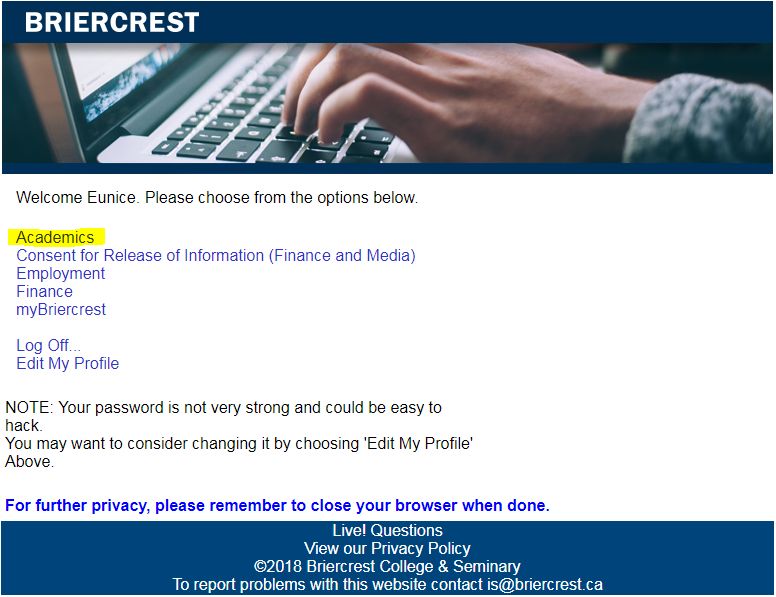
2. Select “Academics”
My desired course is full.
What can I do?
If the course you want is full, try registering
again later to see if a spot has opened up.
If you are planning to drop a class, please
do so as soon as possible to allow others
who need the course to have your seat.
What is a prerequisite?
3. Select “College Course Registration”
A prerequisite is a requirement you need
to meet before you can take certain
courses. Be sure to plan ahead.
How to tell if a prerequisite needed:
1. A pop-up note will appear when you
are registering for courses with pre-
4. Click “View List of All Available Courses” requisites.
2. Check the College Calendar under
“Course Descriptions”
3. Ask your Admissions/Academic Advi-
sor.
Note: Be sure to check out Program Info
Sessions during Week of Welcome
5. Choose the upcoming semester and click “List Courses”
Changes can be made up to the Add/Drop
date –usually the firs t week of school.
6. Select the course code to register.Athletes and Music Students
Briercrest Athletes
are advised to sign up for four 3 c.h. courses (12 credit hours total) per semester. Be sure to choose courses that will
not conflict with your practice and travel times.
Check with your coach to find out when your practice times will be (typically they are scheduled for afternoons or
evenings Monday to Thursday).
Friday classes are not recommended as your team may be travelling for weekend games.
Due to heavy team commitments, most athletes take an extra semester (AA) or year (BA) to complete their degrees.
If desired, it is still possible to complete your program within 2 or 4 years by taking online classes (in the summer only)
or taking “mod” classes in the off-season.
It is incredibly important to practice time-management and self-discipline as a student-athlete or
music student.
Tip: use a paper calendar to keep track of due dates, game days, performance days, etc. and ask
someone to be your accountability partner to help keep you on schedule.
Visit the Academic Resource Centre (ARC) for more resources.
Music Students
are required to take a number of one-credit hour ensembles and private music lessons for credit in addition to their 3
credit hour academic courses.
It is recommended that freshmen music students start with four courses rather than five 3 c.h. classes in their first
semester.
See Program Tip Sheet specific course advising for year one..
Signing up for Ensembles and Music Lessons
For Ensembles, you will audition during the first week of school in September. Be sure to check in with the Perform-
ing Arts Department to know when these auditions will be held.
For Private Music lessons (Voice, Piano, or other instruments,):
1. Go to your Briercrest Live account (as you would to register for any other course).
2. Register for the course PL – Voice or Piano or Instrument.
3. A box will pop up that has a link to the application form you must complete and submit. You need one
registration for each type of lesson.
4. A confirmation that your application was received will come up.
5. Click on “My Briercrest Live” and select PL again, and add it to your registration.
6. You will then be registered for a Private Lesson. If you have any questions contact performingarts@briercrest.ca
For private dance lessons, visit the Performing and Worship Arts office.Road Map to Program Completion
Understanding the Program Sheet
Program sheets outline which courses you need to take in order to complete your
program of study. You can find them on mybriercrest.ca/college/sheets. It can seem a
bit daunting at first, so here’s a simple overview. (For more questions, ask your
Academic Advisor.)
Core courses are a part of every degree at Briercrest
So if you decide to change programs, at Briercrest these re-
quired courses can easily be applied to your new program of
Core courses study.
Likewise, if you complete a two-year Associate of Arts degree at
Briercrest, these core courses can easily transfer into any
Briercrest Bachelor of Arts degree.
+
Major requirements are courses that are specifically required for
Major requirements your program of study. These requirements will vary from
program to program.
+
Free electives are open to any courses you would like to take.
The number of free electives that you will need depends on how
Free electives
many credit hours remain in your program after fulfilling credit
hours from the Core and your Major requirements.
+
Service and Experiential Learning (SEL) units are non-credit
requirements. This is an opportunity to develop hands-on, out-of
Service Learning (non-credit)
-the-classroom experience. Check the Service Learning webpage
for more information or email servicelearning@briercrest.ca
Minors are an add-on to your program. You can earn a minor by
taking specific courses in another area of study that interests
you. You can use your free electives to work towards a minor.
Optional: Minors Talk to your program coordinator or academic Advisor.
Also, remember to let Academic Services know if you want to
pursue a minor.Transitioning to College
College jitters? Feeling overwhelmed?
Need some help organizing and planning your time?
Or help getting started with assignments? Or encouragement to keep going?
Connect with our Academic Resource Centre for support and resources. You can al-
so email academicresourcecentre@briercrest.ca. Or check out one of these services:
ACADEMIC ACADEMIC COUNSELLING
RESOURCE COACHING CENTRE
Free At cost At cost
Tutoring, writing support, One-on-one academic Set up an appointment to meet
workshops, how-to guides, support tailored to individual with one of our counsellors
are available through the ARC. goals to develop your skills
and potential
Find us in the library and on Visit the Visit the
Canvas Academic Resource Centre Counseling Centre
Academic Accommodations
Students with learning disabilities, mental health conditions, physical disabilities, chronic
health conditions, etc. can qualify for academic accommodations.
Academic Accommodations will not modify course expectations,. Instead, they may adjust the for-
mat of how materials and examinations are delivered to you.
More information on academic accommodations can be found on the Briercrest website.
*Professional documentation of diagnosed disabilities that impact learning will be required to access
learning accommodations. Contact the Director of Student Success for more information.Preparing for Briercrest College Academics
College at Briercrest is different than high school, homeschool, and in some cases
other post-secondary education experiences. A word of advice: focus on learning and
growing, and ask when you are stuck. A few other things to note:
High school College
• School days are more structured. College has a more flexible schedule.
Note: with greater freedom comes
greater responsibility.
• Teachers often give you class time to You are responsible to prepare for class
work on assignments. and complete assignments outside of
class time. Students can expect to spend
3-6 hours outside of class on reading and
assignments.
• Take-home assignments can be Start early. College assignments often
completed the night before. take more time than you think.
• Assignments can be handed in late with Late policies exist that can affect your
minimal to no penalty. grade. Check the syllabus.
• It might not matter how many classes you Attendance matters. Missing more than
miss. the allowable absences can lead to a fail.
Check the syllabus.
• Parents/guardians can be your advocate Time to practice ownership for your own
in discussing academic concerns. learning. You are responsible to
communicate with your instructors.
• A pass is 50%. 50% will get you course credit, however a
minimum of 63% average is needed to
maintain good academic standing.
• Passing doesn’t take that much effort. It’s Be prepared for a grade drop, and be
not too hard to catch up after slacking. persistent in your effort. Slacking can
cause major issues and stress.ACADEMIC DICTIONARY
Fancy college terms to know
Each course has a syllabus that outlines what the professor is committed to teaching and
Syllabus what you will be responsible for doing. Late assignment, attendance, and other information
is also included in the syllabus. Syllabi is the plural of syllabus.
The number of credits a course is worth is typically based on weekly instructional hours (i.e.,
Credit hour definition
hours of teaching you get from the instructors).
Most courses are three credit hours, which involve three hours of instruction per week plus
Credit hour details research, writing, study time, and examinations. Students should expect to invest 72-108
hours in total per three credit hour course
These are classes that typically run for four to five days. These classes often require pre—
Modular Course
and post-course work.
Online Course These are semester-long courses delivered through an online platform. Options are limited.
Prerequisite Is a requirement you need to meet before you can take certain courses.
Full –time studies Registered for 12-15 credit hours.
Part-time studies Registered for less than 12 credit hours.
Grade Point Average. This can be by term (averaging just your term classes )or cumulative
GPA
(average of all courses taken).
Program Specific:: At Briercrest all of our Bachelor programs are Arts except for the B
Core A group of required courses from a variety of academic disciplines.
A discipline chosen as a field of specialization typically requiring 36 or more credit hours of
Major
study.
An area of study that must be taken outside of one’s major, involving 18-30 credit hours of
Minor
student. Minor’s are optional.
Concentration An area of focus within a major.
Add/Drop Day The last day to add or drop a course without any financial or grade penalty.The transition to college has its challenges, both expected and unexpected.
If you are feeling overwhelmed, don’t worry. We’re here to come alongside you.
You can talk with your Admissions Advisor, your RA, your RD, your professors,
our Counselling Centre staff, our Academic Resource Centre staff,
our Academic Services and Student Finance staff, and a number of others.
We’re looking forward to seeing you on campus!You can also read


