TUBERCULOSIS & LONG TERM CARE - WHAT YOU SHOULD KNOW - Kelly White, MPH, CPH Director, TB Prevention & Care
←
→
Page content transcription
If your browser does not render page correctly, please read the page content below
TUBERCULOSIS & LONG
TERM CARE – WHAT YOU
SHOULD KNOW

Kelly White, MPH, CPH
Director, TB Prevention & Care
March 22, 2022
Learning Objectives
•   Understand Tuberculosis basics and identify methods for detecting M.
    tuberculosis infections

•   Understand the considerations to take into account when selecting
    between a TST and IGRA to test for TB infection

•   Understand TB related guidelines in Indiana for the long-term care
    setting for both residents and staff

                                                                           2
TB Background

Tuberculosis
• Tuberculosis (TB) is caused by
  the bacterium Mycobacterium
  tuberculosis
• Usually affects the lungs, but
  can attack any part of the
  body
• Divides at a slow rate

                                   4
TB Basics
• How is it spread?
  • Person-to-person through the
    air
  • The bacteria is expelled via
    coughing, speaking, or singing

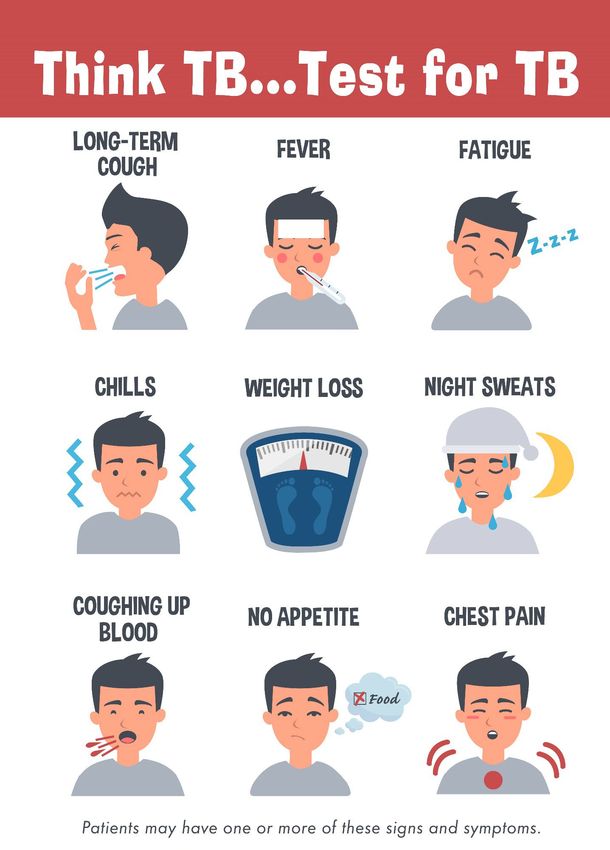
• Signs and symptoms?
  •   Cough greater than three
      weeks
  •   Illustration to the right shows
      other symptoms

                                        5
LTBI Compared to TB Disease

                              6
Diagnostic Tests for M. tuberculosis Infection
Currently there are two methods of testing for M.
tuberculosis (M. tb) infection in the United States.

  • Mantoux tuberculin skin test (TST)
  • Interferon-gamma release assays (IGRAs)

                                                       7
TST Summary
•   If a person is infected, a delayed type of hypersensitivity reaction is detectable two to eight
    weeks after infection.

•   The TST is performed by injecting 0.1 ml of tuberculin purified protein derivative (PPD)
    between the layers of the skin (intradermally), usually on the forearm.

•   The reaction to this test, the induration (the palpable hardened area), is measured 48 to 72
    hours after the injection.

•   Classification as positive or negative depends on the size of the induration and the patient’s
    risk factors for TB.

    •   If the test is not read within 72 hours, the test will need to be redone.

                                                                                                      8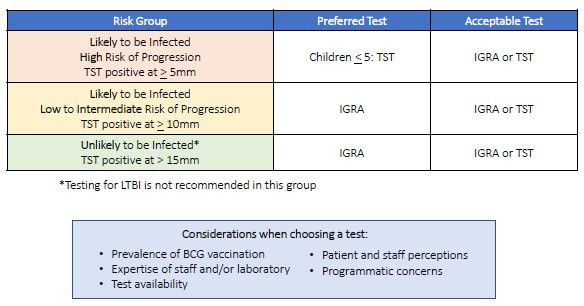
Advantages and Disadvantages of TSTs
               Advantages of TSTs                               Disadvantages of TSTs
   Simple to perform (e.g., no                       Requires trained personnel to
   laboratory equipment required)                    administer and interpret
   Low cost                                          Requires two or more patient visits
   No need for phlebotomy                            False-positive results can occur due
                                                     to previous BCG vaccination
   Well-established definitions of TST conversions   False-positive results can occur due
                                                     to nontuberculous mycobacteria
                                                     False-negative results can occur due
                                                     to concurrent infections
                                                     Rare adverse effects
                                                     Can cause the booster phenomenon
                                                     May be subject to biases and errors with TST
                                                     placement and reading

                                                                                                    9
Special Considerations When Using TSTs
Booster phenomenon:

•   Some people infected with M. tb may have a negative TST reaction when tested
    years after they were infected (e.g., older adults).

•   Initial skin test may stimulate (boost) ability to react to PPD.

•   Subsequent positive boosted reaction may be misinterpreted as a new
    infection.

•   May still be considered for treatment if currently at high risk for TB disease or if
    other vulnerable persons would be put at risk

                                                                                           10
IGRA Summary
• IGRAs are blood tests.
• They measure a person’s immune
reactivity to M. tb.
• Blood samples are mixed with
antigens (protein substances that
can produce an immune response)
and incubated.
• If the person is infected with M. tb,
blood cells will recognize antigens
and release interferon gamma
(IFN-γ) in response.
11IGRA Test Types and Referrals
• Currently, two IGRAs are approved by the Food and Drug Administration
and available in the United States:
• QuantiFERON®-TB Gold Plus (QFT)
• T-Spot®.TB test (T-Spot)
• Patients can be referred to hospitals or local health departments to have
an IGRA test.ǂ
• A health care provider will draw a patient’s blood and send it to a
laboratory for analysis and results.
ǂ Please
note that not all hospitals and local health departments perform IGRAs. Please
check before providing a referral to a specific site.
12Advantages and Disadvantages of IGRAs
Advantages of IGRAs Disadvantages of IGRAs
Requires only a single patient visit to Blood samples must be processed
conduct the test within eight to 32 hours of collection
Results can be available within 24 hours Errors in collecting or transporting
blood specimens or in running and
interpreting the test can decrease
accuracy of the test
Does not cause the booster phenomenon Tests may be expensive
BCG vaccination does not cause a false-positive
result
Not subject to the biases and errors associated
with TST placement and reading
13Selecting Which Test to Use
CDC Risk and Testing Strategy

      Source: https://www.cdc.gov/tb/publications/guidelines/pdf/ciw778.pdf
                                                                              15
CDC Recommendations: Which Test to Use
Source: https://www.cdc.gov/tb/publications/guidelines/pdf/ciw778.pdf
16Testing for Certain Populations
Population TST IGRA
Unlikely to return for TST Not Recommended Recommended
reading
History of BCG vaccine Not Recommended Recommended
Pregnant Both are safe to use
Children < 2 years Recommended Not Recommended
17Case Scenario One
• 75-year-old female
• Diabetes
• Resident of an assisted living facility
TST or IGRA?
IGRA is preferred; however, either test is acceptable.
18Case Scenario Two
• 65-year-old female
• Living with HIV
• Resident of long-term care facility
TST or IGRA?
• Either is acceptable
• Consider dual testing where a positive result from either result would be
considered positive
19Case Scenario Three
• Employee in a long-term care facility
• No other risk factors
TST or IGRA?
An IGRA is preferred; however, either test is acceptable.
20Indiana Long-Term Care Rule
Indiana LTC Rules –Overview & Updates
• Indiana LTC division has TB specific guidelines for both
  staff and residents
• TB guidelines regarding staff in LTC settings was
  updated in late 2019
• Guidance regarding residents was updated August of
   2021
  • https://www.in.gov/health/files/LTC-Newsletter-
     2021-39.pdf
  •
                                                             22
Indiana LTC Rules – Staff Screening
• Program advisory letters were issued by IDOH’s Long-Term care division
in late 2019 updating expectations for Indiana licensed residential care
and comprehensive care nursing facilities for preventing the transmission
of M. tb.
• The updated guidelines indicate facilities may adopt a nationally
recognized standard for TB screening for healthcare personnel and
implement and follow the standard as written.
• The nationally recognized program for employees is located on the Centers for
Disease Control and Prevention’s website at the following link:
https://www.cdc.gov/tb/topic/testing/healthcareworkers.htm
23TB Screening and Testing of Health Care
Personnel (HCP)
• All HCP should receive baseline screening upon hire that
includes:
• A baseline individual TB risk assessment
• TB symptom evaluation
• A TB test (Either IGRA or TST; according to risk)
• Additional evaluation for TB disease as Needed
• Annual TB testing of health care personnel is not recommended
unless there is a known exposure or ongoing transmission at a
healthcare facility.
• Indiana does not currently have ongoing transmission at any health
care facility
24Annual TB Education for Health Care Personnel
(HCP)
• All HCP should receive TB education annually
• TB education should include:
• TB risk factors
• Signs & symptoms of TB disease
• TB infection control policies and procedures
• Please reach out to IDOH TB Prevention & Care Program if you
need resources for this annual education
• Kathy Chapuran, TB Health Educator
• Kchapuran@isdh.in.gov
25Post-Exposure Screening & Testing
• All HCP with a known exposure to TB should receive a
TB symptom screen and timely testing
• IDOH and/or the local health department would already be involved at this point in
the process and would provide additional guidance
• Any HCP diagnosed with Latent TB infection (during pre-
employment testing or post-exposure screening) should be
encouraged to take treatment
• Several short-course regimens available
• Free through any Indiana local health department!
26Summary of Major Changes to TB HCP Screening
Guidelines
27Resident TB Screening
• Each resident must have a health screening upon admission, including
signs and symptoms of TB disease
• A TB test must be completed within three months prior to admission or
upon admission unless there is documentation of a previous positive TB
test.
• Testing can be by TST or an IGRA blood test.
• Two-step testing should be utilized if doing TST testing
• The TST must be administered and read by persons having documentation of
training from a department-approved course of instruction in intradermal
tuberculin skin testing, reading, and recording
• Routine or baseline chest X-rays are not required or recommended prior
to or at the time of admission.
28Resident TB Screening – Prior Positives
• Residents with a documented previous positive TST or IGRA should not
undergo repeat testing
• The prior positive test should have been followed by a clinical evaluation
for TB that included a chest radiograph (X-ray). Results of that evaluation
should be acquired by the facility and be in the patient’s record.
• There is no time limit on this evaluation.
• If documentation of this evaluation cannot be obtained, a clinical
evaluation with a chest radiograph should be performed.
• In the absence of symptoms, this can be delayed up to one week
following admission
29Resident TB Screening – New Positives
• Any asymptomatic resident with a new positive TST or IGRA must have a
medical evaluation and chest X-ray within one week.
• Once TB disease is ruled out, the resident should be considered and
evaluated for treatment
• Latent TB infection (LTBI) treatment is available for free from your LHD
• Residents with LTBI should be screened for HIV infection
• LTBI is reportable to IDOH
• Case reporting forms are available at the IDOH website
• https://www.in.gov/health/tuberculosis/information-forhealth-professionals/tb-
reporting-forms/valuated for treatment of latent TB infection (LTBI)
30Resident TB Screening – Additional Info
• Residents with symptoms of pulmonary TB and an abnormal chest X-
ray consistent with TB disease should have an evaluation done as
soon as possible in airborne transmission-based precautions
• Referral to hospital is likely required
• Medical evaluation will need to include three sputum specimens for acid fast
smear and culture
• Please notify your LHD – suspected or confirmed TB disease is reportable!
• Periodic chest X-rays of residents with a history of positive TST
or IGRA are not advised and are not necessary unless the
individual develops signs and symptoms of TB disease
31Summary
• National TB recommendations should be considered when
selecting which test to use for TB testing
• Indiana LTC rules have recently been updated to match
national TB guidance
• Staff screening should mirror national health care worker
guidance
• TB testing can be completed via either an IGRA or TST
• Removal of requirement for baseline chest x-ray on
residents
32Questions
33Contact Information
Kelly White, MPH, CPH
TB Prevention & Care
317-233-7548
Kewhite@isdh.in.gov
34You can also read


