Exogenous gibberellins inhibit coffee (Coffea arabica cv. Rubi) seed germination and cause cell death in the embryo
←
→
Page content transcription
If your browser does not render page correctly, please read the page content below
Journal of Experimental Botany, Vol. 56, No. 413, pp. 1029–1038, March 2005
doi:10.1093/jxb/eri096 Advance Access publication 21 February, 2005

RESEARCH PAPER

Exogenous gibberellins inhibit coffee (Coffea arabica cv.
Rubi) seed germination and cause cell death in the embryo

E. A. Amaral da Silva1,2, Peter E. Toorop1, Jaap Nijsse1, J. Derek Bewley2 and Henk W. M. Hilhorst1,*
1
 Laboratory of Plant Physiology, Wageningen University, Arboretumlaan 4, 6703 BD Wageningen,
The Netherlands
2
    Department of Botany, University of Guelph, Guelph, Ontario, N1G 2W1 Canada

Received 27 February 2004; Accepted 3 December 2004

                                                                                                                                                  Downloaded from http://jxb.oxfordjournals.org/ by guest on August 4, 2015
Abstract                                                                        Addition of exogenous GAs completely reverts the in-
                                                                                hibitory effect of tetcyclacis and paclobutrazol, for exam-
The mechanism of inhibition of coffee (Coffea arabica
                                                                                ple, in Arabidopsis, indicating that side-effects are absent
cv. Rubi) seed germination by exogenous gibberellins
(GAs) and the requirement of germination for endogen-
                                                                                (Debeaujon and Koornneef, 2000). GAs can promote ger-
ous GA were studied. Exogenous GA417 inhibited                                  mination of dormant seeds by their ability to overcome or
coffee seed germination. The response to GA417                                  ‘short-circuit’ the requirement for environmental factors
showed two sensitivity thresholds: a lower one be-                              that are required for germination, including afterripening,
tween 0 and 1 lM and a higher one between 10 and 100                            light and cold. This has led to the hypothesis that such envir-
lM. However, radicle protrusion in coffee seed depen-                           onmental factors may induce GA biosynthesis during the
ded on the de novo synthesis of GAs. Endogenous                                 early phases of germination (Hilhorst and Karssen, 1992).
GAs were required for embryo cell elongation and                                Indeed, it was shown that red light enhances GA1 levels in
endosperm cap weakening. Incubation of coffee seed                              photoblastic lettuce seeds (Toyomasu et al., 1993).
in exogenous GA417 led to loss of embryo viability and                             GAs may induce endosperm degradation by stimulating
dead cells were observed by low temperature scanning                            hydrolytic activity in the endosperm cell walls. This was first
microscopy only when the endosperm was surround-                                demonstrated in celery (Jacobsen et al., 1976) and pepper
ing the embryo. The results described here indicate                             seeds (Watkins and Cantliffe, 1983; Watkins et al., 1985). In
that the inhibition of germination by exogenous GAs is                          tomato seeds, GAs liberated from the embryo triggered
caused by factors that are released from the endo-                              weakening of the endosperm cap opposing the radicle tip,
sperm during or after its weakening, causing cell death                         induced degradation of the endosperm cell walls, and allowed
in the embryo and leading to inhibition of radicle                              radicle protrusion (Groot and Karssen, 1987; Groot et al.,
protrusion.                                                                     1988). Activities of endo-b-mannanase, b-mannosidase, and
                                                                                b-galactosidase, all involved in the hydrolysis of galacto-
Key words: b-mannosidase, cell death, coffee seed, endo-b-                      mannans, were enhanced in the endosperm of the GA-
mannanase, germination, gibberellins, puncture force.                           deficient (gib1) tomato mutant treated with exogenous
                                                                                GA4+7. In the absence of GAs only a-galactosidase could
                                                                                be detected but no endo-b-mannanase and b-mannosidase
Introduction                                                                    (Groot et al., 1988). Also in Datura ferox endo-b-mannanase
Gibberellins (GAs) play an important role in the stimulation                    and b-mannosidase were induced by GA in the micropylar
of seed germination (Bewley, 1997). GA-deficient mutants                        endosperm (Sánchez and de Miguel, 1997). In tobacco seeds
of Arabidopsis and tomato do not germinate in the absence                       GA4 induced b-1-3 glucanase activity in the micropylar
of exogenous GA (Koornneef and van der Veen, 1980;                              endosperm, which corresponded with endosperm rupture
Groot and Karssen, 1987). Tetcyclacis and paclobutrazol                         (Leubner-Metzger et al., 1996).
are inhibitors of GA-biosynthesis and may prevent seed                             Besides promoting endosperm weakening, GA stimu-
germination (Karssen et al., 1989; Rademacher, 2000).                           lated embryo growth in tomato possibly by enhancing the

* To whom correspondence should be addressed. Fax: +31 317 484740. E-mail: henk.hilhorst@wur.nl

ª The Author [2005]. Published by Oxford University Press [on behalf of the Society for Experimental Biology]. All rights reserved.
For Permissions, please email: journals.permissions@oupjournals.org
1030 da Silva et al.
embryo growth potential (Karssen and Lac xka, 1986; PO4) were used as a source of organic and inorganic phosphate,
Karssen et al., 1989). GAs stimulate elongation in hypo- respectively, added to the GA4+7 solution. Stock solutions of 10ÿ3 M
tetcyclacis (a gift from BASF, Germany) and paclobutrazol (a gift
cotyls of dark-grown lettuce seedlings (Katsu and Kamisaka, from Syngenta, Enkhuizen, The Netherlands) were made in acetone
1981) and in Arabidopsis GA controls cell elongation in (0.3% v/v) by vigorous stirring overnight. Preliminary experiments
light- and dark-grown hypocotyls (Cowling and Harberd, showed that the amount of acetone used did not have any effect on
1999). Evidence is accumulating that expansins (EXP) coffee seed germination (data not shown). The germination percent-
are regulated by GA and ABA and, hence, are potential age was recorded daily until the number of seeds showing radicle
protrusion was constant.
candidates for hormone-regulated cell expansion and em-
bryo growth potential during germination. For example, in
Water potential measurements
tomato seeds, LeEXP8 and LeEXP10 are specifically
The water potential (w) and osmotic potential (wp) of coffee embryos
expressed in the embryo (Chen et al., 2001). However, an were measured by using a calibrated thermocouple psychrometer
increase in embryo pressure potential (turgor) during GA- (Model HR-33T, Wescor, USA) with a C-52 sample chamber
controlled germination has yet to be demonstrated. (Wescor, USA). Samples were equilibrated for 40 min and two
Contrary to many reports on the stimulatory effect of GA readings were taken before starting the experiments to ensure that
during seed germination and tissue elongation, GA3 in- equilibrium had been attained. Cooling time was 45 s. The C-52
chamber was placed in an airtight glove box kept at 100% relative
hibited radicle protrusion (Valio, 1976; Takaki and Dietrich, humidity by a stream of water-saturated air at a constant temperature
1979; Takaki et al., 1979) and seedling emergence in coffee of 2561 8C. Embryos were isolated as described below and placed in
seed (Maestri and Vieira, 1961). This inhibition was pro- the C-52 chamber. Three replications of 5 embryos each were used
Downloaded from http://jxb.oxfordjournals.org/ by guest on August 4, 2015
posed to be caused by mannose, a degradation product of for the measurements. After measurement of the water potential the
the hydrolysis of mannans (Takaki and Dietrich, 1980). embryos were put in liquid nitrogen for the determination of osmotic
potential. After 2 h in liquid nitrogen the embryos were left to thaw
Coffee endosperm cell walls are composed mainly of and the osmotic potential was determined. The pressure potential (wp)
mannans (Wolfrom et al., 1961). Mannose has been shown was calculated from the equation: wp=w–wp.
to inhibit ATP synthesis and normal hexose metabolism
(Herold and Lewis, 1977) and it caused DNA laddering in Embryo growth
Arabidopsis roots and maize suspension cells (Stein and Embryos from 20 coffee seeds were isolated by cutting the endo-
Hansen, 1999) and also plays a role in gene regulation sperm with a razor blade. Embryo length was measured with calipers.
during photosynthesis (Jang and Sheen, 1994). After length measurement the embryos were separated into embry-
In the present study an attempt is made to unravel further onic axes and cotyledons of which the lengths were measured as well.
Alternatively, embryos were isolated and incubated on Murashige
both the mechanism of promotion and inhibition of coffee and Skoog medium (ICN Biomedicals, Ohio, USA) solidified with
seed germination by GAs. 7g lÿ1 of agar. After autoclaving the medium was supplemented with
100 lM GA4+7 or sugars (10 mM of mannose, glucose, galactose,
fructose). The Petri dishes with embryos were incubated at 30 8C in
Materials and methods the dark. After 10 d of incubation the total length of the embryos was
measured.
Seed source
Coffee seeds from Coffea arabica L. cultivar Rubi were harvested in Puncture force measurement
Lavras, MG, Brazil in 2000. The fruits were mechanically depulped, The required puncture force of individual endosperm caps was
fermented, and the seeds were dried to 12% moisture content (fresh measured as described before (Toorop et al., 2000). Briefly, an S 100
weight basis) and shipped to The Netherlands where they were stored material tester (Overload Dynamics Inc., Schiedam, The Netherlands)
at 10 8C. was used with a JP 50 load cell (Data Instruments Inc., Lexington,
MA, USA) at a range of up to 10 lb. A probe with a hemispherical tip
Germination conditions and a diameter of 0.7 mm was placed on the load cell. Endosperm
Seed coats were removed by hand and seeds were surface-sterilized in caps were cut from the seeds and the embryo was removed. The
a 1% sodium hypochlorite solution for 2 min. Seeds were rinsed endosperm cap was placed on the probe and perforated by moving the
in water and imbibed in 10 ml of demineralized water or GA4+7 probe down into a polyvinyl chloride block with a conic hole with
(Sigma, St Louis, Mo, USA; minimum 90% GA4 andGibberellins inhibit coffee seed germination 1031
30 min, washed with ethanol for 10 min, and destained in 1 M NaCl
overnight. Commercial endo-b-mannanase from Aspergillus niger Water, dark
100
(Megazyme, Cork, Eire) was used to generate a standard curve. GA4+7 1000µM
Calculation of enzyme activity in the samples was according to
GA4+7 100µM
Downie et al. (1994).
80 GA4+7 10µM
b-mannosidase extraction and assay GA4+7 1µM
Germination %
Ten endosperm caps (0.1 g) were ground in a mortar with liquid Water, light
60
nitrogen. Enzyme was extracted from the seed parts with McIlvaine
buffer pH 5.0 with 0.5 M NaCl. The extracts were centrifuged for
20 min at 21 000 g at 4 8C. Enzyme activity in the supernatant was
assayed using 75 ll MacIlvaine buffer pH 5.0, 15 ll 10 mM 40
p-nitrophenyl-b-D-mannopyrannoside (Boehringer, Mannheim) dis-
solved in MacIlvaine buffer, pH 5.0 and 60 ll enzyme extract. After
incubation for 2 h at 37 8C the reaction was stopped by adding 75 ll 20
0.2 M Na2CO3. The yellow colour produced was measured at OD405
in a microtitre plate reader. The enzyme activity was expressed as
p-nitrophenol released (nmol sÿ1) per endosperm cap. 0
Tetrazolium stain
2 4 6 8 10 12 14 16 18
Embryos were isolated and incubated in 0.1% (w/v) 2,3,5-triphenyl-
Downloaded from http://jxb.oxfordjournals.org/ by guest on August 4, 2015
tetrazolium chloride (Sigma) at 30 8C in the dark for 16 h, according Time (d)
to Dias and Silva (1986). The tetrazolium salts were used to measure Fig. 1. Germination of coffee seeds in water, in the dark or light, and in
the activity of dehydrogenase enzymes as an index of the respiration various concentrations of GA4+7 in the dark. Data points are averages of
rate and seed viability, distinguishing between viable and dead tissues four replications of 25 seeds each; error bars indicate standard deviation.
(Copeland and McDonald, 1999).
Cryo-scanning electron microscopy
The inhibition of radicle protrusion by exogenous GAs
Seeds from water-, GA4+7- and mannose-imbibed seeds were pre-
pared for cryo-scanning electron microcopy (cryo-SEM). The em-
was only observed in coffee seeds. The same GA4+7 solution
bryos were mounted on aluminium rivets with a drop of tissue-freezing was used to germinate tomato seeds and no inhibition of
medium (Tissue Tek, Sakura, The Netherlands). After mounting, the germination was observed, but GA4+7 increased the speed of
samples were plunge-frozen in liquid propane and stored in liquid radicle protrusion (results not shown). Tetcyclacis and
nitrogen for subsequent cryo-planing and observations. The embryos paclobutrazol, inhibitors of GA biosynthesis (Rademacher,
were cryo-planed at ÿ90 8C in a cryo-ultramicrotome (Reichert-Jung
Ultracut E/FC4D) with a diamond knife (8 mm wide; 458, Drukker
2000), completely inhibited germination at concentrations
International, The Netherlands) according to Nijsse and van Aelst of approximately 400 lM and 300 lM, respectively (Fig. 2).
(1999). The planed surfaces were freeze-dried for 3 min at ÿ89 8C and Application of exogenous GA4+7 overcame the inhibition
10ÿ4 Pa and sputter-coated with platinum in an Oxford CT1500 HF and allowed germination, which excluded the possibility
cryo transfer unit. The surfaces were photographed in a cryo-SEM of side-effects during imbibition, and confirmed the re-
(JEOL 6300 F) at ÿ180 8C and 2.5ÿ5.0 kV using a digital imaging
system.
quirement for GA-biosynthesis of coffee seed germin-
ation (Fig. 3). The dose–response curve displayed
Statistical analysis a narrow optimum of approximately 2 lM of GA4+7 at the
Statistical analyses were performed by using the general linear model paclobutrazol concentration used. Germination in ATP or
(SPSS 10.0.5). KH2PO4+K2HPO4 did not overcome the inhibitory effect of
exogenous GA4+7 (Fig. 4).
Water relations
Results
Psychrometric measurements were started after 2 d of
Radicle protrusion of the first seed occurred at day five of imbibition. At this time water uptake was not yet completed;
imbibition in water and was partially inhibited by light this occurred around day 3 (results not shown). At 2 d of
(Fig. 1). GA4+7 inhibited radicle protrusion in a concentra- imbibition in GA4+7 the embryo water potential was ÿ7.7
tion-dependent manner. However, the dose–response re- MPa and increased to ÿ4.3 MPa at day 4 of imbibition; the
lationship was not linear or log-linear as expected. Rather, osmotic potential increased from ÿ8.2 MPa to ÿ5.7 MPa.
a two step inhibition was observed with high and low This resulted in a significant increase in pressure potential
sensitivity thresholds: 1 and 10 lM GA4+7 resulted in from 0.4 to 1.4 MPa. At day 5 of imbibition a decrease in
a reduction of the maximal germination by 35% whereas embryo water and osmotic potential was observed. The
100 and 1000 lM GA4+7 led to a further reduction by 30%. water potential decreased from ÿ4.3 to ÿ5.8 MPa, the os-
Apparently, the concentration thresholds for inhibition motic potential from ÿ5.7 MPa to ÿ6.3 MPa and the pres-
were between 0 and 1 lM and 10 and 100 lM, respectively. sure potential decreased significantly from 1.4 to 0.4 MPa.1032 da Silva et al.
100 Paclobutrazol
Tetcyclacis
80
Germination %
60
40
20
0
0 100 200 300 400
Paclobutrazol and Tecyclacis µM Fig. 4. Germination of coffee seeds in 0.1, 1 and 10 mM ATP and
Downloaded from http://jxb.oxfordjournals.org/ by guest on August 4, 2015
20 mM of P (KH2PO4+K2HPO4) in the presence of 100 lM of GA4+7.
Fig. 2. Germination of coffee seeds in paclobutrazol and in tetcyclacis.
Data points are averages of four replications of 25 seeds each; error bars Data points are averages of four replications of 25 seeds each; error bars
indicate standard deviation. indicate standard deviation.
80
potential in tetcyclacis- and in paclobutrazol-imbibed seeds
Paclobutrazol (Fig. 5B, C).
60 Embryo growth
The embryo grew inside the endosperm during germination
Germination %
in GA4+7-, tetcyclacis- and paclobutrazol-imbibed seeds
40 until 10 d of imbibition when 50% of the seed population
had germinated in non-inhibiting conditions. In GA4+7-
imbibed seeds the embryo grew approximately 35%, which
was mainly due to elongation of the axis. In water-
20 imbibed seeds the embryo showed growth to the same
extent (Fig. 6A; da Silva et al., 2002). In paclobutrazol- and
in tetcyclacis-imbibed seeds the embryo extended about
0 20% up to day 4 of imbibition and growth levelled off
thereafter (Fig. 6B, C). Embryos incubated in 10 mM of
0.0 0.1 1.0 2.0 5.0 10.0
mannose, glucose, galactose, or fructose showed a similar
GA4+7 µM
final growth as the water control (Fig. 7).
Fig. 3. Germination of coffee seeds in various GA4+7 concentrations in
the presence of 300 lM paclobutrazol. Data points are averages of four Puncture force measurement
replications of 25 seeds each; error bars indicate standard deviation.
The required puncture force was measured in the endo-
sperm cap of coffee seeds imbibed in water, GA4+7,
tetcyclacis or paclobutrazol. In water, there was a significant
From 5 d of imbibition onwards the water-, osmotic- and decrease in the required puncture force prior to radicle
pressure potential increased again (Fig. 5A). protrusion. It was 1.37 N at 2 d of imbibition and decreased
The embryo water potential in tetcyclacis- and in to 0.50 N at 10 d of imbibition (Fig. 8). In tetcyclacis-
paclobutrazol-imbibed seeds increased from ÿ8.1 and imbibed seeds the required puncture force was 1.20 N at 2 d
ÿ8.3 MPa to ÿ3.1 and ÿ4.2 MPa at day 7 of imbibition, of imbibition and it decreased to 0.80 N at day 10 after
respectively. The osmotic potential increased from ÿ8.3 at which it remained constant. Paclobutrazol imbibed seeds
day 2 to ÿ3.2 MPa at day 7 in tetcyclacis-imbibed seeds. showed similar results as the tetcyclacis-imbibed seeds. The
For paclobutrazol-imbibed seeds the osmotic potential puncture force declined from 1.32 N at day 2 of imbibition
increased from ÿ8.3 at day 2 to ÿ4.8 MPa at day 7 of to 0.85 at day 10. In GA4+7-imbibed seeds the puncture
imbibition. There was no significant increase in pressure force showed a significant decrease in the required punctureGibberellins inhibit coffee seed germination 1033
force to 0.55 N at 8 d of imbibition (P1034 da Silva et al.
7
A
0.5
6
0.4
5
Length (cm)
Embryo length (mm)
0.3 4
0.2 3
2
0.1
1
1 2 3 4 5 6 7 8 9 10
Time (d) in 100 µM GA4+7 0
Water fru gal glu man GA
B Fig. 7. Embryo length in water, 10 mM fructose (fru), galactose (gal),
Downloaded from http://jxb.oxfordjournals.org/ by guest on August 4, 2015
0.5 glucose (glu), and mannose (man) or 100 lM of GA4+7 (GA). The
embryos were isolated after 1 d of imbibition in water, placed on
Murashige and Skoog medium solidified with 7 g lÿ1 of agar. Measure-
ments were taken after 10 d of incubation at 30 8C in the dark. Data points
0.4 are averages of 20 embryos each; error bars indicate standard deviation.
Length (cm)
1.6
0.3 Water
100 µM GA4+7
1.4
0.2 400 µM Tetcyclacis
300 µM Paclobutrazol
Required puncture force (N)
1.2
0.1
1 2 3 4 5 6 7 8 9 10 1.0
Time (d) in 400 µM tetcyclacis
0.8
C
0.5
0.6
0.4
0.4
Length (cm)
0.3
2 4 6 8 10 12 14
Time (d)
0.2 Fig. 8. The required puncture force of water-, tetcyclacis-, GA4+7-, and
paclobutrazol-imbibed seeds before radicle protrusion. Data points are
averages of 30 measurements; error bars indicate standard error of mean.
0.1
mannose-imbibed seeds only showed normal turgid cells
1 2 3 4 5 6 7 8 9 10 (results not shown).
Time (d) in 300 µM paclobutrazol
Fig. 6. Length of the embryo (filled circles), axis (open circles), and
cotyledons (filled inverted triangles) from coffee seeds imbibed in Discussion
100 lM GA4+7 (A), 300 lM paclobutrazol (B), or in 400 lM of
tetcyclacis (C). The embryos were isolated shortly before measurements. GAs stimulate and inhibit coffee seed germination
Data points are averages of 20 embryos each; error bars indicate standard
deviation.
GA4+7 substantially inhibited germination of coffee seeds at
a concentration as low as 1 lM. The response to GA4+7Gibberellins inhibit coffee seed germination 1035
coffee seeds. The optimal range of GA concentrations for
germination appeared to be very narrow (Fig. 3).
These results indicate that germination of coffee seeds
depends on de novo synthesis of GAs. This has been shown
for a large number of species, including Arabidopsis and
tomato (Karssen et al., 1989; Nambara et al., 1991). How-
ever, with current knowledge, coffee is the only species that
displays inhibition of germination by GAs at physiological
concentrations.
The site of GA action has been proposed to be both in the
endosperm and in the embryo (Karssen et al., 1989). In
tomato seeds GA induces both embryo growth (Karssen
et al. (1989) and endosperm cap weakening (Groot and
Karssen, 1987; Groot et al., 1988). In the absence of GA
biosynthesis the coffee embryo grew approximately 20%,
which was largely due to the swelling of the tissue as
a result of hydration that was only completed after 3 d. No
increase in pressure potential was measured. Further growth
Downloaded from http://jxb.oxfordjournals.org/ by guest on August 4, 2015
required GAs and was accompanied by an increase in
turgor (Fig. 5A). In the endosperm cap the required
puncture force decreased at a significantly higher rate in
seeds imbibed in GA4+7 than in water. This correlated well
with the higher endo-b-mannanase and b-mannosidase
activities in GA4+7. The required puncture force decreased
until 8 d of imbibition and levelled off thereafter when GA-
biosynthesis was blocked by tetcyclacis or paclobutrazol.
Also endo-b-mannanase and b-mannosidase activities were
considerably lower than in water-imbibed seeds. For radicle
protrusion a decrease in the required puncture force below
0.5 N was required. These results indicate that endogenous
GAs are required both for embryo cell elongation and
endosperm cap weakening during coffee seed germination.
Fig. 9. Endo-b-mannanase (A) and b-mannosidase (B) activities in
water, 100 lM of GA4+7, 300 lM of paclobutrazol, and 400 lM of
tetcyclacis. Data represent three replications of extracts from 10 The mechanism of inhibition by supra-optimal GA
endosperm caps. Error bars indicate standard deviation. concentrations
Incubation of seeds up to 14 d in 100 lM of GA4+7 affected
embryo viability and larger vacuoles and collapsed cells
exhibited two sensitivity thresholds: a lower one between were observed in the hypocotyl region in the cryo-SEM
0 and 1 lM and a higher between 10 and 100 lM. This may studies. However, isolated coffee embryos were able to
be caused by a heterogeneous population, consisting of grow on a medium containing 100 lM GA4+7. Thus, GA
sub-populations of seeds, displaying different sensitivities itself is not toxic to coffee embryos. Takaki and Dietrich
to the hormone. However, previous dose–response experi- (1980) proposed that mannose, released upon endosperm
ments with ABA never indicated any heterogeneity of the degradation by endo-b-mannanase and b-mannosidase is
seed batch (results not shown). The two steps of inhibition involved in the inhibition of radicle protrusion by GA. The
of germination may also be caused by two sites or cell walls of the coffee seed endosperm are mainly
mechanisms of inhibition with different sensitivities. composed of mannans (Wolfrom et al., 1961). Mannose
When GA-biosynthesis was blocked by tetcyclacis or has been shown to inhibit ATP synthesis and normal
paclobutrazol, applied GA4+7 stimulated germination up to hexose metabolism (Herold and Lewis, 1977). Since the
the optimum of 2 lM after which it became inhibitory. inhibitory effect of GA on germination leading to embryo
Clearly, the amount of applied GA adds up to the endogen- death was only observed when the embryo was surrounded
ously synthesized hormone. From these data it was esti- by the endosperm, the effect of mannan degradation
mated that the amount of GAs synthesized in the seed is in products on embryo growth was studied. However, the
the order of a few lM of exogenous GA equivalents. It is not involvement of mannose could not be confirmed: germi-
known to what percentage applied GAs are taken up by the nation was still inhibited when phosphate sources were1036 da Silva et al.
Downloaded from http://jxb.oxfordjournals.org/ by guest on August 4, 2015
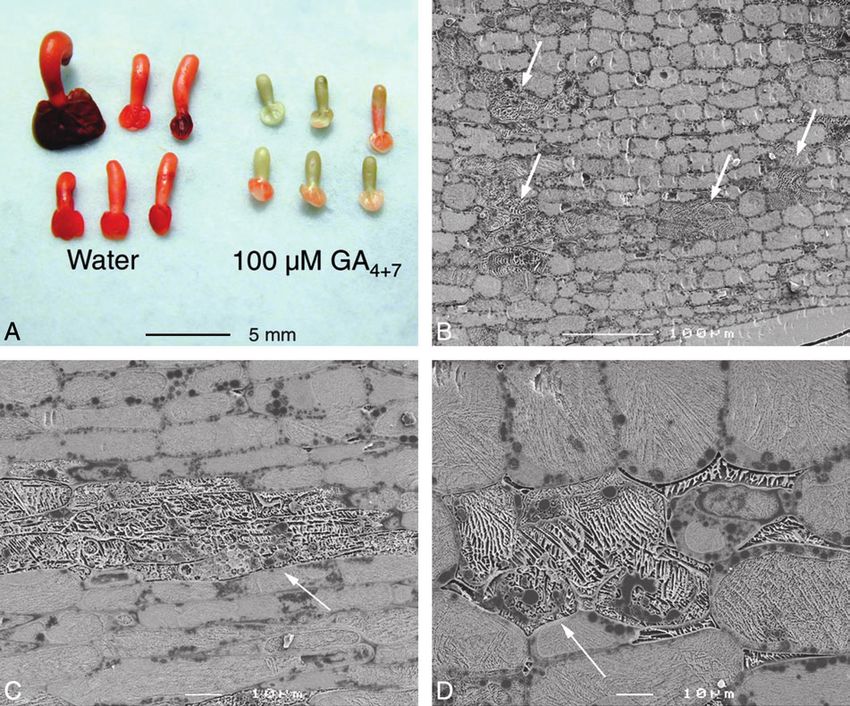
Fig. 10. (A) Tetrazolium-stained coffee embryos from seeds imbibed in water (control) or in 100 lM of GA4+7. After 14 d of imbibition the embryos
were isolated and incubated in 0.1% (w/v) of 2,3,5 triphenyltetrazolium chloride for 16 h. (B, C, D) Scanning electron micrographs of the hypocotyl from
GA4+7-imbibed seeds at increasing magnification. The embryos were isolated from seeds imbibed for 14 d in 100 lM of GA4+7 solutions. Arrows
represent regions with death cells.
added together with GA4+7 although it is not clear whether Cell death is part of a developmental process after
ATP can penetrate unaltered into the embryo cells. Isolated a tissue has fulfilled its role and GAs appear to control
coffee embryos grew normally in a medium containing this process (Fath et al., 2001). In the coffee seed GAs are
10 mM of mannose. In addition, cryo-SEM studies did not required to weaken the endosperm and release nutrients
even show dead or damaged cells in 100 mM of mannose. from storage cells. Bethke et al. (2001) have hypothesized
Thus, phosphate starvation or other possible effects of that hormones regulate cell death in cereal aleurone, which
mannose are unlikely to be the cause of inhibition of radicle is ultimately induced by reactive oxygen species. These
protrusion in coffee seed by supra-optimal GA concentra- results showed that the embryonic axis turned brown in
tions. Also other monosaccharides that are likely to increase 100 lM of GA4+7, an indication of oxidative stress and/or
upon hydrolysis of mannans and galactomannans, includ- the absence of sufficient ‘reducing power’. Thus, what
ing glucose and galactose, had no effect on embryo growth. triggers cell death in the endosperm cap during or after its
These results suggest that supra-optimal GA concentra- degradation may affect the embryo as well, leading to cell
tions release one or more factors from the endosperm that death and, consequently, inhibition of radicle protrusion.
induce cell death in embryonic tissues. It is believed that this In the coffee seed, exogenous GAs speed up germination-
is the cause of inhibition and that it occurs very late during related processes, for example, endosperm cap weakening.
the germination process just prior to radicle protrusion. It is possible that under these conditions normal cell death of
These data show that both embryo growth and endosperm the endosperm occurs too early, with respect to embryo
degradation occur in GA largely as in water-imbibed control growth. The embryo would then be affected by the damag-
seeds. Also the protuberance caused by the growing embryo ing components from the endosperm cells. In other words,
was observed (results not shown). In the presence of too much GA disregulates the synchronization of germin-
GA-biosynthesis inhibitors only the second phase of the ation processes occurring in the embryo and endosperm.
endosperm weakening was inhibited as well as endo-b- As yet, it can only speculated about the ecological
mannanase activity. Thus, it may also be concluded that the relevance of GA-inhibited germination. An argument in
first step of endosperm weakening is independent of the favour of a possible ecological significance of this phenom-
action of GAs. enon is that light inhibits germination of coffee seeds (Valio,Gibberellins inhibit coffee seed germination 1037
1976; Fig. 1). This makes sense in an ecological context Groot SPC, Kieliszewska-Rokicka B, Vermeer E, Karssen CM.
since Coffea arabica is originally classified as a shadow 1988. Gibberellin-induced hydrolysis of endosperm cell walls in
gibberellin-deficient tomato seeds prior to radicle protrusion.
plant (Rena and Maestri, 1986). Light induces GA-
Planta 174, 500–504.
biosynthesis in seeds (Hilhorst and Karssen, 1992; Herold A, Lewis, DH. 1977. Mannose and green plants: occurrence,
Toyomasu et al., 1993). To avoid germination under full physiology and metabolism, and use as tool to study the role of
sunlight coffee seeds may have developed this inhibition orthophosphate. New Phytologist 79, 1–40.
mechanism. Yet, it seems unlikely that, under natural Hilhorst HWM, Karssen CM. 1992. Seed dormancy and ger-
conditions, embryonic cell death occurs as a result of high mination: the role of abscisic acid and gibberellins and the
importance of hormone mutants. Plant Growth Regulation 11,
light intensities. However, at lower levels, factors that 225–238.
contribute to cell death may inhibit cellular processes rather Huxley PA. 1965. Coffee germination test recommendations and
than kill the cells. defective seed types. Proceedings of the International Seed Testing
Association 30, 705–715.
Jacobsen JV, Pressman E, Pyliotis NA. 1976. Gibberellin-induced
separation of cells in isolated endosperm of celery seed. Planta
Acknowledgements 129, 113–122.
Jang JC, Sheen J. 1994. Sugar sensing in higher plants. The Plant
We thank CAPES (Fundac xão e Aperfeicxoamento de Pessoal de Nı́vel Cell 6, 1665–1679.
Superior) for financial support of the studies of EA Amaral da Silva. Karssen CM, Lacxka E. 1986. A revision of the hormone balance
The seed laboratory at Lavras Federal University, MG, Brazil theory of seed dormancy: studies on gibberellin and/or abscisic
(UFLA) is acknowledged for handling and shipping the seeds to acid-deficient mutants of Arabidopsis thaliana. In: Bopp M, ed.
Downloaded from http://jxb.oxfordjournals.org/ by guest on August 4, 2015
The Netherlands. We also thank Ms Katja Grolle of the department Plant growth substances. Berlin: Springer-Verlag, 315–323.
of Food Science for her technical advice with the material tester. Karssen CM, Zagorski S, Kepczynski J, Groot, SPC. 1989. A key
Plant Research International is acknowledged for the use of the role for endogenous gibberellins in the control of seed germination.
psychrometer. Professor W Rademacher of BASF (Germany) is Annuals of Botany 63, 71–80.
acknowledged for his gift of tetcyclacis and Syngenta (Enkhuizen, Katsu N, Kamisaka S. 1981. Effect of gibberellic acid and metabolic
The Netherlands) for the gift of paclobutrazol. inhibitors of DNA and RNA synthesis on hypocotyl elongation
and cell wall loosening in dark-grown lettuce seedlings. Plant and
Cell Physiology 22, 327–331.
Koornneef M, van der Veen JH. 1980. Induction and analysis of
References gibberellin sensitive mutants in Arabidopsis thaliana (L.) Heynh.
Bethke PC, Fath A, Jones RL. 2001. Regulation of viability and cell Theoretical and Applied Genetics 58, 257–263.
death hormones in cereal aleurone. Journal of Plant Physiology Leubner-Metzger G, Frundt C, Meins Jr F. 1996. Effects of
158, 429–438. gibberellins, darkness and osmotica on endosperm rupture and
Bewley JD. 1997. Seed germination and dormancy. The Plant Cell 9, class 1 b-1-3 glucanase induction in tobacco seed germination.
1055–1066. Planta 199, 282–288.
Chen F, Dahal P, Bradford KJ. 2001. Two tomato expansin genes Maestri M, Vieira C. 1961. Nota sobre a reducao da porcentagem de
show divergent expression and localization in embryos during seed germinacao de sementes de café (Coffea arabica L. var. Bourbon.)
development and germination. Plant Physiology 127, 928–936. por efeito do ácido giberélico. Revista Ceres 11, 247–249.
Copeland LO, McDonald MB. 1999. Seed science and technology, Nambara E, Akazawa T, McCourt P. 1991. Effects of the
3rd edn. Norwell, MA: Kluwer Academic Publishers, 111–126. gibberellin biosynthesis inhibitor uniconazol on mutants of Arabi-
Cowling RJ, Harberd PH. 1999. Gibberellins control Arabidopsis dopsis. Plant Physiology 97, 736–738.
hypocotyl growth via regulation of cellular elongation. Journal of Nijsse J, van Aelst AC. 1999. Cryo-planing for cryo-scanning
Experimental Botany 50, 1351–1357. electron microscopy. Scanning 21, 372–378.
Da Silva EAA. 2002. Coffee (Coffea arabica cv. Rubi) seed Rademacher W. 2000. Growth retardants: effects on gibberellin
germination: mechanism and regulation. PhD thesis, Wageningen biosynthesis and other metabolic pathways. Annual Review of
University, The Netherlands, 20–40. Plant Physiology and Plant Molecular Biology 51, 501–531.
Debeaujon I, Koornneef M. 2000. Gibberellin requirement for Rena AB, Maestri M. 1986. Fisiologia do cafeeiro. In: Rena AB,
Arabidopsis seed germination is determined both by testa charac- Malavolta E, Rocha M, Yamada T, eds. Cultura do cafeeiro—
teristics and embryonic abscisic acid. Plant Physiology 122, fatores que afetam a produtividade. Piracicaba, Brasil: Potafos,
415–424. 13–66.
Dias MCL, Silva WR. 1986. Determinacao da viabilidade de Sánchez RA, de Miguel L. 1997. Phytochrome promotion of
sementes de café através do teste de tetrazólio. Pesquisa Agro- mannan-degrading enzyme activities in the micropylar endosperm
pecuária Brasileira 21, 1139–1145. of Datura ferox seeds requires the presence of the embryo and
Downie B, Hilhorst HWM, Bewley JD. 1994. A new assay for gibberellin synthesis. Seed Science Research 7, 27–33.
quantifying endo-b-mannanase activity using Congo red dye. Stein JC, Hansen G. 1999. Mannose induces an endonuclease
Phytochemistry 36, 829–835. responsible for DNA laddering in plant cells. Plant Physiology
Fath A, Bethke PC, Jones RL. 2001. Enzymes that scavenge 121, 71–79.
reactive oxygen species are down-regulated prior to gibberellic Takaki M, Dietrich SMC. 1979. Effect of gibberellic acid on
acid-induced programmed cell death in barley aleurone. Plant peroxidase from coffee seeds during germination. Hoennea 8,
Physiology 126, 156–166. 29–33.
Groot SPC, Karssen CM. 1987. Gibberellins regulate seed ger- Takaki M, Dietrich SMC. 1980. Effect of GA3 and light on
mination in tomato by endosperm weakening: a study with polysaccharide levels and metabolism in germinating cofee seeds.
gibberellin-deficient mutants. Planta 171, 525–531. Journal of Experimental Botany 31, 1643–1649.1038 da Silva et al.
Takaki M, Dietrich SMC, Furtado JS. 1979. Anatomical changes Valio, IFM. 1976. Germination of coffee seeds (Coffea arabica L.
in the hard endosperm of gibberellic acid-treated coffee seeds cv. Mundo Novo). Journal of Experimental Botany 27, 983–991.
during germination. Revista Brasileira de Botanica 2, 103–106. Watkins JT, Cantliffe DJ. 1983. Mechanical resistance of the seed
Toorop PE, van Aelst AC, Hilhorst HWM. 2000. The second step coat and endosperm during germination of Capsicum annuum at
of the biphasic endosperm cap weakening that mediates tomato low temperature. Plant Physiology 72, 146–150.
(Lycopersicon esculentum) seed germination is under control of Watkins JT, Cantliffe JD, Huber DJ, Nell TA. 1985. Gibberellic
ABA. Journal of Experimental Botany 51, 1371–1379. acid stimulated degradation of endosperm in pepper. Journal of the
Toyomasu T, Tsuji H, Yamane H, Nakayama M, Yamaguchi I, American Society of Horticulture 110, 61–65.
Murofushi N, Takahashi N, Inoue Y. 1993. Light effects on Wolfrom ML, Laver ML, Patin DL. 1961. Carbohydrates of coffee
endogenous levels of gibberellins in photoblastic lettuce seeds. bean. II. Isolation and characterization of a mannan. Journal of
Journal of Plant Growth Regulation 12, 85–90. Organic Chemistry 26, 4533–4536.
Downloaded from http://jxb.oxfordjournals.org/ by guest on August 4, 2015You can also read


