A Gender Approach to Equitable Health: Perspectives during a Pandemic - Notes from the webinar - KHPT
←
→
Page content transcription
If your browser does not render page correctly, please read the page content below
A Gender Approach to
Equitable Health: Perspectives
during a Pandemic
Notes from the webinar
Introduction

International Women’s Day (IWD) is celebrated                          Perspectives during a pandemic’ on March 5, with an
globally to recognize the social, economic, cultural and               aim to provide a platform for women to share their
political achievements of women. The day also marks a                  experiences, successes and the obstacles that dwarf
call to action for the acceleration of gender parity. The              women’s ability to access health services in the context
campaign theme for International Women’s Day 2021 is                   of the pandemic, especially with respect to tuberculosis
“Women in Leadership: Achieving an equal future in a                   (TB). The round table also aimed to urge discussion
COVID-19 world”.                                                       on the necessity of employing a gender lens, especially
                                                                       when assessing and responding to a crisis such as
The difficulties women face in terms of health, socio-                 that presented by COVID-19. The discussion also
economic conditions and security have been further                     intended to unpack pressing issues such as women’s
exacerbated due to the current COVID-19 pandemic.                      apathy towards seeking medical assistance for TB and
Not only is the health of women in peril owing to the                  COVID-19 in comparison to their male counterparts.
pandemic, but also severe constraints within the health                The speakers’ expertise was sought on what can be
systems due to broken supply chains, poor allocation                   done to address these obstacles, the need to address
of resources and lack of prioritised approaches to                     the causes of women’s mortality and morbidity by
bridge gaps in terms of reproductive and other women                   strengthening health systems, and allowing for greater
centred health services further negatively impacts                     access to cost-effective services and treatments to
women’s health. KHPT organised a virtual round table                   women, while ensuring accountability and improving
discussion titled ‘A gender approach to equitable health:              the overall quality of care.

  The round table was comprised of expert resource persons with varied work experience in public
                       health, women’s issues and rights, TB and allied fields.

                                                                    The speakers included
                                                                    • Dr Sangita Patel, Director, Health Office, United States
                                                                       Agency for International Development
                                                                    • Dr Nishant Kumar, Deputy Director, Central TB
                                                                       Division, Ministry of Health and Family Welfare,
                                                                       Government of India
                                                                    • Mr. Mohan HL, CEO, KHPT
                                                                    • Ms. Pallavi Prasad, Senior Journalist
                                                                    • Ms. Blessina Kumar, CEO, Global Coalition of
                                                                       TB Activists
                                                                    • Dr. Dalbir Singh, President, Global Coalition
Top, left to right: Mr. Mohan HL, CEO, KHPT; Dr. Dalbir Singh,         Against TB
President, Global Coalition Against TB
                                                                    • Dr. Avni Amin, Technical Officer, Department of
Bottom, left to right: Dr Maithreyi R, Strategic Lead, Adolescent      Reproductive Health and Research on Violence Against
Health, KHPT; Ms. Pallavi Prasad, Senior Journalist
                                                                       Women, WHO, Geneva

Dr Maithreyi R, Strategic Lead, Adolescent Health, KHPT moderated the discussion. Mr. Mohan HL and Ms.
Sangita Patel delivered the key note address.

The speakers underscored the importance of gender-sensitivity in responding to and determining the health needs
of the marginalised women in particular.

The following are key highlights from the webinar, the recording of which can be accessed here.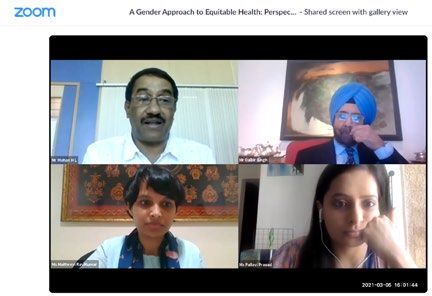
Challenges to women accessing healthcare

Challenges at the community level:                         Systemic challenges to health:
•   Studies have indicated that women comprise a large     •   Across every sphere, from health to the economy,
    proportion of vulnerable populations in terms of           security to social protection, the impact of
    access to health. Gender is a significant influencer       COVID-19 is exacerbated for women and girls.
    of the epidemiology, risk factors, probability of          COVID-19 has amplified gender inequality,
    diagnosis, access to healthcare, treatment adherence       threatening to relegate women to their gendered
    and overall impact of TB on communities.                   roles as caregivers.

•   The nationwide lockdown due to COVID-19, which         •   Limited access, lower index of suspicion of TB for
    has left many facing job losses and uncertainty over       women and the provision of inadequate information
    salaries. Forced isolation and stressed households         to care-seekers also significantly affects the access to
    has resulted in a steep rise in violence against           services. In many areas the primary health facilities
    women. Women with no financial security and                were converted into COVID centres. The private
    the ones who are dependent on their partners for           practitioners had also stopped their consultations
    support are subject to more abuse.                         with the fear of COVID, preventing potential
                                                               TB diagnoses.
•   Mr. Mohan HL said the responsibility of care for
    family members rests largely on women and this         •   In India, nurses and midwives constitute a majority
    causes them to neglect their health. COVID-19              of the female health workforce which provides
    has further compounded the situation, resulting            palliative care to the sick and infirm and emergency
    in greater distress, violence, and lack of access to       and first aid services. Accredited Social Health
    redressal services which have in turn affected the         Activists (ASHAs)are also at the frontline of the
    overall wellbeing of women.                                COVID-19 pandemic, tasked with educating
                                                               people at the grassroots level about the disease.
•   Gender differences and inequalities play a                 However, this workforce has not been provided
    significant role in determining how people of all          for adequately, resulting in poor fund allocation,
    genders access and receive healthcare in the public        inadequate training, and a denial of fair pay,
    and private sectors. Dr. Sangita Patel said that           according to Dr. Dalbir Singh.
    although more men are affected by TB, women
    and transgender persons experience the disease
    differently through their own unique, gendered
    challenges such as stigma and social repercussions.
    Women are especially constrained by social norms
    which prevent the prioritizing of their nutrition,
    health and wellbeing.

•   Stigma is not only a barrier to access, but also to
    function. It stunts women both physically and
    emotionally, said Ms. Blessina Kumar.

Recommendations:
•   There is a need for a gender responsive health         •   Stigma attached to TB must not be condoned.
    programme with different norms for men, women              Support groups must be set up for those who are
    and transgenders, and a need for gender based              affected by stigma due to TB.
    budgeting and planning.
• There should be provisions for a safe non- • Strong legislation, and strong frameworks must be
judgemental space for women in both public and formulated with a view towards better administration
private health care systems. Private and public of health systems and to foster accountability and
facilities must work together to address issues sensitivity towards infectious diseases.
of gender disparities to address health services.
Recruitment of personnel within the health system • Campaigns for increasing gender sensitivity and
must be done in a gender sensitive manner ensuring diversification in representation of transgenders
adequate representation of women. and people living with HIV must be organised.
Boys and girls must be trained both separately
• There is a need to work towards changing gender and together on violence and be empowered to
attitudes of service providers to prevent disrespect work with parents and communities to develop a
and misbehaviour towards the vulnerable sections. nonviolent attitude towards women and sexual
The medical, nursing and midwifery curriculum minority communities.
must be designed in a manner which in turn brings
about a change in the attitude of practitioners. • The media must be trained to sensitively and
accurately report on TB and infectious diseases, and
• Clinical packages must be offered to address mental to raise concerns around inadequate legislations.
health apart from physical injuries. Psychological
first aid must be offered to victims who disclose • Human rights and equity challenges must be
incidents of violence. addressed by equipping caregivers and health care
providers with adequate resources so they could
• Cadres of frontline workers must be paid adequate help their community.
in order to provide effective health care services.
“
Quotes from the speakers
Stigma unites women globally, as the experiences of stigma Girls also internalise the unequal social norms, so working
and discrimination and solutions for the same are not very together with girls and boys is very important. Dr. Avni
different across the globe. Ms. Blessina Kumar, CEO, Amin, Technical Officer, Department of Reproductive
Global Coalition of TB Activists Health and Research on Violence Against Women,
WHO, Geneva
COVID-19 is not only a challenge for global health systems,
but also a test of our human spirit. Recovery must lead to a We need to realize that the system was not favourable for
more equal world that is more resilient to future crises. women or women TB patients even prior to the pandemic.
Dr. Dalbir Singh, President, Global Coalition Against TB
Women’s health is never prioritised and is always neglected.
COVID-19 has only augmented their vulnerability.
Mr. Mohan HL, CEO, KHPT
Providing mental health support and especially psychological
first aid to all survivors of gender based violence is the
Any gender sensitive plan needs to include some form of
Ms. Pallavi Prasad, Senior Journalist
The role of women evolving across domains with changing
“
monetary aid to be given to those who are doubly affected by
a crisis like COVID-19.
roles and norms of all gender, hence a gender responsive
health care system is the need of the hour be it private or
minimum standard of care. Dr. Avni Amin, Technical public. Dr. Nishant Kumar Deputy Director, Central
Officer, Department of Reproductive Health and TB Division, Ministry of Health and Family Welfare,
Research on Violence Against Women, WHO, Geneva. Government of India
Disclaimer: This report is made possible by the generous support of the American people through the United
States Agency for International Development (USAID). The contents are the responsibility of KHPT and do not
necessarily reflect the views of USAID or the United States Government.
KHPT
IT Park, 5th Floor, T: +91 80 40400200 For more information, please contact Shramana Majumder,
No.1-4, Rajajinagar Industrial Area, F: +91 80 40400300
Behind KSSIDC Administrative Office,
Communications Specialist, Breaking the Barriers project at
E: khptblr@khpt.org
Rajajinagar, Bengaluru - 460044 W: www.khpt.org shramana.majumder@khpt.org
© KHPT, March 2021You can also read


