Contract cheating: an increasing challenge for global academic community arising from COVID-19 - Research and Practice in Technology ...
←
→
Page content transcription
If your browser does not render page correctly, please read the page content below
Hill et al. Research and Practice in Technology Enhanced Learning
      (2021) 16:24
https://doi.org/10.1186/s41039-021-00166-8

 RESEARCH                                                                                                                                         Open Access

Contract cheating: an increasing challenge
for global academic community arising
from COVID-19
Guzyal Hill1* , Jon Mason2 and Alex Dunn3

* Correspondence: guzyal.hill@cdu.
edu.au                                     Abstract
1
 Asia Pacific College of Business and
Law, Charles Darwin University,            Due to COVID-19, universities with limited expertise with the digital environment
Australia                                  had to rapidly transition to online teaching and assessment. This transition did not
Full list of author information is         create a new problem but has offered more opportunities for contract cheating and
available at the end of the article
                                           diversified the types of such services. While universities and lecturers were adjusting
                                           to the new teaching styles and developing new assessment methods, opportunistic
                                           contract cheating providers have been offering $50 COVID-19 discounts and
                                           students securing the services of commercial online tutors to take their online exams
                                           or to take advantage of real-time assistance from ‘pros’ while sitting examinations.
                                           The article contributes to the discourse on contract cheating by reporting on an
                                           investigation of the scope and scale of the growing problems related to academic
                                           integrity exacerbated by an urgent transition to online assessments during the
                                           COVID-19 pandemic. The dark reality is the illegal services are developing at a faster
                                           pace than the systems required to curb them, as demonstrated by the results. The
                                           all-penetrating issues indicate systemic failures on a global scale that cannot be
                                           addressed by an individual academic or university acting alone. Multi-level solutions
                                           including academics, universities and the global community are essential. Future
                                           research must focus on developing a model of collaboration to address this problem
                                           on several levels, taking into account (1) individual academics, (2) universities, (3)
                                           countries and (4) international communities.
                                           Keywords: Ghost-writing, Ghost-studying, COVID-19, Contract cheating, Online
                                           exams, Academic integrity, Global community

                                         Introduction
                                         Plagiarism has existed for millennia, as has ghost-writing—one being a misdemeanour,
                                         the other a service (Dougherty, 2020). Over 2500 years ago, even the threat of the
                                         death penalty did not stop examinees cheating in the Chinese Keju examinations, with
                                         records revealing cheating behaviours such as the use of impersonators, bribery and
                                         elaborate cheat notes (Suen & Yu, 2006). Universities and academics worldwide have
                                         had to find solutions to plagiarism and are familiar with the existence of ghost-writing
                                         services for assessments. The problem has become so significant that the term ‘con-
                                         tract cheating’ has superseded ‘ghost-writing’ in the global university sector where the
                                        © The Author(s). 2021, corrected publication 2021. Open Access This article is licensed under a Creative Commons Attribution 4.0
                                        International License, which permits use, sharing, adaptation, distribution and reproduction in any medium or format, as long as you
                                        give appropriate credit to the original author(s) and the source, provide a link to the Creative Commons licence, and indicate if
                                        changes were made. The images or other third party material in this article are included in the article's Creative Commons licence,
                                        unless indicated otherwise in a credit line to the material. If material is not included in the article's Creative Commons licence and
                                        your intended use is not permitted by statutory regulation or exceeds the permitted use, you will need to obtain permission directly
                                        from the copyright holder. To view a copy of this licence, visit http://creativecommons.org/licenses/by/4.0/.
Hill et al. Research and Practice in Technology Enhanced Learning (2021) 16:24 Page 2 of 20
problem is increasingly recognised as a formidable challenge to the preservation of aca-
demic integrity (Lancaster, 2019; Walker et al. 2012).
Existing trends in consumer attitudes towards education, internationalisation and
gaps in plagiarism software capabilities created an environment ripe for cheating when,
due to COVID-19, universities with limited expertise with the digital environment
had to rapidly transition to online teaching. This transition did not create a new
problem but has offered more opportunities for contract cheating, diversified the
types of such services offered and allowed for increased commercial contract cheat-
ing. While universities and lecturers were adjusting to the new teaching style, op-
portunistic contract cheating providers have been offering $50 COVID-19
discounts and students securing the services of commercial online tutors to take
their online exams, or to take advantage of real-time assistance from ‘pros’ while
sitting examinations.
The term contract cheating is used in this article to refer to a situation in which stu-
dents can have their assignments and/or their exams commercially ghost-written due
to an unprecedented move to online teaching formats; however, it is acknowledged that
contract cheating may take many forms, and it does not always require money to be ex-
changed. It would be challenging, if not impossible, to identify how many students have
used or are making use of these services, although Newton (2018) used 65 studies dat-
ing back to 1978 to identify a rise from a 3.52% historical average of cheating students
to 15.7% post-2014, suggesting that such services may be having a significant effect on
cheating behaviours.
Plagiarism software does not necessarily capture all occasions of plagiarism and may
sometimes produce misleading results (Eaton et al., 2020; Walker, 2010). Forensic lin-
guistic software offers opportunities to detect authorial anomalies; however, it is still
being developed and cannot be regarded as infallible (Conlan et al., 2016; Daubner et
al., 2020). Online examinations provide another avenue for contract cheating, and the
literature suggests that students will cheat during online examinations if given the op-
portunity (King et al., 2009; Mata, 2020).
While invigilated in-person exams have historically been considered the only
form of assessment wherein the identity of a student can be completely confirmed,
the emerging service of online invigilated examinations has ameliorated these con-
cerns somewhat, but such services are expensive and not without criticism, e.g.,
privacy concerns (Stewart, 2020; Zhou, 2020). As such, perhaps academics and uni-
versities should be less naive about academic integrity in COVID-19-affected teach-
ing and beyond, particularly in light of empirical findings that academics frequently
pass ghost-written assignments under the impression they were written by students
(Lines, 2016).
Being less naive, however, comes at a cost and can place academics and universities
in a precarious position. If the problem is discussed openly, evidence proving the fact
an assignment has been ghost-written must be used, and action must be taken to
penalise the students responsible. If such action is taken, it must be supported by
the university, government and international community. Ensuring cooperation at
such a large scale is challenging. Conversely, the price for not acting is higher and
includes the erosion of academic integrity and the possibility that graduates will
transfer their cheating tendencies to their workplaces. That is, the heightenedHill et al. Research and Practice in Technology Enhanced Learning (2021) 16:24 Page 3 of 20
development of contract cheating services and the rapid transfer to online exami-
nations has broad implications for academic practice and institutional responses
such as policy and procedures in universities internationally. To probe these issues
more deeply, a literature review was conducted in which several key themes
emerged. This was followed by a form of action research conducted in Australia,
in which one of the authors assumed the role of a student seeking ways to cheat
on assignment work.
Literature review
Trends: consumerism, internationalisation and gaps in plagiarism detection software
Education must be considered holistically in appreciating the contemporary context,
which is often characterised by affordances of the digital environment; moreover, to en-
sure good governance and sustainability, the wider economic, social and technological
dimensions surrounding academic integrity and misconduct must be taken into ac-
count (Goedegebuure & Davis, 2017). Prominent trends relevant for this research are
consumer attitudes in higher education (economic), internationalisation (social) and
the limitations of plagiarism-detecting software (technology). The trend of higher edu-
cation accommodating a mass market (hence, consumer models) has been problematic,
with higher consumer orientation being found to be associated with lower academic
performance (Bunce et al., 2017). Universities are working on the bases of marketisa-
tion, competition, customer satisfaction and other consumer-oriented principles (Les-
nik-Oberstein, 2015), and students are demanding customer ‘value’ from the
universities (Woodall et al., 2014). In this way, education becomes viewed as a com-
modity (Gutting, 2015; Rawlings, 2015) rather than something earned through intellec-
tual labour and through a process of improving skills in academic writing, critical
thinking and communication.
Internationalisation also contributes to undesired consequences. International stu-
dents ‘have less social, and particularly academic, support than their domestic
peers’ (Grayson, 2008). Additionally, international students often lack study skills
and English language fluency and experience cultural pressures to succeed, as well
as the difficulties of living in a different culture for the first time (Simpson, 2016).
This exposes them to stress and makes the option of ‘buying’ an assignment more
attractive. Indeed, the issue with commercialisation of degrees in which students
are, to some extent, also consumers (Bunce et al., 2017) is the fact that universities
come to rely on income from international students, facilitating the development
of unforeseen and unintended consequences. Universities must also be productive
contributors to the economy, but significant improvements must be made before
this can occur in an effective and efficient manner (Goedegebuure & Marshman,
2017). This is a dangerous situation wherein corruption is arguably becoming en-
demic, and long-held expectations of academic integrity are at serious risk of cor-
rosion. Denisova-Schmidt (2017) highlighted that universities have an important
function of socialisation—if students use commercial contract cheating services
during their university study, they have the potential to transfer unethical or cor-
rupt practices to workplaces and other areas of life where intellectual labour and
skill are required and valued.Hill et al. Research and Practice in Technology Enhanced Learning (2021) 16:24 Page 4 of 20
Plagiarism and contract cheating
Plagiarism is usually defined within individual university academic misconduct policies.
Generally, plagiarism occurs when the work of another is presented without acknow-
ledgement. It often includes perhaps unintentional incorrect paraphrasing in more be-
nign occurrences with intentional fraud in more malicious cases (Hexham, 2005). That
is, it is ‘literary theft’ or ‘literary crime’ (Marsh, 2012). Self-plagiarism, or recycling of
previously submitted work, is another area in which students might either intentionally
or unintentionally breach misconduct rules. In legal terms, plagiarism may include
fraud, forgery, false statements, conspiracy to defraud, proceeds of crime, breach of in-
tellectual property laws and in some cases specific statutory offences (Feng, 1999; Lin-
lin, 2011; Steel, 2017).
Universities use software systems such as Turnitin, SafeAssign, SNITCH, Cross-
Check, AntiPlag and other related software to detect plagiarism, and these systems are
constantly improving (Pàmieset al., 2020; Bolkan, 2006; Jiffriya et al., 2013; Niezgoda &
Way, 2006; Walker, 2010; Zhang, 2010). However, currently, there is no fully reliable
tool with which to detect all cases of plagiarism and contract cheating, and some re-
searchers have developed systems to defeat plagiarism detection (Devore-McDonald &
Berger, 2020). Existing systems have gaps that are being addressed but are not resolved
at this stage (Bin-Habtoor & Zaher, 2012). Moreover, while promising developments
have been made in forensic linguistics to ensure that academic integrity is enforced on
a deeper level and breaches of academic misconduct are punished when required
(Coulthard, Johnson, & Wright, 2016; Edwards et al., 2019; Peytcheva-Forsyth, Mellar,
& Aleksieva, 2019; Sousa-Silva, 2020), technology is not being developed and imple-
mented fast enough to curb all plagiarism practices, in particular, the bespoke commis-
sioning of assessment tasks by non-students. As such, with or without the assistance of
software, contract cheating remains a threat that must be considered by academics
worldwide.
Ghost-writing practices are not new to academia. As early as 1960, ghost-writers were
reproached for writing speeches (Bormann, 1961). In 2008, ghost-writing by researchers
was litigated against (Ross et al., 2008). Academics and universities are aware of
the existence of commercial contract cheating services for domestic and inter-
national students (Lines, 2016; Zheng & Cheng, 2015). The most notorious website,
MyMaster, is renowned for causing an international scandal (McNeilage & Visen-
tin, 2014; Visentin, 2015); some students who used it were expelled or suspended
(McNeilage & Visentin, 2014). The website is no longer operational, but many
other websites offer the same or similar services; many of which are owned by the
same illegal enterprises but presented through different shopfronts (Ellis et al.,
2018). Indeed, the business models of contract cheating individuals are becoming
increasingly sophisticated, now extending from self-employed freelancers through
to the sale of off-the-shelf web applications that incorporate all aspects of a con-
tract cheating business (Ellis et al., 2018).
The term contract cheating is used in this article to refer to a situation in which stu-
dents can have their assignments commercially ghost-written due to an unprecedented
move to online teaching formats and the emergence of commercial ghost exam-taking
services, though the term may also be applied to non-financial transactions (Lancaster
& Clarke, 2008; Mahmood, 2009). The problem of contract cheating is often framed asHill et al. Research and Practice in Technology Enhanced Learning (2021) 16:24 Page 5 of 20
a systemic failure as well as a corruption of student integrity standards (Chapman &
Lindner, 2016; Daniel, 2016; Denisova-Schmidt, 2017; Kaktiņš, 2018). Further, Chap-
man considered the problem an international concern for governments, educators, stu-
dents and other stakeholders (Chapman & Lindner, 2016).
While any form of plagiarism corrupts the academic system, contract cheating is par-
ticularly pernicious; in addition to breaching intellectual property laws and committing
literary theft, the students involved undertake another, illegal form of organised com-
mercial activity wherein someone assumes another’s identity, which amounts to com-
mitting fraud. Worryingly, the scale and sophistication of contract cheating practices
are growing (Lancaster & Clarke, 2016). This is particularly concerning since students
around the world admit to cheating with, for instance, 46% of students in Latvia admit-
ting to purchasing a term paper (Danovskis, 2012).
Impact of COVID-19 on assessments
On 11 March 2020, the World Health Organization Director-General declared
COVID-19 a pandemic. A few weeks later, the Australian government introduced
measures to limit its citizens’ exposure to the virus. All Australian citizens and
permanent residents were prohibited from travelling outside Australia unless
granted an exemption. Similar measures were implemented by countries across the
globe. Universities in Australia and worldwide also had to appropriately manage
the risks posed by the pandemic (Bao, 2020; Crawford et al., 2020; Khan & Jawaid,
2020; Wang et al., 2020). Most universities had no alternative but to transfer to
online teaching, with the associated decision to conduct exams online. Notably,
exams are currently the only form of assessment invigilated in person. Invigilation
ensures that students’ identities are checked and that someone else is not taking
an exam under a different ID. While there is some potential for corruption and
fraud if twins or students who look alike take an exam under different IDs, the
chance of this occurring on a mass scale is negligible.
One response to the COVID-19 pandemic has been for universities to employ
commercial third-party online assessment services to invigilate, or proctor, exami-
nations. These services may use humans, artificial intelligence and other digitally
based tools to monitor students undergoing examination. One poll conducted in
the wake of the pandemic suggested that 54% of the institutions polled used
some level of online proctoring, with another 23% considering using such a ser-
vice (Grajek, 2020). Based on reports, only 24 out of 47 Australian institutions
used proctoring (Sankey, 2020). It must be recognised that, according to the
above figures at least, a not inconsequential 46% of institutions are yet to use
proctoring.
While these services provide many security measures unavailable to in-person in-
vigilators, such as the use of biometric data and eye movement and keystroke
tracking, they do so at significant cost to the institutions who use them—both fi-
nancially and in terms of risks associated with breaching data protection and priv-
acy legislation, not to mention the good will that might be lost with students who
may feel the surveillance is so intrusive it breaches their basic rights (Grajek, 2020;
Stewart, 2020; Zhou, 2020).Hill et al. Research and Practice in Technology Enhanced Learning (2021) 16:24 Page 6 of 20
Methods
To further investigate the findings from the literature, this study adopted a form of ac-
tion research in which one of the authors assumed the role of a student and sought
web-based services for cheating on assignment work. This made use of the online re-
search method (ORM) and exploratory content analysis to identify the scope of con-
tract cheating services available to students. In reporting on this, a secondary or
consequent aim of the study is to alert lecturers and universities to the diversification
and prominence of this dangerous practice.
The ORM operated at a basic level, using Google and Google Scholar as the primary
search tools as they are widely available to students and lecturers (Granello & Wheaton,
2004). Advertised sites that typically appear in responses to queries were not considered
because these depend on the budget of the organisations that advertise the services. Goo-
gle, as a company, is using the ranking system calibrated by algorithms to bring most up-
to-date and relevant results on the first page of the search page (Google, 2021).
Search queries were conducted for two generic terms ‘assignment help’ and ‘exam
help’. The top five results were identified and analysed using exploratory content ana-
lysis methods in two points of time: mid-2020 (when pandemic was first declared and
assignments or exams were due) and early 2021 (once the universities and students had
time to adjust to new normal). The exploratory content analysis aspect allowed flexibil-
ity to include the necessary results (Elo & Kyngäs, 2008). The results of the websites
were analysed using theme-based approach. The developed themes are presented in
the ‘Results: COVID-19—from ghost-writing to ghost-studying’ section. These
methods have been previously applied to research issues relating to ethics in man-
agement (Bell & Bryman, 2007) and academic dishonesty policy (Prenshaw et al.,
2001); in this case, they were adapted to examine academic integrity and the ethics
of student practices.
In probing this issue from a potential student perspective, one of the authors chose
to go ‘undercover’ to discover firsthand the scale of available services and the processes
involved in making use of them. ‘Undercover’ is used here in the sense of a lecturer
posing as a student who needs ‘help’ with the assessment.
The limitation of this method is that the websites that can be found on Google are
not the only providers of contract cheating services. As reported, contract cheating
through a particular site-sharing website, Chegg, has increased by 196.25% during the
pandemic (Lancaster & Cotarlan, 2021). This limitation, again, points to the scale of
the problem because the providers of contract cheating services can be found offline, in
file-sharing websites, through social media and websites offering gigs, such as Fiverr
and essay mills—to name several other alternatives.
Results
COVID-19—from ghost-writing to ghost-studying
Commercial assignment ghost-writing: going undercover
The following text is an account of one of the co-authors:
As a lecturer, I used to have idealistic views of studying and education; it took sev-
eral years to bring myself to investigate the services that are available to students.Hill et al. Research and Practice in Technology Enhanced Learning (2021) 16:24 Page 7 of 20
However, as unsavoury as the practice of buying assignments is, I believe that lec-
turers must at least be aware of it. So, in May 2020, after five years of teaching, I de-
cided to go undercover to discover what options students can avail themselves of in
terms of ordering assignments, and what barriers are in place in the same regard.
I faced an ethical dilemma in terms of whether to include in this article the
names of the websites I found, since it would compile them in one location
that students might find, and might serve as ‘advertising’ for unsavoury and, at
times, illegal activity. However, the websites included in this article are the top
responses to a basic Google search and students willing to order ghost-writing
services will have no difficulty finding them online. Further, contract cheating
businesses often use aggressive marketing tactics to reach students (Bre-
tag, 2017). Lecturers and universities, however, are less likely to search for
these services and might be unaware of this academic black market that is also
available through social media.
A Google search for the term ‘assignment help’ returned 279,000,000 results in 2020
and 302,000,000 in 2021. The following commercial contract cheating websites appear
on the first page in the following order (based on a search conducted in mid-June 2020
and early 2021 from Australia):
1. https://myassignmenthelp.com/. My Assignment Help is rated 4.9/5, based on
14,001 reviews, and has an instant chat function. The sample assignments are
grouped by university (e.g. Charles Sturt, Victoria University). A $20 instant
cashback offer was made, and a quote for services depended on the word count
and deadline. There is a loyalty programme, a chance to win $2000 and a $2
reward for providing feedback. My user number was 419,705, so presuming this
represents the number of users it suggests almost half a million students worldwide
have used or are using the service. The website was established in 2007. It ranks as
the first website Google search results in both 2020 and 2021.
2. https://assignmenthelp4me.com/. Assignmenthelp4me is described as delivering
high-quality assignment solutions, facilitated by their ‘substantial work ethics’ and
supported by their global team of 5000 writers and 26,000 academic assignment
helpers. Assignmenthelp4me claims to help students in Australia, Canada, India,
New Zealand, the United Kingdom (UK) and the US. This ranks as the second
website in Google search results 2020 and in 2021.
3. https://www.myassignmentservices.com/. My Assignment Services, at the time of
searching, offered a $50 COVID-19 discount and a 15% discount during World En-
vironment Week, with an accompanying ‘save the planet’ slogan. Furthermore, if
students order in bulk, they receive a 50% discount. The website boasts the follow-
ing: ‘Quality Work: We never compromise on quality. Affordable Pricing: We
understand the stringent budget of a student. Plagiarism-Free: Plagiarism is a big
NO when it comes to academic writing. Time-Saving: Submitting assignments after
the submission time can attract a penalty.’ There is also a high distinction grade
guarantee, or the client will reportedly receive their money back. The website
claims to have been operating since 2010. My Assignment Services lists prominent
Australian universities and includes information regarding assignment writing forHill et al. Research and Practice in Technology Enhanced Learning (2021) 16:24 Page 8 of 20
particular universities. For example, about Monash University, the website states: ‘if
you are seeking the best assignment writing services in Monash at reasonable
prices, there is no better place than My Assignment Services. Just log on … to get
in touch with us now’. According to a quote provided on the website, a 2000-word
essay for an Introduction to Business Law unit costs AU$154.08 or AU$138.67
with the COVID-19 discount, due to service charges. An additional discount was
received when we did not engage through email, further lowering the price to
AU$130.97. Notably, the misleading advertising regarding the $50 discount did not
translate into reality, highlighting the vulnerabilities that students are exposing
themselves to by using these services. This ranks as the third website in Google
search results in 2020 and 2021.
(a) In 2021 https://www.instantassignmenthelp.com.au/ comes third on the page
with 50% COVID-19 discount still offered. The ‘speedy delivery’ and 24/7 sup-
port is emphasised. Logos of major universities are displayed on the first page
to add credibility, and plagiarism report is offered for additional fee.
4. https://www.thanksforthehelp.com/. Thanks for the Help offers $100 instant
credit. The assignments written through this service have a no-plagiarism guar-
antee: ‘every assignment … under our Assignment Help service goes through
Turnitin that ensures that no assignment is plagiarised.’ In addition, the service
is diversifying to online exams: ‘ever stuck in a situation where an assignment
is due in 6 hours and there is no one to help you? If yes, then use [our ser-
vices].’ The services are offered for the following countries: the US, Australia,
the UK, the United Arab Emirates, Canada, Malaysia, Singapore and Ireland.
This ranks as the fourth result on Google search results in 2020 and fifth in
2021.
5. https://www.allassignmenthelp.com/. AllAssignmentHelp claims to be the
world’s number one assignment help service. In answer to the frequently asked
question of whether professors will discover students’ use of the service, the
website claims: ‘as long as you stick to our fair use policy, you should not
worry about anything. We provide 100% unique assignment solutions; hence,
they will not flag in your college.’ The site has a 4.92/5 rating, and nine out of
10 students claim that AllAssignmentHelp assists them to achieve better
grades. Testimonials on the website include, ‘I was panicking about my
Medical homework that was due … Eventually, I came across
allassignmenthelp.com … Within a day I got my work. Moreover, I received a
cashback from them. They are truly the saviours, kudos to the experts’ and ‘so
far I have found allassignmenthelp.com are very professional. Their customer
support is active and available 24/7. Within a day I got my Civil engineering
assignment. I keep coming back to them only due to this quality.’ This ranks
sixth on Google search results in 2020 and fourth in 2021.
We followed up and examined the first five results in detail. All websites were
easy to use, convincing with state-of-the-art marketing and website design tools,
with the exception of Assignmenthelp4me. The websites had mobile contact num-
bers, WhatsApp assistance and persistent online chat options. Before undertaking
this research, we were under the impression that assignment ghost-writing was notHill et al. Research and Practice in Technology Enhanced Learning (2021) 16:24 Page 9 of 20
so widespread and such a mainstream service; however, we now understand that
such services are readily available. The websites also used referrals, discounts,
gamification, artificial intelligence and other functions that universities, in some
cases, are only beginning to introduce. Further, we used to think it would be diffi-
cult for students to use these services. However, to the contrary, the service pro-
viders removed all possible friction points. They were approachable, user-friendly,
included discounts and testimonials and were eager to disburse any doubts regard-
ing the legitimacy and quality of their services.
In addition to the more ‘professional’ contract cheating services that link numer-
ous clients with numerous ghost-writers, individual ghost-writers and their clients
also use freelance marketplace platforms such as Fiverr.com to engage in one-to-
one contract cheating transactions. In a study of this platform in regard to ghost-
writing services, it was found that ‘96 providers have generated around US$270,000
of essay writing business between them’ (Lancaster, 2019). Now, more than ever, it
is easier to link customers with service providers on a global basis and the contract
cheating business is no exception as it includes numerous providers and market-
places for those seeking to cheat. Perhaps universities and academics should be less
naive about integrity and academic standards in COVID-19-era teaching and
beyond?
Commercial exam ghost-studying
IIn terms of online examinations, a review of the literature led Brothen and Peterson
(2012) to formulate the following hypothesis: given the opportunity to gain points, stu-
dents will cheat during examinations. In a US study, 73.6% of business students re-
ported that cheating during online exams is easier (King et al., 2009). Another US
study found that university staff suspected online cheating, but the majority did not
proactively implement relevant prevention measures (Rogers, 2006). From a more opti-
mistic perspective regarding the introduction of online exams, some research found
evidence ‘that the difference in the testing environment creates a disadvantage to stu-
dents taking the online exam which somewhat offsets the advantage that the unproc-
tored students gain from greater opportunities to cheat’ (Fask et al., 2014).
A Google search for the terms ‘online exam help’ returned 538,000,000 results in
2020 and 559,000,000 in 2021. The following commercial ghost-studying websites ap-
pear on the first page in the following order (based on a search conducted in mid-2020
and early 2021 from Australia):
2020
1. https://www.onlineassignmentexpert.com/best-online-quiz-help.htm/. At the time
of searching, Online Assignment Expert offered a discount of up to 50% for
services due to COVID-19. The site offers services for nursing, economics, law, sta-
tistics and other online exams. It boasts confidentiality, 24/7 support and a no-
plagiarism guarantee.
2. https://www.brainyassignmenthelp.com/online-exam-help/. Brainy Assignment
Help has the slogan ‘pay someone to take my exam’. The website sells their
services as being understanding of the pressures that students face: ‘students acrossHill et al. Research and Practice in Technology Enhanced Learning (2021) 16:24 Page 10 of 20
the globe favour Online Exam Help because it is the easiest medium for obtaining
concept clarity. Parents and friends may be unable to help you … and the fees
charged by a private tutor can be a real financial burden.’ In this way, the services
provided are portrayed as students’ only option. The units covered include
accounting, economics, biology, humanities, psychology, mathematics, statistics,
business management, chemistry, physics and sociology.
3. https://www.myassignmentservices.com/. My Assignment Services also provides
both exam services. The following is a list of online quizzes for which help is
available: nursing online quizzes, human resources management online exams,
marketing weekly quizzes, public health quizzes, accounting online exams,
engineering online exams, business law quizzes, MYOB/Perdisco online tests,
management quizzes, bioinformatics online exams, genetics quizzes, epidemiology
online quizzes, physics online exams, biology online exams and chemistry quizzes.
4. https://assignmentgeek.com/online-test-help.html. Assignmentgeek is similar to the
above services and has the slogan of ‘the fastest way to better grades’. The website
advertises the services by stating: ‘You don’t have to waste time trying to solve
problems yourself…. Your information is safe and secure with our team focused on
providing the tools and custom content necessary so (sic) you can succeed.’ The
assistance is available 24/7 ‘assistance is available within minutes; you can work
with a trusted helper that assists each step of the way during the writing process’.
5. https://takemyclassesonline.com/take-my-exam-help.php. Take My Classes Online
runs under the slogan ‘we have the best experts to do online exams for you. Ask us
to take my exam for me!’ and claims that PhD-qualified tutors will assist students.
The prices are US$25 for 1000-word assignments, US$79 to complete a submission
for a class and US$599 to complete a course.
Unlike assignment help results, the online exam help exam results changed in 2021,
with the following websites appearing on the first page:
1. https://www.myassignmenthelp.net/online-exam-help My assignment help claim to
be is the best assignment service provider offered online by a team of expert tutors of
Australia, the UK and the USA’. The site also claims that they have checked 324,987+
assignments, have 5481+ PhD experts and offer services for 157+ subjects.
2. https://www.thetutorshelp.com/online-exam-help.php runs under the slogan
‘Online Exam Help - Pay Someone to Do My Online Exam’. The website offers
payment plans and 24/7 h services.
3. https://myassignmenthelp.com/online-exam/ is the same services that appears for
assignment help and was not active in searches for exams in 2020. In 2021, the
website appears in searches for both categories.
4. https://www.onlineassignmentexpert.com/best-online-quiz-help.htm This website
used to be number 1 in 2020.
5. https://www.myassignmentservices.com/online-quiz-help.html This website used to
be number 3 in 2020.
It is difficult to gauge the number of students who have used or will use such online
exam help services, but it can be observed that both searches returned increasedHill et al. Research and Practice in Technology Enhanced Learning (2021) 16:24 Page 11 of 20
number of results. The increase in assignments market was by 23,000,000 and exam
help market by 21,000,000. It is possible that the websites use misleading advertising to
create the impression that the services are used frequently, despite low actual use rates.
Indeed, ‘slick advertising is not necessarily borne out in reality’, with the potential for
misleading practices, flawed promises and service delivery failure (Sutherland-Smith &
Dullaghan, 2019). This is an area of illegal activity that must be watched closely by the
academic community. The implications of not tracking this academic black market are
examined below.
Discussion and implications for the global academic community
The results demonstrate nimble and adaptable response of illegal contract cheating
websites to the global pandemic. In addition to nimbleness and adaptability, the web-
sites demonstrated longevity with almost the same Google results appearing for assign-
ments. What is required, in these dire circumstances, is systematic organised action to
address a systemic issue that is growing rapidly and persisting on a global scale. The
blame cannot be simply placed on individual lecturers, institutions or even countries.
Therefore, the discussion section begins by identifying the victims of this race to the
bottom and progresses to identify some solutions on several levels, taking into account
academics, universities and global community.
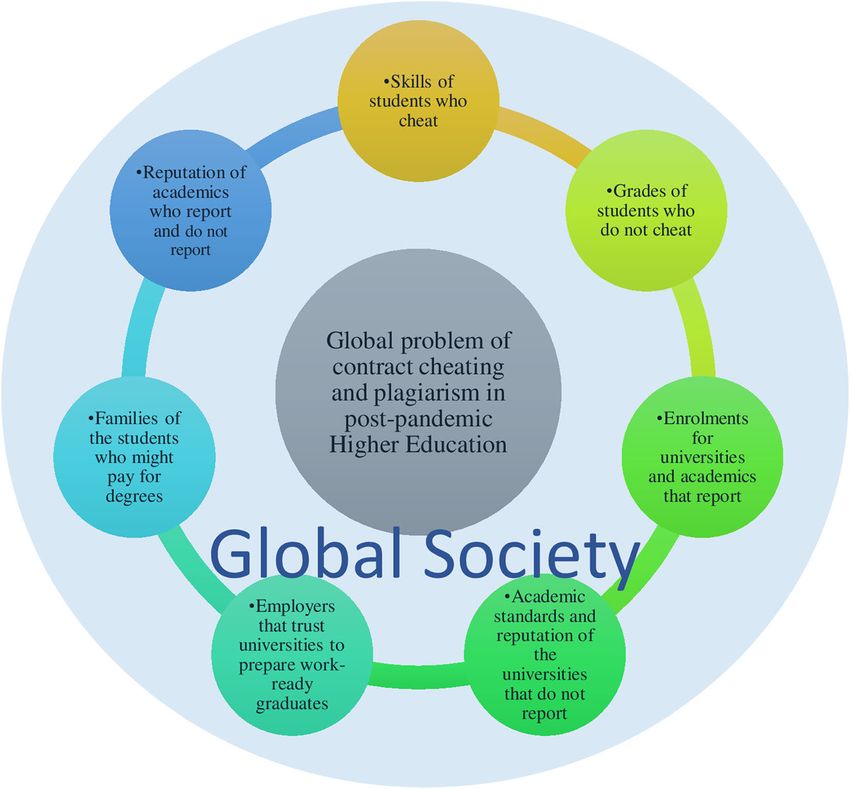
There are no winners of this race to the bottom when it comes to the global problem of
contract cheating and plagiarism in post-pandemic higher education. Figure 1 depicts the
growing scope of impact of contract cheating. The students who use the ‘services’ do not
learn valuable skills, the students who do not use the services observe the cheating stu-
dents receiving grades without necessary effort. Students do not learn new skills and have
even been blackmailed when trying to enforce the ‘high marks guarantee’ adver-
tised by illegal websites (Lancaster, 2016) which becomes an equity issue for the
university. The academics who detect and report the conduct are losing valuable
resources that can be allocated to development of teaching materials, academics
who do not detect and report are seen as naive by students. Universities that
choose to investigate and prosecute the breaches might have lower enrolments and
be seen as ‘too tough’ while universities that choose not to investigate might face
the problem of lowering academic standards. In the long run, the employers can-
not trust universities for preparing skilful work-ready graduates. The global society
at large suffers from ignoring the growing scale of the issue because academic in-
tegrity is corrupted, with the potential for students, providers, industry and the
international community to lose trust in education standards.
Due to the scale of the problem, multi-level solutions are required including aca-
demics, universities and global community.
Academics
Academics are at the frontline of preventing, detecting and often investigating contract
cheating. An Australian study found that ghost-written papers were generally passed by
academics, who thought they were grading real students’ work (Lines, 2016). Con-
versely, Dawson and Sutherland-Smith (2018) found that, when alerted to the potential
presence of ghost-written assignments, markers ‘detected contract cheating 62% of theHill et al. Research and Practice in Technology Enhanced Learning (2021) 16:24 Page 12 of 20
Fig. 1 Growing scope of impact of contract cheating in higher education
time’ and real student papers 96% of the time. In another study, when lecturers were
alerted to contract cheating and trained to detect it, the detection accuracy increased
from 58 to 82% (Dawson & Sutherland-Smith, 2019). Therefore, knowledge of these
practices on behalf of academics worldwide is so important. One of the biggest prob-
lems is not detection, though, it is the difficulty of proving a breach, the administrative
burden of investigations, and a lack of confidence that appeals will be denied, all lead-
ing to a reluctance to report in the first place. One could imagine this is exacerbated by
large class sizes (getting to know your students being one of the best ways to detect
breaches) and a casualisation of the workforce.
The authors note that the pandemic may have led to some positive long-term devel-
opments in relation to academic integrity as well as exacerbating the immediate chal-
lenges that are the focus of this article. Indeed, a collection of reflections from the
Canadian Perspectives on Academic Integrity journal suggests that the crisis has forced
more academic and learning and teaching staff to consider academic integrity when de-
signing online courses and assessments (Bens, 2020; Nearing, 2020; Scurr, 2020). The
link between assessment design and contract cheating in terms of both opportunities to
cheat and motivations associated with dissatisfaction with the learning and teaching en-
vironment has been clearly established (Bretag et al., 2019), and there is no doubt many
teaching professionals have been addressing that link both pre- and post-pandemic. As
such, good course and assessment design that is appropriate to the medium in which itHill et al. Research and Practice in Technology Enhanced Learning (2021) 16:24 Page 13 of 20
is delivered is undoubtedly one part of the solution to the problem of academic mis-
conduct and remote learning.
This paper is about raising awareness and as such a comprehensive guide to prevent-
ing, detecting and investigating academic misconduct in relation to contract cheating, if
it were possible, is outside its scope. However, there is a wealth of resources available.
For example, the Australian Tertiary Education Quality Standards Agency has pro-
duced the evidence backed Substantiating contract cheating: A guide for investigators
(Curtis, et al., n.d.), which provides a range of resources for investigators such as guides
of interviews as well as a list of signals that might indicate misconduct. Examples of
such signals include very high or very low scores on text matching software, checking
document properties, content not appropriate to discipline area, quality alters from ex-
pectations, language use and ability, unreadable language such as jargon or misused
words, reference list but no in-text citations, irrelevant sources, falsified references,
work that does not meet the set criteria, reflections are done badly, check IP addresses
of submissions and check student analytics for little or no engagement other than sub-
mission (Curtis, et al., n.d.). As this list suggests, training is essential for academic and
professional staff who deal directly with academic misconduct. Furthermore, encour-
aging staff to stay in positions relating to academic integrity means that those staff will
build expertise that can then be shared with their peers.
Universities
Awareness and detection of contract cheating by academics alone is not enough to en-
sure that universities effectively deal with the problem and systemisation through sound
policies and processes that are clearly communicated, as well as their consistent appli-
cation within often diverse institutions, are also fundamental to maintaining academic
integrity within and across universities. The dynamics involved in both contract cheat-
ing and university cultures are complex and nowhere is that complexity more obvious
than in devising university policy and processes that not only react to misconduct, but
also seek to proactively address it. Policy can dictate everything from the type of tech-
nology employed to combat cheating and the training provided, or not, through to the
design of courses and assessments. Good policy should create a culture and systems of
integrity that is clear, systematised, adequately resourced and just. Though the details
of good policy are too numerous to recount here, a range of tools to assist with such a
task has been formulated, with the Exemplary Academic Integrity Toolkit being one ex-
ample (https://lo.unisa.edu.au/course/view.php?id=6751). Universities may also choose
to emphasise and embed a values-based approach such as the one advocated by the
International Center for Academic Integrity through its six fundamental values of hon-
esty, trust, fairness, responsibility and courage (ICAI, , n.d.). An institution’s public
commitment to such principles raises and maintains awareness amongst staff and stu-
dents about academic integrity and misconduct.
Of course, with more benign forms of plagiarism, there is room for argument that
students should be educated about the skills of paraphrasing and referencing, rather
than penalised (Blum, 2009). The advantages of embedding academic integrity material
in courses and careful assessment design can also be encouraged or mandated by uni-
versities (East, 2016). For example, without claiming that cheating can ever be designedHill et al. Research and Practice in Technology Enhanced Learning (2021) 16:24 Page 14 of 20
out, a survey of eight Australian universities found that students are prone to rationalis-
ing cheating when there is a perceived lack of care or interest from academic staff or
the university, and as such, it recommends building relationships with students as it
builds trust but also helps in detection as staff reported that they detected over 70% of
cases due to knowledge of the student (Harper et al., 2019). This suggests that the
course and assessment design should not only strive to meet learning objectives in an
engaging way, but it should also foster direct interaction between student and
teacher—something that both students and teachers are finding a challenge in the post-
COVID-19 transition to distance learning. The study also found that while cheating
cannot be designed out of any course, the appropriate use of authentic assessment can
make cheating harder and easier to detect. Assessment by examination remains an im-
portant part of university assessment practice, and as such, it too needs to adapt to an
online environment in a way that ensures, or even increases, integrity.
Notably, online invigilation is subject to the resource availability of an individual uni-
versity. The available literature on COVID-19-related assessment changes suggests an
increase in online invigilation, which may or may not be cost-effective for universities
as institutions (Khan & Jawaid, 2020; Nizam et al., 2020). Apart from the significant
cost of purchasing an externally provided invigilation service, institutions have found
that successfully scaling up invigilated online examinations requires the allocation of
significant resources in terms of training their own staff and students to use, and have
confidence in, such systems (Day & Lawrence, 2020). Online invigilation may well off-
set many concerns surrounding identification verification through using multi-factor
identity checks, keystroke analysis and artificial intelligence to track suspicious facial
movement, lighting changes, etc. (Proctoru, , n.d.); however, such measures have
attracted negative media attention relating to both potential privacy breaches and the
potential commodification of student information (Sky News Australia, 2020; Zhou,
2020). In other words, online invigilation providers are not criticised for being too lax
on identification confirmation, but for being too intrusive. As such, universities should
recognise that COVID-19 has accelerated the need for careful consideration of the way
technology, academic integrity and assessment practices intersect on a larger scale than
has previously been considered.
While online invigilation services provide institutions a certain level of security
against exam misconduct, many institutions have not had the means nor the time to
implement them appropriately at the scale required by the urgent demands of the
COVID-19 pandemic (Hillier, 2020), and as such, they use inappropriate technology
and practices to assure academic integrity. The primary concern for such institutions is
that no lecturer can be confident that the person taking an exam is the intended stu-
dent and not someone else with the student’s login. No lecturer can ensure that only
one person is taking the exam and that there are not multiple students in the same
room. This short-term solution to a pandemic situation might have far-reaching impli-
cations for the integrity of the education system worldwide. A less conventional but
more viable option conducive to preserving academic integrity would have been hiring
large centres to ensure social distancing or conducting exams outdoors with an in-
creased number of invigilators. Even if online exams are required, these could be con-
ducted in a computer lab setting with invigilators present and social distancing
measures implemented. A further issue with uninvigilated online exams is that studentsHill et al. Research and Practice in Technology Enhanced Learning (2021) 16:24 Page 15 of 20
cannot be prohibited from using their mobile devices, which can induce misalignment
and distraction (Barry et al., 2015) and facilitate communication with third parties.
Global community
The literature on plagiarism is unequivocal—plagiarism is ‘a global issue’ (Butakov &
Scherbinin, 2009; Cameron et al., 2012; Roberts, 2007; Sutherland-Smith, 2008). Pla-
giaristic practices and systems that transcend state borders are also causes of alarm for
international organisations. The UNESCO International Institute for Educational Plan-
ning and the International Quality Group of the US Council for Higher Education Ac-
creditation have created the Advisory Statement for Effective International Practice to
alert and inform governments (Daniel, 2016). The Advisory Statement suggests mea-
sures for preventing and combatting corruption in admission, assessment and award
practices worldwide. In addition to publishing and enforcing the codes of conducts, the
Advisory Statement recommends encouraging whistle-blowing practices, a measure
that can be encouraged by universities. Whistle-blowing must be encouraged by both
academics and students. To achieve this, it might be necessary to conduct anonymous
surveys after exams to discover whether students observed other students partaking in
contract cheating practices. The universities can place an anonymous form online to
allow whistle-blowers report academic dishonesty.
The unique circumstances induced by technology and COVID-19 measures heighten
the threat to integrity, for example, the rapid shift to online examinations leading to as-
sessment practices unsuitable for online environments being employed and a conse-
quent jump in test scores (Eaton, 2020). This results in a disconnect between personal
skill and grade and an environment of distrust between students and university staff.
(Kaktiņš, 2018) highlighted the danger of future employers distrusting university quali-
fications if the practice of contract cheating continues.
The commercial scale of contract cheating services offered online presents a threat to
the global academic community. While international organisations, universities and the
academic community are adjusting to new, COVID-19-affected, teaching practices,
these issues must be brought to the attention of individual academics so that the prob-
lem can be addressed at the grassroots level. On a more pessimistic note, the illegal ser-
vices are developing at a faster pace than the systems required to curb them: ‘detecting
contract cheating is becoming more difficult, as students and intermediary contractors
become more sophisticated’ (Clarke & Lancaster, 2013). Moreover, it seems that illegal
websites have significantly benefited from COVID-19’s disruption to tertiary education.
The perceived threat of contract cheating is so serious that governments are increas-
ingly legislating against the practice, though the challenges of making such laws effect-
ive are considerable. Amigud and Dawson (2019) report that while a number of
jurisdictions including a number of US states, Ireland, New Zealand and most recently
Australia have legislated against contract cheating, the efficacy in such laws reducing
contract cheating is questionable. After surveying 17 US states that had legislated
against contract cheating, the authors found that prohibition had no noticeable effect
on cheating behaviours, leading them to conclude that the focus of preventative efforts
should not be on the supply side of contract cheating, but rather on universities, aca-
demics and students (Amigud & Dawson, 2019). As Draper and Newton (2017) suggest,Hill et al. Research and Practice in Technology Enhanced Learning (2021) 16:24 Page 16 of 20
the common perception of contract cheating is that it only takes place between three
parties, the institution, the university and the person hired, but in actuality, it may be
many more ‘a company regulated by a government, hosted on a website, with adver-
tisers and advertising a bidding system with multiple writers etc.’ (p. 7). Legal remedies
to the problem might be further complicated when one considers that each of these ac-
tors could be in different countries (Draper & Newton, 2017). Nevertheless, Draper and
Newton (2017) suggest that pursing new laws designed to combat cheating are ethically
desirable, practically achievable and in the public interest. While jurisdictional and
other enforcement issues will always exist with any legal approach to contract cheating,
the increasing rate of legislation at the very least sends a clear message to students and
institutions across the world about the seriousness of contract cheating.
Conclusion
The issues addressed in this research concern ethics, academic integrity and illegal
commercial activity. There is a certain spectrum of plagiaristic activity, with the darker
side of contract cheating involving criminal activities of assuming and allowing the as-
sumption of another person’s identity for the purposes of committing fraud. This prob-
lem is not limited to a particular university or country; it is international, and as such,
it poses considerable jurisdictional issues in enforcing laws. Further, the possibility of
committing crime in this regard has been exacerbated by the transfer to online teaching
across the whole education sector as a result of COVID-19.
The existing problems of consumer attitudes to education, internationalisation and
gaps in plagiarism detection are the drivers of diversification of contract cheating ser-
vices. These services undermine the value of education and academic integrity stan-
dards and, more importantly, undermining the role of education in preparing
professionals for a workplace. This leads to a problem of global proportions that must
be collaboratively addressed by universities and academics, both while technology is be-
ing developed to curb these practices and after such development, with a constant need
to remain alert to new developments that could threaten academic integrity. The global
scale of the pandemic has accelerated the digital disruption of traditional teaching and
assessment practices across international boundaries, but in so doing, it has also cre-
ated an environment where most providers are unprepared for such a rapid shift into
large-scale online education delivery. As a consequence, some individual institutions
are ill-equipped to design, deliver and monitor assessments to deter and avoid aca-
demic integrity breaches in the face of the sophisticated and easily accessible businesses
ready to take advantage of such a disruption.
In raising awareness about the issues emerging from current practices in contract
cheating, the scale of the problem suggests it cannot be addressed by an individual aca-
demic acting alone and clarifies some directions for multi-level solutions. Future re-
search must focus on developing a model of collaboration to address this problem on
several levels, taking into account (1) individual academics, (2) universities, (3) coun-
tries and (4) international communities. What is required is the proposal of a system-
atic organised action to address a systemic issue on a global scale.
Abbreviations
COVID-19: Coronavirus disease of 2019; ID: Identity document; US: United States of America; UK: United Kingdom;
UNESCO: United Nations Educational, Scientific and Cultural OrganisationHill et al. Research and Practice in Technology Enhanced Learning (2021) 16:24 Page 17 of 20
Acknowledgements
There are no acknowledgments.
Authors’ contributions
Each named author has substantially contributed to conducting the underlying research. All authors read and
approved the final manuscript.
Funding
Not applicable.
Availability of data and materials
Not applicable.
Declarations
Competing interests
The authors declare that they have no competing interests.
Author details
1
Asia Pacific College of Business and Law, Charles Darwin University, Australia. 2College of Indigenous Futures,
Education & Arts, Charles Darwin University, Australia. 3School of Humanities, Arts and Social Sciences, University of
New England, Armidale, Australia.
Received: 18 October 2020 Accepted: 6 June 2021
References
Amigud, A., & Dawson, P. (2019). The law and the outlaw: Is legal prohibition a viable solution to the contract cheating
problem?. Assessment & Evaluation in Higher Education. 45. 1-11. https://doi.org/https://doi.org/10.1080/02602938.2019.1
612851 .
Bao, W. (2020). COVID-19 and online teaching in higher education: A case study of Peking University. Human Behavior and
Emerging Technologies.
Barry, S., Murphy, K., & Drew, S. (2015). From deconstructive misalignment to constructive alignment: Exploring student uses
of mobile technologies in university classrooms. Computers & Education, 81, 202–210. https://doi.org/10.1016/j.compedu.2
014.10.014.
Bell, E., & Bryman, A. (2007). The ethics of management research: An exploratory content analysis. British Journal of
Management, 18(1), 63–77. https://doi.org/10.1111/j.1467-8551.2006.00487.x.
Bens, S. (2020). A reflection on change and academic integrity during COVID-19. Canadian Perspectives on Academic Integrity.
3(2). doi.org/https://doi.org/10.11575/cpai.v3i2.71637
Bin-Habtoor, A., & Zaher, M. (2012). A survey on plagiarism detection systems. International Journal of Computer Theory and
Engineering, 4(2), 185.
Blum, S. D. (2009). Academic integrity and student plagiarism: A question of education, not ethics. The Chronicle of Higher
Education, 55(24), A35.
Bolkan, J. (2006). Avoid the plague: Tips and tricks for preventing and detecting plagiarism. Learning & Leading with
Technology, 33(6), 10–13.
Bormann, E. G. (1961). Ethics of ghostwritten speeches. Quarterly Journal of Speech, 47(3), 262–267. https://doi.org/10.1080/
00335636109382486.
Bretag, T., Harper, R., Burton, M., Ellis, C., Newton, P., van Haeringen, K., Saddiqui, S., & Rozenberg, P. (2019). Contract cheating
and assessment design: Exploring the relationship. Assessment & Evaluation in Higher Education. 44(5), 676-669. doi.org/
https://doi.org/10.1080/02602938.2018.1527892
Bretag, T. (2017). Good practice note: Addressing contract cheating to safeguard academic integrity. Tertiary Education Quality
and Standards Agency. https://www.teqsa.gov.au/sites/default/files/good-practice-note-addressing-contract-cheating.pdf?a
csf_files_redirect.
Brothen, T. & Peterson, G. (2012). Online exam cheating: a natural experiment. International Journal of Instructional Technology
and Distance Learning. 9(2). 15–19. http://itdl.org/Journal/Feb_12/Feb_12.pdf#page=19.
Bunce, L., Baird, A., & Jones, S. E. (2017). The student-as-consumer approach in higher education and its effects on academic
performance. Studies in Higher Education, 42(11), 1958–1978. https://doi.org/10.1080/03075079.2015.1127908.
Butakov, S., & Scherbinin, V. (2009). The toolbox for local and global plagiarism detection. Computers & Education, 52(4), 781–
788. https://doi.org/10.1016/j.compedu.2008.12.001.
Cameron, C., Zhao, H., & McHugh, M. K. (2012). Publication ethics and the emerging scientific workforce: Understanding
‘plagiarism’ in a global context. Academic Medicine: Journal of the Association of American Medical Colleges, 87(1), 51–54.
https://doi.org/10.1097/ACM.0b013e31823aadc7.
Chapman, D. W., & Lindner, S. (2016). Degrees of integrity: The threat of corruption in higher education. Studies in Higher
Education, 41(2), 247–268. https://doi.org/10.1080/03075079.2014.927854.
Clarke, R., & Lancaster, T. (2013). Commercial aspects of contract cheating. Paper presented at the Proceedings of the 18th
ACM conference on Innovation and technology in computer science education.
Conlan, K., Baggili, I., & Breitinger, F. (2016). Anti-forensics: Furthering digital forensic science through a new extended,
granular taxonomy. Digital investigation, 18, S66–S75. https://doi.org/10.1016/j.diin.2016.04.006.
Coulthard, M., Johnson, A., & Wright, D. (2016). An introduction to forensic linguistics: Language in evidence: Routledge, DOI:
https://doi.org/10.4324/9781315630311.You can also read


