Coronavirus Vaccination in Devon - Briefing #12 - 26 March 2021 Key messages - Cricketfield Surgery
←
→
Page content transcription
If your browser does not render page correctly, please read the page content below
Coronavirus Vaccination in Devon
Briefing #12 – 26 March 2021
Key messages
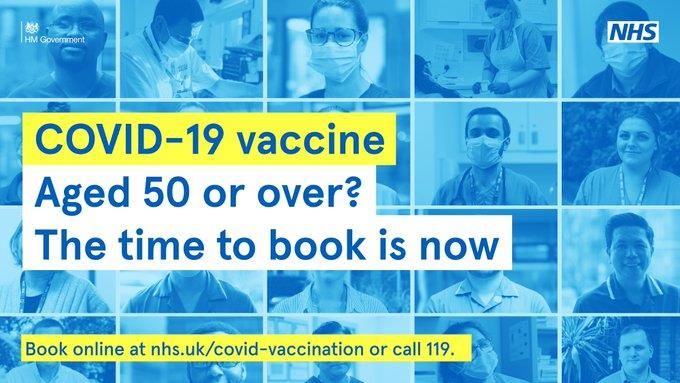
  •   If you are over 50 and you haven’t
      had the jab yet, now is the time to
      book a space before the supply
      constraints begin in April.
  •   593,532 people in Devon received a
      first vaccine dose between 8
      December and 21 March, meaning
      about six in ten people aged 16 and
      over in Devon have had a first dose.
  •   The country’s top doctor has urged
      everyone who is entitled to a Covid jab to come forward as new figures
      showed the NHS vaccination programme racked up record numbers of jabs
      last week.
  •   Midwives in Devon are reassuring women that the Coronavirus vaccine won’t
      affect their fertility, either now or in the future, and that they can have the
      vaccine if they are breast feeding (see below).
  •   The NHS has published a national ‘frequently asked questions’ document on
      second doses.
  •   Nationally, 27 jabs per second were delivered on ‘Super Saturday’ (20 March)
  •   Further to recent concerns regarding blood clots, the UK regulator, the MHRA,
      the World Health Organization and the European Medicines Agency have all
      now said the benefits of the vaccine outweigh the risks.

‘Get your jab now while thousands of spaces are available’
  •   People in Devon who are eligible for a coronavirus vaccine are being urged to
      book an appointment before the end of March while there are thousands of
      spaces available.
  •   Everyone aged 50 and above, people with underlying health conditions or
      health and care workers are among those now eligible for a vaccination.
  •   They are being encouraged to book an appointment for a first dose before the
      supply constraints begin in April:
         o Use the National Booking Service via the website or by calling 119
                ▪ The National Booking Service offers appointments at large
                    vaccination centres or the selected community pharmacies that
                    are offering the jab:
                ▪ Large vaccination centres at Westpoint Exeter and Home Park,
                    Plymouth (or Taunton Racecourse in Somerset and the Royal
                    Cornwall Showground, Wadebridge, if more convenient)
                ▪ Pharmacy sites: Plymouth Cricket Ground, Devonport, run by
                    Devonport Pharmacy; Lewis Pharmacy, Exeter Road, Exmouth;
                    Westward Ho! Baptist Church, run by Arnolds Pharmacy,
                    Westward Ho!
         o Or, if you've been invited by your GP, please respond to book up
             and attend this week while there are still plenty of spaces available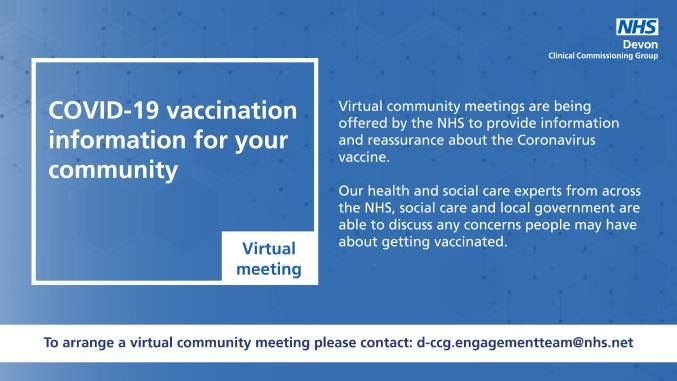
•   GP practices in Devon are especially keen that anyone who is clinically
      vulnerable (JCVI group 6 – people aged 16-64 with underlying health
      conditions which put them at higher risk of serious disease and mortality)
      takes up the offer of a vaccine. Most people in this group will have been
      contacted by their practice in recent weeks and doctors are keen to book in
      anyone who hasn’t yet responded to fix up an appointment.
  •   The nine priority groups, as set by the Joint Committee on Vaccination and
      Immunisation encompass:
      o Everyone aged 50 years and over
      o Frontline health and social care workers
      o People who are clinically extremely vulnerable
      o People of any age with underlying health conditions which put them at
           higher risk of serious disease and mortality
      o Those who are in receipt of a carer’s allowance, or those who are the main
           carer of an elderly or disabled person whose welfare may be at risk if the
           carer falls ill.
      o Residents in a care home for older adults and their carers
  •   It is estimated that taken together, these at-risk groups account for 99% of all
      deaths from COVID-19.
  •   If you’re not sure if you are eligible for a vaccine, you can use the information
      on the NHS website to check before booking.

April supply constraints
  •   On 17 March, the Medical Director for Primary Care at NHS England and
      NHS Improvement wrote to the NHS to update on the latest position on
      vaccine supply and deployment over the next six weeks. The letter says that
      after two weeks of increases, there will be a significant reduction in weekly
      supply from 29 March, estimated to last for four weeks, due to ‘reductions in
      inbound vaccine supply’.
  •   However, vaccine is available between now and then and there are
      thousands of available spaces before the end of March (see above).
  •   The supply constraint means that as of last week, no further first dose
      appointments will be made available on the National Booking Service
      (nationwide) from 1-30 April. Depending on when they opened, some sites are
      yet to reach the time when they need to start administering second doses.
  •   All vaccination centres – GP-led sites, large centres and pharmacies – have
      always flexed their opening hours in line with supply. Therefore they are likely
      to be operating less in April due to the national supply constraints.
  •   A small number of appointments are being rescheduled to alternative days
      and the NHS will contact anyone affected directly.
  •   However, existing appointments are not being cancelled. If you already
      have an appointment over the coming weeks, whether for your first or second
      dose, this remains in place and it’s really important that you attend it as
      planned. The first dose of both the Pfizer/BioNTech and Oxford/AstraZeneca
      vaccine offer good levels of protection, but to get maximum protection
      everyone will need to get a second dose, so we are urging people to come
      back when they are contacted or if they have an appointment booked.
  •   Continue to attend any booked appointments in April unless you hear from the
      NHS. There is no need to contact the NHS about a booked appointment.
  •   Vaccinations continue at Devon’s hospitals, mainly second doses for staff,
      although arrangements vary between sites.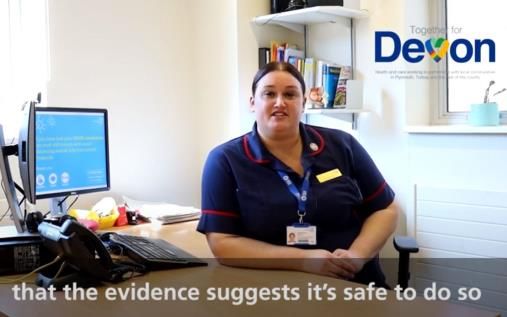
Devon midwife reassures women the Coronavirus vaccine is safe
   •   The NHS in Devon is reassuring women
       that the Coronavirus vaccination will
       have no impact on their ability to have a
       family and is encouraging health and
       social care workers to take up the
       vaccine.
   •   More than 87% of frontline health and
       social care workers across Devon,
       Plymouth and Torbay have had their first
       dose of the life-saving vaccine. However,
       some female staff have hesitated over the jab and highlighted concerns
       caused by misinformation circulating about fertility.
   •   University Hospitals Plymouth Acting Head of Midwifery, Charlotte Wilton is
       among those offering reassurance. She said: “The vaccine works by
       travelling to your lymph glands and then is disposed of within a couple of days
       by the body. There is no mechanism by which the Coronavirus vaccine can
       affect your fertility either now or in the future. If you are considering having the
       vaccine but you are really not sure or are considering a pregnancy at some
       point, then please do be reassured that it is safe to do so and that will protect
       you and everyone else.”
   •   You can watch a short film featuring Charlotte.
   •   The Royal College of Midwives and Royal College of Obstetricians and
       Gynaecologists have also issued statements on the safety of the vaccination.
   •   A guide for women of childbearing age, those currently pregnant or
       breastfeeding has been published by Public Health England.

Vaccination data for Devon
   •   593,532 people in Devon received a first vaccine dose between 8 December
       and 21 March, meaning about six in ten people aged 16 and over in Devon
       have had a first dose, vaccination data published by NHS England and NHS
       Improvement shows, broken down as follows:

                                                                    Approx % of age group
                                  Number of first
 Age group                                                          received at least one
                                  doses given
                                                                    dose*
 80+                                          79,170                  Estimated to be at least
 75-79                                        58,505                      95% for people
 70-74                                        76,944                   aged 70 and above#
 65-69                                        70,333                            93.3%
 60-64                                        72,403                            92.4%
 55-59                                        70,359                            82.2%
 50-54                                        53,328                            62.7%
 Under 50                                    112,490                             24.4
 Total (16+)                                 593,532                            59.4%
* Based on number of first doses given as a proportion of the 2019 ONS population estimates. Data
sourced from NHS England and Improvement.
# Due to population growth since 2019, in some cases the tables show the number of vaccines given

as higher than the 2019 population figures used.
• 15,202 second doses were also given in the last week, with over 45,000
second doses given since the programme began in Devon.
• Data on vaccination by gender take up by NHS region is given in this week’s
figures for the first time. In the South West, the data shows there is little
difference between the sexes:
50-54 55-59 60-64 65-69 70-74 75-79 80+
Women 72.6% 85.4% 94.8% 92.8% 97.4% 100%# 97.7%
Men 64.9% 82.2% 95.1% 93.8% 97.3% 100%# 100%#
• The latest information regarding the percentages of care home staff and
residents, and social care staff is also contained within the weekly figures.
• The data also shows that in the South West, 78.6% of people who are aged
16-64 who are at risk or a carer (excluding residents of younger adult care
homes) have had at least one dose – the highest of any NHS region.
Supporting people with learning disabilities to get the vaccine
• The NHS in Devon is supporting people with learning disabilities to take up
the potentially life-saving coronavirus vaccination.
• The UK government’s vaccine advisory committee has said that all people on
the GP Learning Disability Register should be invited for a Covid-19 vaccine
as part of priority group 6. GP surgeries are contacting people about booking
the vaccine.
• Recent engagement work, including focus groups with members of our
community with learning disabilities, led by NHS Devon Clinical
Commissioning Group (CCG) suggests that the reasons for vaccine hesitancy
locally mirror concerns identified nationally.
• Acting on suggestions made during the engagement, Easy Read leaflets are
being developed and a short film to allay anxieties and support people with
learning disabilities to have the Covid-19 vaccination has been produced.
• This has been a joint project between Devon CCG, NHS England and The
Turning Tides Project. The NHS in Devon teamed up with The Turning Tides
Project to better understand how it could support people with learning
disabilities to have the vaccine.
• The film features ‘Michelle’ and her carer ‘Holly’ who were filmed at Mid
Devon Healthcare Primary Care Network’s vaccination site at Lords Meadow
Leisure Centre in Crediton.
• When contacted for their vaccination, people with learning disabilities should
let their GP or community learning disability nurse know if they need extra
support or reasonable adjustments to make them feel more confident about
having the vaccine.
• The film has been featured on regional TV news this week.
Offering support to increase vaccine take-up
• Devon’s NHS working with local groups and communities to increase vaccine
up-take.
• A range of support is available, including:
• Asking people from communities where uptake is low or concerns are high to
get in touch with the local NHS so support can be offered – email
d-ccg.engagementteam@nhs.net (see image below)• Vaccination ambassadors
from minority communities
attending local community
meetings to answer questions
and allay worries
• Translating key information
about registering with GPs
into different languages, with
further translated materials to
follow
• Developing films to encourage
take up.
• Using social media advertising to reach groups who may be vaccine hesitant
with reassurance messaging
Vaccination isn’t the only way we can fight Covid
The supply issue in April is a further reminder that everyone has a role to play in
bringing the pandemic to an end – here’s what local people can do
1. Stay at home: The best thing the public can do to help the NHS is to stay at
home as much as possible:
o Every time you leave your home you risk coming into contact with an
infected person or touching a surface or door handle or petrol pump
which may be contaminated. Any one of these interactions could be a
crucial link in the chain of transmission which could lead to someone
becoming seriously ill or dying from COVID-19.
o People in Devon have really helped by following the government
guidance seriously. If everyone does as they are asked, our hospitals
and other services will cope.
2. When you get your call from the NHS for your vaccine, please take it up:
o The NHS will get in touch with you when it’s your turn to be
vaccinated.
o Please attend your appointment.
o You will not be offered a choice of which vaccination you receive –
both approved vaccines are rigorously tested, safe and effective.
o Please help us by not calling your local hospital or GP practice about
getting the vaccine – the NHS will contact you when it’s your turn.
o Blocking phonelines with queries stops other people getting healthcare
and diverts staff time, meaning the vaccine rollout will be slower.
3. You may still transmit Covid after you have been vaccinated.
o Having the vaccine should protect you from becoming seriously ill from
COVID-19, but you may still be a risk to others if you are exposed.
o It is crucial that you continue to observe the ‘stay at home’ and ‘hands,
face, space’ advice until advised that it is no longer necessary.
4. Follow the government guidance: ‘Hands, Face, Space’.
5. Use the NHS in the best way
o Think 111 first; or choose the right service for your needs: self-care,
pharmacists, local minor injury services or your GP.
Other important information
• The Government says the NHS still intends to vaccinate everyone in
priority groups 1-9 by mid-April and remains on-track to have offered a
vaccination to all adults by the end of July 2021, despite the supply issue in
April.• Several European countries, including Germany, France, Italy and Spain are
restarting use of the Oxford AstraZeneca vaccine after Europe's medicines
regulator concluded the benefits outweighed the risks and, on Thursday, the
World Health Organization called on countries which had paused its use to
continue using it.
• People aged 50 and above are receiving a text from the National Booking
System as 'NHSvaccine' inviting them to book a coronavirus vaccination
appointment at a larger vaccination centre or pharmacy, followed by a letter a
few days later.
Further information and vaccination data
For more information on vaccination and the health and care response to COVID-19,
click on www.togetherfordevon.uk/priorities/coronavirus-covid-19 or the NHS
website.
ENDSYou can also read


