COVID-19 & Poverty and Hunger - Policy Brief - ReliefWeb
←
→
Page content transcription
If your browser does not render page correctly, please read the page content below
COVID-19 | EMERGENCY RESPONSE PLAN PHASE 2

                                              Policy Brief
   COVID-19 & Poverty and Hunger
                                                   July 2020

COVID-19 has directly killed hundreds of thousands         The economic fallout from COVID-19
of people around the world. It is also taking a deep
                                                           threatens to sharply increase extreme
toll on the food security, nutrition and livelihoods
of millions of people across the globe. The socio-         poverty. Even before the pandemic hit, 736 million
economic fallout from COVID-19 has resulted in             people (more than half of whom were children)
sharp declines in household income due to job              lived in extreme poverty1 and more than 190 million
losses and/or reduced livelihoods options.                 people were out of work.2 Sub-Saharan Africa has
                                                           increasingly become a locus for extreme poverty and
Declining remittances is leading to steep increases        is home to 59% (413 million) of the world’s extreme
in poverty and hunger, particularly in low-income          poor.3 Fragile and conflict-affected contexts have
developing countries. Those living in fragile and          significantly higher rates of extreme poverty as well
conflicted- affected contexts are at heightened            lower poverty reduction rates.4 Most countries have
risk. Unless quick action is taken, decades of             introduced measures to reduce virus transmission,
development gains will be rolled back, posing a            including restricting movement and crowding through
significant threat to achieving the 2030 Agenda            lockdowns, quarantines and increased border
and its vision to ‘leave no one behind’.                   controls. While efforts to reduce virus transmission
                                                           are essential, the economic fallout of these measures
As COVID-19 charts its deadly course across                are deeply affecting small and medium enterprises,
the world, it is magnifying existing inequalities          the self-employed and daily wage earners.5 It is
and vulnerabilities as well as creating new ones.          estimated that 305 million full-time jobs will be
Pandemics amplify existing gender inequalities and         lost and the incomes of 1.6 billion workers in the
other overlapping patterns of social and economic          informal economy will be severely curtailed by the
exclusion and discrimination experienced by                end of June 2020.6 Young people have been hard
marginalised groups such as those living in extreme        hit, with more than one in six losing their jobs, with a
poverty and people with disabilities.                      disproportionate impact on young women.7

                                                       1
World Vision| Policy
                                                                  COVID-19            Brief | COVID-19
                                                                                EMERGENCY      RESPONSE&PLAN
                                                                                                         Poverty and 2Hunger
                                                                                                              PHASE

As gender roles often define women as primary                  The impacts on children. Children’s rights to
caregivers, their loss of income will negatively affect        an adequate standard of living, access to sufficient
their ability to provide for their children8 while             nutritious food and social security are enshrined in
simultaneously increasing the burden of women’s                the Convention on the Rights of the Child. The UN
and girls’ unpaid work.9 Already living on the edge,           estimates that COVID-19 could push an additional
this widespread loss of livelihoods and income will            42-66 million children into extreme poverty,16 which
continue to hit the poorest families hardest as their          would severely curtail the realisation of those rights.
income and livelihoods sources dry up. 10                      Half of the world’s extreme poor live in fragile or
                                                               conflict-affected states, with 80% of humanitarian
World Vision’s community-level data from 14,000                need driven by the impacts of conflict. Fragile
households in Asia, over 2,400 small business owners           contexts are some of the most dangerous places
in Africa, and more than 360 Venezuelan migrants               in the world to be a child and high levels of hunger
across Latin America confirms that projections by              and child undernutrition are common features.
global agencies about the potential impact of the              Poor nutrition is an underlying cause of 45% of all
pandemic are already happening. A staggering 80% of            preventable deaths of children under five annually. A
Venezuelan refugees and migrants surveyed in Brazil,           recent Lancet report estimates that the pandemic
Bolivia, Chile, Colombia, Ecuador, Peru and Venezuela          will likely cause more deaths of children under
reported a significant drop in income. Across Africa,          five indirectly through disruptions in critical health
69% of people surveyed report they are currently               services and decreased access to food. In the most
earning less than half their pre-COVID-19 income,              severe scenario, wasting will increase by 50% and
with the majority of respondents forced to turn                could lead to an additional 1,157,000 preventable
to a common coping mechanism: spending less on                 child deaths.17 School closures have meant that
healthy food.11                                                368 million children in stable, humanitarian and
                                                               fragile contexts are not able to access school meals
Poverty is a major driver of hunger and                        programmes.18
malnutrition. Even before COVID-19, 821
million people were food insecure, with 135 million            Social safety nets,19 as part of comprehensive social
experiencing acute, life-threatening malnutrition12            protection systems, are among the best-documented
and 200 million children acutely undernourished.               and cost-effective policy responses to promote
Global progress on reducing hunger has been                    equity, reduce poverty and vulnerability, and improve
backsliding for a number of years, largely due to a            children’s health, nutrition and education, particularly
deadly mix of conflict, climate change and economic            for the extreme poor. Despite this, one in five of
slowdowns.13 In April, the World Food Programme                the world’s poor are not reached by social safety
(WFP) delivered a somber warning that COVID-19                 nets20 and 65% of children are not reached with
could push an additional 130 million people into a             comprehensive social protection programmes.
hunger crisis, leaving 265 million in need of lifesaving       Results from early recovery assessment of more than
food security assistance.14 Extreme poverty, acute             14,000 households in World Vision programmes
hunger and state fragility are closely linked—of               in nine countries across the Asia region show that
the top 10 countries facing the highest burden of              an estimated 110 million children are going hungry
acute hunger in 2019, all have existing humanitarian           and 8 million children have been pushed into child
response plans and six are included in the OECD-               labour and begging because of the pandemic.22
DAC’s top 10 list of the most fragile states.
                                                               A survey of Venezuelan refugees and migrants
VisionFund (World Vision’s microfinance subsidiary)            indicates that every third child is going to bed
surveyed vulnerable, refugee families in West Nile,            hungry–that is potentially over one million children.23
Uganda, who are members of World Vision’s Savings              Desperate parents and caregivers are finding it
for Transformation groups with some startling                  increasingly difficult to provide their children with
findings. Ten percent of members had already                   healthy nutritious food or buy necessities such as
sold productive assets; 47% were suffering large               medicine and hygiene products.
reductions in income; and 11% had no income at
all. The children in these families–often more than
six per household–are at major risk and require
immediate assistance.15

                                                           2
World Vision| Policy
COVID-19 Brief | COVID-19
EMERGENCY RESPONSE&PLAN
Poverty and 2Hunger
PHASE
Impacts on food systems and markets. While there are currently ample global food supplies
Eighty percent of the extreme poor live in to meet global market demand, climate change-related
rural areas and depend on agriculture-based natural disasters such as drought in Southern and West
livelihoods for the majority of their food and Africa and the locust invasion in east Africa are already
income.24 Smallholder farmers also produce causing localised market disruptions and food price
and sell significant quantities of the food that is hikes that will be exacerbated by measures to contain
traded and sold in smaller local/regional markets the virus’s spread. A missed planting season would
and urban centres, which are where many of the mean even more production shortfalls, less domestic
poor buy food for their households.25 Smallholder food supplies to meet consumer demand, and later,
agricultural production is a seasonal activity that is greater pressure on local, regional and global food
highly labour intensive. In most parts of the world, markets that in turn will drive up the price of food and
primary agricultural planting seasons was set to make it even more unaffordable for the poor.
begin as the pandemic and government policy
response to it took hold.
World Vision’s Response
Improving food security and livelihoods is a core component of World Vision’s COVID-19 response.
Drawing on decades of experience in food security and livelihoods programming in humanitarian,
fragile and development contexts, previous experience responding to complex health and socio-
economic crises, and a track record of working at the humanitarian-development nexus in fragile
contexts, World Vision will leverage its experience to meet urgent hunger needs while building long-
term resilient livelihoods of vulnerable families and children. World Vision is making a difference for
millions of vulnerable girls and boys and their families through its:
Social protection and social safety nets Savings for Transformation (S4T) Groups
programmes (Cash, Vouchers and Food As part of its COVID-19 response, and informed by
Assistance) experiences during the Ebola Outbreak, World Vision
World Vision’s social protection programmes are has grown and supported World Vision has grown and
providing a lifeline for children and families affected supported 54,400 Savings for Transformation (S4T)
by COVID-19 and living in fragile and conflict groups27 in 34 countries with 1.3 million members (80%
affected contexts. Core to World Vision’s response of whom are women).This includes 505,335 caregivers
is the provision of cash voucher programming who look after 1,265,338 children. World Vision is
and food assistance. This is supporting families to doing this by leveraging cash voucher programming to
meet basic needs, facilitate improved recovery and meet their immediate, basic needs and also supporting
preparedness as well as to bolster any disrupted savings group members by working with VisionFund
incomes of vulnerable people to prevent harmful to extend loan repayment plans and provide recovery
coping mechanisms. In response to COVID-19, loans. More recently, World Vision also adapted its
World Vision plans to reach over 4.4 million S4T approach for fragile contexts28 and developed an
vulnerable people, including 2.2 million children, interagency COVID-19 Technical Guidance for Savings
in more than 35 countries via cash programming. Groups to support continued functionality of groups
World Vision has already reached over 786,000 during the COVID-19 crises.29
people with almost USD $12 million distributed in
recent weeks and is adapting all its social protection
and safety nets programmes to minimise risks of
virus transmission.26
3World Vision| Policy
COVID-19 Brief | COVID-19
EMERGENCY RESPONSE&PLAN
Poverty and 2Hunger
PHASE
Ultra-Poor Graduation (UPG) Already, VisionFund works with more than one million
World Vision’s Ultra-Poor Graduation programmes micro and small business owners and with savings
provides extremely poor households, particularly groups in 28 countries. In Sierra Leone during the
female-headed households, with a pathway out Ebola crisis, funded by DFID, VisionFund and World
of poverty, providing an integrated package of Vision in partnership other NGOs, supported 42,000
assistance, S4T, training and assets (e.g., seeds, petty traders to restart their businesses by providing
sewing machines, livestock) coupled with ongoing small loans and grants.31
coaching support, to enable the most vulnerable
families to escape the extreme poverty trap. The World Vision is collaborating with faith actors in its
UPG is a core sector programme of World Vision’s community development response, acknowledging the
Fragile Contexts Programme Approach (FCPA). vital role that faith plays in people’s lives and how they
Piloted in multiple countries,30 the FCPA is designed view the world. World Vision’s Empowered World
to help the most vulnerable households survive, View curriculum fills this gap through an approach
adapt and thrive now and in the future. Due to the that is faith-based and reaches deep into people’s core
high levels of extreme poverty among refugees and beliefs, transforming their view of the world so that
host communities in low-income countries, World the cycle of chronic poverty and hopelessness can be
Vision is part of the innovative Poverty Alleviation broken. A richer understanding of their faith changes
Coalition, which is using a graduation approach to how they see the world and their ability to have an
support 500,000 refugees and host communities on influence on their own circumstances. Empowered
their journey towards self-reliance, and economic Worldview is the foundation for World Vision’s
and social inclusion. Building Secure Livelihoods project model, which
equips farmers to improve their incomes by learning
Micro-finance (MF) improved agricultural and marketing techniques.
As soon as the peak of the crisis has passed and This combination of mindset change and practical
businesses are able to restart trading, VisionFund capacity building has demonstrated its effectiveness
seeks to rebuild the livelihoods of families and on improving family incomes and improving child well-
caregivers of over 3.5 million of the most vulnerable being.32
children across the globe. They will implement a
gender-responsive recovery-lending programme
for its existing microfinance clients, micro, small and
medium enterprises, S4T groups and smallholder
farmer producer groups.
World Vision’s Recommendations
The sheer scale of the socio-economic crises induced by the global pandemic requires a joined-up
effort by humanitarian, development and peace actors to rapidly scale up support to vulnerable
children and families to protect the rights of the most vulnerable children, meet their immediate
needs while addressing the underlying drivers of poverty and vulnerability at the global, national,
community and household levels. World Vision recommends the following:
National Governments should:
• Strengthen and/or establish national child- trade of essential commodities. Priority should be
sensitive social protection systems, ensure placed to support smallholders, pastoralists and
adequate budgetary allocations and put in agricultural workers to access finance, purchase
place accountability mechanisms to ensure the agricultural and livestock supplies, and sell their
most vulnerable children receive transfers of crops in markets. This in turn will help to maintain
sufficient size and duration to meet lifesaving food supply chains between rural, peri-urban, and
food and nutrition needs. urban areas and within and between countries.
• Keep food and agriculture market systems Ensure people along the food supply chain are
functioning. Prioritise the rapid analysis, not at risk of COVID-19 transmission by raising
response and adaptations to food and awareness about food safety and health regulations,
agricultural markets. Policies should support including rights, roles and responsibilities.
the continued global, national, regional and local
4World Vision| Policy
COVID-19 Brief | COVID-19
EMERGENCY RESPONSE&PLAN
Poverty and2Hunger
PHASE
• Protect jobs, wages and livelihoods of the needs of refugee and other forcibly displaced
poorest families to help households avoid populations are integrated into national
negative coping strategies that increase the risk economic recovery plans.
that children will be forced into labour, begging • Invest in interventions promoting a green
or other forms of violence, such as early recovery. Develop economic recovery
marriage. Provide funding to support small interventions that build in resilience to climate
and medium-sized businesses (in particular, change and restore environmental assets central
those led and owned by women) to prevent to food security, safety nets and natural resource-
job losses and allowing for faster economic based livelihoods.This includes large-scale actions
recovery, including loan restructuring that to decarbonise economies and restore degraded
allows flexible repayments, grace periods and landscapes, as well as more localised climate
ensure that support is provided in a timely change adaptation, and risk reduction measures.
manner. Similarly, provide technical assistance These can reduce community exposure and
and coaching so MSMEs can adapt operations vulnerability to climate-related hazards that
to keep workers and customers safe and disrupt and destroy livelihoods and local
respond to changing markets. Ensure the economies.
Implementing Agencies should:
• Urgently scale up child sensitive humanitarian - Prioritise multipurpose cash assistance, through
social protection measures (such as food, cash digital/mobile money transfers as much possible.
and voucher assistance) to help poor families - Put accountability measures in place, including
meet immediate food, nutrition and income social accountability approaches, to ensure
needs of children and other nutritionally delivery of social transfers reach the most
vulnerable groups. vulnerable children and families.
- Prioritise lifesaving and gender responsive - Ensure all COVID-19 response efforts adhere
interventions for the most nutritionally to key humanitarian standards, including Minimum
vulnerable groups including children under Standards for Food Security and Nutrition, the
age five, pregnant and lactating women, and Minimum Economic Recovery Standards, and
people with chronic illnesses such as HIV/AIDS. the Minimum Standards for Child Protection in
Preference should also be given to female- Humanitarian Action.
headed households, persons with disabilities, • Ensure continuity of key humanitarian supply
displaced communities, those in urban hot spots chains at national, regional and international
hosting large numbers of forcibly displaced level for essential commodities and services33
populations. to protect lives and livelihoods assets of the
- Ensure programs are designed to fill key gaps poorest households and communities. Support
in national systems (where they exist). Providing the UN Humanitarian Air Service’s capacity to
a pathway for referral into national systems is quickly move more essential goods and people
particularly important for those excluded from in support of the COVID-19 humanitarian
those systems, such as refugees and other response. This includes greater pre-positioning of
forcibly displaced populations. critical resources (e.g., food, cash, medical/health
supplies) as close to affected populations as
possible and frontloading food/cash distributions
for two to three months.
Donors should:
• Urgently work with other G20 members to This must include support for national governments
deliver on the G20 Leader’s commitment to to adapt, strengthen and scale up inclusive pro-
rapidly mobilise comprehensive and coordinated poor, child-sensitive social protection and gender
policy response to COVID-19’s direct and responsive measures that meets the needs of the
indirect impacts. most vulnerable children and families. Where national
systems do not exist, rapidly scale up funding to
• G20 action plan to support the global economy, humanitarian programmes to meet lifesaving needs
including support to low income countries. for the most vulnerable.
5World Vision| Policy
COVID-19 Brief | COVID-19
EMERGENCY RESPONSE&PLAN
Poverty and2Hunger
PHASE
• Provide multi-year, flexible funding and support social assistance transfers to meet the immediate
implementing agencies to adapt programming needs of the most vulnerable girls, boys and their
to accommodate needs in rapidly changing local families and communities while also assisting them
contexts. In addition, coordinate humanitarian to achieve sustainable development outcomes
and development financing to support an and resilience in the longer term.
inclusive and coherent response that supports
National governments, donors, IFIs, private sector and civil society should:
• Commit to a major “Marshall Plan style” multi- delivery, particularly for low-income, high debt
stakeholder, global partnership to rebuild countries. Income support such as cash transfers
developing country economies from the must be a key part of an inclusive recovery plan
bottom of the pyramid,34 if the world is to avoid and linked to longer-term financial inclusion
a significant increase in extreme poverty and objectives and economic recovery activities41
hunger. This will require significant public and to help the most vulnerable households and
private sector investments from governments, communities bounce back faster and stronger.
donors, International Financial Institutions and This will help build their financial capacities to
the private sector to shore up local and national provide for the basic needs of their children and
market systems that promote inclusive pro- escape the poverty trap.
poor economic growth and resilience, as well • Declare food production, marketing, and
as provide decent employment opportunities distribution essential services everywhere to keep
for the most vulnerable women and men. trade corridors open to ensure the continuous
Debt financing initiatives should allow flexible functioning of the critical aspects of food systems
repayments, grace periods and ensure timely in all countries.
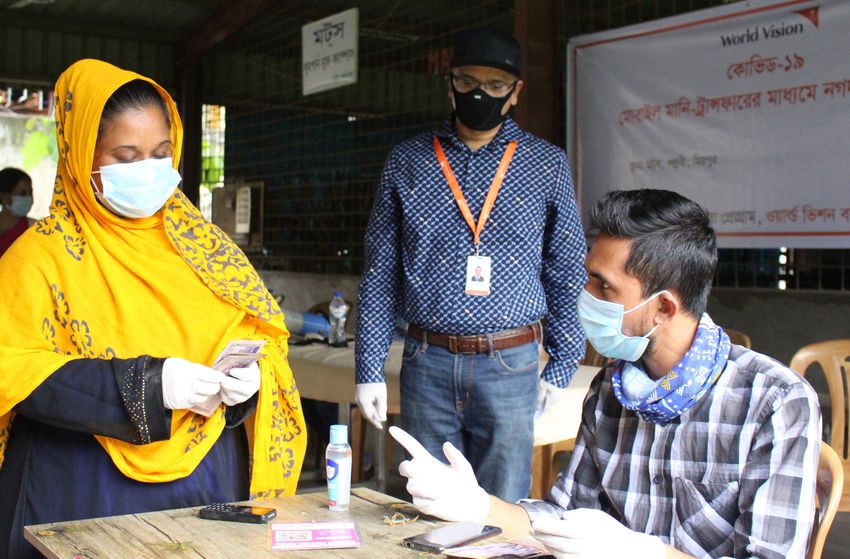
Bangladesh: Laboni, 26, a single mother of three receiving cash support from Mobile Money Transfer agent at a World Vision distribution centre.
Photo Credit:World Vision 6World Vision Policy Brief | COVID-19 & Poverty and Hunger
COVID-19 | EMERGENCY RESPONSE PLAN PHASE 2
1
According to the World Bank, extreme poverty is defined as those living on less than $1.90 a day
2
ILO Monitor 1st Edition: COVID-19 and the world of work: Impact and policy responses (18 March 2020)
3
Beegle, Kathleen; Christiansen, Luc. 2019. Accelerating Poverty Reduction in Africa. Washington, DC: World Bank.
4
Ibid
5
United Nations, Shared Responsibility, Global Solidarity: Responding to Socio Economic Impact of COVID-19 (March 2020).
6
ILO Monitor 4th Edition. COVID-19 and the world of work (May 22, 2020)
7
ILO Monitor: COVID-19 and the world of work. 4th edition (27 March 2020)
8
Korkoya and Wreh (2015): Ebola Impact Revealed: An Assessment of the Differing Impact of the Outbreak on Women and Men in Liberia
9
United Nations, ibid
10
FAO, Q&A: COVID-19 pandemic – impact on food and agriculture: http://www.fao.org/2019-ncov/q-and-a/en/
11
Aftershocks: Out of Time, World Vision International, July 2020
12
Global Food Crises Report 2020, https://www.wfp.org/publications/2020-global-report-food-crises
13
FAO, WFP, UNICEF, WHO, IFAD (2019) State of food insecurity in the World 2019
14
WFP Executive Director Statement to the UN Security Council 21 April 2020 https://www.wfp.org/news/wfp-chief-warns-hunger-pandemic-covid-19-spreads-state-
ment-un-security-council
15 Vision Fund International (VFI). 2020: COVID-19 Client Impact in West Nile, Uganda. https://www.visionfund.org/stories/impact-covid-19-refugee-sav-
ing-groups-uganda
16
United Nations. Policy Brief: The Impact of COVID-19 on children (15 April 2020) https://unsdg.un.org/sites/default/files/2020-04/160420_Covid_Children_Poli-
cy_Brief.pdf
17
Timothy Roberton et al. (2020). Early estimates of the indirect effects of the COVID-19 pandemic on maternal and child mortality in low-income and middle-in-
come countries: a modelling study. Lancet Global Health May 12, 2020
18
Data on the global monitoring of school meals during COVID-19 school closures is updated frequently here
19
According to the World Bank, social safety nets include cash or in-kind transfers, social pensions, public works, and school feeding programs targeted to poor and
vulnerable households.
20 World Bank https://www.worldbank.org/en/topic/safetynets
21
ILO-UNICEF. Towards universal social protection for children: Achieving SDG 1.3 (6 February 2020)
22
These figures were extrapolated from the results of an early recovery rapid assessment of over 14,000 households in World Vision programmes in nine coun-
tries in the Asia region. See the methodology in the Aftershocks: Out of Time report11 https://www.wvi.org/publications/report/coronavirus-health-crisis/after-
shocks-out-time, World Vision International, July 2020
23
Based on World Vision’s survey of 392 migrants in seven countries in Latin America. See the methodology in Aftershocks: Out of Time report
24
FAO (2018) Ending extreme poverty in rural areas: sustaining livelihoods to leave no-one behind. Food and Agriculture Organisation. Rome
25
IFPRI (2020) Global Food Policy Report. Washington DC
26 “Delivering food to half million people in South Sudan’s remote communities was made even tougher by COVID-19,” World Vision, April 2020: https://www.wvi.
org/stories/south-sudan/delivering-food-half-million-people-south-sudans-remote-communities-was-made
27
A savings group is a voluntary group of 15-25 members who save together in a safe, convenient and flexible way and lend out savings as credit to improve business-
es or cope with household emergencies. S4T groups assist poor households to increase financial assets and build resilience to shocks.
28
For example, in a recent review of savings groups in Somalia, membership in a savings group was identified as a key factor in household resilience to shocks
https://wvusstatic.com/2018/SomReP_Positive_Deviance_Study_Report.pdf
29
https://mangotree.org/Resource/Savings-Groups-and-COVID-19
30
FCPA pilot countries: Afghanistan, Burundi, Democratic Republic of Congo, El Salvador, Guatemala, Honduras, Iraq, Mali, Mexico, South Sudan.
31
World Vision International (2016) Still Surviving Ebola: Emergency and Recovery Response in Sierra Leone.
32
Breaking the Chains of Poverty with Empowered World View, World Vision, 2017: https://www.wvi.org/tanzania/publication/breaking-chains-poverty-empow-
ered-world-view
33
FAO. 2020. Covid-19 And The Risk To Food Supply Chains: How To Respond? Rome. Https://Doi.Org/10.4060/Ca8388en
34
The poorest two-thirds of the economic human pyramid, a group of more than four billion people living in abject poverty.
World Vision is undertaking the largest humanitarian response in its 70-year history to limit the spread of COVID-19 and reduce its
impact on vulnerable children and their families, aiming to reach 72 million people, half of them children, over the next 18 months
and raising US $350 million to do so. Response efforts will cover 70 countries where World Vision has a field presence, prioritising
scale up of preventative measures to limit the spread of the disease; strengthening health systems and workers; supporting children
impacted by COVID-19 through education, child protection, food security, and livelihoods; and advocating to ensure vulnerable
children are protected. For more information, read World Vision’s COVID-19 Emergency Response Plan.
World Vision is a Christian relief, development and advocacy organisation dedicated
to working with children, families, and their communities to reach their full potential
by tackling the root causes of poverty and injustice. World Vision serves all people,
regardless of religion, race, ethnicity, or gender.
www.wvi.org
For further information please contact:
Angeline Munzara Sheri Arnott
Senior Advisor, Livelihoods Director of Policy, Disaster Management
External Engagement sheri_arnott@wvi.org
angeline_munzara@wvi.org
7You can also read


