COVID-19 situation report for the Western Pacific Region - WPRO IRIS
←
→
Page content transcription
If your browser does not render page correctly, please read the page content below

COVID-19 situation report for the Western
                    Pacific Region
                          External Situation Report #02
                          Period of report: 6 May - 12 May 2020

        Since 31 December 2019, the WHO Regional Office for the Western Pacific (WPRO) has been responding to
        the outbreak that would eventually become the COVID-19 pandemic. WHO is working with countries across
        the Region, analyzing the latest data and science, informing and engaging the public, providing updates on
        the current situation, coordinating with partners, distributing life-saving supplies, advancing preparedness
        and strengthening health systems. This weekly situation report highlights the most recent developments in
        the regional response.

WEEKLY SITUATION UPDATE

    ●   In the Western Pacific Region, a total of 19 countries and areas have reported COVID-19 cases since December
        2019. Between 6 and 12 May 2020, there has been an increase of 8,004 cases including 240 deaths reported
        in the region, bringing the cumulative total to 161,872 cases including 6,527 deaths (PFC 4.0%), as of 12 May
        2020, 10:00 (GMT+8). Figure 1 shows the geographical distribution of COVID-19 cases. The colour represents
        the number of cases reported in the last 7 days.
    ●   Globally, as of 11 May 2020, 10:00 CEST, there have been 4,006,257 COVID-19 cases including 278,892 deaths
        in 214 countries/states/territories (7.0% PFC). Many countries that have experienced large outbreaks have
        also reported considerable excess mortality. Although AMRO and EURO are the most affected regions,
        accounting for 80% of all cases and 93% of deaths reported globally, an upward trend continues in AFRO,
        EMRO and SEARO.

    Figure 1. Countries, areas or territories with reported confirmed cases of COVID-19, 12 May 2020 10:00 (GMT+8)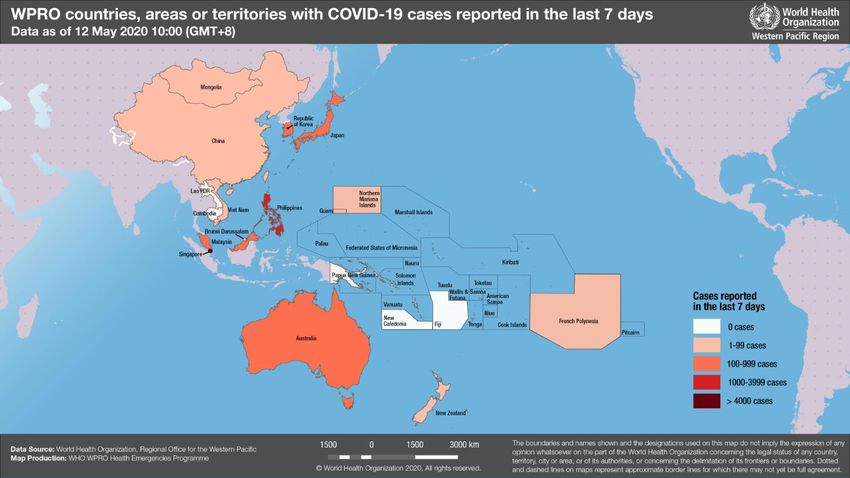
HIGHLIGHTS OF THE WEEK

    ●   WHO has been supporting Pacific Island countries and territories to respond and to simultaneously prepare,
        prepare, prepare. Through a COVID-19 Pacific Joint Incident Management Team (JIMT), WHO is coordinating
        with partners to bring together resources and to assist Pacific Island countries and territories’ readiness to
        delay and control the spread of the virus. This includes mobilizing additional contact tracing and rapid
        response teams, strengthening testing capacity, and supporting countries and territories to implement
        physical distancing and other non-pharmaceutical interventions (NPIs) early on.
    ●   The arrival of 2 million surgical masks has replenished the regional stockpile. The Operational Support and
        Logistics (OSL) team continues creating and dispatching kits of essential items, comprising of personal
        protective equipment (PPE) and finger pulse oximeters, to be dispatched to priority countries. Over the past
        week, items dispatched include 954 goggles, 1 215 face shields, 575 000 surgical masks, 2 195 respirators,
        65 280 examination gloves, 672 gowns, 555 hand sanitizer bottles and 500 finger pulse oximeters.
    ●   In the past week, national response plans from the Marshal Islands, Federated States of Micronesia, Mongolia,
        Papua New Guinea, Philippines, Samoa and Viet Nam were uploaded to the Partners Platform.
    ●   A further 13 consultants were added to the response efforts in the region, including deployments to Papua
        New Guinea and the Philippines. The HR plan has been updated and focus has shifted to ensuring capacity can
        be maintained until December 2020.

WPRO ACTIONS
    Leadership and Management

    ●   The Incident Management Support Team (IMST) comprises of six pillars: Information & Planning, Health
        Service Delivery, Partner Coordination, Strategic Communications, Finance & Administration, and Operations
        Support and Logistics; with focal points for all critical functions identified.
    ●   The IMST convenes twice daily for pillar and country updates as well as dissemination of relevant, response-
        critical information.
    ●   The Regional human resource plan was updated this week to ensure a sustained response in the Region for
        the rest of 2020. Constant and frequent changes to travel restrictions continue to cause difficulty in deploying
        technical support to countries.

    Finance and Administration

    ●   Thirteen consultancy contracts have been processed in the past week, bringing the total deployments to 136.
        Ongoing travel restrictions continue to limit the provision of in-country support but remote support is being
        provided when travel is not possible.
    ●   WPRO is finalizing distribution of available funding resources to eight country offices according to immediate
        country needs.

                                                                                                                           2
                                                                        External/Internal Situation Report #2
Health Service Delivery

Health Systems
● WPRO is exploring the potential impact of decreases in government revenue (due to the economic crisis and
   NPIs) on health, including support to country preparedness, health expenditure, supplementary budget
   planning, and public financial management policies for 2020 and 2021.

Community Engagement
● The Community Engagement team has sourced funding for three country offices, supporting them to engage
   with hard-to-reach and vulnerable populations. This funding will be used for two-way communication through
   multiple trusted channels, as well as to strengthen and leverage existing networks and empower communities
   to initiate ground-up solutions to existing challenges.

Infection Prevention and Control (IPC) and Clinical Management
● The Western Pacific Regional IPC network, established in March 2020, now has over 285 members
    representing 27 countries. Network members are invited to webinars conducted with regional IPC experts
    from WHO and partner institutions. Webinar sessions host more than 170 participants per session and topics
    are based on requests received from countries.
● WPRO is developing a set of audit tools to assess IPC clinical processes in health care facilities, including triage
    and isolation areas. This work is a product of a virtual IPC consultation with Bach Mai Hospital, Hanoi, Viet
    Nam, supported by WHO Viet Nam, and will be used to support health care facilities across the region.

Laboratory
● Between 7 and 12 May, the Laboratory team organized shipments of 70 000 swabs and virus transport
   medium to Brunei, Cambodia, Fiji, Laos, Malaysia, Mongolia, PNG, Philippines, Viet Nam, French Polynesia.
   Twenty thousand swabs and universal transport medium have been sent to Australia to be delivered to Pacific
   Island countries and territories to support swift testing of COVID-19.

Mental Health
● In collaboration with partners, WPRO supported the adaptation and translation of “My Hero is You”, a
  children’s story book for ages 6-11 in several countries in our Region. The additional languages include
  Tagalog, Jarai, Cham, Mong, Khmer, Hoa, Ede and Phu Tai. The aim of the book is to help children learn how
  to cope and manage their emotions, as well as the psychosocial impact of Covid-19.
  https://interagencystandingcommittee.org/iasc-reference-group-mental-health-and-psychosocial-support-
  emergency-settings/my-hero-you

Information and Planning

Surveillance
● WPRO classifies transmission according to three categories: imported cases (stage 1)1, localised community
    transmission (stage 2)2 and large-scale community transmission (stage 3)3. Available data indicate most
    countries and areas in the Western Pacific Region are experiencing stage 1 or stage 2 transmission but have
    not seen stage 3 transmission. In most countries, the number of reported cases is decreasing, after the first

1
  Imported cases (stage 1): most cases have been acquired outside the location of reporting or are directly linked to imported cases, and the generation of
secondary cases is limited.
2
  Localized community transmission (stage 2): local transmission has been detected (i.e., cases cannot be linked to importation), but most sources of
infection are identified, and most cases are occurring within a defined geographical area.
3
  Large-scale community transmission (stage 3): cases cannot be easily linked to a source of infection, persons in the area are at high risk for infection.
                                                                                                                                                              3
                                                                                              External/Internal Situation Report #2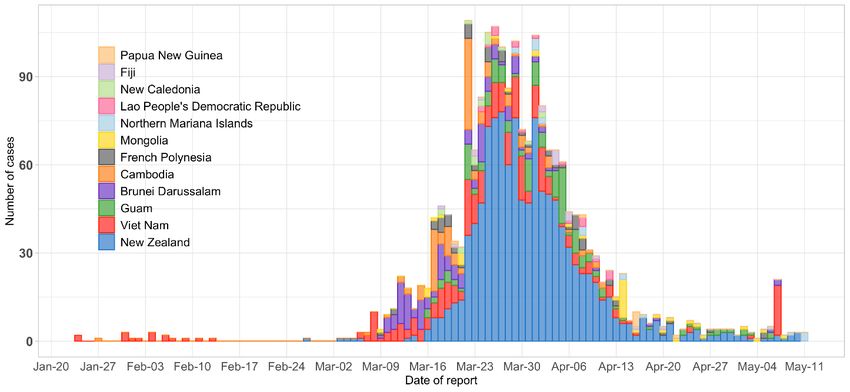
or second wave of cases. Several countries and areas are reporting low case numbers or no reported cases for
     more than seven days. Some countries are starting to lift their non-pharmaceutical interventions (NPIs).
●    The Information and Planning team is revising the regional dashboard and aims to include sub-national data
     on the epidemiology and healthcare capacity for all countries and areas in the region. Activities have
     continued to strengthen existing surveillance systems into a multisource assessment platform to detect cases,
     assess transmission, mobilize resources, and make decisions on NPIs.
●    WPRO is supporting COVID-19 responders in implementing Go.Data. Go.Data, managed by the Global
     Outbreak and Response Network (GOARN), is an online/offline outbreak investigation tool for field data
     collection during public health emergencies. The tool includes functions for case investigation, contact tracing,
     and visualization of chains of transmission. Around 30% of countries in the region are using Go.Data and there
     are ongoing actions and trainings in countries to support WHO country offices, governments and national
     institutions to implement the tool.

Table 1. Countries or areas with reported laboratory-confirmed COVID-19 cases and deaths, as of 12 May
2020, 10:00 (GMT+8) (n=161,872)
                   Country, territory,        Case                        Change in 7-day         Days since last
    WHO Region                                              Deaths
                         area               numbers                          average              reported case
                  China                      84,451          4,644              -1.42                         0
                  Australia                   6,948            97                3.3                          0
                  Brunei Darussalam            141             1                 0.4                          4
                  Cambodia                     122             0                   0                      30
                  CNMI                          19             2                 0.7                          0
                  Fiji                          18             0                   0                      21
                  French Polynesia              60             0                 0.3                          6
                  Guam                         147             5                 -0.7                         5
                  Japan                      15,874           643               -133.0                        0
      WPRO        Korea (Republic of)        10,936           258                6.4                          0
                  Lao PDR                       19             0                   0                      29
                  Malaysia                    6,726           109               -22.9                         0
                  Mongolia                      42             0                   0                          4
                  New Caledonia                 18             0                   0                      39
                  New Zealand                 1,147            21                -0.7                         1
                  Papua New Guinea              8              0                   0                      19
                  Philippines                11,086           726               -15.3                         0
                  Singapore                  23,822            21                98.4                         0
                  Viet Nam                     288             0                 2.3                          4

                                                                                                                         4
                                                                      External/Internal Situation Report #2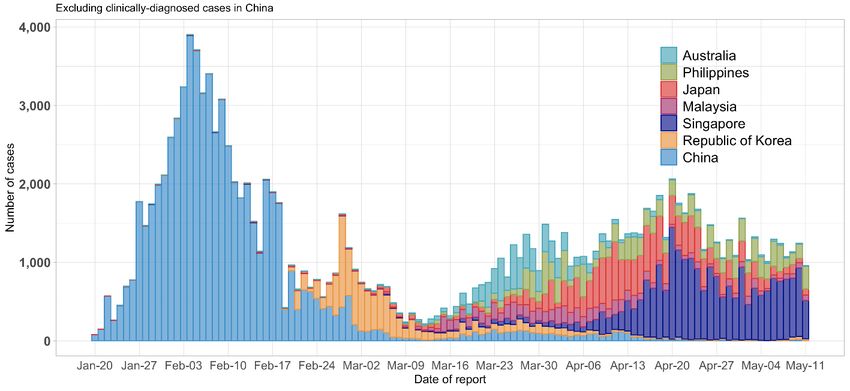
Figure 2. Epidemic curve of confirmed COVID-19 cases in countries >5000 cases, 12 May 2020, 10:00 (GMT+8)

Figure 3. Epidemic curve of confirmed COVID-19 cases in countries
Operations Support and Logistics

●   The arrival of 2 million surgical masks has replenished the regional stockpile. The Operational Support and
    Logistics (OSL) team continues creating and dispatching kits of essential items, comprising of personal
    protective equipment (PPE) and finger pulse oximeters, to be dispatched to priority countries. Over the past
    week, items dispatched include 954 goggles, 1 215 face shields, 575 000 surgical masks, 2 195 respirators,
    65 280 examination gloves, 672 gowns, 555 hand sanitizer bottles and 500 finger pulse oximeters.
●   The OSL team, together with the Partner Coordination pillar, is supporting WHO country offices to submit
    requests for critical supplies in the new Supply Portal.
●   Support is being provided to HQ in establishing distribution hubs in China to supply critical items globally,
    including to countries and areas in our region.

Partner Coordination

●   A Supply Portal has been added to the COVID-19 Partners Platform to streamline procurement and
    distribution of essential supplies. WPRO continues to work closely with HQ to support countries in utilizing
    the COVID-19 Partners Platform and Supply Portal. In the past week, national response plans from the Marshal
    Islands, Federated States of Micronesia, Mongolia, Papua New Guinea, Philippines, Samoa and Vietnam were
    uploaded to the Partners Platform.

Strategic Communication

●   WPRO, working alongside country offices and partners, is supporting countries to communicate the “new
    normal” - that is the way society will function in the mid- to long-term until an effective vaccine is developed
    for COVID-19 or the pandemic comes to an end. The first phase of this support includes:
           o Key messages to help leaders explain the new normal to the public
           o A content plan (e.g. materials on back to work, back to school etc)
           o A webinar on 13 May in which 71 participants came together to share best practices across
                countries
●   New materials are available on:
           o Staying healthy while working from home
           o Combatting stigma
           o Shopping safely during the COVID-19 pandemic and making smart food choices

                                                                                                                       6
                                                                    External/Internal Situation Report #2
MESSAGES FOR THE PUBLIC
Stigma and discrimination towards one
person is a risk to all people. Let’s support our
family, friends, neighbours and frontline
responders in the fight against COVID-19.
#SolidarityNotStigma
More WHO advice for the public on COVID-19
7
External/Internal Situation Report #2ANNEX 1: QUARANTINE BY COUNTRY
Information available to WHO WPRO as of 15 May 2020
Country Scope Duration Modality Enforcement
Australia* (1) All travellers entering the country 14 days Quarantine at designated facility State and Territory health and
(limited exceptions apply) (2) (such as a hotel) for 14 days law enforcement authorities.
Penalties include fines, and
Interstate travellers arriving in 14 days Quarantine at home or other imprisonment in some
Queensland (3), Northern Territory (4) residential premises jurisdictions
South Australia (5), Western Australia
(6), or Tasmania (7) (exemptions apply Certain arrivals in Northern
for certain persons, including essential Territory, Western Australia, and
service personnel) Tasmania may be directed to
quarantine at a designated facility
Close contacts with confirmed or 14 days since exposure Quarantine at home or other
probable cases residential premises, unless
otherwise directed
Close contact defined as over 15
minutes face-to-face contact or sharing
of closed space for prolonged period
(e.g. >2hrs) in the period extending 48
hours before onset of symptoms in
confirmed or probable case (8)
Brunei All arriving travellers (citizens and 14 days Remain at their primary place of Imprisonment up to a period of
Darussalam foreigners) are required to self-isolate. residence 6 months, or a fine up to
(11) They will be served a Self-Isolation B$10,000, or both
Notice at the border control post
China In bound travellers without any 14 days Within the 14 days, they can choose The quarantine will be enforced
symptoms shall be under centralized to take PCR tests on the 3rd and 5th by local law enforcement
quarantine in designated facilities for 14 days and take IgM test on the 5th department
days unless exceptional situations (12) day
8
External/Internal Situation Report #2If all three results are negative, they
can be transferred after 7 days from
centralized quarantine to home
quarantine for another 7 days
In bound travellers confirmed as 14 days If an asymptomatic person develops The quarantine will be enforced
asymptomatic infection shall be under clinical symptoms, then he/shall be by local law enforcement
centralized quarantine in designated transferred to designated hospital department
facilities for 14 days (13) for treatment; if still asymptomatic
and test result is positive, then
quarantine continues
With two consecutive negative PCR
test results (at least 24 hours in
between), the asymptomatic person
can be discharged from quarantine
2 and 4 weeks after discharged from
centralized quarantine, follow-up
medical checks at designated
hospital are required
Close contacts of suspected and 14 days Centralized quarantine in designated The quarantine will be enforced
confirmed cases, or sick with symptoms facilities for 14 days. by local law enforcement
(14) department
If the traveller is sick with symptoms,
he/she shall be transferred to
designated health facilities for
medical observation or treatment
For domestic travel a range of Arrangements depend Since April 29th, domestic travellers With mobile application, the
arrangements have been put in place of type of travel and from "COVID-19 low risk" areas to quarantine will be enforced by
depending on the location where travel itinerary Beijing will NOT need the 14 days of local law enforcement
is from and to which province (15) (16) home quarantine as long as they department
hold a ‘green’ health code. This
9
External/Internal Situation Report #2policy does not apply to travellers
from overseas, Hubei province, or
domestic "medium and high risk"
areas. Domestic travellers planning
to stay at hotels must present a
‘green’ health code
Effective on 11 May, residents of
Zhuhai City of Guangdong Province
who return from work in Macau
would NOT need 14-day centralized
quarantine, as long as they present
proof of their resident status of
Zhuhai, proof of their work in
Macau, negative NA test results in 7
days, and health declaration on APP
Hong Kong All travellers entering from the 14 days Compulsory quarantine at Spot-checks, telephone calls,
SAR, China Mainland, Macao or Taiwan, including designated places (home or other monitoring location of mobile
(17) Hong Kong and non-Hong Kong accommodation) device
residents
Quarantine centres are manned by Leaving premises can be
medical staff and prove to be more regarded as a criminal offense
effective in controlling people
movements and monitoring health
risks. However, capacity is a
constraint. A risk-based approach to
decide which groups merit a stay in
the centres is adopted.
All travellers entering from overseas 14 days All asymptomatic arrivals at Hong
(Arrivals holding a visa with validity of Kong International Airport will have
less than 14 days will be denied entry) to provide a pharyngeal saliva
sample which will be tested for
coronavirus.
10
External/Internal Situation Report #2Travellers will have to wait for test
results at a designated location such
as the Asia World Expo or the DH
Holding Centre for Test Result
(HCTR) set up in the Regal Oriental
Hotel if an overnight stay is required.
Compulsory quarantine at
designated places (home or other
accommodation)
Close contacts of positive case 14 days Close contacts will be sent to Spot-checks, telephone calls,
designated quarantine centres by monitoring location of mobile
ambulance and vehicles arranged by device
the Government.
Leaving premises can be
Medical surveillance will be arranged regarded as a criminal offense
for other contacts.
Japan All travellers entering from other 14 days (counting from Even without symptoms of illness, The test will be enforced by the
countries (19) the day after arrival) self-quarantine- to stay at Government
designated place such as their
homes and prevent from using Health Check will be proceeded
public transportation for any by public health centres.
purpose, including transport from
airports, etc. is requested.
Travellers who have visited any of
specified areas within 14 days before
arrival, they are required to take PCR
test. Even the test result being
negative, they are requested to self-
quarantine- to stay at designated
place such as your homes and need
to prevent from using public
transportation for any purpose,
11
External/Internal Situation Report #2including transport from airports,
etc. They are subject to periodic
health check by Public Health
Centres.
Close contacts of suspected and 14 days after last Self-quarantine, such as their homes
confirmed cases (20) exposed to the is requested. They are subject to
suspected / confirmed health check by Public Health
cases Centres
Korea, All travellers entering the country 14 days Self-Quarantine at home, hotel or Self-Quarantine
Republic of mandatory quarantine government designated facility for a Safety Protection Mobile App;
(24, 25) period of 14 days regular check-in with
government official
Possible contacts with no symptoms Until test results Self-Quarantine at home Local health worker
become available
Close contacts with no symptoms 14 days Self-Quarantine at home or Safety Protection Mobile App;
government designated regular check-in with
centre/hospital (only if home government official
quarantine is not possible)
Lao People’s All travellers entering the country 14 days Designated facility (a government Official notice of the National
Democratic mandatory quarantine facility or a designated hotel) for 14 Ab-hoc Committee and MOFA
Republic (26) days
Public health officers monitor
their health situation by visit or
phone call daily
Close contacts of positive case 14 days Quarantine at government Public health officers monitor
designated centre/hospital their health situation by visit or
phone call daily
12
External/Internal Situation Report #2There is no written order yet but
practice.
Malaysia (28) Malaysians, foreigners holding long- 14 days Mandatory quarantine centre Phone call and visits. Possibility
term passes, diplomatic and consular of arrest and fine/imprisonment
staff entering Malaysia for noncompliance
Close contacts with no symptoms 14 days Home or facility (government issued Phone call and visits. Possibility
checklist to determine whether a of arrest and fine/imprisonment
person has to be quarantined at for noncompliance
facility or at home)
Mongolia (29) All travellers entered the country 21 days Mandatory quarantine at designated Local health workers and law
(repatriated people) quarantine facility enforcement authorities
14 days Mandatory self-quarantine at home Policy documents:
after discharging from quarantine Law on COVID-19 pandemic
facility prevention
National interim guideline
Health care workers who provided 14 days Mandatory isolation at hospital
health service for confirmed cases
14 days Mandatory quarantine at designated
quarantine facility
Close contacts 14 – 21 days Mandatory quarantine at quarantine
facility from last contact with
confirmed cases
Contacts can self-quarantine at
home only if meet home quarantine
criteria
Suspected and probable cases 21 days Mandatory quarantine at designated
quarantine facility
13
External/Internal Situation Report #2New Zealand All travellers entering the country 14 days, unless medical For asymptomatic persons – Health authorities and law
(limited exceptions apply) (30) officer of health or managed facility enforcement. Penalties include
health protection officer fines and imprisonment
assesses further period For symptomatic persons –
required (up to quarantine facility Public may report breaches
maximum of 28 days) online
(31)
Close contact with a suspected, 14 days since last Quarantine at home or other Public health units and
confirmed or probable case (32) exposure residential premises Healthline monitor. Penalties
including fines and
Close contact defined as direct contact For close contacts with imprisonment may apply if a
with body fluids or laboratory suspected cases, 14 direction is given and breached
specimens, living in same household, days or until COVID-19
face-to-face contact or being in a closed ruled out Public may report breaches
environment within 2 metres for over online
15 minutes, among other things
Papua New All PNG citizens and permanent 14 days (day of arrival Designated facility at Port Moresby Joint Agency Task Force,
Guinea (33) residents to midnight on the (cost covered by government); National Operations Centre 19
fourteenth day after designated hotel at Port Moresby
arrival) (cost covered by individual)
All non-citizens and non-permanent 14 days (day of arrival Designated hotel at Port Moresby
residents to midnight on the (cost covered by individual)
fourteenth day after
arrival)
Philippines Repatriated OFs (Overseas Filipinos) 14 days RDT testing upon arrival as baseline Mandatory quarantine under
shall include OFWs (Overseas Filipino then to OWWA-designated the supervision of the OWWA
Workers) whether documented or Mandatory Quarantine Facility. If and the Philippine Coast Guard
undocumented and non OFWs such as logistics and supplies permit, RT-PCR (PCG)
returning students, scholars, exchange may be performed. All foreign
visitors and foreign nationals (diplomats national 9(e) visa holders and their
and tourists among others and their dependents may undergo RT-PCR
14
External/Internal Situation Report #2dependents) without the conditions for testing at their own expense. If RT-
stringent quarantine below (34) PCR testing result is negative then
allowed for 14-day home quarantine
For those who have not been
subjected to RT-PCR testing, shall
undergo RDT at the end of the 14-
day quarantine. Further actions will
depend of results
Sea-based OFs coming from a 14 days BOQ approved stringent quarantine Stringent quarantine shall be
ship/vessel classified as high risk by facility until the result of RT-PCR under the supervision of the
DOH-BOQ Repatriation Core Group testing (at the port of BOQ for the duration of the
entry/designated quarantine facility) quarantine period.
Land-based OFs and foreign nationals is released. Foreign nationals who
coming from a high-risk place of origin are holders of 9(e) visas and their
or lay-over dependents, may be allowed to stay
in a BOQ-approved hotel quarantine
Any individual OF or foreign national facility of their own choice and
who has been assessed to have expense. OFs and foreign nationals
influenza-like signs and symptoms by a who yield negative RT-PCR shall be
QMO upon arrival allowed to discontinue facility-based
stringent quarantine provided that
they undergo 14-day home
quarantine at their respective
domicile, residence or appropriate
local monitoring facilities.
Close Contacts (previously PUMs) (35) 14 days Home quarantine or at the Barangay Local Government
Temporary Treatment and Unit via the Barangay Health
Monitoring Facility Emergency Response Team
(BHERT)
15
External/Internal Situation Report #2All household members (36) Duration of the ECQ Strict home quarantine for all Local Government Unit
members of the household and
movement shall be limited to
accessing essential goods and
services, and for work in permitted
offices and establishments.
Any person below 21 years old and Duration of the GCQ or Shall be required to remain in their Local Government Unit
those 60 years old and above with ECQ residence at all times except when
immunodeficiencies, comorbidities and indispensable under the
other health risks and pregnant women circumstances of obtaining essential
goods and services and for work in
permitted industries and offices
Singapore (37) All citizens, permanent residents and 14 days Self-quarantine at dedicated stay- Video call and random visits.
long-term pass holders returning from home Possibility of arrest and
any country fine/imprisonment for
noncompliance
Close contacts with no symptoms 14 days Home or facility (if no suitable Video call and random visits.
accommodation available) Possibility of arrest and
fine/imprisonment for
noncompliance
Viet Nam (38, All travellers entering the country Mandatory 14-day Centralized quarantine or quarantine Mandatory isolation enforced
39, quarantine at home or workplace or designated by the law enforcement:
places of the companies for
diplomatic people, official visitors, Law on Prevention and Control
expatriate experts, business of Infection Diseases
managers
Samples collected at least 2 times in
14 days, the 1st time immediately
imported to Viet Nam, the 2nd time
before discharge from quarantine
facilities. If the RT-PCR test result is
16
External/Internal Situation Report #2negative with SARS-CoV-2, continue
quarantine until 14 days; if test
result is positive with SARS-CoV-2,
transport to designated
hospitals/departments for COVID-19
treatment.
Daily health monitored by health
staff from military health sector, or
district health centres during the
quarantine period
Close contact with suspected, Mandatory 14 days Centralized quarantine or quarantine
confirmed COVID-19 cases quarantined at hospitals
Samples collected at least 2 times in
14 days, the 1st time right after the
contact is identified, the 2nd time
before discharge from quarantine
facilities.
Those had contact with close contact of 14 days Self-monitored at home Mandatory isolation enforced
with suspected, confirmed COVID-19 by the law enforcement
cases
17
External/Internal Situation Report #2ANNEX 2: ISOLATION BY COUNTRY
Information available to WHO WPRO as of 15 May 2020
Isolation (e.g. mild, asymptomatic cases)
Country Scope Duration Modality Enforcement
Australia Confirmed and Until cleared in accordance with Home or other suitable location, State and Territory health and law
probable cases release from isolation criteria in unless treatment is required. enforcement authorities. Penalties include
national guidelines fines, and imprisonment in some
Except: Northern Territory – jurisdictions.
Confirmed asymptomatic cases – 10 hospital or other place for medical
days since first positive sample and no treatment (9)
symptoms have developed during
period
Confirmed or probable cases with mild
illness who did not require
hospitalization – at least 10 days have
passed since onset of symptoms and
resolution of all symptoms of acute
illness for the previous 72 hours
Confirmed or probable cases with
more severe illness who have been
discharged from hospital – (a) if ready
for discharge, 10 days since discharge
and resolution of all symptoms of
acute illness for the previous 72 hours;
(b) if swabs taken at or prior to
discharge, two consecutive swabs
taken at least 24 hours apart which
are negative for SARS-CoV-2 by PCR
Cases must meet additional criteria
before returning to high risk settings
18
External/Internal Situation Report #2(such as health and aged care
facilities)
Suspect cases Until negative test result, unless Home or other suitable location,
further testing and re-assessment unless treatment is required
required
Except: Northern Territory –
hospital or another specified place
(10)
Brunei Mild and Until no symptom and PCR negative Managed at National Isolation MOH SOP for Clinical Management of
Darussalam asymptomatic Centre COVID-19
(11) cases
China All cases Until discharge Hospital Mandatory isolation enforced by the law
(including mild enforcement department.
cases) Discharge criteria:
1) Body temperature is back to normal After discharge, it is recommended for
for more than three days patients to monitor their own health status
2) Respiratory symptoms improve in isolation for 14 days, wear a mask, live in
obviously well-ventilated single room if possible,
3) Pulmonary imaging shows obvious minimize close contact with family
absorption of inflammation members, separate dinning, practice hand
4) Nuclei acid tests negative twice hygiene and avoid going out. The patients
consecutively on respiratory tract should return to the hospitals for follow-up
samples such as sputum and and re-visit in two and four weeks after
nasopharyngeal swabs (sampling discharge.
interval being at least 24 hours)
Asymptomatic 14 days All asymptomatic cases shall be Mandatory isolation enforced by the law
infections managed in centralized isolation enforcement department
After 14 days of isolation, if two facilities
consecutive PCR tests results are
negative (24 hours in between two
tests), the patient can be discharged.
2 and 4 weeks after discharge, follow-
up medical check at designated
hospital is required.
19
External/Internal Situation Report #2After 14 days of isolation, if the PCR
tests are still positive and still
asymptomatic, isolation will
continue.
Hong Kong A positive case Until recovery (stable conditions, test Admission to a public hospital for Leaving hospital without discharge order or
SAR, China negative twice at a 24h interval) treatment permission can be regarded as a criminal
(18) offense
“StayHomeSafe” app for all residents
Japan (21, 22) All confirmed Until discharge Enforced isolation at hospitals. If Prefectures
cases the patient is asymptomatic and
Discharge criteria: improved without specified conditions such
symptoms (body temperature below as elderly, they can stay at
37.5℃ for 24hours and improved designated facilities or at home
respiratory symptoms) and PCR tests
negative twice at a 24 hours interval
Discharge criteria for asymptomatic
case: PCR tests negative twice at a 24
hours interval
Korea, Mild symptoms Until end of treatment/symptoms Living and Treatment Centre Facility health workers monitor using the
Republic of tested positive (48hr after final symptom, 2 PCR 24hrs app; check in with local health worker
(23) apart)
Moderate, Until end of treatment/symptoms Hospital Healthcare provider
severe, and (48hr after final symptom, 2 PCR 24hrs
extremely apart)
severe, tested
positive
Lao People’s Confirmed cases Until recovery Designated health facility Healthcare provider
Democratic
Republic (27)
Malaysia (28) Mild and Until no symptom and PCR Home or facility Health care providers regularly check
asymptomatic negative (at least 14 days of stay) health status. Possibility of arrest and
cases fine/imprisonment for noncompliance
20
External/Internal Situation Report #2Mongolia (29) All confirmed Until recovery Mandatory isolation at designated Local health workers and law enforcement
cases (including hospital authorities
asymptomatic Discharge criteria:
and mild cases) 1. test results were negative in Policy documents:
samples collected 3 consecutive Law on COVID-19 pandemic prevention
days (nasopharyngeal, sputum, National interim guideline
blood, feces, urine and pharyngeal
swabs etc.) sampling interval
should be at least 24 hours
2. Clinical recovery
14 days Mandatory quarantine at
quarantine facility after discharge
from hospital
14 days Mandatory self-quarantine at
home after discharge from
quarantine facility
New Confirmed, For suspected cases – if negative test, Isolation at home or other Health authorities monitor. Penalties
Zealand (32) probable and until 48 hours after symptoms resolve residential premises, unless including fines and imprisonment may
suspected cases hospitalized apply if a direction is given and breached
For confirmed and probable cases
with mild illness who did not require Public may report breaches online
hospitalization – 10 days since onset
of symptoms and resolution of all
symptoms of acute illness for previous
48 hours
For confirmed and probable cases
with more severe illness who have
been discharged from hospital – 10
days since discharge, resolution of all
symptoms of acute illness for 48
hours, and they do not have major
immunosuppression (in which case
specialist advice is sought)
21
External/Internal Situation Report #2Philippines OFs (defined in Until cleared for discharge plus 14- Transferred from the Stringent Coordinated by the DOH – Health
the quarantine days quarantine facility to a referral Emergency Management Bureau (HEMB)
above) or hospital or a Temporary Treatment
foreign and Monitoring Facility (TTMF) for
nationals who medical management in
yield positive to accordance to DOH protocols and
RT-PCR testing once cleared for discharge shall
(34) undergo 14-day home quarantine
Suspect, 14 days Temporary Treatment or TTMFs managed by LGUs supported by
Probable or Monitoring Facility or DOH
Confirmed Level 1 Hospital / Infirmary
COVID-19 case or
(35) Home isolation provided with
clearance from attending physician
Clinically 14 days Temporary Treatment or TTMFs managed by LGUs supported by
recovered Monitoring Facility or Level 1 DOH
Suspect, Hospital / Infirmary selected for
Probable and Step-down care
Confirmed
COVID-19 cases
(35)
Singapore (37) Mild and Until no symptom and PCR negative Hospital or isolation facility Health care providers regularly check
asymptomatic health status. Possibility of arrest and
fine/imprisonment for noncompliance
“TraceTogether” app for all residents
Foreign workers A total of 25 dormitories have now
involve young been gazetted as isolation areas
and healthy
men who are
either
asymptomatic
or mild, and do
22
External/Internal Situation Report #2not require
hospitalization
Viet Nam (38, All COVID-19 Until discharge Designated hospitals/department Mandatory isolation enforced by the law
39) positive cases of hospital for COVID-19 isolation enforcement department.
Discharge from hospital if stable and treatment
conditions, no symptom, two
consecutive PCR tests results are
negative (24 hours in between two
tests)
Free treatment for Vietnamese
citizens, covered by health insurance,
for those without health insurance,
covered by government budget
23
External/Internal Situation Report #2ANNEX 3: REFERENCES TO ANNEX 1 & 2
Quarantine separates and restricts the movement of people who were exposed to a contagious disease to
see if they become sick. Isolation separates sick people with a contagious disease from people who are not
sick.
AUSTRALIA
*COVID-19 quarantine measures in Australia are administered by State and Territory governments. While
similar measures are being implemented across the country, there are jurisdictional differences, some of
which are noted.
1. Department of Health. Series of National Guidelines – Coronavirus Disease 2019 (COVID-19) CDNA
National Guidelines for Public Health Units (Version 2.10). Canberra: Commonwealth of Australia;
May 2020 (https://www1.health.gov.au/internet/main/publishing.nsf/Content/cdna-song-novel-
coronavirus.htm; accessed 14 May 2020).
2. Department of Health. Coronavirus (COVID-19) advice for travellers. Canberra: Commonwealth of
Australia; 2020 (https://www.health.gov.au/news/health-alerts/novel-coronavirus-2019-ncov-health-
alert/coronavirus-covid-19-advice-for-travellers; accessed 13 May 2020).
3. Border Restrictions Direction (No. 5). Queensland: Queensland Health; 2020
(https://www.health.qld.gov.au/system-governance/legislation/cho-public-health-directions-under-
expanded-public-health-act-powers/border-restrictions; accessed 13 May 2020).
4. COVID-19 Directions (No. 22) 2020 – Directions for Territory Border Restrictions. Northern Territory:
Northern Territory of Australia; 2020
(https://coronavirus.nt.gov.au/__data/assets/pdf_file/0004/819670/cho-22-directions-directions-for-
territory-border-restrictions.pdf; accessed 13 May 2020).
5. Emergency Management (Cross Border Travel No 4) (COVID-19) Direction 2020. South Australia: State
of South Australia; 2020 (https://www.covid-
19.sa.gov.au/__data/assets/pdf_file/0007/196657/Cross-Border-Travel-Direction-2020-No.4.pdf;
accessed 13 May 2020).
6. Quarantine (Closing the Border) Directions. Western Australia: State of Western Australia; 2020
(https://www.wa.gov.au/sites/default/files/2020-
04/Quarantine%20%28Closing%20the%20Border%29%20Directions_0.pdf; 13 May 2020).
7. Emergency Management Act 2006 – Directions in relation to persons arriving in Tasmania. Tasmania:
State of Tasmania; 2020
(https://coronavirus.tas.gov.au/__data/assets/pdf_file/0032/88088/Persons-arriving-in-TAS.pdf;
accessed 13 May 2020).
8. Self-isolation (self-quarantine) for coronavirus (COVID-19). Canberra: Department of Health.
Commonwealth of Australia; 2020 (https://www.health.gov.au/news/health-alerts/novel-
coronavirus-2019-ncov-health-alert/how-to-protect-yourself-and-others-from-coronavirus-covid-
19/self-isolation-self-quarantine-for-coronavirus-covid-19; accessed 13 May 2020).
9. COVID-19 Directions (No. 7) 2020 – Directions for Territory Border Restrictions. Northern Territory:
Northern Territory of Australia; 2020
(https://coronavirus.nt.gov.au/__data/assets/pdf_file/0011/809246/CHO-Directions-No-7-Directions-
for-Infected-Persons-SIGNED.pdf; accessed 13 May 2020).
10. COVID-19 Directions (No. 21) 2020 – Directions for Territory Border Restrictions. Northern Territory:
Northern Territory of Australia; 2020
(https://coronavirus.nt.gov.au/__data/assets/pdf_file/0006/814848/cho-directions-no21-directions-
for-potentially-infected-persons.pdf; accessed 13 May 2020).
BRUNEI DARUSSALAM
11. Stay informed, stay protected against Coronavirus Disease 2019 (COVID-19). Brunei Darussalam:
Ministry of Health; 2020 (http://www.moh.gov.bn/SitePages/COVID-19.aspx; accessed 13 May 2020).
24
External/Internal Situation Report #2CHINA
12. Press Conference of the Joint Prevention and Control Mechanism of the State Council. Beijing: Central
Government of China; 2020 (http://www.gov.cn/xinwen/2020-04/13/content_5502041.htm;
accessed 13 May 2020).
13. Management Specifications of Asymptomatic Infections of COVID-19 issued by the Joint Prevention
and Control Mechanism of the State Council. Beijing: Central Government of China; 2020
(http://www.gov.cn/zhengce/content/2020-04/08/content_5500371.htm; accessed 13 May 2020).
14. The 4th edition of COVID-19 Prevention and Control Plan released by NHC. China: National Health
Commission; 2020
(http://www.nhc.gov.cn/jkj/s3577/202002/573340613ab243b3a7f61df260551dd4.shtml; accessed
13 May 2020).
15. COVID-19 press conference on 29 April of Beijing Municipality. Beijing: Information Office of the
Beijing Municipal People's Government; 2020
(http://www.beijing.gov.cn/shipin/Interviewlive/231.html; accessed 13 May 2020).
16. Zhuhai City COVID-19 Prevention and Control Headquarters announcement. Guangzhou: Xinhua
News; 2020 (http://www.gov.cn/xinwen/2020-05/09/content_5510295.htm; accessed 13 May 2020).
HONG KONG SAR
17. Home quarantine for inbound travellers - frequently asked questions. Hong Kong: Government of
Hong Kong; 2020 (https://www.coronavirus.gov.hk/eng/inbound-travel-faq.html; accessed 13 May
2020).
18. Patient discharge criteria explained. Hong Kong: Government of Hong Kong; 2020
(https://www.news.gov.hk/eng/2020/02/20200212/20200212_180053_610.html?type=ticker;
accessed 13 May 2020)
JAPAN
19. Novel Corona Virus Quarantine Q & A. Tokyo: Ministry of Health, Labour and Welfare; 2020
(https://www.mhlw.go.jp/stf/seisakunitsuite/bunya/kenkou_iryou/covid19_qa_kanrenkigyou_00001.
html#Q1-1; accessed 14 May 2020)
20. Guidance for Active epidemiological investigation of COVID-19 patients (Tentative Edition as of 20
April 2020). Japan: National Institute of Infectious Diseases; 2020
(https://www.niid.go.jp/niid/images/epi/corona/2019nCoV-02-200420.pdf; accessed 14 May 2020)
21. Regarding discharge criteria and restriction on work of COVID-19 patients. Tokyo: Ministry of Health,
Labour and Welfare; 2020 (https://www.mhlw.go.jp/content/000618523.pdf; accessed 14 May 2020)
22. Regarding preparation for the framework for COVID-19 asymptomatic cases staying at facilities or
homes. Tokyo: Ministry of Health, Labour and Welfare; 2020
(https://www.mhlw.go.jp/content/000618525.pdf; accessed 14 May 2020)
REPUBLIC of KOREA
23. Korea’s Response to COVID-19 and Future Direction. Korea: Central Disaster Management
Headquarters; 2020
(http://ncov.mohw.go.kr/en/infoBoardView.do?brdId=15&brdGubun=151&dataGubun=&ncvContSe
q=2187&contSeq=2187&board_id=&gubun=; accessed 13 May 2020).
24. 30 March 2020 COVID-19 press release, briefing by Central Disaster and Safety Countermeasures
Headquarters. Korea: Ministry of Health and Welfare; 2020
(http://ncov.mohw.go.kr/tcmBoardView.do?brdId=&brdGubun=&dataGubun=&ncvContSeq=353800
&contSeq=353800&board_id=&gubun=ALL; accessed 13 May 2020).
25
External/Internal Situation Report #225. COVID-19 response action plan for local governments. Korea: Ministry of Health and Welfare. Central
Disease Control Headquarters. Central Disaster Management Headquarters; 2020
(http://ncov.mohw.go.kr/duBoardList.do?brdId=2&brdGubun=28; accessed 13 May 2020).
LAO PEOPLE’S DEMOCRATIC REPUBLIC
26. Guideline on Travelling in and out Lao PDR during the period of Monitoring, Controlling and
Prevention of COVID 19 issued 11 May 2020. Vientiane: Ministry of Foreign Affairs National COVID-19
Task Force; 2020.
27. Clinical management of patients with novel coronavirus disease (COVID-19): Guidance for Lao PDR.
Vientiane: Ministry of Health; 2020.
MALAYSIA
28. COVID-19. Malaysia: Ministry of Health; 2020
(https://www.moh.gov.my/index.php/pages/view/2019-ncov-wuhan-guidelines; accessed 15 May
2020).
MONGOLIA
29. Updated National Interim Guideline (A269, approved on 29 April 2020); Mongolia: Ministry of Health;
2020
NEW ZEALAND
30. COVID-19 – Border Controls. New Zealand: Ministry of Health. New Zealand Government; 2020
(https://www.health.govt.nz/our-work/diseases-and-conditions/covid-19-novel-coronavirus/covid-
19-current-situation/covid-19-border-controls; accessed 15 May 2020).
31. Section 70(1)(e), (ea), and (f) Health Act Order – 9 April 2020. New Zealand: Ministry of Health; 2020
(https://covid19.govt.nz/assets/resources/legislation-and-key-documents/COVID-19-Section-70-
order-9-April-2020.pdf; accessed 15 May 2020), as extended on 8 May 2020
(https://covid19.govt.nz/assets/resources/legislation-and-key-documents/COVID-19-Section-70-
amendment-and-extension-8-May-2020.pdf; accessed 15 May 2020).
32. Updated advice for health professionals: novel coronavirus (COVID-19). New Zealand: Ministry of
Health. New Zealand Government; 2020
(https://www.health.govt.nz/system/files/documents/pages/updated-advice-for-health-
professionals-covid-19-16-aprilv3.pdf; accessed 15 May 2020).
PAPUA NEW GUINEA
33. National Emergency Order 25. Papua New Guinea: Joint Agency Task Force National Operations
Centre 19; 2020 (https://covid19.info.gov.pg/; accessed 13 May 2020).
PHILIPPINES
34. Department Memorandum 2020-0200. Omnibus Interim Guidelines for the Quarantine and Testing
Procedures for all Arriving Overseas Filipinos and Foreign Nationals During the COVID-19 Pandemic.
Manila: Department of Health; 2020 (http://poloosaka.dole.gov.ph/wp-
content/uploads/2020/05/DOH-Department-Memorandum-No-2020-0200.pdf; accessed 13 May
2020).
35. Department Memorandum 2020-0178 Interim Guidelines on the Health Care Provider Networks
during the COVID-19 Pandemic. Manila: Department of Health; 2020
(https://www.doh.gov.ph/node/21259; accessed 13 May 2020).
36. Executive Order. No 112 Imposing Enhanced Community Quarantine in High Risk Geographic Areas of
the Philippines and A General Community Quarantine in the Rest of the Country and Adopting the
Omnibus Guidelines. Manila: The President of the Philippines; 2020
(https://www.officialgazette.gov.ph/downloads/2020/04apr/2020030-EO-112-RRD.pdf; accessed 13
May 2020).
26
External/Internal Situation Report #2SINGAPORE
37. Updates on COVID-19 (Coronavirus Disease 2019) Local Situation. Singapore: Ministry of Health; 2020
(https://www.moh.gov.sg/covid-19; accessed 15 May 2020).
VIET NAM
38. Directives of the Prime Minister number 5 (issued on 28 Jan), 6 (issued on 31 Jan), and 10 (issued on
25 Feb). Viet Nam; 2020 (http://emohbackup.moh.gov.vn/publish/home; accessed 15 May 2020).
39. Official letter from National Steering Committee number 688 on 24 Feb, 991 on 29 Feb, and 1440 on
20 Mar. Viet Nam; 2020 (http://emohbackup.moh.gov.vn/publish/home; accessed 15 May 2020).
27
External/Internal Situation Report #2You can also read


