Development of a Standard Moodle Course to Optimize the Teacher's Work in Distance Education
←
→
Page content transcription
If your browser does not render page correctly, please read the page content below
Universal Journal of Educational Research 8(12): 6659-6666, 2020                                           http://www.hrpub.org
DOI: 10.13189/ujer.2020.081230

Development of a Standard Moodle Course to Optimize
      the Teacher's Work in Distance Education
        Iryna S. Mintii1, Svitlana V. Shokaliuk1, Tetiana A. Vakaliuk2,*, Olexandr V. Merzlykin3,
                                          Mykhailo M. Mintii1

  1
    Department of Computer Science and Applied Mathematics, Faculty of Physics and Mathematics, Kryvyi Rih State Pedagogical
                                                        University, Ukraine
 2
   Department of Software Engineering, Faculty of Information and Computer Technologies, Zhytomyr Polytechnic State University,
                                                             Ukraine
                 3
                   Kryvyi Rih Educational Complex No 129 "Gymnasium-Lyceum of Academic Approach", Ukraine

                         Received July 15, 2020; Revised August 13, 2020; Accepted November 19, 2020

Cite This Paper in the following Citation Styles
(a): [1] Iryna S. Mintii, Svitlana V. Shokaliuk, Tetiana A. Vakaliuk, Olexandr V. Merzlykin, Mykhailo M. Mintii ,
"Development of a Standard Moodle Course to Optimize the Teacher's Work in Distance Education," Universal Journal
of Educational Research, Vol. 8, No. 12, pp. 6659-6666, 2020. DOI: 10.13189/ujer.2020.081230.
(b): Iryna S. Mintii, Svitlana V. Shokaliuk, Tetiana A. Vakaliuk, Olexandr V. Merzlykin, Mykhailo M. Mintii (2020).
Development of a Standard Moodle Course to Optimize the Teacher's Work in Distance Education. Universal Journal of
Educational Research, 8(12), 6659-6666. DOI: 10.13189/ujer.2020.081230.
Copyright©2020 by authors, all rights reserved. Authors agree that this article remains permanently open access under
the terms of the Creative Commons Attribution License 4.0 International License

Abstract To minimize the time required for designing               Internet resources (finding out which Ukrainian
a Moodle course and to reduce the required level of ICT            pedagogical universities use LCMS Moodle), analysis of а
competence for learning content management system                  pedagogical experience of using LCMS Moodle, modeling
(LCMS) Moodle, we designed standard Moodle course                  (developing a model of standard Moodle course and its use
university and created video tutorials about how to design a       in the educational process), questionnaires (finding out
new Moodle course based on it. The purpose of this paper           whether the model meets the requirements of the
is to consider the structural and content features of the          educational process and the direction of further research).
standard Moodle course university and to review the
methodical instructions for designing a new Moodle course          Keywords Learning Content Management System
based on it. The reasonableness of the creation of a new           Moodle, Standard Course, Backup of the Course, Distance
Moodle course from a backup copy of the standard course            Education
university is substantiated in the work. This approach to
new courses designing eliminates two main factors that
impede using of Moodle in the educational process. When
a teacher has electronic training and methodological               1. Introduction
complex, this approach helps to minimize the time for
course designing. Using of such elements as "URL",                    Today it is very important to train teachers for using of
"Assignment" and "Quiz" reduces the minimal level of               distance technologies in the educational process. Today
teachers' information and communication technologies               there are such Ukrainian-language online educational
competence for work in Moodle. The basic principle of              platforms: "Action. Digital education" [11] – educational
building a standard course is the designing course as the          series "Digital skills for teachers" and "Quarantine: online
online portal. When course is built in this way, it helps not      services for teachers"; "For The Lesson" [12] – courses
to overload the Moodle server. Placing of electronic               "Teaching informatics through distance learning", "Class
learning and methodological complex components on                  Dojo and other feed-back tools", "Using Zoom service for
Google Drive creates the first backup of the course. The           distance lessons", etc. Also there are courses at higher
following methods were used in the research: analysis of           education institutions sites: National Technical University
6660 Development of a Standard Moodle Course to Optimize the Teacher's Work in Distance Education
"Kharkiv Polytechnic Institute" [10] – courses goals most efficiently" [18, p. 19].
"Technology of Distance Course Design 2020" and "Basics Depending on the technical capabilities of Universities
of Distance Learning 2020"; Zhytomyr Polytechnic State and the level of its' teaching staff, it is possible to combine
University [23] – Course "Cloud Technologies in Distance the following types of student learning activities under the
Learning During Quarantine" and others. guidance of the teacher in blended learning [21, p. 304]:
However, analysis of the such scientists as Yu.V. traditional workshops or seminars with video
Tryus[21; 20], V.M. Kukharenko [7], S.O. Semerikov[14; conferences and webinars;
15; 19], Ye.M. Smyrnova-Trybulska[16], etc. makes us to traditional lessons with their discussion at forums,
conclude that for higher education blended learning is more chats or using e-mail;
appropriate than distance learning: "blended learning is one group work on individual tasks with their discussion at
of the most promising innovation trends in higher the class;
education" [21, p. 299]. Internet lectures with workshops and labs at the class;
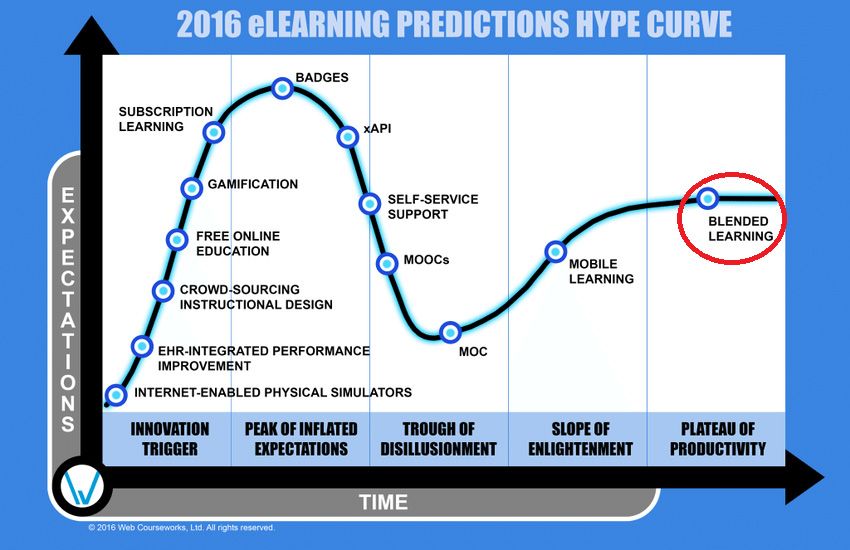
In 2016, Gartner analysts determined that blended lectures at the class and teachers' Internet consulting;
learning reached the plateau of productivity, and therefore individual tasks with sending results to the teacher via
matured, and its' benefits are undoubted [1] (Fig. 1). Internet services;
A.M. Striuk defines blended learning as "the way of implementation of role-playing games and research
realizing the content of learning that integrates classroom projects in the virtual environment at home or at class;
and online learning activities with pedagogically balanced other combinations of using the distance, electronic,
combination of traditional, electronic, distance and mobile mobile learning and traditional learning forms,
learning technologies with the aim to achieve learning methods and tools.
Figure 1. 2016 eLearning Predictions Hype CurveUniversal Journal of Educational Research 8(12): 6659-6666, 2020 6661
2. Materials and Methods Hnatiuk National Pedagogical University [42], Uzhhorod
National University [43], Vinnytsia Mykhailo
According to the European University Association Kotsiubynskyi State Pedagogical University [44],
report, 91% of universities use blended learning, 82% of Volodymyr Vynnychenko Central Ukrainian State
universities offer online courses, over 80% of universities Pedagogical University [45], Yuriy Fedkovych Chernivtsi
have repositories for storing e-courses and digital content, National University [46], Zhytomyr Ivan Franko State
and various systems for creating and managing educational University [47].
resources for students [3]. Teaching staff training to design Moodle courses in
Because of its' wide range of capabilities and simple Universities is carried out according to their own
interface, LCMS Moodle is one of the most popular educational trajectories: self-education using instructions
platforms for blended learning. The LCMS Moodle module in different formats (text, video) [4; 5; 8; 13; 20; 22],
structure makes it easy to modify the design. Another intensive trainings [40; 42], long-term courses on
Moodle advantage is the availability of more than 40 enhancing their ICT competence [9] and others.
language packages.
We designed survey "Using LCMS Moodle in the
As a result of the analysis of Internet resources, it is
University Educational Process" and did this research in
determined that the vast majority (86%) of Ukrainian
2019-2020. Its' results are:
Universities, which provide training in pedagogical
factors that hinder the use of LCMS Moodle in the
specialties, use LCMS Moodle. Among them are
educational process are the lack of time (48% of
Berdyansk State Pedagogical University [24], Bogdan
surveyed teachers) and low level of IT competence
Khmelnytsky Cherkasy National University [25], Borys
(29% of surveyed teachers);
Grinchenko Kyiv University [26], Donbass State
ways to increase the IT competence by using LCMS
Pedagogical University [27], H.S. Skovoroda Kharkiv
Moodle are self-education, communication with
National Pedagogical University [28], Ivan Franko Lviv
colleagues, IT courses, webinars, workshops,
National University [29], Kamianets-Podіlskyi National
Ivan Ohiienko University [30], Khmelnytskyi National seminars. The distribution of the respondents is
University [31], Kryvyi Rih State Pedagogical University shown at the Fig. 2;
[32], Kherson State University [33], Lesya Ukrainka ways to increase the use of LCMS Moodle in the
Eastern European National University [34], Luhansk Taras educational process are periodic seminars,
Shevchenko National University [35], Makarenko Sumy consultations on basic LCMS Moodle capabilities (as
State Pedagogical University [36], Mykolaiv V. O. an option, group or personal electronic appointment
Sukhomlynskyi National University [37], National with a qualified specialist); site stability; blended ICT
Pedagogical Dragomanov University [38], Pavlo Tychyna courses; development of methodological guidelines
Uman State Pedagogical University [39], Rivne State of using some elements in the educational process;
University of Humanities [40], Taras Shevchenko National creation of transparent, predictable and attractive for
University "Chernihiv College" [41], Ternopil Volodymyr authors license and course sample.
Figure 2. Ways to improve Moodle competencies6662 Development of a Standard Moodle Course to Optimize the Teacher's Work in Distance Education
To minimize the time required for designing a Moodle by the need of saving the documentation and materials for
course and to reduce the required level of ICT competence all kinds of activities, which are envisaged in the
for LCMS Moodle, we designed standard Moodle course curriculum of the discipline (lectures, laboratory,
university and created video tutorials about how to design a individual works, workshops) (Fig. 3). We recommended
new Moodle course based on it [6]. The principle of course placing tasks for every laboratory work or workshop in a
design will improve the site stability. separate folder – in this case, it is possible to supplement,
The purpose of this paper is to consider the structural modify and delete resources with constant URL to the tasks
and content features of the standard Moodle course in the Moodle course.
university and to review the methodical instructions for
designing a new Moodle course based on it. 3.3. Overview of the Structure of the Standard Moodle
The following methods were used in the research: Course University
analysis of Internet resources (finding out which Ukrainian
pedagogical universities use LCMS Moodle), analysis of а The General section contains:
pedagogical experience of using LCMS Moodle, modeling teacher information (surname, first name and contact
(developing a model of standard Moodle course and its use information);
in the educational process), questionnaires (finding out links to the curriculum or syllabus;
whether the model meets the requirements of the links to excerpts from curriculum (syllabus) – tables
educational process and the direction of further research). with lectures' topics, laboratory and/or practical
classes;
links to the theoretical content folder (lecture
3. Results materials, etc.);
links to the electronic journal of the academic group
(Moodle journal backup).
3.1. The Basic Principle of Designing
Three thematic sections were added to the course, which
The basic principle of designing the course is to consider in this case contain only assignments. Students respond to
course as an information portal. It means that this course the assignments by sharing links to the folder with the
contains educational materials from different sources. results of their work placed in the students' educational
Electronic learning management complex (ELMC) environments (student's Google Drive).
components placed in remote repositories. The main Also there are additional sections – giving extra points
remote repository is personal or departmental corporate and final control (for example, the lecturer gives extra
(and therefore unlimited) Google Drive [6]. Placing basic points if the student was present and showed activity;
information material outside the course site and using web teacher gives the grade which the student received while
2.0 services for online meetings and discussions are answering the exam questions).
principles of designing massive open online courses. Standard Moodle course can be described by these
criteria:
3.2. Structure of the ELMC Placing on Google Drive structured teaching materials: availability of general
and thematic sections, sections for additional and final
assessment with clearly defined mandatory elements
in them;
the logic of the training course studying (the materials
related to the course as a whole are placed at the
beginning, after them – materials according to the
curriculum and at the end – courses for the final
assessment);
a clear timetable for the completion of the curriculum
(every assignment closes after deadline);
the system of interactive interaction between the
teacher and the students during in the course studying
(there are a forum in the General section and
communication facilities for consultations);
quality of education materials (all course materials are
published in ELMC on Google Drive);
system of evaluation and control for all types of
Figure 3. Structure of the ELMC on Google Drive
students' learning activities (all types of tasks are
automatically displayed in the gradebook; every
The structure of ELMC on Google Drive is determined student has an opportunity to see only his own grades,Universal Journal of Educational Research 8(12): 6659-6666, 2020 6663
the system records the date of the task submission and (grades, shuffle, adding questions (a new question,
its' grade). from question bank, a random question) [8].
Course Settings
4. Discussion By default, the course page contains the Actions menu
and the course content. You can add other blocks to make
course navigation easier. For example:
4.1. Restoring into an Existing Course. Editing the
Activities (in a standard course they are forum,
Structure and Content of Standard Moodle Course
assignments and tests);
for the Requirements of the Teacher/Discipline
Calendar with the specified events and deadlines.
Restore Course from a Backup By default, all the added blocks are located to the left
To develop a new Moodle course, it is enough to restore under the Actions menu. We recommend placing the
it from a backup of the standard Moodle course [6]. There Calendar block to the right for better course navigation.
are such ways of restoring course from a backup: restore as
a new course (this option is available only for course Participants
managers), restore into this course or restore into an At this point, it is advisable to give students access to the
existing course. In our case, it is necessary to restore into course. It can be done in such ways: guest access (with or
this course, with the option "delete the content of this without password), self-registration (with or without
course and then restore". password), manual enrollment (enrollment of students one
at a time) and group synchronization. For group courses, it
Editing Course Structure and Content is advisable to use group synchronizing.
We have to consider these questions of editing the Gradebook Setup
structure and content:
section editing (for example, the General section): After adding all the activities, you should review the
fast (changes only the title) using the tool "Edit title"; Gradebook and make sure that the course total is 100
summary, etc. – on the section editing page; points.
editing links to files (curriculum or syllabus; tables If several groups are learning on the same course, the
with lectures topics, laboratory works and/or gradebook provides an over-view of the separate group,
workshops; electronic gradebook, etc.) [6]. It is also user or activity.
worth to mention here that you can share the ELMC
files hosted on Google Drive. If you work with the Evaluation of Works
standard Moodle course university, we recommend To evaluate the assignment, you have to visit its' page
sharing links to the ELMC folder and then copying where, by default, all students data is shown. At this stage,
the links to items; you can sort the data by one of such parameters: first/last
adding sections (for example, thematic or additional) name, e-mail, status (submitted for evaluation/not
and their moving; submitted; rated/not rated; submitted on time/delayed), rate,
editing elements (for example, lab assignments – title, date of submission/last changes/rate change.
links to the task folder, gradebook, deadlines, etc.): We recommend hiding some fields (such as e-mail, etc.).
fast – change only headings – tool "Edit title"; links to On this page in the Options section you can filter the data:
task folders, gradebook, etc. – on the page of editing without submissions, submitted, evaluation required.
the parameters of the task [6]; Thus, at the first evaluation, it is enough to set the filter
adding new elements by duplicating existing ones (for to display the submitted works, at every next evaluation –
example, assignments to sections or tests) and their only "evaluation required", after the deadline – "without
moving; submissions".
work with a questions bank (adding categories,
import questions from file, and preparation of Course Backup
questions in different formats); Teachers should also pay attention to backing up their
editing tests: settings (quiz opening and closing time, courses [6]. In this process such questions have to be
time limit, allowed attempts, grading method, considered:
questions shuffle, adaptive or interactive mode, selection of course elements to back up;
immediate or deferred feedback, etc.) and quiz uploading the backup to the user's local disk.6664 Development of a Standard Moodle Course to Optimize the Teacher's Work in Distance Education
Figure 4. Scheme for designing a new course based on the standard Moodle course university
5. Conclusions [3] Gaebel, M., Kupriyanova, V., Morais, R., Colucci, E.:
E-Learning in European Higher Education Institutions:
The Moodle course designing based on the standard results of a mapping survey conducted in October-December
2013. EUA Publications, Brussels (2014)
Moodle course university does not overload the server.
All ELMC components are placed on the corporate [4] Havrushko, D.V., Romaniuk, V.M.: Instruktsiia po
Google Drive. The course author has the first backup of his stvorenniu typovoho navchalno-metodychnoho kursu
zasobamy MOODLE (Instruction for creating a standard
course, since the original training content has been hosted
training and methodological course using MOODLE tools).
on the local teacher's media. Designing your course basing K-PNU im. IvanaOhiienka, Kamianets-Podilskyi, (2018)
on the standard Moodle course university takes less of time
and reduces the minimal level of teachers' information and [5] Isaienko, V.M., Kashyn, H.S., Nikolaiev, K.D.,
Pavliuchenko, L.S.: Navchalno-metodychnyi posibnyk dlia
communication technologies competencies.
vykladachiv shchodo orhanizatsii dystantsiinoi formy
The survey "Designing of Moodle Courses Based on the navchannia z perepidhotovky ta pidvyshchennia
standard Moodle course university" found that: kvalifikatsii (Educational and methodological manual for
82% of respondents consider the idea of designing a teachers on the organization of distance learning for
standard Moodle course and designing new Moodle retraining and professional development). Vydavnytstvo
NPU im. M.P. Drahomanova, Kyiv (2014)
courses based on it;
34% of respondents consider the necessity of [6] Kryvyi Rih State Pedagogical University typical Moodle
supplement the standard Moodle course university the course.https://www.youtube.com/playlist?list=PLGLVt6cfu
with elements that reflect the features of the E67PzxHcXrE6xeTyfb5pA1J0 (2020). Accessed 15 Apr
2020
specialties.
[7] Kukharenko, V.M., Berezenska, S.M., Buhaichuk, K.L.,
Therefore, the prospect of further research is to take into Oliinyk, N.Yu.,Oliinyk, T.O., Rybalko, O.V., Syrotenko,
account the features of different specialties, as well as the N.H., Stoliarevska, A.L.: Teoriia ta praktyka zmishanoho
development of standard Moodle courses for other navchannia : monohrafiia (Blended learning theory and
universities. practice: a monograph) / In: Kukharenko, V.M. (ed.).
Miskdruk, Kharkiv (2016)
[8] Mintii, I.S., Shokaliuk, S.V., Vakaliuk, T.A., Mintii, M.M.,
Soloviev, V. N.: Import test questions into Moodle LMS. In:
Kiv, A.E., Soloviev, V.N. (eds.) Proceedings of the 6th
REFERENCES Workshop on Cloud Technologies in Education (CTE 2018),
KryvyiRih, Ukraine, December 21, 2018. CEUR Workshop
[1] 2016 eLearning predictions hype curve. Adapted from Web Proceedings 2433, 529–540. http://ceur-ws.org/Vol-2433/p
Courseworks (2015). https://www.researchgate.net/figure/2 aper36.pdf (2019). Accessed 15 Apr 2020
016-eLearning-predictions-hype-curve-Adapted-from-Web-
Courseworks-2015_fig1_322068935. Accessed 15 Apr [9] Mintiy, I.S., Kharadzjan, N.A., Shokaliuk, S.V.: IC
2020 competencies development of pedagogical higher
educational institutions lecturers by certification training
[2] Bykov, V.Yu., Kukharenko, V.M.: Dystantsiinyi navchalnyi program "Information and communication technologies in
protses : navch. Posibnyk (Distance learning process: the regular-distant (combined) learning". New computer
tutorial). Milenium, Kyiv (2005) technology 15, 240–244 (2017)Universal Journal of Educational Research 8(12): 6659-6666, 2020 6665
[10] National Technical University "Kharkiv Polytechnic [20] Tryus, Yu.V., Herasymenko, I.V., Franchuk, V.M.: Systema
Institute" distance learning system. http://dl.khpi.edu.ua/. elektronnoho navchannia VNZ na bazi MOODLE:
Accessed 15 Apr 2020 metodychnyi posibnyk (MOODLE-based e-learning system :
a toolkit). / In: Tryus, Yu.V. (ed.). Moodle.org, Cherkasy
[11] Osvitnia platforma "Diia. Tsyfrova osvita" (Educational (2012)
platform "Action. Digital Education").
https://osvita.diia.gov.ua/ (2020). Accessed 15 Apr 2020 [21] Tryus, Yu.V., Herasymenko, I.V.: The combined study as
innovative educational technology in higher education.
[12] Osvitnii proiekt "Na Urok" (Education project "For lesson"). Theory and methods of e-learning 3, 299–308 (2012). Mode
https://naurok.com.ua/webinar (2020). Accessed 15 Apr of access:https://ccjournals.eu/ojs/index.php/e-learn/article/
2020 view/353
[13] Prokopenko, A.I., Pidchasov, Ye.V., Moskalenko, V.V., [22] Ustinova, V.O., Shokaliuk, S.V., Mintii, I.S., Pikilnyak,
Dotsenko, S.O., Lebedieva, V.V. Tekhnolohii A.V.: Modern techniques of organizing computer support
dystantsiinoho navchannia: metodolohiia stvorennia ta for future teachers' independent work in German language.
suprovodu navchalnykh kursiv. Navchalnyi posibnyk In: Kiv, A.E., Soloviev, V.N. (eds.) Proceedings of the 6th
(Distance learning technologies: methodology for the Workshop on Cloud Technologies in Education (CTE 2018),
creation and maintenance of training courses. Tutorial). KryvyiRih, Ukraine, December 21, 2018. CEUR Workshop
Mitra, Kharkiv(2019) Proceedings 2433, 308–321. http://ceur-ws.org/Vol-2433/p
aper20.pdf (2019). Accessed 15 Apr 2020
[14] Rashevska, N.V., Semerikov, S.O., Slovak, K.I, Striuk,
A.M.: Model kombinovanoho navchannia u vyshchii shkoli [23] Zhytomyr Polytechnic State University. http://ztu.edu.ua.
Ukrainy (The model of blended learning in the high school Accessed 15 Apr 2020
ofUkraine). In: Sbornik nauchnykh trudov (Collection of
scientific papers), 54–59.Miskdruk, Kharkiv (2011) [24] Berdyansk State Pedagogical University.
http://elearn.bdpu.org/. Accessed 15 Apr 2020
[15] Semerikov, S.O., Striuk, A.M.: Kombinovane navchannia:
problemy i perspektyvy zastosuvannia v udoskonalenni [25] Bogdan Khmelnytsky Cherkasy National University.
navchalno-vykhovnoho protsesu y samostiinіi robotі https://dl.cdu.edu.ua/. Accessed 15 Apr 2020
studentiv (Blended learning: problems and prospects of [26] Borys Grinchenko Kyiv University. http://e-learning.kubg.e
improvement in the educational process and students' du.ua/. Accessed 15 Apr 2020
independent work). In: Konoval, O.A. (ed.) Teoriia i
praktyka orhanizatsii samostiinoi roboty studentiv [27] Donbass State Pedagogical University. http://ddpu.edu.ua:9
vyshchykh navchalnykh zakladiv (Theory and practice of 090/moodle/login/index.php. Accessed 15 Apr 2020
organization of independent work of students of higher
educational institutions), 135–163. Knyzhkovevydavnytstv [28] H.S. Skovoroda Kharkiv National Pedagogical University.
oKyrieievskoho, KryvyiRih (2012) http://lms.hnpu.edu.ua/moodle/. Accessed 15 Apr 2020
[16] Smyrnova-Trybulska, Ye.M.: Teoretyko-metodychni [29] Ivan FrankoLviv National University.http://e-learning.lnu.e
osnovy formuvannia informatychnykh kompetentnostei du.ua/. Accessed 15 Apr 2020
vchyteliv pryrodnychykh dystsyplin u haluzi dystantsiinoho
[30] Kamianets-Podіlskyi National Ivan Ohiienko University.
navchannia : dysertatsiia na zdobuttia naukovoho stupenia
https://itcentre.kpnu.edu.ua/moodle/. Accessed 15 Apr 2020
doktora pedahohichnykh nauk (Theoretical and
methodological bases of formation of informative [31] Khmelnytskyi National University. https://msn.khnu.km.ua/.
competences of teachers of natural disciplines in the field of Accessed 15 Apr 2020
distance learning : the dissertation for the degree of Doctor
of Pedagogical Sciences). NPU im. M.P. Drahomanova, [32] KryvyiRih State Pedagogical University. https://moodle.kd
Kyiv (2008) pu.edu.ua/. Accessed 15 Apr 2020
[17] Spirin, O.M., Vakaliuk, T.A.: Formation of information and [33] KSU Online Kherson State University. http://ksuonline.ksp
communication competence of bachelors of informatics on u.edu/. Accessed 15 Apr 2020
the use of cloud-oriented learning environment.
[34] LesyaUkrainka Eastern European National University.
In-formation Technologies and Learning Tools. 4 (72), 226–
http://cit.eenu.edu.ua/. Accessed 15 Apr 2020
245 (2019). doi: https://doi.org/10.33407/itlt.v72i4.3262
[35] LuhanskTaras Shevchenko National University. http://do.lu
[18] Striuk, A.M.: Teoretyko-metodychni zasady guniv.edu.ua/. Accessed 15 Apr 2020
kombinovanoho navchannia systemnoho prohramuvannia
maibutnikh fakhivtsiv z prohramnoi inzhenerii (Theoretical [36] Makarenko Sumy State Pedagogical University.
and methodological foundations of blended learning of https://dl.sspu.edu.ua/. Accessed 15 Apr 2020
system programming of future specialists in software
engineering). Kryvyi Rih National University, Kryvyi Rih [37] Mykolaiv V.O. Sukhomlynskyi National University.
(2015). http://moodle.mdu.edu.ua/. Accessed 15 Apr 2020
[19] Teplytskyi, I.O., Semerikov, S.O., Polishchuk, O.P.: Model [38] National Pedagogical Dragomanov University.
mobilnoho navchannia v serednii ta vyshchii shkoli (The https://moodle.npu.edu.ua/. Accessed 15 Apr 2020
model of mobile learning in middle and high school). In: [39] Pavlo Tychyna Uman State Pedagogical University.
Proceedings of the 3rd Ukrainian scientific and methodical https://moodle.dls.udpu.edu.ua/. Accessed 15 Apr 2020
workshop on Computer Simulation in Education, Kryvyi
Rih, 24 Apr 2008, 45–46. KDPU, Kryvyi Rih (2008) [40] Rivne State University of Humanities.http://do.iktmvi.rv.ua6666 Development of a Standard Moodle Course to Optimize the Teacher's Work in Distance Education
/. Accessed 15 Apr 2020 University. http://distance.vspu.edu.ua/. Accessed 15 Apr
2020
[41] Taras Shevchenko National University "Chernihiv College".
https://moodle.chnpu.edu.ua/. Accessed 15 Apr 2020 [45] Volodymyr Vynnychenko Central Ukrainian State
Pedagogical University. http://moodle.kspu.kr.ua/.
[42] Ternopil Volodymyr Hnatiuk National Pedagogical Accessed 15 Apr 2020
University. http://elr.tnpu.edu.ua/. Accessed 15 Apr 2020
[46] Yuriy Fedkovych Chernivtsi National University.
[43] Uzhhorod National University. https://e-learn.uzhnu.edu.ua/. https://moodle.chnu.edu.ua/. Accessed 15 Apr 2020
Accessed 15 Apr 2020
[47] Zhytomyr Ivan Franko State University.
[44] Vinnytsia Mykhailo Kotsiubynskyi State Pedagogical http://moodle.zu.edu.ua/. Accessed 15 Apr 2020You can also read


