Emotional Intelligence, Perceived Social Support and Mental Health of Institutionalized Elderly
←
→
Page content transcription
If your browser does not render page correctly, please read the page content below
Tanta Scientific Nursing Journal             ( Print ISSN 2314 – 5595 ) ( On line ISSN 2735 – 5519 )

   Emotional Intelligence, Perceived Social Support and Mental Health of
                          Institutionalized Elderly
             1
              Zebeda Abd El Gawad Elsherif, 2Suzan Abd elmonem Abd Elgafaar,
    1
     Assistant Prof. of Mental Health and Psychiatric Nursing. Faculty of Nursing, Tanta
                                       University Egypt.
 2
   Lecturer of Mental Health and Psychiatric Nursing. Faculty of Nursing, Tanta University,
                                             Egypt
                                    Z.alsherif@gmail.com

                              souzanabdelmenem@yahoo.com

Abstract: Many life circumstances such as physical health, income and social support, may
decline in later adulthood, older adults who are higher in emotional intelligence may adjust
their life goals and use more effective emotion regulation strategies, such as cognitive
reappraisal, to enhance their life and their affective well-being. The objective of this study
was to determine the relationship between the emotional intelligence, social support and
mental health of institutionalized elderly. Design: A correlational descriptive design was
used. Setting: The study was conducted at Dar- El Saada geriatric home in Tanta city.
Subjects: selected only 54 older adults who were passed by cognitive impairment test. Three
tools used for this study: tool I: Emotional intelligence scale, tool II: Multidimensional
perceived social support, tool III: General Health Questionnaire 28 item. Result: The results
of this study showed that the majority of the studied subjects had low emotional intelligence.
And there was low percentage of subjects (83.3%) had low social support levels. Also it was
found that two thirds of the studied subjects had poorer mental health. Conclusions: The
results concluded that there was a significant positive relation between emotional intelligence
and social support. The study also found negative relation between emotional intelligence and
poor mental health, also the study found a significant negative relation between mental health
of elderly and their level of perceived social support. Recommendation: Future researches
are needed to find out exactly how older adults with higher emotional intelligence cope with
the changing life circumstances to maximize their well-being.

Key words: Emotional intelligence, Elderly, Metal health, Social support.

Vol. 20     No. 1 February, 2021                                                     220
Tanta Scientific Nursing Journal ( Print ISSN 2314 – 5595 ) ( On line ISSN 2735 – 5519 )
Introduction depression than those who are medically
One of the main features of the Egyptian well (4, 5).
population over the last few decades is the Various studies indicated that greater
gradual increase in the absolute and vulnerability to mental disorders has been
(1)
relative numbers of older people . The observed in those who are institutionalized
Egyptian census is carried out every 10 which make it essential to investigate the
years, the percent of older people “defined factors that determine the mental health of
(6, 7)
as 60 years of age and more” was 6.27% that population . Mental health can be
in 2006, 8.9% in 2016 and expecting the affected by many factors such as poverty,
(2)
figure rising to10.9 in 2026 . with regard social isolation, loss of independence, and
to the fact that the elderly‟s mental and loneliness. Older adults are more likely to
physical abilities reduces due to senility, experience events such as sadness or
various diseases and mental problems that physical disability that affect emotional
threaten their health make the elderly‟s well-being and can result in poorer mental
health is of particular importance. health. They may also be exposed to abuse
(8-10)
Therefore, increasing elderly population is at home and in care institutions . On
one of the most important economic, the other side, it is necessary to identify
social, and health challenges in the present factors that can promote and have a
century (3). positive impact on the wellbeing of this
Mental health is one of the important group. Among these factors, the construct
aspects requiring special attention to of emotional intelligence are likely to have
prevent mental disorders such as a protective role in the mental health
(11)
depression and anxiety moreover, mental outcomes of this population , and can
health has a big impact on physical health, predict an individual's greater
(12)
(for example, coexisting depression in psychological adjustment . Emotion is
people with diabetes is associated with somewhat unaffected by aging or even
decreased adherence to treatment, higher enhanced with age, in comparing to most
complication rates, decreased quality of cognitive functions (13). Aging is connected
life, increased disability and increased risk with improved emotional problem solving
of death). Conversely, people with medical and increased frequency of positive
conditions such as heart disease, diabetes, feelings (14).
asthma and arthritis have higher rates of
Vol. 20 No. 1 February, 2021 221Tanta Scientific Nursing Journal ( Print ISSN 2314 – 5595 ) ( On line ISSN 2735 – 5519 )
Emotional intelligence (EI) is a generic a direct connection between emotional
ability in perceiving emotions both in one intelligence and physical as well as mental
and in others. This ability helps the health (18,19).
individual to regulate his emotions and Compared to secure persons, insecure
cope effectively with emotive situations individuals are found to be less adjusted on
(15)
. It is defined as ``the ability to monitor measures of well-being including
one's own and others' feelings and loneliness, depression, anxiety, hostility
emotions, to distinguish among them, and and psychosomatic illness. Insecure
to use this information to guide one's attachment has been consistently
(16)
thinking and action'' . Emotional associated with low levels of emotional
intelligence (EI) is made up of four key well-being and high levels of depression
(20)
emotional abilities: accurate perception, and anxiety . Perceived social support
appraisal, and expression of emotions; has been found to be an important
access to and/or generation of feelings that determinant for improving the Quality of
facilitate thought; understanding of Life of older people. Psychological well-
emotions and generation of emotional being among older adults can be enhanced
knowledge; and regulation of emotions by by social support. Instrumental support
improving emotional and intellectual (e.g., affection, companionship,
growth (17). transportation, and nursing care, etc.) has
Generally, emotional intelligence play an been found to play a primary role in
effective role in detecting appropriate increasing older persons‟ self-esteem,
emotional responses in the face of competency, and autonomy. Especially, the
everyday events, broadening the vision, support of family as well as friends can
and creating a positive attitude towards make an important contribution to older
events and emotions. Healthier Individuals adults‟ well-being. These social networks
who accurately perceive and appraise their can give older adults a sense of
emotional states can effectively regulate belonging(21).
their emotional states, know how and when Social support consist of interpersonal
to express their feelings .These communication and interaction, love and
characteristics, can deal with the understanding, caring and concern,
perception, expression, and regulation of affection and companionship, financial
moods and emotions, suggests that there is assistance, respect and acceptance. Many
Vol. 20 No. 1 February, 2021 222Tanta Scientific Nursing Journal ( Print ISSN 2314 – 5595 ) ( On line ISSN 2735 – 5519 )
studies have confirmed the contributions of is believable to assume that social support
social supports to the life satisfaction of might lead to improved psychological
(24)
older people. People in different living well-being of individuals . Therefore
arrangements also vary across indicators of this study was aimed to evaluate the effect
social support. To the extent that particular of emotional intelligence on mental health
types of living arrangements define these of institutionalized elderly.
social conditions, it is important to Aim of the study: The aim of the study
understand how they influence life was to determine the relationship between
satisfaction (22). the emotional intelligence, perceived social
The most frequent cause of emotional support and mental health of
suffering is a late-life depression and is institutionalized elderly.
also found to be a risk for poor self-rated Research question:
health over time. The prevalence of Is there a relation between the elderly
psychological distress increased by emotional intelligence, perceived social
decreasing social status. The negative support and their mental health?
effect of somatic health problems on social Subjects and methods;
support implies that social support may be Research Design:
a moderator in the relationship between A descriptive correlation design was used
somatic disorders and psychological for the current study.
distress. Because somatic health problems Setting:
tend to reduce social support, which is a The study was conducted at Dar- El Saada
risk factor for mental health problems, geriatric home in Tanta city which contain
somatic health problems increase the risk about 50-60 older adults living in it. This
(23)
of mental health problems . setting serves El-Gharbia, el-menofia, and
Having a high level of social support from Khafr-Elsheik Governorate.
multiple sources (e.g., family, friends, Subjects: 54 older adults participated in
significant other) allow individuals to re- this study who have the following
appraise the unlikable situations, share inclusion criteria:
their upsetting emotions, and seek - Selecting only participants who were
alternatives to cope, thereby enhance the passed by cognitive impairment test
possibly harmful impacts of negative -Age 60 and above
events on mental health. Consequently, it -Willing to participate in the study
Vol. 20 No. 1 February, 2021 223Tanta Scientific Nursing Journal ( Print ISSN 2314 – 5595 ) ( On line ISSN 2735 – 5519 )
Exclusion criteria: Likert scoring procedure (5, 4, 3, 2, and 1)
-Cognitive impairment for reversed questions (5, 28, 33) the
-Drug addict scoring is reversed and the total scale score
-Mentally retarded ranges from 33-165
Data Collection Tools: The score ranged from 33 to 165, with the
Three tools were used to collect data for higher scores indicating more
this research: characteristic emotional intelligence. The
The Mini Mental State Examination mean emotional intelligence score is 124;
(MMSE) (25), it was used before embarking higher scores indicate higher levels of
in the actual study to measure the cognitive emotional intelligence:
function of the elderly to include in this Scores below 111 indicate low level of
study. And it was developed by Folstein emotional intelligence or above 137 are
MF, Folstein SE, McHugh PR. (1975), it considered higher levels of emotional
consisted of 11-question measure that tests intelligence.
five areas of cognitive function: 2-Multidimensional perceived social
(27 )
orientation, registration, attention and support scale (MSPSS), It was
calculation, recall, and language. The developed by (Zimet, Dahlem, Zimet and
maximum score is 30. A score of 23 or Farley, 1988) and designed to measure
lower is indicative of cognitive perceptions of support from 3 sources:
impairment. Family, Friends, and Significant
1-Emotional intelligence scale: it was other. The scale is comprised a total of
(26)
developed by Schutte et al (1998) , It 12 items, with 4 items for each subscale,
was used to evaluate emotional there are 7 responses for each question
intelligence ( measuring a person's belief in ranging from very strongly disagree (1) to
his/her emotional ability) This scale very strongly agree (7)
includes 33 items divided into four Scoring system:
subscales ; mood regulation (15) items, The minimum and maximum score that
emotional appraisal (8 items ), emotional can be acquired from each total score is 12
utilization (5) items, and social skills (5) and 84 respectively, and 4 and 28
items , there are 5 responses for each respectively for each subscale. A total
question ranging from strongly disagree (1) score of 12–48 is taken as poor perceived
to strongly agree (5). In the study the social support, 49–68 as moderate
Vol. 20 No. 1 February, 2021 224Tanta Scientific Nursing Journal ( Print ISSN 2314 – 5595 ) ( On line ISSN 2735 – 5519 )
perceived social support and, 69–84 as the responsible authorities to facilitate
high perceived social support. the researchers‟ work.
3-General Health Questionnaire 28 - Ethical consideration:
items (GHQ). It was developed by - Approval of the ethical committee
(28)
Goldberg and Hillier (1979), used was obtained before conducting the
to diagnose brief –non psychotic study.
disorders it consisted of 28 items - A written informed consent was
classified into four subscales; somatic taken from elderly to participate in
symptoms, anxiety and insomnia, social the study after explanation of the
dysfunction, and severe depression, purpose of the study.
each subscale consisted of 7 items, there - The participants were reassured
are 4 responses for each question about the confidentiality and
ranging from (1) not at all, (2) no more privacy of the obtained
than usual, (3) rather more than usual information.
(4) much more than usual). In the study - Respecting the elderly rights to
the Likert scoring procedure (1, 2, 3, refuse to participation in the study
and 4), the total scale score ranges from and to withdraw at any time from
28 to 112. the study.
The maximum score for each subscale in - This study caused no harm for the
this questionnaire is 28. Any score is equal subjects.
or more than 5 is deemed a positive case or -The tool 1, 2, 3 was translated into the
affected. Arabic language by the researchers of the
The tools of the study supported by study.
Interview Schedule Questionnaire contain - The tools were tested for its content
socio-demographic characteristics of validity by a jury composed of 5 experts
elderly which include: age, sex, marital in the field of psychiatric nursing, the
status, residence, level of education, expert panels were asked to evaluate the
occupation, income, causes of admission, questions after translation according to
duration of admission. readability, language appropriateness to
Methods: avoid biases, and ease of understanding
- Official permission to conduct the study items.
was obtained from faculty of nursing to
Vol. 20 No. 1 February, 2021 225Tanta Scientific Nursing Journal ( Print ISSN 2314 – 5595 ) ( On line ISSN 2735 – 5519 )
-A pilot study was carried out on 10% (8) -Each interview lasted for about 20-35
older adults to ascertain the clarity, minute for fulfilling the three tools
visibility, and applicability of the study according to elderly attention and
tools and its translation, as well as to willingness.
determine any obstacles that may be -Data of the study were collected
encountered during the time of data prospectively by the researchers over a
collection. Accordingly the necessary period of 3 months starting from October
modifications were done and those older 2017 and ended at December 2017
adults were excluded from the study Statistical analysis:
subjects. - The collected data was organized,
- Chronbach‟s Alpha coefficient of tabulated, coded and statistically
reliability of tool I is 0.70–0.85 analyzed using SPSS software
- Chronbach‟s Alpha coefficient of statistical computer package
reliability of tool II, Overall internal version(25).
consistency was excellent (Chronbach‟s - Statistical presentation and analysis
Alpha= .88) of the present study was conducted
- Chronbach‟s Alpha coefficient of using, for quantitative data, the
reliability of the subscale of the tool III range, mean and standard deviation
vary around 0.82 and the internal were calculated. For qualitative
consistency of the total scale of the tool data, comparison was done using
III is 0.92 Chi-square test (χ2). Correlation
Data collection between variables was evaluated
-The studied elderly were selected based using Pearson and Spearman‟s
on the inclusion criteria for participation correlation coefficient r. A
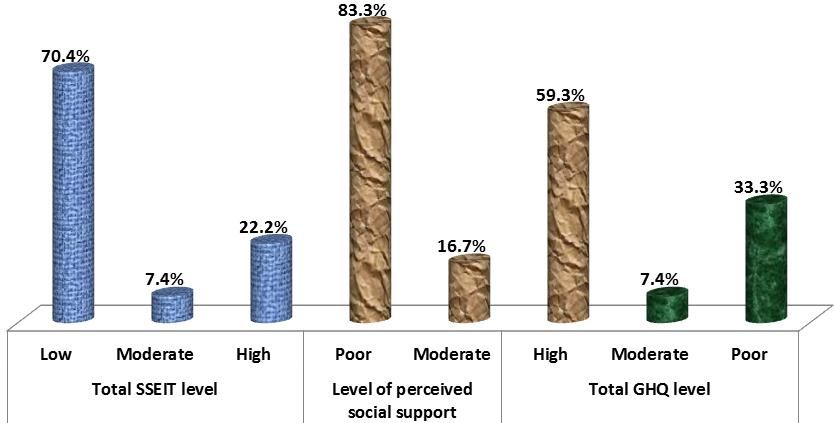
in the study and according the Mini significance was adopted at PTanta Scientific Nursing Journal ( Print ISSN 2314 – 5595 ) ( On line ISSN 2735 – 5519 ) Table (1) Presents the distribution of the score of the subscale mood regulation studied subjects according to their socio- /optimism was 55.6% and the range was demographic characteristics. As their age 22-68 with a mean of 46.17±13.718, ranged between 60-77 years with a mean indicating low level of emotional age of 66-20±4.676 years. The results intelligence. High score of the subscale revealed that the highest percentage of the emotional appraisal was 48.1% and the studied subjects (37%) aged between 60- range was 14-39 with a mean of 26.28 65, and 35.2% aged between 65-70 years ±8.426, indicating low level of emotional and the lowest percentage of them (3.7%) intelligence. Also high score of the aged more than 75 years. It was also found subscale emotional utilization was44.4% that 51.9% of the studied subjects were and the range was10-23 with a mean of female and 48.1% were widowed, and 17.19±4.019, indicating low level of 33.3% of them were divorced. As for emotional intelligence, and high score of living residence (72.2%) of patients were the subscale social skills was 79.6% and from urban areas and (27.8%) of them the range was 8-26 with a mean of were from rural area. 17.13±4.674 , indicating low level of Concerning their educational level emotional intelligence. As total level of (38.9%) of subjects had secondary school Self Report Emotional Intelligence was education, and only 11.1% of them were 70.4% of the studied subjects had low illiterate. Regarding their job 77.8% of the emotional intelligence. studied subjects were retired and only Table (3) Revealed the percent distribution 22.2% do not work. It was found that of the studied subjects regarding their total 75.9% of the studied subjects said that level of perceived social support. The their income was enough, and 44.4% of results showed that low score of subscale them were admitted the geriatric home for significant others was 75.9% and the range reason of loneliness. Also 63% of them was 4-23 with a mean of 11-13±6.069, had less than 5 years for duration of stay indicating low social support from and 37% had 5 or more duration of stay in significant others, and low score of the geriatric home. subscale family was 92.6% and the range Table (2) Showed the total level of Schutte was 4-28 with a mean of 10-00±4.802, Self Report Emotional Intelligence Test indicating low social support from family. (SSEIT). The results revealed that the high Also low score of subscale friends was Vol. 20 No. 1 February, 2021 227
Tanta Scientific Nursing Journal                  ( Print ISSN 2314 – 5595 ) ( On line ISSN 2735 – 5519 )

74.1% and the range was 4-25 with a mean                was a significant positive relation between
of 14-33±5.241 indicating low social                    emotional intelligence and the studied
support from friends, and the total score of            subjects‟ perceived social support at
perceived    social     support   of   subjects         r=0.545, p=0.00. While there was a
(83.3%) had low social support levels.                  significant     negative   relation    between
Table (4) Presents the percent distribution             emotional intelligence and the mental
of the studied subjects regarding their total           health of elderly at r=-0761, p=0.00.
level of General Health Questionnaire                   Table (6) Illustrates the relation between
(GHQ). The results revealed that high                   the intelligence, social support, and the
score of subscale somatic symptoms was                  mental health of elderly (general health).
61.1% and the range was 8-24 with a mean                As there was a significant negative relation
of 17-26±4.443, indicating high level of                between the mental health of elderly and
somatic symptoms, and high score of                     the studied subjects‟ emotional intelligence
subscale anxiety and insomnia was 53.7%                 at r=-0.761, p=0.00. And also there was a
and the range was 8-26 with a mean of 17-               significant negative relation between the
74± 6.559, indicating high level of anxiety             mental health of elderly and the studied
and insomnia. There was low level of                    subjects‟ level of perceived social support
social dysfunction (57.4%) and the range                at r=-0.404, p=0.002.
was 9-25 with a mean of 19-80±4.877,                    Table (7) Clarifies the correlation between
indicating low level of social dysfunctions.            socio-demographic characteristics and total
High score of severe depression was 61.1%               level of Schutte Self Report Emotional
and the range was 7-26 with a mean of 17-               Intelligence Test (SSEIT), total level of
24±6.333, indicating high level of severe               Perceived social support and total level of
depression .It was found that (59.3%) of                General       Health   Questionnaire    (GHQ)
the studied subjects had low mental health.             among the studied subjects. It was found a
Table (5) Presents the comparison and                   significant negative correlation between
correlation between total level of Self                 elderly age and their emotional intelligence
Report      Emotional      Intelligence   Test          at r=-0.440, p=0.001 and also a significant
(SSEIT), total level of Perceived social                negative correlation between elderly age
support and total level of General Health               and their social support at r=0.310,
Questionnaire (GHQ) among the studied                   p=0.023, but the present study found a
subjects. The results revealed that there               significant positive correlation between

Vol. 20      No. 1 February, 2021                                                         228
Tanta Scientific Nursing Journal                       ( Print ISSN 2314 – 5595 ) ( On line ISSN 2735 – 5519 )

elderly age and their mental health at                       correlation between the study subjects‟
r=0.399, p=0.003. As for gender it was                       educational levels and their mental health
found a significant positive correlation                     at r=-0.577, p=0.00.
between female elderly and their mental                      As regards elderly job, there was a positive
health at 0.0439, p=0.001.                                   correlation between the study subjects
Regards marital status it was found a                        „retirement and their emotional intelligence
significant negative correlation between                     at r=0.399, p=0.003, and there was a
single     elderly     and      their   emotional            positive correlation between the study
intelligence at r=-0.490, p=0.00, and also                   subjects retirement and their social support
had a negative one with their social support                 at r= 0.275, p=0.044, but a negative one
at r=-0.584, p= 0.00, but it was found a                     between the study subjects retirement and
significant positive correlation between                     their mental health at r=-0.424, p= 0.001. It
single elderly and their mental health at                    was found a negative correlation between
r=0.282, p=0.039. There was a significant                    the study subjects duration of stay in the
positive    correlation       between        married         geriatric   home     and    their    emotional
elderly and their emotional intelligence at                  intelligence at r=-0.327, p=0.016, and also
r=0.388, p=0.004, and had a negative one                     with their perceived social support at r=-
with their mental health at r=-0.401,                        0.375, p=0.005, but a positive one between
p=0.003. There was a positive correlation                    the study subjects duration of stay in the
between      divorced        elderly    and    their         geriatric home and their mental health at
emotional intelligence at r=280, p=0.004,                    r=0.365,p= 0.007.
and had a negative one with their mental
health at r=-0.330, p=0.015. There was a
positive correlation between widow elderly
with their mental health at r= 0.344, p=
0.011.
In relation to educational level, there was a
positive correlation between the study
subjects‟ educational levels and their
emotional intelligence, social support at
r=0.562,     p=0.00,    r=0.378,        p=    0.005
respectively, but there was a negative

Vol. 20       No. 1 February, 2021                                                               229
Tanta Scientific Nursing Journal ( Print ISSN 2314 – 5595 ) ( On line ISSN 2735 – 5519 )
Table (1) : Distribution of the studied subjects according to their socio-demographic
characteristics.
The studied elderly
Socio-demographic Characteristics (n=54)
N %
Age (in years)
60Tanta Scientific Nursing Journal ( Print ISSN 2314 – 5595 ) ( On line ISSN 2735 – 5519 )
Table (2) Distribution of the studied subjects according to their total level of Schutte Self
Report Emotional Intelligence Test (SSEIT).
The studied elderly
Emotional Intelligence of elderly (n=54)
N %
Mood regulation/optimism
(14–46) Low 30 55.6
(47-58) Average 14 25.9
(59–70) High 10 18.5
Range (22-68)
Mean ± SD 46.17±13.718
Emotional appraisal
(8–26) Low 26 48.1
(27-33) Average 13 24.1
(34–40) High 15 27.8
Range (14-39)
Mean ± SD 26.28±8.426
Emotional utilization
(5–16) Low 24 44.4
(17-21) Average 19 35.2
(22–25) High 11 20.4
Range (10-23)
Mean ± SD 17.19±4.019
Social skills
(6–20) Low 43 79.6
(21-25) Average 8 14.8
(26–30) High 3 5.6
Range (8-26)
Mean ± SD 17.13±4.674
Total Schutte Self Report Emotional Intelligence
< 111 Low 38 70.4
(111-137) Moderate 4 7.4
>137 High 12 22.2
Range (56-156)
Mean ± SD 106.76±27.249
Vol. 20 No. 1 February, 2021 231Tanta Scientific Nursing Journal ( Print ISSN 2314 – 5595 ) ( On line ISSN 2735 – 5519 )
Table (3) : Percent distribution of the studied subjects regarding their total level of Perceived
Social Support.
The studied elderly
Types of Perceived Social Support by the level (n=54)
N %
Form significant others
(4–16) Low 41 75.9
(17-22) Average 10 18.5
(23–28) High 3 5.6
Range (4-23)
Mean ± SD 11.13±6.069
From family
(4–16) Low 50 92.6
(17-22) Average 3 5.6
(23–28) High 1 1.9
Range (4-28)
Mean ± SD 10.00±4.802
Form friends
(4–16) Low 40 74.1
(17-22) Average 8 14.8
(23–28) High 6 11.1
Range (4-25)
Mean ± SD 14.33±5.241
Total level of Perceived Social Support
(12–48) poor 45 83.3
(49–68) Moderate 9 16.7
(69–84) high 0 0.0
Range (13-68)
Mean ± SD 35.46±11.681
Vol. 20 No. 1 February, 2021 232Tanta Scientific Nursing Journal ( Print ISSN 2314 – 5595 ) ( On line ISSN 2735 – 5519 )
Table (4) Distribution of the studied subjects according to their total level of general health
questionnaire.
The studied elderly
General Health Questionnaire (n=54)
N %
Somatic Symptoms
(7–19) High 33 61.1
(20–21) Average 12 22.2
(22–28) Low 9 16.7
Range (8-24)
Mean ± SD 17.26±4.443
Anxiety and Insomnia
(7–19) High 29 53.7
(20–21) Average 6 11.1
(22–28) Low 19 35.2
Range (8-26)
Mean ± SD 17.74±6.559
Social Dysfunction
(7–19) High 18 33.3
(20–21) Average 5 9.3
(22–28) Low 31 57.4
Range (9-25)
Mean ± SD 19.80±4.877
Severe Depression
(7–19) High 33 61.1
(20–21) Average 8 14.8
(22–28) Low 13 24.1
Range (7-26)
Mean ± SD 17.24±6.333
Total General Health Questionnaire
(28–78) High 32 59.3
(79–86) Moderate 4 7.4
(87–112) Low 18 33.3
Range (39-99)
Mean ± SD 72.04±18.917
Vol. 20 No. 1 February, 2021 233Tanta Scientific Nursing Journal ( Print ISSN 2314 – 5595 ) ( On line ISSN 2735 – 5519 )
Figure: Percent distribution of both total level of Schutte Self Report Emotional Intelligence
Test (SSEIT), total level of Perceived social support and total level of General Health
Questionnaire (GHQ) among the studied elderly.
Table (5) Comparison and correlation between total level of Self Report Emotional
Intelligence Test (SSEIT), total level of Perceived social support and total level of General
Health Questionnaire (GHQ) among the studied elderly.
Total SSEIT level (n=54)
Low Moderate High χ2
(n=38) (n=4) (n=12) P
N % N % N %
Total level of perceived social
support
Poor 34 63.0 4 7.4 7 13.0 7.232
Moderate 4 7.4 0 0.0 5 9.3 0.027*
r,P 0.545 , 0.00**
Total level of GHQ
High 19 35.2 1 1.9 12 22.2
39.012
Moderate 1 1.9 3 5.6 0 0.0
0.00*
Low 18 33.3 0 0.0 0 0.0
r,P -0.761 , 0.00**
* Significant at level P < 0.05
** Highly significant at level P < 0.01
Vol. 20 No. 1 February, 2021 234Tanta Scientific Nursing Journal ( Print ISSN 2314 – 5595 ) ( On line ISSN 2735 – 5519 )
Table (6): The relation between emotional intelligence, social support, and the mental health
of elderly (general health)
Total level of GHQ (n=54)
high Moderate Low χ2
(n=32) (n=4) (n=18) P
N % N % N %
Total SSEIT level
low 19 35.2 1 1.9 18 33.3
Moderate 1 1.9 3 5.6 0 0.0 39.012
High 12 22.2 0 0.0 0 0.0 0.00*
r,P -0.761 , 0.00**
Total level of perceived social
support
7.425
Poor 23 42.6 4 7.4 18 33.3
0.024*
Moderate 9 16.7 0 0.0 0 0.0
r,P -0.404 , 0.002**
Vol. 20 No. 1 February, 2021 235Tanta Scientific Nursing Journal ( Print ISSN 2314 – 5595 ) ( On line ISSN 2735 – 5519 )
Table (7) Correlation between socio-demographic characteristics and total level of Self
Report Emotional Intelligence Test (SSEIT), total level of Perceived social support and total
level of General Health Questionnaire (GHQ) among the studied elderly.
Total Perceived
Total SSEIT Total GHQ
Socio-demographic social support
score Score
Data scores
r P r P r P
Age (in years) -0.440 0.001** -0.310 0.023* 0.399 0.003**
Gender
Male 0.160 -0.061 -0.439
0.249 0.661 0.001**
Female -0.160- 0.061 0.439
Marital status
Single -0.490 0.00** -0.584 0.00** 0.282 0.039*
Married 0.388 0.004** 0.251 0.067 -0.401 0.003**
Divorced 0.280 0.04* 0.233 0.090 -0.330 0.015*
Widow -0.159 0.251 0.016 0.909 0.344 0.011*
Residence
Urban 0.062 0.086 -0.155
0.657 0.539 0.262
Rural -0.062 -0.086 0.155
Educational level 0.562 0.00** 0.378 0.005** -0.577 0.00**
Job
Retired 0.399 0.275 -0.424
0.003** 0.044* 0.001**
Don't work -0.399 -0.275 0.424
Income
Enough -0.154 -0.007 0.050
0.265 0.958 0.721
Not enough 0.154 0.007 -0.050
Duration of stay (in years) -0.327 0.016* -0.375 0.005** 0.365 0.007**
* Significant at level P < 0.05
** Highly significant at level P < 0.01
Vol. 20 No. 1 February, 2021 236Tanta Scientific Nursing Journal ( Print ISSN 2314 – 5595 ) ( On line ISSN 2735 – 5519 )
Discussion association between emotional intelligence
Emotional intelligence can be explained by and well-being among older people. (31) So
lifelong learning and also it can be this study was aimed to evaluate the
improved through practice. Young adults association between the emotional
have few opportunities than older adults to intelligence, social support and mental
practice emotional intelligence throughout health of institutionalized elderly.
their lives. Consequently, older adults have The present study revealed that there was a
better understanding of emotions and use significant positive relation between
better emotional regulation strategies than emotional intelligence and social support.
younger adults (29). Toyama et al 2017 confirmed this result as
Social support has a beneficial effect on they stated that the results showed that
psychological well-being, it refers to an emotional intelligence was directly and
extent to which “one‟s perceptions of positively associated with social support,
supportive behaviors from individuals in work environment, and creativity. This
(24)
their social network . Socialization finding extends prior evidence indicating
influences the emotions of individuals as it that higher emotional intelligence can
provides essential skills and habits improve the effectiveness of social support
(32)
necessary for interactions in the society. It . Also it is indicated that in principle, all
enables an individual to have self- the dimensions of emotional intelligence
awareness while alone and in group, construct correlate positively with the
motivate to move positively and handle dimensions of perceived social support (33).
one‟s own and other‟s emotions. Since The present study found negative relation
elderly people require more emotional between emotional intelligence and mental
care, socialization helps in gaining better health as if emotional intelligence were
emotional maturity when associated with high, the mental health were low so, older
peer group (30). adults may obtain higher emotional
Emotional Intelligence has a significant intelligence through learning from their
impact on psychological, social and life, and collected knowledge
physical adjustment according to numerous subsequently, they may be more likely to
studies. However most of those findings use the emotional intelligence to regulate
are related to young and middle aged their emotions and less perceived stress
samples and little is known about the and increase their life satisfaction and
Vol. 20 No. 1 February, 2021 237Tanta Scientific Nursing Journal ( Print ISSN 2314 – 5595 ) ( On line ISSN 2735 – 5519 )
affective well-being. This is in line with favorable mental health. This is the same
Chen Y et al 2016, as they found with Harandi et al 2017, who stated that
emotional intelligence had a positive perceived social support can inhibit the
relationship with both life satisfaction and adverse physiological complications of
affective well-being. Individuals who have diseases and increase self-care among
higher emotional intelligence are also older people. In the field of social support
having higher life satisfaction and on patients‟ mental health, patients
experience more frequent positive certainly find themselves in an insecure
(29)
association to negative affect . Also the situation and seek for support that
results showed that between emotional decreases their anxiety and discomfort, and
intelligence and life satisfaction among the thus, social support in such a situation can
elderly of Sardasht city, there is a reduce their anxiety and discomfort (36).
(34)
significant positive correlation . Also In consistent with Kafetsios 2016 ,who
Rahmawti et al, 2017, stated that stated that persons with secure support
emotional intelligence has significant models use emotional regulation strategies
relation with psychological well-being. to minimize stress and emphasize positive
Meaning that if emotional intelligence, emotions and those with support insecure
self-esteem, self-efficacy are high, the models follow emotion regulation
score of psychological well-being is also strategies that emphasize negative
high (35). emotions and stressful situations, or tend to
The mental health of elderly was related inhibit emotional experiences. This has
negatively to their level of perceived social obvious consequences for the link with
support. This is due to the elderly don‟t both well-being and social support
receive social support and their health is at processes. Older adults have smaller
risk if social unity is poor. Conversely, a support networks but the close relational
high level of social support protects people networks (marital and familial
from illnesses. Social support reduces the relationships) are better established in later
adverse effects of mental stress. In older adulthood (21).
adult communities, it should be said that The results of the this study found a
older people who receive more social significant negative correlation between
support and participate in different aspects elderly age and their emotional intelligence
of social life more than others, enjoy more which came in consistent with Atkins
Vol. 20 No. 1 February, 2021 238Tanta Scientific Nursing Journal ( Print ISSN 2314 – 5595 ) ( On line ISSN 2735 – 5519 )
2005, who stated that younger adults who there was a negative correlation between
use more emotions in decision-making the study subjects‟ educational levels and
appear to find it more hard to control their mental health. This is due to the
strong negative emotions and prevent them increased level of education makes the
from hindering their work. However, this individuals more knowledgeable, more
becomes progressively less true for older mature in their behaviors and able to
(37)
adults . In contrast to diminishing accept facts, and the higher socialization
associated with physical and cognitive and communication with others. As
aging, emotional aging appears to profit regards elderly job, there was a positive
from age. Shifts in cognitive processing of correlation between the study subjects
emotional stimuli, enhanced emotional „retirement and their emotional intelligence
motivation and emotional competence and there was a positive correlation
likely contribute to improvements (38). between the study subjects retirement and
In contrast to the present study Chen Y et their social support, but a negative one
al 2016, who found in their study a between the study subjects retirement and
positive relationship between age and their mental health, this related to those
emotional intelligence, suggested that older who have worked for many years are
adults may gain higher emotional nearing retirement age and thus they are
intelligence due to lifelong learning and expected to be better prepared for
collected knowledge (29). retirement than who don‟t work. As
The result showed that there was a working help older individuals to
significant positive correlation between experience successful aging.
married women elderly and their emotional Conclusion:
intelligence, and had a negative one with The results found that there was a
their mental health. This related to women significant positive relation between
may feel less control over emotions, emotional intelligence and perceived social
negative events and more responsible for support. and there was a significant
emotional tone in relationships. negative relation between emotional
The present study revealed that there was a intelligence and mental health as if
positive correlation between the study emotional intelligence were high, the
subjects‟ educational levels and their mental health were low, also the study
emotional intelligence, social support, but found a significant negative relation
Vol. 20 No. 1 February, 2021 239Tanta Scientific Nursing Journal ( Print ISSN 2314 – 5595 ) ( On line ISSN 2735 – 5519 )
between the mental health of elderly and Ageing Volume 13, Issue 2 December
their level of perceived social support. 2016
Recommendations: 2- The Statistical Year Book (June 2006) –
Based on the results of the current study Central Agency For Public
researchers recommended that: Mobilization and Statistics – Egypt
- Establish workshops and holding 3-Alipour, F. and Sajjadi, H. The Role of
seminars about emotional intelligence Social Supports in Reducing Anxiety
for elderly according to their cognitive and Depression among the Elderly,
ability from health care professionals. Iranian Journal of Ageing, Fourth
- Future researches must focus on Year, Issue 11, spring 2009.
establishing the causal links among 4-Egede LE, and Ellis C. Diabetes and
features of emotional processing, depression: Global perspectives.
retirement and mental health Diabetes Research and Clinical
concurrently and over time. Practice. 2010 Mar; 87(3):302–12
-Future researches are needed to find out 5-Moussavi S, Chatterji S, Verdes E,
exactly how older adults with higher Tandon A, Patel V, and Ustun B.
emotional intelligence cope with the Depression, chronic diseases, and
changing life circumstances to decrements in health: results from the
maximize their well-being. World Health Surveys. The Lancet.
- Development of group activities in 2007 Sep; 370,851–8.
elderly homes and social communities 6-Jongenelis K, Pot AM, Eisses AMH,
that will contribute to reducing isolation Beekman ATF, Kluiter H, and Ribbe
and loneliness in the elderly. MW. Prevalence and risk indicators of
- Immediate need for socialization depression in elderly nursing home
programs to elderly has to be taken care patients: the AGED study. Journal of
of and should be encouraged in future Affective Disorders
researches to enhance mental health and 2004,82(2_3):135_142
life quality in old age. 7-Boorsma M, Joling K, Dussel M, Ribbe
References: M, Frijters D, Van Marwijk HWJ,
1- Sweed H S. Review Articles: Nijpels G, and Van Hout H. The
Population Ageing - Egypt Report. incidence of depression and its risk
Middle East Journal of Age and factors in Dutch nursing homes and
Vol. 20 No. 1 February, 2021 240Tanta Scientific Nursing Journal ( Print ISSN 2314 – 5595 ) ( On line ISSN 2735 – 5519 )
residential care homes. American 13- Scheibe S, and Carstensen L.
Journal of Geriatric Psychiatry2012, Emotional Ageing: Recent Findings
20 (11):932-942 and Future Trends‟ in the Journals of
8-WHO, EURO. Risk factors of ill health Gerontology Series B: Psychological
among older people http://www.euro Sciences and Social Sciences, 2009;
.who.int/en/what-we-do/health-topics/ 2:135-144.
Life-stages/healthy-ageing/facts-and- 14- Carstensen LL, Turan B, Scheibe S,
figures/risk-factors-of-ill-health- Ram N, Ersner-Hershfield H, Samanez
among-older-people Accessed 25.05. Larkin G et al. Emotional experience
2013. improves withage:evidence based
9-McCusker J, Cole MG, Voyer P, onover 10 years of experience
Monette J, Champoux N, Ciampi A, sampling. Psychol. Aging 2011; 26,
Vu M, Dyachenko A, and Belzile E. 21–33.
Observed-rated depression in long- 15-Faralli A M. The impact of instruction
term care: frequency and risk factors. on EI levels of undergraduate nursing
Archives of Gerontology and students. Published Doctoral
Geriatrics 2013. 58:332-338. Dissertation, School of Education,
10- Santiago LM, and Mattos IE. Wilmington.University.Available:http:
Depressive symptoms in //proquest.umi.com.UMI Number:
institutionalized older adults. Revista 3361921. (September 22, 2011)
de Saúde Pública 2014,48 (2):216- 16- Marc A. Brackett and Peter
224. Salovey.Measuring emotional
11-Martins A, Ramalho N, and Morin E. A intelligence with the Mayer-Salovery-
Caruso Emotional Intelligence Test
comprehensive meta-analysis of the
(MSCEIT). Psicothema 2006. Vol. 18,
relationship between emotional
supl., pp. 34-41
intelligence and health. Personality 17- Octavio Luque-Reca, José María
and Individual Differences 49(6):554- Augusto-Landa and Manuel Pulido-
564. Martos. Emotional intelligence and
12-Mayer JD, Roberts RD, Barsade S. depressive symptoms in Spanish
institutionalized elders: does
2008. Human abilities: emotional
emotional self-efficacy act as a
intelligence. Annual Review of
mediator? (2016), PeerJ,1-19
Psychology 2010, 59:507-536
Vol. 20 No. 1 February, 2021 241Tanta Scientific Nursing Journal ( Print ISSN 2314 – 5595 ) ( On line ISSN 2735 – 5519 )
18- Hashemipour s, Askari M, Golmirzai somatic health problems and socio-
J. Investigation of the Relationship economic factors among older adults
between Emotional Intelligence and living at home: a cross sectional study.
Mental Health in the ElderlyPeople of Bio Med Central BMC Geriatrics
Bandar Abbas. J. Life Sci. Biomed. 2012, 12:27.
3(5):335-338, 2013 24-Sammy K Ho and Maria P. Y. Chik.
19- Carole Fantini-Hauwel, and Moïra The Effects of Humor and Gender on
Mikolajczak, Factor Structure, the Relationship between Social
Evolution, and Predictive Power of Support and Psychological Well-
Emotional Competencies on Physical Being. American Journal of
and Emotional Health in the Elderly. Psychological Research. August 12,
Journal of Aging and Health 2014, 2010 Volume 6, Number 1, 218-240.
Vol. 26(6) 993– 1014 25-Folstein MF, Folstein SE, and McHugh
20- Hyun-Wook Kang a, Meungguk Park PR. ``Mini-mental state''. A practical
b, Juliane Poock, and Wallace method for grading the cognitive state
Hernandez. The impact of perceived of patients for the clinician. Journal of
social support, loneliness, and physical Psychiatric Research (1975),
activity on quality of life in South 12(3):189-198.
Korean older adults. Journal of Sport 26-Schutte, N.S. and Malouff, J.M. (1998).
and Health Science 18 July 2016, 1–8. Measuring emotional intelligence and
21-Konstantinos Kafetsios and Georgios d. related constructs. Levinston: Mellen
Sideridis. Attachment,Social Support Press).
and Well-being in Young and Older 27-Zimet D G, and Farely G K. The
Adults. Journal of Health multidimensional scale of perceived
Psychology.2006, Vol, 11(6) 863–876. social support. Journal of personality
22-Hadi Kooshiar, Nurizan Yahaya, assessment, 1988, 52(1), 30-41
Tengku Aizan Hamid, Asnarulkhadi 28-Goldberg, D. P., and Hillier, V. F.
Abu Samah, and Vajiheh Sedaghat Jou (1979). A scaled version of the
. Living Arrangement and Life General Health Questionnaire.
Satisfaction in Older Malaysians: The Psychological Medicine, 9 (1), 139-145.
Mediating Role of Social Support 29- Yiwei Chen, Yisheng Peng, and Ping
Function. August 2012 | Volume 7 | Fang, Emotional Intelligence Mediates
Issue 8 | 1-6. the Relationship between Age and
23-Hege Bøen, Odd Steffen Dalgard and Subjective Well-Being. The
Espen Bjertness. The importance of International Journal of Aging and
social support in the associations Human Development 2016, Vol. 83(2)
between psychological distress and 91–107
Vol. 20 No. 1 February, 2021 242Tanta Scientific Nursing Journal ( Print ISSN 2314 – 5595 ) ( On line ISSN 2735 – 5519 )
30- Jesna Sivasankar, and Vidhya Intelligence and Life Satisfaction.
Ravindranadan. Effects of International Journal of Humanities
Socialization on Emotional Efficacy of and Culture Studies, Issue May 2016,
Elderly. The International Journal of 1720- 1724.
Indian Psychology, 2017, Volume 4, 35- Rahmawati N R , Handarini D M, and
Issue 3, 88-95 Triyono. Relation of Emotional
31-Galdona N, Martínez-Taboada C, Intelligence, Self-esteem, Self-
Etxeberria I, Urdaneta E, and Aldaz efficacy, and Psychological Well-
E. Positive aging: the relationship Being Students of State Senior High
between emotional intelligence and School. Jurnal Pendidikan Humaniora
psychological, social and physical Volume 5, Number 1, March 2017, pp.
wellbeing. MOJ Gerontol Ger. 2018; 3 40–4.
(1):9‒11 36-Harandi T F, Taghinasab M M, and
32- Toyama H, and Mauno S. Associations Nayeri T D .The correlation of social
of Trait Emotional Intelligence with support with mental health: A meta-
Social Support, Work Engagement, analysis. Electronic Physician,
and Creativity in Japanese Eldercare September 2017, Volume: 9, Issue: 9,
Nurses. Japanese Psychological Pages: 5212-5222.
Research, 2017, Volume 59, No. 1, 37-Paul W.B. Atkins .Does emotional
14–25 intelligence change with age? Annual
33- Macula A M. Emotional Intelligence, Conference, Atlanta, US April 6-7
Its Relation with Social Interaction 2005, 1-27.
and Perceived Social Support. 38-Scheibe S and. Carstensen L L. Emotional
European Journal of Social Sciences Aging: Recent Findings and Future
Education and Research, May-August Trends. 2010 ,Journal of Gerontology:
2017 Volume 4, Issue 4, 57-63 Psychological Sciences, 65B(2), 135–144.
34-Sahraei M, Alipour O and, Alipour H.
The Relationship between Emotional
Vol. 20 No. 1 February, 2021 243You can also read


