Female Football Discussion Document - September 2019 - Football West
←
→
Page content transcription
If your browser does not render page correctly, please read the page content below
Female Football
Discussion Document
September 2019

Contents

Executive Summary............................................................................................................................................................4
Female Football Plan .........................................................................................................................................................5
Female Football Strategy Progression .......................................................................................................................5
Plan Context and Impact .................................................................................................................................................6
    Factors Driving Participation and Retention in Female Football ........................................................ 6
    Female Participation in Football ......................................................................................................... 9
    Survey Insights and Program Feedback ............................................................................................ 12
    Marketing and Promotion................................................................................................................. 15
    Facilities ............................................................................................................................................ 15
Female-Specific Programs ........................................................................................................................................... 15
    ALDI MiniRoos Kick-Off for Girls ....................................................................................................... 16
    Club and Association-Based Competitions ....................................................................................... 16
    Talented Player Pathway .................................................................................................................. 17
    Girls’ Skill Acquisition Program ......................................................................................................... 18
    Girls’ Talent Support Program .......................................................................................................... 19
    National Training Centre (NTC) ......................................................................................................... 19
    Football West State Team Program and Competitions .................................................................... 19
        U21 State Team – Women ............................................................................................................ 19
        Open Women’s State Team .......................................................................................................... 19
        National Youth Championships – Competition............................................................................. 19
        National Talent Challenge- Competition....................................................................................... 20
        Challenge Cup ............................................................................................................................... 20
National Representation ............................................................................................................................................... 20
    Westfield Junior Matildas ................................................................................................................. 20
        Players chosen to train and play for Junior Matildas:................................................................... 20
        Young Matildas ............................................................................................................................. 20
        Players chosen to train and play for Young Matildas: .................................................................. 20
Other Participation Opportunities ............................................................................................................................ 21
    Women’s Masters Competition ........................................................................................................ 21
    Women’s Summer Series .................................................................................................................. 21
    Female Football Week ...................................................................................................................... 21
Women’s Development Workshops ........................................................................................................................ 22
    Empowering Women Workshops ..................................................................................................... 22

                                                                                      2
Mentor-Mentee Program ................................................................................................................. 22
Club Ambassador Program ............................................................................................................... 22
Female-Only Coach and Referee Courses ............................................................................................................. 23
Female-Only C License ...................................................................................................................... 23
Female Skill Training Certificate........................................................................................................ 23
Level Four Referee Course ................................................................................................................ 23
Assistant Referee Course .................................................................................................................. 24
Future Planning ................................................................................................................................................................ 24
U8’s Girls Only MiniRoos............................................................................................................... 24
Under 13 NTC Program ................................................................................................................. 24
Expanded State Team Program..................................................................................................... 24
Continued Subsidisation of C Licence Accreditation and Skills Training certificate ..................... 24
Development Workshops to Women’s Clubs ............................................................................... 24
Female Football Webpage ............................................................................................................ 24
Football Your Way ......................................................................................................................... 24
Female Football Good Practice Guide .......................................................................................... 24
FFA Gender Equality Plan .............................................................................................................. 25
Current Progress: .............................................................................................................................. 26
3Executive Summary
• Female football is now the most popular team-based sport for females (up from the third-
most popular in 2017).
• In April 2018, Football West 2018-2022 Female Football Plan was approved by the Football
West Board.
• Football West is the first Member Federation to develop a Female Football Plan.
• Factors considered in development included theories on female participation, participation
trends, existing programs and feedback received during consultation.
• Key initiatives rolled out include:
o Female Masters Program.
o Club Ambassador Program.
o Expanded Female State Team programs.
o Empowering Women Workshops.
o U10 Girls competition.
o Gender and Diversity Policy.
o Increased female staff and Board representation.
o Increased marketing and promotion for female football.
• Registered participants are up 4.7% compared to this time last year.
• Football West’s promotional posts for female football have increased by 86% since the Plan
was introduced.
• Satisfaction of female respondents with Football West programs and events has increased
by 15% since 2018.
• There are now 22 female-only initiatives across football, with over 4,000 participants.
• Key future initiatives include:
o Rolling out a Soccer Mums and CaLD Women and Girls program in conjunction with
FFA.
o Implementing FFA’s Gender Equality Plan.
o Determining facility requirements for Female Football as part of a State-wide
Facilities Plan.
o Securing a major sponsorship partner for Female Football.
4Female Football Plan
In April 2018, Football West 2018-2022 Female Football Plan was approved by the Football West
Board.
Horizon 1 of the Plan relates to Foundation Setting and Stabilisation, including:
• Clarity of Football West’s intent to grow female football in WA.
• Changing attitudes towards Female Football
• Marketing and promoting female football.
• Developing frameworks and guidelines to support growth.
• Targeted initiatives to grow the number of female players, coaches and referees.
The sections below detail the theoretical and practical context behind the Plan, as well as changes in
the Female Football landscape following its introduction.
Female Football Strategy Progression
A summary of completed and planned initiatives against the Female Football Plan is provided below.
This only covers new initiatives which were rolled out as part of the plan.
Figure 1: Female Football Initiatives
Strategic Pillar Developing the Game
Activity Rollout Status
Good Practice Guide distributed, including Q2 2020
female football resources.
Identify and promote model clubs following Q3 2020 ✔
Empowering Clubs rollout of guide.
Empowering Women workshops. Q1 2019 ✔
W-League Club Ambassador program. Ongoing ✔
Integrate female football requirements into Q1 2019 ✔
State Football Centre planning.
Female facilities survey Q1 2019 ✔
Improving Facilities Club audit, including questions on suitability Q3 2019 ✔
of female facilities.
State-wide Facilities Plan, which will include Q4 2019
facilities required to adequately service
female football growth.
Female Masters program Q3 ✔
2018/ongoing
Women’s Summer Series Q2 2019 ✔
Intensive English Learning Centre School Q1 2019 ✔
program
Blueprint for Growth U10 competition Q1 2019 ✔
Expanding Regional Talent Support Programs Q1 2020 ✔
National Training Centre U13 squad Q1 2020
Increased female-only coaching and Ongoing ✔
refereeing courses
5Soccer Mums program Q1 2020
MiniRoos Kick-Off for Girls Ongoing ✔
CaLD women and girls program Q1 2020
Strategic Pillar Outstanding Delivery
Activity Timeframe Status
Gender and Diversity Policy approved Q3 2019 ✔
Increased female Board representation Ongoing ✔
Values-led Culture Increased female staff representation Ongoing ✔
Increased marketing and promotion for Ongoing ✔
female football (see statistics above).
Workforce development, JDFs, HR, talent and Ongoing ✔
performance management systems,
governance structures etc updated to reflect
Capacity to Deliver
needs of female football.
Secure government and corporate grants to Ongoing ✔
support individual programs.
Work with Football Federation Australia to Ongoing
implement Gender Equality Plan.
Strong Partnerships
Secure a major sponsorship partner across Ongoing
Female Football
Plan Context and Impact
Factors Driving Participation and Retention in Female Football
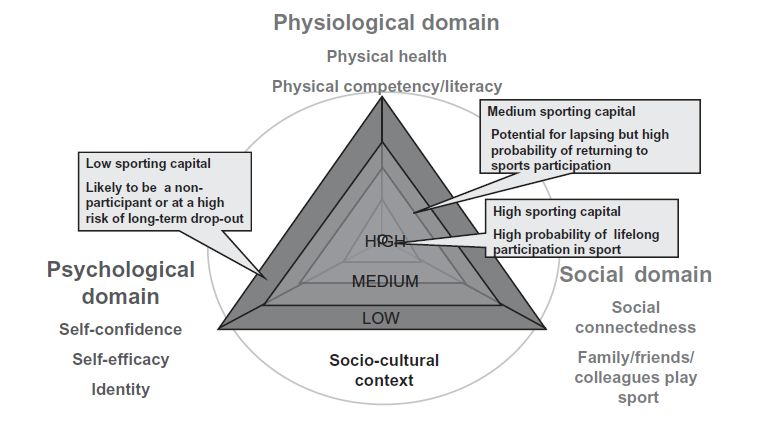
An individual’s likelihood of continued sport participation can be represented using the sporting
capital model. Sporting capital refers to underlying physiological, psychological and social factors
which sustain sport participation over time.1 Programs should be designed to take the target
audience’s sporting capital into account.
Figure 2: The Sporting Capital Model
1
Nicholas F Rowe, ‘Sporting Capital: A Theoretical and Empirical Analysis of Sport Participation Determinants
and its Application to Sports Development Policy and Practice’ (2015) 7(1) Journal of Sport Policy and Politics
43.
6Examples of factors which contribute to an individual’s sporting capital include:
Psychological Domain Social Domain Physiological Domain
• Self-worth • Family and friend participation. • Physical strength and ability
• Perceived confidence and • Social connections to the sport. • Physical health and
self-efficacy • Social interaction within the condition.
• Social/group relationships club.
• Personal identity
Young women tend to have low levels of sporting capital relative to men. Sporting capital can be
increased through programs which emphasise confidence, self-efficacy, positive body image and
programs delivered using empathetic leadership styles. Sporting capital of girls can also be affected
by supportive social networks.
Factors influencing female engagement in physical activity have been summarised by the Victorian
Department of Health and the Canadian Association for the Advancement of Women and Sport and
Physical Activity. Specific strategies to leverage these factors have been summarised in the FFA’s
Women’s Football Development Guide and in a South Australian government report. 2 Findings from
these resources are summarised below:
2
VicHealth, Female Participation in Sport and Physical Activity, Government of Victoria, n.d); Canadian
Association for the Advancement of Women and Sport and Physical Activity, Actively Engaging Women and
Girls: Addressing the Psycho-Social Factors, (Canadian Sport for Life, 2012); Football Federaton Australia,
Women’s Football Development Guide, (FFA, n.d); Lacrosse SA and Government of South Australia, Report &
Findings: Keeping Young Women in Sport Project, (Government of South Australia, 2015).
7Figure 3: Factors and strategies influencing participation in sport, football and physical activity
Girls and Adolescents Adult Women Generally
• Encouraging parental • Flexible options in • Welcoming, non-competitive environment
and sibling terms of cost, • Use of coaches with constructive and positive
involvement location, etc approaches
• Availability of non- • Promote benefits • Personal belief in the importance of sport
competitive options of short duration • Partnerships and consultation with community
• Event is enjoyable and physical activity groups
social • Presence of social • Peer and family support
• Encouraging girls to group and peer • Diversity of female role models presented
bring their friends support • Positive perception of one’s own skills and
• Goal-setting and self- • Enjoyment potential for future mastery
monitoring • Degree of • Focus on motivation, skill and confidence-building,
opportunities involvement in goal-setting, etc
program design • Positive self-image, particularly around body image
and gender stereotypes.
• Time set aside for female-only groups
According to the South Australian report, the main reasons for attrition among female athletes are:
• Competing social, school, work and leisure commitments.
• Lack of self-confidence and perceived personal ability
• Poor coaching and teaching.
• Intimidating transition from junior to senior level
• Inadequate opportunities to play
The FIFA Women’s Football Symposium has summarised four key lessons for growing grassroots
female football.3 These are:
• School football programs are effective at encouraging girls to play football. This is because
school programs introduce girls to the game in a way which legitimises their participation
and avoids cultural barriers which may be present in the club environment. Skill
development programs, formal development plans and support from senior staff were
highlighted as important related factors.
• School football can provide a bridge to participation in club-based football.
• Grassroots programs should be supported by adequate infrastructure, including suitably
qualified referees, coaches and volunteers. Training of school teachers who teach football
was also highlighted as important.
• Increasing the number of participants at a grassroots level can help drive sponsorship
opportunities for female football.
There is little evidence to suggest that funding elite sport necessarily increases grassroots
participation. It has been suggested that where there is a relationship, it is sport and context-
3
4th Women’s Football Symposium, Building Grassroots Programs, (FIFA, 2007).
8specific.4 Grix and Carmichael suggest the use of club registrations as a long-term performance
benchmark in this respect.5
Female Participation in Football
The Australian Institute of Sport’s Ausplay study estimates that there are 37,000 women and girls
are playing football in Western Australia, making it the most popular team-based sport for females
(up from the third-most popular sport for women and girls in 2017). This figure would encompass
Football West programs, as well as those run by schools, recreation centres and private providers.
Across Football West’s registrations, programs, events and affiliated organisations there are
approximately 19,226 female players (5,676 MiniRoos, 10,298 juniors and 3,251 seniors in 2019).
This number is based on a combination of registered players and headcounts logged by Football
West staff.
There are 7,507 female registered players at August 2019 (up 4.7% compared to August 2018).
Participation trends for female MiniRoos, juniors and seniors are expanded upon in the graphs
below.
Figure 4: Registered female participants as at August, 2009-2019
4
For example: Veerle de Bosscher, Popi Sortiriadou and Maarteen van Bottenberg, ‘Scrutinishing the Sport
Pyramid Metaphor: An Examination of the Relationship Between Elite Success and Mass Participation in
Flanders’ (2013) 5(3) Journal of Sport Policy and Politics 319; Jonathan Grix and Fiona Carmichael, ‘Why do
governments invest in elite sport? A polemic’ (2012) 4(1) International Journal of Sport Policy and Politics 73.
5
Grix and Carmichael, as above, n 2, at 85.
9Figure 5: Registered female MiniRoos participants as at August, 2009-2019
Figure 6: Registered female junior participants as at August, 2009-2019
10Figure 7: Registered female senior participants as at August, 2009-2019
Figure 8: Growth rates as at August, 2009-2019 across age brackets
40.00%
30.00%
20.00%
10.00%
0.00%
-10.00%
-20.00%
Female MiniRoos Growth Female Juniors Growth
Female Seniors Growth Male MiniRoos Growth
Male Juniors Growth Male Seniors Growth
11Football West also delivers programs which are exclusive to female participants. In 2019, these
numbers are as follows
Figure 9: Female Referee Registrations
The number of female referees has grown by 87% since 2017.
There are 153 registered female coaches in 2019 formal competitions. Note, coaches outside the
metropolitan area are not required to register and are therefore unknown. Furthermore, coach
registrations should not be compared to 2018 due to issues coaches encountered with the new
registration system rollout.
Survey Insights and Program Feedback
In 2017, Football West conducted a series of Insights surveys to inform the 2018-2022 Strategic Plan.
Areas which female respondents highlighted as important and requiring improvement were club
development, quality of coaching and refereeing and support for coach and referee development.
12A summary of survey feedback from programs and events delivered by Football West is presented
below. This includes feedback from 2018 and 2019.
Figure 10: Program Feedback Summary
13Figure 11: Survey feedback over time
Figure 12: Changes in program feedback over time
14Marketing and Promotion
Since the launch of the Female Football Plan, there have been 463 website and social media posts
related to female football (192 Facebook posts, 61 Twitter posts, 70 Instagram posts and 140
website articles).
This is compared to 249 website and the social media posts in the same period beforehand (114
Facebook posts, 65 Twitter posts, 15 Instagram posts and 55 website articles).
Facilities
In March 2019, Football West conducted a dedicated survey pertaining to the standard of female-
friendly facilities at clubs. This indicated that:
• 100% of clubs who responded planned to increase female participation at their club.
• 68% stated they do not have sufficient facilities to support the growth of female football.
• 68% need upgraded changerooms to support future growth of female football.
• 70% do not have enough high-quality pitches to support future growth of female football.
• 65% of clubs do not have sufficient lighting to support future growth of female football.
• 78% need additional resources to support the development of volunteers and officials.
Female-Specific Programs
Football West runs a suite of programs specifically for female participants. These include:
Program Participant
Number
2019
Metropolitan
Kick-Off for Girls 390
Skill Acquisition Program 96
Talent Support Program (inc Albany) 25
National Training Centre 132
National Youth Championships 32
National Talent Challenge 18
State Women’s Program 36
Women’s Masters Competition 2018 121
Women’s Summer Series 96
Girls’ Day Out 110
Regional Girls Day Out 60
Female Football Forum 92
Empowering Women Workshops 42
Mentor-Mentee Program 8
Female-Only Coaching Courses 18
Female-Only Refereeing Courses 28
Female Football Week School Clinics 400
Intensive English Learning Centre Program 40
Club Ambassador Program 2879
Clontarf Girls Workshop 16
15Regional
Regional Girls’ State Teams 32
Country Camp Girls’ Teams 57
TOTAL 4,728
Further information about these programs is provided below.
ALDI MiniRoos Kick-Off for Girls
The Aldi MiniRoos Kick-Off for girls is an introductory program aimed at children of all abilities
between the ages of 4-11 years old. The aim of the program is to introduce soccer to newcomers in
an inclusive way by having short game-based sessions. Each session is 45 minutes, with one coach
per 10 participants playing modified games and activities to introduce participants to the game of
soccer. There are 3 separate sessions:
• preseason – Jan to March; 6-12 sessions
• winter season – April to august; 6-20 sessions
• post season – October to December 6-12 sessions
The benefits of joining the ALDI MiniRoos is to develop fundamental motor skills to the game of
soccer but also social skills, team work, cooperation, fair play and respect for others. It’s a great way
to keep healthy by getting active while at the same time making life- long friends.
Club and Association-Based Competitions
Club-based competitions are currently available at the following levels:
• Women’s Premier League.
• Women’s Premier U23.
• Women’s State League Division 1 and 2.
• Metropolitan Leagues North Division 1,2 and 3.
• Metropolitan Leagues South Division 1, 2 and 3.
• Junior U18.
• Junior U16.
• Junior U14.
• Junior U12.
• Junior U10.
• Mixed ALDI MiniRoos Clusters.
16Additionally, club or association-based competitions are available in the following areas:
Figure 13: Regional Competitions
Region/Area Girls (as mixed) Girls (girls only) Women
Broome ✔ ✗ ✔
Kununurra ✔ ✗ ✗
Carnarvon ✔ ✗ ✗
Geraldton ✔ ✗ ✔
South West ✔ ✔ ✔
Albany ✔ ✗ ✔
Esperance ✔ ✗ ✗
Kalgoorlie ✔ ✗ ✔
Newman ✔ ✗ ✔
Tom Price ✔ ✗ ✗
Port Hedland ✔ ✗ ✗
Peel Association ✔ ✗ ✗
Please note that Kununurra, Carnarvon, Esperance and Peel do not run senior competitions. Girls in
Peel can however play in Football West metropolitan competitions.
Talented Player Pathway
As part of the Female Football Plan, Football West had developed a Talented Player Pathway for the
development of young players. This is displayed overleaf:
Figure 14: Talented Female Player Pathway
17Girls’ Skill Acquisition Program
The Skill Acquisition Program (SAP) is the first step for young athletes from the age of 9-12 in the
Football West talented player pathway. The girls SAP focuses on building a pathway for talented
girls, to move up the ranks of football developing their technical skills in the game of soccer.
From the SAP program they can move up to the Talent Support Program (TSP) for U13-U15 and on to
National Training Centre (NTC) and move on to national opportunities and national teams. It’s a way
for girls to experience the educational process while developing core skills they can take with them
on and off the field.
During this stage they largely focus on four main skills:
• Striking the ball;
• This involves all forms of striking the ball such as short/long passes, shooting and crossing;
• First touch;
• Controlling the ball with all allowed body parts;
• 1-v-1;
• All moves, feints and acceleration to get past and away from an opponent.
• Running with the ball; and
• At speed (with a lot of space) or “dribbling” (in tight areas), this includes techniques for
protecting the ball and changing direction.
18These four main skills focus on functional game skills and incorporating it into 3 main components;
skill introduction, skill training and skill game.
Girls’ Talent Support Program
The aim of the TSP is to provide talented girls the best practice development and continue picking up
the necessary skills in a more challenging environment. It is designed to complement the player’s
experience in a club environment.
Programs are delivered once a week throughout the year where girls play in a more high-quality
competitive game environment, whilst incorporating the four main skills described above.
National Training Centre (NTC)
The Hyundai NTC Girls program is the Elite Development Pathway for girls in Western Australia. It is
a full-time program in which players are selected yearly in an open trial process before training and
playing in a designated state competition.
The program consists of three age groups:
U14 – Head coach Faye Chambers, Assistant coach James Campbell, Goalkeeper coach Dylan Cope
The squad trains three times weekly and plays in the Boys U13’s Division 1 competition.
U15 – Head coach Darren Young, Assistant coach Jessica Sardi, Goalkeeper coach Dylan Cope
The squad trains three times weekly and plays in the Women’s Premier League U23’s Competition.
U19 – Head coach Gavin Sit, Assistant coach Sam Geddes, Goalkeeper coach Dylan Cope
The squad trains three times weekly and plays in the Women’s Premier League First Team
competition.
Football West State Team Program and Competitions
U21 State Team – Women
The U21 Team is selected from the U23 Premier League and Premier League Competition through
Coaches recommendations and trials.
The Goldfields U21 Women’s State Team train once a fortnight and will compete in the Bali
International Football Championships in August.
Open Women’s State Team
The Open Women’s Team is selected from the both the State League, U23 Premier League and
Premier League Competition through coaches’ recommendations and a trial process.
The Goldfield Open Women’s team will train weekly starting in September to compete in the
Challenge Cup in early November.
National Youth Championships – Competition
Football West Talented Player Pathway provides female youth players the opportunity to represent
the Western Australia at Football Federation Australia’s Women’s National Youth Championships.
Teams comprise the U14 and U15 girls’ State Teams.
19National Talent Challenge- Competition
The National Talent Challenge offers U17 female players the opportunity to showcase their talent in
front of FFA and Australian National Team selectors at the Australian Institute of Sport in Canberra.
Players comprise the U17 Women’s State Team.
The Football West State Team program is an elite football environment that focuses on women
player development. The program is divided into separate but closely linked teams. The Goldfield’s
U21’s Women’s State Team and the Goldfield’s Open Women’s State Team.
Challenge Cup
The Challenge Cup is an annual feature match between the Open Women’s State team and the Perth
Glory W-League squad in the W-League preseason.
National Representation
Westfield Junior Matildas
The Junior Matildas is a representative Australian international women’s U17 team. The team is
controlled by the governing body for football in Australia.
Players chosen to train and play for Junior Matildas:
• Isabella Wallhead - Junior Matildas 2018-19
• Tijan McKenna - Junior Matildas 2018-19
• Hannah Lowry - Junior Matildas 2018-19
• Miranda Templeman - Junior Matildas 2019
• Taneesha Baker - Junior Matildas 2019
Young Matildas
The Young Matildas is a representative Australian international Under 20’s women’s team. The team
is controlled by the governing body for football in Australia.
Players chosen to train and play for Young Matildas:
• Emily Henderson - Young Matildas 2015
• Abbey Meakins - Young Matildas 2017
• Morgan Aquino - Young Matildas 2018-19
• Lexie Moreno - Young Matildas 2018-19
• Leticia McKenna - Young Matildas 2018-19
• Isabella Wallhead - Young Matildas 2019
• Abbey Green - Young Matildas 2019
20Other Participation Opportunities
Women’s Masters Competition
The Women’s Masters competition is a new program targeting senior women aged 30 years and
older. It aims to create a social, supportive and inclusive environment for senior players.
The outdoor tournament lasts for 10 weeks from October till December including finals, where
matches will be played on a half a full-size football pitch and are 30 minutes each half. Teams do not
have to be affiliated with a club however players who have already registered to a club in the
previous year do not need to re-register.
Women’s Summer Series
The Summer Series is a new program open to female social players 15 years and older who are
looking to develop their skills during the Summer.
The program is a 6-a-side outdoor competition which will run over 10 weeks each Sunday in January.
Each half will last for 25 minutes with a 5-minute half time break.
The cost of the program is $650 a team covering the full competition expenses including a $10
registration fee for each individual player. Teams will be nominated before the start of the new year
and awards will be handed out at the end of the competition.
Female Football Week
Female Football Week is an annual nation-wide program aimed at encouraging the development of
female football. It was originally established in 2014 where FFA aims to increase female football
participation at all levels.
The programs promote discussion around gender equality and amplify new and existing female-
specific programs to ensure that barriers for girls and women to get involved in football are
removed. Activities included in the Week are listed below:
Girls’ Day Out: Event for all female footballers aged under 16 years of age which provides an ALDI
MiniRoos coaching certificate course, fun small sided activities where fruits and drinks are provided
and young players get to meet some of the Perth Glory women.
Female Football Forum: A Female Football Forum discusses barriers for participation, athlete
education and player programs and pathways. The forum is aimed coaches, administrators, players
and parents involved in football.
Guest speakers: WA Minister for Women’s Interests Simone McGurk MLA, former Perth Glory and
Wales international Carys Hawkins, Football West Board Member Amy Johnson, Dietician Emma
Walkey, GP Dr Stefanie Bracknell, heart disease specialist Professor Daniel Green and Football West
Referee Jess Byrd.
Female Football Week Awards: We ask the football community to nominate key drivers of female
football to help Football West celebrate their contribution and hard work during Female Football
Week.
Each year five people are selected in each of the following categories:
• Community Female Player of the Year
21• Community Female Coach of the Year
• Female Administrator of the Year
• Female Referee of the Year
Male Champion of the Year (who has significantly contributed to the development of female
football)
A panel from Football West will select one winner in each category with the winners announced
during our Female Football Week, in February each year.
The five WA winners will then go forward to Football Federation Australia’s National Community
Awards ceremony in Sydney in March 2020.
Women’s Development Workshops
Empowering Women Workshops
This program is a new initiative that offers support in building and developing the confidence and
skill level of female coaches, referees and administrators. Its main aim is to develop women’s skill
ability on the field. There are a series of workshops aimed at particular areas of the sport including
leadership, management, communicating to a diverse set of clienteles and building women’s
confidence. The program is also aimed at developing the skills of players and parents as well.
This year’s key focus areas include:
• Leadership and Management: Leading and managing relationships, time management and
showing leadership.
• Communicate with Confidence: Emotional intelligence, communicating effectively, self-
confidence, influencing and persuasion skills.
• Conflict Management: Conflict resolution, difficult conversations, support and the stages of
conflict.
Mentor-Mentee Program
The program provides a supportive environment for potential female coaches to develop their
abilities and aims to increase the number of female coaches in WA by encouraging new coaches to
stay in the game and existing coaches to share their experience with others.
The program will incorporate workshops focused on goal-setting and relationship building and
mentors will meet with their mentees throughout the year to discuss coaching methods and
personal goals.
Football West encourages female coaches from all levels of the game to get involved in this exciting
project.
Club Ambassador Program
Launched in 2017, the program is run in partnership with Perth Glory. One of Perth Glory’s W-
League stars links up with a particular club to help mentor, develop and support the young female
players there.
Under the Female Club Ambassador Program, the Glory players:
22• Attend club training sessions, weekend games and club presentation nights.
• Engage with players during the session.
• Give feedback and guidance.
• Encourage and motivate players.
• Answer questions.
• Talk to the girls about their personal football journey.
• Partake in photos and autographs.
• Provide Perth Glory and Football West merchandise.
Female-Only Coach and Referee Courses
Female-Only C License
Football West are aiming to build the expertise and knowledge female coaches by providing a fully
subsidised C Licence.
The Junior C Licence is aimed at coaching players in the U9 and U16 age group while the Senior C
Licence is aimed at coaching players U18 and older. Both courses are conducted in two parts (part 1
and part 2).
The C Licence is designed to educate candidates about:
1. The National Football Curriculum
2. The objectives and structure of football
3. The FFA Philosophy and Vision
4. The FFA Team Model
1. The Coach Expertise Model
2. Plan, prepare, conduct and evaluate a SAP training session
3. Set a periodised training plan for both the SAP and Game Training phases
4. Communicate with and manage youth players.
The women’s course is primarily aimed to train upcoming female coaches to prepare talented young
female players and to break down stereotypes. Having more women could encourage many young
female players to join the sport and to further encourage more female coaches in WA.
Female Skill Training Certificate
This part of the program helps players nine year-olds and up develop good coaching behaviours to
assist in the developing of core skills, to help plan, organise and deliver an effective training session
by using small sided games to motivate players to learn and develop their skills.
Annually during Female Football Week Football West run a fully subsidised Skill Training Certificate
to females.
Level Four Referee Course
Football West have provided two fully subsidised accredited Football Federation Australia Referee
courses, structured by the Australian Officiating Development Schedule (AODS), These two courses
have qualified 36 females in 2019 with 16 then registered as Football West Referees.
23Assistant Referee Course
Part of the female football week is also the assistant referee course where participants over the age
of 14 will be a part of a free level 4 referee course. This is to encourage more females to take part
not only in playing football but in all levels of the game.
Future Planning
Planned Initiatives 2020
U8’s Girls Only MiniRoos
Promotion of the U8’s Girls only completion with clubs, planned establishment of a running
competition in 2020.
Under 13 NTC Program
Establishment of a full-time program for talented under 13 players. It is expected that the U13s
would play in the U12s boys 9v9 competition.
Expanded State Team Program
Establishment of a season long talent support program for women to complement the current
league competition.
Continued Subsidisation of C Licence Accreditation and Skills Training certificate
Ability to nominate coaches of women’s teams coaching the top level of players in the 2020 season
to complete the C Licence Course at a subsidised cost.
Development Workshops to Women’s Clubs
Football West will host workshops for all clubs to encourage and support creation and expansion of
a club business plan, mission, vision, goals and recruitment policy as well as a season training plans.
Female Football Webpage
Development of an expanded section on the Football West Webpage specific to women and girls.
Football Your Way
Seven active HUBS to host the Football Your Way – Building Inclusive clubs your women and girls
initiative:
1. Soccer Mums
2. Kick On
3. CALD Women and Girls Program
Programs will be designed to be delivered over 8 weeks (1 session per week /total 8 sessions)
Session duration 1 hour. The programs will be delivered in metro, regional and remote areas to
ensure that participants who are geographically challenged can access the programs. The programs
are designed to be sustainable low/no cost programs for Women and Girls from low-medium
income households or low socio-economic status.
Female Football Good Practice Guide
Football West will soon release a Good Practice Guide, which will include resources on how to grow
female football across all clubs.
24FFA Gender Equality Plan
To achieve equal status, rights and opportunities by closing the gap and transforming men’s football
and women’s football into football. Areas of focus are equal pay, access to grounds and facilities at
club and grass root level, leadership representation and participation.
Improving facilities to attract and retain women and girls:
• Provide women and girls with the same level of access to quality pitches - including synthetic
fields well-lit, safe and secure grounds and changing facilities.
- Almost half of the girls who stop playing football report they do so because “the clubs do not treat
girls’ teams equal to boys”.
• Noting this as our biggest issue at a grassroots level.
Changing the environment:
• Policy change to drive gender diversity.
• Review the governance structure of the game and determine the resource and culture
barriers of progression.
• Equal access to facilities at a local level.
• Increased investment in development of women’s game and competition.
• Commitment to reaching males and females 50/50 participation at the grassroots.
Building a pipe line of talent:
• Develop a list of qualified females who could take on board or committee roles within
football.
• Develop leadership training for females at all levels.
• Create recruitment tools and guides for all levels of the game.
Key Principles to support leadership:
• Being transparent about the state of play, set KPI’s and targets which will be owned by all
stakeholders, track our progress.
Whole of Game commitment:
• Framework applies to coaching, refereeing, administrators and leadership, FFA, Member
Federations, Professional Clubs, Grassroots Clubs and Administration.
Leadership:
• Changing football by increasing the number of females at all levels, in all areas of the game.
• Gender diversity is a driver for organisational performance. It goes beyond doing the right
thing, it is good for business, and leads to better business outcomes.
• The FFA constitution commits to 40:40:20 representation, meaning a minimum of 40%
women, 40% men and the remaining 20% being discretionary.
• focusing on women in leadership at all levels of our game.
Marketing and promotion:
• Effectively marketing and promoting the woman’s game to show case new opportunities,
programs and competition.
• Equal representation of females in the football community.
25Current Progress:
Date Summary
03/09/18 Football Federation Australia, Head of
Community, Women’s and Football
Development, Emma Highwood – Gender
Equality Plan announcement
03/09/18 Football Federation Australia Workshop,
Gender Equality and Sport, Sydney. Presented
by Our Watch; Cassie Gleeson & Cara Davies.
Attendees for Football West; Head of
Development, Jamie Harnwell, Female Football
Development Officer, Annie Leyland
24/01/19 Football Federation Australia, Women’s
Football Coordinator –Allana Neeve. Trailing
tools, resources and structures around the
Gender Equality Plan being created, yet to be
distributed to Member Federations.
21/02/19 Football West, Annie Leyland planned gender
equality presentation by FFA for Female
Football Forum in Female Football Week 2019.
Alana Neeve advised that presentation to be
postponed.
TBC Allana Neeve advised discussion is being had
internally about the delivery to Member
Federations first.
26You can also read


