FINANCE FOR AGROECOLOGY: MORE THAN JUST A DREAM? - AN ASSESSMENT OF EUROPEAN AND INTERNATIONAL INSTITUTIONS' CONTRIBUTIONS TO FOOD SYSTEM ...
←
→
Page content transcription
If your browser does not render page correctly, please read the page content below
POLICY BRIEFING
                                                  September 2020

FINANCE FOR AGROECOLOGY:
MORE THAN JUST A DREAM?
AN ASSESSMENT OF EUROPEAN AND INTERNATIONAL
INSTITUTIONS’ CONTRIBUTIONS TO FOOD SYSTEM
TRANSFORMATION

                              together for global justice
2
KEY FINDINGS
As prominent public investors, the Green Climate Fund (GCF), the European Union (EU), European countries
(EU Member States and others), the Food and Agriculture Organisation (FAO), the International Fund for
Agricultural Development (IFAD) and the World Food Programme (WFP) have the potential to play a big role
in supporting the transformation of our food systems. Unfortunately, our findings show that public money
channelled towards agroecology is insufficient in quantity and quality:
• Projects supporting transformative agroecology were only found in the GCF portfolio and
represent 10.6% of the money invested in agricultural projects by the GCF.
• Projects partially supporting agroecology represent only 2.7% of the EU funds channelled
through FAO, IFAD and WFP projects between 2016 and 2018.
• 79.8% of the EU funds channelled through the FAO, IFAD and WFP and 79.3% of the GCF
agricultural money flows are still targeting programmes and projects focusing on conventional
agriculture and/or efficiency-oriented approaches (such as sustainable intensification).
• Th
e room for improvement compared to the current situation is huge.
ABOUT THIS PAPER:
This policy brief was developed by CIDSE and builds on the research led by Nina Moeller at the Centre for Agroecology,
Water and Resilience (CAWR) of Coventry University in the UK. CIDSE would like to thank Nina Moeller for her support
and valuable research work. The briefing and the related background report by Coventry University are available in English at
www.cidse.org.
CIDSE is an international family of Catholic social justice organisations, working together to promote justice, harness the power of
global solidarity and create transformational change to end poverty and inequalities. We do this by challenging systemic injustice and
inequity as well as destruction of nature. We believe in a world where every human being has the right to live in dignity.
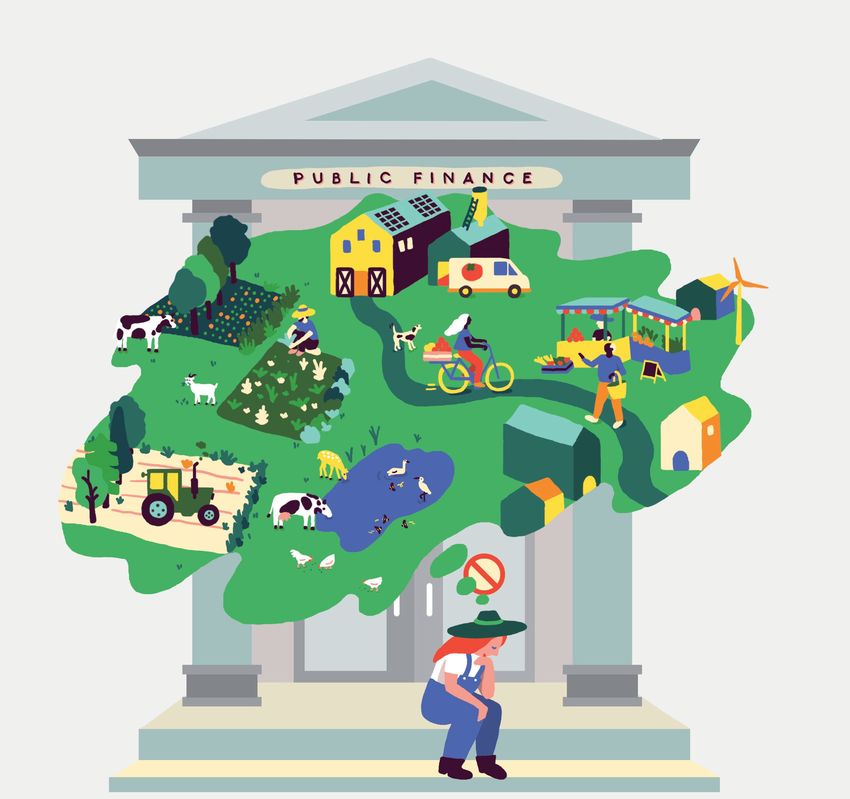
Cover illustration: © Bhakti Mills, Pouce-pied, pouce-pied.com
Design and layout: Hearts&Minds, Brussels, www.heartsnminds.euFINANCE FOR AGROECOLOGY: MORE THAN JUST A DREAM?
AN ASSESSMENT OF EUROPEAN AND INTERNATIONAL INSTITUTIONS’ 3
CONTRIBUTIONS TO FOOD SYSTEM TRANSFORMATION
COPING WITH THE
MULTIPLE CRISES WE ARE
FACING REQUIRES FOOD
SYSTEM CHANGE
Over the past years, discourses have changed rapidly. There In parallel, the importance of agricultural investments
is now a clear consensus to profoundly transform our food to eradicate poverty, hunger and malnutrition has been
systems in order to cope with the multiple crises we face. repeatedly underlined8 but public investments in agriculture
The Covid-19 outbreak sheds light on the vulnerability and have stagnated globally9, representing around 5.5% (or 10.2
the lack of resilience of our food systems. Agroecology is key billion USD in 2018) of total Official Development Assistance
to that transformation and as such the approach has gained (ODA). In this context, Public Private Partnerships and
momentum in the past years. IFAD and FAO underlined that blending finance – mechanisms which rely on partnerships
agroecology is key to achieving the Sustainable Development with private sector companies and financial actors – have
Goals (SDGs)1. The FAO presented it as a “promising option multiplied but have focused on industrial agriculture, and
to implement the Paris Agreement”2 as it addresses climate have failed to demonstrate their benefits for smallholders. A
change adaptation and mitigation simultaneously. Recent 2019 Oxfam report found that “the assumptions that blended
reports by the IPBES3, the IPCC4 and the High-Level finance is inherently beneficial for agricultural development
Panel of Experts (HLPE) of the UN Committee on world and that it is an efficient way to finance smallholder
Food Security (CFS)5 all highlight the important role that agriculture, are not supported by the evidence currently
agroecology plays in the fight to overcome the crises we are available”10. Does public finance support the food system
facing. More recently, agroecology has found its way into transformation required by the crises we are facing? This was
the European Green Deal through its Farm to Fork6 and our initial question.
Biodiversity7 strategies.
What is agroecology?
Agroecology is a way of redesigning and managing food systems, “from the farm to the table, with a goal of achieving ecological,
economic, and social sustainability”11 by applying a series of principles. Such principles have been captured in the FAO 10
elements of agroecology to guide the transition towards sustainable agriculture and food systemsI as well as in the HLPE
consolidated set of 13 agroecological principles12. The latter draws on CIDSE’s “Principles of Agroecology”, highlighting the
environmental, economic, social and political dimensions of agroecology.
see CIDSE infographic and report (available in 7 different languages).
I
The 10 elements were approved by the FAO council in 2019.4
SCOPE AND METHODOLOGY
In order to conduct such an assessment, CIDSE established 1. PROJECTS THAT DO NOT SUPPORT A
a partnership with the Centre for Agroecology, Water and TRANSITION TOWARDS AGROECOLOGY
Resilience (CAWR) at Coventry University. a. O
ther agricultural projects: industrial or conventional
agriculture and other rural development objectives such
as energy, information systems and infrastructure
b. Level 1: efficiency-oriented approaches such as
sustainable intensification
We chose to focus on: We are referring to those projects as “business as usual”
U Official Development Assistance (ODA) funds
E or as projects enabling conventional agriculture and
channelled through the Food and Agriculture Organisation efficiency improvements.
(FAO), the International Fund for Agricultural
Development (IFAD) and the World Food Programme 2. PROJECTS WITH UNCERTAIN POTENTIAL
(WFP) - referred to hereafter as the Rome-based agenciesII TO SUPPORT AGROECOLOGY
- because of the importance of those institutions in setting a. “social enablers’ projects”: conventional agriculture
the tone of food security policies and projects at the projects with a social dimension such as strengthening
international level and because of their recent engagement community-based organisations, smallholder participation
in favour of agroecology.III and access to land
b. Governance organisations: financial support for
e Green Climate Fund (GCF), which describes itself
Th international governance bodies and mechanisms
as “the world’s largest dedicated fund helping developing
countries reduce their GHG emissions and enhance their 3. PROJECTS THAT PARTIALLY SUPPORT
ability to respond to climate change”13. As “over 90% of AGROECOLOGY – LEVEL 2
countries’ Nationally Determined Contributions (NDCs) • Substituting industrial inputs and projects that involve
include agriculture targets” and as 12.5% of NDCs multiple approaches to sustainability
specifically refer to agroecology14, one would expect money
flows to reflect this increased focus on agroecology. 4. PROJECTS THAT SUPPORT TRANSFORMATIVE
AGROECOLOGY – LEVELS 3, 4 AND 5
a. L
evel 3: projects that focus on the redesign of
agroecosystems
b. Levels 4 and 5 or "food systems change": projects
The findings of the CIDSE-CAWR study are based on a that also contribute to a broader transformation of the
thorough analysis of 152 projectsIV of the United Nations food system, including through alternative forms of
(UN) Rome-based agencies financed through the EU budgetV economic exchanges and market relationships
over 3 years (2016-2018) and of the entire GCF portfolio
(from its creation until December 2019). The methodology Overall, the study which this briefing summarises has applied
used builds on Gliessman’s 5 levels of transition towards a generous interpretation of the projects’ potential contribution
sustainable food systems15 as well as additional categories. to agroecology, regardless of whether the term ‘agroecology’
These categories were then grouped together depending on was used in the project documentation.
the impact they have on a transition towards agroecology:
ee Coventry University background report16
S
for more detailed information about the
methodology used.
II
The three UN agencies working on food security (FAO, IFAD, WFP) are based in Rome.
III
In particular, through their collective contribution to the “scaling-up agroecology” initiative launched in 2018 during the FAO second international symposium on agroecology.
IV
152 projects out of the 367 that were funded through FAO, IFAD and WFP during that period of time (so 41.4% of the overall portfolio). 215 “emergency responses” projects
(or 58.6%) were excluded from the dataset.
V
70% of European ODA is financed directly by the EU budget, with the remaining 30% financed through the European Development Fund.FINANCE FOR AGROECOLOGY: MORE THAN JUST A DREAM?
AN ASSESSMENT OF EUROPEAN AND INTERNATIONAL INSTITUTIONS’ 5
CONTRIBUTIONS TO FOOD SYSTEM TRANSFORMATION
EU ODA FUNDING FOR UN ROME-
BASED AGENCIES’ PROJECTS
MAIN FINDINGS:
Focus on social enablers’ projects
•
None of the projects of the UN agencies financed
through the EU were supportive of a transformative Social enablers’ projects – which represent just around 15%
agroecology (targeting food system change or the redesign of the money flows – should not be overlooked. As such they
of the agroecosystem as a whole). represent the sole category of projects taking a more systemic
approach, by targeting agricultural production AND the
•P
rojects at level 2 – which should be the starting point social and economic context. If this social dimension were
of a transition towards agroecology – only represent 2.7% coupled with level 3 interventions, it could represent a strong
of the money channelled by the EU to the Rome-based contribution to food system transformation. Assessing how
agencies while in comparison, around 31.1% is dedicated such projects could progressively shift towards agroecology
to level 1 programmes, focusing on efficiency-oriented would be a step in the right direction.
approaches, with a simplistic approach to food production.
•
Overall, 79.8% of the money flows are supporting
business as usual approaches, with an additional 17.5%
of flows representing an uncertain potential to support
agroecology.
Figure 1:
Total investments per category in USD millions of EU flows towards FAO, IFAD and WFP (2016-2018)
Projects partially supportive
of agroecology
2.7%
Level 1: 106.8 mio USD
31.1 %
Projects with uncertain
potential to support Other: 167.2 mio USD
agroecology 48.7%
17.5%
Social enablers: 50.5 mio USD
14.7%
Governance organisations: 9.6 mio USD
2.8%
Level 2: 9.1 mio USD
2.7%
Support for transformative agroecological
Projects that are
projects is not represented because it
not supportive
receives no investments.
of agroecology
79.8%6
THE GREEN CLIMATE FUND
MAIN FINDINGS:
Focus on finance facilities
•O
ut of the 58 projects related to agriculture (representing
47% of the GCF portfolio), 8 projects are supportive of
5 of the 8 projects which matched level 3 (transformative
a transformative agroecology (5 of them being secondary
agroecology) set up finance facilities in project regions:
funds – see box). It represents 10.6% of the money
operating as secondary funds, they channel grants and/or
invested in agricultural projects by the GCF.
loans towards Micro, Small and Medium-sized enterprises
(MSMES) or community-based organisations. Though we
• Another 10.1% of the money invested in agricultural
have categorised them as level 3, we have little information
projects by the GCF are channelled towards projects
on how such funds are or will in fact be operating and if local
partially supporting agroecology.
communities were consulted as part of the development of
the project proposal. Nevertheless, in principle such facilities
•O
verall, 79.3% of the money flows are going towards
could play an important role in supporting a transition
business as usual approaches (enabling of conventional
towards agroecology, provided that they support people and
agriculture and efficiency improvements).
organisations in submitting proposals; that they include social
and environmental safeguards; that grants are an important
•A
ll agriculture-relevant projects are either focused
component of the project; and that there is a window of small
on climate adaptation (46.1%) or cross-cutting both
grants that smallholder farmers and food producers can access.
adaptation and mitigation (53.9%). Projects focusing only
on mitigation are all non-agricultural projects.
Figure 2:
Total investments per category in USD millions for the total amount of GCF agricultural projects
Projects that
support transformative
Level 1: 1202.8 mio USD
agroecology
53%
10.6%
Other: 296.3 mio USD
Projects 26,3%
partially supportive
of agroecology
10.1% Level 2: 229.4 mio USD
10.1%
Level 3: 241.1 mio USD
10.6%
Support for Levels 4 and 5 projects
that would implement "food systems
Projects that are change" is not represented because
not supportive they receive no investments.
of agroecology
79.3%FINANCE FOR AGROECOLOGY: MORE THAN JUST A DREAM?
AN ASSESSMENT OF EUROPEAN AND INTERNATIONAL INSTITUTIONS’ 7
CONTRIBUTIONS TO FOOD SYSTEM TRANSFORMATION
A CLOSER LOOK AT EUROPEAN
COUNTRIES’ FUNDING
Are the trends that were identified above also reflected at the These studies have also shown that public money channelled
national level? To answer this question, we have examined through and handled by NGOs and Africa-based institutions
a growing series of research reports mapping national tended to be much more supportive of agroecology. In Belgium
financial flows in support of agroecology (in Belgium17, 48% of the non-governmental flows promoted transformative
Germany18, Switzerland19, the United Kingdom20). In the agroecology. In Switzerland they identified that “projects led
case of Switzerland “51% of […] agricultural research for by Africa-based institutions tend to be more systemic and
development projects had agroecological components21. In inclusive, but these organisations receive relatively little […]
all the other cases available at national level, the financial funding from Swiss public donors”22.
support for transformative agroecology is either minimal
(Belgium, Germany) or inexistent (UK) – as it is the case for The European Commission and European countries are major
the GCF and the EU partnership with Rome-based Agencies. donors of agricultural ODA and a major source of finance for
Regardless of the support given to some agroecological international institutions focusing on food security. European
projects, in most country cases, agroecology is not a category countries are also key players in most of the governing bodies
used to report agricultural spending (e.g. UK, Ireland). of these institutions and the EC is only represented at FAO.
Key facts about European countries, the EU and the Rome-based agencies
EU institutions FAO
20%
EU institutions are the second largest funder of the FAO (representing around 20% of the budget
Others EU Member States
52,1% 16,3% in 201723). Together with EU Member States (14 of them having financed the FAO in 201724),
Non-EU European the EU contributed to 36.3% of the FAO 2017 budget. Contributions by European countries
countries
11,6% which are not members of the EU (Switzerland, Norway and the UK) represent an additional
11.6% of the 2017 budget.
EU Member States (Austria, Belgium, Finland, France and Germany25) represent around 10% of
the FAO Council members. The UK is also a Council member.
23 EU Member States and the Commission26 are sitting on the Committee on Agriculture that
advises the Council and reviews the FAO work programme, representing 20% of its members.
The Committee also includes Norway, the UK and Switzerland.
IFAD
EU Member States with an IFAD membership represent 26.7% of the votes27 in the Governing
Council. Norway, Switzerland and the UK represent and extra 8.27%28.
Currently (September 2020), 10 EU Member States: France, Germany, Italy, The Netherlands (members)
and Belgium, Denmark, Finland, Greece, Spain, Sweden (alternates) are sitting on its Executive Board
(representing 28% of the total)29. The UK, Switzerland and Norway are also sitting on the Board.
WFP
Austria, Denmark, The Netherlands, Norway, Spain, Sweden, UK, Hungary, Poland are currently
sitting on the Executive Board of the WFP representing 25% of its members.8
Key facts about European countries, the EU and the GCF
• Though EU institutions are not channelling money directly into the GCF, “collectively, EU Member States have disbursed
USD 4.78 billion to the GCF, making them the biggest provider of finance to the GCF”30.
• Development cooperation agencies of Germany, Belgium, Luxembourg, the Netherlands, France, Austria, and Spain have
been accredited to propose projects and support implementing organisations, as was the European Investment Bank.
• European countries represent 43% of the 44 members and alternates of the GCF Board. European Union Member States
represent around 32% of them31.
CONCLUSION
• As prominent public investors, the Green Climate Fund, European countries, EU Member States and the European Union
have the potential to play a big role in supporting the transformation of our food systems. Based on the current situation, the
room for improvement is huge.
• Our findings all highlight a lack of support for transformative and holistic interventions which do not reflect the objectives and
the urgency set by both the SDGs and the Paris Agreement.
• Nonetheless, an important part of the Belgium ODA channelled towards non-governmental organisations as of the Swiss-
funded agricultural research for development projects and 8 GCF projects have shown to be supportive of transformative
agroecology. Such cases should be investigated further and the lessons learned used to scale up support for an agroecological
transition.
• As it is clear that food systems need to be profoundly transformed in order to address the crises we face, the current financial
architecture also needs to be designed and equipped to support such radical transformation.
How can financial flows catalyse transformation?
This is a critical question that CIDSE and the Centre for Agroecology, Water and Resilience at Coventry University have
started addressing through action research and dialogue with various stakeholders. The findings of this research will be released
later this year.FINANCE FOR AGROECOLOGY: MORE THAN JUST A DREAM?
AN ASSESSMENT OF EUROPEAN AND INTERNATIONAL INSTITUTIONS’ 9
CONTRIBUTIONS TO FOOD SYSTEM TRANSFORMATION
RECOMMENDATIONS
Based on the key findings of this research we recommend that European countries, the EU, UN Rome-based agencies and
the Green Climate Fund:
• Redirect investments and finance towards agroecology and end funding of projects which are detrimental to the transformation
of food systems towards greater sustainability and social justice;
• When the evidence is available, identify which projects have a transformative potential, review them and identify ways to
increase funding for such type of projects;
• When the evidence is not available, undertake an analysis of governmental or institutional financial flows to assess their
contributions to a transition towards agroecology;
• Increase the funding for agroecological projects and programmes by: using an assessment tool that includes the principles of
agroecology to develop and select future agriculture projects; developing agroecological criteria in funding proposals;
• Focus on supporting farmer organisations and local NGOs that are accountable to smallholder farmers – especially those focusing
on agroecology – and who have been shown to be more inclusive, systematic and to take a more transformative approach;
• Support the creation by the public sector of an enabling environment for smallholders' investments in agriculture, taking into
account the fact that farmers are the primary investors in agriculture32;
• Review the financing mechanisms in order
to decrease the number of intermediaries;
maintain grants as a primary source of
finance; remove complex requirement
to access funds; decrease the minimum
size of funds so that local organisations SPECIFICALLY:
can easily access them; decentralise
access to funding.VI
The Green Climate Fund should:
• Support region or country-wide programmes on the transition towards
agroecology in such a way that they allow/afford the flexibility and efficiency
to deliver finance to small scale projects;
• Include a strong focus on agroecology in the fund sectoral guidance related
to agriculture, food security, ecosystems and land-use.
The EU should:
• Include a strong focus on agroecology in the programming guidance for
cooperation with third countries in the period 2021-2027;
• Cooperate with Rome-based agencies to increase support for agroecology.
The FAO, the IFAD and the WFP should:
• Increase support to the “scaling-up agroecology initiative” and give increasing
visibility to it;
• As GCF accredited entities, the FAO, the IFAD and the WFP should encourage
submissions and support the implementation of agroecological projects.
• Cooperate with the EU to increase support for agroecology.
VI
Ensuring that control over decision-making and access to
funds sits with those most directly affected by and best able
to identify strategies to cope with current and future crises.10
REFERENCES
1
I FAD (December 2019), “How agroecology can respond to a changing climate and benefit farmers”. https://www.ifad.org/en/
web/latest/story/asset/41485825 ; FAO (2018), FAO’s work on agroecology: a pathway to the SDGs. http://www.fao.org/3/
I9021EN/i9021en.pdf.
2
FAO (2018), FAO’s work on agroecology: a pathway to the SDGs. http://www.fao.org/3/I9021EN/i9021en.pdf.
3
I PBES (2019), Summary for policymakers of the global assessment report on biodiversity and ecosystem services of the Inter-
governmental Science-Policy Platform on Biodiversity and Ecosystem Services. https://www.ipbes.net/system/tdf/ipbes_7_10_
add.1_en_1.pdf?file=1&type=node&id=35329.
4
I PCC (2019), IPCC Special Report on Climate Change, Desertification, Land Degradation, Sustainable Land Management,
Food Security, and Greenhouse gas fluxes in Terrestrial Ecosystems. https://www.ipcc.ch/site/assets/uploads/2019/08/Fullre-
port-1.pdf.
5
LPE (2019), Agroecological and other innovative approaches for sustainable agriculture and food systems that enhance food
H
security and nutrition. A report by the High-Level Panel of Experts on Food Security and Nutrition of the Committee on
World Food Security, Rome. http://www.fao.org/3/ca5602en/ca5602en.pdf.
6
uropean Commission (2020), Farm to Fork strategy: For a fair, healthy and environmentally-friendly food system.
E
https://ec.europa.eu/food/sites/food/files/safety/docs/f2f_action-plan_2020_strategy-info_en.pdf.
7
uropean Commission (2020), EU Biodiversity Strategy for 2030 Bringing nature back into our lives. https://eur-lex.europa.
E
eu/resource.html?uri=cellar:a3c806a6-9ab3-11ea-9d2d-01aa75ed71a1.0001.02/DOC_1&format=PDF.
8
AO (2012), The state of food and agriculture: investing in agriculture for a better future. http://www.fao.org/3/i2885e/
F
i2885e00.pdf.
9
FAO (2017), Ending poverty and hunger by investing in agriculture and rural areas. http://www.fao.org/3/a-i7556e.pdf.
10
xfam (2019), Accountability deficit? Assessing the effectiveness of private finance blending in ensuring that small-scale far-
O
mers are not left behind. https://www.oxfam.org/en/research/accountability-deficit.
11
Gliessman S. (2016), Transforming food systems with agroecology, Agroecology and Sustainable Food Systems, 187-189.
https://www.tandfonline.com/doi/full/10.1080/21683565.2015.1130765.
12
LPE (2019), Agroecological and other innovative approaches for sustainable agriculture and food systems that enhance food
H
security and nutrition. A report by the High-Level Panel of Experts on Food Security and Nutrition of the Committee on
World Food Security, Rome. Page 41. http://www.fao.org/3/ca5602en/ca5602en.pdf.
13
GCF – Website. https://www.greenclimate.fund/about.
14
eippert, F., Darmaun, M., Bernoux, M. and Mpheshea, M. (2020), The potential of agroecology to build climate-resilient
L
livelihoods and food systems. FAO and Biovision. http://www.fao.org/3/cb0438en/CB0438EN.pdf.
15
Gliessman, S. (2016), Transforming food systems with agroecology, Agroecology and Sustainable Food Systems, p.187-189.
https://www.tandfonline.com/doi/full/10.1080/21683565.2015.1130765.
16
oeller, N.I. (2020), Analysis of Funding Flows to Agroecology: the case of European Union monetary flows to the United
M
Nations’ Rome-based agencies and the case of the Green Climate Fund. https://www.cidse.org/2020/09/28/analysis-of-fund-
ing-flows-to-agroecology/.FINANCE FOR AGROECOLOGY: MORE THAN JUST A DREAM?
AN ASSESSMENT OF EUROPEAN AND INTERNATIONAL INSTITUTIONS’ 11
CONTRIBUTIONS TO FOOD SYSTEM TRANSFORMATION
17
oalition Contre la Faim (2020), Pour une aide publique au développement belge qui soutienne la transition agroécologique.
C
https://yes2agroecology.be/wp-content/uploads/2020/05/CCF-PolicyBrief-ABP-Agroecologie-Juin2020_FR-Web.pdf and
Vermeylen M., De Schutter O. (2020), The share of agroecology in Belgian Official Development Assistance: an opportunity
missed. https://yes2agroecology.be/wp-content/uploads/2020/05/CRIDHO-WP-2020-3_ODeSchutter_Share-Agroecology-
Belgian.pdf.
18
J ahresbilanz Agrarökologie: Analyse ein Jahr nach Veröffentlichung des Positionspapiers „Agrarökologie stärken“ (2019).
https://www.inkota.de/fileadmin/user_upload/Presse/Pressemitteilungen/Agraroekologie2020_Bilanzpapier.pdf.
19
iovision Foundation for Ecological Development & IPES-Food (2020), Money Flows: What is holding back investment
B
in agroecological research for Africa? Biovision Foundation for Ecological Development & International Panel of Experts on
Sustainable Food Systems https://www.agroecology-pool.org/moneyflowsreport/.
20
imbert, M. & Moeller, N. (2018), Absent Agroecology Aid: On UK Agricultural Development Assistance Since 2010.
P
Sustainability. https://www.mdpi.com/2071-1050/10/2/505/htm.
21
iovision Foundation for Ecological Development & IPES-Food (2020), Looking at Swiss investments in agricultural research
B
for Africa. The money flows fact sheets. https://www.agroecology-pool.org/download/3285/.
22
imbert, M. & Moeller, N. (2018). Absent Agroecology Aid: On UK Agricultural Development Assistance Since 2010.
P
Sustainability. https://www.mdpi.com/2071-1050/10/2/505/htm.
23
alculations made on numbers from the following page: http://www.fao.org/3/I9057EN/i9057en.pdf. FAO budget for 2017
C
= 1.4 billion – received 281 552 988 USD from EU institutions = 20,11% of FAO 2017 budget.
24
In descending order in terms of contribution: Germany, Italy, France, Sweden, Belgian, the Netherlands, Austria, Ireland,
Poland, Denmark, Greece, Finland, Portugal, Czech Republic. Source: http://www.fao.org/3/I9057EN/i9057en.pdf.
25
FAO – Website. http://www.fao.org/unfao/govbodies/gsbhome/council/en/.
26
uropean union; Austria, Belgium; Cyprus; Czechia; Denmark; Estonia; Finland; France; Germany; Greece; Hungary; Ireland;
E
Italy; Latvia; Lithuania; Netherlands; Poland; Portugal; Romania; Slovakia; Slovenia; Spain; Sweden. Source: http://www.fao.
org/unfao/govbodies/gsbhome/coag/en/.
27
ustria 1,05% of total votes; Belgium 1,23%; Croatia 0,24; Cyprus 0,24; Denmark 1,23; Estonia 0,24; Finland 1,20;
A
France 3,37; Germany 3,98; Greece 0,27; Hungary 0,24; Ireland 0,54; Italy 3,73; Luxembourg 0,32; Malta 0,24; Neth-
erlands 3,55; Poland 0,24; Portugal 0,27; Romania 0,25; Spain 0,88; Sweden 3,40. Source: https://www.ifad.org/docu-
ments/38711624/40240493/Votes+by+Member+States/85a59a85-696d-4876-87c5-5300177ad357.
28
Switzerland 1,88; UK: 3,68; Norway 2,71. Source: https://www.ifad.org/documents/38711624/40240493/Votes+by+Mem-
ber+States/85a59a85-696d-4876-87c5-5300177ad357.
29
elgium, Denmark, Finland, Greece, Spain, Switzerland and the UK are all alternate members. Source: https://webapps.ifad.
B
org/members/eb.
30
ietjen B., Rampa F., Knaepen H. (2019), Finance to adapt: making climate funding work for agriculture at the local level. ECDPM
T
https://ecdpm.org/wp-content/uploads/Finance-Adapt-Climate-Funding-Agriculture-Local-Level-ECDPM-Brief-
ing-Note-111.pdf.
31
embers: UK, Switzerland, France, Sweden, Italy, Spain, Norway, Germany, Denmark. Alternates: UK, Finland, France,
M
Sweden, Austria, Ireland, Norway, Germany, The Netherlands, Belgium. Source: https://www.greenclimate.fund/boardroom.CIDSE members
Austria Belgium Belgium
Canada England and Wales France
Germany Ireland Italy
Luxembourg the Netherlands the Netherlands
Portugal Scotland Slovakia
Spain Switzerland USA
Contact
François Delvaux, Agroecology and Food Sovereignty Officer - delvaux(at)cidse.org
CIDSE – Rue Stévin 16 – B-1000 Bruxelles
T: +32 (0)2 230 77 22 – F: +32 (0)2 230 70 82 – www.cidse.orgYou can also read


