GENE1500 Faculty of Engineering UNSW Engineering - UNSW ...
←
→
Page content transcription
If your browser does not render page correctly, please read the page content below
Faculty of Engineering
                                                                            UNSW Engineering

GENE1500
Creative Entrepreneurship

Term 1, 2022

            GENE1500 // Term 1, 2022 // published at 15-02-2022 © UNSW Sydney, 2022
                                                                                           1
Course Overview
Staff Contact Details
Convenors

 Name                Email                                      Availability              Location   Phone

 Lucas Hakewill      l.hakewill@unsw.edu.au                     By appointment            Working
                                                                                          remotely

Lecturers

 Name                Email                                      Availability              Location   Phone

 Fi Woolliscroft     f.woolliscroft@unsw.edu.au                 By appointment            Working
                                                                                          remotely

Tutors

 Name                Email                                      Availability              Location   Phone

 Lizette Lee         mcic@unsw.edu.au                           By appointment            Working
                                                                                          remotely

School Contact Information

Faculty of Engineering

Email: eng.tsa@unsw.edu.au

                         GENE1500 // Term 1, 2022 // published at 15-02-2022 © UNSW Sydney, 2022
                                                                                                             2
Course Details
Units of Credit 6
Summary of the Course
What is creativity? What is entrepreneurship? Why do they matter?
In this course, you will identify, analyse and propose a solution to a meaningful unsolved problem in the
world.
You'll focus on a specific market segment, develop your own prototypes, and deliver a pitch to an expert
panel.
This course is more practical than academic: you'll form a multidisciplinary team to tackle your chosen
problem. You'll develop experience with some of the foundational skills you need to embark on an
entrepreneurial venture:
Critically develop solution concepts
Analyse competitors
Solve problems
Build your network and work in a team
Design prototypes and experiments to validate concepts
Communicate your ideas with influence
After this course, you will have taken steps towards creating your own first startup, with mentors, support
structures and fellow UNSW students to bring your ideas and companies to life.
This course can be taken by students as a General Education course.
Course Learning Outcomes
1. Identify the common characteristics of successful entrepreneurs and startups, and understand
the processes and support mechanisms that enable them to succeed.
2. Define a problem statement developed from a compelling societal need, generate multiple
alternative solution concepts, and evaluate them using Design Thinking and processes such as
Minimal Viable Product, A/B testing, product-market fit, the Business Model Canvas and the
Value Proposition Canvas.
3. Source significant quantities of detailed relevant and/or technical background information and
perform a rigorous competitor analysis.
4. Use language, visual representations, and/or digital media to insightfully and precisely represent
and persuasively convey qualitative and quantitative information.
5. Apply coordinated, sustained and effective team effort and critical thinking.
6. Produce a convincing and user-focused complete solution and explain in detail how it addresses
the problem statement.
Teaching Strategies
The course will:
GENE1500 // Term 1, 2022 // published at 15-02-2022 © UNSW Sydney, 2022
3Be delivered through an innovative online/face-to-face curriculum that combines theory,
experiential practice, and self-reflection to enhance the student learning
Focus on developing generative capacity in students so that they can both think and act on new
ideas to solve valuable problems
Use an expansive mix of technology-enhanced learning activities combined with real case
studies of UNSW alumni who have become creative entrepreneurs
Additional Course Information
Some entrepreneurial skills can be learned (secondhand) by reading and listening to others. However,
research on entrepreneurship education shows that much of it is best learned (first-hand) by taking
action, dealing with inevitable obstacles and unanticipated consequences, and finding ways of working
around or with them.
During this course you are encouraged not to simply learn about entrepreneurship, but to pursue your
entrepreneurial project as if it's a real startup.
By design this course will take you out of your comfort zone (in a safe and supportive environment),
encourage you to share ideas, apply theory rapidly and learn from decisions and mistakes.
You will work together in teams to design a creative entrepreneurial venture. As an entrepreneur, you
always choose your own team. In fact, you have to work very hard to attract people to join a startup.
You'll build your team early in the course and work with them for the remainder of the time.
GENE1500 // Term 1, 2022 // published at 15-02-2022 © UNSW Sydney, 2022
4Assessment
In your assessments you may need to cite sources for your secondary research. For example, you may
have gleaned some statistics from a research paper, or gathered market sizing information from
IBISWorld.
Please use APA author-date referencing style for citations. You can find some great instructions here:
https://www.student.unsw.edu.au/apa
Referencing is a pain if you don't keep on top of your sources. One way to save yourself a lot of time and
stress is to use a tool like Zotero (zotero.org) while you write your paper. This can generate a
bibliography for you automatically if you use its word processor plugin.
For your final pitch you are not required to go through your bibliography but you should include it either
as a separate document or at the end of your submitted pitch deck.
Assessment task Weight Due Date Course Learning
Outcomes Assessed
1. Validating a Problem 25% 13/03/2022 11:00 PM 2, 4, 5
Space
2. Reflective Peer Feedback 25% 27/03/2022 11:00 PM 1, 2
3. Group Project: Present 50% 12/04/2022 02:00 PM 1, 2, 3, 4, 5
and Submit Group Project
Assessment 1: Validating a Problem Space
Due date: 13/03/2022 11:00 PM
Written report (1400 words) + 2 minute video
Identify and analyse a meaningful unsolved problem in the world for an identified market segment. Use
Customer Discovery methodology to present evidence that validates (or invalidates) your identified
problem space. Critically reflect on this process
This assignment is submitted through Turnitin and students can see Turnitin similarity reports.
Additional details
Your course convenor will provide a rubric with assessment criteria outlined.
Assessment 2: Reflective Peer Feedback
Due date: 27/03/2022 11:00 PM
Reflective Peer Feedback (300 words)
Each student is randomly assigned 3 reports and videos from Assessment 1 for them to provide
GENE1500 // Term 1, 2022 // published at 15-02-2022 © UNSW Sydney, 2022
5structured feedback on.
This is not a Turnitin assignment
Additional details
Your convenor will provide details through Moodle.
Assessment 3: Group Project: Present and Submit Group Project
Submission notes: You'll present this during your tutorial.
Due date: 12/04/2022 02:00 PM
Present and Submit Group Project
Students in teams will be required to design a business model and pitch deck for a creative
entrepreneurial venture that targets a problem space generated by the cohort (Individual Project A). This
exercise is meant to tie together the course materials from each of the weeks in an innovative and
imaginative way. The team based applied learning exercise simulates the activities that real
entrepreneurs do when designing a venture.
Requirements: 5 minute pitch presentation plus 10 minutes Q&A.
Students will receive both a group component (50% of assessment value) and an individual component
(50% of assessment value) in their mark.
This is not a Turnitin assignment
Additional details
Assessment criteria will be available on Moodle.
GENE1500 // Term 1, 2022 // published at 15-02-2022 © UNSW Sydney, 2022
6Attendance Requirements
Students are strongly encouraged to attend all classes and review lecture recordings.
Course Schedule
Students who do well in GENE1500 generally:
Show up for their lectures and especially the tutorials
Get feedback on drafts of their work, and make use of office hours or coaching sessions
View class timetable
Timetable
Date Type Content
Week 1: 14 February - Lecture
18 February
About the course – getting the most of out
of it
What is entrepreneurship? Why does it
matter? What is a startup?
Design Thinking/Lean approach
Week 2: 21 February - Tutorial
25 February
Observing and noticing problems worth
solving
Customer Discovery
First steps to finding your team
Lecture What is creativity?
Creativity process and Inventure Cycle
Immersing yourself in the problem space –
observing and noticing
Pain points, frictions, life hacks – flaws,
hacks, annoyances
Buglists
5 Ws
GENE1500 // Term 1, 2022 // published at 15-02-2022 © UNSW Sydney, 2022
7Week 3: 28 February - Lecture
4 March
Giving and receiving feedback
Finding and validating meaningful
problems to solve
Customer discovery and Rapid Research
Secondary market research
How big is the opportunity (TAM, SAM,
SOM)
Tutorial
Giving and receiving feedback
Customer Discovery
Refining your problem statement
Week 4: 7 March - 11 Assessment Assessment 1: Validating a Problem Space (Due
March 13 March at 23:00pm AEDT)
Lecture Guest speaker: James Tawadros, MCIC
Fabrication Coordinator
Prototyping - making ideas tangible
Thinking with you hands
Feedback loops and iteration
Listening to your users
Iteration cycles
Tutorial
Market Size
Ideation
Personas
Week 5: 14 March - 18 Lecture Introduction to lean startup and the Lean
March Canvas
Competitive landscape
Tutorial
GENE1500 // Term 1, 2022 // published at 15-02-2022 © UNSW Sydney, 2022
8Prototyping activity
Week 6: 21 March - 25 Assessment Assessment 2: Reflective Peer Feedback (Due 27
March March)
Week 7: 28 March - 1 Lecture Designing an innovative, sustainable
April business model
Unit economics for early-stage founders
Tutorial Using the Lean Canvas
Business Model research
Week 8: 4 April - 8 April Lecture Pitching and communicating ideas
Gaddie pitch framework
Introduction to storytelling
Tutorial Workshopping and practising your pitch
Developing your pitch deck
Week 9: 11 April - 15 Lecture Essential skills of entrepreneurs
April Building mindsets and resilience
Tutorial Week 9 Quiz
Present and submit your group project.
Complete MyExperience feedback survey
Assessment Assessment 3: Present and Submit Group Project
(Due during your tutorial)
5 minute live or pre-recorded video pitch
presentation and 10mins live Q&A with experts.
Week 10: 18 April - 22 Lecture
April
Introduction to entrepreneurial
ecosystems and support
GENE1500 // Term 1, 2022 // published at 15-02-2022 © UNSW Sydney, 2022
9Resources
Recommended Resources
Here are a few books that the UNSW Founders team have found useful. These are entirely optional for
you to read.
Talking to Humans - Giff Constable, Frank Rimalovski and Tom Fishburne (available free for
students on talkingtohumans.com)
The Creators Code – Amy Wilkinson
Business Model Generation – Alexander Osterwalder
Each week the lecturer will suggest recommend readings, videos, podcasts and ecosystem events.
These will be available in Moodle.
Course Evaluation and Development
Feedback on the course is gathered periodically using various means, including the
UNSW myExperience process, informal discussion in the final class for the course, and the School’s
Student/Staff meetings.
Your feedback is taken seriously, and continual improvements are made to the course based, in part, on
such feedback.
Feedback and the resulting improvements will be summarised and posted on the course Moodle
page each time the course is run.
GENE1500 // Term 1, 2022 // published at 15-02-2022 © UNSW Sydney, 2022
10Submission of Assessment Tasks
Work submitted late without an approved extension by the course coordinator or delegated authority is
subject to a late penalty of five percent (5%) of the maximum mark possible for that assessment item,
per calendar day.
The late penalty is applied per calendar day (including weekends and public holidays) that the
assessment is overdue. There is no pro-rata of the late penalty for submissions made part way through a
day. This is for all assessments where a penalty applies.
Work submitted after five days (120 hours) will not be accepted and a mark of zero will be awarded for
that assessment item.
For some assessment items, a late penalty may not be appropriate. These will be clearly indicated in the
course outline, and such assessments will receive a mark of zero if not completed by the specified date.
Examples include:
Weekly online tests or laboratory work worth a small proportion of the subject mark, or
Online quizzes where answers are released to students on completion, or Professional
assessment tasks, where the intention is to create an authentic assessment that has an absolute
submission date, or Pass/Fail assessment tasks.
GENE1500 // Term 1, 2022 // published at 15-02-2022 © UNSW Sydney, 2022
11Academic Honesty and Plagiarism
UNSW has an ongoing commitment to fostering a culture of learning informed by academic integrity. All
UNSW students have a responsibility to adhere to this principle of academic integrity. Plagiarism
undermines academic integrity and is not tolerated at UNSW. Plagiarism at UNSW is defined as using
the words or ideas of others and passing them off as your own.
Plagiarism is a type of intellectual theft. It can take many forms, from deliberate cheating to accidentally
copying from a source without acknowledgement. UNSW has produced a website with a wealth of
resources to support students to understand and avoid plagiarism, visit: student.unsw.edu.au/plagiarism.
The Learning Centre assists students with understanding academic integrity and how not to plagiarise.
They also hold workshops and can help students one-on-one.
You are also reminded that careful time management is an important part of study and one of the
identified causes of plagiarism is poor time management. Students should allow sufficient time for
research, drafting and the proper referencing of sources in preparing all assessment tasks.
Repeated plagiarism (even in first year), plagiarism after first year, or serious instances, may also be
investigated under the Student Misconduct Procedures. The penalties under the procedures can include
a reduction in marks, failing a course or for the most serious matters (like plagiarism in an honours thesis
or contract cheating) even suspension from the university. The Student Misconduct Procedures are
available here:
www.gs.unsw.edu.au/policy/documents/studentmisconductprocedures.pdf
GENE1500 // Term 1, 2022 // published at 15-02-2022 © UNSW Sydney, 2022
12I. Special consideration and supplementary assessment
If you have experienced an illness or misadventure beyond your control that will interfere with your
assessment performance, you are eligible to apply for Special Consideration prior to submitting an
assessment or sitting an exam.
Please note that UNSW now has a Fit to Sit / Submit rule, which means that if you sit an exam or submit
a piece of assessment, you are declaring yourself fit enough to do so and cannot later apply for Special
Consideration.
For details of applying for Special Consideration and conditions for the award of supplementary
assessment, please see the information on UNSW’s Special Consideration page.
II. Administrative matters and links
All students are expected to read and be familiar with UNSW guidelines and polices. In particular,
students should be familiar with the following:
Attendance
UNSW Email Address
Special Consideration
Exams
Approved Calculators
Academic Honesty and Plagiarism
Equitable Learning Services
III. Equity and diversity
Those students who have a disability that requires some adjustment in their teaching or learning
environment are encouraged to discuss their study needs with the course convener prior to, or at the
commencement of, their course,or with the Equity Officer (Disability) in the Equitable Learning Services.
Issues to be discussed may include access to materials, signers or note-takers, the provision of services
and additional exam and assessment arrangements. Early notification is essential to enable any
necessary adjustments to be made.
Image Credit
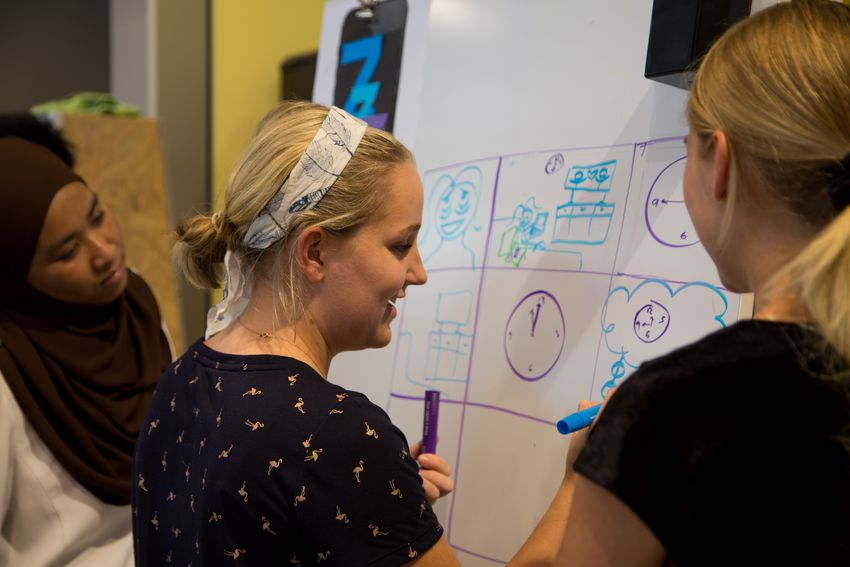
MCIC, Division of Enterprise, UNSW.
CRICOS
CRICOS Provider Code: 00098G
Acknowledgement of Country
We acknowledge the Bedegal people who are the traditional custodians of the lands on which UNSW
Kensington campus is located.
GENE1500 // Term 1, 2022 // published at 15-02-2022 © UNSW Sydney, 2022
13
Powered by TCPDF (www.tcpdf.org)You can also read


