International Journal of Arts and Humanities (IJAH) Ethiopia - African Journals Online
←
→
Page content transcription
If your browser does not render page correctly, please read the page content below
IJAH VOL 8 (2), APRIL, 2019

       International Journal of Arts and Humanities (IJAH)
                              Ethiopia
                   Vol. 8 (2), S/No 29, APRIL, 2019: 18-30
               ISSN: 2225-8590 (Print) ISSN 2227-5452 (Online)
                   DOI: http://dx.doi.org/10.4314/ijah.v8i2.3

        Comparative Analysis of Funding of Education in Nigeria

                    Uhunmwuangho, Sunday Okungbowa, Ph.D.
              Institute of Public Administration and Extension Services
                            University of Benin, Benin City,
                                   Edo State, Nigeria
                      E-mail: uhunmwuangho4you@yahoo.com

                                  Diakpomrere, V. O., Ph.D.
                                  Department of Theatre Arts
                                     University of Benin,
                                     Benin City, Nigeria

                                                 Abstract
Some of the obstacles to the nascent democracy In Nigeria include the neglect of education for
Its citizens, the spate of armed robbery attacks, political assassinations, religious conflicts and
lack of proper education funding coupled with the seeming helplessness of security agencies to
handle criminal acts. The focus of this paper is to comparatively analyse the funding of
Education in Nigeria tertiary institutions. In the 19 years since Nigeria returned to civil rule
under the Fourth Republic, University teachers in the country have embarked on strikes 14
times that saw them stay away from work for about 40 months. The latest strike by the teachers
under the Academic Staff Union of Universities (ASUU) began in November 2018 lasted till
February 2019, in spite of several rounds of meetings between leaders of the Union and the
Federal Government all because of funding of education. ASUU has been locked in a protracted
dispute with the Nigerian government over issues connected to poor funding of public
universities. In the course of this study, the Comparative Analysis of Funding of Education in
Nigeria were brought to the fore while the objectives of the study were well spelt out.
Hypotheses were postulated and the Group Theory was used to explicate the works. Data were
obtained from both primary and secondary sources. From the primary sources, the survey
method was adopted. Data obtained from this method were analysed with the aid of Simple
Percentage. Thereafter, the five researchable hypotheses were tested and accepted while the
null hypotheses were rejected. The implication is that there was relationship between the

Copyright © International Association of African Researchers and Reviewers,
2012-2019: www.afrrevjo.net                                                               18
Indexed African Journals Online (AJOL): www.info@ajol.info
IJAH VOL 8 (2), APRIL, 2019
dependent and independent variables. Generally, the paper brought to focus that effective
funding of education in Nigeria is a task that must be done with collective efforts of all
stakeholders for the growth and development of universities in Nigeria. In a nutshell, this paper
suggested policy prescription and recommendations which are aimed at repositioning
universities in Nigeria. Finally, this paper however, painstakingly appraised several of these
issues and concluded that all stakeholders in the federal polity should thread softly, be objective,
rational, altruistic and magnanimous in order not to make the existence of true federalism
(social, education, political and economic cohesive existence of the people, peace and
tranquillity) a fleeting illusion and a mirage.
Key Words: Education, Funding, Strikes, Federal, State, Government
Introduction
Nigeria sovereign nation, more than anything else, the greatest obstacle to the nascent
democracy is the neglect of education for Nigerian citizens in nation building, as evidenced by
the spate of armed robbery attacks, political assassinations, religious conflicts and education
funding coupled with the seeming helplessness of security agencies to handle criminal acts
(Uhunmwuangho & Epelle, 2011). The situation is worsened by the increasing number of
uneducated Nigerians some of whom are ready recruits for criminal activities (Nigerian
Tribune, 2002). The above statement from an editorial comment by a national daily in Nigeria
indeed epitomises the central focus of this paper, the aim of which is to analyse the importance
of education to democratic sustainability in Nigeria.
The focus of this paper is to comparatively analyse the funding of Education in Nigeria tertiary
institutions. Universities all over the world and particularly in Nigeria often provide the
philosophical drive, and in some cases, the front-line troops for social change, including
revolutions and, occasionally centre of excellence. In the 19 years since Nigeria returned to
civil rule under the Fourth Republic, University teachers in the country have embarked on strike
14 times that saw them stay away from work for about 40 months. The latest strike by the
teachers under the Academic Staff Union of Universities (ASUU) began on the 4th of November
2018 and there is yet no end in sight, in spite of several rounds of meetings between leaders of
the Union and the Federal Government all because of funding of education. ASUU has been
locked in a protracted dispute with the Nigerian government over issues connected to poor
funding of public universities (Wikipedia, 2018).
The history of Academic Staff Union of Universities (ASUU)’s strike can be traced back to
1978, the period of the beginning of the decline in the oil boom, when the country faced the
consequences of the failure by its rulers to use the oil wealth to generate production and a social
welfare system. Military dictatorship had eroded deeply the basic freedoms in the society.
Academic freedom and university autonomy were casualties of military dictatorship. The
funding of education, and so of universities, became poorer. The factors required a changed
orientation of the union of academics, from 1980. Asia’s orientation became radical, more
concerned with broad national issues, and stood firmly against oppressive, undemocratic
policies of the country (UNIBEN Strategic Plan, 2010).
Therefore, the development of political and administrative institutions in Western Europe has
shown that other countries that have modernized or developed politically and those new and
old nation states that strive towards modernization or development have developed political
system. These features have made the demands for their societies. On the other hand, the
Copyright © International Association of African Researchers and Reviewers,
2012-2019: www.afrrevjo.net 19
Indexed African Journals Online (AJOL): www.info@ajol.infoIJAH VOL 8 (2), APRIL, 2019
problem of the developing world primarily lies in the historical perspective e.g. the colonial
and post-colonial era. The current civilian regime in Nigeria has been in place since May 1999.
It would be expected that the relationship between the Government and the Universities
stakeholders as regards funding would be more cordial and more productive. Unfortunately,
that is not the case. Therefore, it is an incontrovertible fact that most governments in the third
world countries regard people as the real wealth of the nation, and the basic objective of
development is to create an enabling environment for people to enjoy long, healthy, poverty-
free and creative lives. This is the focus of education for all in the year 2000, a policy statement
of the government and development in the late twentieth century. Whether viewed from
economic, social, political or cultural perspective, education is pivotal to development and is
now assessed on what people are capable of doing or how best they can mobilize their local
resources to meet domestic needs (Akintoye & Uhunmwuangho, 2018).
University worldwide is regarded as the citadel of learning, the fountain of intellectual
development and a ground for the production of leaders of tomorrow. According to Fafunwa
(1999) a university fulfils, one major function, it is a knowledge and value provider, in other
words, a university progresses when it is able to provide knowledge and value and when it is
not properly managed by the administrators and staff, it then fails in its function of providing
knowledge for service and value. Accordingly, this explains why merit has been the watchword
in the university system, an institution in which a student must first be certified worthy in
character and learning before being admitted into the Honours’ Degree.
Problems
It is not difficult to see that our country is brimming with frustrated young men and women.
The more desperate among them form cult, kidnapping and armed robbery groups and take it
out on the society. Sadly, their victims are not in a position to make things better for them. You
are looking at the unacceptable face of a monumental national scandal. So many institutions,
so few opportunities for the training of our leaders of tomorrow. The problem is that the big
people do not see this as a major national scandal.
One is tempted to argue that the under-funding of educational institutions in Nigeria is
deliberate. It started under the military era, realizing that ideas were more powerful than the
guns, the military pauperized and under-developed tertiary education so as to make tertiary
institutions lecturers subservient to their antics, whims and caprices (Iyayi & Momoh, 2015).
Therefore, under-funding of tertiary education is a deliberate state strategy for the imposition
of ruling elite hegemony for the purpose of social and political control and domination. It was
also designed to reverse the adage that says “the pen is mightier than the sword”, to “the sword
is mightier than the pen”. It came in the context of the role of what Antonio Gramsci calls the
organic intellectuals have played in Nigerian policy, they manifested as Nigerian public
intellectuals and they had organic links to new social movements and Labour Movement, and
involved in popular struggles for political transformation (Iyayi & Momoh, 2015).
The approach of the Government is to challenge the Universities to manage their finances
better, and to generate funds from other sources. As a result, this logical argument is being met
with extreme resistance by university staff, and of course, the students, who claim that the
Government is perfectly capable of funding education fully if proper prioritization was applied
to the Nation’s expenditure and if corruption was eliminated (Makanjuola, 2003).
Copyright © International Association of African Researchers and Reviewers,
2012-2019: www.afrrevjo.net 20
Indexed African Journals Online (AJOL): www.info@ajol.infoIJAH VOL 8 (2), APRIL, 2019
Consequently, there is multiple and hydra-headed crises in tertiary education in Nigeria, and
generally our education has become mundane, moribund and backward as regards under-
funding. It is also suffering the crisis of relevance and unable to respond to the challenges of
the times, and it has huge technological and cultural deficits. It is also unable to empower the
people and bring about rapid technological development in ways in which education, especially
research, has led to the rapid development of China, Japan, South Korea, and Singapore. More
often, the rapid technological development of those countries is attributed to the specific kind
of leadership they had, but the secret to their success is the kind of educational system and their
ability to valorise and give special attention and preference to knowledge produced by their
various tertiary institutions, which are also well funded (Iyayi & Momoh, 2015)
The majority of students in most of the higher institutions in the West African sub-region are
Nigerians. These are the young men and women whose parents can afford to parcel them off
every year to more educationally salubrious institutions of higher learning. If they do not do
that, their children and wards would remain here and be subjected to the yearly trauma of taking
JAMB and IJMB (Guardian, 2017). We have neglected education at the peril of our nation. We
may continue to pretend that all is well. But a nation that lives a lie lives to regret it in the long
term.
However, in a world Bank study of budgetary allocation to the education sector of 20 countries,
Nigeria had the lowest allocation for the year 2012. Ghana, Cote D’’Ivoire, Uganda, Morocco,
South Africa and Swaziland constituted the top 6, respectively; while Kenya placed 8th behind
Mexico. Nigeria’s 2012 education allocation was 8.4%.
Annual Budgetary Allocations to Education of 20 World Bank Sampled Countries -
2012
Country % Budget Position
Ghana 31 1st
Cote D’Ivoire 30 2nd
Uganda 27 3rd
Morocco 26.4 4th
South Africa 25.8 5th
Swaziland 24.6 6th
Mexico 24.3 7th
Kenya 23 8th
United Arab Emirates 22.5 9th
Botswana 19 10th
Iran 17.7 11th
United States of America 17.1 12th
Tunisia 17 13th
Lesotho 17 14th
Burkina Faso 16.8 15th
Norway 16.2 16th
Columbia 15.6 17th
Nicaragua 15 18th
India 12.7 19th
Nigeria 8.4 20th
Source: World Bank, 2012
Copyright © International Association of African Researchers and Reviewers,
2012-2019: www.afrrevjo.net 21
Indexed African Journals Online (AJOL): www.info@ajol.infoIJAH VOL 8 (2), APRIL, 2019
A careful study of table one above reveals that Nigeria is at the lowest ladder with 8.4 percent
of budgetary allocation. In the words of Okebukola (2003),
the benefits of the acquisition of any higher education programme now went
largely to the individual as a private good for which beneficiaries and their
families should pay … a additional co-commitant of the private good is that,
grants have been changed to loans, placing major burdens on many university
graduates.
University worldwide is regarded as the citadel of learning, the fountain of intellectual
development and a ground for the production of leaders of tomorrow. According to Fafunwa
(1999) a university fulfils, one major function, it is a knowledge and value provider, in other
words, a university progresses when it is able to provide knowledge and value and when it is
not properly managed by the administrators and staff, it then fails in its function of providing
knowledge for service and value. Accordingly, this explains why merit has been the watchword
in the university system, an institution in which a student must first be certified worthy in
character and learning before being admitted into the Honours’ Degree.
The major problem is that funding to the Universities has become progressively more
inadequate. In actual sense, even dollar terms, the funding has increased. However, a series of
salary increases has had disastrous effects on the financial situation. Almost all the funds
available are being utilized for the payment of salaries, and many institutions have difficulty in
meeting even this obligation (Ita, 2007)
It is against this background that the following hypothetical questions needs to be answered:
1. What is the concept of ASUU in academic administration in Nigeria?
2. What are the causes of frequent ASUU strike in Nigerian Universities?
3. Who are the most affected whenever there is strike in Nigeria universities?
Objectives
The specific objectives are:
1. To ascertain if inadequate funding hinders effective University administration in Edo
State.
2. To examine whether the dispute with Government is connected to poor funding of
Nigerian Universities in Edo State.
3. To investigate the impact of incessant strike on academic performance of students in
Universities in Edo State.
4. To ascertain the problems associated with the implementation of agreement between
ASUU and Federal Government
5. To examine whether the on-going strike by ASUU is connected with under-funding of
Universities in Nigeria.
Hypotheses
In order to achieve the above objectives, the following research hypotheses were formulated:
1. There is no significant relationship between inadequate funding and University
Copyright © International Association of African Researchers and Reviewers,
2012-2019: www.afrrevjo.net 22
Indexed African Journals Online (AJOL): www.info@ajol.infoIJAH VOL 8 (2), APRIL, 2019
administration in Edo State.
2. There is no significant relationship between the dispute with Government and poor
funding of Nigerian Universities in Edo State
3. There is no significant relationship between the impact of incessant strike and
academic performance of students in Edo State.
4. There is no significant relationship between the problems associated with the
implementation of ASUU agreement and the Federal Government
5. There is no significant relationship between the on-going strike by ASUU and under-
funding of Universities in Nigeria.
Theoretical Exposition
The particular theories that can sufficiently act as a guide for the analysis of issues in this paper
are Pluralist and Unitarianism theories. Each theory offers a particular perception of workplace
relations and will therefore interpret such events as workplace conflict, the role of unions, strike
or industrial action and job regulation differently.
(a) Pluralist Theory
Pluralist theory tends to see conflict as inherent in workplaces. In pluralism, the organization is
perceived as being made up of powerful and divergent sub-groups, each with its own legitimate
loyalties and with their own set of objectives. In particular, the two predominant sub-groups in
the pluralist perspective are the management and trade unions (Moja, 2007). Consequently, the
role of management would lean less towards enforcing and controlling and more toward
persuasion and co-ordination. Trade unions are deemed as legitimate representatives of
employees; conflict is dealt by collective bargaining and is viewed not necessarily as a bad
thing and, if managed, could in fact be channelled towards evolution and positive change. The
theory of pluralism is a by-product of the concern of bourgeois oriented social scientists for
„democratic‟ and „stable‟ political institutions in the face of the threats posed to the continued
survival of capitalist democracies (parliamentary or military dictatorship) by the pressures of
the struggles of the deprived working masses. The Pluralist doctrine is therefore a political
theory which seeks to redress the shortcomings of a capitalist political order with a view to
prevent its overthrow and safeguard the status-quo, (Natufe, 2006).
(b) Unitarianism Theory
In Unitarianism theory, the organization is perceived as an integrated and harmonious whole
with the ideal of "one happy family", where management and other members of staff all share
a common purpose, emphasizing mutual cooperation. Furthermore, unitarianism has a
paternalistic approach where it demands loyalty of all employees, being predominantly
managerial in its emphasis and application, (Morgan, 2007). Conflict is perceived the
pathological result of agitators, interpersonal friction and communication breakdown. The
unitary approach posits the least amount of conflict. The unitary approach sees no conflict
except as a pathological condition. This approach does not accept that there is any intrinsic
conflict involving industry, labour and society. It sees industrial actions as a harmonious means
of organizing society under normal circumstances. Unitary theory disputes that there is a
meaningful role for conflict in the workplace. Unitarianism posit that management should set
the rules and workers should cooperate in complying with the rules. Conflict is seen as
Copyright © International Association of African Researchers and Reviewers,
2012-2019: www.afrrevjo.net 23
Indexed African Journals Online (AJOL): www.info@ajol.infoIJAH VOL 8 (2), APRIL, 2019 disruptive. Managers and workers share a common interest and there is no need for “third party‟ interventions, (Ekong, 2007). The goal of the Unitarianism is to domesticate the whole of the social unit under his control (Hinchcliffe, 2012). The unitarist ruler alone can determine how society is to be organized, what the goals should be and what changes are desirable. Sectarian agitations/activity by workers, students, peasants, professionals, market women, etc., can only dissipate the national will and energy. Literature Review Several scholars have written on the comparative analysis of funding of education in Nigeria. However, we shall review few of them. In the 19 years since Nigeria returned to civil rule under the Fourth Republic, university teachers in the country have embarked on strike 14 times that saw them stay away from work for about 40 months. The latest strike by the teachers under the Academic Staff Union of Universities (ASUU) began on 4th November, 2018 and there is yet no end in sight, in spite of several rounds of meetings between leaders of the union and the Federal Government. In fact, the teachers have warned students and parents to be prepared for a very long strike this time around (Adedigba, 2018). ASUU has been locked in a protracted dispute with the Nigerian government over issues connected to poor funding of public universities. Every time the dispute boiled over to strike by the teachers, negotiations between the two parties always produced agreements. However, the government’s failure to meet the teachers’ expectations within the context of the agreements have been a primary reason ASUU has been on strike almost every year since 1999. Analyzed below is the timeline of ASUU strike since 1999 to date: (1) 1999 At the end of Military rule in 1999, Nigerians ushered in democracy and a government that promised to be people-oriented. However, it did not take long for Nigerian students to experience a disruption in their academic schedules. A few months after the Obasanjo-Atiku administration was sworn-in, ASUU embarked on a nationwide strike that lasted five months (Adedigba, 2018). (2) 2001 In 2001, ASUU declared another strike over the sack of 49 lecturers by the University of Ilorin. The industrial action happened after the then President, Olusegun Obasanjo, described Nigerian University Lecturers as “a bunch of lazy and ungrateful people.” The strike lasted three months. (3) 2002 The 2001 strike ended after an agreement between the union and government. However, ASUU embarked on another strike on December 29, 2002 after the Obasanjo administration failed to implement the agreement. The strike lasted two weeks. The issues in contention were the under- funding of universities and the need to reinstate the “unjustly” sacked 49 lecturers of the University of Ilorin (Adedigba, 2018). (4) 2003 In 2003, Nigerian university students were at home for six months as ASUU embarked on another industrial action over the non-implementation of previous agreements related to poor funding of universities and disparity in salary and retirement age of teachers. The union alleged Copyright © International Association of African Researchers and Reviewers, 2012-2019: www.afrrevjo.net 24 Indexed African Journals Online (AJOL): www.info@ajol.info
IJAH VOL 8 (2), APRIL, 2019

that despite revenue from fees, the ASUU-FG agreement on funding was not implemented.
ASUU also accused the government of violation of laws.
(5) 2005
University Lecturers went on another industrial action which lasted two weeks (Adedigba,
2018).
(6) 2006
All academic activities were put on hold in public universities across the country when ASUU
declared a three-day warning strike in 2006. The strike eventually lasted one week.
(7) 2007
The 2006 industrial action was followed by another one on March 26, 2007. The reasons for
the strike which lasted three months were pretty much the same as for the previous strikes.
(8) 2008
ASUU went on strike for one week in 2008 in demand of an improved salary scheme and
reinstatement of the 49 lecturers dismissed in 2001 from the University of Ilorin. A Court ruled
that the University of Ilorin should reinstate the Lecturers but the university ignored the ruling
(Adedigba, 2018).
(9) 2009
Lecturers in public universities across the country embarked on an industrial action that lasted
four months over the implementation of the agreement government reached with ASUU about
two and a half years earlier. The strike which started in June was called off in October, 2009.
Before the strike was called off, the Federal government and the union entered into a new
agreement. The 2009 ASUU/FG agreement later became the reason for subsequent industrial
action.
(10) 2010
ASUU embarked on another indefinite strike that lasted over five months. The strike started on
July 22, 2010, and was not called off until January 2011 (Adedigba, 2018).
(11) 2011
Saying the FG had failed to honour the 2009 agreement to adequately fund universities and
implement the 70-year retirement age for professors, ASUU again paralyzed academic
activities nationwide in December 2011. The strike lasted 59 days and was called off in 2012.
(12) 2013
The government’s failure to review the retirement age for professors from 65 to 70 years;
approve funding to revitalize the university system; increase the budgetary allocations to the
education sector by 15 - 20 per cent among other demands led to another industrial action. The
strike began on July 1, 2013, and was only called off on December 17, 2013. It lasted for five
months, 15 days (Adedigba, 2018).
(13) 2017
On August 17, 2017, ASUU again declared an indefinite strike over unresolved and contentious
issues with the Federal Government. The strike was called off in September. Earlier in February

Copyright © International Association of African Researchers and Reviewers,
2012-2019: www.afrrevjo.net                                                               25
Indexed African Journals Online (AJOL): www.info@ajol.info
IJAH VOL 8 (2), APRIL, 2019

of the year, the Minister of Education, Prof. Adamu Adamu, constituted a committee “to
engender sustainable peace, industrial harmony in tertiary institutions and resolve impending
issues.”
(14) 2018
ASUU declared an indefinite nationwide strike on November 4 after a meeting of its National
Executive Council at the Federal University of Technology, Akure, Ondo State (Adedigba,
2018).
The strike was over poor funding of Nigerian universities, an alleged plan by the federal
government to increase students’ fees and introduce an education bank, as well as non-
implementation of previous agreements. Government set up a committee to interface with the
university-based labour unions – the Academic Staff Union of Universities (ASUU), Non-
Academic Staff Union (NASU), Senior Staff Association of Nigerian Universities (SSANU)
and National Association of Academic Technologists (NAAT) over the contents of the
agreement the unions reached with government in 2009. But in August, ASUU described the
chairman of the committee, Adewale Babalakin as “a stumbling block in the renegotiation
process” and called for the suspension of the committee (Adedigba, 2018).
                                              Methodology
This research adopted a descriptive survey method. The method was based on selected
Universities, University of Benin and Ambrose Alli University both in Edo State, Nigeria. The
scope of the study is therefore restricted to only two Universities, University of Benin and
Ambrose Alli University, Benin City which are the focal point. The population of the study
consist of 1,054 respondents, based on two categories (Academic staff and Students) (see table
two). Out of this number, nine hundred and seventy-one of them met our criteria and therefore
form our sample size as can be seen in table two below:
Table 2: Population of the Study/Rate of Returned Survey Questionnaire

   S/No        Universities       Category of       No. of Returned     No. of Not         Total No. of
                                  Respondents       Questionnaires      Returned/Invalid   Sampled
                                                                        Questionnaires     Respondents
   1.          University of      Academic              420                 31
               Benin              Students              180                 09                 640
   2.          Ambrose Alli       Academic              230                 26
               University,        Students              141                 17                 414
               Ekpoma
   TOTAL                                                971                   83             1,054
Source: Field Survey 2018

Both Primary and Secondary sources of data were explored in trying to generate data for this
study. The specific information required for the study was poor funding of education in Nigeria,
poor reading habits of students among others. The questionnaire formed the main instrument
used in generating primary data, while documented information on prints that are relevant to
this study, constituted the secondary source of data. To compliment the information received
through the questionnaire, respondents were also interviewed. As the research is based on
attitude and opinions, the statistical tools employed in analysing responses include, tables and
simple percentages. Out of the one thousand and fifty-four copies of the questionnaire

Copyright © International Association of African Researchers and Reviewers,
2012-2019: www.afrrevjo.net                                                                     26
Indexed African Journals Online (AJOL): www.info@ajol.info
IJAH VOL 8 (2), APRIL, 2019
distributed to the respondents, nine hundred and seventy-one studied were duly completed and
returned in a useable form. The Statistical Package for Social Sciences (SPSS) was used for
the data analysis.
Data Analysis
Of all the nine hundred and seventy-one respondents, eighty (47%) of them are married; fifty
(29%) are single while twenty-one (13%) are divorced and the remaining nineteen (11%) are
either widow or widowers. Thirty (18%) of them are within the age bracket of 18 – 25, Fifty
(29%) are between the age bracket of 26-35; while eighty (47%) are within the age bracket of
36-45 and the remaining forty-six years and above are ten (6%).
Table 3: Hypothesis 1: There is no significant relationship between inadequate funding and
University administration in Edo State
Responses No. of Respondents Percentage
Yes 670 65
No 301 35
Total 971 100
Source: Statistical Analysis
Table 3 above shows that 670 (65%) of the total respondents agreed that inadequate funding of
Universities hinders poor academic performance of students conversely responsible for the
dwindling academic activities in Nigeria.
Therefore, the hypothesis one which states that there is no significant relationship between
inadequate funding and University administration in Edo State is accepted.
Table 4: Hypothesis 2: There is no significant relationship between the dispute with
Government and poor funding of Nigerian Universities in Edo State
Responses No. of Respondents Percentage
Yes 715 62
No 256 38
Total 971 100
Source: Statistical Analysis
Table 4 shows that 715 (62%) of the respondents agreed that the dispute with Government is
responsible for poor funding of Nigerian Universities in Edo State conversely led to students’
poor academic performance while 256 (38%) were not satisfied or disagreed.
Table 5: Hypothesis 3: There is no significant relationship between the on-gong ASUU strike
and under-funding of Universities in Nigeria.
Responses No. of Respondents Percentage
Yes 740 71
No 230 29
Total 971 100
Source: Statistical Analysis
Table 5 shows that 740 (71%) of the respondents agreed that the on-gong ASUU strike is related
and/or contributed immensely to poor academic performance of Universities in Nigeria while
230 (29%) disagreed with the opinion.
Copyright © International Association of African Researchers and Reviewers,
2012-2019: www.afrrevjo.net 27
Indexed African Journals Online (AJOL): www.info@ajol.infoIJAH VOL 8 (2), APRIL, 2019
Therefore, the hypothesis which states that there is no significant relationship between the on-
going ASUU strike and academic performance of students is accepted.
Findings Based on Hypotheses
Based on the analysis of the hypotheses, all the research hypotheses were positive which implies
that (Hr) 1-3 were accepted.
More so, the study revealed that poor funding of tertiary institution impacted negatively on poor
academic performance of students. However, the desire of every university student is to
complete his or her academic programmes without any hitch, but as it turns out in contemporary
Nigeria society, ASUU strikes have placed limitations on this aspiration, apart from the fact
that the strikes elongate the study duration of university students, the performance of students
in academic activities are hampered, so much so that good and brilliant students end up
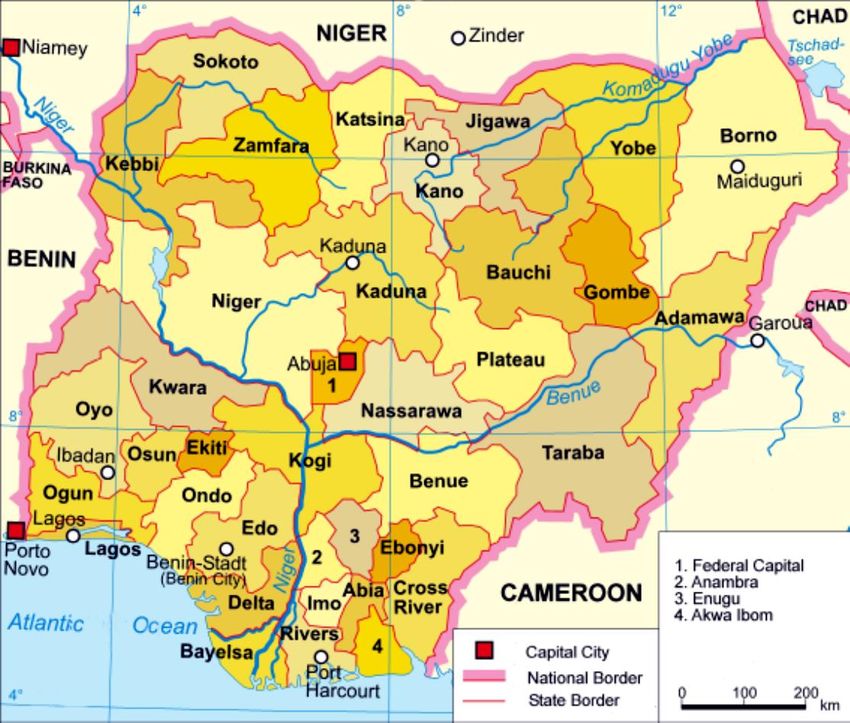
graduating with poor grades. See figure 1 below for more details of Nigeria Political map.
Figure 1: Political map of Nigeria
Source: Wilkipedia catched 20 November, 2018.
Conclusion and Recommendations
Conclusively, this paper revealed that poor funding of Nigerian Universities, an alleged plans
by the Federal Government to increase students’ fees and introduce an education bank, as well
as non-implementation of previous agreement and also the epileptic academic calendar in
Nigerian Universities, particularly University of Benin and Ambrose Alli University which are
Copyright © International Association of African Researchers and Reviewers,
2012-2019: www.afrrevjo.net 28
Indexed African Journals Online (AJOL): www.info@ajol.infoIJAH VOL 8 (2), APRIL, 2019
the focal points; is responsible for poor academic records as per the attestation in the hypothesis
and findings of this paper,
Consequently, Education must e viewed as serving a public good rather than an individual good.
It must be seen as having use-value rather than a commodity. The Federal Government had
failed to honour the 2009 agreement to adequately fund Universities and implement the
Memorandum of Action. This avoidable conflict between the government and ASUU must not
be allowed to jeopardize the academics and future of Nigerian students. Education in Nigeria
must be given its pride of place; the government must strive hard to meet the United Nation’s
minimum standard. Nigerian Universities cannot be locked up permanently and think ASUU
and government will move about comfortably.
Arising from the result of the analysis and the conclusion made there from, the following
recommendations are hereby made:
a. Adequate measures should be put on ground by government and the Academic Staff
Union of Universities and other stakeholders to check incessant strike in the
educational system.
b. Academic staff of Universities should ensure that a cordial relationship exists between
them and their employer.
c. Wealthy individuals and indigenous foundations should be encouraged to support
endowments. This is one secret to the financial solvency of many Ivy-League schools
in the United States of America.
d. Alumni of tertiary institutions must play a proactive role beyond annual dinners and
token interventions. It is incumbent upon tertiary institutions to connect and
communicate well with individual members of their alumni and encourage them to
render better assistance, individually and collectively (Iyayi & Momoh, 2018).
e. Government at both Federal and State Levels must separate recurring expenditure of
staff emolument from capital expenditure and ensure that they give weighted premium
to both.
f. Government should not make TERTFUND take over its statutory obligation to fund
tertiary institutions. It should also give Grant-In-Aid to deserving institutions both
Federal and State, using set criteria including diversity, inclusiveness, scholarship,
protection of rights of minorities and needs (Iyayi & Momoh, 2018)
References
Adedigba, A. (2018). Timeline: How Nigerian university teachers, ASUU, embarked on strike
for over three years since 1999. Premium Times,16th December, 2018 p.1.
Agbese D. (2017). ASUU and the Crises in Education Sector. Guardian Newspaper of 29th
August, 2017 p.3
Akintoye, E. O. & Uhunmwuangho, S.O. (2018). Analysis of the effects of frequent strikes on
academic performance of students in universities in Nigeria: Edo State as a focal point.
African Research Review: An International Multi-Disciplinary Journal, Bahir Dar,
Ethiopia Vol. 12 No.1
Editorial Comment (2002). Three years of democracy. Nigerian Tribune, Vol. 1, pp.10.
Copyright © International Association of African Researchers and Reviewers,
2012-2019: www.afrrevjo.net 29
Indexed African Journals Online (AJOL): www.info@ajol.infoIJAH VOL 8 (2), APRIL, 2019
Ekong, E. E. (2007). Management styles in Nigerian universities under military rule and the
challenges of democracy: How democratic can university management be? Retrieved
on 28th August, 2018 from
Fafunwa, B. (1999). A history of Nigeria higher education. London: Macmillian Publishers.
Hinchcliffe, K. (2012). Public expenditure on education in Nigeria: Issues, estimates and some
implications. Abuja, World Bank: National Bureau of Statistics, Labour Force Survey
2009
Ita, B. (2007). Academic Staff Union of Universities blames Federal Government and
International Monetary Fund over varsity funding. Retrieved on 3rd September, 2018
from http://www.allafrica.com/articles/html.
Iyayi, F. & Momoh, A. (2018). The deepening crisis in the Nigerian university system and the
way forward. Academic Staff Union of Universities (ASUU) Ambrose Alli University,
Ekpoma Chapter.
Makanjuola R.O. A. (2008). What use are politicians to universities- a vice versa. Ile-Ife:
Obafemi Awolowo University Press.
Moja, T. (2007). Nigeria education sector analysis: An analytical synthesis of performance and
main issues. Abuja: World Bank.
Morgan, D. (2007). Deregulating education in the United States: From vouchers to home
schooling to the end of voluntary deregulation. Retrieved on October 22, 2018 from
http://www.writ.news.finalw.com/commentary/2018
Natufe, O. I. (2006). Governance and politics in Nigeria. (A Lecture Delivered at The
Department of Political Science & Public Administration, UNIBEN November).
Okebukola, P. (2003). Issues in funding university Education in Nigeria. NUC Monograph
Series (Abuja: NUC).
Uhunmwuangho S. O. & Epelle, A. (2011). Challenges and solutions to ethno-religious
conflicts in Nigeria: Case study of Jos crises. Journal of Sustainable Development in
Africa, Vol. 13 No. 5.
University of Benin, Report of Strategic Plans for 2010 (Benin City, UNIBEN Press, 2002)
Wikipedia.org (2018). UNDP. http://enwikipedia.org/wiki/UNDP., accessed on 12th
November, 2018
Copyright © International Association of African Researchers and Reviewers,
2012-2019: www.afrrevjo.net 30
Indexed African Journals Online (AJOL): www.info@ajol.infoYou can also read


