Ministers in the House of Lords - BRIEFING PAPER - UK Parliament
←
→
Page content transcription
If your browser does not render page correctly, please read the page content below
BRIEFING PAPER
        Number 05226, 22 April 2020

        Ministers in the House of                                                       By Richard Kelly

        Lords
                                                                                        Contents:
                                                                                        1. Ministerial appointments:
                                                                                           background
                                                                                        2. Ministers in the Lords: lists
                                                                                           and statistics
                                                                                        3. ‘Outsider’ ministers
                                                                                        4. Accountability of Cabinet
                                                                                           Ministers in the Lords

www.parliament.uk/commons-library | intranet.parliament.uk/commons-library | papers@parliament.uk | @commonslibrary
2 Ministers in the House of Lords
Contents
Summary 3
1. Ministerial appointments: background 4
2. Ministers in the Lords: lists and statistics 5
2.1 Ministers in the House of Lords since 1979: statistics 5
2.2 Cabinet Ministers in the House of Lords since 1979 5
Should there be any Cabinet ministers in the House of Lords? 7
2.3 Historical information 7
3. ‘Outsider’ ministers 9
3.1 Gordon Brown’s ‘Government of all the talents’ 9
3.2 ‘Outsider’ ministers in other administrations 11
4. Accountability of Cabinet Ministers in the Lords 14
4.1 House of Commons 14
4.2 House of Lords 16
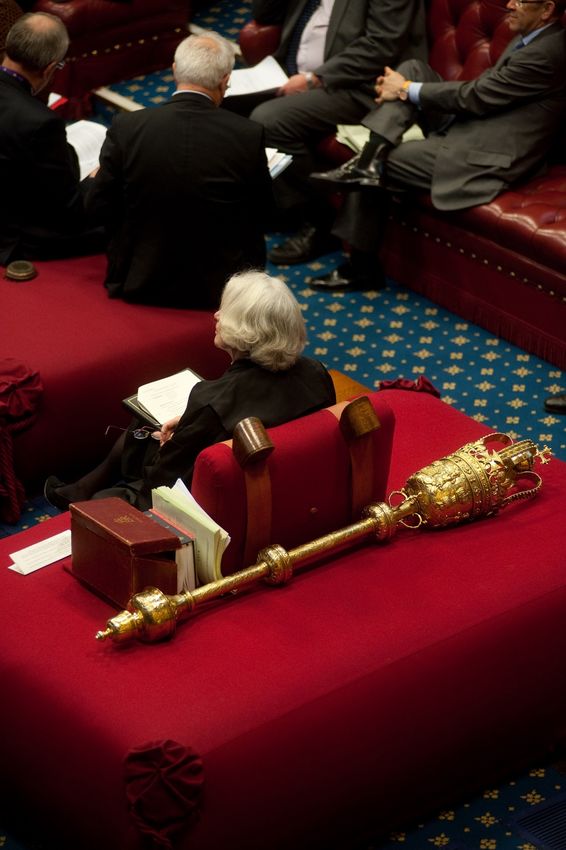
Cover page image copyright: CRI-1767 by UK Parliament/Mark Crick image. Licensed
under CC BY 2.0 / image cropped.3 Commons Library Briefing, 22 April 2020
Summary
In theory a Government minister does not have to be a member of either House of
Parliament. In practice, however, convention is that ministers must be members of either
the House of Commons or House of Lords in order to be accountable to Parliament. From
time to time, Prime Ministers appoint non-parliamentarians as ministers. In recent years
such ministers have been appointed to the House of Lords.
In Boris Johnson’s December 2019 administration, there were two Cabinet Ministers in the
House of Lords (the Leader of the House of Lords and the Secretary of State for Digital,
Culture, Media and Sport). In all, 24 out of the total 116 ministers in government (21%)
were in the House of Lords.
In Theresa May’s June 2017 administration, the Leader of the House of Lords was the only
Cabinet Minister in the House of Lords; 25 out of the total 118 (21%) ministers in
government were in the House of Lords. This compares to 23% at the start of the 2015
Cameron administration and 20% at the start of the 2010 Coalition Government.
Concerns were raised about ministerial appointments to the House of Lords whilst Gordon
Brown was Prime Minister. Gordon Brown had announced his intention to create a
‘government of all the talents’. He appointed two departmental Secretaries of State from
the House of Lords, raising some questions about the accountability of such ministers to
the elected House. He also appointed a number of ministers directly to the House of
Lords; a practice that has also occurred under other recent Prime Ministers.
Concerns were expressed again in December 2019, when following the general election,
Boris Johnson announced that Nicky Morgan, who had stood down from the House of
Commons, would continue to serve as Secretary of State for Digital, Culture, Media and
Sport, as a Cabinet Minister in the House of Lords. She served as Secretary of State until
February 2020.
In response to Gordon Brown’s appointment of secretaries of state to the House of Lords,
the Lords introduced additional oral questions. Generally, members of the House of Lords
ask questions of the Government. In late 2009, it was agreed that once a month time
would be set aside for oral questions to any Secretary of State sitting in the Lords. This
procedure was revived in January 2020, and Baroness Morgan of Cotes answered
questions on 23 January.4 Ministers in the House of Lords
1. Ministerial appointments:
background
In theory there is no requirement for a minister to be a member of
either House of Parliament. However, in practice, for parliamentary
scrutiny and accountability to work, ministers must have a seat in either
chamber. Because the House of Lords is a predominantly appointed
chamber, it is possible for ministers to be directly appointed to the
second chamber.
There are some legal limits on ministerial appointments. The House of
Commons Disqualification Act 1975 provides that not more than 95
holders of Ministerial offices may sit and vote in the House of Commons
at any one time. There are also statutory limits on the total number of
paid ministers that can be appointed, set out in Schedule I, Part V of the
Ministerial and other Salaries Act 1975, as amended. The limit on paid
ministers is 109. The full details are set out in the Commons Library
Briefing Paper, Limitations on the Number of Ministers.5 Commons Library Briefing, 22 April 2020
2. Ministers in the Lords: lists and
statistics
2.1 Ministers in the House of Lords since
1979: statistics
The table below sets out the number of Ministers in the House of Lords
and House of Commons at the start of each Parliament since 1979.
In Boris Johnson’s December 2019 administration, there were two
Cabinet Ministers in the House of Lords (the Leader of the House of
Lords and the Secretary of State for Digital, Culture, Media and Sport). 1
In all, 24 out of the total 116 ministers in government (21%) were in
the House of Lords. This compares to 21% following the June 2017
general election; 23% at the start of the 2015 Cameron administration;
and 20% at the start of the 2010 Coalition Government.
Ministers by Chamber since 1979
1979 1983 1987 1992 1997 2001 2005 2010 2015 2017 2019
1
Cabinet Ministers (Total) 22 21 21 22 22 23 23 23 22 23 23
MPs 19 18 18 20 20 21 21 21 21 22 21
Peers 3 3 3 2 2 2 2 2 1 1 2
Non-Cabinet Ministers (Total)2 33 33 31 32 34 31 30 32 36 35 34
MPs 25 26 25 26 27 25 25 28 28 28 27
Peers 8 7 6 6 7 6 5 4 8 7 7
Junior Ministers (Total) 31 29 32 33 34 35 37 38 35 37 40
MPs 28 25 27 25 27 27 29 29 25 28 31
Peers 3 4 5 8 7 8 8 9 10 9 9
Whips (Total) 20 20 20 20 22 22 23 25 25 23 19
MPs3 13 13 13 13 15 15 15 16 17 15 13
Peers 7 7 7 7 7 7 8 9 8 8 6
TOTAL IN GOVERNMENT POSTS 106 103 104 107 112 111 113 118 118 118 116
MPs 85 82 83 84 89 88 90 94 91 93 92
Peers 21 21 21 23 23 23 23 24 27 25 24
Peers as % of total 20% 20% 20% 21% 21% 21% 20% 20% 23% 21% 21%
1
This includes some occasions where the Conservative Party Chairman was a member of the Cabinet but paid by the Party not the Government
2
This figure includes law offices
3
The Chief Whip (Parliamentary Secretary to the Treasury) is normally listed with non-Cabinet Ministers except in 2001 and 2005 when the
postholder was in the Cabinet
Sources: Dod's Parliamentary Companion, 1980, 1988, 1993,1998, 2002, 2006, 2011
Hansard lists of HM Government
House of Commons Parliamentary Information Lists
2.2 Cabinet Ministers in the House of Lords
since 1979
The list below sets out Cabinet Ministers in the House of Lords since
1979, not including Lord Chancellors (from modern times until the
Constitutional Reform Act 2005 the holder of this post was a peer) or
Leaders of the House of Lords. The list does also not include law
officers, who often attend Cabinet, but are not always Cabinet
1
Baroness Morgan of Cotes, formerly Secretary of State for Digital, Culture, Media
and Sport, left the Government in the February 2020 reshuffle6 Ministers in the House of Lords
Ministers. 2 It does, however, include those who have held the post of
Chancellor of the Duchy of Lancaster and Minister without Portfolio.
Cabinet Ministers in the House of Lords since 1979
(not including Lord Chancellors or Leaders of the House of Lords)
Margaret Thatcher’s Government 1979-1991
Lord Carrington Foreign Secretary May 1979 – Apr 1982
Lord Cockfield Trade Secretary Apr 1982 – June 1983
Chancellor of the Duchy of Lancaster June 1983 – Sept 1984
Earl of Gowrie Chancellor of the Duchy of Lancaster Sept 1984 – Sept 1985
Baroness Young* Chancellor of the Duchy of Lancaster Oct 1981 – April 1982
Lord Young of Graffham Minister without Portfolio Sept 1984 – Sept 1985
Employment Secretary Sept 1985 – June 1987
Trade and Industry Secretary June 1987 – July 1989
John Major’s Government 1991-1997
None
Tony Blair’s Government 1997-2007
Lord Falconer Lord Chancellor and Secretary of State for Constitutional June 2003-May 2007
Affairs (note: from the passing of the Constitutional
Reform Act 2005 the Lord Chancellor no longer had to sit
in the House of Lords)
Lord Chancellor and Secretary of State for Justice May – June 2007
Baroness Amos International Development Secretary May – October 2003
Gordon Brown’s Government 2007-2010
Lord Adonis Transport Secretary June 2009 – May 2010
Lord Mandelson First Secretary of State and Secretary of State for Business, October 2008 – May 2010
Innovation and Skills
The Coalition Government 2010-2015
Baroness Warsi Minister without Portfolio May 2010 – September 2012
David Cameron's 2015-2016 Government
None
Theresa May's 2016 and 2017 Governments
None
Boris Johnson's July 2019 and December 2019 Governments
Baroness Morgan of Cotes Secretary of State for Digital, Culture, Media and Sport December 2019-February 2020
* Lady Young was also Leader of the House of Lords at the same time
Source: David Butler and Gareth Butler, Twentieth Century British Political Facts, 2000 and Parliamentary Information Lists, Ministers in the 2010-15 Coalition Government
(SN06544) and Ministers in the 2015 Conservative Government (CBP07335)
Until September 2012, the Coalition Government included one Cabinet
minister, other than the Leader of the Lords, in the House of Lords: the
Minister without Portfolio, Baroness Warsi.
Under Gordon Brown there were two departmental secretaries of state
of in the House of Lords: from June 2009 until May 2010 the First
Secretary of State and Secretary of State for Business, Innovation and
Skills (Lord Mandelson) (October 2008 to May 2010) and the Secretary
of State for Transport (Lord Adonis) (June 2009 to May 2010).
Under Tony Blair, for the months of June to October 2003 there were
two departmental secretaries of state in the second Chamber at the
same time: the Secretary of State for International Development
(Baroness Amos) and the Lord Chancellor and Secretary of State for
Constitutional Affairs (Lord Falconer). Lord Falconer held the post first
of Lord Chancellor and Secretary of State for Constitutional Affairs (June
2
The information in this note is taken from David Butler and Gareth Butler, Twentieth
Century British Political Facts, 20007 Commons Library Briefing, 22 April 2020
2003 to May 2007) then Lord Chancellor and Secretary of State for
Justice (May to June 2007). Baroness Amos served as International
Development Secretary from May to October 2003.
Should there be any Cabinet ministers in the House
of Lords?
Following a ministerial reshuffle in 2014, Baroness Stowell of Beeston
was appointed Leader of the House of Lords but not a Cabinet minister.
The Lords Constitution Committee reported “widespread concern …
about the status of the Leader of the House”. 3
The Committee quoted from a letter from the Prime Minister, agreeing
that the Leader of the House should be a Cabinet minister:
[The Prime Minister] agreed “that the Leader of the House should,
as a general rule, always be a full member of the Cabinet;
unfortunately it was not possible on this occasion, owing to the
provisions of the Ministerial and other Salaries Act 1975. I want to
reassure you, and the whole House, that I see the current
situation as a purely temporary one, which I will want to rectify at
the earliest opportunity. I will certainly do so immediately after the
General Election, if I am returned as Prime Minister, if no
opportunity has arisen to do so over the coming nine months.”
He said that Lady Stowell would have the same role in Cabinet as
her predecessors and that she would attend the same meetings in
Downing Street. 4
The Committee reviewed literature that described the Leader of the
House of Lords as a Cabinet minister. It made no recommendations but
noted that:
… the Prime Minister’s assurance that the current position is
temporary and will be rectified at the first opportunity. Were it
desired to prevent a repeat of this situation, that may be achieved
in law through an amendment to the Ministerial and other
Salaries Act 1975. For example, the Act could be amended to
provide that one of the 21 salaries for Cabinet ministers must be
paid to a member of the House of Lords or to provide that the
Leader of the House of Lords must be among the 21, or in either
case to increase the number to 22. 5
2.3 Historical information
The number of Cabinet Ministers in the House of Lords decreased over
the course of the twentieth century. The Public Administration Select
Committee report Goats and Tsars: ministerial and other appointments
from outside Parliament (March 2010) sets out the decline, and
exceptions to it, as follows:
The presence of Cabinet Ministers in the House of Lords has
diminished markedly since the turn of the twentieth century,
when there were nine Members of the House of Lords in the
Cabinet, including the Prime Minister. Attlee's first Cabinet in
1945 and Macmillan's in 1957 contained five Lords, and
3
Constitution Committee, Status of the Leader of the House of Lords, 25 July 2014,
HL 41 2014-15, para 1
4
Ibid, para 8
5
Ibid, para 238 Ministers in the House of Lords
Churchill's in 1951 included seven. By the mid-1960s, however, it
had become the norm for an incoming Prime Minister to recruit
only the Leader of the House of Lords and the Lord Chancellor
from the House of Lords into his or her Cabinet.
There were, however, exceptions to this rule such as Lord
Carrington's appointment as Secretary of State for Defence in
1970. Margaret Thatcher's governments included several
Secretaries of State based in the Lords, including Lord Carrington
as Foreign Secretary from 1979 until 1982, Lord Cockfield as
Trade Secretary from 1982 to 1983, and Lord Young as
Employment Secretary, from 1985 to 1987, and subsequently
Secretary of State for Trade and Industry, from 1987 to 1989.
However, it was not until Tony Blair's government briefly included
Baroness Amos as Secretary of State for International
Development in 2003 that there were two Secretaries of State
based in the House of Lords at the same time - the first time this
had occurred since Macmillan's Government in the late 1950s. 6
In the Conservative Governments of 1957-64, there were two periods
where there were two concurrent departmental secretaries of state in
the Lords: from January 1957 until September 1957, and from October
1959 until October 1963, the Earl of Home and Viscount Hailsham were
both in the Cabinet. The Earl of Home was Commonwealth Relations
Secretary from January 1957 until July 1960, and Foreign Secretary from
July 1960 until October 1963. Viscount Hailsham was Minister for
Education from January 1957 to September 1957, and then Minister of
Science from October 1959 until he disclaimed his peerage in November
1963 (he was elected as an MP the following month).
There have been cases where a single departmental secretary of state
had a seat in the House of Lords. For example, in the 1970-74 Heath
Government, Lord Carrington was Secretary of State for Defence (June
1970 to January 1974) and then Secretary of State for Energy. As set
out in the table above Lord Carrington, Lord Cockfield and Lord Young
of Graffham were departmental secretaries of state during Margaret
Thatcher’s administration.
6
Public Administration Select Committee, Goats and Tsars: ministerial and other
appointments from outside Parliament, HC 330 2009-10, Paras 47 and 489 Commons Library Briefing, 22 April 2020
3. ‘Outsider’ ministers
3.1 Gordon Brown’s ‘Government of all the
talents’
When Gordon Brown became Prime Minister in June 2007 he
announced his intention to “reach out beyond narrow party interest”
and “build a government that uses all the talents”. 7 There was some
concern over the number of peerages created in order to place Ministers
in Parliament. For example, in a report on Constitutional Reform and
Renewal published in July 2009 the Justice Select Committee wrote
that:
The present Prime Minister has appointed 11 people to be life
peers so that they could serve as ministers or as an adviser to the
Government, some of whom have already given up ministerial
office but remain members of the House of Lords. These measures
accentuate a trend towards an appointed second chamber,
contrary to the view expressed by the three main parties and by
the House of Commons. Moreover, it is likely to lead to a
continuous trend in future governments appointing peers in order
to rebalance the numbers and this is unsustainable. 8
Although it can be difficult to be certain which peerages have been
created in order to give an individual ministerial office, the peerages
conferred by Gordon Brown listed below appear to have been created
for this purpose.
• Lord Malloch-Brown, Minister of State for Africa, Asia and UN and
Government spokesperson, Foreign and Commonwealth Office
(introduced to the Lords on 9 July 2007). 9
• Lord West of Spithead, Parliamentary Under Secretary, Home
Office (introduced to the Lords on 9 July 2007).
• Lord Jones of Birmingham, Minister of State, Department for
Business Enterprise and Regulatory Reform and Foreign and
Commonwealth Office (introduced to the Lords on 10 July
2007). 10
• Baroness Vadera, Parliamentary Under-Secretary of State,
Department for International Development (introduced to the
Lords on 11 July 2007). 11
7
Gordon Brown’s Downing Street Speech, June 2008, available on the BBC website
at: http://news.bbc.co.uk/1/hi/uk_politics/6246114.stm
8
Justice Select Committee, Constitutional Reform and Renewal, 29 July 2009, HC 923
2008-09, para 58
9
Lord Malloch-Brown stood down from his ministerial post at the start of the summer
recess in July 2009, see ‘Another of Gordon Brown's 'goats' decides to leave the
fold’, The Times, 8 July 2009
10
Announced in August 2008 that he would leave government before the end of the
year, and he did so in October 2008, see ‘Digby Jones quits after just 18 months’,
Telegraph, 23 August 2008
11
Stepped down in September 2009 to take up new post advising the G20, see
‘Vadera quits for G20 Advisory Role’, Financial Times, 25 September 200910 Ministers in the House of Lords
• Lord Darzi of Denham, Parliamentary Under-Secretary of State,
Department of Health (introduced to the Lords on 19 July 2007). 12
• Lord Mandelson, Secretary of State, Business, Enterprise and
Regulatory Reform (BERR) (introduced to the Lords on 13 October
2007);
• Lord Carter of Barnes, Parliamentary Under-Secretary of State,
BERR /Department for Culture, Media and Sport (introduced to
the Lords on 16 October 2008). 13
• Lord Myners, Financial Services Secretary, HM Treasury
(introduced to the Lords on 16 October 2008)
• Lord Davies of Abersoch, Minister of State, BERR /Foreign and
Commonwealth Office (FCO) (introduced to the Lords on 2
February 2009)
• Baroness Kinnock, Minister of State for Europe, FCO (introduced
to the Lords on 30 June 2009). 14
The Public Administration Select Committee launched an inquiry in June
2009 into outside appointments into Government. Their report, Goats
and Tsars: Ministerial and other appointments from outside Parliament,
was published on 11 March 2010. 15 This raised questions about the
scale of recent appointments, why they needed to be made, and their
impact on Parliament and Government. 16 The report suggested that
Ministers appointed to the House of Lords should be required to resign
their seats after they leave government. 17
The Committee suggested that the House of Lords Appointments
Commission should be allowed to vet ministerial appointees for
propriety in the same way as for any other working peer. 18 In
conclusion, the Committee raised the possibility that a small number of
junior ministers could be directly appointed without requiring them to
be members of either House, suggesting that this could provide a
mechanism to place clear limits on the number of ministers that could
be appointed in this way and their role. They acknowledged that “this
would be a considerable constitutional innovation” but “an idea that
deserves further consideration”. 19
In its response to the report, the Coalition Government agreed with the
Committee that “ministerial appointments from outside the existing
12
Stood down in July 2009, see ‘Darzi to quit as Health Minister’, The Times, 15 July
2009
13
Announced in June 2009 he would step down from his post during the summer, see
‘Further resignation adds to pressure on Brown’, Scotsman, 13 June 2009
14
Became Minister of State with responsibility for Africa, United Nations, Human
Rights and Climate Change and Energy in October 2009.
15
Public Administration Select Committee, Goats and Tsars: Ministerial and other
appointments from outside Parliament, 11 March 2010, HC 330 2009-10
16
Ibid, para 14
17
Ibid, para 79
18
Ibid, para 84. For more information about the House of Lords Appointments
Commission see the Library Standard Note, SN/PC/2855, The House of Lords
Appointments Commission
19
Public Administration Select Committee, Goats and Tsars: Ministerial and other
appointments from outside Parliament, 11 March 2010, HC 330 2009-10, para 9011 Commons Library Briefing, 22 April 2020
membership of the House of Commons or the House of Lords should be
exceptional”. 20
There were no Secretaries of State in the House of Lords at the time of
the Government’s response, nor throughout the time of the Coalition.
However, in response to suggesting that peers answer questions in the
House of Commons, the Government noted a “risk that the burden on
ministers of having additional duties in the other House might
compromise their ability to participate fully in the work of the House in
which they sit”. 21
The Government reported that following the 2010 General Election, the
House of Lords Appointments Commission had vetted ministerial
appointments. 22
3.2 ‘Outsider’ ministers in other
administrations
The Constitution Unit published a report in January 2011 which
discussed the appointment of ‘outsider’ ministers to government and
focused on issues of competence and accountability. 23 The report
noted:
Gordon Brown was not the only Prime Minister to bring in outside
talent: British Prime Ministers have been doing so for many years.
Tony Blair had brought into the Lords, amongst others, David
Simon (former Chairman of BP) and Gus MacDonald (former
broadcaster and businessman), referred to as ‘Tony’s cronies’. And
before Blair, Harold Wilson, Edward Heath and Margaret Thatcher
had all attempted to bring in ‘experts’ or ‘outsiders’.
The authors suggested that “coalition constraints on ministerial
appointment” had resulted in a tendency to make appointments to
advisory positions rather than to ministerial office during the 2010-15
Coalition Government. Nevertheless, there had been some ‘outside’
ministerial appointments:
Jonathan Hill, former special adviser and head of John Major’s
political office, as Parliamentary Under-Secretary of State for
schools; and Lord (James) Sassoon, former Treasury civil servant
and adviser to the then Shadow Chancellor as the Commercial
Secretary to the Treasury. The Government has also recently
announced the appointment of Lord (Stephen) Green, former
Chairman of HSBC, as Trade Minister. 24
It was reported at the time of the September 2012 reshuffle that Paul
Deighton, then Chief Executive Office of LOCOG, would join the
20
Public Administration Select Committee, Government Responses to the Committee’s
Eighth and Ninth Reports of Session 2009-10: Goats and Tsars: Ministerial and other
appointments from outside Parliament and Too Many Ministers? 21 October 2010,
HC 150 2010-12, p5
21
Ibid, p6
22
Ibid, p7
23
Ben Yong and Robert Hazell, Putting Goats among the Wolves: appointing ministers
from outside Parliament, Constitution Unit, January 2011
24
Ibid, p1112 Ministers in the House of Lords
Government as Commercial Secretary to the Treasury at the start of
2013. He would be a Minister (unpaid) in the House of Lords. 25
Following the 2015 General Election, six peerages were announced for
new Ministers: 26
• Lord Maude of Horsham, Minister of State for Trade and
Investment from May 2015 to April 2016
• Baroness Altmann, Minister of State for Pensions from May 2015
until July 2016.
• Lord Bridges of Headley, Parliamentary Secretary for the Cabinet
Office from May 2015 until July 2016 and then Parliamentary
Under Secretary of State at the Department for Exiting the
European Union on 17 July 2016.
• Lord Dunlop was appointed Parliamentary Under Secretary of
State at the Scotland Office in May 2015. He was also appointed
Parliamentary Under Secretary of State at the Northern Ireland
Office on 17 July 2016.
• Lord O’Neill of Gatley was appointed Commercial Secretary to the
Treasury in May 2015.
• Lord Prior of Brampton was appointed Minister for NHS
Productivity and a member of the House of Lords in May 2015.
In addition, Lord Price was appointed as the Minister as State for
International Trade at the Department for Business, Innovation and Skills
(BIS) and the Foreign and Commonwealth Office (FCO) on 4 April 2016.
He was appointed to the same role at the new Department for
International Trade on 16 July 2016.
Theresa May appointed four non-parliamentarians to ministerial posts.
They all received peerages:
• Lord Duncan of Springbank was appointed as a minister in the
Scotland Office and a member of the House of Lords in June
2017.
• Baroness Fairhead was appointed as a minister in the Department
of International Trade and a member of the House of Lords in
September 2017.
• Lord Agnew of Oulton was appointed as Minister for Academies
in the Department for Education and a member of the House of
Lords in September 2017.
• Baroness Blackwood of North Oxford was appointed as a minister
in the Department of Health and Social Care and a member of the
House of Lords in January 2019.
In addition to appointing Nicky Morgan to the House of Lords, Boris
Johnson also appointed Zac Goldsmith, in December 2019. Both
retained ministerial posts they had held immediately before the general
25
See: Cameron reshuffles his government: Politics live blog, 4 September 2012
26
HM Government, Election 2015: Prime Minister and ministerial appointments, 14
May 2015 and Politics Home, Six Peerages announced for new ministers, 14 May
201513 Commons Library Briefing, 22 April 2020
election. Nicky Morgan did not contest the election but Zac Goldsmith
was defeated in Richmond Park.
On 18 March 2020, Boris Johnson appointed two non-parliamentarians
as ministers and announced that they would receive peerages:
• Lord Grimstone of Boscobel was appointed as Minister for
Investment in the Department for Business, Energy and Industrial
Strategy and the Department for International Trade.
• Lord Greenhalgh was appointed as a Minister of State in the
Home Office and the Ministry of Housing, Communities and Local
Government.
Both took their seats in the House of Lords on 21 April 2020. 27
27
HL Deb 21 April 2020 c1 and c114 Ministers in the House of Lords
4. Accountability of Cabinet
Ministers in the Lords
4.1 House of Commons
The accountability arrangements of departmental Cabinet ministers in
the House of Lords became a topic of interest after Gordon Brown
appointed two peers as departmental secretaries of state: Lord
Mandelson at Business, Enterprise and Regulatory Reform (BERR) in
2008, and Lord Adonis at the Department for Transport in 2009. In their
2008 report which considered the scrutiny of BERR, the Business and
Enterprise Select Committee suggested that it should be possible for
Lord Mandelson to be accountable to the House of Commons. It
suggested that the “most obvious method” would be to allow him to
appear at the Despatch Box:
Whilst we recognise that many of our colleagues will have an
instinctive dislike of the idea of a peer appearing in this chamber,
we would point out that peers have entered the House of
Commons before. Lords can appear before the Commons as
witnesses, if they consent to do so, and earlier editions of Erskine
May give details of the procedure, in which Lords are seated
within the bar of the House. Indeed, there are precedents for
peers addressing the House directly, as did Lord Melville in 1805
and the Duke of Wellington in 1814. If the House could show
such flexibility two centuries ago, we believe it should be able to
act in a similar spirit now.
The Committee also suggested other options could be explored, such as
whether a Ministers could be called to make a statement and answer
questions upon it:
We note that the Standing Orders provide for a Minister of the
Crown, whether or not a Member of the House, to make a
statement and answer questions upon it in a grand committee,
meeting in a large committee room. Again this seems to us a
precedent which might be usefully adapted. It might also be
possible for Lord Mandelson to appear in Westminster Hall, the
parallel chamber.
The Committee suggested that the matter be considered by the
Procedure Committee. 28
The Speaker also suggested that ministers in the Lords should face
questioning from the Commons. In a September 2009 Hansard Society
lecture he stated:
I find the fact that backbenchers have no means of directly
questioning prominent Ministers of the Crown because they
happen to sit in the House of Lords to be less than satisfactory.
That is even more true at a time when the Cabinet contains the
esteemed Lord Mandelson, whose empire is of a scale not seen
since the death of Alexander the Great, and the thoughtful Lord
Adonis who presides over the country's transportation network. I
28
Business and Enterprise Committee, Departmental Annual Report and Scrutiny of
the Department for Business, Enterprise and Regulatory Reform, 25 November 2008,
HC 111615 Commons Library Briefing, 22 April 2020
suspect that both of these individuals would concede that they
should be responsible to backbench MPs and would be more than
willing to participate in an experiment in which they were made
available publicly through Westminster Hall, as one option, and I
intend to consult on how we might take this forward. 29
In October 2009 it was reported that Speaker Bercow had written to
party leaders to discuss calls for peers who serve as Cabinet Ministers to
appear in the Commons. 30 It was also reported that the then Prime
Minister had written to Mr Speaker, stating that “I am keen that all
secretaries of state are fully accountable to Parliament”. 31
The Public Administration Select Committee’s also considered the
accountability of Cabinet Ministers in the House of Lords in their 2010
report, Goats and Tsars: Ministerial and other appointments from
outside Parliament, concluded that so long as there was an unelected
chamber, there was a “strong argument” in favour of ministers being
directly accountable to the elected chamber as a whole. 32
The Committee noted that the Procedure Committee was looking into
the matter but went on to recommend that ministers should be able to
present their policies and answer questions in both chambers. This
would allow government to ensure that their policies were being
presented in the most effective way by the person best placed to debate
them. It would also expose Secretaries of State from both Houses to
the different sorts of scrutiny carried out by each House and would
remove the need to appoint Members of the Lords as ministers to
ensure departmental representation in both Houses. 33
On 22 March 2010 the House of Commons Procedure Committee
published a short report on Accountability to the House of Commons of
Secretaries of State in the House of Lords. 34 The Committee stated that
it would be an appropriate time to conduct an experiment of
procedures for Lords Ministers being questioned in the Commons. 35
The Procedure Committee went on to recommend that the experiment,
which was to last one parliamentary session, should consist solely of
questions and should take place in Westminster Hall. It would apply only
to departmental secretaries of state in the House of Lords and would
complement rather than replace the regular departmental question
times. Subject to the length of the parliamentary session, each secretary
of state would be subject to two question sessions. Each session would
consist of thirty minutes of ‘normal’ questions followed by a fifteen-
29
Speech to the Hansard Society, 24 September 2009
30
‘Speaker acts on peers’ questions’, BBC News, 26 October 2009
31
Quoted in, ‘Mandelson could soon be back in the Commons; Prime Minister seeks to
overturn rules barring peers from Lower House and set up battle of the big business
beasts’, Daily Telegraph, 26 October 2009
32
Public Administration Select Committee, Goats and Tsars: Ministerial and other
appointments from outside Parliament, 11 March 2010, HC 330 2009-10Ibid, para
58
33
Ibid, para 61
34
House of Commons Procedure Committee, Accountability to the House of
Commons of Secretaries of State in the House of Lords, 22 March 2010, HC 496
35
Ibid, paras 13-1416 Ministers in the House of Lords
minute period of topical questions. These question times would be
chaired by a Deputy Speaker. 36
In the event, no changes were made before the May 2010 General
Election.
4.2 House of Lords
Meanwhile, the Lords had already established a new procedure for oral
questions to departmental Secretaries of State on their departmental
responsibilities, in the Chamber. The Lords Procedure Committee had
recommended that, on one Thursday each month when the House was
sitting, 15 minutes should be set aside for three oral questions
addressed to the Secretary of State, immediately following the existing
30 minutes for oral questions. 37 Where there was more than one
Secretary of State in the Lords, they would answer questions on
different Thursdays within any given month. The new procedure was
used for the first time on Thursday 14 January 2010 when questions
were put to Lord Adonis, Secretary of State for Transport. 38
In the 2010 Parliament, the Leader of the House of Lords established a
Group on Working Practices. Its recommendations were considered by
the Procedure Committee. The Leader’s Group recommended that:
The procedure adopted in early 2010, whereby Secretaries of
State sitting in the Lords should answer three oral questions, on
one Thursday each month, directed to them in their ministerial
capacity, should be made permanent, with a view to its revival as
appropriate.
The Procedure Committee concurred, with one proviso, “namely that
the ballot for such questions would, in accordance with the practice
agreed in April 2011, take place at 1 pm, rather than 2 pm”. 39
When the House of Lords considered the Procedure Committee’s report
on 8 November 2011, an amendment to allow 20 minutes, rather than
15 minutes, for oral questions to secretaries of state was accepted. 40
Oral questions to departmental secretaries of state in the House of Lords
were revived on 23 January 2020, when 20 minutes were set aside for
three questions to the Secretary of State for Digital, Culture, Media and
Sport. 41
36
Ibid, para 17
37
Procedure Committee, Oral questions to Secretaries of State; Committee for
Privileges and Standing Order 78; Personal Bills Committee, 9 December 2009, HL
13 2009-10; the report was agreed HL Deb 15 December 2009 c1404
38
See HL Deb 14 January 2010 c611
39
Procedure Committee, Proposals arising from the Report of the Leader’s Group on
Working Practices, 1 November 2011, HL 213 2010-12, paras 8-9
40
HL Deb 8 November 2011 cc150-151
41
HL Deb 23 January 2020 cc1155-1162About the Library
The House of Commons Library research service provides MPs and their staff
with the impartial briefing and evidence base they need to do their work in
scrutinising Government, proposing legislation, and supporting constituents.
As well as providing MPs with a confidential service we publish open briefing
papers, which are available on the Parliament website.
Every effort is made to ensure that the information contained in these publicly
available research briefings is correct at the time of publication. Readers should
be aware however that briefings are not necessarily updated or otherwise
amended to reflect subsequent changes.
If you have any comments on our briefings please email papers@parliament.uk.
Authors are available to discuss the content of this briefing only with Members
and their staff.
If you have any general questions about the work of the House of Commons
you can email hcenquiries@parliament.uk.
Disclaimer
This information is provided to Members of Parliament in support of their
parliamentary duties. It is a general briefing only and should not be relied on as
a substitute for specific advice. The House of Commons or the author(s) shall
not be liable for any errors or omissions, or for any loss or damage of any kind
arising from its use, and may remove, vary or amend any information at any
time without prior notice.
The House of Commons accepts no responsibility for any references or links to,
BRIEFING PAPER or the content of, information maintained by third parties. This information is
Number 05226
provided subject to the conditions of the Open Parliament Licence.
22 April 2020You can also read


