Physics Programme IISER Pune 2015
←
→
Page content transcription
If your browser does not render page correctly, please read the page content below
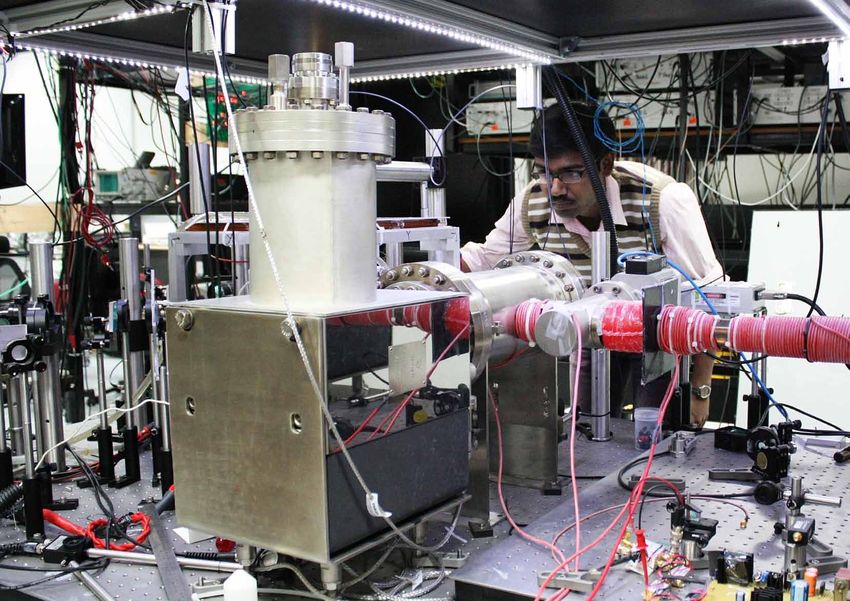
Physics Programme
                                    IISER Pune

                                                              2015

Indian Institute of Science Education and Research Pune   1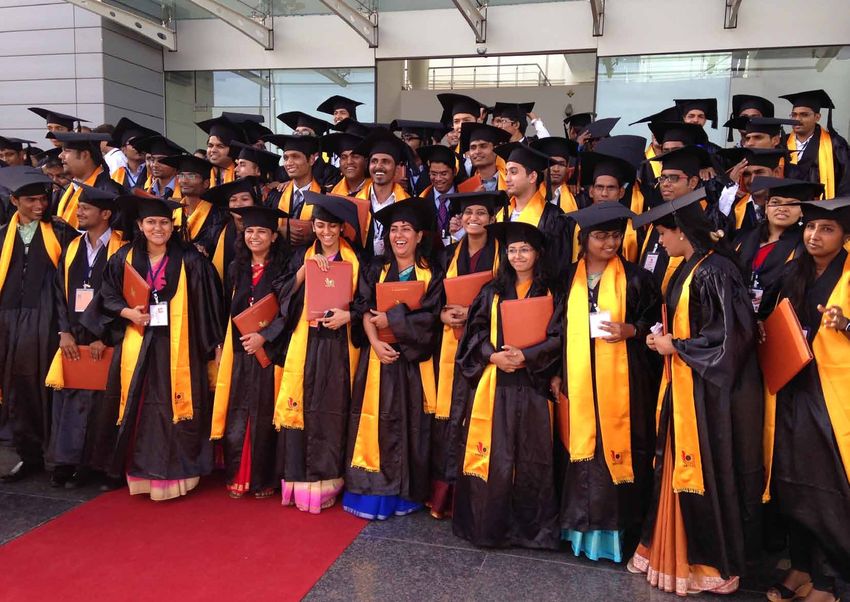
2 Indian Institute of Science Education and Research Pune Indian Institute of Science Education and Research Pune 3
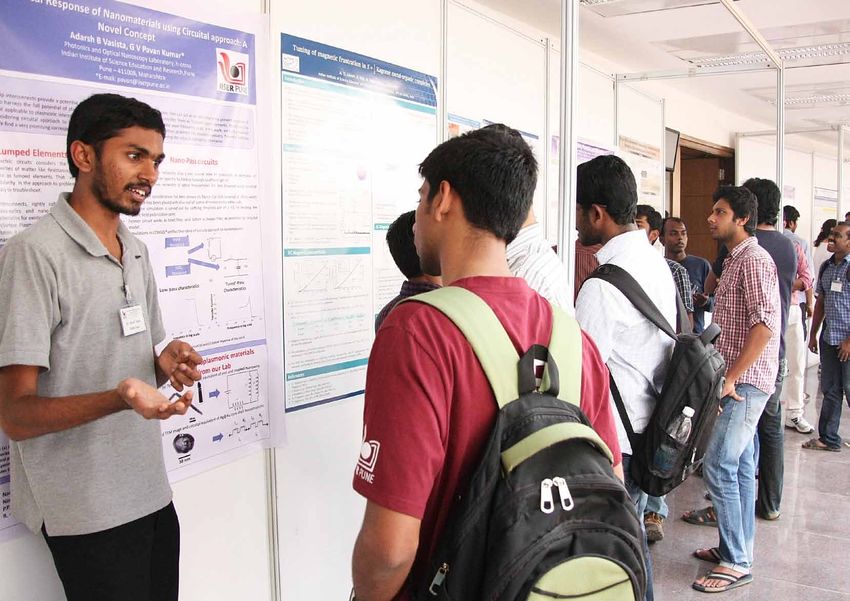
4 Indian Institute of Science Education and Research Pune Indian Institute of Science Education and Research Pune 5
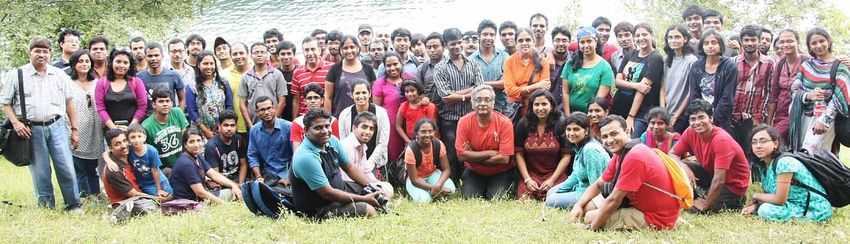
Contents
                                                              Welcome from the Chair                                         11

                                                              The Physics Programme                                          13

                                                              Faculty Members                                                16

                                                              Postdoctoral Fellows                                          58

                                                              Ph.D. Students                                                 62

                                                              Seminars and Colloquia                                        84

                                                              Academic Events and Special Lectures                          94

                                                              Facilities and Equipment                                      98

                                                              Teaching Programme                                            108

6   Indian Institute of Science Education and Research Pune   Indian Institute of Science Education and Research Pune   7
8 Indian Institute of Science Education and Research Pune Indian Institute of Science Education and Research Pune 9
Welcome from the Chair

                                                               The Physics Programme at IISER Pune is built on the twin pillars
                                                               of research and education, in keeping with the overall philosophy of
                                                               IISER. We see this as a mutually beneficial arrangement for faculty and
                                                               students alike.
                                                                 Faculty members find it invigorating to have strongly motivated
                                                               students participating in their laboratory-based or theoretical research.
                                                               Students, in turn, benefit from the strong research background of their
                                                               teachers, who bring a confident and modern understanding of their
                                                               subject to the classroom and the teaching laboratory. The involvement of
                                                               undergraduates in research work, often leading to publications, is a key
                                                               feature of IISER’s programme.
                                                                 Our programme is still youthful. It is in a phase where strengths are
                                                               being consolidated and plans starting to bear fruit. Our research goals
                                                               span all the profound and challenging questions in physical science,
                                                               from the micro-world to the cosmos. We are equally at home pursuing
                                                               fundamental principles of long-term relevance and seeking solutions
                                                               with a more immediate social impact. Rather than compartmentalising
                                                               our programme, we emphasise the unity of all of physics and encourage
                                                               research across traditional boundaries.
                                                                 Over the next decade, I am confident that we will be seen as a leading
                                                               player in Indian and global science, and a force to reckon with.

                                                               Sunil Mukhi

10   Indian Institute of Science Education and Research Pune   Indian Institute of Science Education and Research Pune   11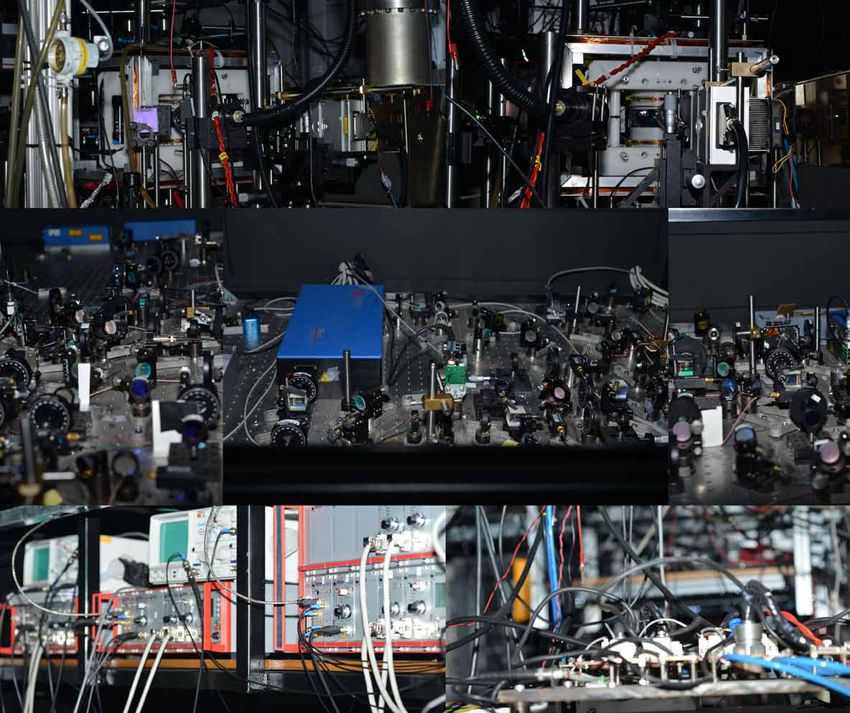
The Physics Programme
                                                               Research in Physics at IISER Pune is broad-based and spans                       Programme can be found in the appopriate section of this
                                                               virtually all contemporary areas of global excitement in the                     brochure.
                                                               field.                                                                              While IISER does its best to support new faculty in setting
                                                                  From the outset, the goal has been to put together                            up their research programmes, all faculty members are
                                                               exceptionally skilled and innovative faculty with state-of-                      encouraged to apply for competitive, peer-reviewed grants
                                                               the-art facilities to pursue the most challenging questions                      to fund their research in the longer term. Many faculty
                                                               in both experimental and theoretical Physics. Experimental                       members have entered into formal collaborations both
                                                               research has been generously supported, both in terms of                         nationally and internationally with the support of granting
                                                               funding and infrastructure.                                                      agencies and/or joint agreements between science
                                                                  The Physics research laboratory, named h-bar, is a pre-                       academies. Some of the grants active or recently active at
                                                               engineered building that was rapidly built to kickstart                          IISER Pune include DST-SERB projects, DST-DAAD projects,
                                                               experimental research while the rest of the IISER campus                         DST Nano-mission grants, Wellcome Trust-DBT Fellowships,
                                                               was still under construction. This may have initially been                       CEFIPRA grants, ISRO projects, INSPIRE, Ramanujan and J.C.
                                                               conceived as a temporary measure, but today this smart                           Bose Fellowships. Special mention may be made of the
                                                               and spacious building functions smoothly and houses                              Centre for Research in Energy and Sustainable Materials
                                                               nearly a dozen major laboratories and facilities, most of                        being set up at IISER (across different disciplines) under a
                                                               which will continue to function there in the near future.                        DST grant, and the recent entry of IISER Pune into the CMS
                                                               Additional space has recently become available in the new                        Collaboration at CERN, for which India’s participation is
                                                               Main Building to house future research laboratories. On the                      supported by a special DAE-DST Consortium.
                                                               theoretical side, plans are also under way for a new High                           Ph.D. students are a key component of our programme.
                                                               Performance Computing Centre. All Physics faculty and                            Endowed with fellowships and housed on campus, they
                                                               Ph.D. student offices are located within the Main Building.                      play a major role in our research activity and provide a lively
                                                                   Research in Physics at IISER Pune can broadly be                             audience for seminar speakers. We have held special lecture
                                                               classified into Complex Systems and Nonlinear Dynamics,                          series to sensitise our students to exciting opportunities
                                                               Condensed Matter and Statistical Physics, Soft Condensed                         in areas ranging from soft matter systems to neutrinos to
                                                               Matter, Plasmonics and Photonics, Ultracold Atoms,                               topological insulators, and these have always been widely
                                                               NMR and Quantum Information, Nanoscience and                                     appreciated.
                                                               Nanomaterials, High Energy Physics, Gravitation and String                          We are also appreciative of the excellent scientific staff
                                                               Theory, and Astronomy and Astrophysics. These are broad                          who manage our research and teaching laboratories. We
                                                               headings but not boundaries, and there is considerable                           pride ourselves on our instrumentation, both purchased
                                                               collaboration across them through the exchange of ideas                          and home-built, and on the fact that it is kept in excellent
                                                               and facilities as well as through joint publications. Several                    working condition, for which their dedicated service
                                                               faculty members associated to the Physics programme                              (through very long days and sometimes nights) has proved
                                                               are jointly associated with other programmes at IISER,                           essential. This provides an efficient research and teaching
                                                               particularly Chemistry and Biology. An outline of the                            environment and goes a long way towards inspiring
                                                               research of each faculty member associated to the Physics                        students in the direction of experimental research.

12   Indian Institute of Science Education and Research Pune                                                 Indian Institute of Science Education and Research Pune   13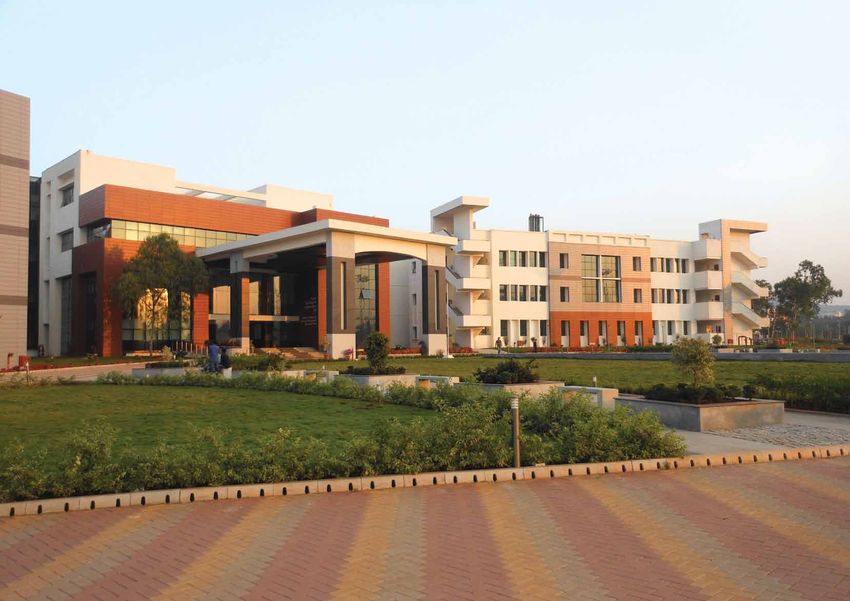
Faculty Members

       14   Indian Institute of Science Education and Research Pune   Indian Institute of Science Education and Research Pune   15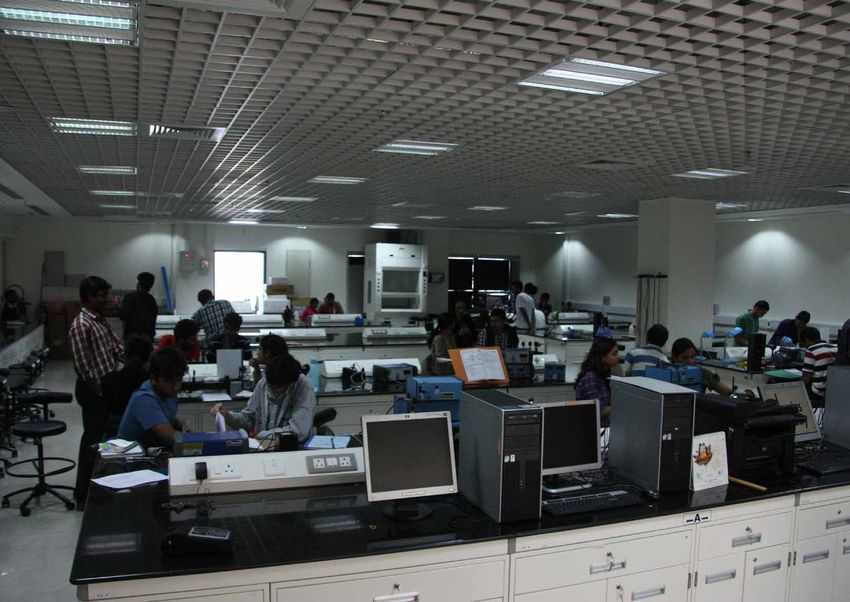
G. Ambika Sudarshan Ananth
Professor and Dean, Graduate Studies Associate Professor
http://www.iiserpune.ac.in/~g.ambika/ www.aei.mpg.de/~ananth
Joined IISER Pune: August 2006 Joined IISER Pune: January 2008
Research: Research:
My research interests are in theoretical studies on nonlinear dynamics as Quantum Yang-Mills theory provides a remarkably accurate description of three
applied to complex systems and understanding complex systems using complex of the four fundamental forces in Nature (the weak, strong and electromagnetic
networks and time series analysis. The focus of our research is on applying theory forces). The fourth force, gravity, is classically well understood thanks to the general
of dynamical systems to understand and control emergent dynamics and pattern theory of relativity but lacks a consistent quantum description. My research is
formation in complex systems. aimed at understanding this apparent incompatibility between general relativity
We study dynamics on networks with slow and fast dynamics, relevant and quantum mechanics. Current themes of investigation include the physics of
mechanisms underlying the growth of complex networks, connectivity decay higher spin fields, perturbative ties between Yang-Mills theory and gravity, and
in directed networks specifically in the context of Alzheimer’s disease, and continuous-spin representations.
complexity measures from time series and complex networks especially for
astrophysical and physiological data. In the next few years I plan to focus on Academic background:
specific issues like characterisation of cross topology in interacting networks, I received a Ph.D. in Theoretical Physics from the University of Florida in 2005.
connectivity measures in directed networks, stability of power grids and spreading Subsequently I was a Junior Scientist at the Max Planck Institute for Gravitational
of epidemics on dynamic networks of social interactions. Physics (Albert Einstein Institute) for two years before moving to IISER Pune in 2008.
Academic Background:
My PhD is from Cochin University of Science and Technology (1988) in nonlinear
dynamics. After this I carried out postdoctoral research in the same university for 5
years on the characterisation of chaos and nonlinear time series analysis. Thereafter I
was a faculty member at Maharajas College, Cochin until 2006.
Selected Publications / Last Five Years: characterize ECG data for diagnosis and Organisational Activities: Selected Publications / Last Five Years: Grants and Awards: Organisational Activities:
• “Dynamical behaviours in time-delay therapy” (2014). • Dean, Graduate Studies, since 2006. • “Factorization of cubic vertices involving • Member, National Academy of Sciences I have served on many committees over
systems with delayed feedback and • DST-SERB project: “Emergent dynamics • Member, Senate, IISER, Pune. three different higher spin fields”, Y. S. India, 2013. the past 6 years. Some of these include the
digitized coupling”, Chiranjit Mitra, G. on growing networks with comparable • Presiding Officer, Internal Complaints Akshay and Sudarshan Ananth, Nucl. • N. S. Satya Murthy Memorial Award, Women’s cell, Physics faculty recruitment
Ambika and Soumitro Banerjee. Chaos, time scales” (2010-13). Committee. Phys. B 887, 168 (2014). Indian Physics Association, 2012. committee, Physics curriculum committee,
Solitons and Fractals, 69, 188-200 (2014). • DST-DAAD project: “Interacting networks • Chair, Academic Committee. • “Light-cone gravity in AdS4”, Y. S. Akshay, • Young Scientist Medal, Indian National Physics PhD student selection committee, IT
• “On interrelations between recurrences to model and control dynamics of • Chair, Committee on Graduate Courses. Sudarshan Ananth and Mahendra Mali, Science Academy, 2011. committee, IISER website in-charge, Awards
and connectivity trends between stock complex systems” (2012-14). • Chair, Physics Curriculum Committee. Nucl. Phys. B 884, 66 (2014). • Young Scientist Platinum Jubilee Award, committee, New campus committee,
indices”, B. Goswami, G. Ambika, N. • Outstanding Faculty Award, IISER Pune • Chair, Women’s Cell, IISER, Pune, 2009-13. • “Cubic interaction vertices in higher spin National Academy of Sciences India, 2011. Student welfare committee, New physics
Marwan and J. Kurths. Physica A, 391, (2008-09). • Library in charge, 2006-2009. theories”, Y. S. Akshay and Sudarshan • Young Associate, Indian Academy of building committee.
4364 (2012). • Visiting Associate, Physical Research Lab, • Warden, 2006-10. Ananth, J. Phys. A 47, 045401 (2014). Sciences, 2009 – 2013.
• “Amplitude death in complex networks Ahmedabad (2008-09) and IUCAA, Pune • “Spinor helicity structures in higher spin • Max Planck Partner Group, Max Planck Outreach Activities:
induced by environment”, V. Resmi, G. since 1995. In addition, I take initiative and offer theories”, Sudarshan Ananth, JHEP 1211, Society, 2009 – 2014. I regularly give talks aimed at student
Ambika, R.E. Amritkar and G. Rangarajan, assistance in several general activities: 089 (2012). • Ramanujan Fellowship, DST, Govt. of audiences at various colleges/institutions.
Phys. Rev. E 85, 046211 (2012). Teaching Activities: Organisation of the annual convocation • “Gauge-invariant correlation functions India, 2008 – 2012. Most recently: on the “Forces of Nature” at
• “General mechanism for amplitude death • Mechanics, Fall 2006, Fall 2007. of the institute, selection and interview in light-cone superspace”, Sudarshan NIT Suratkal, the University of Hyderabad
in coupled systems”, V. Resmi, G. Ambika • Electromagnetism and Optics, Spring committees, institutional brochures, Ananth, Stefano Kovacs and Sarthak Teaching Activities: and CMI, Chennai.
and R.E. Amritkar, Phys. Rev. E 84, 046212 2007 organisation of academic events etc. Parikh, JHEP 1205, 096 (2012). • World of Physics I (Mechanics): Fall 2008,
(2011). • Classical Mechanics, Fall 2009, Fall 2010, Fall 2009, Fall 2010, Fall 1011, Fall 2012,
• “Nonlinear time series analysis of the light Fall 2011, Fall 2012 Outreach Activities: Fall 2014.
curves from the black hole system GRS • Classical Mechanics, Fall 2008, Fall 2009, My outreach activities include giving talks in • Mathematical Methods in Physics: Spring
1915+105”, K.P. Harikrishnan, R. Mishra, Fall 2010, Fall 2011, Fall 2012. INSPIRE science camps and KVPY summer 2014.
G. Ambika. Res. Astr. Astrophys. 11, 71-90 • Nonlinear Dynamics, Spring 2009 , Spring programmes for school students, refresher • World of Physics III (Electromagnetism):
(2011). 2010, Spring 2014. courses at academic staff colleges, Science Spring 2008.
• Dynamical Systems, Spring 2011. Day lectures in colleges, SERC schools and • Group Theory: Spring 2009, Spring 2010.
Grants and Awards: • Electrodynamics, Fall 2013. fostering undergraduate research through • Nuclear and Particle Physics: Spring 2011.
• DST-SERB project: “Complexity • Classical Electrodynamics, Fall 2013. summer projects for students from colleges • Quantum Field Theory: Spring 2013.
measures from multifractal analysis to and universities.
16 Indian Institute of Science Education and Research Pune Indian Institute of Science Education and Research Pune 17
Ramana Athreya Arjun Bagchi
Associate Professor INSPIRE Faculty Fellow
www.iiserpune.ac.in/~rathreya www.iiserpune.ac.in/~a.bagchi
Joined IISER Pune: August 2009 Joined IISER Pune: June 2013
Research: Research:
I am a radio astronomer with research interests spanning a range of phenomena I am a theoretical high energy physicist working on aspects of string theory.
best studied at low radio frequencies, viz. galaxy cluster radio halos, high String theory is the most successful attempt at a theory of quantum gravity. One
redshift Universe, active galactic nuclei and pulsars. To this end we have of its most intriguing ideas is the Holographic Principle which states that in a
invested considerable effort into developing high sensitivity imaging quantum gravity theory all physics within some volume can be described in terms
algorithms. I also devote half my time to research in biological diversity and of some theory on the boundary. This revolutionary proposal was put on firm
evolutionary biology. footing by the AdS/CFT correspondence, a conjectured equivalence or duality
between a theory of gravity in a negatively curved Anti de-Sitter (AdS) spacetime
Academic Background: and the a conformal field theory (CFT) on its boundary.
Following a PhD from the National Centre for Radio Astrophysics (TIFR) in 1996, The primary goal of my research is to understand the Holographic Principle by
I worked at the Institute of Astrophysics, Paris (postdoc, 1998-99), European Southern trying to generalise it to different situations which go beyond standard AdS/CFT.
Observatory (postdoc, 1999-2002), and NCRA-TIFR (faculty, My current main research programme aims to understand aspects of holography
2003-2009), before joining IISER. in flat spacetimes. I am also interesting in the recent formulations of a holographic
connection for higher spin theories and its potential link to the tensionless limit of
string theory.
Academic Background:
I did my PhD in 2010 at the Harish Chandra Research Institute, India under Ashoke Sen.
Thereafter I was a Post-Doctoral Fellow at the University of Edinburgh, UK (2010-2013)
and a Visiting Post-Doctoral Fellow at MIT (2013).
Selected Publications / Last Five Years: B0525+21 and PSR B2045-16”, Rahul Basu, Organisational Activities: Selected Publications / Last Five Years: Grants and Awards: Teaching Activities:
• “A survey for H I in the distant Universe: Ramana Athreya, Dipanjan Mitra, ApJ, I have been managing the Summer Student 1. “Higher spin theory in 3-dimensional flat • PEIN Excellence Grant 2014: Visiting Classical Mechanics, Fall 2014.
the detection of associated 21-cm 728, 157 (2011). programme at IISER for the last 4 years. space”, Hamid Afshar, Arjun Bagchi, Reza Professorship, University of Santiago de Quantum Field Theory, Spring 2014.
absorption at z = 1.28”, S.J. Curran, M.T. Fareghbal, Daniel Grumiller, Jan Rosseel. Compostela, Spain.
Whiting, A. Tanna, E.M. Sadler, M.B. Pracy, Teaching Activities: Phys. Rev. Lett. 111 (2013) 121603, e-Print: • “Holography for Flat Spacetimes” Organisational Activities:
R. Athreya, MNRAS, 429, 3402 (2013). • Introduction to Astronomy & arXiv:1307.4768 [hep-th]. Fulbright Nehru Research Award 2014: Physics Seminar Coordinator (Aug 2013 –
• “Low-frequency radio observations of Astrophysics; Fall 2009, Spring 2010, 2. * “Cosmic Evolution from Phase Transitions Awarded by Department of State, Aug 2014).
Seyfert galaxies: A test of the unification Spring 2011, Spring 2012, Fall 2013. in 3d Flat Space”, Arjun Bagchi, Stephane USA (Fulbright foundation): Research Organiser, “Stringy Days” -- a 2-day workshop
scheme”, V. Singh, P. Shastri, C.H. Ishwara- • Physics Lab I, Fall 2010, Fall 2011, Fall Detournay, Daniel Grumiller, Joan Simon. Fellowship for a stay of 18 months at on string theory and related physics.
Chandra, R. Athreya, A & A, 554, 85 (2013). 2012. Phys. Rev. Lett. 111, 181301 (2013), e-Print: Massachusetts Institute of Technology, Curriculum development: I proposed,
• “Recurrent radio outbursts at the center • Introduction to Mathematical Methods, arXiv:1305.2919 [hep-th]. USA (2014-2016). Total amount: 70,000 developed and taught a course on
of the NGC 1407 galaxy group”, Simona Spring 2013. 3. * “Holography of 3d Flat Cosmological USD (approx). Quantum Field Theory in Spring 2014.
Giacintucci, Ewan O’Sullivan, Tracy E. • Biostatistics, Fall 2013, Fall 2014. Horizons”, Arjun Bagchi, Stephane • Gravitational Research Foundation: Member, post-doctoral programme
Clarke, Matteo Murgia, Jan M. Vrtilek, • Scientific Enquiry, Spring 2011. Detournay, Reza Fareghbal, Joan Simon. Gravitational Essay Competition 2013. committee, Physics.
Tiziana Venturi, Laurence P. David, Somak Phys. Rev. Lett. 110, 141302 (2013), e-Print: Honourable Mention (with Daniel
Raychaudhury, Ramana M. Athreya, ApJ, arXiv:1208.4372 [hep-th]. Grumiller).
755, 172 (2012). 4. * “Flatspace Chiral Gravity”, Arjun Bagchi, • Lise Meitner Award 2013: Awarded by
• “A combined low-radio frequency/X- Stephane Detournay, Daniel Grumiller. FWF Austrian Science Fund.
ray study of galaxy groups. I. Giant Phys.Rev.Lett. 109, 151301 (2012), e-Print: • “Probing Quantum Gravity through
Metrewave Radio Telescope Observations arXiv:1208.1658 [hep-th]. Holography” - Lise Meitner Award 2013.
at 235 MHz and 610 MHz”, Simona 5. * “Correspondence between Awarded by FWF Austrian Science Fund.
Giacintucci, Ewan O’Sullivan, Jan M. Asymptotically Flat Spacetimes and Total amount: 150,000 Euros (approx).
Vrtilek, Laurence P. David, Somak Nonrelativistic Conformal Field Theories”,
Raychaudhury, Tiziana Venturi, Ramana M. Arjun Bagchi. Phys.Rev.Lett. 105 (2010)
Athreya, Tracy E. Clarke, Matteo Murgia, 171601.
Pasquale Mazzotta and 5 coauthors, ApJ,
732, 95 (2011).
• “Detection of off-pulse emission from PSR * Before joining IISER Pune
18 Indian Institute of Science Education and Research Pune Indian Institute of Science Education and Research Pune 19Ashna Bajpai Nabamita Banerjee
Ramanujan Fellow Assistant Professor
Joined IISER Pune: December 2011 Joined IISER Pune: July 2014
Research: Research:
I am an experimental condensed matter physicist and my broad area of I am a theoretical high energy physicist. I mainly work on black holes. We
research is electronic correlations and magnetism. My current interests centre explore the fundamental issues related to black hole entropy and apply various
around synthesis and physical properties of magnetic materials for spintronic black hole solutions to understand properties of interacting quantum field
applications. One of the key research areas in spintronics has been to identify theories in the context of AdS/CFT correspondence. I am also interested in fluid
materials with large spin polarization (normal ferromagnets / half metallic dynamics. By applying the second law of thermodynamics, we constrain the
ferromagnets) as well as materials that can change their magnetic state by not number of transport coefficients for both relativistic and non-relativistic fluids. We
only the applied magnetic field but also through electric field (magnetoelectricity) also build models to compute the transport coefficients of Quark-Gluon Plasma
or mechanical stress (piezomagnetism). I am particularly interested in exploring that has been produced at the Relativistic Heavy Ion Collider (RHIC).
interface effects in magnetically functional core-shell materials relevant to above
mentioned spintronic applications. Academic Background:
I did my Ph.D at the Harish Chandra Research Institute in 2010. Thereafter I had several
Academic Background: postdoctoral positions including a FOM Fellowship, ITF Utrecht, under Prof. Gerard ‘t
I received my PhD in Physics from UGC-DAE Consortium for Scientific Research in Hooft (2009-2010), a Veni Grant at Utrecht University (2010-2012) and at NIKHEF, The
Indore, India. My post doctoral research spanned different institutes: Tata Institute of Netherlands (2012-2013). I then took up an Assistant Professorship at IACS, Kolkata
Fundamental Research, Mumbai (2000-2002 and 2004-2005); Center for Advanced during 2013-2014.
Technology, Indore (2003); Leibniz Institute for Solid State and Material Research,
Dresden, (2005-2009) and the Department of Materials at Oxford University (2010-
2011).
Selected Publications / Last Five Years: • Chromium dioxide and composites of Grants and Awards: Selected Publications / Last Five Years: Grants and Awards:
• * “The filling of carbon nanotubes with chromium dioxide and other oxides of Marie Curie International Incoming • * “Entropy current for non-relativistic • NWO Veni grant, The Netherlands
magnetoelectric Cr2O3”, A. Bajpai, S. chromium such as CrO2/Cr2O3 and CrO2/ Fellowship (IIF) fluid”, Nabamita Banerjee, Suvankar Dutta, • Ramanujan Fellowship, 2013, DST India.
Gorantla, M. Löffler, S. Hampel, M.H. Cr2O5, A. Bajpai and A. K. Nigam. US Ramanujan Fellowship (2012) Akash Jain and Dibakar Roychowdhury,
Rümmeli, J. Thomas, M. Ritschel, T. Patent No. 7276226 / Indian Patent No. JHEP 1408, 037 (2014). Teaching activities:
Gemming, B. Büchner, R. Klingeler. 204533 / EU Patent Pending. Teaching Activities: • * “Constraints on fluid dynamics Will teach Quantum Field Theory I in Spring
Carbon, 50, 1706 (2012). • Physics Lab IV: Fall 2012 from equilibrium partition functions”, 2015.
• * “Tuning the magnetic properties of iron • Physics Lab III: Spring 2013 N. Banerjee, J. Bhattacharya, S.
filled carbon nanotubes”, F.C. Dillon, A. • Physics Lab VI: Fall 2013 Bhattacharyya, S. Jain, S. Minwalla and T.
Bajpai, A. Koós, S. Downes, Z. Aslam, N. • Physics Lab VII: Spring 2014 Sharma, JHEP 1209, 046 (2012).
Grobert. Carbon, 50, 3674 (2012). • Physics Lab I: Fall 2014 • * “Hydrodynamics from charged black
• * “On the influence of nano meter thick branes”, Nabamita Banerjee, Jyotirmoy
antiferromagnetic surface layer on Outreach Activities: Bhattacharya, Sayantani Bhattacharyya,
ferromagnetic CrO2 grain”, P. Das, A. Bajpai, Organised the Science Academies Refresher Suvankar Dutta, R.Loganayagam and P.
Y. Ohno, H. Ohno and J Mueller. Journal of Course in Experimental Physics in IISER Pune Surowka, JHEP 1101:094 (2011).
Applied Physics, 112, 053921 (2012). in December 2013. • * “Moduli and electromagnetic black
• * “Interface driven magnetoelectric brane holography”, Dumitru Astefanesei,
effects in granular CrO2”, A. Bajpai, P. Nabamita Banerjee and Suvankar Dutta,
Borisov, S. Gorantala, R. Klingeler, J. JHEP 1102:021 (2011).
Thomas, T. Gemming, W. Kleemann and • * “Black hole hair removal”, Nabamita
B. Buechner. Europhys. Lett. 91, 17006 Banerjee, Ipsita Mandal and Ashoke Sen,
(2010). JHEP 0907:091 (2009).
• * “Unusual field dependence of remanent
magnetization in granular CrO2: possible
role of piezomagnetism”, A. Bajpai, R.
Klingeler, N. Winzent, A. K. Nigam, S-W
Cheong, and B. Buechner. J. Phys: Cond.
Mat. 22, 096005 (2010). * Before joining IISER Pune * Before joining IISER Pune.
20 Indian Institute of Science Education and Research Pune Indian Institute of Science Education and Research Pune 21Bhas Bapat Arijit Bhattacharyay
Associate Professor Associate Professor
www.iiserpune.ac.in/~bhasbapat www.iiserpune.ac.in/~a.bhattacharyay
Joined IISER Pune: July 2014 Joined IISER Pune: June 2008
Research: Research:
I work in experimental atomic and molecular physics. A major area of research I am a theoretical physicist. I am presently working on some basic issues related
has been kinematically complete dissociative ionisation studies on molecules, to equilibrium of a mesoscopic system over an inhomogeneous conformation
with a view to understand the formation, properties and stability of highly space. The other areas of my interest on which I am presently working are
charged molecular ions. We combine ion momentum spectrometry and electron analogue gravity in Bose-Einstein condensates, effects of non-local interactions
energy spectroscopy along with multiparticle coincidence techniques to obtain on density modulated states, and vortices in a Bose-Einstein condensate. I am also
phase-space maps of the dissociative ionisation products. To create highly working on the resistive regime of a one-dimensional superconductor where the
charged molecules we use fast electrons and ions from an accelerator (IUAC, superconducting and normal phases coexist.
Delhi) as well as soft x-rays from a synchrotron (Indus-1, Indore). Some highlights
of our work include identification of bent states of CO23+ and determination of the Academic Background:
lifetimes of metastable states of CO22+. I did my Ph.D. work on pattern formation at IACS (Kolkata) and got a degree from
Jadavpur University, Kolkata. I carried out postdoctoral work at TU Darmstadt, Germany
Academic Background: (2003-2004), Padova University, Italy (2004-2007) and University of Warwick, UK (2007-
I got my PhD from TIFR, Mumbai (1997). Thereafter I was a Postdoctoral Fellow at 2008).
University of Freiburg, Germany (1998-2000), a Visiting Fellow at Centre for Advanced
Technology, Indore (2000-2001) and a Faculty Member at PRL, Ahmedabad (2001-
2014).
Selected Publications / Last Five Years: Grants and Awards: Outreach Activities: Selected Publications / Last Five Years: Grants and Awards: Organisational Activities:
• * “Charge symmetric dissociation of At PRL we have a sanction for developing I work with Eklavya, an organisation based • “Nonlocal interactions in a BEC: an Co-PI on the DST Project “Emergent Member, Curriculum Committee, selection
doubly-ionized N2 and CO molecules”, the ion spectrometer for the Aditya-L1 at Bhopal working on improving science analogue gravity perspective”, Supratik dynamics on growing networks with committees for PhD and undergraduates
Amrendra Pandey, B. Bapat, K. R. mission of ISRO. curricula and teaching methods in schools. Sarkar and A. Bhattacharyay. J. Phys. A: comparable time scales” with Dr. M.S. in physics and interdisciplinary areas. I
Shamasundar, Journal of Chemical I have conducted teachers’ workshops, Math. Theor. 47, 092002 (2014) (FTC). Santhanam and Dr. G. Ambika. have been a regular member of various
Physics 140, 034319 (2014). Teaching activities: and have been involved in the writing • “Equilibrium of a mesoscopic system with departmental committees. I helped in
• * “Three body dissociation of CS22+ In the first semester after joining IISER Pune I of learning-by-doing modules for high conformation dependent damping: An Teaching Activities: developing the academic time-table at an
subsequent to various S(2p) Auger coordinated the first year Physics Laboratory school science teachers and students being alternative approach”, A. Bhattacharyay. • Linear Algebra (2008) early stage of IISER Pune. I organized several
transitions”, K Saha, S B Banerjee and B course. In Ahmedabad I taught regularly developed by that organisation. I am the Physica A 392, 4265 (2013). • Statistical Physics I (Spring 2009) seminars and special lectures by experts in
Bapat, Journal of Chemical Physics 139, in an extra-curricular programme for B.Sc. primary author of the module on Heat and • “Directed transport in equilibrium: a • Condensed matter physics I (2009) the respective fields.
164309 (2013). students from colleges all over Gujarat for Temperature (published), and a contributor model study”, A. Bhattacharyay. Physica A • Condensed matter physics II (2010)
• * “A combined electron-ion spectrometer 7 years. to modules on Motion (motion), Nature 391, 1111 (2012). • Physics Lab 2 (Spring 2011)
for studying the complete kinematics of Matter (in press), Light (in press), and • “Revisiting the Langer-Ambegaokar- • Biophysics (2011)
of molecular dissociation upon shell Organisational Activities: Electricity (being developed). McCumber-Halperin theory of resistive • Condensed matter physics I (2011)
selective ionization”, K. Saha, S. B. I am coordinating the creation of online transitions in one-dimensional • Quantum Mechanics and Statistical
Banerjee, B. Bapat, Review of Scientific courses from IISER Pune under the ‘Swayam’ In Ahmedabad I have worked for several superconductors with exact solutions”, Physics (2012)
Instruments 84, 073101 (2013). initiative of the Ministry of Human Resource years coordinating science competitions, Darshan G. Joshi and A. Bhattacharyay. J. • Condensed matter physics I (2012)
• * “Ion-induced triple fragmentation of Development. I have proposed a project conducting quizzes and screening school Phys. Cond. Mat. (FTC), 23, 342203 (2011). • Thermodynamics (2013)
CO23+ into C+ + O+ + O+”, M. R. Jana, P. N. for re-building of classic experiments that and college students for scholarships under • “Equilibrium of a Brownian particle in • Quantum Mechanics I (2014)
Ghosh, B. Bapat, R. K. Kushawaha, K. Saha, form the bedrock of 20th and 21st century the outreach programmes of PRL. a damping induced inhomogeneous • Physics Lab I (Fall 2014)
I. A. Prajapati, and C. P. Safvan, Physical physics, with the participation of students, space: an alternative approach”, Avik
Review A 84, 062715 (2011). thereby facilitating experimental pedagogy Biswas and A. Bhattachayay, J. Phys. A:
• * “Triple F+ ejection from SF6 bombarded in physics. Eventually this activity could Math. Theor. 48, 015003 (2015).
by swift ions”, R K Kushawaha, S Sunil enable the formation of a nodal centre for
Kumar, M R Jana, I A Prajapati, C P Safvan experimental activities in undergraduate
and B Bapat, Journal of Physics B 43, physics courses throughout the country.
205204 (2010).
* Before joining IISER Pune
22 Indian Institute of Science Education and Research Pune Indian Institute of Science Education and Research Pune 2324 Indian Institute of Science Education and Research Pune Indian Institute of Science Education and Research Pune 25
Apratim Chatterji Harsh Chaturvedi
Assistant Professor Ramanujan Fellow
www.iiserpune.ac.in/~apratim/ www.iiserpune.ac.in/people/fellows-details/65
Joined IISER Pune: January 2009 Joined IISER Pune: June 2010
Research: Research:
I am a soft matter physicist using methods of statistical physics and multiscale Our research can broadly be classified as: (1) solution phase studies, (2)
simulations to investigate emergent properties of coarse-grained models of many condensed phase studies and (3) application driven research and development.
interacting macromolecules (a) in equilibrium, and (b) in flow. I have been working We aim to functionalize nanoparticles such as single walled carbon nanotube
at identifying the principles leading to self-assembly of nano-rods with an axial (SWNT) and graphene with optically active and biologically sensitive molecules
pore seen in some experiments performed in IISER-Pune. In a different project, we and use these functionalized SWNT/graphene for fabricating novel electro-
observe the hierarchical self assembly of model (Lennard-Jones) nano-particles in optical sensors and bio-nano hybrid devices. In these years, we have specifically
a background nematically ordered self-assembled micellar matrix. We are currently functionalized SWNT with optically active, organic polymer OPV and also
investigating the effect of shear on these systems. I have also been working to biologically synthesized, optically active bacterio-rhodopsin. We have built
develop a computational scheme to obtain steady state extensional flow with required research labs and a clean room facility at IISER Pune for functionalisation,
PBC incorporated so that one can systematically investigate soft matter systems in fabrication and electro-optical characterization of fabricated thin film and
extensional flow. I have started projects looking at active matter incorporating 3-D molecular transistors based on these functionalised SWNT for diverse electro-
hydroynamic interactions and its effect on the coil globule transition of a polymer. optical applications. Along with devices we are deeply interested in understanding
Two other running projects are: the dynamics of a single polymer diffusing in electro-optical effects in colloidal solutions of nanoparticles.
a hydrodynamic medium confined between two fluctuating membranes, and
equilibrium structure and aggregation of star polymers with dipoles at the tips of Academic Background:
star-arms. Completed doctoral research on optical effects in functionalized single walled carbon
nanotubes at the University of North Carolina, Charlotte, under the supervision of
Academic Background: Dr. Jordan C Poler in 2008. Joined as an IISER Fellow in 2009 and was subsequently
I did my PhD from IISc, Bangalore in 2003 under the supervision of Rahul Pandit. awarded Ramanujan Fellowship by Dept. of Science and Technology (DST, India) in
Thereafter I held postdoctoral positions at University of Mainz (2002-2005), University 2010.
of Toronto (2005-2007) and Research Center Juelich (2007-2009).
Selected Publications / Last Five Years: Teaching Activities: Outreach Activities: Selected Publications / Last Five Years: Grants / Awards: Teaching Activities:
• “Self-assembly of monodisperse CdS • Electrodynamics, Fall 2009. • Gave popular lectures on soft matter • “Optical effects in carbon nanotubes”, “Optical gate based on Bacteriorhodopsin Electrodynamics: Spring 2009, Spring 2010
nanocylinders with an axial pore”, J. • Statistical Physics, Spring 2010. and/or computational techniques at H.Chaturvedi, Book, Scholar’s Press, functionalized carbon nanotubes”, Dept. Optics: Fall 2009, Spring 2011
Kiruthiga and Apratim Chatterji. Phys. Rev. • Electrodynamics I, Fall 2010. the University of Pune, Presidency Germany (2013). of Science and Technology (2013-16). Rs UG Lab: Spring 2009, Fall 2009, Fall 2010, Fall
E 89, 022304, (2014). • Statistical Physics, Spring 2011. College Kolkata, Maharastra Institute of • Technology for “Separation of 85 Lakhs. 2012, Fall 2013, Spring 2014
• “Dynamical and rheological behaviour • Mathematical Methods, Fall 2011. Technology, Pune. semiconducting and metallic single “Optical effect in functionalized single- Nanoscience: Spring 2012
of ultrasoft colloids under shear flow”, • Statistical Physics, Spring 2012. • Organized the Soft Matter@ IISER walled carbon nanotubes” Patent (2013) walled carbon nanotubes”, Nanomission ( Waves & Matter: Spring 2013
Sunil P. Singh, Apratim Chatterji, Gerhard • Mathematical Methods, Fall 2012. event in 2013 as part of departmental (applied for). 2013-15), Rs 65 Lakhs).
Gompper and Roland G. Winkler. • Modern Physics Lab, Spring 2013. activities, where the speakers were Rama • * “Mechanically docked “Infrared sensors based on nanotubes”, Outreach Activities:
Macromolecules 46, 8026 (2013). • Modern Physics Lab, Spring 2014. Govindarajan, Roop Mallik, K. Guruswamy metallodendrimers about single walled DRDO (Reviewed), Rs 85 Lakhs. Actively contributed for outreach
• “Steady state dynamics of colloids/ • Computational Methods in Physics, Fall and myself. carbon nanotubes”, H.Chaturvedi and SPIE (International society for Optics and activities giving talks, donating books and
polymers in uniaxial extensional flow”, 2014. • Gave academic talks at many institutes, J.C.Poler;. J.Phys. Chem C (2009). Photonics) Research Scholarship Award, encouraging students at Rawatbhatta
Dhairyashil Ghatage and Apratim conferences held in India and out of • * “Dispersions and aggregation of carbon 2007. (Rajasthan), Jain Institutes ( Bangalore),
Chatterji. Phys. Rev. E 88, 043303 (2013). Organisational Activities: India. nanotubes”, H.Chaturvedi, J.C.Poler. In SPIE Graduate Award, 2007. Bhartiya Vidyapeeth ( Pune) , Indus Valley
• “Nanochannel induced advection • Coordinator for Integrated PhD • Thesis examiner for PhD theses of two the “Handbook of Nanophysics; a seven Best Graduate Research Award, UNC School ( Pune) among other places.
combined with reaction diffusion programme in Physics since its inception. students from IIT Madras and IIT Kanpur, volume project, published by Taylor & Charlotte, 2007, 2008.
dynamics of reacting ions leads to • Carried out committee work to purchase respectively. Francis (2010). Ramanujan Fellowship, DST, 2010.
self assembly of ordered cylindrical IISER’s first compute cluster.
nanostructures”, J. Kiruthiga and Apratim • Warden for 6 months.
Chatterji. J. Chem. Phys. 138, 024905, • Contributed to various question paper
(2013). committees for IISER-admissions and
• “The role of effective charges in the other all-India competitive exams.
electrophoresis of highly charged • Hosted the Mumbai-Pune Soft Matter
colloids”, Apratim Chatterji and Juergen meetings twice at IISER-Pune.
Horbach. J. Phys: Cond. Mat. 22, 494102 • Kickstarted the Soft-Matter-YIM
(2010). (Pondicherry) programme along with
other soft matter physicists in India.
* Before joining IISER Pune.
26 Indian Institute of Science Education and Research Pune Indian Institute of Science Education and Research Pune 27Shouvik Datta Aparna Deshpande
Assistant Professor Assistant Professor
www.iiserpune.ac.in/~aparna.d
www.iiserpune.ac.in/~shouvik Joined IISER Pune: August 2011
Joined IISER Pune: July 2008
Research: Research:
I am an experimental condensed matter physicist studying the quantum I am a condensed matter experimentalist specializing in Scanning Tunnelling
opto-electronics of semiconductor nano-structures and devices. Some of the Microscopy (STM), Scanning Tunnelling Spectroscopy (STS), and single atom and
questions I focus on are: how to understand electronic processes within a molecule manipulation to visualize, probe and manipulate matter at the atomic
semiconductor laser diode under very high charge injection, what happens to scale. My research interests span the investigation of local electronic properties
the dielectric response of a material medium or a laser diode, when it starts to of novel materials like graphene, topological insulators and strongly correlated
emit light and finally starts lasing, what are the electrical signatures of excitonic electronic systems. Presently, in my lab, my students and I are working on the
electroluminescence, Mott transition as well as excitonic BEC and excitonic lasing, topological insulator material Bi2Se3. I am also interested in the manipulation of
what is the precise roles of fluid dynamics in nanofabrication. In my laboratory we single molecules and molecular self assembly on conducting surfaces to test their
also carry out studies on how to fabricate efficient quantum dot solar cells and functionality for device applications.
how bulk electronic defects behave at the nano-scale.
Academic Background:
Academic Background: I did a B.Sc in Physics from D. G. Ruparel College, Mumbai followed by an M.Sc in
I got my Ph.D. from the Tata Institute of Fundamental Research (University of Mumbai) Physics from Mumbai University. I completed my PhD in Physics at Ohio University,
in 2001. Thereafter I was a Postdoctoral Fellow at the University of Nebraska-Lincoln, Athens, Ohio, USA in 2007. I did my postdoctoral research work at the University of
USA (2001-2004) and University of Oregon, USA (2004-2008). Arizona, Tucson (2007-2010) and at Northwestern University, Evanston (2010-2011).
Selected Publications / Last Five Years: • “Voltage modulated electro- Teaching Activities: Selected Publications / Last Five Years: spectroscopy of ultra-flat graphene Teaching Activities:
• “Dynamics of electronic transitions and luminescence spectroscopy to • Physics Laboratory: Fall 2008, Fall 2010, • * “Templating sub-10 nm atomic layer on hexagonal boron nitride”, Jiamin • Introductory physics lab, Fall 2011
frequency dependence of negative understand negative capacitance and Fall 2014. deposited oxide nanostructures on Xue, Javier Sanchez-Yamagishi, Danny • Physics lab III, Spring 2012
capacitance in semiconductor diodes the role of sub-bandgap states in light • Electronics Laboratory: Spring 2009. graphene via one-dimensional organic Bulmash, Philippe Jacquod, Aparna • Physics lab VI (Coordinator), Fall 2012
under high forward bias”, Kanika Bansal, emitting devices”, Kanika Bansal and • Fall Thermodynamics: 2009. self-assembled monolayers”, Justice M. Deshpande, K. Watanabe, T. Taniguchi, • Physics lab VII, Spring 2013
M. Henini, M. Alshammari, and Shouvik Shouvik Datta, J. Appl. Phys. 110, 114509 • Experimental Methods: Spring 2010. P. Alaboson, Chun-Hong Sham, Sumit Pablo Jarillo-Herrero and Brian LeRoy, • Introductory physics lab (Coordinator),
Datta, Applied Physics Letters 105, (2011). • Advanced Physics Laboratory: Spring Kewalramani, Jonathan D. Emery, James Nature Materials, 10, 282 (2011). Fall 2013
123503 (2014). 2011, Fall 2011. E. Johns, Aparna Deshpande, TeYu Chien, • Physics lab II, Fall 2014.
• “Cadmium vacancy minority defects as Grants and Awards: • Atomic & Molecular Physics: Spring 2012. Michael J. Bedzyk, Jeffrey, W. Elam,
luminescence centers in size and strain • Co-PI in DST Nano-Science Unit at IISER- • Introductory Classical Mechanics and Michael J. Pellin, and Mark C. Hersam, Outreach Activities:
dependent photoluminescence shifts Pune, Rs 5.6 Crore (2009-2014). Electricity Magnetism: Fall 2012. Nano. Lett. 13, 5763 (2013). Gave a talk titled “Scanning Tunneling
in CdS nanotubes”, Arthur Varghese, • Co-PI on Indo-Israel Grant from DST-OCS, • Quantum Mechanics: Spring 2013. • * “Self-assembly and photopolymerization Microscopy, Atomic Force Microscopy”
Prasenjit Ghosh and Shouvik Datta, Rs 19.44 Lakhs, 2011-2013. • Classical Mechanics: Fall 2013. of sub.2 nm one-dimensional organic at the DST sponsored Consolidation of
Journal of Physical Chemistry C 118, • PI of a DST project, Rs 54.4 Lakhs, July, • Waves and Matter: Spring 2014. nanostructures on graphene”, Aparna University Research for Innovation and
21604 (2014). 2013-June, 2016. Deshpande, Chun-Hong Sham, Justice M. Excellence (CURIE) Workshop at Banasthali
• “Temperature dependent reversal of • Co-PI of the Centre for Research in Energy Organisational Activities: P. Alaboson, Jonathan M. Mullin, George University, Rajasthan during 5-7 October
voltage modulated light emission and and Sustainable Materials (CORESUM) at Was a Hostel Warden in the initial phase of C. Schatz, and Mark C. Hersam, J. Am. 2012.
negative capacitance in AlGaNP based IISER-Pune, Rs 4.5 Crore. IISER. Chem. Soc, 134, 16759 (2012).
multi quantum well light emitting • * “Scanning probe microscopy of
devices”, Kanika Bansal and Shouvik Datta, Outreach Activities: graphene”, Aparna Deshpande and Brian
Appl. Phys. Lett. 102, 053508, (2013). Have tried to forge a strong research LeRoy, Physica E, 44, 743 (2012) (invited
• “Directionally asymmetric self-assembly collaboration between industrial R&D labs review article).
of cadmium sulfide nanotubes using and IISER-Pune. • * “Determination of chemical specific
porous alumina nanoreactors: Need for atomic interaction with scanning
chemohydrodynamic instability at the tunneling microscope”, Aparna
nanoscale”, Arthur Varghese and Shouvik Deshpande, Kai-Felix Braun and Saw-Wai
Datta, Physical Review E 85, 056104 Hla, Appl. Phys. Lett., 99, 221902 (2011).
(2012). • * “Scanning tunnelling microscopy and * Before joining IISER Pune
28 Indian Institute of Science Education and Research Pune Indian Institute of Science Education and Research Pune 29C.V. Dharmadhikari Sourabh Dube
Visiting Faculty Assistant Professor
www.iiserpune.ac.in/~sdube
Joined IISER Pune: December 2011 Joined IISER Pune: September 2013
Research: Research:
My work involves development of a whole range of Scanning Probe I am an experimental particle physicist. I work at the CMS experiment and try to
Microscopes and their applications to the investigation of a host of problems at discover new particles in the high energy collisions at the LHC. The LHC is gearing
the frontiers of surface science, thin films and nanoscience. My current interests up to start collisions at 13 TeV in 2015, which is the highest energy collisions
are in: achieved ever. I will primarily focus on sifting through the data to find hints that
• photon emitting STM (PESTM, low current STM operating in field emission the Standard Model of particle physics is insufficient. I also have an interest in
mode for imaging nanostructures/nanobiostructures) finding supersymmetric particles. I hope and expect the next two years of data at
• contact mode/non-contact mode current imaging using AFM the LHC will help us to address a lot of unanswered questions about our universe.
• force spectroscopy of colloidal systems
• AFM imaging using piezoelectric/piezoresistive cantilevers Academic Background:
• noise analysis of tunneling and field emission current fluctuations I got my PhD at Rutgers University (2008). Subsequently I was Chamberlain Fellow at
• electron transport across nanostructures Lawrence Berkeley National Laboratory, Berkeley, US (2009-2013).
• synthesis of nanostructures using SPM
Academic Background:
I did my Ph.D from the University of Pune in 1979. After this I was a Postdoctoral Fellow
at the James Franck Institute, University of Chicago (1980-84) and a faculty member at
the University of Pune (1984-2011).
Selected Publications / Last Five Years: doped (1%) zinc oxide (ZnO) sample Teaching activities: Selected Publications / Last Five Years: Teaching Activities: Outreach Activities:
• “Charge storage and electron transport using scanning tunneling microscopy”, • Physics Lab III: Spring 2012 • * “Search for New Phenomena in Events • World of Physics - Quantum Mechanics: I am the co-administrator of the Physics
properties of gold nanoparticles S. Dey, S. D. Shinde, K. P. Adhi and C. • Physics Lab V: Spring 2013 with Three Charged Leptons at a Center- Spring 2014 Programme’s Facebook page, with the
decorating urethane - methacrylate V. Dharmadhikari, Appl. Phys. Lett. 95, • Physics Lab VI: Fall 2012, Fall 2013, Fall of-Mass Energy of 8 TeV with the ATLAS • Physics Laboratory II: Fall 2014 stated aim of bringing the science and
comb polymer network”, S. Patil, S. 063503 (2009). 2014 detector”. ATLAS Collaboration, Tech. the scientists of the physics department
Datar, R. Narayan, Asha S.K and C. V. • Physics Lab VII: Spring 2014 Report ATLAS-CONF-2013-070 (2013). Organisational Activities: to the outside world. I served as judge for
Dharmadhikari, Nanoscale, 5,4404 (2013). Grants and Awards: • * “Search for microscopic black holes I am a member of the IISER Curriculum BrainCafe Budding Scientist Contest 2013
• “Force on a conducting tip near a • Prin. V. K. Joag Award for excellence Restructuring of laboratory courses in a like-sign dimuon final state using Committee and the IISER Library Committee. at City Pride School, Nigdi, Pune where
metallic surface coated with a polarizable in Teaching & Research 2003-04 by with emphasis on hands-on approach / large track multiplicity with the ATLAS I was also the Faculty Coordinator for school children from all over Maharashtra
dielectric layer: theory and experiment”, K. University of Pune. relevance to the corresponding theory detector”, ATLAS Collaboration, Phys. Rev. Karavaan 2014, the science-and-cultural presented their science projects. I gave
S. Date, A.V. Kulkarni, C. V. Dharmadhikari, • Homi J Bhabha Award: Applied Sciences courses. Setting up of classic experiments D 88, 072001 (2013). student festival of IISER, Pune. I am also an invited outreach talk at the Frontiers in
e-J. Surf. Sci. Nanotech. 9, 206 (2011). 2002 by University Grants Commission, with modern methods of data analysis and • * “Search for new phenomena in events the member of the Physics Department Physics VII Conference held at Fergusson
• “A comparative study of thermionic New Delhi. instrumentation. with three charged leptons at √s = 7 Screening Committee for new faculty hires. College, Pune. Recently I served as an expert
emission from vertically grown carbon • BRNS Eminent Visiting Professor, Indira TeV with the ATLAS Detector”. ATLAS for interacting with students participating
nanotubes and tungsten cathodes”, S. K. Gandhi Center for Atomic Research Outreach Activities: Collaboration, Phys. Rev. D 87 052002 in the National Children Science Congress
Kolekar, S. P. Patole, P. S. Alegaonkar, J. B. (IGCAR), Kalpakkam, 2002-03. • Workshop on Innovation: Brokering (2013). (NCSC) held at SJBIT, Bengaluru.
Yoo and C. V. Dharmadhikari, Appl. Surf. • Welch Foundation Award by International Nanotechnology, Creating Capacity, • * “Search for strong gravity signatures
Sci. 257, 10306 (2011). Union for Vacuum Science Techniques & March 27-28, 2014 in same-sign dimuon final states using
• “Electrical characterization of zinc oxide/ Application (IUVSTA), USA ,1980 • Science academies refresher course in the ATLAS detector at the LHC”, ATLAS
aluminum nitride thin film precursor field experimental physics, December 9-24, Collaboration, Phys. Lett. B 709, 322
effect transistor structures: A conducting 2013 (2012).
atomic force microscopy and density • Symposium on collaboration between • * “The FE-I4 pixel readout integrated
functional theoretical study”, S. Dey, S. industries and academia,Oct 28-29, 2013 circuit”, M. Garcia Sciveres et al., Nucl. Inst.
Jejurikar, S. K. Bhattacharya, A. Banerji, K. • Experimental physics workshop for post- and Meth. A 636, S155 (2011).
P. Adhi and C. V. Dharmadhikari, J. Appl. graduate teachers, May 13-14, 2013
Phys. 108, 094510 (2010).
• “Observation of electron tunneling
induced photon emission in gallium (Ga) * Before joining IISER Pune.
30 Indian Institute of Science Education and Research Pune Indian Institute of Science Education and Research Pune 3132 Indian Institute of Science Education and Research Pune Indian Institute of Science Education and Research Pune 33
Anil Gangal Prasenjit Ghosh
Visiting Faculty Assistant Professor
www.iiserpune.ac.in/~pghosh
Joined IISER Pune: May 2010 Joined IISER Pune: September 2010
Research: Research:
I am a theoretical physicist. I work in the area of nonlinear dynamics with a My research involves exploring novel physics and chemistry at the nanoscale
particular focus on calculus on fractals. My main research program currently using theoretical tools. In particular we are interested in how properties (e.g.
consists of developing calculus on highly irregular structures and fractals with a structural, electronic, vibrational, magnetic and chemical) change upon reducing
view to applications in statistical physics and space-time physics. A systematic size or lowering dimensionality (particularly in the nano-scale) and how the
development of calculus on two classes of fractals was carried so far. These are changes in these properties affect the phenomena associated with these low
(1) fractal subsets of real line and (2) fractal paths or continuous fractal curves. dimensional (e.g. nanowires, nanotubes, surfaces and clusters) materials. To
Sobolev spaces on fractals of these classes were constructed. The calculus address such issues we perform first principles calculations using quantum
developed retains much of the simplicity of ordinary calculus. A conjugacy of mechanical density functional theory (for ground state properties), density
this calculus with ordinary calculus is established, which allows one to construct functional perturbation theory (for vibrational properties) and time dependent
solutions of a wide class differential equations on fractals with ease. density functional theory (for excited state properties). Although, we are primarily
a computational group, we collaborate with experimental groups. Our goals are
Academic Background: to understand aspects of chemical bonding and microscopic couplings, to obtain
I obtained a PhD in Physics in 1981 from the University of Bombay working at theTata information about the atomistic structure and electronic states and to design new
Institute of Fundamental Research. I then worked at the University of Kaiserslautern, materials with desired properties.
Germany as a Wissenschaftlicher Mitarbeiter till July 1983. Subsequently I was on the
faculty of University of Pune until 2010. Academic Background:
I did my PhD in 2007 from JNCASR, Bangalore. Thereafter I held a postdoctoral position
at the Abdus Salam International Centre for Theoretical Physics, Trieste (2007-2010).
Selected Publications / Last Five Years: Teaching activities Selected Publications / Last Five Years: Grants and Awards: Organisational Activities:
• Chapter 9: “Outline of Calculus on Fractals • Thermodynamics: Fall 2010 • “Cadmium vacancy minority defects as Co-PI, DST-Nano Mission, Jointly with Pune • PhD Coordinator for Chemistry from
and Applications”, Abhay Parvate, Seema • Particle and Nuclear Physics: Spring 2010, luminescence centers in size and strain University and CDAC Pune. Grant amount Rs 2011-2013
Satin, A.D.Gangal, and Chapter 10: Spring 2011 dependent photoluminescence shifts 8 Crore INR. • Currently member of IT Committee
“Random Walk and Broad Distributions • Electrodynamics: Fall 2011 in CdS nanotubes”, A. Varghese, P. Ghosh • Currently member of Physics
on Fractal Curves”, Seema Satin and A.D. • World of Physics II: Spring 2012 and S. Datta, J. Phys. Chem. C, 118, 21604 Teaching Activities: Infrastructure Committee
Gangal, “Fractional Calculus: Theory and • Statistical Mechanics I: Spring 2013, (2014). • Numerical Methods (IDC): Spring 2011,
Applications”, Narosa Publishing House Spring 2014 • “Fluxionality of Au clusters at ceria Spring 2012
(2014). • Statistical Mechanics II: Fall 2012, Fall surfaces during CO oxidation: • Mathematical Methods (IDC): Spring 2013
• “Fokker–Planck equation on fractal 2013, Fall 2014 relationships among reactivity, size, • Computational Physics: Fall 2011, Fall
curves”, Seema E. Satin, Abhay Parvate cohesion, and surface defects from DFT 2012, Fall 2014
and A.D. Gangal, Chaos, Solitons & simulations”, P. Ghosh, M. F. Camellone • Physics Undergraduate Lab (second year):
Fractals 52, 30 (2013). and S. Fabris, J. Phys. Chem. Let., 4, 2256 Fall 2013
• “Calculus on fractal subsets of real line (2013). • Solid State Chemistry: Fall 2011, Fall 2012
II: conjugacy with ordinary calculus”, A. • “Substrate induced changes in the • Modelling and Simulations in Chemistry:
Parvate and A.D. Gangal, magnetic and electronic properties of Fall 2011
Fractals 19:271 (2011). hexagonal boron nitride”, N. Joshi and P.
• “Calculus on fractal curves”, A. Parvate, S. Ghosh, Phys. Rev. B, 87, 235440 (2013).
Satin and A.D. Gangal, Rn. Fractals 19:15 • “Hydrogen-induced reversal of spin
(2011). alignment in graphene supported on
• * “Calculus on fractal subsets of real line I”, Ni(111) surface”, N. Joshi, N. Ballav and P.
A. Parvate and A.D. Gangal, Ghosh, Phys. Rev. B, 86, 121411(R) (2012).
Fractals 17:53 (2009). • “Hydrogenation of ferrimagnetic
graphene on a Co surface: significant
enhancement of spin moments by C-H
functionality”, I. Kaul, N. Joshi, N. Ballav
and P. Ghosh, J. Phys. Chem. Lett., 3, 2852
* Before joining IISER Pune (2012).
34 Indian Institute of Science Education and Research Pune Indian Institute of Science Education and Research Pune 35You can also read


