PLEAD Verdict - UNDP in Kenya
←
→
Page content transcription
If your browser does not render page correctly, please read the page content below
ISSUE NO.4, 2020

                                                                                                    PLEAD
Funded by the European Union

                                                                                                    Verdict
                                                   Responsibilities of the Police in
                                                                                                    NEWSLETTER OF THE PROGRAMME FOR LEGAL
                                                   Handling Sexual and                              EMPOWERMENT AND AID DELIVERY IN KENYA – PLEAD
                                                                        Gen
                                                                            d
                                                                           er-B
                                                                             ase
                                                                                dV
                                                                                  iole
                                                                                   nce
                                                                                     (SG
                                                                                        BV)
                                                                                         Cas
                                                                                          es

                                                                                                                                        How the Police
                                                                                                                                        Should Handle
                                                                                                                                        Special Interest Groups

                                  Approaches to Crowd Control

                                                                                  eLearning Modules for the
                                                                                    eLEARNING
                                                                                  National Police Service

                                                       rms
                                                   irea
                                                 dF
                                            an
                                   of Force
                               Use

                                                       In this issue
                                                       Alternatives to imprisonment in focus on Nelson Mandela International Day                  1
                                                       Online training a first for the National Police Service                                    3
                                                       Community Legal Aid and Information Centre Launched                                        4
                                                       Hygiene supplies and office equipment boost justice services                               5
                                                       State of Legal Aid in Nairobi County 2020 report                                           7
                                                       PLEAD Partner Voices: deepening ADR accountability in Garissa County                       8
                                                       PLEAD partner interview: Kituo cha Sheria Legal Advice Centre, Mombasa County              9
                                                       Art competition to empower young offenders                                                11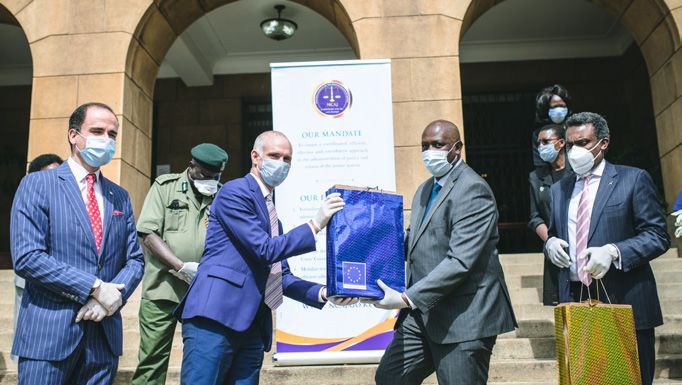
Alternatives to imprisonment in focus on
    Nelson Mandela International Day
    Observed each year on 18 July, Nelson Mandela International Day focuses attention on prisons. A central
    goal of the Programme for Legal Empowerment and Aid Delivery in Kenya (PLEAD) is to reduce prison
    overcrowding, primarily through widening the use of alternatives to imprisonment. One specific target is
    to achieve a 30 per cent reduction in the number of pre-trial detainees by 2022.

    According to the PLEAD Baseline Survey, the official capacity of prisons in Kenya is 26,687 but the prison
    population was 52,833 as at 31 August 2018. The steps taken to decongest prisons in response to the
    pandemic have seen a reduction in the population, stated below as 44,000.

    Here are excerpts from the messages issued by Kenya Prisons Service (KPS), United Nations Office on Drugs
    and Crime (UNODC) and the United Nations Development Programme (UNDP) to mark this international day.

                                                                                             Mr. Wycliffe O. Ogallo,
                       Dr Amado Philip de Andrés                                             OGW, EBS, CBS
                       Regional Representative                                               Commissioner General,
                       for Eastern Africa, UNODC                                             Kenya Prisons Service

    The current UN Standard Rules, best known as                       As it is globally, the unprecedented challenges of
    the “Nelson Mandela Rules”, set out the minimum                    COVID-19 have posed unguided challenge to KPS.
    accepted principles and practices in the humane                    As we monitor and respond to the situation, I am
    treatment of prisoners and prison management                       pleased to note that we have managed to fortify
    globally. UNODC is the custodian.                                  the 44,000 confined vulnerable prisoners against
                                                                       COVID-19 infiltration.
    During this COVID-19 pandemic, KPS has gone to
    the next level in implementation of the Nelson                     Notwithstanding the protocols by the Service and
    Mandela Rules. Among their guidance, the Rules                     enhanced by the Ministry of Health, the Nelson
    urge countries to reduce prison overcrowding and,                  Mandela Rules remains buoyancy towards the
    as appropriate, to resort to non-custodial measures                handling and treatment of prisoners. In effect, the
    as alternatives to pretrial detention.                             Service has taken all-around effective measures
                                                                       to combat the spread of this virus by establishing
    UNODC commends the justice sector for releasing                    quarantine and isolation facilities in all the 129
    vulnerable, low risk offenders serving prison terms of             penal institutions.
    less than six months and for embracing alternatives
    to imprisonment to reduce prison congestion, such                  To be proactive and preventive, the Service has
    as plea bargaining and diversion. Yet such steps                   suspended visits to its penal institutions, Youth
    taken to decongest prisons due to the COVID-19                     Corrective Centers and all Borstal Institutions.
    pandemic must not be seen as a “one-off”. UNODC                    Together with our valuable development partners,
    remains committed to assisting justice agencies to                 we will continue adjusting our contingency and
    aggressively pursue alternatives to imprisonment.                  preparedness measures to protect the prison

               About PLEAD:
               The Programme for Legal Empowerment and Aid Delivery in Kenya (PLEAD) is a partnership involving the Government of Kenya,
               European Union, United Nations and civil society in improving the delivery of justice services, settlement of disputes and use
               of alternatives to imprisonment. The KSh 4.2 billion programme runs until 2022 and is funded by the European Union.
               Editorial enquiries: unodc-plead@un.org I Phone: +254 20 762 3739 www.unodc.org/easternafrica/plead/
               This newsletter was produced with the financial support of the European Union. Its contents are the sole responsibility of the
               co-implementers of PLEAD – UNODC and UNDP – and do not necessarily reflect the views of the European Union.
               On the cover: Graphics by Amina Darani are among those featured in the National Police Service online training. See story p.3

1     PLEAD VERDICT: AUG 2020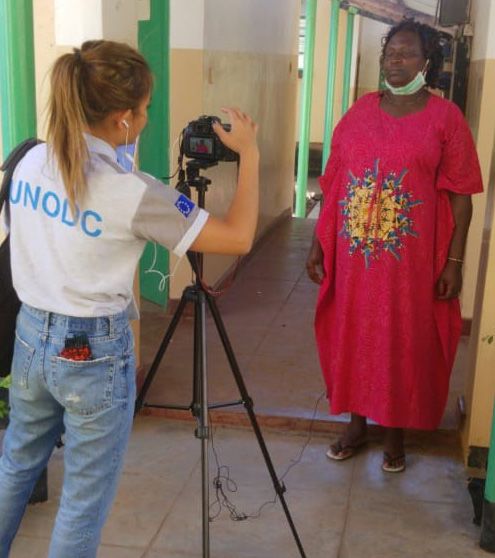
populace which is confined and thus vulnerable
against the virus.

Equally, I salute the work of prison staff and the
important social service they provide, especially
during these testing times of the COVID-19 pan-
demic. Hail to Nelson Mandela International Day!

                 Walid Badawi
                 Resident Representative                Our PLEAD CSO partners in the counties have
                 UNDP in Kenya                          responded to COVID-19 robustly; through setting
                                                        up platforms for online paralegal services, creating
The message of Mandela Day – Take action, inspire       apps, advocating through radio shows and social
change – is both timely and apt for every citizen in    media, and notably setting up video-links to
Kenya and beyond. For development institutions          facilitate legal aid and assistance in prisons and
like UNDP, it is a call for collective action that      jails, together we are ensuring that legal aid is
transforms the lives of people in Kenya. Within the     available and justice is not delayed, especially
context of the global COVID-19 pandemic, the call       during these challenging times. For example,
for us to take individual and collective action as we   in partnership with Kenya Prison Service and
support national efforts to win the war against the     the Legal Resources Foundation (LRF), we have
pandemic cannot be overstated. The pandemic             facilitated the attendance of over 550 pre-trial
has not only impacted on national health systems,       detainees in court proceedings via video link.
it has impaired the effective delivery of important     Lawyers and paralegals have also been able to
public services, including the delivery of justice.     attend virtual court appearances.

UNDP, through close collaboration with partners,        We will continue to give special attention to the
is currently undertaking different interventions to     promotion of humane conditions of imprisonment
ensure that legal aid and assistance continues to be    as well as to raise awareness about prisoners
available in prisons and jails, despite the COVID-19    being a continuous part of our society. Every
circumstances. As innovation is at the heart of         day, we are challenged to ensure that those
our work, UNDP has already invested resources           behind bars are treated according to the "Nelson
in ensuring that the delivery of justice services       Mandela Rules" – through the PLEAD partnership
continues, this time, through digital means.            involving the Government of Kenya, European
Through our Accelerator Lab, we are also advising       Union, the United Nations and civil society, we will
on the development of promising solutions to            continue to play our part to ensure legal support
enhance delivery of justice and provision of legal      and justice are available and accessible to all
aid, which include digital applications, vending        Kenyans, especially the poor, marginalized and
machines, and hotlines.                                 most vulnerable.

            Programme for Legal Empowerment and Aid Delivery in Kenya Ð PLEAD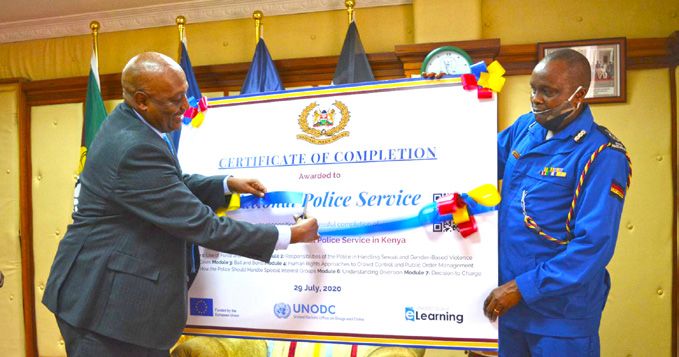
Online training a first for the
    National Police Service

     Inspector General Mutyambai (left) and Police Commissioner and Director of Reforms, Mr David Birech, during the launch

    The first ever online training course for Kenya’s             officers with relevant information for better service
    National Police Service (NPS) was launched on                 delivery to the public while observing the Rule of
    29 July.                                                      Law, their personal safety and that of offenders, and
                                                                  I thank the European Union and UNODC for this
    The training is the result of collaboration between           initiative,” the Inspector General added.
    the NPS, EU and UNODC to address the unique
    challenges police officers are facing in enforcing            The course was jointly developed with EU financial
    law and order during the COVID-19 pandemic.                   support by a special committee appointed by the
    Developed through PLEAD, the mandatory course                 Inspector General of police, UNODC’s PLEAD team
    comprises seven e-learning modules that police                in Kenya and UNODC Global eLearning Programme
    officers can complete at their own pace on a                  colleagues in Austria, where it is hosted.
    computer, tablet or smart phone.
                                                                  “The Police Service is to be commended for
    Among the topics covered are the use of force                 prioritizing the training of its officers to the
    and firearms, human rights approaches to crowd                highest standards so that they can meet the
    control and public order management, police                   unforeseen policing challenges that have arisen as
    responsibility in handling of sexual and gender-              a consequence of the pandemic and comply with
    based violence cases, bail and bond, and how to               Kenya’s constitutional human rights standards. We
    deal with special interest groups such as persons             hope there’s a positive uptake of the e-learning
    with disabilities and children in conflict with the           by officers across the country who stand to gain
    law. More than 740 police officers accessed the               from this capacity building, in terms of immediate
    online course in its first week.                              refresher training in relation to the pandemic and
                                                                  for their longer-term professional development,”
    “The COVID-19 pandemic has created new                        the EU Ambassador, Mr Simon Mordue, said in
    challenges for policing in Kenya and we therefore             congratulating everyone involved.
    need new response strategies to crime and
    incidents, and the enforcement of COVID-related               Each module contains written information, case
    regulations,” the Inspector General of NPS, Mr Hilary         scenarios with related questions and answers,
    Mutyambai, said during the virtual launch. “These             videos, graphs and illustrations.
    training modules will go a long way in equipping our          “The pandemic has presented a new opportunity

3     PLEAD VERDICT: AUG 2020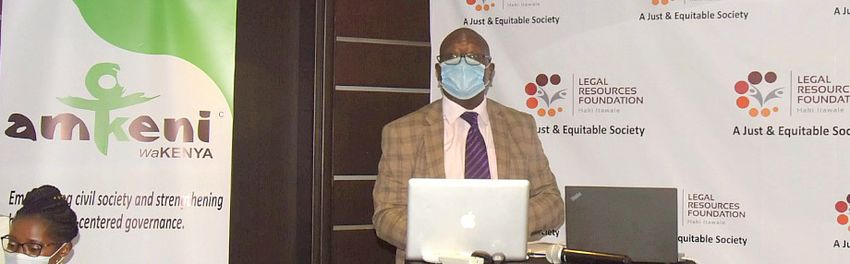
to accelerate the digital transformation of law           that the modules happen to address some of the
enforcement and justice institutions, and that            key concerns that ourselves as the Independent
includes turning to online training. I appreciate         Medico Legal Unit but also the larger Police
the effort that has gone into ensuring everything         Reforms Working Group within the civil society
is ready for this initiative within the shortest time     have had with regard to the way the National Police
possible,” UNODC Regional Representative, Dr              Service has interacted with this very challenging
Amado Philip de Andrés, said.                             situation – such as Use of force and firearms and
                                                          administering of police bail and bond.
The NPS is benefitting through PLEAD under
the auspices of the National Council on the
Administration of Justice (NCAJ) which is
coordinating the sector’s COVID-19 pandemic
response. Also participating in the launch via a
video link, the Acting Chief Executive of the NCAJ,
Dr Conrad Bosire, expressed his hope that officers
will be able to actively engage with the training
content and re-adjust their focus in the way of
dealing with their clientele, the public. “I believe
the rich content which is shared here can make a
difference if it is internalized and put into practice”
Dr Bosire said.

Members of the Police Reform Working Group
also participated in the launch. Mr. Peter Kiama,
Executive Director of IMLU and speaking on behalf
of the working group, congratulated the IG and
                                                          Illustrations by Paul ‘Maddo’ Kelemba feature in the training
UNODC for this achievement. ‘I am happy to note

                                                          Community Legal Aid
                                                          and Information
                                                          Centre Launched
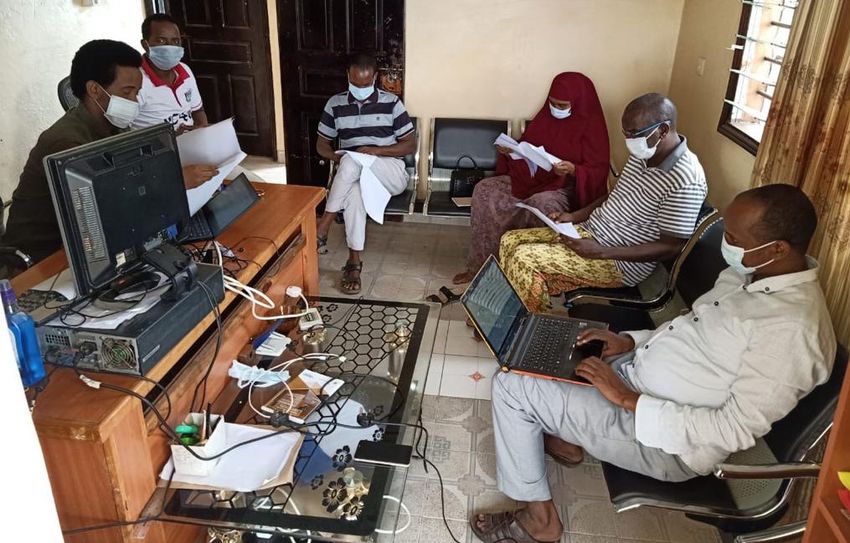
                                                          PLEAD CSO partner Kenya Community Support
                                                          Centre (KECOSCE) launched the Tana River County
                                                          Community Legal Aid and Information Centre
                                                          on 12 June 2020 in Garsen, Tana River County. In
                                                          conjunction with UNDP, KECOSCE has trained 9
                                                          paralegals as part of its work under PLEAD, and
                                                          these paralegals will use the centre to provide legal
                                                          aid and assistance as well as train volunteers to
                                                          expand their work further.

                                                          Operation of the Centre is to be a joint initiative
                                                          between the Judiciary, the County Government,
                                                          KECOSCE and other key stakeholders from the
                                                          community including councils of elders, religious
                                                          leaders, women’s groups and youth groups. The
                                                          opening of the Centre follows the launch of the
                                                          Mombasa County Legal Aid Unit by PLEAD partner
                                                          Human Rights Agenda (HURIA), as detailed in the
                                                          last PLEAD newsletter.

                                                                                      PLEAD VERDICT: AUG 2020         4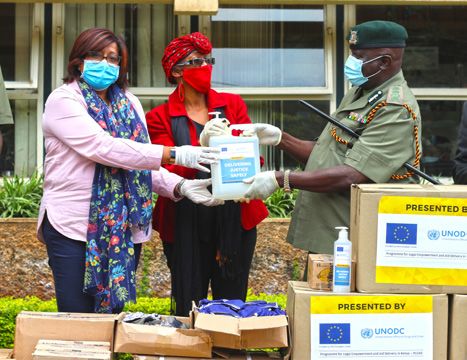
Hygiene supplies and office equipment boost
    justice services
    PLEAD implementation has ramped up to support the justice sector’s response to the COVID-19 pandemic.
    This has included donations of vital hygiene supplies and office equipment funded by the EU and procured
    by UNODC, consistent with priorities of the National Council on the Administration of Justice (NCAJ).

    The coordination role of NCAJ is proving pivotal in the current context. In June, the National Police Service
    received a consignment of 60,000 gloves, 17,000 face masks and 108,065 litres of hand sanitizer, facilitated
    by NCAJ.

    See story: www.ncaj.go/ke/news-media.
    © Allisha Azlan/UNODC

                             (L-R) Principal Assistant to the Inspector General, Mr Nyale Munga,
                             NCAJ Acting Chief Executive Dr Conrad Bosire and UNODC’s
                             Ms Irene Omari.

    Also in June, 60,000 protective gloves,
    251,250 litres of hand sanitizer and
    18,000 face masks funded through
    PLEAD were among the commodities
    presented to the Kenya Prisons
    Service (KPS) to safeguard the health
    of prisoners and staff. “We’re privileged
    to be able to assist KPS to maintain
    safe hygiene standards within its
    institutions, knowing that despite
    the restrictions placed on custodial
    environments to contain COVID-19,
    the Nelson Mandela Rules for the
    treatment of prisoners still apply,” the
    Head of UNODC’s Crime Prevention
                                                                                 © Allisha Azlan/UNODC

    and Criminal Justice pillar in Eastern
    Africa,   Ms    Kagwi-Ndungu          said
    during a handover ceremony at KPS
    headquarters with the Commissioner
    General of Prisons, Mr Wycliffe Ogallo,
    and NCAJ’s Dr Bosire.                                                                                (L-R) UNODC’s Ms Toral Vadgama Toral and Ms Charity Kagwi-Ngungu, and
                                                                                                         Commissioner General Ogallo.

5                           PLEAD VERDICT: AUG 2020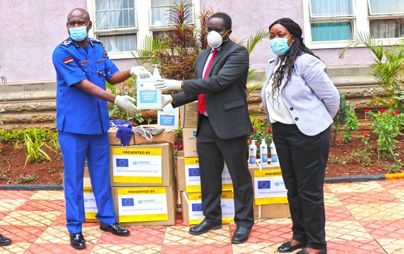
© Allan Gichigi/UNODC

                        (L-R) Dr de Andrés, Ambassador Mordue, Inspector General Mutyambai and Director of Public Prosecutions, Mr Noordin Haji

To enable wide participation in virtual court proceedings, 38 PLEAD-funded laptops were handed over in May
by European Union Ambassador Mr Simon Mordue and UNODC Regional Representative for Eastern Africa,
Dr Amado Philip de Andrés, for immediate use by the Kenya Prisons Service (18), the Judiciary (5), National
Police Service (5), Probation and After Care Service (5) and Office of the Director of Public Prosecutions (5).
“This crisis is unfolding now, so I’m pleased we’re able to deliver this first consignment of laptops, with more
equipment on the way,” Ambassador Mordue said.
     © UNDP

                        UNDP Amkeni Wakenya Project Officer Mohamud Abdullahi with Raia Development Initiative (RDI), a PLEAD CSO part-
                        ner operating in Wajir County. Through procurement of Zoom video conferencing licenses for partners, we aim to transi-
                        tion towards virtual rather than in-person monitoring for the safety of all.

                                                                                                                   PLEAD VERDICT: AUG 2020        6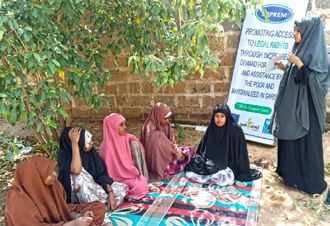
State of Legal Aid in Nairobi County 2020 report
Report launches through support from the PLEAD partnership
© Amkeni/UNDP
Whereas legal aid plays an important role in Dr. Dan Juma, Team Leader of the Governance and
ensuring that the most vulnerable can access justice, Inclusive Growth Unit of UNDP Kenya, thanked
provision of legal aid in Nairobi is heavily reliant on partners from the Government of Kenya and civil
external support, so finds the State of Legal Aid society for their collaboration in working towards
in Nairobi County 2020 Report from PLEAD civil equitable justice for all in Kenya, and highlighted
society grantee the Legal Resources Foundation the potential positive impacts of decentralization
(LRF). Launched in Nairobi on 18 June 2020 in the (including through legal aid) on improving
presence of representatives from the Government inclusivity in this regard.
of Kenya, United Nations and civil society, the LRF
Report explores a number of key themes related A number of recommendations towards improving
to access to justice and was produced with the enabling environment and operation of legal
technical support from UNDP through the Amkeni aid in Nairobi County and Kenya more widely are
Wakenya project. made in the Report, including:
The finding that there is high dependency on Continuing the development and use of
donor funding and technical capacity to undertake information management systems to ensure
legal aid is determined to be a barrier to the long- that NLAS can coordinate and identify indigent
term sustainability of legal aid in Nairobi County. populations in need of legal aid
Other key findings of the Report include: justice Supporting institutional service providers,
centres built by non-state actors are temporary and which will enhance delivery of legal aid without
there is difficulty in sustaining these; COVID-19 has inviting competition
exposed many justice institutions’ lack of basic IT Fast-track full operationalization of the Legal
to enable effective virtual litigation; a lot of legal Aid Act 2016 and the Small Claims Courts Act
aid work being carried out in courts, police stations 2016
and prisons is largely undocumented; and, there is Development and implementation of a clear
need for a standardized framework to guide what guide for determination of financial eligibility
constitutes legal aid. for legal aid in civil matters.
Speaking at the launch, Hon. Lady Justice Grace Since the onset of the COVID-19 pandemic,
Ngenye, Chair of the Committee on Criminal UNDP have been working with LRF to undertake
Justice Reforms (NCCJR), emphasized the need to interventions to ensure continuity of justice
prioritize legal aid for special interest groups like services, including setting up video links between
children, among others. Flora Bidali, Acting Director jail and the courts, which has resulted in several
of the National Legal Aid Service (NLAS), delivered bond reviews and successful cash bail reductions.
a speech on behalf of Hon. Attorney General Currently UNDP engages over 40 civil society
Kihara Kariuki: Ms. Badali emphasized that the organizations (CSOs), including LRF, providing
fundamental principle of justice should be fair and grants and technical support towards the provision
balanced regardless of cost, and only when access of legal aid and assistance towards the aims
to justice is available to all notwithstanding ability of PLEAD.
to pay will equitable justice truly be realized.
7 PLEAD VERDICT: AUG 2020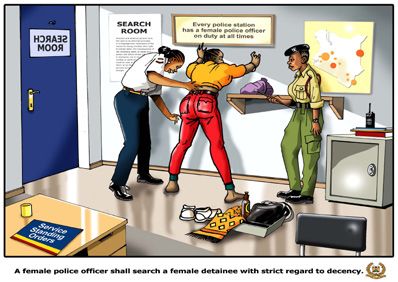
PLEAD Partner Voices: deepening ADR
accountability in Garissa County
                                                       representative of different clans, there were afraid to
                                                       talk about each other, he said, and there are limited
                                                       ways to formally prevent favouritism shown.

                                                       In one notable case in which SUPKEM intervened,
                                                       Mama Halima from Maaliin village, Garissa County,
                                                       attended a SUPKEM legal education session where
                                                       she was able to talk to Project Officer Jamila Farah
                                                       about a case she had previously raised that the local
© SUPKEM/UNDP

                                                       chief had failed to act on for some time. Mama
                                                       Halima was divorced by her husband and evicted
                                                       from their plot, which is used as a kiosk, depriving
                                                       her of a home and of income. Ms. Farah contacted
Due to the absence of formal courts in many parts of   the local chief and the case of Mama Halima was
Kenya, including Garissa County, it’s often the case   revisited by the elders: ultimately, Mama Halima
that networks of elders work with local chiefs to      was offered KSH 3000 per month as an upkeep for
solve disputes amongst their communities. Known        her children by the husband.
by many names locally, this practice is formally
referred to as Alternative Dispute Resolution (ADR).   Additionally, the ADR providers were able to benefit
                                                       from capacity building training held by SUPKEM on
Though well-established, there are rarely account-     human rights principles. Whereas previously most
ability mechanisms put in place to address             of the chiefs have not been recording the cases
grievances from the community on how the               they have handled, Mr. Abdirahman Gure, Chief of
elders administer justice in this way, nor has the     Modogashe, showed the other chiefs present all
Government of Kenya formulated guidelines on           the documentation of the cases him and his team
how appointments to ADR committees should be           solved in 2020. At this event, the other chiefs were
done. In Lagdera, Garissa County, ADR committee        challenged by the ACC that they should imitate the
members are clan representatives with relationships    same spirits and that they should document cases
stemming from this: hence, to whom they are            that have reached in their offices.
accountable is not always clear-cut.
                                                       There is a long way to go to improve accountability,
When we at the Supreme Council of Kenya Muslims        and the Government, chiefs, elders and civil society
(SUPKEM) and our partner UNDP introduced an            organizations like SUPKEM all have a role to play
EU-supported project titled ‘Promoting access to       so that communities can have confidence in their
justice through increased demand of legal aid and      ADR systems.
assistance by the poor and marginalized’, a platform
was created where the elders in the ADR committees                  Contributed by: Aden Awle of the Supreme Council of Kenya
                                                                    Muslims (SUPKEM) [Edited for brevity/clarity]
could interrogate their own performance in passing
judgement, as well as that of their peers. We were
also able to train ADR committees on best practices.

In Modagashe, Garissa County, women in a local
ADR committee told us how they had noted biases
in the elders, who would favour their relatives and
are influenced by external forces. Mama Sambur
of Modogashe peace committee noted how in
a particular case one of the elders’ sons, who
was alleged to be a thief, was favoured in a case
                                                       © UNDP

against a poor woman. Further, an Assistant County
Commissioner (ACC) in Modogashe also confirmed
                                                                Locals in Modagashe, Garissa County, attend a consul-
to us that some ADR committee members were                      tation with SUPKEM about equitable ADR practices.
known to exhibit clan biases. Since the elders are

                                                                                            PLEAD VERDICT: AUG 2020             8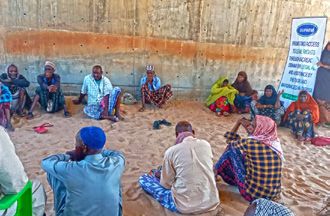
PLEAD partner interview:
             Kituo cha Sheria Legal Advice Centre, Mombasa County

                                                                   ZA: PLEAD has enabled us to provide a platform
                                                                   for advocating for institutional reforms. Sourcing
                                                                   of resources to conduct activities implementing
                                                                   the objectives, institutional enhancement of
                                                                   capacity building for staff to perform well under
                                                                   the program. Development of monitoring tools for
                                                                   assessing progress and improving partnership with
                                                                   other civil society organizations to do the work.
    © UNDP

                                                                   AM: Please tell us about the context of the
              Zedekiah Adika, Kituo Project Officer, speaks at a   communities you serve, including in the local
              PLEAD partners learning workshop in July 2019
                                                                   area and in the prisons. What are the challenges
                                                                   and opportunities facing these Kenyans?
    Kituo cha Sheria Legal Advice Centre (Kituo) is a
    CSO operating in a number of counties which offers             ZA: We serve an urban population. Our main clients
    legal aid and assistance to over 10,000 poor and               are urban poor and those in prison. The prisons we
    marginalized Kenyans each year. Through the EU-                are focused to are Shimo La Tewa Prisons - Men and
    supported PLEAD partnership, UNDP has engaged                  women. In the latest trend, COVID-19 regulations
    Kituo in Mombasa County, where they have a                     have led to locking out any one from Prison facilities.
    particular focus on promoting equitable access to              So many do not know how to relate with Prisons.
    justice for prisoners. In April 2020, UNDP Amkeni              The advent of online court attendance is still a
    Wakenya’s Akyar Maalim spoke with Zedekiah                     challenge and needs sensitization to be involved.
    Adika, Project Officer at Kituo, about his work and
    the challenges that Kituo is facing.                           AM: What has the impact of COVID-19 been on
                                                                   your work and on the communities you serve?
    AM: Good afternoon Zedekiah. Please outline the
    key challenges your project is addressing                      ZA: COVID - 19 has affected number of participants
                                                                   we can engage in every event. Judiciary is also
    ZA: The project Njia za Haki seeks to address                  difficult to access. We also have to plan more
    challenges facing access to justice among the                  activities and take fewer hours. Some of our target
    vulnerable and marginalized in Mombasa County.                 participants do not have access to phone.
    This is both in community and prisons centers,
    especially Shimo La Tewa Men and Women prisons.                AM: How have you adapted your work to the
                                                                   operating conditions during the COVID-19
    AM: What are some of the main approaches you                   pandemic?
    are taking to address these challenges?
                                                                   ZA: We are working with state actors to learn and
    ZA: The key approaches used included a                         sensitize communities on emerging modalities for
    sensitization on different laws through different              operations, like e filing at court and attendance. The
    for a like media, direct contact forums. Training              challenge of access to prisons is another.
    and refresher training of paralegals to cascade
    knowledge to those marginalized. Advocating for                AM: What are the greatest emerging challenges
    institutional reforms, strengthening of institutions           which Kituo sees?
    like Legal Aid Act services by sensitizing citizens
    on their role to ensure vigilance and push for their           ZA: Access to justice in the emerging circumstances
    comprehensive functionality. Providing legal aid               have doubled courtesy of COVID-19. This is
    services to communities, including representation              specifically a challenge for clients without an
    of clients.                                                    advocate. At Kituo, we note that some donors are
                                                                   also affected. This has led to fears that we may need
    AM: How have UNDP and the EU supported your                    to cut down on staff who are under the support of
    work and your interventions through PLEAD.                     those programs.

9            PLEAD VERDICT: AUG 2020
PLEAD briefs
An essential aspect of the justice sector’s pandemic
Delivering justice safely response is ‘social distancing’ at courts and other
sites, consistent with Government of Kenya
guidelines.
Using the NCAJ common tagline ‘delivering
justice safely’, the sensitization efforts of partner
institutions are being supported through PLEAD. A
total of 28,525 stickers and posters promoting social
distancing have been produced for the Judiciary,
Witness Protection Agency, Office of the Director of
Public Prosecutions and NCAJ.
© Judiciary
Webinars and videos drive national conversation
and Kenyans from all walks of life in the policy’s
content and implications.
The taskforce staged a series of webinars in July and
August on such topics as AJS and gender justice,
academia, youth, and land and natural resources,
in conjunction with a range of partners, including
the Judiciary, Lawyers Hub Kenya, Pamoja Trust,
UNODC and UNDP. Gertrude Angote, UNDP
‘Amkeni Wakenya’ CSO facility Project Specialist,
was among the speakers in the 30 July webinar on
Civil Society Organizations in AJS, during which she
spoke of the involvement of civil society in PLEAD….
© Makau Kithuka/UNODC
Video testimonials produced for the taskforce
by UNODC are also contributing to the national
conversation. Among those featured are the
taskforce Chair and Judge, Nakuru High Court,
Justice Joel Ngugi; Chairperson of Samburu
UNODC’s Ms Allisha Azlan interviewing Mrs Nairesie Elders Council, Mrs Joyce Nairesie; Senior Resident
in Isiolo Magistrate, Othaya Law Courts, Hon Monica
Munyendo; and Principal Magistrate, Thika Law
Ahead of the launch of the Alternative Justice Courts, Hon Ben Mark.
System (AJS) Policy, the Taskforce on Traditional,
Informal and Other Mechanisms for Dispute The videos are available on the AJS Taskforce
Resolution in Kenya has been promoting a national website and NCAJ YouTube:
conversation to further engage justice stakeholders www.ajskenya.or.ke / https://bit.ly/346NffU
PLEAD VERDICT: AUG 2020 10Art competition to empower young offenders
Probation: A New Beginning
Art Competition!!
offenders can change
The competition is enabling children and youth to share their experiences of the justice system
An art competition with a difference is under 2. Lessons learnt: Entrants can convey lessons
way. Entitled ‘Probation: A New Beginning’, learnt from crimes committed, the arrest
the competition is open to children who are process, experience in remand or court, and
on probation, under the supervision of Kenya’s from Probation Officers.
Probation and After Care Service (PACS). The 3. Vision in the future: Art describing entrants’
competition is a joint initiative of PACS, the dreams of the future.
European Union and UNODC through PLEAD, 4. COVID-19: Entrants can express how the
and will culminate with awarding of prizes and an pandemic is affecting them.
exhibition. Eligible young probationers can take
part by creating paintings, drawings or collages “We hope this art project will empower children
through which they can express their feelings and and youth who are on probation to have their voices
emotions about what it is like to go through the heard and provide an outlet for creative expression.
criminal justice system. The entrants can choose This competition is also intended to improve
from these sub-themes: understanding of what the Probation and After
Care Service does and of the importance of giving
1. Change: Change is one of the key outcomes young offenders a second chance,” the Head of
of a successful supervision and rehabilitation UNODC’s regional Criminal Justice Pillar, Ms Charity
process. Entrants can express how they want to Kagwi-Ndungu, said.
change their lives. After entries are submitted by 30 September, the judging will take place.
Key dates AUG–OCT
20 20
Useful links
27 PLEAD government partners
August Department of Justice www.statelaw.go.ke
11 9th anniversary of NCAJ
Judiciary www.judiciary.go.ke
27 10th anniversary of the promulgation of the
Constitution of Kenya 2010 and scheduled National Council on the
www.ncaj.go.ke
launch of the Alternative Justice System Administration of Justice (NCAJ)
Policy for Kenya NGOs Coordination Board www.ngobureau.go.ke
18–19 New PLEAD grantees induction workshop, Office of the Director of Public
www.odpp.go.ke
Machakos County Prosecutions (ODPP)
Probation and After Care Service
www.probation.go.ke
September (PACS)
Judging of ‘Probation: Witness Protection Agency
A New Beginning’ Art Project www.wpa.go.ke
(WPA)
11 PLEAD VERDICT: AUG 2020
Follow the PLEAD partnership: #PLEADyetuYou can also read


