Preparing for 2020: the tax and legal developments that will impact employers Joke De Bruycker, Uschi Van Doren, Wendy Van Hullebusch & Julien ...
←
→
Page content transcription
If your browser does not render page correctly, please read the page content below

Preparing for 2020: the tax and legal developments that will impact employers
Joke De Bruycker, Uschi Van Doren, Wendy Van Hullebusch & Julien Hick
© 2019 Deloitte Belgium & Laga

Speakers contact details

             Julien Hick         Wendy Van Hullebusch          Uschi Van Doren          Joke De Bruycker
             Director            Senior Manager                Senior Manager           Experienced Senior
             juhick@laga.be      wvanhullebusch@deloitte.com   uvandoren@deloitte.com   jdebruycker@deloitte.com
             +32 2 800 70 66     +32 2 800 28 25               +32 2 600 68 97          +32 2 600 69 03

                                                                                                                   2
© 2019 Deloitte Belgium & Laga
Agenda

                           1     Introduction

                           2     Implications of the new company code regarding the social security status of corporate officers

                           3     Equal pay for seconded employees and local employees

                           4     Flemish target group reduction for young employees as from 2020

                           5     Tax & social security considerations regarding foreign remuneration

                           6     Company cars: increased taxable benefit-in-kind for “fake hybrids” in 2020 and update CO2 reference emission coefficient

                           7     The latest developments regarding severance payment, benefit-in-kind for free housing and non-recurring result tied bonus

                                                                                                                                                            3
© 2019 Deloitte Belgium & Laga
Implications of the new company code
The social security status of members of corporate bodies

© 2019 Deloitte Belgium & Laga
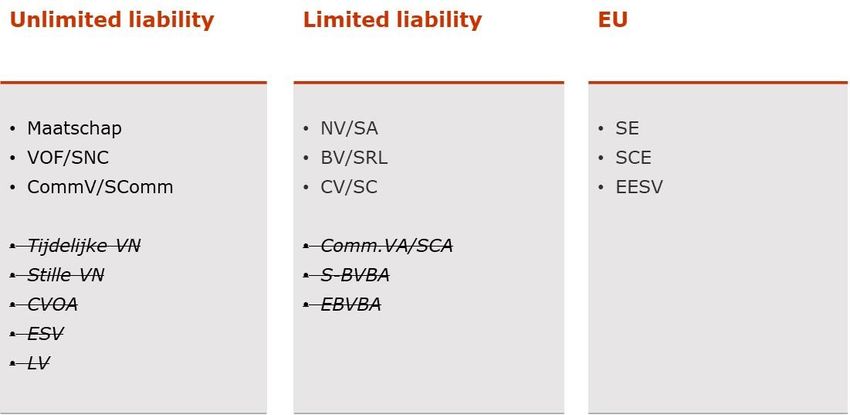
General introduction

New Code on Companies and Associations (NCCA) of 23 March 2019, published 30 April 2019, entered into force 1 May 2019

• Objectives = Modernization and more flexible Belgian corporate law

   • A single Code for companies and associations with common provisions

       − Associations can now pursuit profit (but still not distribute it to their members):   leading to corporate income tax

       − Only non-profit associations are subject to the legal entities tax

   • Limitation of the number of corporate forms

           ─ Abolishment of certain cumbersome formalities
             and entry into the digital age (email, internet)

           ─ Greater flexibility and freedom (suppletive
             law)

           ─ Abolishment of the “real seat theory” to
             facilitate mobility (see tax impact below)

© 2019 Deloitte Belgium & Laga                                                                                                   5
Focus on BV/SRL and NV/SA

• Main changes relate to the BV/SRL (one size fits all)

   • Abolishment of share capital

   • Creditor protection (incorporation, distribution of assets, alarm bell)

   • Shareholders’ rights: different types of shares

   • “open” BV/SRL

• The main principles governing the current NV/SA remain the same (as based on EU laws)

• But also important changes for the NV/SA

   • One shareholder possible

   • 3 governance models, including single director

   • Multiple voting rights (loyalty double voting right for listed companies)

© 2019 Deloitte Belgium & Laga                                                            6

New governance structure in the NV/SA: one-tier vs. two-tier structure

                                               Governance
                                                structure

                    Two-tier                                                One-tier
                    structure                                               structure

                                 Supervisory                                            Board of
                                                            Sole director     OR
                                   board                                                directors

                                    AND

                                 Management
                                    board

© 2019 Deloitte Belgium & Laga                                                                      7
Two-tier system

Management committee replaced by a genuine two-tier system with a Supervisory board and a Management board

                                 Old version                                New version

                                                                             Supervisory
                                      BoD                                      Board
            Composition

                                                                              Management
                                               MC                               Board

            Powers                                                                                 •   Strategy
                                 BoD                                         Supervisory
                                                                                                   •   Supervision of
                                                                               Board                   management board
                                         MC

                                                                              Management           •   Full operational
                                                                                Board                  management

© 2019 Deloitte Belgium & Laga                                                                                            8
Governance structure in SRL / BV

                                                 Governance
                                                  structure

                                                 Only one-tier
                                                  structure

                                 Sole director       OR          Board of
                                                                 Directors

© 2019 Deloitte Belgium & Laga                                               9
Legal status and remuneration corporate officers (BV/SRL and NV/SA)
• Legal status
• The directors cannot, in this capacity, be bound to the company by an employment contract
• Directors must be self-employed in that capacity (it is possible to enter into an employment contract for other functions)
• The same applies to members of supervisory board and management board ( separate employment contract for members of a
management board more difficult)
• Remuneration
• Presumption in the NCCA: the office of directors, members of the SB or MB, is remunerated
− The articles of association or the appointment decision can deviate from this rule
• The general meeting resolves on the compensation to be awarded to directors or members of the supervisory board
• The remuneration of the members of the management board is decided by the supervisory board
© 2019 Deloitte Belgium & Laga B. Feron, A. Tilleux, K. Maresceau – 3 April 2019 10Legal status and remuneration corporate officers (BV/SRL and NV/SA)
• Dismissal
• Principle: ad nutum dismissal (effective immediately and without justification)
• Possible deviations:
− for directors and members of a supervisory board, the general meeting may, at the time of dismissal, provide for a severance payment
(unless contrary provisions in the articles of association) or the articles of association may provide for a severance payment fee in case of
dismissal
− for members of a management board, a management agreement may be entered into, that provides for notice or severance pay in the
event of termination
• Dismissal based on legitimate reasons without any notice period or severance pay always possible
© 2019 Deloitte Belgium & Laga B. Feron, A. Tilleux, K. Maresceau – 3 April 2019 11Corporate officers’ liability
• Common legal framework applicable to all legal persons
• Confirmation of the standard of care for corporate officers: “each member of a management body or daily manager is liable for the correct
performance of his/her office”
• Marginal assessment of potential liability
• The corporate officers (or the other persons who manage the company, e.g. de facto directors) are liable towards the company for the
faults committed in the course of their office and towards third parties in tort law (≠ contract)
• In case of collegial decision-making, there is a joint and several liability of corporate officers
• Possibility for the corporate officer not to be liable for the faults that he/she has not committed, if he/she has reported it to the other
offices within the same body
• Limitation of the liability (Cap) but exceptions:
• willful misconduct or fraudulent intent
• guarantee obligations (capital increase and payment of share contribution)
• tax and social security liabilities
• minor but usual faults and gross negligence
© 2019 Deloitte Belgium & Laga 12Limitation of the directors’ liability
Caps linked to the size of the enterprise
Average yearly turnover Average total of the Cap (€)
calculated during the balance calculated during
three last financial the three last financial
exercises (€) exercises (€)
< 350.000 AND ≤ 175.000 125.000
< 700.000 AND ≤ 350.000 250.000
≤ 9.000.000 OR ≤ 4.500.000 1.000.000
< 43.000.000 AND < 50.000.000 3.000.000
≥ 43.000.000 OR ≥ 50.000.000 12.000.000
Cap for public interest entities: € 12.000.000
© 2019 Deloitte Belgium & Laga 13Equal pay Seconded employees and local employees © 2019 Deloitte Belgium & Laga
Equal pay for equal work
• Following the revision of the posted workers directive (EU Directive 2018/957) , the principle of “equal pay for equal work” is
  being implemented (implementation deadline = 30 July 2020)

• In Belgium, draft submitted to the National Council for Labour (nationale arbeidsraad/conseil national du travail), which
  rendered its opinion on 26 November 2019

• Objective of bill and directive: remuneration of assigned workers should be at the same level of the salary of their local
  peers, including additional salary components such as bonuses or allowances.

• Many areas of uncertainty remain:
             • What does “equal pay” exactly means – identical salary and benefits package ?
             • Reference to the wage scales and specific allowances deriving from local legislation?
             • How labour specific remuneration components, e.g. seniority premiums, 13th month, Christmas bonus, bad weather
               allowance, etc.

                                     Local employee                                                    Assignment

                                                                                                                                    15
© 2019 Deloitte Belgium & Laga
Flemish target group reduction Young employees as from 2020 © 2019 Deloitte Belgium & Laga
Flemish target group reduction                       • Low skilled
                                                         • Medium skilled

                                                              Target
                                                              group

•  Limited quarterly reference salary:
  • 1st 4 quarters: € 7.500                                                             • Reduction employer social
  • 2nd 4 quarters: € 8.100                                   Target                      security
                                              Conditio
• Employee younger than 25 years
                                                ns            group           Benefit     • Low skilled: full exemption
• Ordinary employment contract                              reduction                     • Medium skilled: reduction
• Education level attested with the Flemish
                                                                                            of € 1.000 each quarter
   Employment Agency

                                                              Future
                                                               2020

                                                         • Only low skilled
                                                                                                                        17
    © 2019 Deloitte Belgium & Laga                       • Grandfathering
                                                           rules
Tax & social security considerations Foreign income © 2019 Deloitte Belgium & Laga
General rules – foreign remuneration

      Withholding taxes in Belgium are only required if the remuneration is considered taxable in Belgium (per application of double
      tax treaties) since withholding taxes are the pre-financing of the final income tax liability.

   There is a withholding tax requirement if remuneration is paid or attributed by a Belgian company.

   If the payment or attribution of remuneration is made by a foreign company, the following rules apply:

       • If a beneficiary is working for the Belgian subsidiary ((klein)dochtervennootschap / filiale) there is a withholding tax requirement
         if the subsidiary acts as intermediary in the payment/attribution of the remuneration.

           Based on case law, a cost recharge from the parent company to the subsidiary is not always sufficient to conclude that the
           subsidiary is the debtor or act as intermediary in the payments/attributions of the remuneration.

       • If the beneficiary is working for a direct Belgian establishment (inrichting / établissement) of the foreign company then there
         could be a withholding tax requirement, irrespective of a recharge of cost (since costs linked to the Belgian activities are deemed
         to be at charge of the Belgian establishment).

       • The beneficiary can also create via his/her activities in Belgium a Belgian establishment of the foreign company. If so, there is a
         withholding tax requirement (if Belgium is allocated the power of taxation following applicable double tax treaty).

                                                                                                                                                19
© 2019 Deloitte Belgium & Laga
New fiction
General rule New Fiction
No cost recharge
No cost recharge
Foreign head company Belgian subsidiary or Foreign group company Belgian group entity
direct branch
No intervention of the Belgian
No intervention of the Belgian
subsidiary/branch in the
Belgian tax resident / entity in the decision to grant Individual working for the
decision to grant the benefit to
non-resident the salary to the beneficiary benefit of the Belgian
the employee
company
The Belgian subsidiary did not act as a intermediary in the payment The Belgian entity is now assumed to have attributed the
or attribution of the remuneration. Under the general rules, there is remuneration granted by the foreign related company to the
no withholding tax requirement in hands of the Belgian subsidiary beneficiary. Consequently, the Belgian company has a withholding
tax and reporting requirement (in the event of Belgian taxation!)
The fiction has a much broader scope compared to the general rules:
Foreign group company vs. Foreign head company
Belgian group entity vs. Belgian subsidiary or direct branch
20
© 2019 Deloitte Belgium & LagaIn practice – income year 2019
01/01/2019 11/02/2019 28/02/2019 31/12/2019
Entry into force • Transitional period for income • Withholding and reporting
paid during 01/01/2019 – obligation for income paid
28/02/2019 01/03/2019 – 31/12/2019
• Only reporting obligation • Fee forms 281.10 and 281.20 will
• Fee forms 281.10 and 281.20 will be determined by Royal Decree
be determined by Royal Decree • Filing deadline end of February
• No separate fee form! 2020
• Filing deadline end of February
2020
21
© 2019 Deloitte Belgium & LagaChange in administrative instructions
Salary protection Act of 12 April 1965 Former position authorities New Position authorities
(until September 2018) (as of September 2018)
Benefit: Benefit: Benefit:
1. in cash or valuable in monetary 1. in cash or valuable in 1. in cash or valuable in monetary terms; and
terms; and monetary terms; and
2. granted because of or on occasion of the
2. granted because of or on 2. granted because of or on employee’s employment = at charge of
occasion of the employee’s occasion of the employee’s employer; and
employment; and employment; and
3. to which the employee is entitled.
3. to which the employee is 3. to which the employee is
entitled; and entitled; and
4. at charge of the employer. 4. at charge of the employer
• paid by employer (directly
or indirectly); or
• employer is employee’s
main contact point in
relation to benefit or
intervenes in granting
process.
22
© 2019 Deloitte Belgium & Laga
22New position social security authorities supported by case law
Roularta case
Supreme Court 10 October 2016
Adjustment of administrative instructions mainly inspired by SISLEY case
Grant by group entity
At charge of employer due to possibility to
turn to employer if no grant
Brussels Labour Court 7 March 2018
(benefit according to employment contract)
Third party (Sisley) giving commissions to employees of Belgian company (Planet
Parfum) for selling their products
Esko case
Belgian social security contributions are due by Sisley as grant (not published)
Ghent Tribunal 5 February 2018
concerns is reward for employment for Belgian employer
NOT relevant whether or not AT CHARGE of Planet Parfum Grant by group entity
At charge of employer due to broad
interpretation of ‘intervention by employer’
Pending appeal
Ford case
Supreme Court Brussels Court 7 February 2019
20 May 2019 Commissions to third party employer
At charge of employer as it concerns
redistribution of benefit that normally would
be for account of employer
23
© 2019 Deloitte Belgium & Laga
23Assessment methodology
We have put together an easy to follow cascade system to enable the assessment whether or not social security
contributions are due on benefits awarded directly to employees of a third party:
Counterpart for work?
Can the benefit be considered counterpart for the work under the employment contract with the Belgian employer? Is
the benefit linked to the performance?
Intervention / at charge?
Is the benefit financially at charge of the Belgian employer (either directly paid or cross charged) or does the Belgian
employer in any way intervene somehow in the grant process?
Is there a legal entitlement?
Can the employees address to the Belgian employer to obtain the benefit from the foreign parent company?
Employer Social security
intervention liability
Cost is NOT borne
by employer Legal entitlement Social security
towards employer liability
NO employer
NOT linked to intervention
performance NO legal
entitlement ?????
Foreign HQ towards employer
grants equity to Cost is borne by Social security
Belgian based employer liability
employees
Linked to Social security
performance liability
24
© 2019 Deloitte Belgium & LagaCompany cars Increased taxable benefit-in-kind for “fake hybrids” in 2020 and update CO2 reference emission coefficient © 2019 Deloitte Belgium & Laga
Increased taxable benefit-in-kind for “fake hybrids” in 2020

                                 • “Fake” hybrid company car: rechargeable hybrid car (i.e. a car equipped with both
                                   a fuel engine and electric battery to be charged by an external energy source)
                                   with

                                   • an electric battery having an energy capacity of less than 0,5 kWh per 100 kg
                                     car weight; or

                                   • an emission of ≤ than 50 grams of CO2 per kilometer.

                                 • Benefit-in-kind and disallowed expenses will be determined as if the car was
                                   not a hybrid car, i.e. taking into account the CO2 emission of the corresponding
                                   ordinary car with only a fuel engine.

                                 • In case no corresponding ordinary car is available, the CO2 emission will be
                                   multiplied with a correcting factor of 2,5.

                                 • Application to fake hybrid company cars purchased, rented or leased as of 1
                                   January 2018.

                                                                                                                       26
© 2019 Deloitte Belgium & Laga
Update CO2 reference emission coefficient
• Formula to determine the benefit-in-kind of company cars:
Catalogue value x [5,5 + 0,1 x (CO2 emission car – CO2 reference emission
coefficient)]*6/7
• The new CO2 reference emission coefficient for 2020 have been published by
Royal Decree:
• 111 g/km for cars with fuel, LPG,
• 91 g/km for cars with gasoline engine
• Conclusion: following the increase of the CO2 reference emission coefficient, the
benefit-in-kind will be reduced
• However, taking into account
− the changes regarding the deductibility of car related costs;
− the new rules for the deductibility of (fake) hybrid cars; and
− the impact of the new WLTP method to determine the CO2 emission
coefficient of cars
The result will likely be an increased tax and management cost of companies’
fleets
27
© 2019 Deloitte Belgium & LagaThe latest developments Severance payment, benefit-in-kind for free housing and non- recurring result tied bonus © 2019 Deloitte Belgium & Laga
Severance payment
• Severance payments are taxable at a separate tax rate (if more favorable than globalization), being the average tax
  rate of the last previous year during which the taxpayer had a “normal professional activity”

   • Previous interpretation

       Different positions existed regarding the concept of “normal professional activity”.

       - For some scholars it was sufficient to have received professional income (such as unemployment income or
         state pension) during that previous year
       - Others, followed by the Supreme Court, required that the taxpayer had effectively worked for 12 months during
         that previous year.

   • New interpretation (favorable for the taxpayers)

       Explicit reference made to “the latter previous year in which the taxable person has had taxable professional
       income for 12 months”

       - Unemployment / pension income qualifies to be taken into account to determine the 12 months period
       - Non-remunerated mandates / unpaid professional activities do not qualify

       Applicable as of January 1, 2018

Example: if a taxpayer worked for 9 months and received unemployment income for 3 months in 2019, the average tax rate
which will be applied on the severance payment will be the average tax rate of income year 2019 instead of 2018 during which
the individual effectively worked during 12 months

                                                                                                                               29
© 2019 Deloitte Belgium & Laga
Dismissal and Training budget formation
• The employee who receives a severance payment has the option to spend one third of the amount of his severance payment
on training in the form of a training budget
• Applicable as of January 1, 2022 (unless decided otherwise in executive decisions)
Tax
• Exemption if the budget is spent within Social security
60 months after termination
• Employee: no social security
• If the budget is not timely spent:
contributions are due
• The unspent amount taxed as • Employer: 25% solidarity
severance payment at the average tax
rate of last year (limited to 86,93%) contribution on the amount of the
• The dismissed employee will pay a tax training budget
increase of 13,07% of the gross
amount of the unspent budget
• List of recognized ‘trainings’ will be published (to be determined by Royal Decree)
• Possible requirement to deposit the training budget on a third-party account (to be determined by
Royal Decree)
30
© 2019 Deloitte Belgium & LagaBenefit-in-kind free housing
As from 1 January 2019: new formula
100/60 x NRV x 2 (X 5/3*)
• NRV: notional rental value of (part of) the house
made available
• * if the house is furnished
Background: previously if the house was made available by a
legal entity, the benefit-in-kind was increased by a multiplier
coefficient depending on the NRV that did not apply when
free housing was granted by an individual.
Case law considered this difference as discriminatory.
31
© 2019 Deloitte Belgium & LagaNon-recurring result tied bonus – CBA 90
• Cash bonus
What? • Clear, transparent, measurable and verifiable goals
• Attractive from a tax point of view
• Not taken into consideration for social contributions (vacation pay, pension, indexation, indemnity
Advantages payment)
• Not taken into consideration for the wage norm
• CAO or accession act required
• Collective basis, categorized possible based on objective qualifications
Disadvantages
• Specific timeframe (reference period minimum 3 months)
• Maximum amount (gross amount of € 3.383 IY 2019 and € 3.413 IY 2020)
• Special employer contribution: 33%
Fiscal and social • Employee solidarity contribution: 13,07%
security treatment • No personal income tax on a taxable amount of € 2.941 (IY 2019) and € 2.968 in 2020
• Tax deductible cost for the employer
32
© 2019 Deloitte Belgium & LagaQ&A © 2019 Deloitte Belgium & Laga
Upcoming webinar

                                 Next webinar scheduled on 16
                                 January 2020

© 2019 Deloitte Belgium & Laga
You can also read


