Preparing Your Practice for the 2021 E/M Documentation and Coding Changes - December 14, 2020
←
→
Page content transcription
If your browser does not render page correctly, please read the page content below

Preparing Your Practice for
the 2021 E/M Documentation
    and Coding Changes
             December 14, 2020

@novahealthfdn                   novahealthfdn.org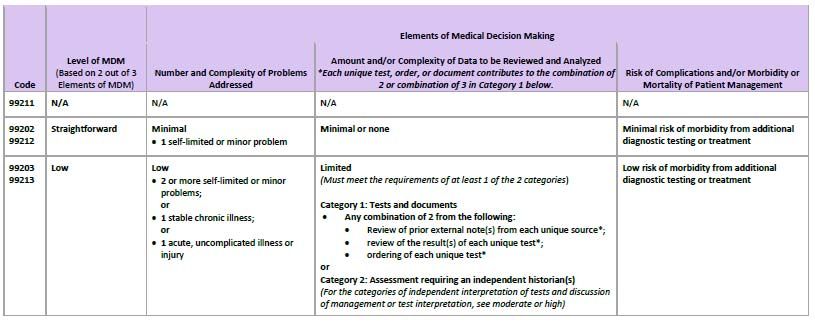
RS&F Healthcare Services
Coding, Medical Record Patient Satisfaction Surveys
Audits, and Compliance and Customer Service
Plans Training
Third Party Provider Outsourced Practice
Credentialing and Contract Management
Negotiations
Fee Schedule and RVU Practice Start-Up, including
Analysis, including Cost and Planning and Promotion
Collection Metrics Hospital Physician Enterprise
ACO and NCQA PCMH Optimization
Recognition and Support CLIA/OSHA/HIPAA
Community Health Compliance Review, Training,
Center/FQHC Operational and Implementation
and Billing Support 2
Health Care Division
History of E/M Coding Guidelines

 Two Set of Guidelines from 1995 and 1997:
  • History level based on meeting 3/3 sub‐component
    levels.
  • Exam level based on 1995 OR 1997 criteria.
  • Medical decision‐making level based on 2/3
    subcomponents.
  • New patient code levels based on 3/3 major
    components.
  • Established patient levels based on 2/3 major
    components.
  • Only direct face‐to‐face time was factored into time‐
    based service.

                       Health Care Division
                                                            3
History of E/M Coding Guidelines

2020 CHANGES TO DOCUMENTATION REQUIREMENTS:

 • Focus on what has changed or pertinent factors that have
   not changed since the last encounter.
 • Acknowledge, rather than re‐document that a patient’s
   HPI or CC has been reviewed and verified.
 • Acknowledge and verify, rather than re‐document
   notations made by other members of the medical
   team.

                       Health Care Division
                                                              4
Benefits of New 2021
E/M Documentation Changes
• Decreased administrative burden of documentation and coding.
• Decrease unnecessary documentation that may not be pertinent
to patient care.
• Addition and expansion of key definitions and guidelines would
reduce the need for audits.
• Payment is resource‐based with no direct goal for payment
redistribution among specialties.
Health Care Division
52021 E/M Coding Changes
UPCOMING MAJOR CHANGES:
• Eliminating the History and Physical exam components
as a requirement for determining the level of service.
• Basing the level of E/M service on Medical Decision
Making (MDM) only OR Time only, regardless of 50%
counseling.
• Revising the definition and duration of times associated
with each level of Medical Decision Making
Health Care Division
62021 E/M Coding Changes
WHAT DOES NOT CHANGE – MEDICAL NECESSITY STANDARDS
• Medical Necessity is the overarching criteria to
meet the level of E/M service.
• Medical Necessity dictates that a “condition
appropriate” History and Exam must be
documented.
• Notes that are copied and pasted (cloned) without
updates do not meet Medical Necessity standards.
Health Care Division
7Effective January 1, 2021
• Only the New and Established Office/Outpatient E/M
codes are subject to the new guidelines.
• History and physical exam are removed as a key
component.
• Code selection should be based on MDM or Time.
• Time will be based on the total time personally spent
on the date of the encounter either by the physician
or other qualified healthcare professional.
Health Care Division
8Effective January 1, 2021
• Elimination of CPT code 99201 because the level of
medical decision making is the same as 99202.
• Code descriptions contain a “medically appropriate
history and/or exam” for each level of service.
• Code descriptions include the specified level of
medical decision making.
• Descriptions are revised to include specific time based
instruction.
Health Care Division
9Sample New E/M Code Descriptor
99204 Office or other outpatient visit – for the
evaluation and management of a new patient, which
requires a medically appropriate history and/or
examination and moderate level of medical decision
making.
When using time for code selection, 45‐59 minutes of
total time is spent on the date of the encounter.
Health Care Division
102021 E/M Office/Outpatient Codes
CODE MDM TIME
99201 Straightforward Deleted 1‐1‐
2021
99202 Straightforward 15‐29 minutes
99203 Low 30‐44 minutes
99204 Moderate 45‐59 minutes
99205 High 60‐74 minutes
Health Care Division
112021 E/M OFFICE/OUTPATIENT CODES
CODE MDM TIME
99211 Minimal Physician or QHP’s
presence not
required
99212 Straightforward 10‐19
minutes
99213 Low 20‐29
99214 Moderate 30‐39
99215 High 40‐54
Health Care Division
12Coding Based on Time
• Time preparing for the visit, (e.g., review of records,
tests, obtaining results).
• Time obtaining and/or reviewing separately obtained
history.
• Time performing a medically appropriate exam
and/or evaluation.
• Time counseling and educating the patient and/or
family/caregiver.
• Time ordering medications, tests or procedures.
Health Care Division
13Coding Based on Time
• Referring and communicating with other health care
professionals (when not separately reported)
• Documenting the clinical information in the patient’s
medical record.
• Independently interpreting results (not separately
reported) and communicating results to the patient
and/or family/caregiver.
• Care coordination (not separately reported).
Health Care Division
14Coding for Additional Time
• ✚ ● 99417 Prolonged office or other outpatient
evaluation and management service(s) (beyond the
minimum time of the primary procedure which has
been selected using total time), requiring total time
with or without direct patient contact beyond the
usual service, on the date of the primary service;
each 15 minutes (List separately in addition to codes
99205, 99215 for office or other outpatient E/M
services).
Health Care Division
15Total Duration of New Patient E/M Code(s)
Less than 75 minutes Not reported separately
75‐89 minutes 99205 and 99417 X 1
90‐104 minutes 99205 and 99417 X 2
105 or more 99205 mad 99417 X3 or more for each
additional 15 minutes
Total Duration of Established Patient Code(s)
E/M
Less than 55 minutes Not reported separately
55‐69 minutes 99215 and 99417 X 1
70‐84 minutes 99215 and 99417 X 2
85 minutes or more 99215 and 99417 X 3 or more for each
additional 15 minutes
Health Care Division
16Coding Based on Medical Decision
Making (MDM)
• The level of service is based ONLY on the level
of MDM.
• The final level of MDM remains based on
meeting or exceeding the level in 2 out of 3
elements of MDM.
• Use the current level descriptors of
straightforward, low, moderate and high
complexity.
Health Care Division
17Coding Based on MDM
The 3 elements of MDM have been re‐defined.
EXPIRES 12‐31‐2020
Number of diagnoses Amount and/or Risk associated with
or management complexity of data to presenting problem,
options be reviewed diagnostic test
ordered or
management option
EFFECTIVE 1‐1‐2021
Number and Amount and/or Risk of complications
complexity of complexity of data to and/or morbidity or
problems addressed be reviewed and mortality of patient
analyzed management.
Health Care Division
18Definitions- Number & Complexity
Problem: A disease, condition, illness, injury, symptom, sign,
finding complaint or other matter addressed at the encounter,
with or without a diagnosis being established at the time of the
encounter.
Problem addressed: When it is evaluated or treated at the
encounter. This includes consideration of further testing or
treatment that may not be elected by virtue of risk/benefit
analysis or patient/surrogate choice. The mere presence of a
condition listed in the patient’s record or managed by another
provider does not qualify as being addressed.
Health Care Division
19Definitions- Number & Complexity
Minimal problem: One that does not require MDM or the
presence of a physician or QHCP. (99211)
Self‐limited or minor problem: One that runs a definite and
prescribed course, is transient in nature and is not likely to
permanently alter the patient’s health status.
Acute, uncomplicated illness or injury: Low risk of morbidity
for which treatment is considered. Little to no risk of mortality
with treatment, and full recovery without functional impairment
is expected. A minor problem that is not resolving.
Health Care Division
20Definitions- Number & Complexity
Stable, chronic illness: A problem with an expected duration of
at least a year or until the death of the patient. The patient is at
their treatment goal.
Chronic illness with exacerbation, progression, or side effects
of treatment: Acutely worsening, poorly controlled or
progressing and requiring additional supportive care, but that
does not require consideration of hospital level of care.
Undiagnosed new problem with uncertain prognosis: A
problem in the differential diagnosis that represents a
condition that is likely to result in a high risk of morbidity
without treatment.
Health Care Division
21Definitions- Number & Complexity
Acute illness with systemic symptoms: One that causes systemic
symptoms and has a high risk of morbidity without treatment.
Acute, complicated injury: Requiring treatment that includes
evaluation of body systems that are not directly part of the
injured organ, the injury is extensive or the treatment options
are multiple and/or associated with risk of morbidity
Chronic illness with severe exacerbation, progression, or side
effects of treatment: The severe exacerbation or
progression of a chronic illness or severe side effects of
treatment that have significant risk of morbidity and
may require hospital level of care.
Health Care Division
22REVISED MDM DEFINITIONS
CODE Level of Number and Complexity of Problems
MDM Addressed
99211 N/A N/A
99202 Straight‐ Minimal
99212 forward • 1 self‐limited or minor problem
99203 Low Low
99213 • 2 or more self‐limited or minor problems; or
• 1 stable chronic illness; or
• 1 acute, uncomplicated illness or injury
Health Care Division
23REVISED MDM DEFINITIONS
CODE Level of Number and Complexity of Problems
MDM Addressed
99214 Moderate Moderate
99204 • 1 or more chronic illnesses with
exacerbation, progression, or side effects of
treatment; OR
• 2 or more stable chronic illnesses; OR
• 1 undiagnosed new problem with uncertain
prognosis; OR
• 1 acute illness with systemic symptoms; OR
• 1 acute complicated injury
Health Care Division
24REVISED MDM DEFINITIONS
CODE Level of Number and Complexity of Problems
MDM Addressed
99215 High High
99205 • 1 or more chronic illnesses with severe
exacerbation, progression or side effects of
treatment
OR
• 1 acute or chronic illness or injury that
poses a threat to life or bodily function.
Health Care Division
25THREE CATEGORIES OF DATA
• Category 1 – Tests and documents (each unique
test or document is counted to contribute to the
level)
• Category 2 – Assessment requiring an
independent historian(s)(each independent
historian is counted to contribute to the level) OR
Independent interpretation of tests not
separately reported
• Category 3 – Discussion of management or test
interpretation(s) with external physician or other
QHP or appropriate source.
Health Care Division
26Data Definitions
Tests: Tests are imaging, laboratory, psychometric, or physiologic
data. A clinical laboratory panel (e.g., basic metabolic panel
[80047]) is a single test. The differentiation between single or
multiple unique tests is defined within the CPT code set.
External: Records, communications and/or test results that are
from an external physician, other qualified health care
professional, facility or healthcare organization.
External physician or other qualified healthcare professional: An
external physician or other qualified health care professional is an
individual who is not in the same group practice or is a different
specialty or subspecialty
Health Care Division
27Data Definitions
Independent historian(s): An individual or individuals who
provide a history in addition to that provided by the patient who
is unable to provide a complete or reliable history or because a
confirmatory history is judged to be necessary.
Independent interpretation: The interpretation of a test for which
there is a CPT code and an interpretation or report is customary. A
form of interpretation should be documented, but need not
conform to the usual standards of a complete report for the test.
Discussion of management: A source that includes professionals
who are not health care professionals but may be involved in the
management of the patient (e.g., lawyer, parole officer, case
manager, teacher).
Health Care Division
28REVISED MDM DEFINITIONS
CODE Level of Amount and/or Complexity of Data to be
MDM Reviewed and Analyzed * Each unique test,
order or document is counted in Category 1
99211 NA NA
99202 Straight‐ Minimal or none
99212 forward
99203 Low Limited – Meet the requirement of 1 out of 2 categories
99213 • Category 1 – at least 2 of the following:
• Review of prior external note(s) per source*
• Review of the result(s) of each test*
• Ordering of each unique test*
• Category 2
• Assessment requiring an independent historian(s)
Health Care Division
29REVISED MDM DEFINITIONS
CODE Level of Amount and/or Complexity of Data to be
MDM Reviewed and Analyzed * Each unique test,
order or document is counted in Category 1
99204 Moderate Must meet the requirement of at least 1out of 3 categories.
99214 Category 1 – Any combination of 3 from the following:
• Review of prior external note(s) per source*
• Review of the result(s) of each test*
• Ordering of each unique test*
• Assessment requiring an independent historian(s)
• Category 2‐ Independent interpretation of a test
performed by another Provider
• Category 3 – Discussion of management of test
interpretation with external Provider or appropriate
source.
Health Care Division
30REVISED MDM DEFINITIONS
CODE Level Amount and/or Complexity of Data to be
of Reviewed and Analyzed * Each unique test, order
MDM or document is counted in Category 1
99205 High Must meet the requirements of at least 2 out of 3 categories.
99215 Category 1 – Any combination of 3 from the following:
• Review of prior external note(s) per source*
• Review of the result(s) of each test*
• Ordering of each unique test*
• Assessment requiring an independent historian(s)
• Category 2‐ Independent interpretation of a test performed
by another Provider
• Category 3 – Discussion of management of test
interpretation with external Provider or appropriate
source.
Health Care Division
31Risk of Complications and/or Morbidity or
Mortality of Patient Management
Risk: For the purposes of MDM, the level of risk is based upon
consequences of the problem(s) addressed at the encounter
when appropriately treated. Risk also includes medical decision
making related to the need to initiate or forego further
testing, treatment and/or hospitalization.
Morbidity: A state of illness or functional impairment that is
expected to be of substantial duration during which function is
limited, quality of life is impaired, or there is organ damage that
may not be transient despite treatment.
Health Care Division
32Risk Definitions
Risk of Complications and/or Morbidity or
Mortality of Patient Management
Social determinants of health (SDOH): Economic and social
conditions that influence the health of people and communities.
Examples may include food or housing insecurity that would add
moderate risk to the patient’s management.
Drug therapy requiring intensive monitoring for toxicity: A drug
that requires intensive monitoring is a therapeutic agent that has
the potential to cause serious morbidity or death (high risk). The
monitoring is performed for assessment of these adverse effects
and not primarily for assessment of therapeutic efficacy.
Health Care Division
33REVISED MDM DEFINITIONS
CODE Level of Risk of Complications and/or Morbidity or
MDM Mortality of Patient Management
99211 NA NA
99202 Straight‐ Minimal risk of morbidity from additional diagnostic testing or
99212 forward treatment.
99203 Low Low risk of morbidity from additional diagnostic testing or
99213 treatment.
Examples only:
• Over the counter drugs
• Superficial biopsies
• Minor surgery with no identified patient or procedure risk
factors
• Physical therapy
• PFT’s or imaging studies with contrast (non‐cardiovascular)
Health Care Division
34Revised MDM Definitions
CODE Level of Risk of Complications and/or Morbidity or
MDM Mortality of Patient Management
99204 Moderate Moderate risk of morbidity from additional diagnostic
99214 testing or treatment.
Examples only:
• Prescription drug management
• Decision regarding minor surgery with identified patient
or procedure risk factors
• Decision regarding elective major surgery without
identified patient or procedure risk factors
• Diagnosis or treatment significantly limited by social
determinants of health
• Physiologic tests under stress
• Cardiovascular imaging studies with contrast and no risk
factors
Health Care Division
35Revised MDM Definitions
CODE Level of Risk of Complications and/or Morbidity or
MDM Mortality of Patient Management
99205 High High risk of morbidity from additional diagnostic testing or
99215 treatment.
Examples only:
• Drug therapy requiring intensive monitoring for toxicity
• Decision regarding elective major surgery with identified
patient or procedure risk factors
• Decision regarding emergency major surgery
• Decision regarding hospitalization
• Decision not to resuscitate or to deescalate care because
of poor prognosis
• Cardiac electrophysiological tests
• Diagnostic endoscopies with identified risk factors
Health Care Division
36Medical Decision Making Grid
Health Care Division
37Medical Decision Making Grid
Health Care Division
38Coding Scenarios
99202 or 99212: A 69 year old male with HTN and type 2
diabetes presents with sudden worsening of hearing in the left
ear over a period of several days. He is found to have cerumen
occluding the entire external auditory canal, which is amenable to
removal by irrigation. The physician performs the procedure in
the office. The HTN and diabetes are not addressed at this visit
and are not factored into the MDM. The performance of the
procedure is not factored into the MDM.
One acute uncomplicated illness = low
Amount and complexity of data = minimal
Risk of complications/morbidity = minimal
Health Care Division
39Coding Scenarios
99203/99213: A 28 year old male presented urgently with a
power‐saw wound to his left palm. The patient was conscious but
nauseated and was accompanied by his girlfriend. A targeted
history was obtained . The physician evaluated him and ordered
and interpreted a hand X ray reported separately to verify the
apparent superficial depth of the injury. The physician advised
that the wound would require layered closure with sutures.
One acute uncomplicated injury = low
Amount and complexity of data = straightforward
Risk of complication/morbidity = low
Health Care Division
40Coding Scenarios
99204 or 99214: Patient presents with history of HTN, DM Type 2
and hypercholesteremia for transfer of care or follow‐up.
Provider reviews patient’s recordings of BP and home glucose
monitoring which are under good control. Discussion of diet and
exercise reveal poor choices. Orders CMP (80053), A1c (83036),
Lipid panel (80061) and ECG (93000) performed in‐house.
Assessment is stable HTN, DM2 and hypocholesteremia and all
prescriptions are renewed.
Amount and complexity of problems = moderate
Amount and complexity of data = moderate
Risk of complications/morbidity = moderate
Health Care Division
41Coding Scenarios
99204 or 99214: A 5 year old female presents with upper
respiratory symptoms and sore throat with pain when swallowing.
Per mom there has been no associated fever or nausea. Provider
examines HEENT and chest. Provider orders a quick strep and
throat culture. Strep comes back positive and a course of
antibiotics is administered.
One acute uncomplicated illness = low
Amount and complexity of data = moderate (>3 T, D, Ihx)
Risk of complications/morbidity = Moderate
Health Care Division
42Coding Scenarios
99204 or 99214: A 12 year old male with ADHD present for follow
up of mild symptoms and minimal medication side effects. The
patient is accompanied by his mother and history is obtained
form both. They report that grades are good but appetite is poor
and per mom teachers report that he is distracted during class.
Physician reviews previous progress notes and plant to renew the
stimulant prescription with increased dosage.
Amount and complexity of problems = moderate
Amount and complexity of data = low
Risk of complications/morbidity = moderate
Health Care Division
43Coding Scenarios
99204 or 99214: A 48 year old female with a long history of
anxiety and depression for follow up and medication adjustment.
She complains that she has missed work, is unable to sleep and is
emotional with crying episodes most days. She worries about the
pandemic situation and has began washing her hands 15 times a
day. She denies suicide ideations and feelings of rage. Physician
reviews previous progress notes and maintains her current Paxil
dosage and adds Cymbalta.
Amount and complexity of problems = moderate
Amount and complexity of data = minimal
Risk of complications/morbidity = moderate
Health Care Division
44Coding Scenarios
99205 or 99215: Elderly patient with history of cardiovascular
disease presents with shortness of breath and chest pain,
accompanied by daughter who is the primary caregiver.
Daughter describes compliance with current medications and
progression of symptoms. Treatment plan includes chest x‐ray to
rule out pneumonia, CBC and ECG. Chest x‐ray indicates
pneumothorax and ECG shows arrhythmia. Hospitalization
discussed for management with IV diuretics and cardiac
observation.
Amount and complexity of problems = high
Amount and complexity of data = high
Risk of complications/morbidity = high
Health Care Division
45Separately Reportable Services
• Services reported separately are not to be counted in the
time spent on the encounter or as an independent
interpretation contributing to the level of MDM.
• Modifier 25 should be appended to the E/M service to
unbundle it from minor procedures performed on the
same date as the E/M.
• When separately reported services are performed on the
same date as a time based E/M service, time should be
documented as exclusive of other reported services.
Health Care Division
46Separately Reportable Services
• Modifier 25 should be appended to the E/M service when
reporting the office E/M visit on the same date as a
preventive visit (routine physicals).
• TIP: Use MDM to determine the level of the E/M that may
be reported on the same date as a preventive service to
eliminate differentiating time spent on simultaneously
performed portions of the visit (obtaining history and
performing an exam)
• Associate orders and plan of care with specific diagnoses
or problems evaluated or identified during the routine
exam.
Health Care Division
47Work RVU Changes
CODE 2020 2021 % Increase
99201 0.48 NA NA
99202 0.93 0.93 0%
99203 1.42 1.6 13%
99204 2.43 2.6 7%
99205 3.17 3.5 10%
99211 0.18 0.18 0%
99212 0.48 0.70 46%
99213 0.97 1.30 34%
99214 1.50 1.92 28%
99215 2.11 2.80 33%
Health Care Division
48How to Prepare for the Changes
• Educate your providers and staff.
• Review your templates to eliminate unnecessary
documentation of History and Exam.
• Revise your time‐keeping procedures to incorporate the
new time frames and to account for non face to face time.
• Talk to your EMR vendors to update the MDM calculators.
• Contact your payers to verify their readiness to accept the
new guidelines.
• Calculate the financial impact on your organization.
Health Care Division
49Resources
• AMA Education Hub https://edhub.ama‐assn.org/cpt‐
education/interactive/18057429
• AAPC https://www.aapc.com/evaluation‐
management/em‐codes‐changes‐2021.aspx
• CMS Final Rule‐Physician Fee schedule
https://www.cms.gov/Medicare/Medicare‐Fee‐for‐
Service‐Payment/PhysicianFeeSched
• Novitas Reference‐ https://www.novitas‐
solutions.com/webcenter/portal/MedicareJL/pagebyid?co
ntentId=00238707
Health Care Division
50Questions?
Health Care Division
51PRESENTERS
Marie Pelino, CPC Denise Walsh, CPC, CHSP
mpelino@rsandf.com dwalsh@rsandf.com
(410) 581‐0800 (410) 581‐0800
Northern Virginia Health Foundation
https://novahealthfdn.org/
Health Care Division
52Medical Decision Making for Outpatient E/M Codes
(effective January 2021)
Risk of complications and/
Amount and/or complexity of data to review and analyze or morbidity or mortality of
MDM (Combination of two or combination of three in Category 1) patient management
Time (Two out of Number and complexity (diagnostic testing
E/M code (minutes) three elements) of problems addressed CATEGORY 1 CATEGORY 2 CATEGORY 3 or treatment)
Level 1
99211 0 N/A N/A N/A N/A
Level 2 Minimal Minimal or none Minimal risk
99202 15-29 Straightforward • 1 self-limited or minor problem Minimal or no complexity and/or data reviewed • Rest
• Gargles
99212 10-19 • Bandages
• Superficial dressings
Limited
Level 3 Low (Must meet the requirements of at least 1 of the 2 categories) Low risk
99203 30-44 Low • 2 or more self-limited Category 1: Tests and Category 2: Assessment N/A • OTC drugs
or minor problems documents requiring an independent • Minor surgery
99213 20-29 historian(s) without risk factors
or At least 2 from the following:
• PT/OT
• 1 stable chronic illness • Review of prior external • IV fluids without
or note(s) from each unique additives
source
• 1 acute, uncomplicated illness
or injury • Review of the result(s) of
each unique test
• Ordering of each unique
test
Moderate
Level 4 Moderate (Must meet the requirements of at least 1 out of 3 categories) Moderate risk
99204 45-59 Moderate • 1 or more chronic illnesses with Category 1: Tests, Category 2: Independent Category 3: Discussion of • Prescription drug
exacerbation, progression or side documents, or interpretation of tests management or test management
99214 30-39 effects of treatment independent historian(s) interpretation
• Independent interpretation • Decision regarding minor
or At least 3 from the following: of a test performed by • Discussion of management or surgery with identified risk
• 2 or more stable chronic illnesses • Review of prior external another physician/other test interpretation with external factors
note(s) from each source qualified healthcare physician/other qualified • Decision regarding elective
or professional healthcare professional/
• Review of the result(s) of major surgery without risk
• 1 undiagnosed new problem with appropriate source factors
uncertain prognosis each unique test
• Ordering of each unique • Diagnosis or treatment
or significantly limited by social
test
• 1 acute illness with systemic determinants of health
symptoms • Assessment requiring an (SDoH) [e.g., socioeconomic
independent historian(s) status, geographic location,
or
education, employment,
• 1 acute complicated injury transportation access)
Find more coding and documentation content to boost your
organization’s revenue cycle on the MGMA Resources page
MEMBER-BENEFIT TOOLS | PODCASTS | WEBINARS | DATA REPORTS | ARTICLES | ASK AN ADVISORMedical Decision Making for Outpatient E/M Codes
(effective January 2021)
Extensive
Level 5 High (Must meet the requirements of at least 2 out of 3 categories) High risk
99205 60-74 High • 1 or more chronic illnesses Category 1: Tests, Category 2: Independent Category 3: Discussion of • Drug therapy requiring
with severe exacerbation, documents, or interpretation of tests management or test intensive monitoring for
99215 40-54 progression, or side effects of independent historian(s) interpretation toxicity
• Independent interpretation
treatment At least 3 from the following: of a test performed by • Discussion of management or • Decision regarding elective
or another physician/other test interpretation with external major surgery with identified
• Review of prior external qualified healthcare physician/other qualified patient or procedure risk
• 1 acute or chronic illness or note(s) from each source
injury that poses a threat to life professional healthcare professional/ factors
or bodily function • Review of the result(s) of appropriate source • Decision regarding
each test emergency major surgery
• Ordering of each test • Decision regarding
• Assessment requiring an hospitalization
independent historian(s) • Decision not to resuscitate
or to de-escalate care
because of poor prognosis
Time-based coding elements* (when performed and documented)
• Reviewing patient’s record prior to visit • Obtaining/reviewing separately obtained history from someone other than patient
• Performing a medically appropriate history and examination • Counseling/educating the patient/family/caregiver
• Ordering prescription medications, tests, or procedures • Referring and communicating with another healthcare provider(s) when not separately reported during the visit
• Independently interpreting results • Documenting clinical information in the patient’s electronic health record
• Communicating results to the patient/family/caregiver • Coordination of care for the patient
* Time-based coding is based on total time spent on the date of the encounter.
Important notes:
• E/M code 99201 is deleted in 2021 due to low utilization.
• Documentation of history and exam will not be counted as an element, but medical necessity must be established by documenting risk and MDM relevant to management of patient’s condition.
• Interpretation of tests or discussion of management with another qualified healthcare professional is considered only when not separately reported.
For more information on these changes, consult the American Medical Association’s E/M office revisions for level of MDM (effective Jan. 1, 2021).
GET EXPERT ANSWERS FOR ALL YOUR QUESTIONS VIA MGMA
MGMA Consulting is the best line of defense against all your MGMA Chart Auditing and Coding Education Services puts our
challenges, if only for the simple fact that they have more than team of coders to work, creating personalized experiences that
30 years’ experience in healthcare and access to industry-leading teach and lead your team through practices of establishing
information and resources. Because they have the elements accurate coding. Our team works in conjunction with your
needed already at their hands, you can benefit from bringing them providers, medical coders, administrators and revenue cycle staff
in to support your organization and community. Learn more to ensure coding on all levels is compliant. Learn moreYou can also read


