Priorities for the 2019 Federal Election - Making Health Better - April 2019 - Consumers Health Forum of ...
←
→
Page content transcription
If your browser does not render page correctly, please read the page content below
Priorities for the 2019
      Federal Election
       Making Health Better

                  April 2019
Consumers Health Forum of Australia 2019
Priorities for the 2019 Federal Election
Canberra, Australia
P: 02 6273 5444
E: info@chf.org.au
twitter.com/CHFofAustralia
facebook.com/CHFofAustralia
Office Address
7B/17 Napier Close
Deakin ACT 2600
Postal Address
PO Box 73
Deakin West ACT 2600
Consumers Health Forum of Australia is funded by
the Australian Government as the peak healthcare
consumer organisation under the Health Peak and
Advisory Bodies Programme
ii Consumers Health Forum of Australia Priorities for the 2019 Federal ElectionCONTENTS
The Consumers Health Forum of Australia 1
Case for Change 2
Patient Leadership 4
Primary and Integrated Care Reform 5
Prevention in place 7
Patient activation, self-management 8
and health literacy
Social Determinants of Health 10
Prioritising Aboriginal and Torres Strait 12
Islander Health
Oral and Dental Health 13
Support for Early Childhood, Youth and Family 15
iii Consumers Health Forum of Australia Priorities for the 2019 Federal ElectionThe Consumers Health
Forum of Australia
The Consumers Health Forum of Australia (CHF) is the national peak body for healthcare consumers and those
with an interest in health consumer affairs. CHF advocates for a health system that is designed to benefit
consumers and the health of the community, informed by the needs and preferences of consumers.
CHF has a diverse membership of health consumer organisations and individuals that represent the interests of
consumers with diseases and conditions. Many CHF members have developed election platforms, and these will
be available on their respective websites. CHF is also supported by research institutes, professional associations,
Primary Health Networks (PHNs) and local hospital networks (LHNs) through associate membership.
Vision
A world class health and social care system centred on consumers and communities.
Mission
To draw on consumer and community knowledge and experience to relentlessly drive innovation and
improvements to the Australian health and human service system.
We believe
… in a universal health system where equitable access is based on need
… in a health system where people have choice and control over their health and care
… a truly world class system should have a strong and influential national consumer voice as part of its framework
… that better health and care decisions, experiences of care and outcomes are achieved when consumers are
involved from beginning to end
… place-based care designed with consumers and communities will deliver better outcomes and experiences of
care and more locally responsive services
… that policy and healthcare decisions should be informed by a strong evidence base including consumer
experience
1 Consumers Health Forum of Australia Priorities for the 2019 Federal ElectionCase for Change
Many Australians need more support to get the best out of our health system. A consumer sentiment survey
conducted by CHF found that most Australians are largely satisfied with the health system. But many raised two
recurring issues: cost and uncertainty.
About twenty per cent of people skipped getting a prescription or getting a recommended test or follow-up, often
because of cost.
People want assurance that they can get the care they need at the right time. They want - and deserve - a guarantee
from our political leaders that there is a plan for the future of our health system. A visible, long-range plan is needed
to keep healthcare affordable and capable of delivering the kind of 21st century health care we should all expect.
Even when services are available, between a quarter and a third of consumers had difficulties navigating the system
from understanding the details of care and finding the right healthcare option. Their experience is one of frustration
at our fragmented system. We need to get better at coordinating care.
Worse still, health care is lagging other sectors failing to embrace the benefits offered by digitisation. We have 20th
century thinking but 21st century expectations.
It is time for the health and social care system to innovate and improve at pace and do so with consumer and
community insights deep at the heart of driving change.
In our Election Priorities, CHF focuses on critical areas for action that will move Australia towards a modern and
sustainable health system that provides consumer choice and empowerment, supported by innovation, emerging
evidence, and best practice.
To achieve this and move towards a consumer-focused and sustainable health system, CHF calls for our political
leaders to act in the following ways:
Future proofing a healthy Australia
Develop a National Prevention Strategy and boost spending on prevention to at least five per cent of the
health budget.
Leading and reshaping
Lead a ten-year, forward-looking National Vision for Australia’s Health 2030 including funding and other strategies
to reduce federal/state divisions. These plague the coordinated delivery of care in so many areas such as mental
health, disability and aged care services and generate disconnected care, public waiting times and out of pocket
costs. Initiate a National Wellbeing Dashboard so, as a nation, we can track our current and future wellbeing.
Integrating
Join up care through Medicare coverage to stimulate team-based care that incorporates the full range of our
available workforce in care teams including nurse practitioners, health coaches and dental hygienists.
2 Consumers Health Forum of Australia Priorities for the 2019 Federal ElectionPeople-centred, place-based
Make the most of our PHN regional infrastructure by giving them authority and mandate to serve as stewards of
integrated primary health and human services, to work with hospitals to innovate towards hospitals of the future and
to commission services at scale. Fund a few vanguards through PHNs to accelerate approaches to co-commissioning
health and human services.
Broadening
Modernise Medicare’s scope on where and how care is delivered by de-regulating the need for face-to-face
consultations and prescribing, enabling hospital in the home, telehealth, email/telephone follow-up and other
community outreach modes of care.
Encouraging
Adopt policies that take a whole-of-person approach that bridges mental, physical and social needs and translates
those principles into programs and services.
Consumer-focused
Fund initiatives designed to activate the consumer’s part in care through shared decision-making practice and self-
management programs; ensure everyone has the health literacy they need to optimise health and wellbeing; and invest
patient leadership skills so they can fulfill productive roles in the design and governance of health policies and services.
Embrace
Harness technology and all it can deliver to improve health care access and consumer experience.
Priorities
Take early action on obesity, dental health and primary care reform in the first 100 days of office.
3 Consumers Health Forum of Australia Priorities for the 2019 Federal ElectionPatient Leadership
What we want Why it is important
A patient-centred approach to the design, delivery and Digitisation, changing consumer expectations, and the
evaluation of healthcare services will improve patient advent of genomics and precision and personalised
outcomes, the quality of care and reduce costs. To succeed medicines is accelerating innovation in health care delivery.
where previous health reforms have faltered, consumers We are moving into a future where consumers have the
must have a seat at the table and have their expertise as power to control and choose the services that they pay
system users and agents of change recognised. Consumer for and have access to rapidly moving information and
input cannot end with raising problems, they have most innovations to manage their health. Policy makers, health
impact when they are co-leaders in designing, implementing administrations and clinicians will need to change the current
and evaluating meaningful reforms. We need to invest in and decision-making processes to realise the many and varied
accelerate the extent to which our system is moving towards ways that consumers can contribute to shaping health care.
best practice and maturity in patient-centred design.
In a White Paper last year, CHF outlined eight key functions
This requires culture change, a paradigm shift away from
fulfilled by consumers and consumer advocates as leaders at
a provider orientation, and initiatives that promote
all levels. A Patient Leadership Academy that provides formal
innovation and consumer leadership in health care.
support and training to people stepping into leadership roles
will mean greater recognition for the skills and knowledge
Key commitments they bring generally but, importantly, to optimise their
roles as partners in their own health and as advocates who
• Fund and establish an Australian Patient Leadership have an impact on policy, planning, delivery, evaluation
Academy that delivers training to develop and grow and monitoring.
a skilled, prepared, energised and motivated group of
existing and emergent patient leaders. Consumers are already involved as advocates and
representatives across government committees, working
• Fund the scale-up of CHF’s Collaborative Pairs Australia,
parties, expert panels and policy roundtables. They are
a model of joint consumer and clinical leadership
often the only consumer representative among many
development currently being implemented on a
clinicians and other industry members, which does not
demonstration basis.
adequately reflect Australia’s diverse population and must
• Investing in the future role of consumers by supporting be addressed with more balanced ratios. For patient leaders
the other leadership development initiatives outlined
to be more effective in their roles, their expertise needs to
in CHF’s Shifting Gears White Paper at all levels of the
be valued and remunerated in the same manner as clinical or
health system.
research expertise. Leadership needs to be reinforced with
• Introduce indexation funding for the Health Peak and investments in organised networks, communities of interest
Advisory Bodies Programme and social media-enabled platforms that garner consumer
• Invest in an independent national voice for mental sentiments and insights to inform decisions.
health consumers and carers to complement the work
of consumer organisations like the National Mental
Health Consumer and Carer Forum. Want to know more?
• Fund CHF to support and develop young leaders Consumers Health Forum, 2018, Shifting Gears: Consumers
through the Youth Health Forum focusing on advocacy, transforming health, https://chf.org.au/sites/default/
youth representation, mentorship, health literacy and files/181125_shifting_gears_-_consumers_transforming_
awareness of best practice engaging with young people health.pdf.
in all health settings and to further develop Australia’s NHS Leadership Academy, 2019 Patient Leadership,
Health Panel to add to the rich consumer insights CHF https://www.londonleadershipacademy.nhs.uk/
already provides.
what-we-do/patient-leadership.
Collaborative Pairs Australia
https://chf.org.au/collaborative-pairs
4 Consumers Health Forum of Australia Priorities for the 2019 Federal ElectionPrimary and Integrated
Care Reform
DIGITAL
eHEALTH HEALTH
APPS
HEALTH
RECORDS DATA
Primary
care SPECIALISTS
provider SURGEONS
DOCTORS
NURSES
CARE CARE
What we want and improvement science. The centre should be a private-
public partnership involving clinical, consumer, academic
Healthcare is more than hospitals. We need an open and and industry leaders and philanthropic funding.
connected health system that focuses on accessible, high-
• Broaden the funding framework for primary health care
value care in primary health care settings where health
settings to include blended and bundled payments to
care providers are empowered and resourced to adapt to encourage health care teams, integrated services and
meet increasing demand and to introduce services that telehealth.
keep people out of hospitals with new options for care in
• Continue and increase funding for patient and family-
the community.
centred health care home models that incorporate the
learnings from the Health Care Homes Trial.
Key commitments • Integrate shared-decision making, social prescribing,
supported self-management and a service coordinator
• Invest in the establishment of a government-led National
workforce (link workers) as a central feature of primary
Centre for Health Care Innovation and Improvement.
health care delivery to build knowledge, skills and
The centre would have access to a Future Health Fund
confidence in people with long-term physical and
to support system stewardship by testing and scaling up
mental health conditions and assist them to live well
new models of care and payment systems that work for
patients, build capacity in the commissioning work of • Remove restrictions about where and how hospital
PHNs and their co-operation with LHNs, and spearhead patients can be treated to relieve growing pressures on
national efforts to support the development of clinical emergency departments.
and consumer skills in leadership, change management
5 Consumers Health Forum of Australia Priorities for the 2019 Federal Election• Remove professional service delivery funding from the Finally, we would emphasise that system reform does not
Community Pharmacy Agreement to open opportunity stop with implementation. Consultation and evaluation
for these services to occur in general practice and are an important part of ensuring changes will adapt over
hospital settings as well as community pharmacy. the long-term. For example, the review of the MBS should
• Develop a primary health care data set for better be ongoing to ensure that services funded by the health
service planning and improvement system meet current clinical and patient standards of high
value care.
• Recognise PHNs as the key regional infrastructure
though which we can achieve integrated health,
community and other services through regionalised
Want to know more?
commissioning and invest in their capability
developments to fulfill this role. The George Institute for Global Health, The Consumers
Health Forum, and the University of Queensland,
• Continued funding for a sustainable MyHealthRecord
2017, Snakes and Ladders: The journey to primary care
system that aligns with community privacy and ethics
integration, https://chf.org.au/sites/default/files/sal_phci_
standards.
report_j130918.pdf.
The George Institute for Global Health and the Consumers
Why it is important Health Forum, 2016, Putting the Consumer First: Creating
With growing rates of chronic illness in Australia and many a consumer-centred health system for a 21st century
of us now living with one or more chronic conditions, it Australia, https://chf.org.au/sites/default/files/putting-the-
is more important than ever that consumers have access consumer-first-apr16.pdf.
to affordable early diagnosis and treatment. The recent
The Primary Health Care Advisory Group (PHCAG), 2015,
Report on Government Services showed that we are
Better outcomes for people with chronic and complex
failing to deliver basic care that is accessible with almost
health conditions, https://www.health.gov.au/internet/
twenty per cent of people feeling like they waited too long
main/publishing.nsf/Content/76B2BDC12AE54540CA2
to see a GP and a slight rise in emergency department
57F72001102B9/$File/Primary-Health-Care-Advisory-
presentations for non-urgent care.
Group_Final-Report.pdf.
We also know that high out of pocket costs and private
AHHA, 2017, Blueprint for a Post-2020 National Health
health insurance premiums are leading more people to rely
Agreement, https://ahha.asn.au/Blueprint.
on the public health system. Patients are accessing care
later through channels that are more affordable to them Medicare Benefits Schedule Review Taskforce, 2018,
personally such as emergency departments but often Report from the General Practice and Primary Care Clinical
less appropriate for their needs. This is an unsustainable Committee: Phase 2, http://www.health.gov.au/internet/
arrangement for hospitals struggling to meet demand and main/publishing.nsf/Content/mbs-review-2018-taskforce-
increasing their funding without addressing the underlying reports-cp/$File/General-Practice-and-Primary-Care-
issues will have disastrous long-term impacts on the health Clinical-Committee-Phase-2-Report.pdf
of Australians. Productivity Commission, 2017, Shifting the Dial: 5 year
CHF’s recommendations for primary care build on a productivity review, https://www.pc.gov.au/inquiries/
wealth of literature and research - there is no shortage completed/productivity-review/report.
of discussion or policy guidance around the systemic
issues and barriers preventing services and providers
from evolving. The commitments we ask for focus on
care delivery according to patient preferences and reflect
what we have heard through our own research and
consultations.
6 Consumers Health Forum of Australia Priorities for the 2019 Federal ElectionPrevention in place
What we want The Public Health Association of Australia recently reported
that the top ten public health successes over the last
An overarching national commitment to population health twenty years in Australia have been preventative. Many
and wellbeing across all government portfolios and delivered of the items on their list fall outside the mandate of the
in key settings such as workplaces, schools and primary care. Health portfolio, for example gun legislation, taxation and
plain packaging of tobacco products, and enforcing the
use of seat belts and bicycle helmets. The success of these
Key commitments campaigns shows what can be achieved for public health
• Develop a National Prevention Plan to 2030 that and means Australians generally believe that government
increases expenditure to five per cent of total health has a responsibility to help change individual behaviour
spending within this term of government. (Essential Research 2014).
• Commit to addressing obesity by implementing the eight
actions recommended in the Tipping the Scales report.
Want to know more?
• Increase investment in family and early childhood
programs to ensure healthy behaviours start early, Consumers Health Forum, 2018, Results of Australia’s
including strategies to tackle childhood obesity. Health Panel survey on recommendations and regulation
of smartphone apps for health and wellness, https://chf.
• Invest in data, training, tools and resources that help
org.au/sites/default/files/results_of_australias_health_
health providers to support patients becoming active
panel_survey_on_recommendations_and_regulation_of_
managers of their health. This should include the ability to
smartphone_apps_for_health_and_wellness.pdf
write ‘social prescriptions’ to encourage people to reach
out to support like health coaches or community groups. Essential Research (2014), The Essential Report – Health
• Ensure patient resources are supported by a framework Star Ratings, 16 December 2014.
and review process that aids in identifying high quality, The George Institute, Consumers Health Forum of Australia
evidence-based information and tools e.g. digital and the University of Queensland, 2018, Snakes and
applications. Ladders: The journey to primary care integration, https://
chf.org.au/sites/default/files/sal_phci_report_j130918.pdf.
Why it is important Global Obesity Centre and the Obesity Policy Coalition,
In addition to boosting our overall focus on the primary 2017, Tipping the Scales: Australian obesity prevention
health care system, a concerted effort to reach Australians consensus, http://www.opc.org.au/what-we-do/tipping-
with lifestyle risk factors with preventative measures, the-scales.
early interventions, and health education will be essential Public Health Association of Australia, 2018, Top 10 public
to address rising rates of preventable chronic diseases, health successes over the last 20 years, https://www.phaa.
obesity, and mental ill health. net.au/documents/item/3241.
We know that ignoring the early warning signs will mean a Australian Health Policy Collaboration, 2016, Getting
great burden for the health system in the future. However, Australia’s Health on Track, https://www.vu.edu.au/sites/
the broader implications of an unhealthy population will be default/files/getting-australias-health-on-track-ahpc-
felt on many fronts, beginning with ability to participate in nov2016_0.pdf
the community and economy.
7 Consumers Health Forum of Australia Priorities for the 2019 Federal ElectionPatient activation,
self-management and
health literacy
INCREASING LEVELS OF
ACTIVATION
3 4
1 DISENGAGED AND
2 BECOMING
TAKING ACTION
MAINTAINING
BEHAVIOURS
AND PUSHING
FURTHER
OVERWHELMED AWARE, BUT STILL Individuals have
STRUGGLING the key facts and Individuals have
Individuals are passive are building self- adopted new
and lack confidence. Individuals have some management skills. behaviours, but may
Knowledge is low, knowledge, but large they strive for best struggle in times of
goal orientation is gaps remain. they practice behaviours, stress or change.
weak, and adherence believe health is largely and are goal- Maintaining a healthy
is poor. out of their control, but orientated. lifestyle is a key focus.
Their perspective: can set simple goals. Their perspective: Their perspective:
“My doctor is in Their perspective: “I am part of my “I am my own
charge of my healt”. “I could be doing more”. health care team”. advocate”.
Source: Insignia Health 2018
What we want • Implement a Healthy Families, Healthy Communities
initiative to educate and support primary care providers
At the point of care delivery, we want to strive for better to engage effectively with parents to support healthy
health outcomes and consumer experience by supporting early childhood development and health literacy by
patients to be activated and equipped to be partners in providing them with resources, education, training and
care and to better self-manage. new referral options
• Build on the Health Care Homes Programme pilot
Key commitments by implementing patient and family-centred health
care home model of care general practice-wide
• Develop an Australian patient self-management
in keeping with the Primary Health Care Advisory
initiative to support people with chronic conditions to
Group (PHCAG) and MBS Review Taskforce’s General
actively manage their own health featuring key features
Practice and Primary Care Clinical Committee
of forerunners such as the UK’s Co Creating Health
(GPPCCC) recommendations. This would change the
programme and more recent Universal Personalised
way coordinated care is funded through blended and
Care Strategy. It should feature an expert patient
bundled payments supplementing fee-for-service
program, education and training for doctors and nurses
arrangements; include incentives that require the
and support to service settings like general practice
use of patient experience and activation measures;
• Implement a Prescriptions for Health Living program stimulate workforce innovation such as the accelerated
to equip people at risk of chronic disease with practical introduction of non-prescribing pharmacists in general
steps they can take to stay well and lower their risk, practice to assist with quality use of medicines and
and to provide primary care providers with skills, new enhanced health literacy in this area.
services and referral pathways to help motivate and
support patients
8 Consumers Health Forum of Australia Priorities for the 2019 Federal Election• Dedicate regional funding to ensure consumers are
Want to know more?
involved in commissioning, designing and providing
consumer training to local services and PHNs and Consumers Health Forum, 2018, Shifting Gears:
their regional partners have access to tools and Consumers transforming health, https://chf.org.au/
resources that promote mature practices in consumer sites/default/files/181125_shifting_gears_-_consumers_
participation and involvement in commissioning transforming_health.pdf.
• Invest in consumer reviews of health information CSIRO Futures, 2018, Future of Health: Shifting Australia’s
to ensure resources and program information is focus from illness treatment to health and wellbeing
consumer-friendly, comprehensive, and easy to find. management, https://www.csiro.au/en/Do-business/
Futures/Reports/Future-of-Health.
Why it is important Hibbard, L. and Gilburt, H. 2014, Supporting people to
manage their health: An introduction to patient activation,
Patients with long-term conditions spend less than one
https://www.kingsfund.org.uk/sites/default/files/field/
per cent of their time in contact with health professionals
field_publication_file/supporting-people-manage-health-
meaning that up to ninety-nine per cent of their care
patient-activation-may14.pdf.
is self-managed or managed with the support of a
carer. A recent UK Health Foundation report shows that Insignia Health, 2018, Patient Activation Measure (PAM)
patients most able to manage their health conditions survey levels, https://www.insigniahealth.com/products/
had thirty-eight per cent fewer emergency department pam-survey.
admissions, thirty-two per cent fewer emergency
UK Health Foundation, 2018, Self-management capability
department attendances and eighteen per cent fewer
in patients with long-term conditions is associated with
GP appointments than those who were less able. With
reduced healthcare utilisation across a whole health
the Australian hospital system under increasing pressure,
economy: cross-sectional analysis of electronic health
approaches that support productive consumer behaviour
records, https://qualitysafety.bmj.com/content/27/12/980.
should be prioritised in the same way that traditional
models of clinician-centred interventions have been in
the past. The government needs to recognise that people
who successfully manage their health are experts in their
own health and can be used to teach others.
Limited health literacy is associated with poor health
outcomes and with hospitalisations and greater use of
emergency care. Health literacy is identified as a health
priority for transforming health in many OECD countries.
Health systems of the future need to lift health literacy
rates, particularly among those at risk of poor health
outcomes as a major reform initiative. Health literacy is
the degree to which people have the capacity to obtain,
process and understand basic health information and
services needed to make appropriate health decisions.
The Australian Commission on Safety and Quality in
Healthcare estimates that only forty per cent of adults
have the level of individual health literacy needed to
meet the complex demands of everyday life, such as
understanding and following health advice and making
good health care choices.
With disruptors redefining industries like online banking,
ride sharing, and music streaming, it is essential for Australia
to develop a strategy and framework with consumers to
ensure that health innovation and information meets their
expectations for safe, high quality healthcare.
9 Consumers Health Forum of Australia Priorities for the 2019 Federal ElectionSocial Determinants
of Health
What
makes us GOOD
WORK
healthy? FAMILY
FRIENDS & OUR
SURROUNDINGS
COMMUNITY
MONEY &
TRANSPORT RESOURCES
THE
Food HOUSING
WE EAT
EDUCATION
& SKILLS
Source: The Health Foundation, 2017
What we want • Work with organisations whose members receive
support payments to ensure that policies and services
Various forms of social support have the potential to close are respectful and delivered in ways that achieve
or widen gaps experienced by vulnerable populations. the best level of participation in the community and
Australia needs to follow the example of other OECD economy.
countries who consider the impacts of all policies on the • Commit to meaningful and lasting improvements
long-term health and wellbeing of their population. in closing the gap between the general Australian
population and Aboriginal and Torres Strait Island
populations by leading action on the recommendations
Key commitments of the Uluru Statement of the Heart.
• Initiate a National Wellbeing Dashboard so, as a nation,
• Prioritise the needs of the most at-risk communities by
we can track our current and future wellbeing.
leading legislative changes to enshrine fair treatment in
• Guarantee affordable and sustainable access to health, the health and justice systems to empower individuals to
disability and aged care services to meet the growing seek help.
needs of an aging and chronically ill population. Commit
• Initiate a Productivity Commission review of the private
to a regular review process to ensure support payments
health insurance system.
are in line with the cost of living, starting with raising the
rate of NewStart payments by $75 per week.
10 Consumers Health Forum of Australia Priorities for the 2019 Federal ElectionWhy it is important
Eighty per cent of a person’s length and quality of life is
influenced by non-health factors like income, education,
and home environment, meaning clinical care only
factors for about twenty per cent. In their 2018 Report
on Australia’s Health, the Australian Institute of Health
and Welfare (AIHW) found that every step up the
socioeconomic ladder has an associated health benefit.
Accordingly, CHF supports calls from organisations such
as the Australian Council on Social Services (ACOSS) to
review the income tax system in Australia and channel
savings towards sustainable social support mechanisms
to address critical non-health factors.
Australia is proud of a world class health system and a
strong record of funding for services, medicines, and
research, however our leaders have still not responded
to calls to recognise our First Nation’s people as an
important step towards reconciliation. To maintain
our status as a health leader, action in the non-health
portfolios is urgently required and begins with respect
and support for Australia’s most vulnerable population.
Want to know more?
AIHW, 2018, Australia’s Health: Chapter 4, https://www.
aihw.gov.au/getmedia/746ded57-183a-40e9-8bdb-
828e21203175/aihw-aus-221-chapter-4-2.pdf.aspx.
ACOSS, 2019, ACOSS’ response to the Minister for Social
Service’s opinion piece, https://www.acoss.org.au/
media_release/acoss-response-to-the-minister-for-social-
services-opinion-piece/
ACOSS, 2019, Health, https://www.acoss.org.au/health/
ACOSS, 2018, Could you live on $39 per day? https://www.
acoss.org.au/raisetherate/
New Zealand Treasury, 2018, Living Standards Framework,
https://treasury.govt.nz/information-and-services/
nz-economy/living-standards/our-living-standards-
framework/measuring-wellbeing-lsf-dashboard.
World Health Organisation (WHO), 2011, Closing the gap:
policy into practice on social determinants of health:
discussion paper, https://www.who.int/sdhconference/
Discussion-paper-EN.pdf.
11 Consumers Health Forum of Australia Priorities for the 2019 Federal ElectionPrioritising Aboriginal
and Torres Strait
Islander Health
What we want Why it is important
A commitment to meaningful, lasting improvements As with all consumer groups, CHF believes that Aboriginal
in closing the gap between the general Australian and Torres Strait Islander peoples have the fundamental
population and Aboriginal and Torres Strait Island right to be consulted and involved as equal partners in
populations. This needs to be a priority across decisions about health and social services.
government that is founded on a genuine partnership and
Aboriginal and Torres Strait Islander populations currently
guided by Aboriginal-led research and design.
have about a 10-year lower life expectancy and more
than double the burden of disease compared to non-
Key commitments Indigenous Australians. Despite efforts to close the gap,
these populations still experience worse health outcomes
• Government to lead action on the recommendations of and unacceptably high levels of preventable conditions.
the Uluru Statement of the Heart.
Disparities highlight the barriers continuing to prevent
• Funding to expand the Aboriginal Community access to care and speaks of a broader disconnect
Controlled Health Organisation model (ACCHO) between policymakers and how services are delivered in
models of care and for National Aboriginal Community the community.
Controlled Health Organisation (NACCHO) to conduct
sector and service mapping that will identify areas Our recommendation intends to support calls from sector
with inadequate services or high levels of preventable leaders for service delivery to be evidence-based, person-
admissions and deaths. centred and based on the wants and needs outlined by
patients and communities.
• Fund the development of a National Strategy on the
Social Determinants of Health that identifies evidence-
based policies and programs to address factors like Want to know more?
education, income inequality, employment and public
housing that contribute to unacceptable levels of CHF, 2019, Support for Uluru Statement of the Heart,
Rheumatic Heart Disease in Aboriginal communities. https://chf.org.au/uluru-statement-heart
NACCHO, 2018, https://www.naccho.org.au/about/
strategic-plans/.
National Constitution Convention, 2017, Uluru Statement
of the Heart, https://www.referendumcouncil.org.au/
sites/default/files/2017-05/Uluru_Statement_From_The_
Heart_0.PDF.
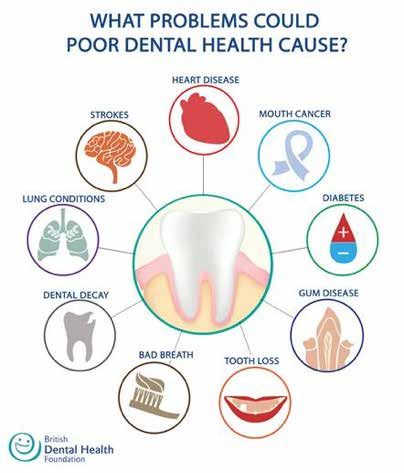
12 Consumers Health Forum of Australia Priorities for the 2019 Federal ElectionOral and Dental Health
What STROKES
HEART
DISEASE
problems
are LUNG MOUTH
associated CONDITIONS CANCER
with poor
dental
health? DENTAL DIABETES
DECAY
BAD GUM
BREATH DISEASE
TOOTH
LOSS
Source: British Dental Health Foundation, 2018
What we want Why it is important
In the long term we want a universal dental health scheme Despite a significant and growing body of evidence that
that treats oral and dental health in the same way as any shows the positive relationship between oral health and
other part of the health system. In the shorter-term we overall health status, there is no universal coverage in
want to see some increase in the provision of publicly Australia. Most oral health and dental care services are
funded dental health services for children and adults. provided in the private sector on a fee for service basis
and access to oral health care is inequitably distributed in
Australia. Oral health status is one of the worst disparities
Key commitments in the Australian health system.
• A dental benefits scheme for adults like the existing Data from the Australian Bureau of Statistics (ABS) for 2017
Child Dental Benefit Scheme, focusing on basic
shows that nearly 2 million people or around 18 percent of
dental care with capped funding and allowing choice
those needing dental care either delayed or did not see a
of provider. This would aim to replace the current
dentist due to cost. This is probably underreported as cost
Commonwealth funding for public dental care and
may be a factor for some other delaying treatment, but it is
would roll out in stages to adults on low income,
not the primary or only reason for deferral.
followed by those on other welfare payments, before
eventually being a universal scheme that targets The work that CHF did on out of pocket costs in 2018
children, people under the age of 25, and older people showed that cost of health services is a real barrier to
over the age of 65 (with a special scheme for people access and people either delay treatment of must make
living in residential aged care). difficult decision about going without other necessities to
• Commit to and financially support the National Oral pay for some kinds of health care.
Health Plan.
13 Consumers Health Forum of Australia Priorities for the 2019 Federal ElectionThere is inadequate attention to investing in prevention, in
addressing the causes of dental disease and in fostering
stronger community attention to oral health hygiene and
eating habits.
As a result, too many Australians suffer preventable
oral disease and more than 60,000 Australians are
hospitalised each year because of oral conditions, which
is an unnecessary health burden for consumers and an
unnecessary cost to the health system.
Support for quality oral health services has gone
backwards over the last several years with public waiting
lists for dental care blowing out to almost two years in
some areas and no national oral health care plan in place
to address the broader issues around prevention and
oral healthcare.
Want to know more?
ABS, 2017, Patient experiences in Australia; Summary of
Findings, 2016-17, http://www.abs.gov.au/ausstats/abs@.
nsf/mf/4839.0.
British Dental Health Foundation, 2019, Better Oral Health
For All, https://www.dentalhealth.org/
Consumers Health Forum, 2018, Hear our pain: consumers
in their own words, https://chf.org.au/sites/default/
files/20180404_hear_our_pain.pdf.
14 Consumers Health Forum of Australia Priorities for the 2019 Federal ElectionSupport for Early Childhood,
Youth and Family
Early
childhood SKILLED
WORKFORCE
development BETTER BETTER
PUBLIC SCHOOL
HEALTH READINESS
REDUCED GREAT
RISK OF ECONOMIC
SUBSTANCE
ABUSE EQUITY
ENHANCED REDUCED
GLOBAL
POVERTY
STANDING
Source: Atlas Family Foundation, 2018
What we want • Fund the Parenting Today in Australia survey to
determine the best evidence based, evaluated programs
A renewed commitment to giving children the best to improve parent capacity to support healthy early
possible start in life by providing funding and support for childhood development.
families in the early years, and strategies to address the
• Provide tools, training and resources for healthcare
specific health needs of and give voice to young consumers providers to identify and help families requiring extra
who are the ‘the missing middle’ in our health system. support.
• Commit to including the youth voice in national
Key commitments consultations, put in place a Minister for Youth Affairs
and provide funding for groups such as CHF’s Youth
• Introduce models of person and family-centred health
Health Forum.
care homes that include enrolment and blended and
bundled payments to serve the modern health care
needs of children and families and increased investment Why it is important
in early childhood health and wellbeing services
Young Australians are facing unprecedented health issues
through ACCHOs.
including rising rates of obesity, depression and anxiety.
• Embed the right@home program of nurse home visits For the first time in many decades, we face the prospect
for mothers and babies who have been identified as that the current generation of Australians might have a
at-risk and provide PHNs funding to implement positive shorter life expectancy than previous generations.
parenting programs. This should be rolled out a local
level and provide essential referral pathways. Many of the health problems in later life can be traced back
to what happened in childhood and adolescence. Early
intervention matters and will have long-term benefits.
15 Consumers Health Forum of Australia Priorities for the 2019 Federal ElectionWe need to ensure that appropriate services are available
Want to know more?
to a young and growing Aboriginal and Torres Strait
Islander population. In contrast to the ageing non- Australian Bureau of Statistics, 2016, Aboriginal
Aboriginal population, sixty five per cent of the Aboriginal and Torres Strait Islander Population, 2016, https://
population is under 30 years old and in 2016 the median www.abs.gov.au/ausstats/abs@.nsf/Lookup/by%20
age was 23 and the birth rate was twenty five per cent Subject/2071.0~2016~Main%20Features~Aboriginal%20
higher than the Australian average. and%20Torres%20Strait%20islander%20Population%20
Article~12.
Providing the right tools and support to those caring
for a child early in their life can impact on long-term Australian Early Development Census National Report,
wellbeing. Our recommendations include research to 2015, A Snapshot of Early Childhood Development in
gather evidence about what works, helping health Australia.
professionals to identify and provide comprehensive Australian Research Alliance for Children and Youth, 2019,
support for parents, and health care models that support Our Children – They don’t vote but they do matter, https://
integrated care. www.aracy.org.au/publications-resources/command/
The right@home trial targets mothers and babies living download_file/id/386/filename/Our_Children_-_They_
in adversity and includes 25 home visits from a social don%27t_vote_but_they_do_matter.pdf
worker and maternal child and family health nurse during Australian Research Alliance for Children and Youth,
pregnancy and the first two years of a child’s life. Early Report Card 2018: The Wellbeing of Young Australians,
results of this randomised controlled trial include warmer https://www.aracy.org.au/the-nest-in-action/report-card-
parenting practices, fewer risks in the home, and parents the-wellbeing-of-young-australians.
feeling more confident in facilitating learning in the home.
At present Australia has few programs targeting parents Australian Research Alliance for Children and Youth,
in this way and most are not evaluated so CHF supports 2019, right@home, https://www.aracy.org.au/the-nest-in-
calls from the Australian Research Alliance for Children action/righthome/righthome.
and Youth (ARACY) for a survey to collect data about The Atlas Family Foundation, 2018, It All Starts Here,
parents to inform better policies and programs. www.atlasfamilyfoundation.org/.
The overall health of young Australians is rarely in the Youth Health Forum, 2018, Call to Action, https://chf.org.au/
spotlight; yet this is the time when adults learn to care sites/default/files/chf_yhfcall_to_action_final_002.pdf.
for themselves independently. This is an opportunity to
establish healthy habits, for example regular preventative
dental care, yet youth health policy and funding has
tended to focus on mental health. It is important that the
health system is one they feel comfortable and able to
afford to engage with.
CHF calls on government and policymakers to commit to
hearing and supporting young people now and engaging
this demographic in a meaningful way.
16 Consumers Health Forum of Australia Priorities for the 2019 Federal ElectionYou can also read


