REFERENCE GUIDANCE Non-Commissioned Officer Corps Professional Development - NATO
←
→
Page content transcription
If your browser does not render page correctly, please read the page content below

Non-Commissioned Officer Corps
Professional Development

REFERENCE GUIDANCE
Non-Commissioned Officer Corps
Professional Development

REFERENCE GUIDANCE

Version One, January 2020
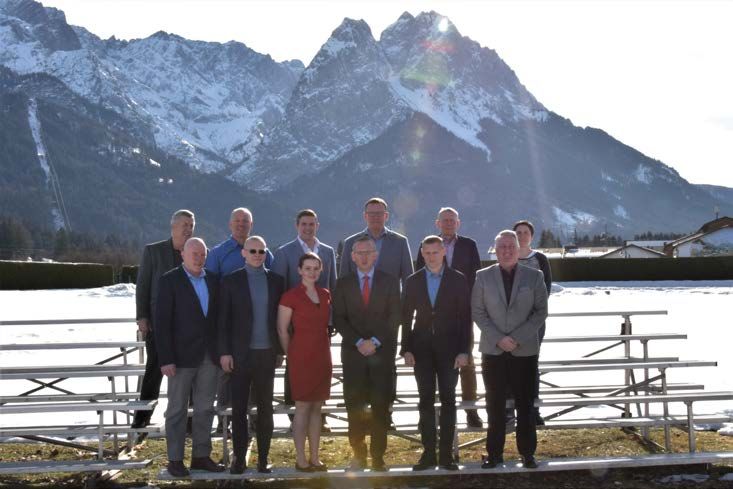
TABLE OF CONTENTS

FOREWORD............................................................................................................... 5
AIM. . ............................................................................................................................... 9
INTRODUCTION.................................................................................................. 10
Chapter 1: Components of the Professional NCO Corps. . ............................ 11
    1-0.         Professional NCO Corps:....................................................................... 11
    1-1.         Duties, Roles, and Responsibilities:.. ..................................................... 11
    1-2.         NCO-Officer Relationship:.................................................................... 14
    1-2.a. The Command Team Concept:.. ............................................................ 14
    1-2.b. Empowering the NCO:.. ......................................................................... 14
    1-3.         NCO Support Channel:......................................................................... 15
Chapter 2: Legislation, Policy, Regulation, and Doctrine............................. 16
    2-0.         Legislation:................................................................................................ 16
    2-1.         Policy:......................................................................................................... 16
    2-2.         Regulation:................................................................................................ 16
    2-3.         Doctrine:. . .................................................................................................. 16
Chapter 3: Resources............................................................................................... 17
    3-0.         Resources:.................................................................................................. 17
    3-1.         Human Capital:. . ...................................................................................... 17
    3-2.         Material Resources:.................................................................................. 17
    3-3.         Fiscal Resources:....................................................................................... 17

                                                                                                                                     3
Chapter 4: Personnel Management System....................................................... 18
4-0. Recruitment:............................................................................................. 18
4-1. Retention:.................................................................................................. 18
4-2. Pay, Allowances, and Compensations:.................................................. 18
4-3. Career Management (Selection, Promotion, and Assignment):....... 19
4-4. Privileges, Benefits, and Incentives:....................................................... 19
4-5. Transitioning:............................................................................................ 20
4-6. Retirement:. . .............................................................................................. 20
Chapter 5: NCO Professional Military Education System............................ 21
5-0. Policy:......................................................................................................... 21
5-1. Curriculum Development:.. .................................................................... 21
5-2. Faculty (Cadre) Development:............................................................... 21
5-3. Facilities and Learning Resources:........................................................ 21
5-4. Quality Assurance:................................................................................... 21
SUMMARY................................................................................................................ 23
NCO Corps PD Reference Guidance Project Team. . ....................................... 25
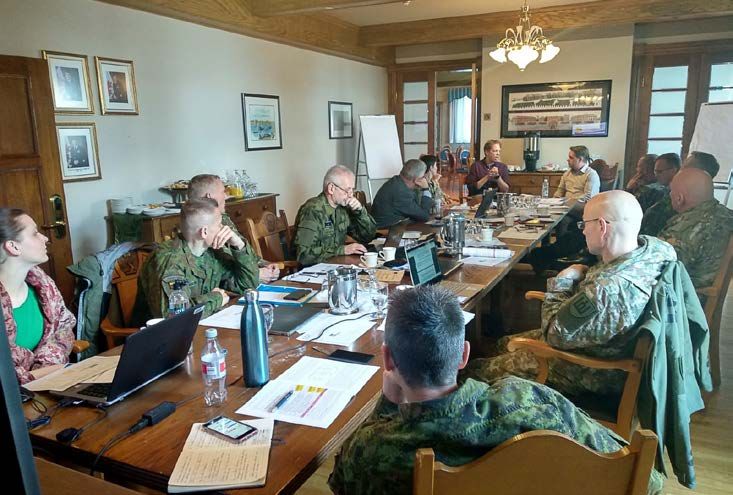
NCO Corps PD Reference Guidance Project Team Meeting,
Saint-Jean-sur-Richelieu, Canada, May 2019
4FOREWORD1
“The best of all lessons is example and before attempting to awaken the soul
of the soldier to noble sentiments it is necessary for us to have inculcated these
sentiments into the soul of his non-commissioned officers.”
Captain Constatin
“La Confience: Essai de Psychologie Militaire”, 1908
I hope you find this reference guidance to be a useful tool in the establishment and
improvement of a professional non-commissioned officer (NCO) corps. We know
from experience that creating a corps of NCOs that are competent, resilient, and
adaptive requires a comprehensive approach within a nation’s armed forces and
empowerment of those NCOs by all levels of political and military leadership.
NCOs who understand their unique role within the military hierarchy and establish
trust-based relationships with their officers and soldiers are force multipliers. Good
NCOs can lift the readiness, effectiveness, and morale of the entire armed forces.
Since 2009, the Defence Education Enhancement Programme (DEEP) NCO
professional development teams have assisted partner nations in establishing and
improving NCO training and education programmes. In that capacity, we are
pleased to provide this reference guidance.
Marc Di Paolo
Director, Defence Institution and Capacity Building,
NATO HQ
1 Use of Terms: This document is non-gender specific. Terms that denote gender are not
used exclusively to denote men or women. The use of the term “armed forces” applies to all
applicable services (Air Force, Navy, Army, etc.) or any other military branch within a country.
The use of the term “soldier” refers to a service member from any branch.
5NORTH ATLANTIC TREATY ORGANIZATION
ORGANISATION DU TRAITÉ DE L’ATLANTIQUE NORD
HEADQUARTERS SUPREME ALLIED COMMANDER TRANSFORMATION
7857 BLANDY ROAD, SUITE 100
NORFOLK, VIRGINIA, 23551-2490
ACT/JFD/TT-2190/SER:
TO: See Distribution
SUBJECT: Approval of the Non-Commissioned Officer Corps
Professional Development Reference Guidance as a
NATO Reference Document
DATE: December 2019
REFERENCE(S): NCO Professional Military Education (PME) Reference
Curriculum (RC), dated 2013.
1. Given the continued interest in developing the Non-Commissioned
Officers (NCO) Corps for partners, I am convinced that the NCO Corps
Professional Development Reference Guidance (NCO PDRG) can serve
as a reference for Partner Nations in the design and development of their
course models, building their professional development, and serve as an
enhancement of military interoperability between NATO and its Partners.
Therefore, it is my pleasure to support and enhance dialogue of the NCO
PDRG through publishing this guide in appropriate NATO partner venues as
a NATO document.
2. In an effort to strengthen collaboration towards the development
of building security through NCO education and Professional Development
(PD), the NATO Defence Education Enhancement Programme (DEEP), on
behalf of NATO, has developed the NCO PDRG. This document serves as
a guide that complements the NCO Professional Military Education (PME)
Reference Curriculum (RC) and will assist Nations in identifying critical
areas necessary to developing a professional NCO Corps. Building a solid
foundation with critical milestones for personnel will lead to a professional,
6empowered, educated, and motivated NCO Corps. Therefore, I encourage
all respective designers of partner countries involved in the development
of the NCO Corps to review the documentation and distribute within their
countries.
3. Should there be any questions, our point of contact is the Allied
Command Transformation Command Senior Enlisted Leader, CSM Tibor
Bogdan, Tibor.Bogdan@act.nato.int.
FOR THE SUPREME ALLIED COMMANDER TRANSFORMATION
Alfonso Fernández de Córdoba
Vice Admiral, ESP N
Deputy Chief of Staff, Joint Force Development
7AIM
This document serves as a guide that complements the NCO Professional
Military Education (PME) Reference Curriculum (RC). The NCO PME RC
focuses exclusively on the structure and content of NCO courses. The NCO
Corps Professional Development Reference Guidance is designed to help nations
and Defence Education Enhancement Programme (DEEP) expert teams identify
areas that are necessary to develop a professional NCO Corps but lie beyond
the immediate scope of education. Building a solid foundation with critical
milestones for personnel will lead to a professional, empowered, educated, and
motivated NCO Corps. To that end, nations are encouraged to use this guide
to identify necessary components to develop a professional NCO Corps and
pinpoint challenges that cause stagnation in NCO educational development.
NCO Corps PD Reference Guidance Project Team Meeting,
Saint-Jean-sur-Richelieu, Canada, May 2019
9INTRODUCTION This guide references the foundational concepts that underlie the development of a professional NCO Corps. The foundation begins with a systems approach to establish and manage the development of an NCO Corps. The key lines of effort include: Duties, Roles, and Responsibilities; Policy and Doctrine; Resource Management; Personnel Management System; and NCO Educational System. As a planning tool to fix a capability gap it is recommended to apply the DOTMLPF-I and specific, measurable, achievable, relevant, and time-bound (SMART) framework to be interpreted in the military context: 1) Doctrine: the way to fight, e.g., emphasizing maneuver warfare combined air-ground campaigns. 2) Organization: how to organize to fight; divisions, air wings, etc. 3) Training: how to prepare to fight tactically; basic training to advanced individual training, various types of unit training, joint exercises, etc. 4) Materiel: all the resources necessary to equip the forces, weapons, spares, etc. to operate effectively. 5) Leadership and education: how to prepare leaders to lead the fight from squad leader to general/admiral; professional development. 6) Personnel: availability of qualified people for peacetime, wartime, and various contingency operations. 7) Facilities: real property; installations and industrial facilities that support the forces. 8) Interoperability: the ability to be interoperable with other forces. Applying SMART and holistic principles at all levels of NCO functionality, pertaining to operations, exercises, education, training, partnerships, and employment to define and close capability gaps. 10
Chapter 1: Components of the Professional NCO Corps

1-0.    Professional NCO Corps:

The profession of arms is distinguished by the concept of service before self, the
lawful ordered application of military force, and the acceptance of the concept
of unlimited liability. Its members possess systematic and specialized body of
military knowledge and skills gradually acquired through education, training
and experience. Members of the profession of arms share a set of values and
beliefs found in the military ethos that guides them in the performance of their
duties and enables them to maintain the trust and confidence of the society
they serve. Ultimately, the goal is to firmly implant a professional NCO Corps
within the profession of arms.

1-1.    Duties, Roles, and Responsibilities:

The modern NCO is a professionally developed leader who serves as the
“backbone” of any Armed Forces. The professional NCO serves as a trainer
and advisor who assists the leadership as the technical and tactical expert in
supporting the mission and in the training, care, and discipline of Soldiers.
NCOs have roles as leaders, communicators, experts, mentors, and advisors,
and are committed to excellence and pursuit of the highest standards of
skills, knowledge, and attributes. Mutual trust and common goals are the two
characteristics that enhance the relationship between NCOs and Officers.

NCOs operate at the tactical, operational, and strategic levels in line units and
staff organizations. They are relied upon to execute complex tactical operations,
make intent-driven decisions, and operate in multi-domain environments.
NCOs are responsible for maintaining and enforcing standards and discipline.
They train, lead by example, and are accountable for the care of soldiers. Within
functional bodies such as commands and staffs, staff NCOs perform tasks
relating to staff processes based on their acquired knowledge, competencies, and
relevant experiences.

The following model serves as a general guideline for the scope of NCO
leadership at each rank level:

                                                                               11
Guidelines for NATO NCOs
CSEL/OR 9 This key senior enlisted leader, at the pinnacle of the
NCO Ranks, serves as a senior advisor to the commander
and the staff element leadership. This Senior NCO makes
recommendations to the commander on all matters
pertaining to the Other Ranks. He or she ensures compliance
with policies, adherence to standards and performance,
conduct and effective training and maintenance of
discipline within the organization. This senior NCO
overseas the professional development of all Other Ranks.
He or she serves at the highest level and provides oversight
at the tactical, operational and strategic-level, supporting the
commander’s intent. That said, this position should not be a
secondary position, which could jeopardize the integrity of
the Command Team concept
OR 9 The most experienced senior NCO within the NATO
NCO structure. Uses enhanced leadership skills and
broad experience in a greater capacity to successfully
implement planning and management for collective
mission accomplishment. Advises staff element, instructs
and mentors subordinates, and coordinates and supervises
training. Monitors unit effectiveness and upholds standards.
Additionally, monitors unit morale and welfare, other ranks
professional development and upholds standards. The OR-9
serves as role model for all NCOs/ORs, as well as junior
officers and is an advisor within a higher headquarters.
OR 8 Uses enhanced leadership skills and broad experience to
successfully implement planning and management for
collective mission accomplishment. Advises unit / element
and higher commanders and mentors subordinates,
coordinates and supervises training. Monitors unit
effectiveness and upholds standards.
12OR 7 The OR-7 is empowered and considered a key element
within the command structure. They focus their increased
experience and leadership skills toward collective mission
accomplishment and are responsible for the effective
management of larger numbers of personnel and equipment.
At this level, senior NCOs are expected to be able to provide
sound advice to their leadership.
OR 6 This is the first of the NATO senior NCO ranks. The
OR-6 is usually assigned in positions requiring increased
responsibilities. The OR-6 is responsible for more
subordinates and more equipment, and uses greater
experience and leadership to shape his/her sphere of
influence under all circumstances. It is important to note,
some NATO Nations recognize OR-7 as their first senior
NCO rank.
OR 5 The OR-5 is the level of leadership with the greatest impact
on subordinate ranks. Practices leadership-by-example,
demonstrating personal compliance with standards while
enforcing those standards in order to ensure the good
order and discipline, training, personal appearance and
general welfare of subordinate personnel. Unquestionably
competent to execute tasks correctly, exercise leadership, care
for assigned personnel and support mission accomplishment.
OR 4 The first level of leadership within the NATO NCO ranks.
Is responsible for the good order and discipline, training,
personal appearance and general welfare of their subordinate
personnel.
OR 1-3 These are the basic entry ranks into the military structure.
Personnel are expected to uphold national standards of
conduct and follow the orders of supervisors and regulations.
Note: National promotion systems vary, therefore, it is
imperative to measure the military member’s time -in-grade,
time-in-service, age and maturity to ensure this entry level is
challenged accordingly.
131-2. NCO-Officer Relationship: The NCO-Officer relationship is one of the most important in the profession. The very existence of these two Corps reflects the complex nature of the profession of arms and the need to organize and structure the profession to accommodate the many demands placed on it. NCOs are involved in training, developing, and mentoring junior Officers; forming professional and personal bonds with the Officers based on mutual trust and common goals. 1-2.a. The Command Team Concept: The command team is composed of the Commander and a Senior NCO. The command team concept is designed to be complementary in nature and a professional, loyalty-based partnership that provides mutual supporting efforts to meet the Commander’s intent. It also provides the Commander with a counterpart who can provide constructive advice concerning the Commander’s options, supports the decision, and provides feedback after the fact. The command team shares the responsibility of leadership and the burden associated with command. The command team relationship begins at the platoon level and continues through to the highest level of Command. At the lowest level, an experienced NCO is usually paired with a junior Officer, serves as a mentor, and advisor concerning soldiers with regards to morale and welfare. As NCOs and Officers progress through their careers, the role of the NCO expands and shifts primarily to an advisory capacity. 1-2.b. Empowering the NCO: NCO’s and Officer’s duties, roles, and responsibilities are both separate and distinct. Distinguishing these roles allows NCOs and Officers to understand how they work in conjunction with one another to meet the Commander’s intent. In order to be successful in multi-domain operations, NCOs need to be empowered throughout the chain of command at the tactical, operational, and strategic levels. Officers operate from a position of formal command authority. NCOs, in contrast, operate from a position of leadership and influence, performing both complex and routine tasks, allowing their superiors maximum time to perform their duties. 14
A relevant leader understands that the best way to create an effective organization
is to empower NCOs. As empowered NCOs learn and grow they are enabled to
cope with increasing responsibilities.

1-3.    NCO Support Channel:

NCO Support Channels executes established policies, directives and orders,
standardizes performance, executes and provides guidance on training and
education ensures professional behavior and conduct of forces. The NCO
Support Channel enforces established policies, executes directives and orders,
enforces standards and performance, provides guidance on training and
education, and promotes professional behavior and conduct. Additionally,
NCO Support Channels must understand the Commander’s Intent in order
to be able to issue effective implementing instructions throughout the forces.

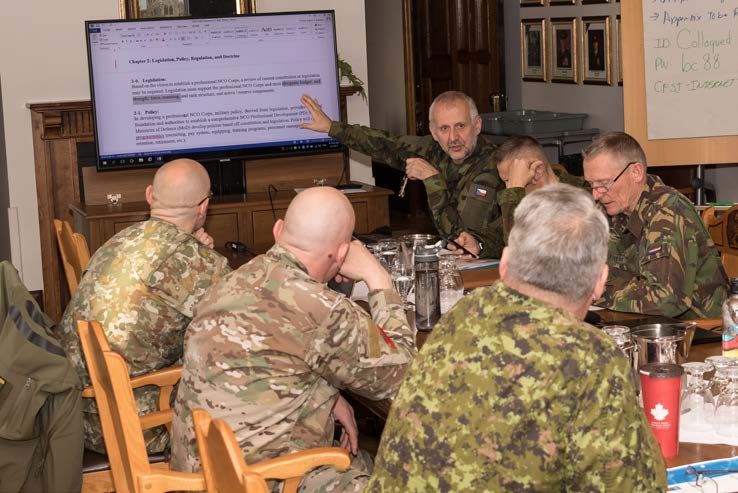
               NCO Corps PD Reference Guidance Project Team Meeting,
                     Saint-Jean-sur-Richelieu, Canada, May 2019

                                                                                15
Chapter 2: Legislation, Policy, Regulation, and Doctrine 2-0. Legislation: Based on the vision to establish a professional NCO Corps, a review of the current force structure or legislation may be required. Legislation must support the professional NCO Corps by designating budget and force structure for active and reserve components. Laws governing legal considerations should be established at this level based on national requirements. 2-1. Policy: A Ministry of Defence (MoD) has the responsibility to develop policies based on force structures and legislation. In developing a professional NCO Corps, defence policy, derived from legislation, provides the legal foundation and authority to establish a comprehensive NCO PD System. Policy will outline various programs such as pay systems, equipment acquisition, training and education programs, personnel management systems, etc. 2-2. Regulation: Regulations are derived from policies and need to be established to address NCO PD System to include: structure, duties, roles, responsibilities, authorities, career management, education and training requirements, etc. 2-3. Doctrine: Doctrine in turn derives from regulations, concepts, research and analysis, lessons learned, etc. Policy directs the Armed Forces concerning what to do while doctrine provides the why (philosophical basis) and the how (required actions) to operate within the regulatory framework. Doctrine outlines tactics, techniques and procedures in the form of various official documents, such as: field, training, and technical manuals, etc. 16
Chapter 3: Resources

3-0.    Resources:

Developing a professional NCO Corps requires sustainable resourcing. This area
may present the most challenges because no military has unlimited resources,
and each element within a military usually competes for its own share. Senior
leaders (at their respective levels) should communicate where NCO development
lies in respect to funding priorities, and communicate effectively with those who
budget and distribute resources (finances, manpower, equipment, etc.).

3-1.    Human Capital:

Human capital is defined as assigning the best-prepared NCOs to be in the
right place, at the right time, based on their experience, skills, knowledge, and
attributes. Human capital is managed through a personnel management system
within the Armed Forces. Such a system is necessary to build and sustain a
professional NCO Corps. This system and its subsystems provide programs
such as recruitment, career management, evaluations, recognition, retention,
compensation, retirement, etc., in order to provide Soldiers with predictability
and stability throughout their career.

3-2.    Material Resources:

Material resources are managed through a logistics system which includes
acquisition and procurement processes, fielding equipment, maintenance,
training resources (training areas, classrooms, ammunition, etc.), and divestment.

3-3.    Fiscal Resources:

Fiscal resources must be identified, allocated, and managed by type of funding.
Appropriate and accurate funding must be forecasted and resourced to achieve
required objectives.

                                                                               17
Chapter 4: Personnel Management System 4-0. Recruitment: Recruitment is the process of attracting, selecting, and appointing personnel within the Armed Forces. Selection standards for new applicants must be considered. These include, but are not limited to, citizenship, educational levels, pending legal actions, medical and security screenings, and fitness standards. Additionally, focused campaigns and recruitment incentives should be considered for undermanned military occupational specialities and tailored incentives for more challenging military positions. 4-1. Retention: There are multiple methods to retain competent, qualified soldiers. Some methods that can help retention include but are not limited to: 1) Pay and allowances (see paragraph 4-2) 2) Quality of life (soldiers and their families) 3) Career management including progression in rank (see paragraph 4-3) 4) Training / education opportunities (see chapter 5) 5) Assignment opportunities 6) Recognition 7) Privileges, benefits, and incentives (see paragraph 4-4) 8) Retirement plans (see paragraph 4-6) 4-2. Pay, Allowances, and Compensations: The NCO Corps pay scale must be fair and equitable in relation to Officer and Civilian scales. A system must be established to outline reimbursement, incentives, and bonuses to offset financial expenses and hardships related to military service, deployments, relocation, and on-duty travel. Consideration should be given for housing allowance or providing standardized housing, allowances for cost of living increments, and compensation for required official 18
travel. Armed Forces should also consider special duty pay / allowances for
specific duty specialties and positions.

4-3.    Career Management (Selection, Promotion, and Assignment):

Establish a career management system that is transparent, inclusive, non-gender
specific, which will provide the ability to select, promote (where required), and
assign the best-qualified soldier at the right time, and the right place. Design a
career path for each specific occupation that outlines the requirements for career
progression. Selection boards should be conducted at the appropriate rank level
to create a fair and transparent process, whether centralized, decentralized, or
combined. Establishing a progressive NCO rank structure will provide talent
management capability at the junior, middle, and senior ranks. By creating a
structure that aligns NCO and Officer duties, roles, and responsibilities against
a span of control ratio, Armed Forces will increase efficiency, operational
effectiveness, and sound fiscal management. The career management system
should consider terms on longevity of military service for NCOs either by years
of service, individual performance, experience, or combination of all.

4-4.    Privileges, Benefits, and Incentives:

In order to support recruitment, retention, and enhance quality of life, some
tools should be considered, e.g.:

1) Medical care including dental care (Soldiers and Family members)
2) Education
3) Financial incentives
4) Family care and support programs
5) Life insurance
6) Housing
7) Community support
8) Rest, relaxation and leave programs

                                                                               19
4-5. Transitioning:
In order to assist with transitioning from the military, support programs should
be considered, e.g.:
1) Second career opportunities:
a) Resume writing
b) Job fairs
c) Interview coaching
d) Job search assistance (i.e. social media and networking)
e) Financial readiness counselling
2) Skills and competencies recognitions
3) Education benefits including retraining
4) Veteran benefits
5) Housing relocation
4-6. Retirement:
In addition to the transitioning programs listed above, consider establishing a
retirement system which can include:
1) Competitive pension plan
2) Medical and dental benefits
3) Funeral benefits
4) Community support
20Chapter 5: NCO Professional Military Education System
5-0. Policy:
Policies should outline an NCO Professional Military Education system applying
the Systems Approach to Training. Creating a culture of lifelong learning in the
military structure where self-motivated leaders set goals and achieve professional
and personal development in the areas of military studies, civilian education,
technical certifications, language skills, etc.
5-1. Curriculum Development:
Curriculum development is guided by doctrine which outlines content of the
respective courses, how the content will be delivered, and how students will be
assessed. Curricula are recommended to be tailored towards the NCO PME
RC. When developing curricula, both NCO and Officer PME should include
comprehensive understanding of each other’s PD.
5-2. Faculty (Cadre) Development:
Faculty development courses should be developed for instructors, facilitators,
and curricula developers who are referred to as cadre. Ideally, NCOs should be
primary instructors and/or facilitators for NCO PME courses. Cadre are subject
matter experts who bring credibility and achieve desirable learning outcomes.
5-3. Facilities and Learning Resources:
Suitable infrastructure is conducive to an enhanced learning environment. This
includes, but is not limited to: facilities (e.g. classrooms, training areas, lodging,
dining) equipped and furnished with functional items, training aids, operational
equipment, etc.
5-4. Quality Assurance:
It is necessary to evaluate education and training programs to determine the
relevance and effectiveness of those programs. Data is collected from students
and staff in order to be analysed so leadership can make informed decisions
21about what programs to continue, alter, increase resources, cancel, etc. Internal
evaluations and external validations are necessary to ensure learning objectives
and outcomes are achieved based on curricula and operational requirements.
NCO Corps PD Reference Guidance Project Team Meeting,
Garmisch-Partenkirchen, Germany, February 2019
NCO Corps PD Reference Guidance Project Team Meeting,
Saint-Jean-sur-Richelieu, Canada, May 2019
22SUMMARY
An empowered and professionally developed NCO Corps is a force multiplier
to the Armed Forces. A proper foundation established through legislation,
policies, regulations, and doctrine is necessary to form the guiding principles for
the NCO Corps governance. Changing the national NCO PD system requires
buy-in from all stakeholders, to include political leadership when necessary.
Without a fundamental understanding of the nature and purpose of these
changes, the transformation will be inefficient and the process may stagnate.
Adequate resources are critical to build and sustain a comprehensive NCO PD
system. Failure to properly resource NCO PME will undercut the effectiveness
of NCO development programs.
An effective and extensive personnel management system provides a process
to assign the best-qualified NCOs, at the right time, in the right place. An
NCO PME system will provide skills, knowledge, and attributes to build a
professional NCO Corps capable of successfully operating in the complex and
uncertain environment of the 21st Century.
Note: In order to keep this reference guidance relevant, a review as needed
should be conducted.
23NCO Corps PD Reference Guidance Project Team
Name Nationality Institutional Affiliation
Mr. Pavel Anastasov Bulgaria NATO International Staff,
DEEP
CSM (OR9) Lithuania Military Academy of
Bronius Basalykas Lithuania
CWO (OR9) Canada Canadian Defence
Necole Belanger Academy
CWO (OR9) Netherlands NATO School
Henry Bethlehem Oberammergau
CSM Tibor Bogdan Hungary Headquarters Supreme
Allied Command
Transformation
1SG (OR8) Kristin USA California Army National
Caldwell Guard
CWO (OR9) Canada NATO Partnerships
Martin Cartier Directorate
Ms. Maria Galperin USA Partnership for Peace
Donnelly Consortium
25CWO (OR9) Canada NATO Partnerships
Rodney Gallant Directorate
Mr. Charles USA NCO Leadership Centre of
Guyette Excellence and U.S. Army
Sergeants Major Academy
LTC (OF4) Lithuania NATO Representation in
Rolandas Kiskis Ukraine
SGM (OR9) Ludek Czech Ministry of Defence of the
Kolesa Republic Czech Republic
SGM (OR9) Lithuania NATO Representation in
Alvydas Ukraine
Kuprusevicius
Mr. Bjorn Lagerlof Canada Canadian Defence
Academy
SGM (OR9) Jason USA NCO Leadership Centre of
Leeworthy Excellence and U.S. Army
Sergeants Major Academy
CWO (OR9) Kevin Canada Chief Warrant Officer
Mathers Osside Profession of Arms
Institute
26CWO (OR9) Rick Canada Chief Warrant Officer
Plante Osside Profession of Arms
Institute
MWO (OR8) Jean- Canada Chief Warrant Officer
Louis Proteau Osside Profession of Arms
Institute
MSG (OR8) USA NCO Leadership Centre of
Matthew T. Saylor Excellence and U.S. Army
Sergeants Major Academy
MCPO (OR9) Slovenia NATO School
Gorazd Skorjanc Oberammergau
SGM (OR9) Janez Slovenia General Staff of the
Smid Slovenian Armed Forces
Mr. Mariusz Solis Poland NATO International Staff,
DEEP
CSM (OR9) Koba Georgia Georgian Defence Forces
Tsirekidze
SGM (OR9) Slovenia Non-commissioned Officer
Alexander Varga School
2728
0024-20 NATO Graphics & Printing

Layout Coordinator / Distribution:
Gabriella Lurwig-Gendarme
NATO International Staff
Defence Education Enhancement Programmes (DEEP)
lurwig.gabriella@hq.nato.int
You can also read


