COMMUNITY 2019 STUDY OF AGILITY IN ROMANIAN SOFTWARE
←
→
Page content transcription
If your browser does not render page correctly, please read the page content below

STUDY OF AGILITY IN
ROMANIAN SOFTWARE
COMMUNITY 2019

SUMMARY

Introduction                                       3
Software and Services Sector                       4
Companies Overview                                 4
Employees                                          5
Productivity                                       6
Discussion                                         8

Agile Practices Survey                             9
Organisations Overview                             9
Respondent Overview                               11
Organisations Agile Context                       12
Reasons for Adoption and Agile Benefits           13
What helps integrating Agile?                     14
Agile Challenges                                  14
Measuring Agile Success                           15
Would you recommend Agile as a way of working?    15
Methods and Practices                             16
Team Meetings                                     17
Tools and Tracking                                17
Measuring Progress                                19
Engineering Practices                             20
DevOps Initiative / Machine Learning Initiative   20
Learning and Sharing Knowledge                    21

Tech Community and Events                         22
Education and Continuous Learning                 24
Conclusion                                        25
References                                        26
About Us                                          27

INTRODUCTION

In this study we aim to assess the development of practices in the Romanian
Software Community by observing how it has evolved in the past years and
what are the opportunities that lay ahead.

As Agile Methodology becomes the norm in software development agility is
more and more important even for companies that have already adopted its
principles and practices.

Companies are entering a process of digital transformation, therefore the entire
organisation (department, teams and individuals) need to act, initiate projects
and, most importantly, have the capacity to carry them along with those they
work with.

The report has a research component of the software and services sector,
tech communities and events, education and learning. This offers
comprehensive perspective on the software ecosystem in Romania.

For several years, the sector has enjoyed growth in both the number of
employees and in revenue. The delivered quality is also reflected in productivity
gains. Industry performance is sensitive to rapid technology changes and as
we face a new wave of technology, there is a risk of losing the pace if we do
not adapt.

We are grateful to be helpers for those companies who feel the call for
adventure. And humble because they are making the hard work. These are
some of the thoughts that led me to start DOvelopers and work with
passionate people that make things happen.

We hope you find this research useful and feel free to contact me at
connect@dovelopers.com if you have any questions.

                                                                Eduard Budacu
                                                      Founder and Agile Coach
                                                                    DOvelopers
SOFTWARE AND SERVICES SECTOR

Taken into account that Agile was first used in IT companies, we wanted to have an overview of the industry in
Romania in the past years. We have selected over 2000 companies with specific software services1. These companies
had generated a revenue greater between 50.000 and 225 mil euros., with no less than than 5 employees. Our
sample of selected companies employ around 94000 people in 2017.

Companies Overview

In Romania the software and services sector is comprised of a lot of small players, that provide custom software
development and a few big players such as Oracle Romania, IBM Romania or Ericsson Telecommunications Romania.
Software factories are among the employers that have between 1000 and 2000 people. These companies usually
provide software development capabilities for enterprise local and international clients.

                                                                      FIG. 1 DISTRIBUTION OF COMPANIES BY SIZE

85% of the companies in the selected sample have less than 50 employees. At this size usually founders are directly
involved in managing the company. Furthermore 41% have 10 or less employees.

1   We took into account organisations that have the following NACE codes: 5821, 5829, 6201, 6202, 6203, 6209, 6311, 6312
    © DOvelopers 2019. Developed by Eduard Budacu and Cristina Pana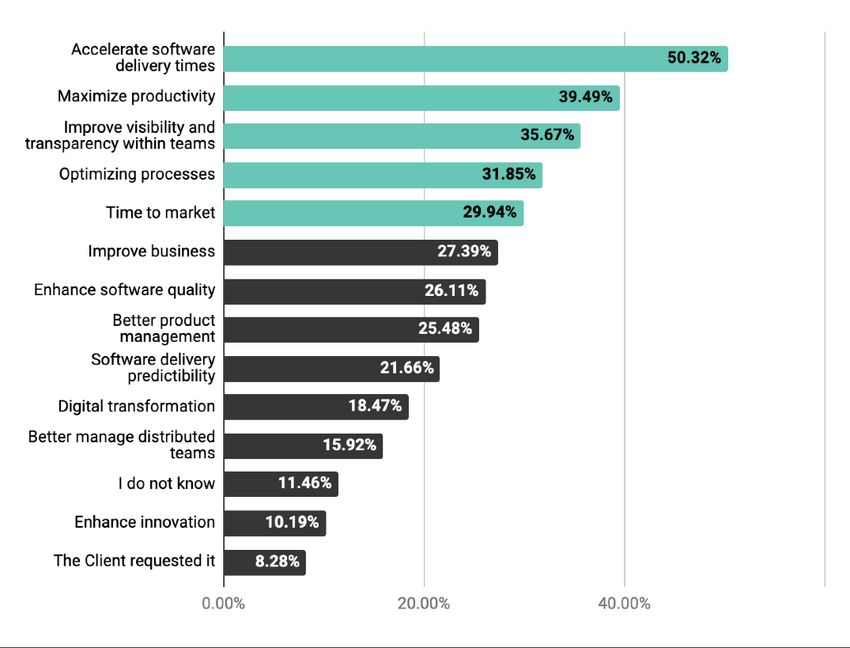
Turnover is highly correlated with the size of the company.

                                                                  FIG. 2 TURNOVER VERSUS NUMBER OF EMPLOYEES

Employees

The data shows us a growth of 77,12% in employees number as from 2013, with an average of 15,37%. The timeline
taken into account for data analysis is 2013 - 2017.

                                                                  FIG. 3 NUMBER OF EMPLOYEES AND YEARLY GROWTH
© DOvelopers 2019. Developed by Eduard Budacu and Cristina Pana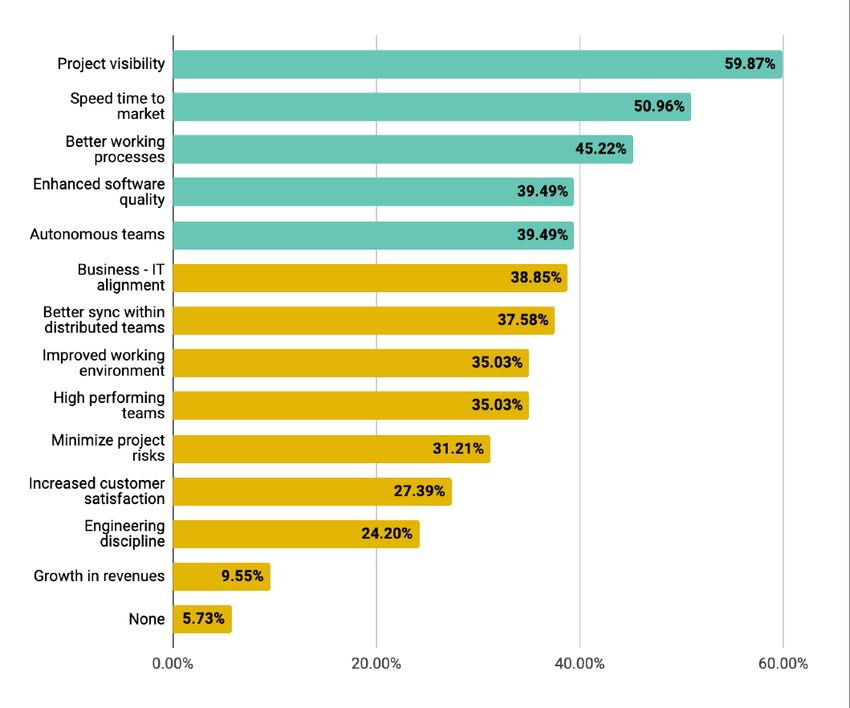
Based on current growth trend, we can imagine a scenario where we estimate 13% growth for 2018. In this case the
number of employees reached ≈ 106300, meaning it doubles since 2013.

From the extracted sample, we noticed that 33 big companies employ more than 38% of the total number of
approximately. 94000 . Medium sized companies that have between 101 and 400 employees cover 24%, while small
sized companies with less than 100 employees cover 38% of the total number of employees.

Productivity

Regarding productivity we can look at it from different perspectives.
If we exclude outliers, we can deduct that average productivity of
employee per company each year has the following distribution (fig. 4):

•   25% of companies have less than ≈ 22000 euro productivity

•   50% of companies have less than ≈ 34800 euro productivity

•   75% of companies have less than ≈ 52000 euro productivity

We can also measure productivity in relation to the total number of
employees at sector level, please see figure 5.

                                                                                  FIG. 4 AVERAGE PRODUCTIVITY OF
                                                                                      EMPLOYEE PER COMPANY

        FIG. 5 AVERAGE TURNOVER PER EMPLOYEE IN COMPARISON WITH ANNUAL TURNOVER

© DOvelopers 2019. Developed by Eduard Budacu and Cristina Pana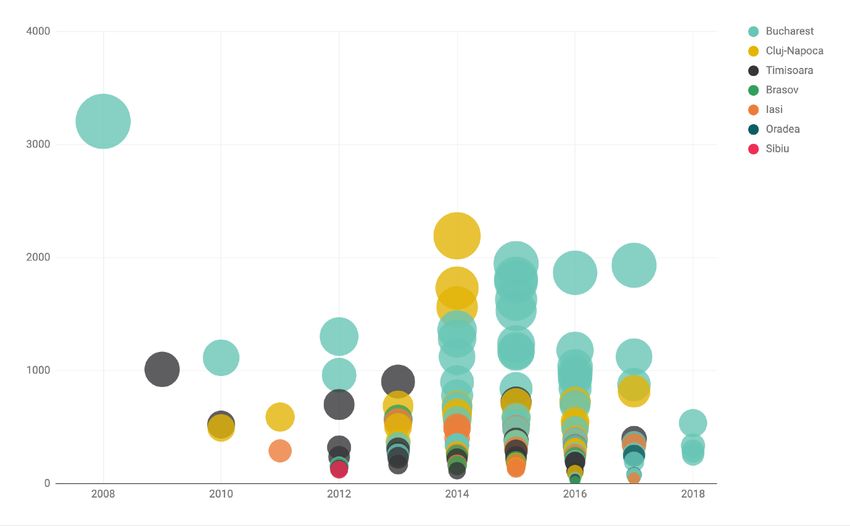
One of the main concern of the software sector is that it would lose its competitive advantage due to the constant
increase in cost of labour. However Romania has talented technical and software development capabilities,
recognised oversee. Regardless of the economical changes, investment costs are still convenient and salaries are
affordable by western European standards.

                                                      FIG. 6 AVERAGE COST OF LABOUR IN IT (RON / EMPLOYEE / MONTH)

The years before the economic crisis meant a rapid growth of labour costs, followed by a decrease immediately after
the crisis started. In the last years we see a constant increase of around 10%.

                                                                    FIG. 7 YEAR OVER YEAR VARIATION
© DOvelopers 2019. Developed by Eduard Budacu and Cristina Pana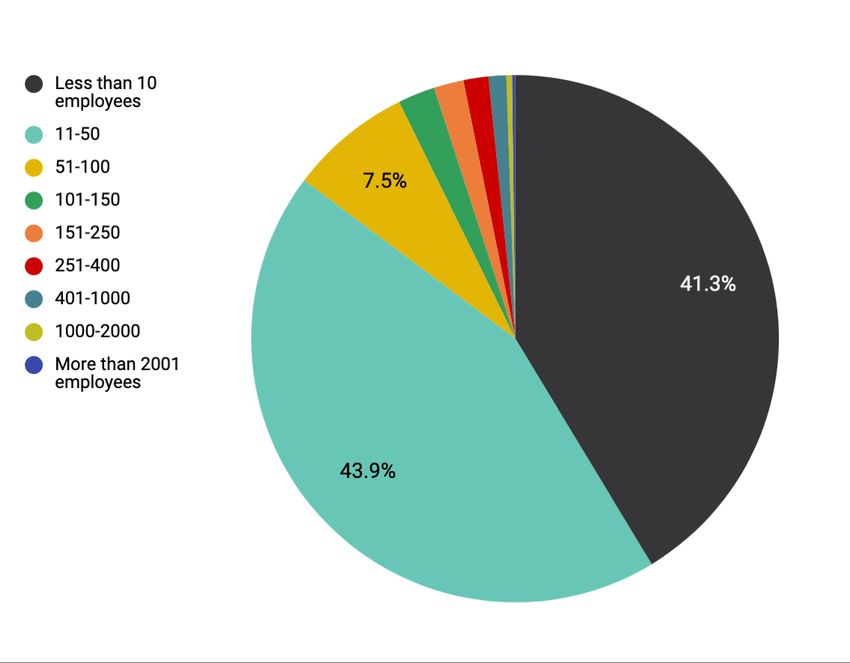
Discussion

We further selected company profiles from each category and extracted details from corporate websites, social media
and LinkedIn profiles of employees regarding structure, roles and references to methodologies uses.

Most of the companies are focused on specific technologies that are provided services. References to Agile methods
are made to emphasise the quality of the development practices. Also flexibility is promoted as a benefit for employees
that would rather work in a dynamic environment without bureaucratic procedures and a flat hierarchy.

Smaller companies tend to be lead by the founders that are also involved in execution. The way of working is usually
customised for the specific needs of the company.

Medium companies are managed by boards comprised of CEO, COO, CTO and representatives from other
departments like HR, Finances, Quality Assurance. In the past years there were companies organised around teams
that are lead either by a technical lead or a mix between project management / adapted Scrum roles. We also noticed
a lot of roles combining responsibilities of process and product management.

As companies grow in size we tend to notice more complex structures that involve diverse roles and titles. Still a big
part of the employees are focused on execution as a reflection on the main source of revenue that is outsourcing
software development.

                The acknowledgement of the good technology education system, talented developers and affordable
                human resources costs attracted big players in finance, telecommunications and retail that further increased
                competition between companies to retain talent. Highlights in values like trust, innovation, continuous
                improvement and flexibility are meant to create unique employer propositions.

                Increases in revenue are highly dependent on managing to hire more people, but we can also see an
                increase in productivity as the companies developed the capacity to deliver end-to-end projects and more
                complex services.
                Adding more value is the primary concern of company managers. This emerges from the threat of losing the
                price advantage due to salaries increase.

                Majority of the jobs in the industry are available for technical roles, but we've seen an increase in job ads
                that reference agile methods and practices as a necessary skill set for candidates. Also there are slightly
                more roles of Agile professionals like Agile Project Managers, Scrum Masters and Product Managers. This
                creates opportunities for training employees to gain new skills, experience new roles and take more
                responsibility.

© DOvelopers 2019. Developed by Eduard Budacu and Cristina Pana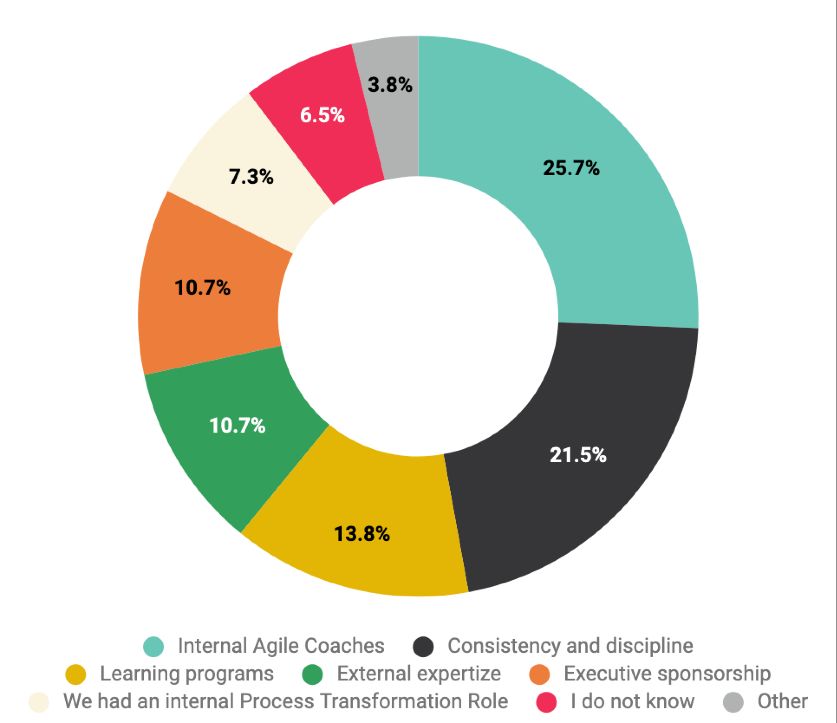
AGILE PRACTICES SURVEY

This survey was completed by 162 respondents from cities around Romania, predominantly Bucharest, Cluj Napoca
and Iasi. The online survey was conducted between November 2018 - February 2019. We discarded 3% of invalid
responses, counting a total of 157 respondents to be taken into account for this study.

The channels used for distribution were: social media channels (LinkedIn, Facebook, Instagram), www.meetup.com
platform in the communities that had an agile interest stated; direct messages to target audience.

Respondents were able to make multiple selections with several preconfigured answers for participants. Open-ended
questions were available as well, for detailed inputs and answers.

Organisations Overview

Most respondents work in Technology, Outsourcing Software Development or E-commerce industry. We have also
noticed in the past 2 years a rise of interest for Agile concept, practices and tools from Banking industry and non-tech
companies, also shown in the survey results.

                                                                  FIG. 8 RESPONDENTS INDUSTRY

© DOvelopers 2019. Developed by Eduard Budacu and Cristina Pana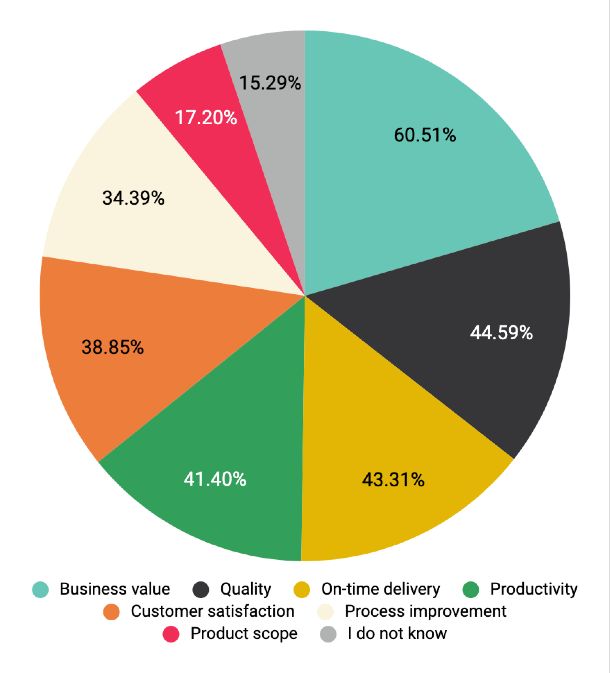
Approximately 51% of respondents work in organisations bigger than 400 employees, while 8% represent small
companies of less than 10 people.
More than 33% have a dedicated Development Units consisting of 1 - 10 people, followed by ≈ 30% with a size of 26
- 100 people.

                           FIG. 9 ORGANISATION SIZE                                 FIG. 10 DEVELOPMENT UNIT SIZE

Common team size is 5 - 9 people per project / product, which includes IT and non-IT roles. In regards to distribution,
we can see a mix of co-located and distributed team, with a variation of more than three hour time zone difference.
We can conclude that much of the development work is catered towards international clients.

                                FIG. 12 DISTRIBUTION                                   FIG. 11 PRODUCT TEAM SIZE
© DOvelopers 2019. Developed by Eduard Budacu and Cristina Pana
Respondent Overview
The target audiences were persons who worked in software teams and certified agile practitioners. Respondents roles
distribution is balanced, covering a perspective from a process, product, development, quality and management side.
FIG. 13 ROLES
About 73 % from respondents have over 5 years experience IT. And ≈41% from respondents have grown their
practical Agile Experience within the last 3 - 5 years.
FIG. 14 IT EXPERIENCE FIG. 15 AGILE EXPERIENCE
© DOvelopers 2019. Developed by Eduard Budacu and Cristina PanaOrganisations Agile Context
Companies in Romania are in a full process of adapting to Agile methods and practices. We notices in figure 16 that
approximately 71% of respondents have mentioned that their organisations have been practicing agile development
methods in the past 5 years.
FIG. 16 ADOPTION TIMELINE FIG. 17 AGILE MATURITY
Respondents were also asked to assess the current state of Agile in their organisation and approximately 32% of
responses ranked the maturity level below intermediate.
While we have a good percentage of people that show themselves satisfied, 31,8% are neutral. The current
satisfaction level reflects an opportunity for improvement within companies that apply Agile methods and practices.
The way of working has a significant impact in job satisfaction, engagement and employee motivation.
15,3% 35,7% 31,8% 13,4% 3,8%
FIG. 18 SATISFACTION WITH CURRENT AGILE STATE IN THE ORGANISATION
© DOvelopers 2019. Developed by Eduard Budacu and Cristina PanaReasons for Adoption and Agile Benefits
We can observe that the main area of focus is towards efficiency and productivity through process improvements.
The top five key reasons for adopting
an Agile way of working are:
Accelerate software delivery time
Maximise productivity
Improve visibility and transparency within
teams
Optimize processes
Time to market
They are followed by improving the
business, having a quality software
and a better product management.
Other mentions where referring to
increasing customer value, solving
complex problems and the need to
adapt to volatile, uncertain and
ambiguous contexts.
FIG. 19 REASONS FOR ADOPTION
Respondents concluded that these
top five benefits were seen after
experiencing Agile:
Project visibility
Speed time to market
Better working processes
Enhanced software quality
Autonomous teams
We can see a correlation between
benefits and reason, for example
improving visibility and processes
and time to market.
FIG. 20 BENEFITS OF AGILE ADOPTION
© DOvelopers 2019. Developed by Eduard Budacu and Cristina PanaWhat helps integrating Agile?
Respondents indicated what helped most in
implementing the new way of working, top five
being :
• Internal Agile Coaches
• Consistency and discipline
• Learning programs
• External Expertise
• Executive Sponsorship
Other mentions were referring to the team
maturity in embracing the mindset and
willingness to adapt quickly and over deliver.
FIG. 21 SUPPORT FOR INTEGRATING AGILE
Agile Challenges
Results from survey have
convey that most of the
common challenges faced by
organisations and individuals
while implementing Agile are:
Superficial documentation
Team resistance to change
Misunderstanding roles
Customer does not understand
Agile
Conflicts with other departments
Respondents mentioned that
long term planning, sometimes
scope and prioritising can be
challenging.
FIG. 22 CHALLENGES IN ADOPTING AGILE
© DOvelopers 2019. Developed by Eduard Budacu and Cristina PanaMeasuring Agile Success
With a score higher than 40%, most respondents evaluated
that success is measured by looking at Business value added,
Quality, On-time delivery and Productivity.
These result are corresponding with the reasons for adopting
Agile and benefits seen after experiencing Agile methods /
practices.
FIG. 22 AGILE SUCCES METRICS
Would you recommend Agile as a way of working?
With an overwhelming majority, but not surprising, respondents recommend Agile as a way of working. Success is
being recognised and respondents can see the benefits of using methods, and practices that integrate Agile
concepts.
97% 3%
FIG. 23 AGILE PROMOTER SCORE
© DOvelopers 2019. Developed by Eduard Budacu and Cristina PanaMethods and Practices
Respondents recognise Scrum as the most used Agile method with a high result (83%), followed by Kanban, a hybrid
version between both methods and SAFe . This is also correlated with the distribution of roles (Scrum Master, Product
Owner) and with the previous analysis regarding certifications and communities in Romania.
FIG. 24 AGILE METHODS
As to Agile Practices, the top five consists of : Product Backlog, Sprint Backlog, User Story, Acceptance Criteria and
Definition of Done. These results are consistent with the previous Agile Methods conclusion.
FIG. 25 AGILE PRACTICES
© DOvelopers 2019. Developed by Eduard Budacu and Cristina PanaTeam Meetings
Furthermore, most of meetings and events that the respondents participate at mostly Scrum related events. This is in
direct connection to previous results in regards to adopted Agile methods.
Although sometimes it is considered undesirable, the Daily Standup has the highest value (91%). Other types of
meetings were defined as weekly standup, team meetings or alignment meeting (2 times per week).
FIG. 26 MEETINGS
Tools and Tracking
Atlassian Jira is by far the most used tracking and management tool used by respondents, with 86% response rate.
FIG. 27 MANAGEMENT & TRACKING TOOLS
© DOvelopers 2019. Developed by Eduard Budacu and Cristina PanaSimilar results can be found in the 12th Annual State of Agile Report conducted by VersionOne, within the global
software community, where Atlassian Jira, Microsoft Tools and Google Docs most common used.
Our findings in regards to tools are used in the development work, we can grasp a comprehensive perspective in
figure 28. More than 70% of respondents use an Agile Project Management Tool, Bug Trackers, Taskboard,
Confluence, GitHub. Least used tool is Index cards, with a low of ≈ 78%.
We can see a direction towards using automating deployment, build and release tools. Meanwhile there is a low usage
for automates test tools and refactoring, as less than 37% of users currently use such tools.
One question may arise from this data: How can we help teams in automating their work, so they can focus towards
user satisfaction and business growth?
FIG. 28 TOOLS
Other mentioned tools were: SFDC, Craft.Io Aha!, Confluence, Github, Assembla, Open Air, Kumu, Test Track, Service
Now, IBM Clearcase, Version One, Clubhouse Basecamp, Clarity, Gitlab, Bitbucket, Value Proposition Canvas, Google
Sites, Redmine, BunnyShell, Octopus, Jira Connections, Adobe XD, Jama, CA Directory, Zidox, Cypress, Value
Stream Mapping, Target Process,Jenkins, Snow, Trello, Wbs, Git, Intellij, Upraise.
© DOvelopers 2019. Developed by Eduard Budacu and Cristina PanaMeasuring Progress
“Velocity”, a metric for work done, which is often used in agile software development, has the highest value (49,04%).
It is followed closely by Customer satisfaction. The least measured and tracked metric is Unsuccessful Deployments,
with a value of approximately 1%.
While Business value was a key metric in measuring Agile success, respondents also counted it as a valuable metric in
measuring progress.
49%
VELOCITY
46%
CUSTOMER
SATISFACTION
40%
BUSINESS
VALUE
FIG. 30 METRICS FOR MEASURING PROGRESS
© DOvelopers 2019. Developed by Eduard Budacu and Cristina PanaEngineering Practices
Respondents demonstrated an increased use of continuous integration, unit tests and coding standards and less
interaction with refactoring and automated testing.
FIG. 31 ENGINEERING PRACTICES
DevOps Initiative / Machine Learning Initiative
FIG. 32 DEVOPS INITIATIVE FIG. 33 MACHINE LEARNING INITIATIVE
© DOvelopers 2019. Developed by Eduard Budacu and Cristina PanaLearning and Sharing Knowledge
We can observe that most learning is done by individual study and practice and less by training and internal Agile
support via coaches or dedicated learning roles.
FIG. 34 LEARNING AGILE TECHNIQUES
We can observe that knowledge sharing is done mostly through interactions and informal ways, presentations being the top
option in sharing know-how.
FIG. 35 KNOWLEDGE SHARING TECHNIQUES
© DOvelopers 2019. Developed by Eduard Budacu and Cristina PanaTECH COMMUNITY AND EVENTS
The evolution of the community is contributing to the spread of best practices. This is consistent with agile values that
emphasis the importance of individuals and interactions in producing quality software. By the use of online social
networks we assist to a new way learning that is more decentralised and less dependent on a single source of
information.
Groups of interests are self organising by using online platforms to find people with similar concerns. To have an
overview for Romanian we extracted from meetup.com most popular groups and communities which organises tech
events on topics related to technology, software development and Agile.
FIG. 36 MEETUP COMMUNITIES
In regards to sharing Agile know-how, The Bucharest Agile Software Meetup Group is a community of practice with
the purpose of spreading Agile and Software Craftsmanship best practices in Romania. It was founded in 2008 by
Maria Diaconu and has now reached a number of 3206 members in January 2019.
The most popular event called Agile Talks is hosted every month by local tech hubs or companies and brings two
speakers that share their experience and learnings. Group discussions are facilitated after the presentation using the
Open Space technique.
© DOvelopers 2019. Developed by Eduard Budacu and Cristina PanaAnother example of community based event is Agile Coach Camp Romania. This is a two days conference where
experienced Agile coaching enthusiasts get together to exchange ideas, learn, share, coach and be coached. The first
edition took place in 2016 and this year it managed to reach the 4th edition.
We wanted to extract what are the interests in 2018 within the technology and software industry based on the growth
of subscribers in these groups and communities. Table 1 shows AI, Agile and DevOps as top discussion themes, with
a flavour of UX, Blockchain and Design Thinking.
TABLE 1. TOP COMMUNITIES RANKED BY GROWTH IN 2018
Group Name No. Members at end of 2018 Growth in 2018 City
Bucharest.AI Meetup 1932 1128 Bucharest
The Bucharest Agile Software Meetup Group 3206 731 Bucharest
Code for Romania 1866 721 Bucharest
DevTalks Romania 1123 694 Bucharest
Bucharest DevOps Hackers Meetup 1947 671 Bucharest
ING Bank - Tech Meetups 535 530 Bucharest
Google Developer Group Bucharest 1814 495 Bucharest
Today Software Magazine 2193 476 Cluj-Napoca
Security Espresso 876 469 Bucharest
FullStack Cluj 1731 455 Cluj-Napoca
Product Camp Bucharest Meetup 1628 450 Bucharest
Bucharest A.D.C.E.S. Meetup 1163 440 Bucharest
UX City 818 402 Cluj-Napoca
Agile Connexions - Romania 1176 389 Bucharest
BucharestJS 1785 388 Bucharest
Bucharest Java User Group 1531 388 Bucharest
Blockchain Romania 690 374 Bucharest
Bucharest Big Data Meetup 1360 356 Bucharest
DigitalOcean Bucharest 923 352 Bucharest
Design Thinking Bucharest 1180 348 Bucharest
Google Developer Group Cluj-Napoca 719 343 Cluj-Napoca
Bucharest PHP Meetup 336 327 Bucharest
SQL Server User Group Romania 842 322 Bucharest
Colors in Projects - Meetup Group 985 301 Bucharest
Romanian Robotic Process & Cognitive
Automation Group 288 286 Bucharest
© DOvelopers 2019. Developed by Eduard Budacu and Cristina PanaEDUCATION AND CONTINUOUS LEARNING Universities are the main source of talent for companies providing more than *7000* graduates every year. Great majority of the students undertake internship programs during the college that allow them to acquire practical experience. Most of them even opt-in for a full time job that makes finding a balance between studying and working quite a challenge. What universities provide: What companies expect: Comprehensive theoretical courses Practical experience proven with project portfolios Fundamental knowledge and strong technical skills Ability to work in a team and great communication skills Graduates expected to become jack-of-all trades Specialists willing to continuously learn and improve Introducing Agile Practices as a framework to sustain learning allows actors involved in education to create personalised project based learning. This would enhance practical experience, foster collaboration and improve soft skills. As more and more teachers are adopting projects as a way of learning technical disciplines students require the capacity to self-organise, maintain focus and handle pressing deadlines. Practices like Sprints, Goals, Backlogs, Kanban Boards, Pair Programming, Code Review, Demos and Retrospectives can be easily integrated in class. Creating bonds between students and practitioners would facilitate new ways of learning by introducing mentoring and coaching approaches. Companies should continue to play an active role in development of future graduates. And while there is a practice in opening internships for students, there is a greater need in designing research programs that would engage students in creating knowledge and allowing them to become active contributors in the community. From a continuous learning perspective, a study published by Eurostat in 2018 states that only 4% of the Romanian companies provide training in digital skills for employees. This is very low compared with the EU average of 21%. Large businesses are more likely to provide training a 26% do it compared the the EU average of 68%. There is a great need to integrate learning as part of the development process because sending people to a training is often not enough to gain the skills required to keep pace with the rapid development of technology. There is a tendency for people in the tech industry to be self-taught and the gap in training provided by companies is covered with personal development by attending conferences, hackatons, meet-ups and online courses. This gives the employee a competitive advantage and a freedom to choose the company that best fits it’s career path. Along with this the development of interest groups and community events have a positive effect in engaging more people in learning. We see this both as a way of compensating low investments from companies and an opportunity to create meaningful relationships that would lead to a new generation of leaders and entrepreneurs. © DOvelopers 2019. Developed by Eduard Budacu and Cristina Pana
CONCLUSION

Agile is becoming the norm and standard of an optimal software development process
approach. Many software companies have adapted their practices in order to respond to
the dynamic business environment. Although in this research we can grasp that there is
significant room for improvement, the benefits of Agile methods and practices are
corresponding with the expectations and reason for adoption.

Organisations are starting to shift towards business value and quality, with an emphasis on
technical capability and process improvement. While customer satisfaction has a high
score in measuring progress and joins the top five in measuring Agile success, the main
focus is on accelerating the software delivery times and maximising productivity.

Respondents have stated that having internal Agile Expertise, consistency, discipline and
learning programs help mostly with the adoption process. Nevertheless, they stated that
they mostly learn about Agile topics on their own and by doing, with a lower involvement
from Agile Coaches, external consultants or via workshops.

Adopting a new practice in a team involves a significant effort because of the time invested
in acquiring know-how and getting all teams members aligned. One of the challenges
mentioned are resistance to change and misunderstanding of roles, which can be caused
by lack of right knowledge.

Scrum is recognised as the most used Agile method, with most of meetings being
prescribed by the Scrum framework. This iterative and incremental approach to developing
software is mirrored in the engineering practices selected such as: continuous integration
and deployment, unit testing, small releases, developing by feature, etc.

The survey received positive responses in regards to using automated tools and having
DevOps initiative in progress. In terms of innovation, we noticed a positive result, with an
approximately 35% of currently in the works and planned for the future Machine learning
initiatives.

Romania has talented technical and software development capabilities, recognised
oversee. Regardless of the economical changes, investment costs are still convenient and
salaries are affordable by western European standards.

Companies in Romania already reached a functional and stable level of integrating best
practices. Now is the time for action and experimenting in order to increase the value of
products developed within Agile teams.

© DOvelopers 2019. Developed by Eduard Budacu and Cristina Pana
REFERENCES

Agile Alliance, Agile Glossary
https://www.agilealliance.org/agile101/agile-glossary/

Eurostat, Digital economy & society in the EU, 2018
https://ec.europa.eu/eurostat/cache/infographs/ict/bloc-1c.html

Version One, State of Agile 12th Annual Report, 2018
https://stateofagile.versionone.com/

Scrum Alliance, 2017-18 State of Scrum Report
http://info.scrumalliance.org/State-of-Scrum-2017-18.html

Development of Agile Practices in Romanian Software Community, Eduard Nicolae BUDACU
http://revistaie.ase.ro/content/82/08%20budacu.pdf

National Institute of Statistics
http://statistici.insse.ro/shop/index.jsp?page=tempo3&lang=ro&ind=CON110E

Lista Firme, database for figures 1 - 7
listafirme.ro

Meetup Community
meetup.com

Photo by You X Ventures on Unsplash
ABOUT US

At DOvelopers we provide knowledge and expertise to fast - growing customers in a
connecting environment, helping them feel empowered and experience innovation.
We work with software development companies to create a productive working
environment based on collaboration, agility, and continuous improvement.

We explore with organisations and teams ways to improve productivity and
strengthen their capabilities through Learning programs (in-house workshops), Agile
Coaching, Research and Consultancy.

The company was founded in 2016 in Bucharest by Eduard Budacu and Cristina
Pana.

                  CRISTINA PANA                  EDUARD BUDACU
                LEARNING FACILITATOR                 AGILE COACH
               CERTIFIED SCRUM MASTER          CERTIFIED SCRUM MASTER

Eduard has over 11 years of experience in software development in several technical
and management roles. His mission is to support software development teams to
produce positive change in order to achieve high performance using agile principles       WWW.DOVELOPERS.COM
and practice at DOvelopers.
                                                                                          SOS. NICOLAE TITULESCU NO. 1,
                                                                                          BUCHAREST, ROMANIA, 011131.
Cristina has been exposed in the past 7 years to project management, software
teams formation, training delivery and consultancy experiences in her previous roles.     CONNECT@DOVELOPERS.COM
                                                                                          EDUARD@DOVELOPERS.COM
Her mission is to facilitate learning sessions at DOvelopers, to contribute to people's   CRISTINA@DOVELOPERS.COM
growth and support them in their practice.
You can also read


