Return to Work Health & Safety Plan August 2020 - University of Lethbridge
←
→
Page content transcription
If your browser does not render page correctly, please read the page content below
Simulation Health Centre
                                             Return to Work Health & Safety Plan
                                                        August 2020

Simulation Health Centre (SHC) Return to Work Health and Safety Plan

Supervisor: Sharon Dersch; Dr. Monique            Department:
Sedgwick

Unit: Simulation Health Centre (SHC)              Phone: 403-593-2873

Faculty (if applicable): Faculty of Health        Email: sharon.dersch@uleth.ca;
Sciences                                          monique.sedgwick@uleth.ca

                                                                                   1
Simulation Health Centre
Return to Work Health & Safety Plan
August 2020
Hazard Assessment
1. The SHC Hazard Assessment (Appendix A) has been updated with applicable COVID-19 controls.
2. The COVID-19 Supplementary Hazard Assessment will be emailed to all students, faculty and staff
who will be accessing the SHC, and a reply that they have read and understand the hazard assessment is
required.
3. The SHC Hazard Assessment will be reviewed, and updated as necessary, when changes to Public
Health Orders, Government of Alberta Guidance for Post-Secondary Institutions and/or University of
Lethbridge directives occur.
Training
1. Faculty, staff and students will complete the U of L online COVID-19 Campus Access Safety Training
Module and the Return to Work Attestation.
2. Faculty staff and students will have current WHIMS training.
3. SHC specific training for Cleaning and Disinfecting SOP and COVID-19 infection prevention and
control measures will be completed by SHC staff and instructors.
4. Faculty, staff and students will review the COVID-19 Rapid Response Plan.
5. Employee training will be documented in Personnel Training Records retained in online logs.
2Simulation Health Centre
Return to Work Health & Safety Plan
August 2020
Physical Distancing
1. Public health directives regarding the maximum number of people in a room or area and 2-metre
physical distancing will be maintained.
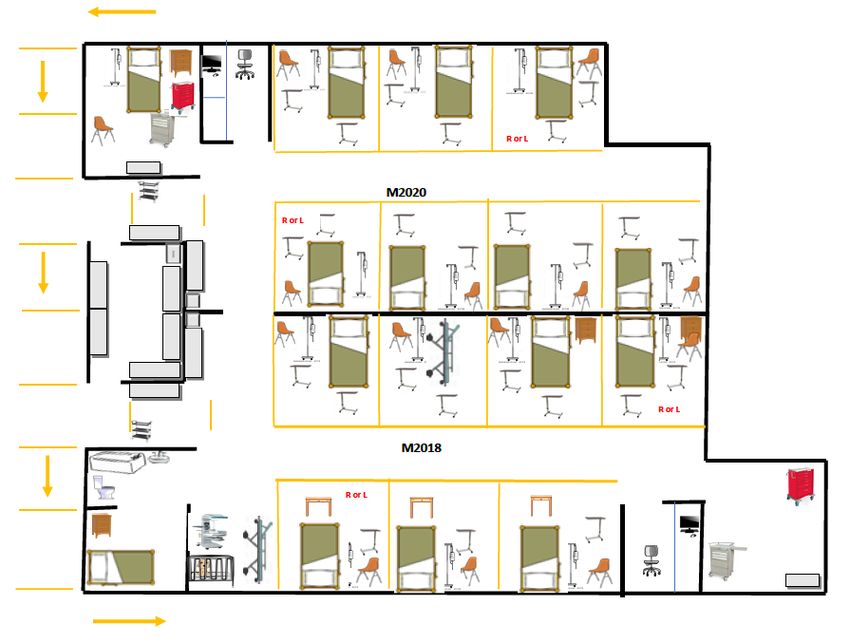
2. To allow for and safeguard physical distancing in the SHC the number of people permitted in each lab
(rooms M2018 and M2020) will be restricted to less than ten people. Skills practice labs/classes are
comprised of seven students and one instructor. Occupancy limits will be posted on lab doors.
3. All other rooms in the SHC will remain locked with access restricted to SHC instructors or staff.
4. Additional controls and reminders to safeguard physical distancing in the SHC include:
i. Signage and floor markings showing two-meter distancing and direction of movement.
ii. Removal of all unnecessary equipment and furniture and reconfiguration of required equipment and
furniture to allow for ease of movement for physical distancing.
iii. Staggered start and end times for labs/classes, see Appendix B.
iv. Students and instructors will be instructed to arrive at their scheduled time and to wait in the
second-floor hallway adjacent to the lab until directed to enter the SHC.
v. Each student will be assigned an individual practice-station upon entering the SHC and will be
instructed that they must remain within the boundary of the practice-station, as indicated by floor
markings (see Appendix C), or as otherwise instructed by an instructor.
vi. Any personal items brought into the SHC must also remain within the boundary of the assigned
practice-station and must be removed when class is finished.
vii. Due to limited space to store personal items at the practice-stations only outwear (e.g. a coat or
jacket), one bag or backpack, and a paper notebook and pen or electronic notebook or laptop per
person, will be allowed.
3Simulation Health Centre
Return to Work Health & Safety Plan
August 2020
Hand Hygiene and
Respiratory 1. Sinks for handwashing are located in each lab (rooms M2018 and M2020).
Etiquette
2. Alcohol-based hand rub (ABHR) dispensers will be located at entry/exits to the SHC labs (M2018 and
M2020) and at each practice-station.
3. Students, instructors and staff must perform hand hygiene before entering and exiting the SHC, and at
all times as would be indicated during patient care as per clinical infection control requirements,
including before and after glove use.
4. Hand Hygiene and Respiratory Etiquette posters will be posted at entrances to the SHC.
5. All persons entering the SHC will adhere to Respiratory Etiquette guidelines.
Cleaning &
disinfection 1. Equipment and supplies will not be shared or exchanged between students and /or instructors during
classes. Each student practice-station will be stocked with ABHR and the suppies and equipment
needed for the class.
2. Equipment that must be shared between classes will be cleaned and disinfected between use by SHC
staff, using checklists, according to SOP for cleaning and disinfecting (Appendix D). Checklists will
be retained in a locked file in the SHC for documentation that cleaning and disinfecting was
completed.
3. Time between classes will be scheduled (see Appendix B) to allow for environmental cleaning and
disinfection of high touch surfaces, and furniture within each practice-station (chairs, tables, and beds
including siderails, head and footboards, controls and mattresses) using checklists.
4. Garbages will be emptied and sinks and floors cleaned at the end of the day by Caretaking Services.
4Simulation Health Centre
Return to Work Health & Safety Plan
August 2020
Use of Face Masks
and Respirators 1. Face masks must be correctly worn at all times while in the SHC.
2. For the safety and protection of the campus and local community, the University of Lethbridge will
require the wearing of face coverings or non-medical masks in indoor public spaces and outdoors
when physical distancing cannot be maintained on its Lethbridge campus beginning on Monday, Aug.
10.
Frequency/Scheduli
ng 1. Working alone will be avoided, however SHC staff and instructors may periodically need to work
alone between August 17, 2020 and Sept. 9, 2020 to prepare the SHC for classes.
2. Faculty, instructors and staff working alone will follow the U of L Working Alone Protocol and
complete the online Working Alone Registry.
3. Class start and end times will be staggered to avoid congestion in hallways and common areas. See
Appendix B.
Health Monitoring
and Self Isolation
1. All students, faculty, and staff will be required to complete the AHS COVID-19 Self-Assessment
before entering the SHC to ensure they are healthy. Anyone experiencing symptoms of COVID-19 is
required by law to follow Alberta’s isolation requirements and be prepared to share their contact
information for contact tracing.
a. Any person with symptoms of COVID-19, that are not related to a pre-existing illness or health
condition, will not be permitted access to the SHC and will be reminded they must register on the
U of L Staff / Faculty illness COVID-19 registry.
5Simulation Health Centre
Return to Work Health & Safety Plan
August 2020
2. Daily attendance lists of all persons entering the SHC will be collected by the SHC staff and will be
retained in a locked cabinet in the SHC.
Equipment
1. Equipment will be tested, calibrated, and maintenance completed during the week of Aug. 24th, 2020.
Building Systems
1. Sinks will be flushed for 3 minutes while being monitored for leaks.
Deliveries/Supply
Chain 1. Required supplies and equipment have been secured for the Fall 2020 semester and delivered to the
SHC.
Inspection /
Compliance 1. The Simulation Health Centre Coordinator and Instructors will conduct inspections and enforce the
requirements of the Return to Work Plan.
By signing this form, you acknowledge that you understand and will adhere to the details outlined in the Return to Work
Health & Safety Plan:
Supervisor’s Name:
Supervisor’s Signature:
Worker Name Signature Date
6Simulation Health Centre
Return to Work Health & Safety Plan
August 2020
7Simulation Health Centre
Return to Work Health & Safety Plan
August 2020
Appendix A: Hazard Assessment
COVID-19 HAZARD ASSESSMENT AND CONTROL REPORT FORM
Job/Position/Work Type: Faculty/ Location of Work: Simulation Date: 19/07/2020
Students/Staff/SHC Skills Labs Health Centre
Assessment completed by: Sharon Dersch Reviewed/Revised:
Activity/Task Description of Hierarchy of Hazard Controls
Rating (High, Moderate, Low)
Hazard (OHS Code 2009, Part 2 section 9)
Risk Total = (L*S)
Likelihood (L)
Severity (S)
(List all tasks and Note: There may be Elimination/Substitution (E/S) if this
activities of the more than one hazard not an option the following hierarchy
job/work) associated with an of controls is to be followed:
activity or task.
• Engineering Controls (EC)
• Administrative Controls (AC)
• Personal Protective Equipment
(PPE)
Working Alone -Isolation EC: telephone, cell phone,
-Lack of AC: training, organizing and planning work, rotation of workers, U of L working alone
communication 3 3 9 H procedure and login system; check in/out procedure, Working on Campus Registry, list of
in the event of emergency contact phone numbers
an emergency
8Simulation Health Centre
Return to Work Health & Safety Plan
August 2020
Campus -hazards associated AC: report property damage and/or maintenance, report to Security and Facilities
awareness property damage or 2 2 4 M Services.
maintenance required
Work activities Potential contact with
able to maintain droplets, expelled either AC: self-isolation of symptomatic workers from workplace, practice good hand hygiene,
2 2 4 M
physical by a cough/sneeze or on practice respiratory etiquette, safety training, frequent cleaning of touched surfaces,
distancing of 2 m a contaminated surface cleaning SOP.
Work activities Probable contact with EC: physical barriers/Plexiglas windows
not able to droplets, expelled either AC: self-isolation of symptomatic workers from workplace, practice good hand hygiene,
maintain by a cough/sneeze or on 3 2 6 H practice respiratory etiquette, safety training, frequent cleaning of touched surfaces,
physical a contaminated surface cleaning SOP.
distancing of 2m PPE: face masks,
Working with • electrical shock EC: engineered design of equipment; properly grounded,
electrical equip • burns AC: safety training; disconnect equipment before cleaning; do not overload outlets,
minimize the use of extension cords, do not use power strips and extension cords in
1 3 3 M multiple combinations, i.e. plugging one power strip into another or an extension cord;
inspect cords regularly for fraying cuts, or breakage; do not attach cords to walls, pipes, or
windows; do not twist cords or push tightly into outlets; use only approved electrical
equipment (CSA,ULC etc); do not run cords across hallways, walkways or under carpets
Lifting and Musculoskeletal injuries EC: lifting aids and carts
carrying AC: use correct body mechanics; use lifting aids or request assistance when moving
2 1 2 L
heavy objects; minimize lifting from the floor and from heights; use caution moving carts
on slopes
Working with Needle stick injury; cuts, EC: sharps disposal container at each workstation; shielded needles; tools for handling of
sharps broken glass ampules, sharp materials/equipment
2 1 2 L
AC: safety training, organizing and planning work, access to first aid kit
PPE: ampule guards
Group Labs Potential person-to- EC: -Signage and floor markings showing two-meter distancing and direction of
person transmission of movement.
SARS-CoV-2 via - Removal of all unnecessary equipment and furniture and reconfiguration of required
droplets equipment to allow for physical distancing and ease of movement
AC: -Self-isolation of symptomatic workers from workplace.
3 2 6 H
- Two-meter distancing at all times
- Staggered start and end times for classes.
- Access to skills lab (rooms M2018 and M2020) restricted to less than ten people
/class. All other rooms locked, and access restricted to only one SHC instructor or
staff member at a time.
9Simulation Health Centre
Return to Work Health & Safety Plan
August 2020
- Each attendee will be assigned an individual practice-station/work area delineated
with floor signage.
- Frequent hand hygiene.
- Respiratory etiquette.
- Frequent cleaning of high touch surfaces.
PPE:- Continuous face masking while in the SHC is required.
Group Labs Possible exposure to EC: -Removal of unnecessary supplies and linens that cannot be cleaned and disinfected
surfaces or objects between users
contaminated with AC: - Self-isolation of symptomatic workers from workplace.
SARS-CoV-2 - Enhanced cleaning and disinfecting procedures.
- Frequent cleaning, at least twice a day, of high touch surfaces
- Equipment cleaned and disinfected between users using SOP and checklists;
3 2 6 H - Staff training on SOP for cleaning and disinfecting equipment.
- No sharing of supplies, equipment, or personal items (e.g. pens, books) between
attendees.
- Personal items brought into the SHC must remain within the boundary of the
assigned practice-station/work area.
- Respiratory etiquette.
- Frequent hand hygiene
Use of chemical Skin eye irritant AC: -WHMIS training; read SDS on all chemicals prior to use; store chemicals
disinfectants 2 1 2 L appropriately, do not store unneeded chemicals; Phone security Services desk for
chemical spills
By signing this form, you acknowledge that you understand the hazards and associated controls:
Supervisor’s Name Supervisor’s Signature
Worker Name Signature Date
10Simulation Health Centre
Return to Work Health & Safety Plan
August 2020
Appendix B: Simulation Health Centre Fall 2020 Lab Schedule
Room M2018
Date Time Class
Thursday Sept. 10 0730-1400 NURS 4530 Section XF
(1030-1100 Break and cleaning)
1400-1530 Cleaning and disinfecting
Friday Sept. 11 0800-1430 NURS 4530 Section XH
(1030-1100 Break and cleaning)
1430-1600 Cleaning and disinfecting
Monday Sept. 14 0700-1330 NURS 4530 Section X
(0930-1000 Break and cleaning)
1330-1500 Cleaning and disinfecting
Tuesday Sept. 15 0800-1430 NURS 4530 Section XB
(1030-1100 Break and cleaning)
Room M2020
Thursday Sept. 10 0700-1330 NURS 4530 Section XD
(0930-1000 Break and cleaning)
1330-1500 Cleaning and disinfecting
1500-2130 NURS 4530 Section XE
(1730-1800 Break and cleaning)
Friday Sept. 11 0700-0830 Cleaning and disinfecting
0830-1500 NURS 4530 Section XG
(1130-1200 Break and cleaning)
1430-1600 Cleaning and disinfecting
Monday Sept. 14 0730-1400 NURS 4530 Section XA
(1030-1100 Break and cleaning)
1400-1530 Cleaning and disinfecting
Tuesday Sept. 15 0830-1500 NURS 4530 Section XC
(1030-1130 Break and cleaning)
11Simulation Health Centre
Return to Work Health & Safety Plan
August 2020
Appendix C: Floor Plan
Floor Signage
12Simulation Health Centre
Return to Work Health & Safety Plan
August 2020
Appendix D: Simulation Health Centre Standard Operating Procedures: Cleaning and Disinfecting
COVID-19 Baxter SIGMA Spectrum Infusion Pump Cleaning and Disinfecting
Purpose: This standard operating procedure (SOP) provides instructions on when and how to clean the Baxter Sigma Spectrum Infusion Pump to
prevent the risk of transmission of SARS-CoV-2 by indirect contact.
Frequency: Pumps must be cleaned and disinfected between each user.
Materials: Compatible Disinfectants
Product Name Contact Time- surface must remain visibly wet
Metrex Cavicide®1 3 minutes
TM 1
Metrex CaviWipes 3 minutes
Super Sanicloth® 2 minutes
Sani-Cloth® Bleach Wipes 4 minutes
1. Cavicide spray and CaviWipes are approved for both use on the Sigma Pump and currently included on the Government of Canada list of hard-surface
disinfectants demonstrating that they are likely to be effective and may be used against SARS-CoV-2.
Notes and Warnings:
1. Don gloves prior to handling the pump and disinfectants used for cleaning and disinfecting.
2. Turn pump off and unplug before cleaning and disinfecting.
3. If present clean any visible soiling on the pump using a soft cloth and warm water prior to disinfecting. A single disinfectant wipe can be
used to clean and disinfect when the product label indicates it can be used for both (AHS, 2020).
4. Only use SIGMA spectrum specified compatible disinfectants included on the Government of Canada list of hard-surface disinfectants
demonstrating that they are likely to be effective and may be used against SARS-CoV-2.
5. Do not use sprays directly on the pump.
6. Do not allow fluid to seep into the pump or between pump components (especially through the keyhole, door latches, or speaker vent).
7. Do not immerse any part of the pump or battery.
8. Do not apply disinfectants directly to battery packs exposed terminals.
9. Only use damp, not wet or dripping, wipes and cloths. Wring excess disinfectant out as needed.
10. Only use a damp lint-free foam tipped swabs to clean the tube channel. Apply disinfectant sparingly and blot excess moisture from the
swab using a lint free towel of gauze squares.
11. Allow disinfectant to remain on the pump surface in an even, but not dripping, film for the manufactures' recommended contact time.
12. Ensure pump is dry before reuse. Wipe dry or air-dry after completion of contact time period
13Simulation Health Centre
Return to Work Health & Safety Plan
August 2020
Process:
Step Detail
1. Perform hand hygiene and don gloves
2. Turn the pump off and unplug the AC power adaptor from the power source.
3. Clean exterior of pump with damp cloth to remove any visible soiling if present.
4. Using a damp disinfecting wipe, or cloth moistened with approved disinfectant, wipe all the
outside surfaces of the pump using caution that no fluids seep into the keyhole, door latches,
or rear case speaker vent.
5. Open the pump door using an IV slide clamp.
6. Apply disinfectant sparingly to a lint-free, foam tipped swab and blot the swab onto a dry
lint-free towel to remove excess solution.
7. Clean the pump channel areas using the moistened foam tipped swab.
8. Using a new disinfecting wipe, or cloth dampened with approved disinfectant, wipe the
power cord connector and full length of the cord. Do NOT wipe the A/C power adapter
9. Wipe the IV pole, including the hooks at the top, and pump pole clamp with disinfectant
wipe.
10. Wipe dry or air-dry after completion of contact time period before reconnecting power sourc .
References
AHS. (2020). Key points for Ready-to-Use disinfectant Wipes. Retrieved from
https://www.albertahealthservices.ca/assets/healthinfo/ipc/if-hp-ipc-bpg-ready-to-use-wipes-info.pdf
Baxter Health Care Corporation. (2018). Cleaning and storage. SIGMA Spectrum Infusion Pump Operator’s Manual
41018v0800 Rev. Medina, New York
Government of Canada. Date modified: 2020-07-09. Hard-surface disinfectants and hand sanitizers (COVID-19): List of
disinfectants with evidence for use against COVID-19. Retrieved from https://www.canada.ca/en/health-canada/services/drugs-
health-products/disinfectants/covid-19/list.html
Metrex. (2019). Surface disinfectants. Retrieved from https://www.metrex.com/en-ca/products/surface-disinfectants/caviwipes
14Simulation Health Centre
Return to Work Health & Safety Plan
August 2020
COVID-19 Laerdal Manikin and Bed Cleaning and Disinfecting
Purpose: This standard operating procedure (SOP) provides instructions on when and how to clean the Laerdal Nursing Anne, Nursing Kelly and
3G manikins, and beds to prevent the risk of transmission of SARS-CoV-2 by indirect contact.
Frequency: Manikins and beds must be cleaned and disinfected between each user.
Materials: Compatible Disinfectants
Product Name Contact Time-
surface must remain visibly wet
Metrex Cavicide® 3 minutes
Metrex CaviWipes® 1 3 minutes
Clorox® Disinfecting Wipes 2 15 seconds
Lysol® Disinfecting Wipes 2 4 minutes
Virkon® M 3% solution 10 minutes
60 % Isopropanol 10 minutes
70 - 90 % Ethanol 10 minutes
0.5 % Sodium Hypochlorite 3 10 minutes
1. Can be used for cleaning and disinfecting
2. Surface must be precleaned of visible soil prior to disinfection
3. Skins with nylon zippers should not be cleaned with Sodium Hypochlorite (e.g. Laerdal 3G manikins).
Notes and Warnings:
1. Don gloves prior to handling the manikin and bed and when using disinfectants.
2. Unplug from power source (outlet or battery pack) before cleaning and disinfecting.
3. If present clean any visible soiling from surfaces using a soft cloth and soap and water prior to disinfecting. A single disinfectant wipe can be
used to clean and disinfect when the product label indicates it can be used for both (AHS, 2020).
4. Only use disinfectants included on the Government of Canada list of hard-surface disinfectants demonstrating that they are likely to be
effective and may be used against SARS-CoV-2.
5. Disinfectants must remain visibly wet for the manufactures' recommended contact time.
6. Do not allow fluid to seep into the manikins around the hard-plastic chest component.
7. Wipe dry or air-dry after completion of contact time period before reconnecting power source.
15Simulation Health Centre
Return to Work Health & Safety Plan
August 2020
Process:
Step Detail
1. Perform hand hygiene and don gown and gloves.
2. Unplug the manikin from the power source (battery pack or outlet).
3. Remove patient gown and place in laundry hamper. (No other linens will be on the
beds).
4. For each of the following steps examine surfaces for any visible soiling and if present
clean with soap and water to remove visible soiling prior to disinfecting. This step is not
required if using disinfecting wipes designated for both cleaning and disinfecting (e.g.
CaviWipes TM).
5. Disinfect the front/ventral surfaces and perineum of the manikin by thoroughly wetting with
approved disinfecting wipes or cloth moistened with approved disinfectant ensuring surfaces
remain visibly wet for the specified contact time.
6. Roll manikin onto one side.
7. Disinfect the back and upper lateral side of the manikin by thoroughly wetting with approved
disinfecting wipes, or spray disinfectant directly onto precleaned surface, ensuring surfaces
remain visibly wet for the specified contact time.
8. Disinfect the exposed top half and side of the mattress by thoroughly wetting with approved
disinfecting wipes, or spray disinfectant directly onto precleaned surface. After the specified
contact time has elapsed, if needed, dry mattress and manikin before completing the next
step.
9. Roll manikin onto other side and disinfect the other lateral surface of the manikin and
exposed mattress top and side as per steps 7 and 8.
10. Disinfect the side-rails, and attached bed control unit if present on siderails, with an approved
disinfectant wipe or cloth moistened with approved disinfectant ensuring surfaces remain
visibly wet for the specified contact time.
11. Disinfect the headboard, and bed control unit if present on headboard, with an approved
disinfectant wipe or cloth moistened with approved disinfectant ensuring surfaces remain
visibly wet for the specified contact time.
12. Disinfect the footboard with an approved disinfectant wipe or cloth moistened with approved
disinfectant ensuring surfaces remain visibly wet for the specified contact time.
16Simulation Health Centre
Return to Work Health & Safety Plan
August 2020
References
AHS. (2020). Key points for Ready-to-Use disinfectant Wipes. Retrieved from
https://www.albertahealthservices.ca/assets/healthinfo/ipc/if-hp-ipc-bpg-ready-to-use-wipes-info.pdf
Clorox. (2020). Help Prevent the Spread SARS-CoV-2 (coronavirus that causes COVID-19). Retrieved from https://clorox.ca/stop-
the-spread/
Laerdal. (2020). Hygiene and cleaning procedures for CPR manikins. Retrieved from
https://laerdal.force.com/HelpCenter/s/article/Hygiene-and-cleaning-procedures-for-CPR-manikins#ManikinSkins
Lysol. (2020). Lysol disinfecting Wipes: Usage. Retrieved from https://www.lysol.com/products/disinfecting-wipes/lysol-
disinfecting-wipes-lemon-and-lime-blossom/
Metrex. (2019). Surface disinfectants. Retrieved from https://www.metrex.com/en-ca/products/surface-disinfectants/caviwipes
Government of Canada. (Date modified: 2020-07-09). Hard-surface disinfectants and hand sanitizers (COVID-19): List of
disinfectants with evidence for use against COVID-19. Retrieved from https://www.canada.ca/en/health-canada/services/drugs-
health-products/disinfectants/covid-19/list.html
17Simulation Health Centre
Return to Work Health & Safety Plan
August 2020
COVID-19 SHC Cleaning and Disinfecting Checklist
Room #: ________ Practice Station #: _______
Initial Step Cleaning and disinfecting performed according to SHC COVID-19 SOP
Infusion Pump
11. Performed hand hygiene and donned gloves.
12. Turned the Baxter infusion pump off and unplugged the AC power adaptor.
13. Examined pump for any visible soiling and if present cleaned prior to disinfecting.
14. Disinfected the front, back, and both sides of the Baxter infusion pump
15. Disinfected the top and bottom of pump.
16. Disinfected the pump channel using a moistened foam tipped swab.
17. Disinfected the pump power cord connector and full length of the cord.
18. Disinfected the full length of the IV pole, including hooks and pump pole-clamp.
19. Ensured pump was dry after completion of contact time before plugging it back in.
Manikin and Mattress
20. Unplugged bed from the power source (battery pack or outlet).
21. Removed patient gown and placed in laundry hamper.
22. Examined surfaces for any visible soiling and if present cleaned prior to disinfecting.
23. Disinfected the front surfaces and perineum of the manikin.
24. Turned manikin onto left side and disinfected the back and right side of the manikin.
25. Disinfected the exposed top half and left side of the mattress.
26. Disinfected left side-rails and attached bed control unit if present on siderails.
27. Disinfected headboard, and bed control unit if present on headboard
28. Dried mattress and manikin, if still wet, after the specified contact time (3 minutes).
29. Turned manikin onto right side and disinfected left side of the manikin and exposed mattress top and
side.
30. Disinfected right side-rails and attached bed control unit if present on siderails.
31. Disinfected footboard.
32. Dried mattress and manikin after the specified contact time if still wet.
Cleaning and disinfecting completed according to the SHC COVID-19 SOP
Signature: ______________________Date: __________ Time: _________
18Simulation Health Centre
Return to Work Health & Safety Plan
August 2020
Furniture
• Examined surfaces for any visible soiling and if present cleaned prior to disinfecting.
• Disinfected supply tabletop, height control lever, and ABHR bottle.
• Disinfected overbed tabletop and height control lever.
• Disinfected chair.
• Disinfected sharps container, suction regulator, canister and tubing.
19You can also read


