SCDHEC COVID-19 GUIDANCE FOR K-12 SCHOOLS
←
→
Page content transcription
If your browser does not render page correctly, please read the page content below
SCDHEC COVID-19 GUIDANCE
                  FOR K-12 SCHOOLS
                                                          2021-2022 Academic Year

                                                                                               Notice
           Guidance is subject to change as new information requires. Updates will be indicated in dates
        associated with each individual document and will be recorded for historical records within each.

                                                                                  Leigh Bragg, MD

PG. 0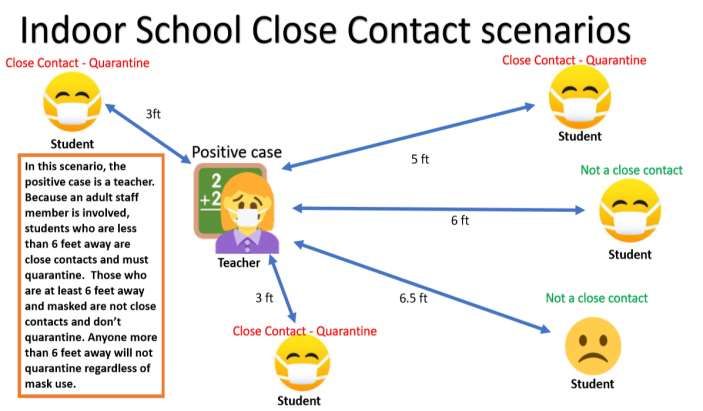
Table of Contents
   August 20, 2021 ............................................................................................................................................................. 3
COVID-19 Interim Guidance for K-12 School Operations .................................................................................. 5
   August 20, 2021 ............................................................................................................................................................. 5
            1. Vaccination ...................................................................................................................................6
            2. Mask Use ......................................................................................................................................6
            3. Physical Distancing .......................................................................................................................7
            4. Contact Tracing in Combination with Isolation and Quarantine ..................................................8
            5. Staying Home When Sick and Getting Tested ..............................................................................8
            6. Asymptomatic Screening Testing .................................................................................................8
            7. Ventilation ....................................................................................................................................9
            8. Handwashing and Respiratory Etiquette......................................................................................9
            9. Cleaning and Disinfection ...........................................................................................................10
Interim Guidance for School Buses ...................................................................................................................... 11
   May 12, 2021 ............................................................................................................................................................... 11
            Social Distancing and Capacity .......................................................................................................11
            Cleaning and Disinfection ...............................................................................................................11
            Ventilation ......................................................................................................................................11
            Personal Prevention Practices ........................................................................................................12
            Messaging to Parents .....................................................................................................................12
K-12 Schools Interim Guidance for Management of COVID-19 Cases ......................................................... 13
   August 20, 2021 ........................................................................................................................................................... 13
            Preparation for COVID Cases in the School ....................................................................................14
            Individuals with symptoms of COVID-19 (but no known exposures to COVID-19)........................14
            COVID Case in School .....................................................................................................................14
            Management of Cases and Contacts in School Settings Table .......................................................16
            Athletics/Activities* .......................................................................................................................18
            Household contact .........................................................................................................................18
            Staff working while in quarantine ..................................................................................................18
......................................................................................................................................................................................... 20
   Interim DHEC COVID-19 School Testing Guidance ....................................................................................... 20
   August 15, 2021 ........................................................................................................................................................... 20
            Types of Covid-19 Tests ..................................................................................................................20
            Diagnostic Testing ..........................................................................................................................20
            Asymptomatic Screening Testing (Optional Program) ...................................................................21

PG. 1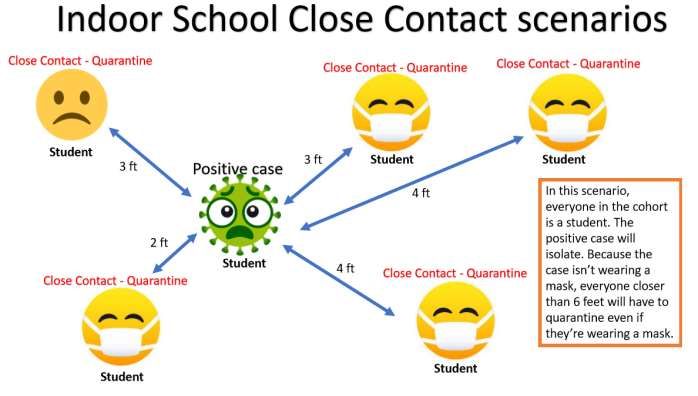
Screening testing in activities/sports .............................................................................................22
            At-home self-testing .......................................................................................................................23
Resources .................................................................................................................................................................... 25
            South Carolina School and Childcare Exclusion LIst .......................................................................25
            Understanding Quarantine Calendars............................................................................................25
            CDC K-12 Schools and Childcare Guidance ....................................................................................25
            CDC Antigen Tests Guidelines ........................................................................................................25
            DHEC List of Reportable Conditions ...............................................................................................25
            CDC Antigen Tests Guidelines ........................................................................................................25
            ........................................................................................................................................................26
            COVID-19 School Notification Letter ..............................................................................................26
            Current as of Aug. 2, 2021 ..............................................................................................................26
            ........................................................................................................................................................27
            COVID-19 Close Contact Notification Letter ..................................................................................27
            Current as of Aug. 2, 2021 ..............................................................................................................27
            Indoor School Close Contact Scenarios ..........................................................................................28
            August 20, 2021..............................................................................................................................28

PG. 2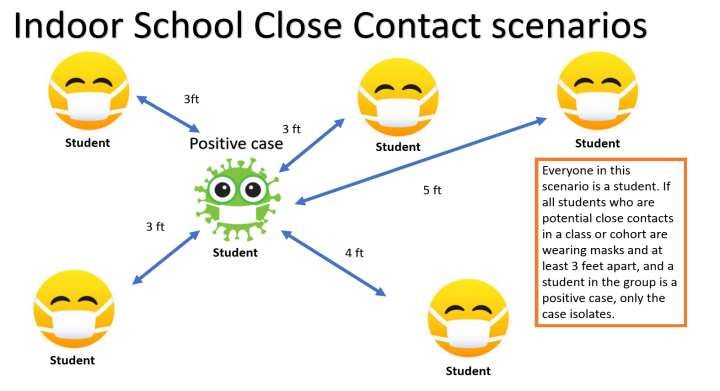
Definitions
                                                   August 20, 2021

Isolation: Isolation is used to separate people infected with the virus (those who are sick with COVID-19 and those
with no symptoms) from people who are not infected. They must remain at home or the place they were told to
isolate and avoid contact with other people until their isolation period is over. This includes avoiding contact with
those in their household as much as possible.

Quarantine: Quarantine is used to separate people who are close contacts of someone with a contagious disease, like
COVID-19, from others for a period of time to see if they become sick. This is a method to prevent the spread of
disease. When someone is quarantining, they should stay home and avoid contact with other people until the
quarantine period is over. This includes people in their household as much as it is possible.

Close contact: Someone who was within 6 feet of an infected person (laboratory-confirmed or a clinically compatible
illness) for a cumulative total of 15 minutes or more over a 24-hour period (for example, three individual 5-minute
exposures for a total of 15 minutes) from 48 hours prior to symptom onset (or specimen collection for an
asymptomatic infected person) of the infected person.
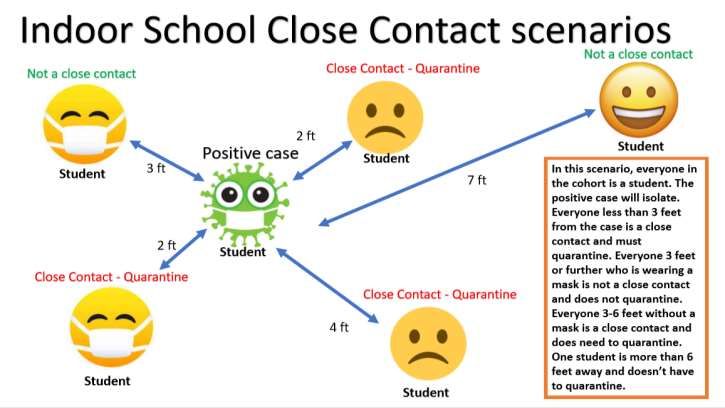
     • The close contact definition excludes students who were within 3 to 6 feet of an infected student (laboratory-
          confirmed or a clinically compatible illness) if both the infected student and the exposed student(s) wore
          masks during the exposure time. This exception does not apply to teachers, staff, or other adults in the indoor
          classroom setting.
     • Close physical contact can include contact with the mucous membranes of a COVID infected person through
          such things as, kissing, sharing eating/drinking utensils, etc., regardless of the time frame.

Contact tracing: The practice of identifying, notifying, and monitoring individuals who may have had close contact with
a person determined to be a confirmed or probable case of an infectious disease as a means of controlling the spread
of infection.

Fully vaccinated: A person is considered fully vaccinated, ≥2 weeks following receipt of the second dose in a 2-dose
series, or ≥2 weeks following receipt of one dose of a single-dose vaccine.

Diagnostic Testing: The use of viral (antigen or PCR) COVID-19 tests to determine if an individual with symptoms
compatible with COVID-19 is currently infected with SARS CoV-2, the virus that causes COVID-19.

Screening: Routine, typically performed at least once weekly, viral (PCR or antigen) testing of asymptomatic individuals
in order to identify asymptomatic individuals infected with SARS CoV-2, the virus that causes COVID-19.

Rapid Test: A test (antigen or PCR) that is administered and processed within the same day on premise without
sending to another location for processing. Results are typically processed and available within several minutes.

OTC: Over the Counter Use – a medical product approved for use at home without need of a medical professional and
without a prescription.

PG. 3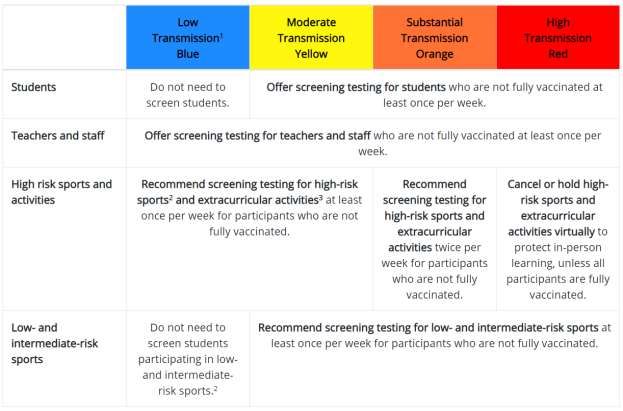
PPE: Personal protective equipment that includes but is not limited to medical grade gloves, face masks, N-95
Respirators, face shields, and gowns.

Prevention strategies: Actions taken to help reduce the transmission of the virus that causes COVID-19.

PG. 4
COVID-19 Interim Guidance for K-12 School Operations
                                                   August 20, 2021
Introduction

As noted by the American Academy of Pediatrics (AAP) and the Centers for Disease Control and Prevention (CDC),
reopening schools so students can resume in-person, full time education is vitally important to ensuring students do
not fall behind scholastically or socially. This interim guidance is based on the latest evidence-based science with the
goal of ensuring schools can reopen as safely as possible. As conditions change and more evidence becomes
available, the South Carolina Department of Health and Environmental Control (DHEC) will update this interim
guidance as needed.

Schools should consider multiple factors, based on the school population and surrounding community, when making
decisions about implementing layered prevention strategies against COVID-19. The primary factors to consider
include (in order of importance):
    • COVID-19 outbreaks or increasing trends in the school or surrounding community. (See DHEC School Data)
    • Level of community transmission of COVID-19. (See CDC County Level Data)
    • Ages of children served by K-12 schools and the associated social and behavioral factors that may affect risk
        of transmission and the feasibility of different prevention strategies.
    • COVID-19 vaccination coverage in the community and among students, teachers, and staff, if available. (See
        CDC Vaccination Data and DHEC Vaccination Dashboard)
    • Use of an optional frequent screening testing program for students (with parental permission), teachers, and
        staff who are not fully vaccinated.

The SC General Assembly included a proviso, or condition, in the budget for this year that prohibits schools or school
districts from using state funds for requiring masks: “No school district, or any of its schools, may use any funds
appropriated or authorized pursuant to this act to require that its students and/or employees wear a facemask at any
of its education facilities. This prohibition extends to the announcement or enforcement of any such policy.” (Proviso
1.108 of the Fiscal Year 2021-2022 General Appropriations Act)

Layered Prevention Strategies to Reduce Transmission of COVID-19 in Schools

Prevention strategies are essential to safe delivery of in-person instruction and help to prevent COVID-19
transmission in schools. Schools will have a mixed population of both people who are fully vaccinated and people
who are not fully vaccinated. These variations require schools to make decisions about the use of COVID-19
prevention strategies in their schools to protect all people in the school environment, including those who are not
fully vaccinated.

The need for layering specific prevention strategies will vary, and localities might implement more or fewer COVID-
19 prevention strategies based on community transmission levels, vaccination coverage, and local policies and
regulations. However, if considering whether and how to remove prevention strategies, it is important that only one
prevention strategy should be removed at a time and students, teachers, and staff should be closely monitored (with
adequate testing through the school or community) for any outbreaks or increases in COVID-19 cases after removal.

PG. 5
These COVID-19 prevention strategies remain critical to protect people, including students, parents and guardians,
teachers, and staff, who are not fully vaccinated, especially in areas of moderate-to-high community transmission
levels:
1. Vaccination
2. Mask use
3. Physical distancing
4. Contact tracing, in combination with isolation and quarantine
5. Staying home when sick and getting tested
6. Screening testing to promptly identify cases, clusters, and outbreaks
7. Ventilation
8. Handwashing and respiratory etiquette
9. Cleaning and disinfection
1. Vaccination
• Vaccination is currently the leading public health prevention strategy to end the COVID-19 pandemic.
• Currently vaccination with the highly effective Pfizer vaccine is available to all people age 12 years and
above. Vaccination with the highly effective Moderna and Janssen vaccines are available to those 18 years
and above.
• Schools are strongly encouraged to work with local public health officials and healthcare facilities and
professionals to provide factual information and education about COVID-19 vaccination and to increase
access to COVID-19 vaccines by coordinating vaccine clinics for staff, students, and families who wish to be
vaccinated.
• Schools should not inquire about individuals’ vaccination status, but people may voluntarily disclose it to the
school.
2. Mask Use
• DHEC recognizes mask use cannot be mandated per the SC General Assembly but is providing the following
guidance for teachers, staff, and parents.
• DHEC strongly recommends mask use for all people when indoors in school settings, especially when physical
distancing is not possible. Children under two years old, anyone who has trouble breathing, or anyone
unable to remove the face covering without assistance should not wear a mask.
o Based on the needs of the community and the rates of community or school spread and vaccination,
school districts may opt to recommend mask use in a school.
o All people in the school setting should be allowed to wear a mask if they wish, and steps should be
taken to ensure students are not bullied or criticized for wearing a mask.
• A close contact who is ending quarantine early (less than 14 days) and returning to the school environment
should wear a mask and follow physical distancing guidelines in order to return to in-person learning, per
CDC and DHEC guidelines for ending quarantine early.
o Districts and schools may elect to implement or forego the option of shortened quarantine
depending on their individual capabilities. Individuals should defer to district or school policy when
determining their return to the educational environment from quarantine.
• The most effective fabrics for cloth masks are tightly woven, such as cotton and cotton blends, breathable,
and in two or three fabric layers. Masks with exhalation valves or vents, those that use loosely woven fabrics,
and those that do not fit properly are not recommended.
o Schools should provide masks to those students who need or request them, such as students who
forget to bring their mask or whose families are unable to afford them.
• Indoors: Masks are strongly recommended to be worn at all times in school facilities (classroom and non-
classroom settings), with exceptions for specific people (children under 2 years old, anyone who has trouble
breathing, or anyone unable to remove the face covering without assistance), or for certain settings or
activities, such as while eating or drinking or when alone in an office.
PG. 6• Outdoors: In general, people do not need to wear masks when outdoors with the following exception.
o In areas of substantial to high transmission, CDC recommends that people who are not fully
vaccinated wear a mask in crowded outdoor settings or during activities that involve sustained close
contact with other people who are not fully vaccinated.
• School buses: Mask use is required on school buses and other public transportation per federal CDC Order
regardless of the mask policy at school or the individual’s vaccination status; school systems should take
appropriate steps to ensure compliance with this requirement by students, staff, and others. Per the CDC:
o “CDC’s Mask Order requires the wearing of masks by travelers to prevent the spread of the virus that
causes COVID-19. The requirement to wear a mask also applies to passengers and drivers on school
buses, including on buses operated by public and private school systems, subject to the exclusions
and exemptions in CDC’s Order. Operators of school buses should refer to the Department of
Education’s COVID-19 Handbook for additional guidance. Note, drivers do not need to wear a mask if
they are the only person on the bus. For additional information on the requirements of this Order,
please visit Requirement for Face Masks on Public Transportation Conveyances and at Transportation
Hubs | CDC.”
• Healthcare areas: Locations designated for healthcare, testing, or for awaiting pickup due to illness are
considered healthcare facilities. Examples include health rooms and athletic trainer offices. As such,
infection control policies and practices are held to healthcare facility standards and expectations which may
differ from policies of non-healthcare school facilities.
o Individuals being assessed, tested, or dismissed from attendance due to respiratory symptoms
should be required to wear a face covering while in these designated healthcare areas and also when
transiting to/from these areas.
3. Physical Distancing
• At least three (3) feet of distance between each person should be maintained to the greatest extent possible.
o Arrange desks to maximally increase the space between them. Make desks face in the same
direction (rather than facing each other). Remove non-essential furniture to maximize the distance
between students.
• Avoid in-person assemblies or other congregate events. These may be done virtually with cohorts of
students in classrooms if technology is available.
• Avoid students congregating in common use areas. For example, have students eat meals outdoors when
feasible or utilize a consistent seating arrangement (similar to cohorting) rather than mixing in the cafeteria
or other common indoor area.
o If it is not possible to suspend use of common areas, try to limit the extent to which students mix
with each other, and particularly with students from other classes.
o Restrict hallway use through staggered release of classes. Stagger arrival and dismissal times.
• Limit people present to only students and essential faculty and staff.
• Cohorting: keeping people together in a small group and having each group stay together throughout an
entire day. Cohorting can be used to limit the number of students, teachers, and staff who come in contact
with each other, especially when it is challenging to maintain physical distancing, such as among young
children, and particularly in areas of moderate-to-high transmission levels. The use of cohorting can limit the
spread of COVID-19 between cohorts but should not replace other prevention measures within each group.
Cohorting people who are fully vaccinated and people who are not fully vaccinated into separate cohorts is
not recommended. It is a school’s responsibility to ensure that cohorting is done in an equitable manner that
does not perpetuate academic, racial, or other tracking, as described in the U.S. Department of
Education’s COVID-19 Handbook, Volume 1.
• Transportation: Create distance between children on school buses (for example, assign seats, seat children
one child per row, skip rows, use seating charts to assist with contact tracing), to the greatest extent
PG. 7possible. Masks are required by federal order on school buses and other forms of public transportation in
the United States. Open windows to improve ventilation when it does not create a safety hazard.
4. Contact Tracing in Combination with Isolation and Quarantine
• Case investigation and contact tracing are critical strategies to identify and isolate cases and test and
quarantine close contacts to reduce transmission. Schools should collaborate with local health departments
when investigating cases and exposures to COVID-19.
• Require sick students and staff to stay home as per the School and Child Care Exclusion List. Establish
procedures for those who are sick at school to be sent home as soon as possible and kept masked and
separate from others until they can leave.
• CDC defines a close contact as someone who was within 6 feet of an infected person (laboratory-confirmed
or a clinically compatible illness) for a cumulative total of 15 minutes or more over a 24-hour period (for
example, three individual 5-minute exposures for a total of 15 minutes). An infected person can spread the
virus starting from 48 hours before they have any symptoms (or, for asymptomatic patients, 48 hours before
the specimen was collected), until they meet criteria for discontinuing home isolation.
• In the K–12 schools, the close contact definition excludes students who were within 3 to 6 feet of an infected
student (laboratory-confirmed or a clinically compatible illness) if both the infected student and the exposed
student(s) wore masks during the exposure time. This exception does not apply to teachers, staff, or other
adults in the indoor classroom setting.
• Fully vaccinated people and people verified (positive PCR or antigen test) to have been infected with COVID-
19 in the previous 90 days who were in close contact with someone who has COVID-19 but do not have
COVID-19 symptoms do not need to quarantine unless they develop symptoms. Individuals may voluntarily
choose to provide documentation of their full vaccination status to eliminate the need for quarantine. Fully
vaccinated people are recommended to get tested 3-5 days after exposure, even if they do not have
symptoms, and it is important for them to wear a mask at school until 14 days after exposure or they receive
a negative test result.
5. Staying Home When Sick and Getting Tested
• Educate staff, students and their parents on the symptoms of COVID-19 and the importance of staying home
if they have any of the symptoms or if anyone in the household tests positive for the disease. Anyone who
has symptoms of contagious illness, such as COVID-19, should stay home and be referred to their healthcare
provider for testing and care.
• If a student becomes sick at school see What to do if a Student Becomes Sick or Reports a New COVID-19
Diagnosis at School.
• Schools participating in the COVID antigen testing program have the ability to do rapid testing on site which
could facilitate COVID-19 diagnosis and inform the need for quarantine of close contacts and isolation.
Contact DHEC if you are not participating in the program but wish to join it.
6. Asymptomatic Screening Testing
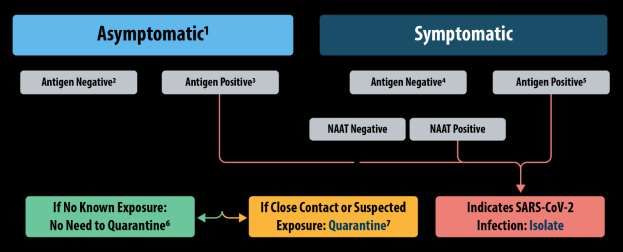
• Diagnostic testing of symptomatic individuals and routine screening testing of asymptomatic individuals are
both essential strategies for reducing disease transmission. Schools may elect to provide either type of
testing or both.
• Asymptomatic screening testing of individuals who are not fully vaccinated identifies infected people,
including those without symptoms or before development of symptoms, who may be contagious, so that
measures can be taken to prevent further transmission.
o If schools implement screening testing, they can more quickly detect new cases and isolate cases,
quarantine those who may have been exposed to COVID-19 and are not fully vaccinated and identify
clusters to reduce the risk to in-person education.
PG. 8• Individuals who are fully vaccinated do not need to participate in screening testing.
• Screening testing should be done in a way that ensures the ability to maintain confidentiality of results and
protect students, teachers, and staff privacy. Consistent with state legal requirements and Family
Educational Rights and Privacy Act (FERPA), K-12 schools should obtain parental consent for minor students
and assent/consent from students themselves.
• Screening program considerations:
o Screening testing may be offered to students who have not been fully vaccinated when community
transmission is at moderate, substantial, or high levels and to all teachers and staff who have not
been fully vaccinated at any level of community transmission.
o To be effective, the screening program should test at least once per week, and rapidly (within 24
hours) report results. Although evidence regarding more frequent testing is limited, knowledge
about COVID-19 characteristics indicates that screening testing more frequently than one per week
may be more effective at interrupting transmission and therefore keeping the greatest number of
students and teachers in school.
o Schools may consider multiple screening testing strategies, for example, testing a random sample of
at least 10% of students who are not fully vaccinated, or conducting pooled testing of cohorts.
• To facilitate safe participation in sports, extracurricular activities, and other activities with elevated risk (such
as activities that involve singing, shouting, band, and exercise that could lead to increased exhalation),
schools may consider implementing screening testing for participants who are not fully vaccinated.
o Schools can routinely test student athletes, participants, coaches, and trainers, and other people
(such as adult volunteers) who are not fully vaccinated and could come into close contact with
others during these activities.
o Schools can implement screening testing of participants who are not fully vaccinated up to 24 hours
before sporting, competition, or extracurricular events.
7. Ventilation
• Improve ventilation to the extent possible to increase circulation of outdoor air, increase the delivery of
clean air, and dilute potential contaminants. This can be achieved through several actions:
o Bring in as much outdoor air as possible.
o Ensure heating, ventilation, and air conditioning (HVAC) settings are maximizing ventilation.
o Filter and/or clean the air in the school by improving the level of filtration as much as possible.
o Use exhaust fans in restrooms and kitchens.
o Open windows in buses and other transportation, if doing so does not pose a safety risk. Even just
cracking windows open a few inches improves air circulation.
8. Handwashing and Respiratory Etiquette
• People should practice handwashing and respiratory etiquette (covering coughs and sneezes) to keep from
getting and spreading infectious illnesses including COVID-19. Schools should encourage these behaviors and
provide adequate handwashing supplies.
• Teach and encourage handwashing with soap and water for at least 20 seconds. Posting signs in restrooms
and at other sinks can serve as a helpful reminder of proper handwashing technique.
• Remind everyone in the facility to wash hands frequently and assist young children with handwashing.
• If handwashing is not possible, use hand sanitizer containing at least 60% alcohol (for teachers, staff, and
older students who can safely use hand sanitizer). Hand sanitizers should be stored up, away, and out of
sight of young children and should be used only with adult supervision for children under 6 years of age.
PG. 99. Cleaning and Disinfection
• In general, cleaning once a day is usually enough to sufficiently remove potential virus that may be on
surfaces. Disinfecting (using disinfectants on the U.S. Environmental Protection Agency COVID-19 list)
removes any remaining germs on surfaces, which further reduces any risk of spreading infection.
• For more information on cleaning a facility regularly, when to clean more frequently or disinfect, cleaning a
facility when someone is sick, safe storage of cleaning and disinfecting products, and considerations for
protecting workers who clean facilities, see Cleaning and Disinfecting Your Facility.
• If a facility has had a sick person or someone who tested positive for COVID-19 within the last 24 hours, clean
AND disinfect the space.
Questions and Additional Information
School officials who have questions about this guidance should contact their local DHEC office.
History and Updates
• July 29, 2021: Document first published.
• August 13, 2021: Removed “unvaccinated” from the close contact definitions and clearly defined a student
close contact.
• August 20, 2021: Edited the close contact definitions for students in section 4.
This guidance is consistent with data and information available as of August 20, 2021 and may be updated as
necessary as the situation evolves.
PG. 10Interim Guidance for School Buses
May 12, 2021
Social Distancing and Capacity
• The number of students on the bus should be a maximum of 67% of standard capacity.
• Allow only one child on a seat at a time to the extent possible.
o To allow up to 67% capacity, some seats may be occupied by two students but only if they
belong to the same household. The first uses of two students on a seat should pair
household members together on the seat.
o Three students on a seat should not occur.
o As feasible, consider increasing the number of buses in use to decrease the number of seats
with double occupancy.
• Consider use of assigned seats which remain consistent, in order to facilitate the spreading out of
students as much as possible and the seating of household members together as necessary.
Alternately, may consider an adult monitor on the bus to ensure appropriate seating is occurring.
• As possible, load the bus back-to-front.
Cleaning and Disinfection
• Each bus shall be cleaned then disinfected using an EPA-approved disinfectant twice per day after
completion of morning and afternoon routes.
o The disinfectant may be applied manually to seats, seat belts, portions of windows that
students may touch, handrails, and driver’s seat and controls.
• Frequently wipe down with disinfectant frequently touched surfaces, including those in the
entrance touched by passengers, such as handrails, and those touched by the driver.
o Disinfect with a product that is EPA-approved for use against the virus that causes COVID-19,
diluted bleach solution, or alcohol solution with at least 70% alcohol.
• Follow the manufacturer’s instructions for all cleaning and disinfection products (e.g.,
concentration, application method, contact time, and personal protective equipment).
• Ensure adequate supplies to support frequent cleaning and disinfection practices.
Ventilation
• Increase air exchange on the bus and the input of outside air via available mechanisms, including
opening the roof vents and some windows as weather and safety allows.
o For buses with air conditioning, increasing circulation of outside air should still be performed
to the extent possible, since the air conditioning on these buses only recirculates interior air.
o Recognize that frequent openings of the door will also increase air exchange.
PG. 11Personal Prevention Practices
• Masks are required by Federal Order on school buses and other forms of public transportation in
the United States. Drivers and passengers must wear face masks or cloth face coverings that cover
the nose and mouth while on public school buses/ transportation.
Cloth face coverings should not be used on children under two years old, anyone who has
trouble breathing, or anyone unable to remove the face covering without assistance.
o The CDC has a pattern and a video available demonstrating how to make a cloth face
covering.
▪ Note: Although Executive Order No. 2021-34. Section I provides an option for parents,
guardians, legal custodians, foster-care providers, or other representative authorized
to provide consent for or on behalf of a student in any South Carolina public school to
opt out of any face covering requirement imposed by any public school official or
public school district in South Carolina, the aforementioned Federal Order supersedes
the Executive Order. Drivers and passengers on public school buses and other public
transit must wear face masks or cloth coverings.
Drivers may wear disposable gloves, but they should be optional and are not routinely recommended
unless for cleaning and disinfecting. Frequent use of hand sanitizer is more strongly recommended,
with care being taken not to spill any on the floor of the bus when using.
o If gloves are used, they should be changed when soiled or damaged or after touching
something outside of the driver’s controls. Used gloves should be disposed of in a lined trash
can, and hands should be washed with soap and water for 20 seconds after removing them.
o Care should be taken not to touch one’s face or mask/face covering while wearing gloves,
and if this occurs, the gloves should then be changed.
Messaging to Parents
• Educate drivers and students and their parents on the symptoms of COVID-19 and the importance
of staying home if they have any of the symptoms or if anyone in their household tests positive for
the disease.
• Frequently send a message to parents via a variety of methods the importance of social distancing,
including not allowing students to congregate at bus stops.
• Translate messaging to appropriate languages.
References
• DHEC COVID-19 webpage: scdhec.gov/covid19
• What Bus Transit Operators Need to Know About COVID-19 (CDC): cdc.gov/coronavirus/2019-
ncov/community/organizations/bus-transit-operator
This is consistent with guidance available as of June 4, 2020 and may be updated as new information on
this novel virus and evolving situation become available.
PG. 12K-12 Schools Interim Guidance for Management of COVID-19 Cases
August 25, 2021
This guidance is intended for K-12 schools to plan their response to known and possible cases of COVID-19 as well as
known contacts. This is based on what is currently known about COVID-19 and will be updated as more information
and guidance become available. (Information updated since last guidance provided in italics).
Definitions
Isolation: Isolation is used to separate people infected with the virus (those who are sick with COVID-19 and those
with no symptoms) from people who are not infected. They must remain at home or the place they were told to
isolate and avoid contact with other people until their isolation period is over. This includes avoiding contact with
those in their household as much as possible.
Quarantine: Quarantine is used to separate people who are close contacts of someone with a contagious disease, like
COVID-19, from others for a period of time to see if they become sick. This is a method to prevent the spread of
disease. When someone is quarantining, they should stay home and avoid contact with other people until the
quarantine period is over. This includes people in their household as much as it is possible.
Close contact: Someone who was within 6 feet of an infected person (laboratory-confirmed or a clinically compatible
illness) for a cumulative total of 15 minutes or more over a 24-hour period (for example, three individual 5-minute
exposures for a total of 15 minutes) from 48 hours prior to symptom onset (or specimen collection for an
asymptomatic infected person) of the infected person.
• The close contact definition excludes students who were within 3 to 6 feet of an infected student (laboratory-
confirmed or a clinically compatible illness) if both the infected student and the exposed student(s) wore
masks during the exposure time. This exception does not apply to teachers, staff, or other adults in the indoor
classroom setting.
• Close physical contact can include contact with the mucous membranes of a COVID infected person through
such things as, kissing, sharing eating/drinking utensils, etc., regardless of the time frame.
Contact tracing: The practice of identifying, notifying, and monitoring individuals who may have had close contact with
a person determined to be a confirmed or probable case of an infectious disease as a means of controlling the spread
of infection.
Fully vaccinated: A person is considered fully vaccinated, ≥2 weeks following receipt of the second dose in a 2-dose
series, or ≥2 weeks following receipt of one dose of a single-dose vaccine.
Diagnostic Testing: The use of viral (antigen or PCR) COVID-19 tests to determine if an individual with symptoms
compatible with COVID-19 is currently infected with SARS CoV-2, the virus that causes COVID-19.
Screening: Routine, typically performed at least once weekly, viral (PCR or antigen) testing of asymptomatic individuals
in order to identify asymptomatic individuals infected with SARS CoV-2, the virus that causes COVID-19.
PG. 13Rapid Test: A test (antigen or PCR) that is administered and processed within the same day on premise without
sending to another location for processing. Results are typically processed and available within several minutes.
OTC: Over the Counter Use – a medical product approved for use at home without need of a medical professional and
without a prescription.
PPE: Personal protective equipment that includes but is not limited to medical grade gloves, face masks, N-95
Respirators, face shields, and gowns.
Prevention strategies: Actions taken to help reduce the transmission of the virus that causes COVID-19.
Preparation for COVID Cases in the School
Schools should identify a room that is available to be used for the purpose of isolating students or staff who exhibit
symptoms of COVID-19 during the school day.
• Students and staff should be moved safely, respectfully, as well as in accordance with any applicable
privacy laws or regulations, to the isolation room for evaluation. The individual will be provided a mask
which they must wear if they are able to use one, and students should be supervised by a staff member
who maintains at least six feet of distance and uses appropriate personal protective equipment (PPE) if
available.
• School nurses and other healthcare providers should use Standard and Transmission-Based Precautions
when caring for sick people. See: What Healthcare Personnel Should Know About Caring for Patients with
Confirmed or Possible COVID19 Infection.
• Health rooms and isolation rooms should be treated as healthcare setting and are classified differently
than other school settings when establishing preventive actions within schools.
Individuals with symptoms of COVID-19 (but no known exposures to COVID-19)
Individuals should be excluded from school if they have any of the following with or without fever:
o Shortness of breath or difficulty breathing -or -
o Loss of taste or smell -or –
o New or worsening cough
If these symptoms are explainable by an underlying condition (such as shortness of breath for an individual with
asthma) exclusion may not be necessary.
This is not a complete list of all symptoms of COVID-19, but only those that should trigger an automatic exclusion and
evaluation for COVID-19. Other symptoms may include fever, chills, fatigue, muscle or body aches, headache, sore
throat, congestion or runny nose, nausea/vomiting, or diarrhea. A person is able to spread the virus up to two (2) days
before they have any symptoms, but many COVID-19 cases show no symptoms at all.
Given the overlap of COVID-19 symptoms with other more common illnesses and the lack of symptoms in many cases,
it is not possible to identify and exclude all cases of COVID-19 through screening of symptoms. Careful prevention
strategies within the school are needed to reduce the chances of spread.
COVID Case in School
CDC picture: https://www.cdc.gov/coronavirus/2019-ncov/downloads/community/schools-childcare/What-Do-I-Do-
Student-Sick-At-School-Flowchart-print.pdf
• Isolation is required for all cases of COVID-19.
• Enforce that staff and students disclose and stay at home or go home if:
PG. 14o They are showing COVID-19 symptoms, until they meet criteria for return described in the table
below
o They have tested positive for COVID-19, until they meet criteria for return described in the table
below
• If a student or staff member tests positive for COVID-19, they could have been contagious with the virus up
to 48 hours before their symptoms began or before their test specimen was collected (for those with no
symptoms).
• Quarantine is required for an individual who has been a close contact of someone who is determined positive
with COVID-19 either through testing or symptom consistent diagnosis, with the following two exceptions:
o Individuals who are fully vaccinated and do not have symptoms do NOT need to quarantine after a
close contact.
o People who have tested positive (PCR or antigen test) for COVID-19 within the past 90 days and
recovered and do not have symptoms do NOT need to quarantine.
• CDC continues to recommend quarantine for 14 days after last exposure. However, there are options to
reduce the duration of quarantine in either of the following two scenarios:
o 10 days of quarantine have been completed and no symptoms have been reported during daily at
home monitoring.
o 7 days of quarantine have been completed, no symptoms have been reported during daily at home
monitoring, and the individual has received results of a negative antigen or PCR/molecular test that
was taken no earlier than day 5 of quarantine.
o A close contact who is ending quarantine early (less than 14 days) and returning to the school
environment should wear a mask and follow physical distancing guidelines in order to return to in-
person learning. The individual should also continue to monitor for symptoms through 14 days after
the date of last exposure.
• Report to Regional DHEC health authorities any COVID-19 cases among children and staff who were
contagious with COVID-19 while on campus or attending an official campus event using established reporting
processes.
• The following information is requested when reporting a COVID-19 case:
o Name
o Date of birth
o Address
o Whether they are a student or staff member
o Contact information – phone number for staff or parent/guardian name and phone number for
students
o Location and date of test, if known
• DHEC will also notify schools of any reported cases that may have been contagious while on campus.
• Schools that are conducting school-based testing (e.g., BinaxNOW) should refer to that guidance for reporting
information.
• All close contacts at the school will need to be identified. Close contacts of COVID-19 cases in schools do not
need to be reported to DHEC.
• If 3 or more COVID-19 cases are identified within a classroom or other cohort of students (e.g. sports team or
extracurricular group) within fourteen (14) days of each other, consideration should be given to excluding all
students and staff, who have not voluntarily provided evidence of vaccination, in the classroom (or cohort of
students) for fourteen (14) days after contact with the last identified COVID-19 case. These cases should be
reported to the regional DHEC health authorities using established reporting process.
• The classroom (or room used by the cohort of students) may need to be closed for cleaning and disinfection
before use again.
PG. 15Management of Cases and Contacts in School Settings Table
Adhere to the following criteria for allowing a student or staff member to return to school:
Scenario Criteria to return to school
If the person has a repeat PCR/molecular test
performed within 24 – 48 hours of their positive
antigen test, and that PCR/molecular test is negative:
the positive antigen test can be considered a false
positive and the person can immediately return to
Person has tested positive with an antigen school;
Asymptomatic test but does not have symptoms of COVID- OR
Diagnosis 19 and is not known to be a close contact to If the person does not have a repeat PCR/molecular
someone diagnosed with COVID-19. test or has one within 24 – 48 hours and it is also
positive, the person can return to school 10 days
after the first positive test, as long as they did not
develop symptoms.
The person is not required to have documentation of
a negative test in order to return to school.
Person has tested positive with a
Asymptomatic Person can return to school 10 days after their
PCR/molecular test, but the person does
Diagnosis positive test.
not have symptoms.
Person can return to school when
• It has been 10 days since the first day of
symptoms; AND
Person has symptoms of COVID-19 and has
Symptomatic • It has been at least 24 hours since the person had a
tested positive with an antigen test or
(no close contact) fever (without using fever reducing medicine); AND
PCR/molecular test.
• Other symptoms of COVID-19 are improving.
The person is not required to have documentation of
a negative test in order to return to school.
Person has symptoms of COVID-19 but has
Person can return to school when
not been tested for COVID-19 nor has
• It has been 10 days since the first day of
visited a health care provider.
Symptomatic symptoms; AND
Therefore, the person who has symptoms is
(no close contact) • It has been at least 24 hours since the person had a
presumed positive for COVID-19 due to the
fever (without using fever reducing medicine); AND
presence of a clinically compatible illness in
• Other symptoms of COVID-19 are improving.
the absence of testing.
Person has symptoms of COVID-19 but has
received a negative test for COVID-19* or
has visited a health care provider and
received an alternate diagnosis that would
Person can return to school when they meet criteria
explain the symptoms of COVID-19.
per DHEC exclusion list and:
*In a person with symptoms, a negative test
• It has been at least 24 hours since the person had a
Symptomatic is defined as either (1) a negative
fever (without using fever reducing medicine); AND
(no close contact) PCR/molecular test or (2) a negative antigen
• They have felt well for at least 24 hours. Note: The
test if the person has a low likelihood of
health care provider is not required to detail the
SARS-CoV-2 infection (e.g., the person has
specifics of the alternate diagnosis.
no known or suspected exposure to a
person with COVID-19 within the last 14
days or is fully vaccinated or has had a
SARS-CoV-2 infection in the last 90 days.)
Person who is not fully vaccinated and has
Close Contact Person can return to school after completing up to
been in close contact with someone with
(asymptomatic) 14 days of quarantine. The 14 days of quarantine
COVID-19.
PG. 16begin after the last known close contact with the
COVID-19 positive individual.
Alternatively, if the school offers a shortened
quarantine, the person may complete a 10-day
quarantine if the person is not presenting symptoms
of COVID-19 after daily at-home monitoring, or they
may complete 7 days of quarantine if they report no
symptoms during daily at-home monitoring, and the
individual has received results of a negative antigen
or PCR/molecular test on a test taken no earlier than
day 5 of quarantine.
If quarantine is discontinued before day 14, the
individual should continue to monitor symptoms and
strictly adhere to all non-pharmaceutical
interventions (e.g. wear a mask, practice physical
distancing) through 14 days after the date of last
exposure.
Person does not need to quarantine if they
voluntarily choose to provide documentation of their
full vaccination status to eliminate the need for
quarantine.
• Recommended to get tested 3-5 days after
exposure.
• It is important for them to wear a mask at school
Person who is fully vaccinated and does not until 14 days after exposure or until they receive a
Close Contact
have any symptoms after a close contact negative test result.
(asymptomatic)
with someone with COVID-19. • Testing of vaccinated close contacts living in a
household with someone in isolation that cannot be
separated should occur 3-5 days after the initial
exposure, and again 3-5 days after the end of
isolation for the person diagnosed with COVID-19.
They should continue wearing a mask in public
indoor settings until they obtain the results of their
final test.
Person must wear a mask at all times while in the
Person who has tested positive (positive
school, monitor for symptoms daily and throughout
PCR or antigen test) for COVID-19 in the last
Close Contact the day, practice physical distancing to the extent
90 days and does not have symptoms after
(asymptomatic) possible, practice good hand hygiene, and clean
a close contact with someone with COVID-
frequently touched surfaces often until 14 days after
19.
exposure.
Person who has been in close contact with
someone with COVID-19, who develops
symptoms while in quarantine and has no
Person can return to school when
other alternate diagnosis to explain the
• It has been 10 days since the first day of
symptoms. This applies to vaccinated or
Close Contact symptoms; AND
unvaccinated individuals.
(symptomatic) • It has been at least 24 hours since the person had a
fever (without using fever reducing medicine); AND
*If an alternate diagnosis has been
• Other symptoms of COVID-19 are improving.
determined, refer to the above close
contact guidance based on
vaccine/previously infected status.
PG. 17Athletics/Activities*
• Close contacts will include anyone who was within 6 feet of an infected person (laboratory-confirmed or
a clinically compatible illness) for a cumulative total of 15 minutes or more over a 24-hour period (for
example, three individual 5-minute exposures for a total of 15 minutes) from 48 hours prior to symptom onset
(or specimen collection for an asymptomatic infected person) of the infected person.
• To determine who may be a close contact, investigators need to consider total time spent together during the
infectious period. This includes time on the bus, bench, locker room, field/court/arena, etc. unless it is known
that they were unlikely to be in close proximity of each other.
*Activities where forced expiration produces increased respiratory droplets in the surroundings, including
shouting, singing, physical exertion, etc.
Household contact
• If the child or staff member lives in the same household as a known case, their quarantine period begins on
the date their household member has been cleared from their isolation period. If they are not a caretaker of
the household member who is sick and can separate themselves into their own space in the home, their
quarantine period begins the day that they had their last close contact with the ill person.
• Testing of vaccinated close contacts living in a household with someone in isolation that cannot be separated
should occur 3-5 days after the initial exposure, and again 3-5 days after the end of isolation for the person
diagnosed with COVID-19. They should continue wearing a mask in public indoor settings until they obtain the
results of their final test.
Staff working while in quarantine
• To limit the chances of COVID-19 spread in the facility, staff should plan to quarantine at home and not return
to work after close contact to someone contagious with COVID-19.
• Fully vaccinated staff who were in close contact with someone who has COVID-19 but do not have COVID-19
symptoms do not need to quarantine unless they develop symptoms.
o Individuals may voluntarily choose to provide documentation of their full vaccination status to eliminate
the need for quarantine.
o Fully vaccinated people are recommended to get tested 3-5 days after exposure, even if they do not have
symptoms. If fully vaccinated people test negative, they may not need to wear a mask.
o These individuals should also continue to monitor for symptoms daily and throughout the day, practice
physical distancing to the extent possible, practice good hand hygiene, and clean frequently touched
surfaces often until 14 days after exposure.
• Staff verified (positive PCR or antigen test) to have been infected with COVID-19 in the previous 90 days who
were in close contact with someone who has COVID-19 but do not have COVID-19 symptoms do not need to
quarantine unless they develop symptoms.
o Those individuals who have been previously infected with COVID-19 within the previous 90 days who
remain at school during quarantine, must wear a mask at all times while in the school, monitor for
symptoms daily and throughout the day, practice physical distancing to the extent possible, practice good
hand hygiene, and clean frequently touched surfaces often until 14 days after exposure.
PG. 18PG. 19
Interim DHEC COVID-19 School Testing Guidance
                                               August 15, 2021
Types of Covid-19 Tests
There are two main types of viral tests that can be used to diagnose someone with COVID-19: nucleic acid
amplification tests (NAATs) and antigen tests. A polymerase chain reaction (PCR) test is a type of NAAT.
Please reference the Center for Disease Control and Prevention (CDC) COVID-19 Testing Overview website
for the most up-to-date information on the types of COVID-19 tests.

Testing can be done by a participating school, healthcare provider or DHEC testing site.
   • Schools that are utilizing school-based testing should refer to the schools testing guidance. Also,
       consents must be obtained for any individual being tested at the school.

Diagnostic Testing
Diagnostic testing for SARS-CoV-2 is intended to identify the occurrence of SARS-CoV-2 infection at the
individual level and is performed when there is a reason to suspect that an individual may be infected, such
as having symptoms or suspected recent exposure.

   •     A student or staff member who develops symptoms of COVID-19 should be tested for the virus. If a
         student or staff member does not get tested this could limit DHEC’s ability to appropriately respond
         to new cases and ensure the health and safety of other students and staff.

An antigen test, PCR test (nose or throat swab or saliva) or similar tests that directly detect the virus is
required as there is delay in developing detectable antibodies. A negative antibody test is insufficient to
rule out a new infection and a positive antibody test does not rule out the possibility of re-infection.

The presence of any of the symptoms below generally suggests a student, teacher, or staff member has an
infectious illness, regardless of whether the illness is COVID-19. For students, staff, and teachers with
chronic conditions, symptom presence should represent a change from their typical health status to
warrant exclusion from school. Occurrence of any of the symptoms below while a student, teacher, or staff
member is at school suggests the person may be referred for diagnostic testing.

   •     Temperature of 100.4 degrees Fahrenheit or higher
   •     Sore throat
   •     Cough (for students with chronic cough due to allergies or asthma, a change in their cough from
         baseline)
   •     Difficulty breathing (for students with asthma, a change from their baseline breathing)
   •     Diarrhea or vomiting
   •     New loss of taste or smell
   •     New onset of severe headache, especially with a fever

Schools should separate students with COVID-19 symptoms or COVID-19 diagnosis by, for example,
placing students in isolation room/areas until transportation can be arranged to send them home or seek
emergency medical attention.

PG. 20
You can also read


