School of Education Imagine Innovate Inspire - Teacher Education Graduate Handbook -Fall 2014
←
→
Page content transcription
If your browser does not render page correctly, please read the page content below
School of Education
         Imagine

         Innovate

         Inspire

1                  Teacher Education Graduate Handbook –Fall 2014   Revised 9/9/2014
Table of Contents


    Welcome .................................................................................................................................... 3
    Program Faculty and Staff ....................................................................................................... 4
    Vision Statement ........................................................................................................................ 7
    Knowledge Base........................................................................................................................ 8
    Admission Requirements at a Glance .................................................................................... 9
    Admission Guidelines .............................................................................................................. 10
    Graduate Programs in Teacher Education .......................................................................... 14
              Master of Education in Curriculum and Instruction (M.Ed.) ..................................... 14
              Masters of Arts in Curriculum and Instruction (MACI) ............................................... 14
              Masters of Arts in Curriculum and Instruction (MTC Mississippi Teacher Corps) .... 15
              Education Specialist (Ed.S.) ......................................................................................... 15
              Doctor of Education (Ed.D.) or Doctor of Philosophy (Ph.D.).................................. 15
    Expectations for Candidates ................................................................................................. 16
              Work Ethic ...................................................................................................................... 16
              Forms of Expression ....................................................................................................... 16
              Personal Attributes and Professional Dispositions...................................................... 16
    Program Planning and Registration for Classes ................................................................... 17
    Doctoral Dissertation ............................................................................................................... 17
    Time Limits for Completion of Degrees ................................................................................. 17
    Transfer of Graduate Credit ................................................................................................... 18
    Funding Opportunities for Graduate Candidates ............................................................... 18
    The Graduate Catalog ........................................................................................................... 18
    Dismissal from the Program .................................................................................................... 19
    Appeal Policy........................................................................................................................... 19

                                                               Appendices
              Appendix A – Masters of Education Programs ......................................................... 20
              Appendix B – Education Specialist Programs............................................................ 23
              Appendix C – Doctoral Degree Programs ................................................................ 26
              Appendix D – Graduate Field Experience Log (For All Programs) .......................... 30
              Appendix E – Graduate Reference Form (For All Programs)................................... 38
              Appendix F – Miscellaneous Forms (For All Programs) ............................................ 41

2                                           Teacher Education Graduate Handbook –Fall 2014                                         Revised 9/9/2014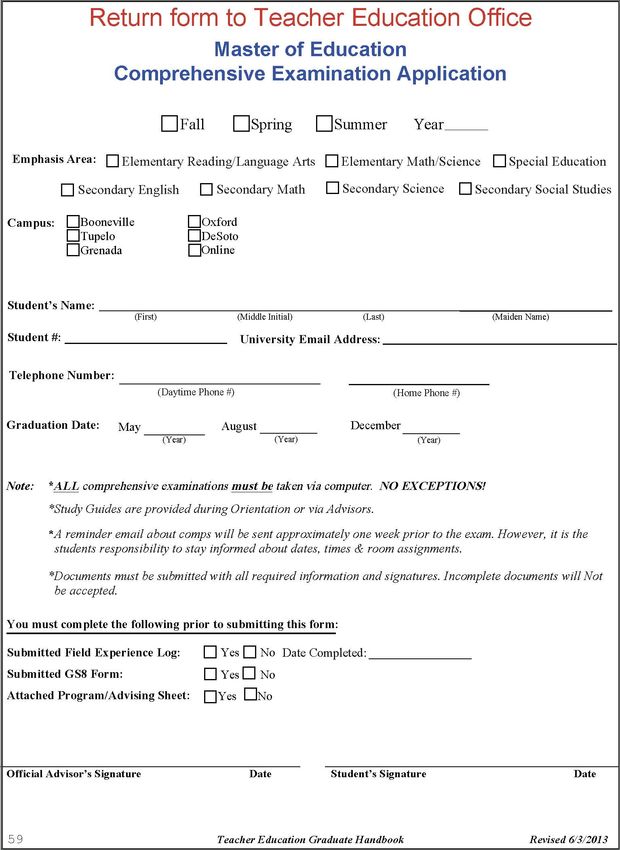
                                            Welcome
We are glad you have chosen to enter one of the Teacher Education programs at The
University of Mississippi. We wish you success and offer support in your goal to further your
education. It is our desire that your time spent here is both challenging and rewarding.

The Teacher Education Graduate Handbook was written to help answer questions and/or
address concerns that may arise during your graduate program. We realize that each
candidate’s program is unique, but it is hoped that this handbook will help guide you in your
endeavors. Program requirements and policies are included in this document and all
candidates need to become familiar with these. This handbook may not answer all your
questions about each of the graduate programs. You may be referred to the Graduate
Catalog, The M Book, or other publications. While it is your responsibility to see that all
requirements are met, faculty and staff will be glad to assist you and to answer any questions
you may have.

The Graduate Catalog has specific information regarding admission policies, academic
regulations, and requirements for degrees. Candidates are responsible for being aware of
and adhering to the policies and procedures set forth in the Graduate Catalog. Policies and
procedures are subject to change; therefore, always refer to the most current handbook
and notices posted on our web page.

Again, welcome to the Department of Teacher Education. It is our sincere wish that we
provide you with a rigorous and challenging program as you prepare for significant positions
in your chosen specialization.

David Rock, Ed.D.
Dean, School of Education
Professor of Curriculum and Instruction
School of Education
222 Guyton Hall
662-915-7063
rock@olemiss.edu

Susan McClelland, Ph.D.
Chair, Department of Teacher Education
Associate Professor of Leadership and Counsel Education
Department of Teacher Education
School of Education
316 Guyton Hall
662-915-7350
ssmc@olemiss.edu

3                           Teacher Education Graduate Handbook –Fall 2014       Revised 9/9/2014
Program Faculty & Staff

Beverly Alford                                            Sharon Clemmer
Assistant Professor of Early Childhood Education          Teacher Education
327 Guyton Hall                                           Graduate Activities Assistant
662-915-5037                                              336 Guyton Hall
blalford@olemiss.edu                                      662-915-5986
                                                          sclemmer@olemiss.edu
Joel Amidon
Assistant Professor of Secondary Education                Holly Coffey
323 Guyton Hall                                           Teacher Education
662-915-7588                                              Administrative Assistant
jcamidon@olemiss.edu                                      330 Guyton Hall
                                                          662-915-8984
Allan Bellman                                             hcoffey@olemiss.edu
Associate Professor of Mathematics Education
320 Guyton Hall                                           Renee Cunningham
662-915-5309                                              Assistant Professor of Mathematics Education
abellman@olemiss.edu                                      Tupelo Center
                                                          662-844-5622
Susan Bennett                                             prhillcu@olemiss.edu
Assistant Professor of Elementary Education
DeSoto Center                                             Svjetlana Curcic
662-342-4765                                              Assistant Professor of Special Education
sbennett@olemiss.edu                                      Tupelo Center
                                                          662-844-5622
Nichelle Boyd-Robinson                                    scurcic@olemiss.edu
Associate Professor of Elementary Education
DeSoto Center                                             Lynn Darling
662-342-4765                                              Coordinator of Early Childhood Initiatives
ncboyd@olemiss.edu                                        Assistant Professor of Early Childhood
                                                          Education
Stacey Britton                                            319 Guyton Hall
Assistant Professor of Teacher Education                  662-915-8984
DeSoto Center                                             lddarlin@olemiss.edu
662-393-9290
sbritton@olemiss.edu                                      Karen Davidson-Smith
                                                          Clinical Assistant
Andy Cheng                                                DeSoto Center
Assistant Professor of Elementary Education               662-393-9290
DeSoto Center                                             kvdavids@olemiss.edu
662-342-4765
qcheng@olemiss.edu                                        Nancy E. Douglas
                                                          Clinical Assistant Professor of Special
Debby Chessin                                             Education
Assistant Interim Chair of Teacher Education              305 Guyton Hall
Coordinator of Study Abroad & Service Learning            662-915-7620
Professor of Teacher Education                            douglasn@olemiss.edu
301 Guyton Hall
662-915-5878
dchessin@olemiss.edu

4                             Teacher Education Graduate Handbook –Fall 2014                Revised 9/9/2014
Ellen Foster                                            Dianne Lowry
    Associate Professor of Secondary Education-             Clinical Assistant Professor of Special Education
    Social Studies                                          302 Guyton Hall
    330 Guyton Hall                                         662-915-5753
    662-915-3760                                            dlowry@olemiss.edu
    ejfoster@olemiss.edu
                                                            Fannye Love
    Lane R. Gauthier                                        Professor of Elementary Education
    Associate Professor of Teacher Education                662-393-9290
    203 Guyton Hall                                         flove@olemiss.edu
    662-915-2005
    gauthier@olemiss.edu                                    Amber McCullough
                                                            Assistant Professor of Elementary Education
    Kerry Holmes                                            Desoto Center
    Associate Professor of Elementary Education             662-342-4765
    318 Guyton Hall                                         ajmcoll@olemiss.edu
    662-915-7586
    kholmes@olemiss.edu                                     Ann Monroe
                                                            Coordinator of Elementary Education Program
    Administrative Secretary                                Assistant Professor of Elementary Education
    316 Guyton Hall                                         320 Guyton Hall
    662-915-7350                                            662-915-5250
    awiles@olemiss.edu                                      amonroe@olemiss.edu

    Sarah Jacobs                                            Jerilou Moore
    Program Coordinator                                     Associate Professor of Elementary Education
    smjacobs@olemiss.edu                                    333 Guyton Hall
                                                            662-915-7622
    Burhanettin Keskin                                      jjmoore@olemiss.edu
    Associate Professor of Early Childhood Education
    321 Guyton Hall                                         Virginia Moore
    662-915-5891                                            Coordinator of Master of Literacy Programs
    bkeskin@olemiss.edu                                     Assistant Professor of Elementary Education
                                                            311 Guyton Hall
    Tammie Kirkland                                         662-690-6260
    Dir. of World Class Teaching Program                    vjmoore@olemiss.edu
    662-507-9867
    kirkland@olemiss.edu                                    Michael Mott
                                                            Assistant Professor of Literacy and Science
    Sarah Langley                                           Tupelo Center
    Director of Willie Price                                662-844-5622
     slburson@olemiss.edu                                   msmott@olemiss.edu

Rosemary Oliphant-Ingham                                    Katie Naron
Professor of Secondary Education-English                    Instructor
Coordinator of Secondary Education                          662-832-7970
331 Guyton Hall                                             mkyarbo1@olemiss.edu
662-915-7589
ringham@olemiss.edu

5                               Teacher Education Graduate Handbook –Fall 2014                Revised 9/9/2014
Mark Ortwein Sidney Rowland
Assistant Professor of Elementary Education Associate Professor of Elementary Education
DeSoto Center 307 Guyton Hall
662-393-9290 662-915-7738
mortwein@olemiss.edu srowland@olemiss.edu
James Payne Angela Rutherford
Professor of Special Education Director of CELI
322 Guyton Hall Associate Professor of Teacher Education
662-915-5921 224 Guyton Hall
edjp@olemiss.edu 662-915-7625
araines@olemiss.edu
Kaye Pepper
Professor of Elementary Education Alicia Cooper Stapp
Director of Assessment Assistant Professor of Health and Physical
210 Guyton Hall Education
662-915-3996 328 Guyton Hall
kpepper@olemiss.edu 662-915-7350
acstapp@olemiss.edu
6 Teacher Education Graduate Handbook –Fall 2014 Revised 9/9/2014Vision Statement
Imagine Innovate Inspire
The vision of the School of Education at The University of Mississippi is to prepare reflective
professional educators, create and disseminate new knowledge, and provide service to the
state and nation to meet the educational challenges of the 21st century. Undergraduate
and graduate programs in the unit are conceptualized to prepare candidates who can
positively impact students to be productive and caring citizens.
The University of Mississippi School of Education imagines equality, excellence, and caring,
innovates through practice, collaboration, and assessment, and inspires professionalism,
transformation, and leadership.
Imagine
Equality- Demonstrate an expectation that all students can learn and are a vital part of the
learning community.
Excellence- Demonstrate outstanding content and pedagogical knowledge.
Caring- Display sensitivity to students’ needs.
Innovate
Collaboration- Work with peers, clinical instructors, university supervisors, and relevant
stakeholders to advance student learning.
Practice- Design and use educational environment and instructional practices to meet
all students’ needs, abilities, and interests.
Assessment- Understand and thoughtfully use formal and informal evaluation
strategies.
Inspire
Professionalism- Model poise, maturity, and sound judgment.
Transformation- Engage in continuous self-evaluation and improvement.
Leadership- Act as stewards of the profession.
7 Teacher Education Graduate Handbook –Fall 2014 Revised 9/9/2014Teachers as Facilitators" Knowledge Base
Each graduate program offered by the Department of Teacher Education is built on eight
themes that embody the idea that teachers are facilitators, whether they are operating at
the master, specialist, or doctoral level. Themes are aligned with the conceptual framework
of the School of Education and its mission. The themes are reflected in all program courses
where candidates are engaged in reading, research, discussions, simulations, reflection, and
application intended to help them grow in their abilities as professionals.
T --Thinking and problem solving: A teacher uses knowledge of the learning process and
fosters thinking skills and complex conceptual learning as well as more basic skills
and learning.
E -- Equality and respect for diversity: A teacher develops an understanding of and a
respect for individual and cultural diversity.
A -- Appropriate teaching strategies: A teacher understands how to effectively use a
variety of instructional strategies appropriate to his/her discipline to maximize
student learning.
C -- Communication and cooperation: A teacher understands the nature of schools as a
part of a social system. A teacher communicates sensitively with learners, their
families, professionals, and others in a manner, which includes an understanding of
the special vocabulary specific to his/her discipline.
H -- Human development and curriculum: A teacher understands the continuum of
human growth and development and the nature of different discipline structures. A
teacher implements an appropriate and conceptually spiraling curriculum.
E -- Esteem, autonomy, and lifelong learning: A teacher engages learners in active, self-
monitoring roles and develops personal standards and career aspirations. A teacher
develops in his/her students’ expectations of becoming life-long learners and
professional educators.
R -- Relevance: social and global: A teacher relates experiences in the school to critical
issues in our local and global society.
S -- Supervision, management, and guidance: A teacher effectively supervises and
guides learners and utilizes effective techniques for classroom management and
behavior.
8 Teacher Education Graduate Handbook –Fall 2014 Revised 9/9/2014Admission Requirements at a Glance
Qualified candidates are admitted to programs based on admission criteria approved by
the graduate faculty. Masters programs prepare teachers to work in their classrooms at
advanced levels and in increasingly refined ways. Specialist and doctoral programs prepare
leaders in education who are able to conduct independent research and apply theory in a
continuing search for educational improvement. Entry requirements for full admission to
graduate programs are listed below:
Certification
Admission Requirements GPA GRE/Praxis Written Preliminary Exam
/ Experience
Master of Education (M.Ed.) Degree
Elementry 3.0 GPA on last 60 hours Praxis II content scores (six Hold or be eligible to
previous undergraduate work points higher than licensure hold a Class A
Secondary requirement) teaching certificate in
Special Ed content area
Literacy Ed
Master of Arts in Curriculum and Instructions
3.0 GPA overall or on last 60 Pass Core Academic Skills for Writing sample
hours of undergraduate work Educators (CASE)Assessment and
Praxis II area content (Priority for
M.A.C.I admission given to those who pass
by March 1 deadline.)
3.0 GPA on all undergraduate Writing sample
Pass Core Academis Skills for
work Educators (CASE) and Praxis ll.
(Please note that you do not have to
take the Praxis (CORE) and II area
content before applying to the
MTC Mississippi Teacher Corps.
However, if accepted, you will need
to take and pass both Praxis tests
before the start of summer
training.)
Education Specialist (Ed.S.) Degree
3.25 GPA on all previous Competitive scores on GRE Hold or be eligible to Complete an acceptable
graduate work hold a Class AA writing sample under
Elementary
teaching certificate conditions set forth by the
plus 2 years of graduate faculty
General Test ( Verbal Reasoning, teaching or two years
Secondary Quantitative Reasoning, Analytical
Writing) General Test (Verbal of relevant
Reasoning, Quantitative Reasoning, professional
experience. (letter from
Special Ed employer required)
Doctor of Education (Ed.D.) Degree or Doctor of Philosophy (Ph.D.)
3.5 GPA on all previous Competitive scores on GRE Hold or be eligible to Submit an admission statement
graduate work hold a Class AA and successfully complete a
Elementary (Ed.D.)
teaching certificate preliminary written exam and
plus 2 years of oral interiew under conditions
Secondary (Ph.D.) General Test (Verbal Reasoning, teaching or two years set forth by the graduate
Quantitative Reasoning, Analytical of relevant faculty
Special Education (Ph.D) Writing)
professional
experience. (letter from
employer required)
Conditionally admitted candidates must meet requirements specific to each degree program area and are
not eligible for financial aid.
9 Teacher Education Graduate Handbook –Fall 2014 Revised 9/9/2014Admission Guidelines
The information below will answer questions regarding the steps for admission to the
University of Mississippi and the School of Education Department of Teacher Education.
1. Application: Applicants must complete the Application for Graduate Admission.
! Please note that the first and most important step in the application process is the
completion of the APPLICATION FOR GRADUATE ADMISSION. This form must be
completed online. If you have any problems with completing the application online
please call the Graduate School at
662-915-7474.
! The application is available on the University of Mississippi website at
http://www.olemiss.edu/gradschool.
DEADLINES FOR APPLICATION SUBMISSIONS
Semester Enrolling Completed Application Deadlines
Spring (M.Ed., face-to-face programs only) October 1
Fall (M.Ed., M.A.C.I., Ed.S., Ph.D., Ed.D.,) March 1
! Financial Aid information may be found on the University of Mississippi website at
http://www.olemiss.edu/depts/graduate_school/financial_aid.html
2. GPA: Applicants are required to have at least a minimum Grade Point Average (GPA) for
full admission. Minimum GPA requirements are listed below:
! Master of Education Program (M.Ed.): The undergraduate GPA requirement for full
admission into the M.Ed. program is 3.0; conditional admission may be considered
when GPA is between 2.75-2.99.
! Master of Arts in Curriculum and Instruction (M.A.C.I.): The undergraduate GPA
requirement for full admission into the MA program is 3.0.
! Education Specialist Program (Ed.S.): The GPA requirement for full admission into the
Ed.S. program is 3.25.
! Doctor of Education (Ed.D.) or Doctor of Philosophy (Ph.D.): The graduate GPA
requirement for full admission into either the Ed.D. or Ph.D. program is 3.5.
3. Transcript: Transcript Information
! If you are a graduate of The University of Mississippi you are not required to submit
official transcripts. Your transcripts are on file.
! If you are not a graduate of The University of Mississippi you ARE REQUIRED to submit
official transcripts from all institutions you have attended during and following your
undergraduate/graduate work. All transcript(s) must be sealed and stamped with the
institution's seal to confirm authenticity.
10 Teacher Education Graduate Handbook –Fall 2014 Revised 9/9/2014! To obtain your official transcript, email the registrar or records office at the institution
from which you graduated. Many institutions will allow you to order a transcript
electronically. If you elect to have the transcript sent directly to your home address,
please do NOT open the envelope(s) or the document(s). Opened documents will be
considered unofficial. Transcripts should be mailed to the address below:
The UM Graduate School
P.O. Box 1848
University, MS 38677-1848
Email: gschool@olemiss.edu
Fax: 662-915-6557
Phone: 662-915-7474
PLEASE NOTE THAT IMMUNIZATION RECORDS MUST ALSO BE SUBMITTED TO STUDENT HEALTH.
You may wish to ask your school or university to send these with your transcripts.
4. GRE & Praxis II: Ed.D. and Ph.D. applicants must have competitive scores on the GRE©
General Test in each of the test areas (Verbal Reasoning, Quantitative Reasoning, and
Analytical Writing). M.Ed applicants must submit official Praxis II scores with a minimum of
six points higher than state requirements in content area. MACI applicants must submit
official Praxis I (CASE) scores before application is considered.
! Applicants may find information regarding the GRE General Test and Praxis at
www.ets.org. Official scores should be sent to The University of Mississippi, School of
Education department by ETS. Student issued copies of scores are not accepted.
! Praxis content area test codes: Praxis 1 (CASE 5712,5722,5732), Praxis 2: Elementary
0011 or 5011, Secondary/MACI: Biology 0235, English 0041 or 5041, Mathematics
0061 or 5061, Social Studies 0081, Chemistry 0245, Physics 0265, or 5081, Special
Education 0354 or 5354
! Praxis II (Priority will be given to those who pass by March 1 deadline in the MACI
program.)
5. Graduate Reference Forms: Applicants must submit two completed Graduate Reference
forms (Excluding MACI & MTC).
! Principals, peer teachers, former professors, or educational professionals may
complete the Graduate Reference forms. Applicants will complete page one and
attach this to page two. Graduate Reference forms are found on pages 39 and 40
of the Teacher Education Graduate Handbook (Do not submit/upload forms to the
Graduate School).
! Do not upload Graduate Reference forms to the Graduate School website.
! The persons completing the form should fax, mail, or email both pages to the
address below:
University of Mississippi
School of Education
Department of Teacher Education
ATTN: Graduate Activities Assistant
P.O. Box 1848
University, MS 38677
FAX (662) 915-6718
sclemmer@olemiss.edu
11 Teacher Education Graduate Handbook –Fall 2014 Revised 9/9/20146. Teaching License: Applicants must hold or be eligible to hold a Current and Valid Class A
Teaching License (Class AA for Specialist or Doctoral Programs) with an endorsement in
the area for which they have applied (Excluding MACI & MTC).
Please photocopy your teacher license and mail, fax, or e-mail to the Department of
Teacher Education (address and fax number listed in Item #5). Do not upload to
Graduate School website.
! NOTE to GRADUATING SENIORS: To apply to Graduate School, prior to receiving your
teacher’s license, you must submit a copy of your PLT scores to the Graduate Activities
Assistant in the Teacher Education department and a official copy of your final
transcript which shows your degree was conferred to the UM Graduate School.
7. Letter of Work Experience: Specialist and doctoral applicants are required to submit
evidence of two (2) years of K-12 teaching experience or two years of relevant
professional work experience in the form of a letter from your employer on letterhead.
! The letter should be mailed, emailed, or faxed to the Department of Teacher
Education (address and fax number listed in Item #5).
8. Writing Sample: Writing Sample will be specific to each degree program as follows:
Specialist of Education applicants submit a writing sample to include the following:
! Please answer each of the following essay questions and submit to the Teacher
Education Graduate Activities Assistant:
1. What is your personal philosophy of teaching and learning? Please include current
educational issues and reference well-known educators/researchers related to the
topic(s).
2. Why are you seeking an advanced degree from the University of Mississippi?
Please include personal goals and future professional plans.
Master of Arts (MACI) applicants must submit a writing sample to include the following:
! Please answer each of the following essay questions and submit to the Teacher
Education graduate activities assistant.
1. What do you view as the greatest need in education and what characteristics do
you possess that would allow you to address this need?
2. What would you like to have accomplished after five years in the teaching
profession?
Master of Arts (MTC) applicants submit a writing sample in response to a video.
Doctor of Education (Ed.D.) or Doctor of Philosophy (Ph.D.) applicants are required to
submit a typewritten admission statement. An electronic copy should be submitted to
the Graduate Activities Assistant (via email at sclemmer@olemiss.edu). The admission
statement must be received before written and oral preliminary examinations will be
scheduled. The admission statement should include the following information:
! An autobiographical narrative (educational background, teaching experiences,
research interests and personal goals and future professional plans);
12 Teacher Education Graduate Handbook –Fall 2014 Revised 9/9/2014! A statement of your personal philosophy of teaching and learning: briefly outline the
branch of educational philosophy you subscribe to, include major philosophers and
thoroughly explain why you subscribe to this theory (connect to your practice);
! Reasons for wanting to enter the Doctor of Education (Ed.D.) elementary education
program or the Doctor of Philosophy (Ph.D.) secondary education program;
! A description of experiences (for example, work, education, personal and
professional development opportunities, leadership roles, etc.) that have prepared
you to enter the doctoral program; include background information that strengthens
candidacy for admission to the program.
NOTE: Doctoral applicants will complete a written preliminary examination and will also
participate in an oral interview with faculty representatives.
! Directions for preliminary examinations, dates of exams and registration forms will be
sent to applicants when all required paperwork is on file.
Questions regarding the application process or requirements may be directed to:
Sharon Clemmer
Graduate Activities Assistant
336 Guyton Hall
662-915-5986
sclemmer@olemiss.edu
Once ALL of the above documents have been submitted a candidate should expect to
receive notification of admission status within six (6) weeks. Please allow for the six (6)
weeks processing time prior to e-mailing or calling the Graduate Activities Assistant office
to inquire on the status of your application.
Re-admission
• If there is a break in the enrollment for one semester (not including summer),the
candidate must apply for RE-ADMISSION (form GS10 on Graduate School Website).
• If there is a break in the enrollment for more than one semester, the candidate must
apply for admission through the Graduate School online.
• Re-admitted candidates are subject to regulations in effect at the time of re-admission
13 Teacher Education Graduate Handbook –Fall 2014 Revised 9/9/2014Graduate Programs in Teacher Education
The teacher education programs prepare professionals in four areas.
• Elementary Education
• Literacy Education
• Secondary Education - content areas: English, Mathematics, Science (Biology,
Chemistry, Physics), and Social Studies
• Special Education
Master of Education (M.Ed.)
M.Ed. graduates are prepared to exhibit extensive mastery, depth, and sophistication in their
coursework and in their classrooms. They are aware of current and emerging research and
its implications for classroom practice. As a result of their classroom experiences, interactions
with colleagues and faculty, and continued study, they think reflectively about classroom
practice and ways to enhance it.
The M.Ed. programs enhance excellence in teaching by encouraging individual growth and
application of research-based techniques and emerging theory in the classroom. In
addition, these programs build on basic-level preparation that teachers have received and
require more in-depth study, reading, research, and sharing with classmates in a
professional, collegial, and academic setting.
M.Ed. candidates complete a 30-hour program in elementary, secondary, and special
education and a 36-hour a program in literacy education; 45 clock hours of field-based
learning opportunities (excluding the Literacy program); a graduate capstone project; and
successful completion of a written comprehensive examination. Each program includes
three foundation courses (9 hours): EDCI 603: Measurement and Evaluation for the Classroom
Teacher (excluding the Literacy program), EDCI 601: Advanced Curriculum & Theory, and
EDRS 605: Educational Research.
• The Elementary Education program emphasizes 15 hours in a language arts/reading or
math/science focus.
• The Special Education program includes 15 concentrated hours in the Special
Education area.
• The Secondary Education program includes two (2) options. Option 1 includes fifteen
(15) hours of education courses and six (6) hours of courses in the content area.
Option 2 includes one three (3) hour course in Advanced Teaching Methods and
eighteen (18) hours of courses in the content area.
Master of Arts in Curriculum and Instruction (MACI)
The Master of Arts in Curriculum and Instruction (MACI) is a 36-hour alternate certification
program for candidates who currently hold a bachelor's degree in a field other than
education. The MACI program focuses on the pedagogical content knowledge and skills
needed for secondary instruction. Included in the program is an internship to give the
candidate first hand experiences in the 7–12 classroom. MACI candidates may apply for
certification in English, math, science (biology, chemistry, physics) or social studies. Please
see the MACI website for current information
14 Teacher Education Graduate Handbook –Fall 2014 Revised 9/9/2014http://education.olemiss.edu/academics/programs/maci.html.
Mississippi Teacher Corps in Curriculum and Instruction (MTC)
The Mississippi Teacher Corps (MTC) leads to a Master of Arts in Curriculum and Instruction
and is a 36-hour alternate certification program for candidates who currently hold a
bachelor’s degree in a field other than education. The MTC program focuses on the
pedagogical content knowledge and skills needed for secondary instruction. Students in the
MTC teach for two years in a high need district in Mississippi while earning their masters. MTC
candidates may apply for certification in English, math, science (biology, chemistry) or social
studies. Please see the MTC website for current information: mtc.olemiss.edu
Education Specialist (Ed.S.)
Ed.S. graduates exemplify the highest standards of teaching and serve as mentors to others
in their fields. They apply personal and systematic reflection to all aspects of professional
growth and development. They possess extended knowledge of research as it applies to the
classroom setting and they are able to utilize technology and research in order to improve
their classrooms and schools through acquiring grants, focused inquiry, and reflective
practice.
Ed.S candidates must complete 60 hours of graduate study beyond the bachelor's degree
(30 hours above the M. Ed.). The Ed.S degree offers candidates a program with emphasis in
elementary, secondary, or special education and is intended for candidates who wish to
earn a post-master's graduate degree that leads to an AAA certification. All Ed.S candidates
complete a manuscript for submission to a peer-reviewed periodical, make a presentation
to a professional group, and complete 65 clock hours of field-based learning opportunities.
Doctor of Education (Ed.D.) or Doctor of Philosophy (Ph.D.)
Doctoral graduates are prepared to be educational leaders. Many assume positions as
teacher educators, curriculum directors, state department of education personnel, or
leaders in other educational settings. Many of them also add educational leadership courses
to their program and assume administrative roles in the school. A few doctoral graduates
choose to remain in their classrooms serving as leaders and mentors for their colleagues.
Doctoral level graduates generate, utilize, and apply research and theory in curriculum
development and communicate ideas with other professionals in the field.
Doctoral degree graduates complete a program of study that requires a minimum of 99
graduate hours of coursework post bachelors, which includes 18 hours of dissertation. A
minimum of 30 hours above the M.Ed. degree must be taken at The University of Mississippi.
These hours do not include dissertation hours. In addition, the graduate must successfully
complete and orally defend a dissertation representing independent and original research.
Each doctoral graduate will complete 75 clock hours of field-based learning opportunities
and successfully complete a written comprehensive examination.
15 Teacher Education Graduate Handbook –Fall 2014 Revised 9/9/2014Expectations for Candidates
Work Ethic
Candidates should dedicate nine or more hours/week for each course taken. Entering a
Graduate Program requires a substantial commitment of time and energy. Candidates must
be prepared to spend time not only in class but also outside of class reading, writing, and
conducting research. While it is a demanding experience, its purpose is to broaden the
candidate’s knowledge awareness of the complexity of education and society.
Forms of Expression
This is a program that prepares educators as reflective professionals; therefore candidates
are expected to use standard and effective forms of oral and written communication.
Additionally, all papers and projects submitted to the faculty, unless otherwise stated, should
follow the form and style documented in the Publication Manual of the American
Psychological Association, 6th edition. Finally, since much of what classroom teachers do is
verbal in nature, the ability to communicate effectively in this form is essential. Candidates
are encouraged to attend workshops conducted by the Office of Research and Sponsored
Programs and the Writing Center as a means for improving these skills.
Personal Attributes and Professional Dispositions
Teachers should develop and model the dispositions that are expected of professional
educators. Our accrediting agency, the National Council for Accreditation of Teacher
Education (NCATE), defines dispositions as the values, commitments, and professional ethics
that influence behaviors toward students, families, colleagues, and communities and affect
student learning, motivation, and development as well as the educator's own professional
growth and development. Dispositions are guided by beliefs and attitudes related to values
such as caring, fairness, honesty, responsibility and social justice. Our faculty expects all
candidates to exhibit dispositions characteristic of a professional educator; therefore, we
take the responsibility of assessing and enhancing the dispositions of our candidates. Listed
below are dispositions the Department of Teacher Education have identified as most
important to an educator.
• Exhibit poise, maturity, and sound judgment.
• Display professionalism through attendance, dependability, and academic
integrity.
• Maintain a positive and enthusiastic disposition toward the education profession.
• Respond in a sensitive manner to diverse populations.
• Accept constructive criticism in a positive manner.
• Share and/or seek professional materials and ideas.
• Follow appropriate policies and procedures.
• Respect and tolerate opinions and views of others.
16 Teacher Education Graduate Handbook –Fall 2014 Revised 9/9/2014Candidates who fail to show acceptable dispositions during their graduate program in
classes, coursework assignments, interactions with the course instructor and peers, and other
situations related to the graduate program will be cited with a Disposition Infraction. If a
candidate receives two of these Disposition Infractions during his/her program, the
Disposition Committee will convene a meeting to discuss interventions for improvement or
dismissal from the program.
Program Planning and Registration for Classes
Each candidate is assigned a faculty advisor at the time of admission. Who will assist in
writing a program plan prior to or during the first registration period. In addition to an advisor,
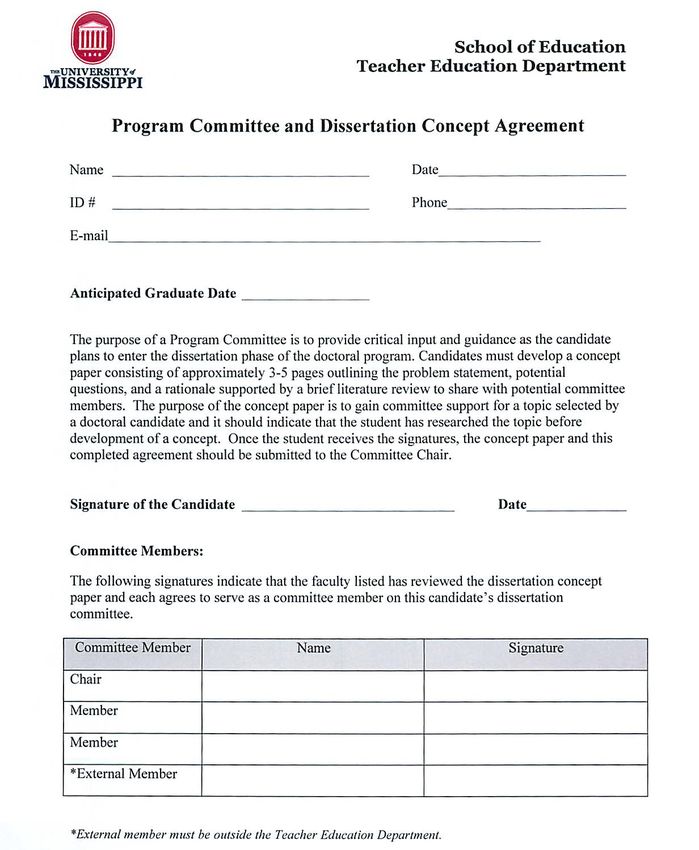
the doctoral candidate will be assigned a dissertation committee following acceptance of
the candidate's Concept Paper by a faculty team. Program plans are flexible and advisors
may be amenable to change.
Following receipt of admissions notification, each candidate should contact his/her
designated faculty advisor to schedule an appointment to plan the program of study. In
addition, each candidate is required to meet with or contact his/her designated faculty
advisors at least once each semester. This usually takes place during priority registration
periods as noted in the University calendar. Under no conditions should a candidate register
for classes or change approved classes listed on the Program Sheet checklist without prior
advisor approval.
Doctoral Dissertation
All doctoral candidates must adhere to the program and Graduate School requirements for
conducting independent research that results in the writing of the doctoral dissertation.
Important information regarding this procedure is detailed in the Graduate Catalog. The
Graduate School will also provide the candidates with a useful publication, A Manual for
Theses and Dissertations.
Registration for a minimum of 18 credit hours of dissertation is required, and the candidate
must be registered for a minimum of three hours during the semester of the defense.
Candidates are expected to follow procedures found in the current APA manual for
publication and the APA guide for writing dissertation and theses. Your designated faculty
advisor will provide you with additional information about requirements.
Time Limits for Completion of Degrees
The Graduate Catalog contains information regarding time limits for degree completion.
Currently, a M.Ed. and/or Ed.S. degree must be completed within six years from the date of
enrollment in the first course that is counted towards fulfillment of the requirements of the
degree. For doctoral degrees, all required formal course work and passing the
comprehensive exam must be completed within four calendar years of initial enrollment.
After passing the comprehensive exam, a student becomes a candidate for the doctoral
degree and must complete all remaining requirements within five calendar years. Once
advanced to candidacy, doctoral candidates should be aware of the Graduate School’s
policy concerning continuous enrollment.)
17 Teacher Education Graduate Handbook –Fall 2014 Revised 9/9/2014Transfer of Graduate Credit from another Institution
Candidates may receive credit for work accomplished in recognized institutions upon the
recommendation of the Department of Teacher Education and the approval of the dean of
the Graduate School. Candidates may only transfer courses in which a “B” or higher has
been earned. Transfer of credit from another institution will not be accepted for workshops,
internships, correspondence courses and other courses of a similar nature, and for courses in
which regular letter grades are not awarded. All transfer of credit is subject to the following
conditions:
• The residence or degree credit requirement is not reduced;
• Students in the Masters programs must complete a GS3 form (found on the
Graduate School Website);
• The other graduate school must offer a graduate degree in the field in which the
work has been completed;
• The candidate must have completed at least 12 semester hours of acceptable
graduate course work at the university before transfer will be considered;
• The credit must be recommended by the candidate’s department in the university
as specifically applicable to the candidate’s degree program;
• In the field of education, transfer credits will only be accepted from a graduate
school that is accredited for graduate study by the National Council for
Accreditation of Teacher Education and by the regional accrediting association;
• There is a six-year time limit on the applicability of transferred credit; and
For M.Ed. degree candidates, a maximum of six (6) hours of credit may be transferred. For
Ed.S. degree candidates, no more than 12 hours may be transferred. For M.Ed. degree
candidates that have already received one M.Ed. degree; not more than six (6) hours,
subject to departmental approval, may be applied from a previous M.Ed. degree to a
second M.Ed. degree.
Funding Opportunities for Graduate Candidates
Candidates are urged to check with the Graduate School, The Office of Research and
Sponsored Programs, and the Teacher Education office in the School of Education for
information and applications regarding scholarships and fellowships. Other sources of
financial support can be found on the Graduate School web page
http://www.olemiss.edu/depts/graduate_school/financial_aid.html or example, some
organizations and publishers will provide financial assistance to candidates conducting
research in specific areas. Since such funding opportunities change often, periodic checks
are suggested. Candidates who have presentations accepted at professional meetings are
eligible to apply for travel assistance from the Office of Research and Sponsored Programs.
The Graduate Catalog
This important publication has been mentioned several times throughout this handbook.
Candidates are advised to obtain a copy and become familiar with the policies that affect
their programs. The catalog is published each year and it becomes the candidate’s
responsibility to be aware of information necessary for the timely completion of a graduate
18 Teacher Education Graduate Handbook –Fall 2014 Revised 9/9/2014degree. The notice of admission to Graduate School indicates the particular catalog (year)
for each candidate. The Graduate Catalog may be found on the Graduate School Website.
Dismissal from the Program
In the “Expectations for Candidates” section of this handbook, personal attributes and
professional dispositions were discussed. Please review that section for more specific
information on this important topic. Also, it is strongly suggested that candidates review the
policy statements in the University of Mississippi’s M-Book. Although not limited to the
following, reasons for dismissal include:
• Failure to maintain the required GPA set forth in the Graduate Catalog (3.0) and/or
any other specified admission requirements;
• Engagement in behavior that is deemed inappropriate for effective school
educators. This includes failure to demonstrate appropriate personal attributes and
professional dispositions;
• Failure to respond appropriately to supervision;
• Violating policies and procedures established by the University, the Department of
Teacher Education, or those established by a job or field experience site;
• Failure to pass the comprehensive examination after two administrations;
• Violations of standards of honesty, such as cheating, plagiarism, or knowingly
furnishing false information; and
• Failure to successfully complete the dissertation and the dissertation defenses after
two opportunities to defend.
In the case of dismissal, the candidate will be provided reasonable assistance to facilitate
transition from the program to another academic program if deemed feasible. If the
decision is for continuance, the candidate must agree to the conditions set by the faculty.
Failure to adhere to these conditions may result in dismissal.
Appeal Policy
If the recommendation for dismissal is made or if a candidate wishes to appeal a grade, the
candidate may follow the School of Education and University’s policy for appeal, detailed in
the M-Book. A copy of the M-Book: The University of Mississippi Handbook of Standards and
Activities may be obtained from the Office of the Dean of Students or can be found on the
web at https://umwebtst.olemiss.edu/sacs/pub/Item30901StudentRights/M-Book.pdf.
19 Teacher Education Graduate Handbook –Fall 2014 Revised 9/9/2014Appendix A
Master of Education Programs
(M.Ed.)
(30 hours)
(Literacy M.Ed. 36 hours)
20 Teacher Education Graduate Handbook –Fall 2014 Revised 9/9/2014THE UNIVERSITY OF MISSISSIPPI
SCHOOL OF EDUCATION
DEPARTMENT OF TEACHER EDUCATION
Checklist for progressing through the Masters (face-to-face) Degree Program
" 1. Receive admission letter from Teacher Education and Graduate School.
" 2. Receive the Teacher Education Graduate Orientation Assessment. Complete and submit to
Graduate Activities Assistant before registering for class. A Departmental hold will be placed
on your account until you successfully complete the Orientation Assessment.
" 3. Contact your faculty advisor to determine the courses you will take in your program and
obtain approval for field experiences.
" 4. Contact your faculty advisor each semester to report your progress on field experience, and
obtain approval for selected courses.
" 5. At the completion of 12-15 hours of coursework, contact your faculty advisor for a mid-point
check on your field experiences and complete a Graduate Candidate Dispositions Instrument
Mid-Point Assessment. Your designated faculty advisor should initial/rate completed items
during the mid-point check. FIELD EXPERIENCE IS MANDATORY FOR GRADUATION.
" 6. During the semester in which you are enrolled in the last 3-6 hours of your coursework, you
should apply to take the M.Ed. comprehensive exams. A notice regarding dates will be
posted on the School of Education’s website YOU must be enrolled to take the exam.
This application can be found in the Teacher Education Graduate Handbook and School of
Education website. The application must be submitted to the Administration Secretary in
Guyton Hall 316 (Fax: 662-915-6718).
The comprehensive exam is given in the fall, spring, and summer. If you take the last class for your
program during intercession, the comprehensive exam will be taken the following semester. If your
final class is in the summer, you will take the comprehensive exam on the administration date
during the summer, regardless of when you finish the class(es). You will receive notification of
pass/fail status of your exam by email within four weeks.
" 7. You will apply for graduation with the Graduate Activities Assistant during the semester in
which you take your final courses. Graduate application forms (GS8) may be found on the
School of Education website. Be sure to check the deadline dates. If you will finish the final
courses for your program during the summer, you may walk in the May graduation by
completing the appropriate application form. Note: You must complete this form in order to
graduate. Program Coordinator and Advisor must sign forms before submitting. This is the
students’ responsibility.
" 8. Submit your field experience notebook and log, for final evaluation, to your advisor four
weeks before comprehensive exams (excluding the Literacy program). You must have the
field experience form in the front with your faculty advisor’s initials to indicate that you have
successfully completed the 45 hours field experience required. Include the necessary
documentation for each field experience. Successful completion of the field experience is a
requirement to graduate from the program.
" 9. Once the GS8 is processed you will receive an automated email from the Registrar’s Office
asking you to fill out the diploma application. This will automatically put you on a list to receive
other graduation information. Check your university email and the Teacher Licensure link on
the Mississippi Department of Education website for instructions about upgrading your
certificate. This checklist sheet does not apply to the Literacy Program.
NOTE: Shuttles run between campuses during Fall/Spring semesters from Monday-Thursday. Candidates may send
material via shuttle to Oxford. All material must be in a sealed envelope/bag/box and addressed to Teacher
21 Teacher Education Graduate Handbook –Fall 2014 Revised 9/9/2014Education Department, Room 316, Guyton Hall, Oxford Campus. Material must be shipped one full week before due
date to allow for transit time.
THE UNIVERSITY OF MISSISSIPPI
SCHOOL OF EDUCATION
DEPARTMENT OF TEACHER EDUCATION
Checklist for progressing through the Masters Elementary Online Degree Program
" 1. Receive admission letter from the Teacher Education Department and Graduate
School.
" 2. During the semester in which you are enrolled in the last 3-6 hours of your
coursework, you should apply to take the M.Ed comprehensive exams. A notice
regarding dates will be posted on the School of Education website. This application
can be found in the Teacher Education Graduate Handbook. The application must be
submitted to the Graduate Activities Assistant (fax: 662-915-6718).
" 3. Apply for graduation with the Graduate Activities Assistant during the semester in
which you are enrolled in the last 3-6 hours. Application forms may be found on the
website http://www.olemiss.edu/depts/graduate_school/index.php. Be sure to check
the deadline dates. This application must be submitted to the Graduate Activities
Specialist (fax: 662- 915-6718).
" 4. If you will finish the final courses for your program during the summer, you may walk
in the May graduation by submitting an appropriate application form approved by
the department chair. See the Graduate School website for information. At the
completion of 12-15 hours of coursework, contact your faculty advisor for a Graduate
Candidate Dispositions Instrument Mid-Point Assessment, not to be confused with the
field experience.
The comprehensive exam is given in the fall, spring, and summer. If you take the last class for your
program during intercession, the comprehensive exam will be taken the following semester. If your
final class is in the summer, you will take the comprehensive exam on the administration date
during the summer, regardless of when you finish the class(es). You will receive notification of
pass/fail status of your exam by email within four weeks.
" 5. Successfully complete 45 hours of required field experience. Submit your completed
documentation along with the field experience form to the online program
coordinator. Successful completion of field experiences is a requirement to graduate
from the program.
" .6. Once the GS8 is processed, you will receive an automated email from the
Registrar’s Office asking you to fill out the diploma application. This will automatically
put you on a list to receive other graduation information. Check your university email
and the Teacher Licensure link on the Mississippi Department of Education website for
instructions about upgrading your certificate.
22 Teacher Education Graduate Handbook –Fall 2014 Revised 9/9/2014Appendix B
Education Specialist Programs
(Ed.S.)
(30 hours)
23 Teacher Education Graduate Handbook –Fall 2014 Revised 9/9/2014THE UNIVERSITY OF MISSISSIPPI
SCHOOL OF EDUCATION
DEPARTMENT OF TEACHER EDUCATION
Checklist for progressing through the Specialist Degree Program
" 1. Receive admission letter from Teacher Education and Graduate School.
" 2. Submit Teacher Education Graduate Orientation Assessment the first semester of
admission. This is a requirement for graduation.
" 3. Contact your faculty advisor to determine the courses you will take in your program
and discuss program requirements such as submission of a manuscript, professional
presentation, and field experience completion.
" 4. Contact your faculty advisor each semester to report your progress on the
manuscript and field experience requirements and obtain approval for selected
courses.
" 5. At the completion of 12-15 hours of coursework, contact your faculty advisor and
schedule a mid-point check to report your progress regarding the field experience
requirements and complete a Graduate Candidate Dispositions Instrument Mid-Point
Assessment. You should also provide an outline and preliminary work on the required
manuscript to your faculty advisor at this time.
" 6. On the program sheet for the Ed.S. degree, you will find that there is a sequence set
for two courses. This sequence is set to assist you in the completion of the manuscript
to be submitted for publication. A requirement of the Ed.S. degree program is the
development of a manuscript for publication in conjunction with the candidate’s
major advisor or other faculty in the program area. This manuscript must be
developed and submitted to a peer-reviewed periodical as a requirement of degree
completion. For Elementary Education, EDCI 658 Trends and Issues in Teaching and
EDEL 767 Field Study, serve as the foundation for this requirement. For Secondary
Education EDCI 658 Trends and Issues in Teaching and EDSE 767 Field Study, serve as
the foundation for this requirement. For Special Education, EDCI 658 Trends and Issues
in Teaching and EDSP 767 Field Study serve as the foundation for this requirement.
Note: EDCI 658 precedes EDEL/EDSE/EDSP 767 or the two courses may be taken
concurrently.
" 7. Before the end of the program, you should have submitted the manuscript, made a
presentation, and completed the 65 hours of field experiences.
_____ Submit the manuscript for publication to a peer reviewed periodical
_____ Make a presentation to a professional group
_____ Complete 65 hours of field experience and submit documentation to your
Faculty advisor for final approval.
24 Teacher Education Graduate Handbook –Fall 2014 Revised 9/9/2014" 8. You will apply for graduation with the Graduate Activities Assistant during the
semester in which you take your final courses. Graduate application forms (GS8) may
be found on the School of Education website. Be sure to check the deadline dates. If
you will finish the final courses for your program during the summer, you may walk in
the May graduation by completing the appropriate application form. Note: You must
complete this form in order to graduate.
" 9. Submit evidence of the following degree requirements to your faculty advisor.
_____ Packet of student work, including letters of correspondence and the manuscript
of a completed research project submitted to a peer reviewed professional
periodical;
_____ Evidence of a satisfactory, professional presentation to a professional group that
may include graduate-level class and graduate faculty, or outside workshop,
conference, or meeting (Candidate must see advisor for copy of an appropriate
evaluation or rubric); and
_____ Completed field experience form and required documentation.
" 10. Submit to the Ed.S Coordinator for proof of manuscript submission, proof of
professional presentation, and original Field Experience form.
" 11. Once the GS8 is processed you will receive an automated email from the
Registrar’s Office asking you to fill out the diploma application. This will automatically
put you on a list to receive other graduation information. Check your university email
and the Teacher Licensure link on the Mississippi Department of Education website for
instructions about upgrading your certificate.
25 Teacher Education Graduate Handbook –Fall 2014 Revised 9/9/2014Appendix C
Doctoral Degree Programs
(Ed.D. & Ph.D.)
(99 Hours)
26 Teacher Education Graduate Handbook –Fall 2014 Revised 9/9/2014THE UNIVERSITY OF MISSISSIPPI
SCHOOL OF EDUCATION
DEPARTMENT OF TEACHER EDUCATION
Checklist for progressing through the Doctoral Program
" 1. Receive admission letter from Teacher Education and Graduate School.
" 2. Submit Teacher Education Graduate Orientation Assessment the first semester
of admission. This is a requirement for graduation.
" 3. Contact your faculty advisor to determine the courses you will take in your program
and discuss program requirements such as dissertation and field experience
completion.
" 4. Contact your faculty advisor each semester to report your progress and obtain
approval for selected courses.
" 5. During the semester in which you are enrolled in the last hours of your coursework,
you should apply to take the comprehensive exams. A notice regarding dates will be
posted on the School of Education website. This application can be found in the
Teacher Education Graduate Handbook and the School of Education website. The
completed application must be submitted to the Administrative Secretary, in Guyton
Hall 316 (fax: 662:915-6718).
The comprehensive exam is given in the fall, spring, and summer. If you take the last class for your
program during intercession, the comprehensive exam will be taken the following semester. If your
final class is in the summer, you will take the comprehensive exam on the administration date
during the summer, regardless of when you finish the class(es). You will receive notification of
pass/fail status of your exam by email within four weeks.
" 6. Upon successful completion of the doctoral comprehensive exam, you may begin
the dissertation portion of the doctoral program. The Doctoral Candidate Dissertation
Procedures provides specific information about completing the dissertation process.
You will receive this during EDEL/EDSE 700 Dissertation Seminar or it can be found in the
Graduate Student Handbook. Additional information can be found on the Graduate
School website.
" 7. Complete and submit GS6-Dissertation Prospectus Defense form, found on the
Graduate School website, to the Graduate Activities Assistant two weeks prior to the
scheduled prospectus defense. An approved copy of the prospectus will be filed
with the Graduate School immediately following the defense.
27 Teacher Education Graduate Handbook –Fall 2014 Revised 9/9/2014You can also read


