Secure Societies SC7 Calls 2019 - LEGALLY NOT BINDING - FFG
←
→
Page content transcription
If your browser does not render page correctly, please read the page content below
Secure Societies SC7 Calls 2019 -
      General Information
      Markus MÜLLER, Christoph CASTEX
           Call Coordinators REA/B4
     Secure Societies Infoday – MAR 12 2019
                            LEGALLY NOT BINDING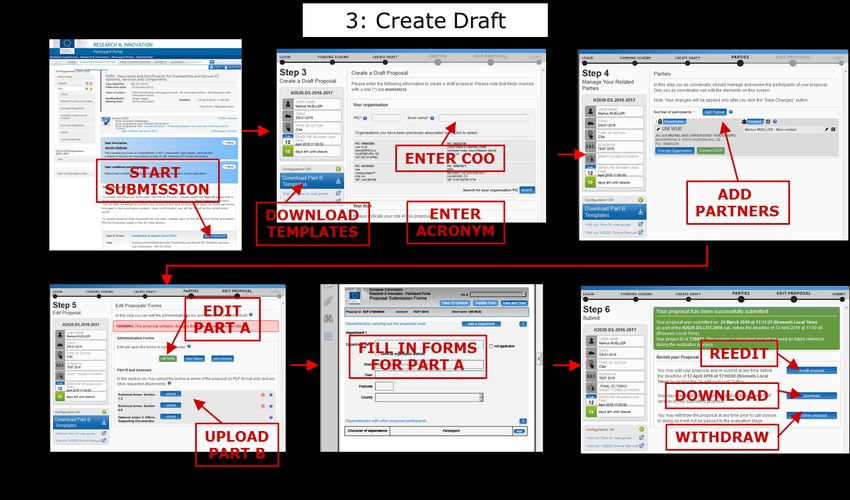
The call opening for the SEC and INFRA Calls
        has been moved to 19 March.
This due to a minor Work Programme update to be
 published on 18 March, related to the deletion of
         topic SU-GM03-2018-2019-2020.
      This does not affect the call closure.
               The pre-published WP is available here:
https://ec.europa.eu/programmes/horizon2020/en/h2020-section/secure-
societies-%E2%80%93-protecting-freedom-and-security-europe-and-its-
                              citizens
Outline

• Work Programme 2019 – an overview
• Key features & requirements
• General Annexes
• Participation in practice
• Evaluation of the proposals
• Final tips
Work Programme 2018-2020 - Structure

              INFRA                              SEC                             DS
              Protecting                         Security                     Digital
            Infrastructures                                                  Security

    •   CIs: Cyber- & physical security                            •   Cyber-security
    •   Security of public spaces                                  •   Privacy and Data Protection

             DRS                     FCT                   BES                     GM
            Disaster-            Fight against          Borders and               General
            Resilient             Crime and              External                 Matters
            Societies              Terrorism             Security

•       Human factors     •    Human factors       •   Human factors         •   Pract. Networks
•       Technologies      •    Technologies        •   Technologies          •   PCPs
•       Prenorm. Research •    Data management     •   Demo of solutions
•       CBRN, pandemics
        https://ec.europa.eu/research/participants/data/ref/h2020/wp/2018
        -2020/main/h2020-wp1820-security_en.pdf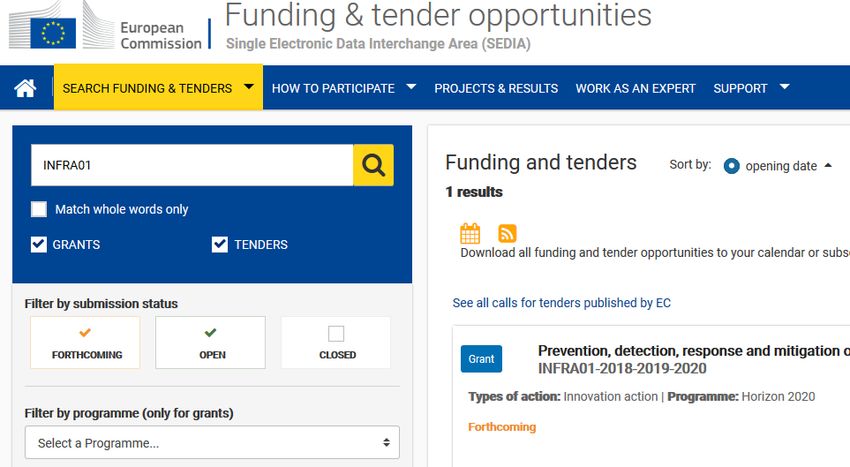
Budget (M€): 240,47 (+14%)
       INFRA: 38 , DS: 38 , SEC: 157.36 , OTH: 7.11

                       7,1                      SEC - DRS
             38
                              59,7              SEC - FCT
                                                SEC - BES
                                                SEC - GM
        38                                      INFRA

                              53,16             DS
                                                OTH
       3,5
                  41

• SC7 1.7 MEUR in (2.2% of H2020 budget)
• 50% of public funding for Sec. Research in Europe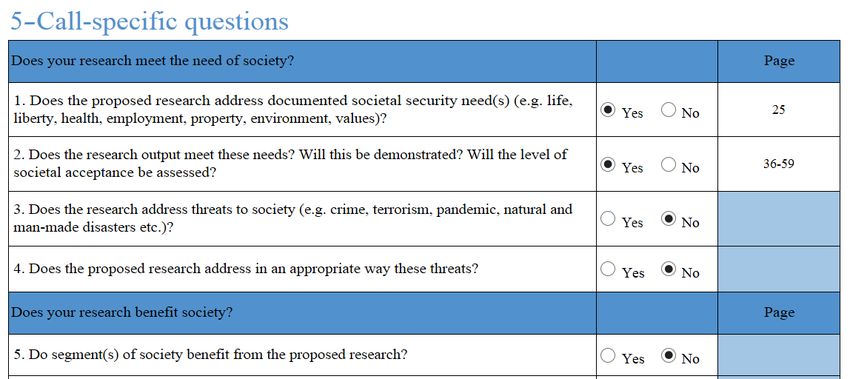
WP 2018-2020 – General principles
• Challenge-driven
 - Needs of society, practitioners and relevant entities
 - Reflected in 'Expected Impacts'

• Obligatory participation of Practitioners (INFRA, SEC)
 - In continuation since 2016
 - Better market uptake and higher impact
 - Enhanced policy support
 - Reduced oversubscription (success rate 2018: 18%)

• Increased involvement of civil society
 - e.g. as part of consortium
 - target group for dissemination bringing thus research closer to the public
INFRA - Protecting the infrastructure…
• SU-INFRA01-2019-2019-2020: Prevention, detection, response and
 mitigation of combined physical and cyber threats to critical
 infrastructure in Europe (IA)
 - water systems
 - energy (power plants and distribution, oil rigs, offshore platforms, Gas
   networks *)
 - transport (, ports, railways, urban multimodal nodes, airports* )
 - communication and ground segments of space systems
 - health services
 - e-commerce and the postal infrastructure
 - sensitive industrial sites and plants*
 - financial services

• !! Overlap with already funded projects is to be avoided !! – please see
 detailed information in the participant portal (under call / topic updates
 and topic conditions)

*project in Grant Preparation from 2019 call

INFRA - Protecting the infrastructure…

• SU-INFRA02-2019: Security for smart and safe cities, including for
 public spaces (IA)
SEC - Security                                             DRS
• SU-DRS01-2019-2019-2020: Human factors, and social, societal,
 and organisational aspects for disaster-resilient societies (RIA)

• SU-DRS02-2019-2019-2020: Technologies for first responders
 (RIA)

 - Sub-topic 2: [2019] Innovation for rapid and accurate pathogens
   detection

 - Sub-topic: [2019-2019-2020] Open

• SU-DRS03-2019-2019-2020: Pre-normative research and
 demonstration for disaster-resilient societies (IA)

 - Sub-topic 2: [2019] Pre-standardisation in crisis management
   (including natural hazard and CBRN-E emergencies)
SEC - Security                                        DRS

• SU-DRS04-2019-2020: SU-DRS04-2019-2020: Chemical, biological,
 radiological and nuclear (CBRN) cluster (RIA)

       [Check the ENCIRCLE catalogue – information available on
       the portal: ]

• SU-DRS05-2019: SU-DRS05-2019: Demonstration of novel concepts
 for the management of pandemic crises (IA)

       [Check the DRS04 topic of the 2014 Call – information
       available on the portal]
SEC - Security FCT • SU-FCT01-2019-2019-2020: Human factors, and social, societal, and organisational aspects to solve issues in fighting against crime and terrorism (RIA) - Sub-topic 2: [2019] Understanding the drivers of cyber-criminality, and new methods to prevent, investigate and mitigate cybercriminal behavior - Sub-topic: [2019-2019] Open • SU-FCT02-2019-2019-2020: Technologies to enhance the fight against crime and terrorism (RIA) - Sub-topic 1: [2019] Trace qualification - Sub-topic: [2019-2019-2020] Open • SU-FCT03-2019-2019-2020: Information and data stream management to fight against (cyber)crime and terrorism (IA)
SEC - Security                                             BES
• SU-BES01-2019-2019-2020: Human factors, and social, societal,
 and organisational aspects of border and external security (RIA)
 - Sub-topic 2: [2019] Modelling, predicting, and dealing with migration
   flows to avoid tensions and violence
 - Sub-topic: [2019-2019] Open
                              2019: no add. A&E conditions !!
• SU-BES02-2019-2019-2020: Technologies to enhance border and
 external security (RIA)
 - Sub-topic 3: [2019] Security on-board passenger ships
 - Sub-topic 4: [2019] Detecting threats in the stream of commerce
   without disrupting business
 - Sub-topic: [2019-2019-2020] Open
• SU-BES03-2019-2019-2020: Demonstration of applied solutions to
 enhance border and external security (IA)
 - Sub-topic 2: [2019] New concepts for decision support and information
   systems
 - Sub-topic: [2019-2019-2020] Open
SEC - Security GM
• SU-GM01-2019-2019-2020: Pan-European networks of practitioners
and other actors in the field of security (CSA)
- a. [2019-2020] Practitioners
• SU-GM03-2019-2019-2020: Pre-commercial procurements of
innovative solutions to enhance security (PCP)
REMOVED FROM WORK PROGRAMMEDS - Digital Security • SU-DS03-2019-2020: SU-DS03-2019-2020: Digital Security and privacy for citizens and Small and Medium Enterprises and Micro Enterprises (IA) - (a): Protecting citizens' security, privacy and personal data - (b): Small and Medium-sized Enterprises and Micro Enterprises (SMEs&MEs): defenders of security, privacy and personal data protection • SU-DS05-2019-2019: Digital security, privacy, data protection and accountability in critical sectors (IA) - (a) [2019]: Digital security, privacy and personal data protection in multimodal transport • SU-DS05-2019-2019: Digital security, privacy, data protection and accountability in critical sectors (RIA) - (b) [2019]: Digital security, privacy and personal data protection in healthcare ecosystem
Outline

• Work Programme 2019 – an overview
• Key features & requirements
• General Annexes
• Participation in practice
• Evaluation of the proposals
• Final tips
WP Features 2019-2020:
The participation of practitioners (or other categories of
participants) is a mandatory criterion in SEC and INFRA

Meaning of practitioners:
"A practitioner is someone who is qualified or registered to
practice a particular occupation, profession in the field of
security or civil protection."

• Applicants have to identify which members of the consortium
 are "practitioners" in the specific context
• Proposal template with specific table in template under Part B 4.3
 (SEC and INFRA)
WP Features 2019-2020:
   Additional eligibility and admissibility
   conditions
An example:
This topic requires the active involvement of at least 3
first responders' organisations or agencies from at
least 3 different EU or Associated countries (SU-DRS01-
2019-2019-2020)
- these entities have to be participants and
- should be directly involved in carrying out the tasks
 foreseen in the grant.

- 2018: 15 proposals declared ineligible as not fulfilling
 the additional admissibility and eligibility conditions !!
WP Features 2019-2020:
   Cross-cutting issues

• Social Sciences and Humanities (SSH) are integrated
 across all Horizon 2020 activities to successfully address
 European challenges

• Gender dimension in the content of R&I - a question on
 the relevance of sex/gender analysis is included in proposal
 templates

• The new strategic approach to international cooperation
 consists of a general opening of the WP and targeted
 activities across all relevant Horizon 2020 parts
WP Features 2019-2020:
 Cross-cutting issues – where is it flagged?
   Call    Topic #   ToA      SSH   Gender Int. Coop
                01     IA                      X
  INFRA INFRA
                02     IA      X
                01    RIA      X      X        X
          BES   02    RIA
                03     IA
                01    RIA      X      X        X
                02    RIA      X      X        X
          DRS   03     IA
   SEC          04    RIA
                05     IA
                01    RIA      X      X
          FCT   02    RIA      X
                03     IA      X
                01    CSA
          GM
                02    CSA
                03     IA      X
   DS     DS
                05   RIA/IA    X
WP Features 2019-2020: Separate Budgets (=Panels) • Continued feature from WP 2016/2017 • All topics ranked individually (16 topics in 17 panels) Rationale: • Better coverage of areas while fewer duplications of projects • Better support to policy implementation • No competition between CSA/RIA vs. IA (different weights) • Reduction of bias in certain (scientific) areas
WP Features 2019-2020:
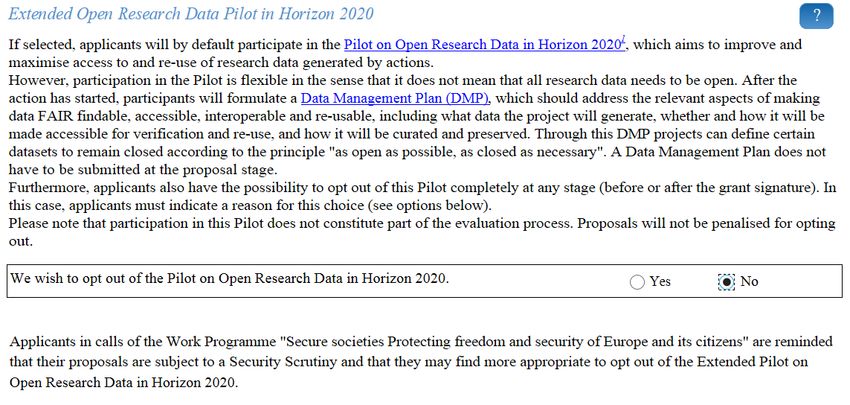
    Open Access to Data

                                                  ?

• Specific reminder of security aspects when leaving option to
 participate in the open research data pilot
• Note: NO impact on evaluation (cf. General Annex L)
Outline • Work Programme 2019 – an overview • Key features & requirements • General Annexes • Participation in practice • Final tips
General Annexes                                                                A
  A. List of countries eligible for funding
  1- the 28 MS
  2- the 16 Countries Associated to Horizon 2020 (As of 1 January
  2017):

   •   Iceland                              •   Switzerland
   •   Norway                               •   Faroe Islands
   •   Albania                              •   Ukraine (except Autonomous
   •   Bosnia and Herzegovina                   Republic of Crimea or the city of
   •   the former Yugoslav Republic of          Sevastopol)
       Macedonia                            •   Tunisia
   •   Montenegro                           •   Georgia
   •   Serbia                               •   Armenia
   •   Turkey
   •   Israel
   •   Moldova

Latest Update on Associated Countries:

https://ec.europa.eu/research/participants/data/ref/h2020/grants_manual/hi/3cpart
/h2020-hi-list-ac_en.pdf

                                                                                    23
General Annexes … A continued 3- List of third countries as in Annex A. 4- International European interest organisations (the majority of whose members are MS or AC, and whose principal objective is to promote scientific and technological cooperation in Europe ) 5- Legal entities established in countries not listed above will be eligible for funding when such funding is explicitly foreseen in the call. 6- In addition, legal entities established in countries not listed in Annex A and international organisations (IOs) will be eligible for funding: When funding for such participants is provided for under a bilateral scientific and technological agreement or any other arrangement between the EU and an international organisation or a third country; When the Commission deems participation of the entity essential for carrying out the action funded through Horizon 2020 (outstanding competence and expertise, access to unique know-how, access to research infrastructures, access to geographical environments, involving key partners in emerging markets, access to data, etc.)
Official Communication on Brexit
 "News for British applicants to Horizon 2020 06/10/2017
 For British applicants: Please note that until the UK leaves the EU,
 EU law continues to apply to and within the UK, when it comes to
 rights and obligations; this includes the eligibility of UK legal entities to
 fully participate and receive funding in Horizon 2020 actions.
 Please be aware however that the eligibility criteria must be
 complied with for the entire duration of the grant*.
 If the United Kingdom withdraws from the EU during the grant period
 without concluding an agreement with the EU ensuring in particular
 that British applicants continue to be eligible, you will cease to be
 eligible to receive EU funding (while continuing, where possible,
 to participate) or be required to leave the project on the basis of Article
 50 of the grant agreement."
 http://ec.europa.eu/research/participants/portal/desktop/en/support/about.html

 *Please note that also the additional admissibility and eligibility
 conditions must be complied with for the entire duration of the
 grant.                                                                           25
General Annexes                                                         B
B. Standard admissibility conditions and related requirements
• Submitted electronically in the system
• Readable, accessible and printable
• Complete
• Draft plan for exploitation and dissemination

• Page limits
 - part B.1-3 only (no restriction on part B.4-6)

 - Limit: default 70 pages IA/RIA, 50 for CSAs; all pages above blank

• Supporting Docs for operational capacity assessment:
 - CVs of responsible / key persons

 - ~5 relevant publications / products / services

 - Description of infrastructure / equipment (if relevant)

 - Possible 3rd party involvement                                           26
General Annexes                                                      …C

C. Standard eligibility criteria
   •   Minimum number of partners as set out in the call
       conditions
   •   Be in scope
   •   Other criteria may apply on a call-by-call basis as set out in
       the call conditions

   • For us:

       • Additional Admissibility / Eligibility Conditions:
       • For all SEC and INFRA topics: please fill out practitioner self-
       declaration table of 4.3

                                                                            27
Types of Action: Funding & Eligibility - Annex D / E
Coordination and Support Action (CSA): -> SU-GM01 only
• Up to 100% of eligible costs
• Eligibility criteria: 1 legal entity established in a MS or AC (overruled
by additional conditions in GM01 !)
Research and Innovation Action (RIA):
• Up to 100% of eligible costs
• Eligibility criteria: 3 independent legal entities, each established in a
different MS or AC (cross-check w/ possible add. conditions)
Innovation Action (IA):
• Up to 70% of eligible costs (exception: for non-profit LEs up to 100%)
• Eligibility criteria: 3 independent legal entities, each established in a
different MS or AC (cross-check w/ possible add. conditions)
28General Annexes: G
G. Technology Readiness Levels (TRL)
Where a topic description refers to a TRL, the following definitions apply,
unless otherwise specified:
TRL 1 – basic principles observed
TRL 2 – technology concept formulated
TRL 3 – experimental proof of concept
TRL 4 – technology validated in lab
TRL 5 – technology validated in relevant environment (industrially
relevant environment in the case of key enabling technologies)
TRL 6 – technology demonstrated in relevant environment (industrially
relevant environment in the case of key enabling technologies)
TRL 7 – system prototype demonstration in operational environment
TRL 8 – system complete and qualified
TRL 9 – actual system proven in operational environment (competitive
manufacturing in the case of key enabling technologies; or in space)
29General Annexes H
Evaluation Rules
• Selection Criteria
• Financial Capacity (e.g. on-line self-assessment) –
typically at grant preparation
• Operational Capacity – during evaluation
• Award Criteria
• Excellence Criterion
• Impact Criterion
• Quality and efficiency of the Implementation
• Mirrored in the structure of part B1-3 of the
proposal
• Exact sub-criteria dependent on Type of Action (ToA)
30Evaluation criteria (RIA/IA)
Excellence Quality and efficiency of the
(to the extent that the proposal Impact
implementation
addresses the WP topic)
• Clarity and pertinence of the • The extent to which the outputs of the • Quality and effectiveness of the
objectives; project would contribute to each of the work plan, including extent to
expected impacts mentioned in the which the resources assigned to
• Soundness of the concept,
work programme under the relevant work packages are in line with
and credibility of the
topic; their objectives and deliverables;
proposed methodology;
• Any substantial impacts not mentioned • Appropriateness of the
• Extent that the proposed work
in the work programme, that would management structures and
is beyond the state of the art,
enhance innovation capacity; create procedures, including risk and
and demonstrates innovation
new market opportunities, strengthen innovation management;
potential (e.g. ground-
competitiveness and growth of
breaking objectives, novel • Complementarity of the
companies, address issues related to
concepts and approaches, participants and extent to which
climate change or the environment, or
new products, services or the consortium as whole brings
bring other important benefits for
business and organisational together the necessary expertise;
society;
models)
• Appropriateness of the allocation
• Quality of the proposed measures to:
• Appropriate consideration of of tasks, ensuring that all
interdisciplinary approaches • Exploit and disseminate the project participants have a valid role and
and, where relevant, use of results (including management of adequate resources in the project
stakeholder knowledge. IPR), and to manage research data to fulfil that role.
where relevant.
• Communicate the project activities
to different target audiences
31Evaluation criteria (CSA)
Excellence Quality and efficiency of the
(to the extent that the proposal Impact
implementation
addresses the WP topic)
• Clarity and pertinence of the • The extent to which the outputs of the • Quality and effectiveness of the
objectives; project would contribute to each of the work plan, including extent to
expected impacts mentioned in the which the resources assigned to
• Soundness of the concept,
work programme under the relevant work packages are in line with
and credibility of the
topic; their objectives and deliverables;
proposed methodology;
• Quality of the proposed measures to: • Appropriateness of the
• Quality of the proposed
management structures and
coordination and/or support • Exploit and disseminate the project
results (including management of procedures, including risk and
measures.
IPR), and to manage research data innovation management;
where relevant.
• Complementarity of the
• Communicate the project activities participants and extent to which
to different target audiences the consortium as whole brings
together the necessary expertise;
• Appropriateness of the allocation
of tasks, ensuring that all
participants have a valid role and
adequate resources in the project
to fulfil that role.
32Outline • Work Programme 2019 – an overview • Key features & requirements • General Annexes • Participation in practice • Evaluation of the proposals • Final tips
Tentative Timeline
                       Opening                                 Remote
  Publication                             Deadline         Evaluation (IER)
  27/10/2017             14-             22/08/19            16/09/19 –
                     [19]/03/19                               27/09/19

      CMs               Remote          Panel Meeting      Evaluation in Bxl
Ethics Screening    Ethics Screening        (ESR)                (CR)
 4-8/11/2019          21/10-1/11        October 2019       30/09-18/10/19

                     Information to    Grant Preparation
                       Programme               +
Security Scrutiny                        Programme         Start of projects
                     Committee and
                      to applicants       Committee              from
 Nov-Dec 2019                            consultation        May 2020
                      + Evaluation
                    Review Jan 2020     Feb-April 2020
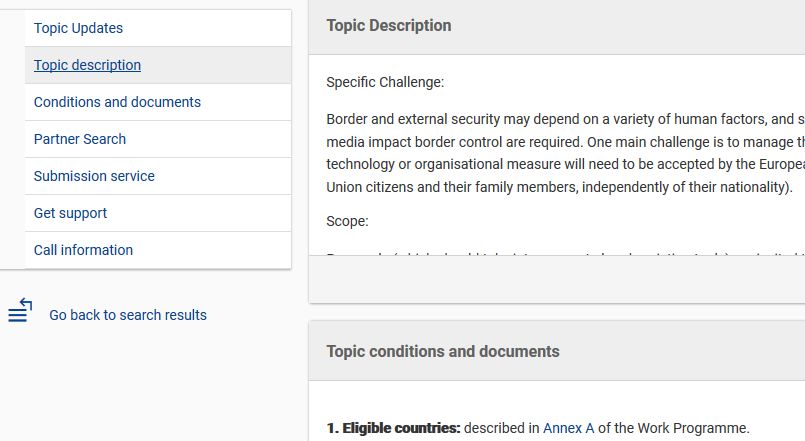
Understand the Topic Description
1. Specific Challenge
• Background information: context, policies, state of the art,
existing gaps, etc.
2. Scope (to be addressed in B.1 "Excellence" and B.3
"Implementation")
• Requirements for successful proposals: content, formal,..
• Additional information such as flags (SSH, international
cooperation), TRL, indicative budget, etc...
3. Expected Impact (to be addressed in the B.2
“Impact” criterion)
• Short/medium term
• Long termUnderstand the Types of Actions (ToA)
• Innovation Action (IA) – 8 topics
• Research and Innovation Action (RIA) - 8 topics
• Coordination and Support Action (CSA) – 1 topic [GM01]
37Innovation Action (IA) Action primarily consisting of activities that produce plans and arrangements or designs for new, altered or improved products, processes or services − May include prototyping, testing, demonstrating, piloting, large- scale product validation and market replication − Aim to validate the technical and economic viability in a (near) operational environment and/or support the first application / deployment in the market of an innovation that has already been demonstrated but not yet applied/deployed in the market due to market failures/barriers to uptake − Projects may include limited research and development activities − TRL ≈ 6-8 (if not indicated otherwise in the WP)
Research & Innovation Action (RIA)

Action primarily consisting of activities to establish
new knowledge and/or explore feasibility of new or
improved technology, product, process, service or
solution

− May include basic and applied research, technology
  development and integration, testing and validation on small-
  scale prototype in laboratory or simulated environment

− Projects may contain closely connected but limited
  demonstration or pilot activities to show technical feasibility in
  a near to operational environment

− TRL ≈ 4-6 (if not indicated otherwise in the WP)
Coordination & Support Action (CSA)

Actions consisting primarily of accompanying measures
such as

− standardisation, dissemination, awareness-raising and
  communication, networking, coordination or support
  services, policy dialogues and mutual learning exercises and
  studies, including design studies for new infrastructure

− may also include complementary activities of strategic planning,
  networking and coordination between programmes in different
  countries
SEARCH

                   TOPIC

SELECT PROGRAMME
                           42
TOPIC NAME and CODE
UPDATES OPENING DATE
(pls. check!) WP TOPIC AND DEADLINE
DESCRIPTION
CONDITIONS
& DOCS
PARTNER SEARCH TOOL 43How to create your proposal and submit
START
SUBMISSION
PROCESSProposal – General Structure in SC7
• Part A (fill-in on-line): Sections 1 to 5
• Part B (upload 2 pdf): please download templates from topic page
1- First pdf file – Sections 1-3 (specific to ToA!):
- Section 1: Excellence
- Section 2: Impact
- Section 3: Implementation
Page limits: 70 pages (RIA/IA) or 50 pages (CSA)
2- Second pdf file – Sections 4-6 (common for all ToAs):
- Section 4: Members of the consortium (operational
capacity)
SEC and INFRA only: 4.3 with table for declaration of
practitioners
- Section 5: Ethics and Societal Impact (in addition to the
self-assessment of part A)
- Section 6: Security (no classified information in the proposal,
to address possible classification of fore/background)
No page limit 45Mandatory sub-topic selection (for SEC only)
• Only applicable to 6 topics (≥ open 2 sub-topics in 2019):
BES01, BES02, BES03, DRS02, FCT01, FCT02
• Sub-topic selection required (blocking feature):
• Sub-topic visible in part A and can be changed laterAll calls: specific templates part A
A.5: Societal Impact Table
• must be filled in (cf. also part B5.2 "Societal Impact on next slide).
• compliance with the provisions of the Charter of Fundamental Rights
of the European Union !
• When developing technologies, please consider the concept of
"Privacy by Design"All calls: specific templates part B
B 5.2: Societal Impact
Please download
part B templates
using button at
step 3
(cf. previous
slides) !
B 6: SecurityINFRA & SEC: additional section Part B 4.3
Please download
part B templates
using button at
step 3
(cf. previous
slides) !
Facilitates the verification of the additional
admissibility and eligibility conditions for both sides !!Attention points
• Respect the page limits: excess pages will be blank
• Note: All tables must be included within this limit. Minimum
font size allowed is 11 points. The page size is A4, and all
margins (top, bottom, left, right) should be at least 15 mm (not
including any footers or headers).
• Note: Relevant information for Sections 1-3 cannot be moved
to sections 4-6 or elsewhere.
• Submit on time:
• Complete the submission, including all checks, well before
the deadline to avoid last-minute technical problems, human
errors, time-delay in uploading, ...
• Note: Until the deadline you can always reedit and resubmit
50Reminder - no “creative” form atting attempts!
Extracts from the template
51Operational Capacity
• As part of the Individual Evaluation, the evaluators give their view on
whether each applicant has the necessary basic operational
capacity to carry out their proposed activity(ies) based on the
information provided in Section 4:
− Curriculum Vitae or description of the profile of the applicant
− Relevant publications or achievements
− Relevant previous projects or activities
− Description of any significant infrastructure or any major
items of technical equipment
• At the consensus group, the evaluators consider whether
an applicant lacks basic operational capacity
• If yes, the evaluators make comments and score the
proposal without taking into account this applicant and its
associated activity(ies)Outline • Work Programme 2019 – an overview • Key features & requirements • General Annexes • Participation in practice • Evaluation of the proposals • Final tips
Evaluation - Process
                                                         Eligible /
                      Proposal                           admissible
                                                         proposal

Expert       Expert     Expert     Expert       Expert   Minimum 3
                                                         experts
                                                         assigned
                      Individual

                                                                      Evaluators
                      Evaluation                         Individual
      Individual                   Individual
                        Report
      Evaluation                   Evaluation            evaluation
        Report                       Report              (remote)
Individual                                  Individual
Evaluation                                  Evaluation
  Report                                      Report
                      Consensus
                                                         Consensus

                                                                           Recorder
                        group
                                                         (Brussels)

                      Consensus
                        Report
                                                                                      54
Evaluation -
Scoring/weights/thresholds
• Each criterion scored out of 5 (cf. next slide)
• Individual threshold of 3
• Overall threshold of 10
- Ranking: sum of the scores on each criterion
- For IA, Impact (CR2) weighted by 1.5 to determine ranking:
- Normalised score = (CR1+1.5*CR2+CR3)/17.5*15
- The procedure for setting a priority order for proposals with the
same score is given in part H of the General Annexes.
55Evaluation - Interpretation of the Scores
0 The proposal fails to address the criterion or cannot be
assessed due to missing or incomplete information.
1 Poor. The criterion is inadequately addressed, or there
are serious inherent weaknesses.
2 Fair. The proposal broadly addresses the criterion, but
there are significant weaknesses.
3 Good. The proposal addresses the criterion well, but a
number of shortcomings are present.
4 Very Good. The proposal addresses the criterion very
well, but a small number of shortcomings are present.
5 Excellent. The proposal successfully addresses all
relevant aspects of the criterion. Any shortcomings are
minor.Ranking proposals with identical total scores
• Proposals that sub-topics, not otherwise covered by more highly-
ranked proposals, will be considered to have the highest priority.
• The panel then orders them according to:
− First, their score for EXCELLENCE (IMPACT [IA only])
− And second, their score for IMPACT (EXCELLENCE [IA only])
• If there are ties, further prioritisation on:
− First, the size of the budget allocated to SMEs
− Second, the gender balance of personnel carrying out the research and/or innovation
activities
• If there are still ties, the panel agrees further factors to consider:
− e.g. synergies between projects or contribution to the objectives of the call or of
Horizon 2020
• The same method is then applied to proposals that address topics
that are already covered by more highly-ranked proposalsSEC: Exceptions for priority order for funding
Ethics Review
 • Only proposals that comply w/ the ethical principles and legislation
     may receive funding

 • For main and reserve list proposals an ethics screening and, if required,
     an ethics assessment is carried out by independent ethics experts after
     the scientific evaluation
 •   For those proposals in which one or more ethical issues have been
     identified, the experts will assess whether the ethics issues are
     adequately addressed
 •   The ethics experts will produce an ethics report and give an opinion on the
     proposal, such as:

 • granting ethics clearance (or not)
 • recommending the inclusion of ‘ethics requirements’ in the grant
   agreement, or

 • recommending a further Ethics Assessment and/or an Ethics Check
   or Audit
Security Scrutiny Procedure
No “classified” proposals (i.e. proposals disclosing classified
information) are allowed (SEP IT tool does NOT allow)… BUT: a
proposal could lead to a “sensitive” project
The Security Scrutiny Group will be requested (via their national
security authority representatives – not done by EC staff) to verify
that all security aspects are properly addressed
the scrutiny procedure is done, in a 2 months period, following
the technical evaluation and before the start of the GAP
The results of the scrutiny could be:
go ahead with GAP – no security concerns;
recommendations for the GAP without classification;
recommendations for the GAP with classification;
Recommendation not to finance the proposal
Applicants receive the conclusions of the scrutiny procedure with the
“Information letter” via the Participant PortalOutline • Work Programme 2019 – an overview • Key features & requirements • General Annexes • Participation in practice • Evaluation of the proposals • Final tips
Final Tips!
• Check carefully [incl. additional!] admissibility and
    eligibility conditions
• Read carefully the topic description ("scope", "expected
    impact") – will your proposal match the expectations?
•   Use the right proposal templates and follow the instructions
•   Address thoroughly the selection and award criteria
•   Respect the page limits
•   Clearly describe what you will achieve and how you will do it
•   Choose your consortium based on your project needs (e.g.
    no duplications or partners without clear responsibilities,...)
• Describe carefully the impact (expected, societal, economic
    [IA: business analysis, market potential,..])
• Submit (a first version) well before the final deadline
                                                                      62
More info, Questions?
• Funding & Tender Opportunities
https://ec.europa.eu/info/funding-tenders/opportunities/portal/screen/how-to-
participate/tenders
• H2020 Reference Documents
https://ec.europa.eu/info/funding-tenders/opportunities/portal/screen/how-to-
participate/reference-documents
• Research Enquiry Service
https://ec.europa.eu/info/research-and-innovation/contact/research-enquiry-
service-and-participant-validation_en
• Support Overview (including FAQ and Helpdesks)
https://ec.europa.eu/info/funding-
tenders/opportunities/portal/screen/support/support
• National Contact Points
https://ec.europa.eu/info/funding-tenders/opportunities/portal/screen/support/ncp
63Thank you for your attention.
64You can also read


