STRENGTHS ASSESSMENT TECHNICAL SUMMARY: DEVELOPMENT AND VALIDATION DR. COURTNEY R. MCCASHLAND - STANDOUT
←
→
Page content transcription
If your browser does not render page correctly, please read the page content below
Strengths Assessment
 Technical Summary:
Development and Validation

    Dr. Courtney R. McCashland
             May, 2011

                    TM
Technical Report
Introduction
This Technical Summary provides answers to questions you may have about the stability,
reliability, and validity of StandOut. We explain how the research approach and instrument design
support our mission to help each person excel through his/her comparative advantage.
The Research Approach
Between 2000 and 2010, we developed and administered a talent inventory to 435,564
participants in order to uncover the most reliable talents found to predict multi-industry job
performance for six common job families—Leader, Manager, Professional, Sales, Service and
Support. During this period, more than two hundred focus groups and discovery interviews were
administered as part of seventy-three validation studies designed to capture the profiles of top
performers for each job family.
For the talents to be a valid predictor of success, we first had to ensure they were, statistically
speaking, ‘reliable.’ Coefficient alpha is the most common statistical technique applied to assess
the reliability of a unified construct measured by multiple items. Each talent was examined for
internal consistency and analyzed using Cronbach’s Alpha. Across the samples, alphas for the
eighteen talents ranged from .64 to .93, demonstrating acceptably high internal consistency to
the industry standard of alpha = .6. While the configuration and weighting of predictive talents
varies by job family, Table 1 provides a summary of data from a large study of the eighteen talents
most commonly found to have both high reliability and predictive validity across studies.
These eighteen talents are fundamental building blocks at the heart of the strength Roles
measured by StandOut.
2Technical Report
Table 1: Reliability of Predictive Talents by Strength Role
Cronbach’s Alpha
Talent Number of Items Reliability Coefficient Strength Role
(n=94756)
Problem Solver 6 .76 ADVISOR
Common Sense 8 .69 ADVISOR
Initiator 6 .64 CONNECTOR
Team 9 .76 CONNECTOR
Adaptability 7 .76 CREATOR
Analytical 5 .76 CREATOR
Responsibility 8 .68 EQUALIZER
Structure 8 .79 EQUALIZER
Persistence 5 .69 INFLUENCER
Courage 7 .70 INFLUENCER
Achiever 5 .75 PIONEER
Belief 7 .68 PIONEER
Relator 8 .74 PROVIDER
Service 7 .84 PROVIDER
Positivity 5 .83 STIMULATOR
Intensity 5 .70 STIMULATOR
Developer 9 .76 TEACHER
Individualization 5 .77 TEACHER
*p < .05, **p < .01
To supplement patterns that emerged from this quantitative data set, we analyzed qualitative data
from interviews with top performers and identified powerful talent combinations credited by the
best as their secret to success.
3Technical Report
The StandOut Instrument
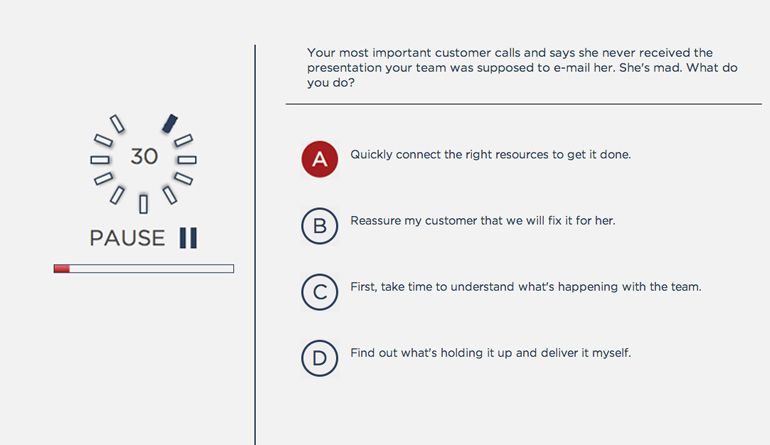
StandOut is an online assessment of talent –-innate patterns of thought, feeling and behavior—
measuring nine powerful combinations called “Strength Roles.” To measure which strength
Roles are most dominant, we selected a test design and an item-type called ‘situational
judgment.’ In the typical situational judgment test (SJT), you are provided with a variety of
situations gleaned from critical incidents on the job. In recent years SJT’s have increased in
their popularity because, of all item-types—from Lickert, to Binary, to Open-ended—they have
shown most power as a predictor of subsequent job performance. Indeed, research by McDaniel,
Morgeson, Finnegan, Campion and Braverman (2001) accumulated 102 validity coefficients and
estimated the mean validity of SJTs to be .34, which as Weekley and Ployhart showed (2005),
puts SJT’s on a par with cognitive ability tests. In other research, Weekley and Jones (1999)
found an SJT to provide incremental validity over cognitive ability and experience.
For StandOut, we designed situations from impact moments in life where a person’s pre-
existing skills or technical knowledge would have minimal relevance to response options. We
created hundreds of situations and talent-based response options, then trialed them in multiple
test environments. Iterations of specific “StandOut” life situations and response options were
reviewed to isolate distinct personality differences and subsequently tested in an alpha version
of StandOut that was administered to 232,000 participants across jobs and industries globally in
2009-2010. The psychometric properties of the assessment were analyzed to refine StandOut’s
146 situation and response combinations.
4Technical Report
The Sample
The 232,000 global participants who responded to the alpha version of StandOut had the
option to report their demographic information. N = 6018 responded to at least one of the three
demographic questions. Below is a summary of the demographic distributions.
Table 2: Gender Statistics
Frequency Percentage
Male 2568 50.1
Female 2561 49.9
Total 6018
Table 3: Age Statistics
Statistics Age
Minimum 17
Maximum 85
Mean 42
Std. Deviation 11
Table 4: Education Statistics
Education Level Frequency Percentage
Less than high school 11 .2
High School graduate 169 2.8
Some College 636 10.6
Associate Degree 227 3.8
Bachelor’s Degree 2188 36.4
Master’s Degree 1235 20.5
Post Graduate Degree 445 7.4
Other 28 .5
5Technical Report
The Scoring
In scoring the response options for StandOut, we measured each of the nine strength Roles 12
times across 34 situations. Thirty-two of the situations offered four response options. Two of the
situations had weighted computations with all nine strength Roles measured in each. Not all of
the response options presented for each scenario were scored in the overall calculations. The
scores by strength Role were coded and converted into a t-score calculation to standardize the
distribution. The calculations of the scores for each of the response options involved weighting
for degree of difficulty for each scenario and dimension reliability for each strength Role.
Table 5: StandOut Situation and Response Set
6Technical Report
StandOut Stability and Reliability
Would you expect your StandOut results to change if you take the assessment more than once?
If you are curious, we can take a look at the stability and reliability of the assessment. An initial
reliability measure of these scores was completed on a random sample of N = 269 participants
from the US workforce using Chi-Square and test-retest analysis of mean Role levels. The
sample of participants completed the assessment in October of 2010, and then completed
the same assessment again in May of 2011. A statistical analysis called the Chi-Square test of
Independence was conducted, with a dichotomous variable labeled “Strength Role Match from
Time One to Time Two.”
In reviewing the top three strength Roles computed from the analysis, 90 percent of the sample
had their leading Role in their top three from time one to time two, and 47 percent of the sample
had two matches among their top three from time one to time two. All of the nine strength Roles
had significant Chi-Square results, indicating that their presence in the top three roles on the initial
administration of the assessment was significantly related (p < .05) to their presence in the top
three roles during the second administration of the assessment.
7Technical Report
Introduction
This Technical Summary provides answers to questions you may have about the stability,
reliability, and validity of StandOut. We explain how the research approach and instrument design
support our mission to help each person excel through his/her comparative advantage.
Table 6: Chi-Square Test of Independence Results: N = 269
Theme Chi-Square Significance
Advisor 5.039 .025
Connector 6.335 .012
Creator 11.245 .001
Equalizer 29.911 .000
Influencer 9.444 .002
Pioneer 25.460 .000
Provider 6.822 .009
Stimulator 28.906 .000
Teacher 20.530 .000
To scrutinize further the consistency of results from time one to time two, statisticians computed
a t-test of change for each of the nine strength Roles. There were not significant differences in
scores for any of the nine strength Roles from time one to time two (p < .05).
The Validity
The validity of an assessment must be evaluated with its intended purpose. The purpose of
StandOut exists through its promise to help you pinpoint and channel your unique gifts.
Built upon the principles of positive psychology, its application focuses your time on your strength
Role as the path of least resistance to deliver results. Let’s dig a little deeper into what StandOut
measures, then take a look at how these strength Roles have been validated with top performing
leaders, managers and sales associates.
8Technical Report
Content Validity: What the StandOut Strengths Assessment Measures
As we explored the data patterns from half a million talent assessments and listened through
thousands of interviews to understand what explains success, it became apparent that the
eighteen core predictive talents measured combine into common clusters with dominant peaks
of frequency and intensity that best explain how someone will tend to think, feel and behave.
StandOut measures how these talents converge into nine strength Roles, which are powerful,
frequently reoccurring patterns that emerged through our research. For example, when you
go looking for the answer to a question from my former head of research, you always learn
something. While he knows the answer, he cannot just give you the answer. He needs to teach
you how to find the answer on your own. He is a learner by nature, who craves knowledge.
He starts with where you are at and he develops you to be that much better. At his heart, in
the language of StandOut, he is a Teacher. He peaks with intensity across three key talents—
curiosity, individualization, and a coaching instinct—which come together to explain the brilliance
of a Teacher. In the body of the book, chapter 4 defines the nine StandOut strength Roles.
9Technical Report
Face Validity: Strengths Studies with Top Performers
In the study of top performers for a given job, you will find that specific talent clusters emerge to
explain success. As part of our research in the validation of StandOut, we sought to understand
excellence in practice through the lens of our nine strength Roles. With each sample, we brought
prior expectations from our historic experience. In every study, the stories through the data
provided rich learning and strong face validity for StandOut.
Table 7 provides a summary of composite results from a study of 140 top executives from a
national financial institution. The average scores by strength Role are ranked from the highest
scoring role to the lowest scoring role. Given the regulated nature of the industry, and the
inherent need of Equalizers to create balance and order through doing the right thing, we
expected to find Equalizer as a the primary strength Role. And we did.
Table 7: Top Executives at National Financial Institution (N = 140):
EQUALIZER
TEACHER
INFLUENCER
CREATOR
CONNECTOR
STIMULATOR
ADVISOR
PIONEER
PROVIDER
40 45 50 55
10Technical Report
Likewise, aggregate data results from the study of 55 top General Managers within a leading
international hotel brand revealed three strengths at the top that would be expected given the
demands of the job. First and foremost, an abundance of research would support that the best
managers teach (Buckingham and Coffman, First, Break All The Rules, Simon & Schuster, 1999,)
so it is not surprising that their lead Role is Teacher—they understand the unique strengths of
each team member and capitalize on those strengths to turn them into success. To do this,
many create a spirited environment, where they honor and celebrate the success of each team
member. This is the strengths path of Stimulators, which was ranked at three for the sample.
Finally, to run a large hotel, it is critical to create order and structure—you need a clean room
ready at the right time. So, it’s not surprising that Equalizer is ranked number two.
Table 8: Top General Managers of International Hotel Organization (N = 55):
TEACHER
EQUALIZER
STIMULATOR
CONNECTOR
CREATOR
INFLUENCER
PROVIDER
ADVISOR
PIONEER
40 45 50 55
11Technical Report
Forty-five sales organizations participated in a sales study of top talent. Each selected their two
highest producers and invited them to participate in StandOut. A sample of N = 82 of the 90
selected as the best completed the assessment. You can probably predict what the aggregate
data results revealed. Our anticipated strengths profile was validated with Influencer and
Connector at the top and Equalizer a close third. It’s not surprising that the persuasion of the
Influencer combined with their profound need to create a network—Connector—and make good
on their commitments—Equalizer—merge to create the most successful sales representatives.
Table 9: Top Sales Representatives from a National Association (N = 82):
INFLUENCER
CONNECTOR
EQUALIZER
TEACHER
PIONEER
ADVISOR
CREATOR
PROVIDER
STIMULATOR
40 45 50 55
Face validity was also apparent across studies with private school principals, engineers, teachers
and humanitarians.
StandOut, by design, fulfills its promise to reveal accurately how your top talents intersect
to define your strength Roles. The beauty is that each of us is truly unique. We each offer
something of rare and significant value. This value is fully realized only when we take
accountability to offer up our most dominant strengths as we serve in work, and in life.
For more information on how to use StandOut in your organization, email standout@tmbc.com.
Copyright © 2014 by The Marcus Buckingham Company. All rights reserved.
Reproduction is any form without the express written consent of The Marcus Buckingham Company is prohibited. 12You can also read


