Teenage Pregnancy Year of conception, ending 31 December 2017 Publication date 2 July 2019 - ISD Scotland
←
→
Page content transcription
If your browser does not render page correctly, please read the page content below
Information Services Division

           Teenage Pregnancy
           Year of conception, ending 31 December
           2017

                                                   Publication date
                                                   2 July 2019

                            A National Statistics publication for Scotland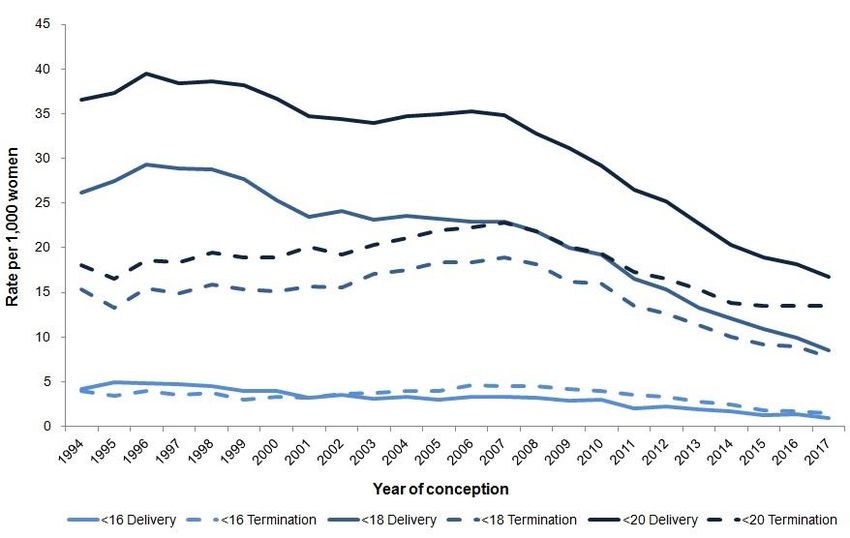
Information Services Division

This is a National Statistics Publication

National Statistics status means that the official statistics meet the highest standards of
trustworthiness, quality and public value. They are identified by the quality mark shown
above.

They comply with the Code of Practice for statistics and are awarded National Statistics
status following an assessment by the UK Statistics Authority’s regulatory arm. The Authority
considers whether the statistics meet the highest standards of Code compliance, including
the value they add to public decisions and debate.

Find out more about the Code of Practice at:
https://www.statisticsauthority.gov.uk/osr/code-of-practice/

Find out more about National Statistics at:
https://www.statisticsauthority.gov.uk/national-statistician/types-of-official-statistics/

                                                  1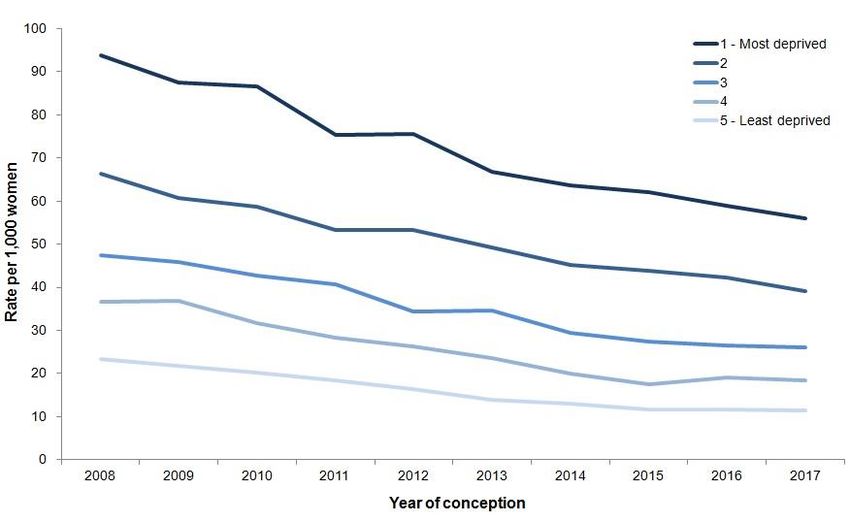
Information Services Division

Contents

Introduction .............................................................................................................................. 3
Main Points .............................................................................................................................. 4
Results and Commentary......................................................................................................... 5
   Teenage pregnancy by age group at conception ................................................................. 5
   Teenage pregnancy by NHS Board of residence ................................................................. 6
   Teenage pregnancy by council area of residence ................................................................ 7
   Teenage pregnancy by outcome .......................................................................................... 8
   Teenage pregnancy by deprivation .................................................................................... 12
   Teenage pregnancy in Scotland compared to England & Wales ........................................ 16
Glossary ................................................................................................................................. 17
List of Tables .......................................................................................................................... 18
Contact................................................................................................................................... 19
Further Information ................................................................................................................ 19
Rate this publication ............................................................................................................... 19
Appendices ............................................................................................................................ 20
   A1a – Background Information ........................................................................................... 20
   A1b – Methodology ............................................................................................................ 22
   Appendix 2 – Publication Metadata .................................................................................... 23
   Appendix 3 – Early access details ...................................................................................... 25
   Appendix 4 – ISD and Official Statistics ............................................................................. 26

                                                                     2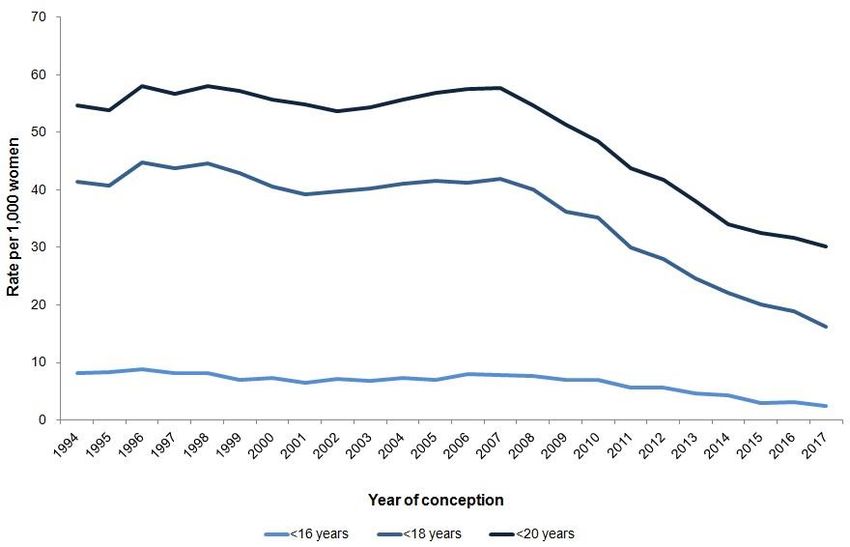
Information Services Division

Introduction
This release by Information Services Division (ISD) provides an annual update on teenage
pregnancy statistics in Scotland. This is based on age at conception and presented by year
of conception and the most recent information is for the calendar year ending 31 December
2017. The main tables and charts show numbers and rates for women presented across
three age groups: under 16, under 18 and under 20.

Many teenage women experience unintended or unwanted pregnancies, although for some
women this may be a planned, positive life choice. Scotland has historically had a higher rate
of teenage pregnancy than most other Northern and Western European countries and
reducing unintended teenage pregnancy remains a priority for the Scottish Government.

A reduction in teenage pregnancy rate has been observed since the most recent peak in
2007. While this may be due to various interventions such as Scotland’s ‘Pregnancy and
Parenthood in Young People Strategy’, a report by The British Pregnancy Advisory Service
(BPAS) suggests that changing lifestyle factors such as reduced risk-taking behaviour and
reduced alcohol consumption may have also contributed to the decline.

Scotland’s Strategy
In March 2016 the Scottish Government published ‘The Pregnancy and Parenthood in Young
People (PPYP) Strategy’ which aims to drive actions that will decrease the cycle of
deprivation associated with pregnancy in young people. The strategy notes that ‘evidence
shows that having a pregnancy at a young age can contribute to a cycle of poor health and
poverty as a result of associated socio-economic circumstances before and after pregnancy
(as opposed to the biological effects of young maternal age)’.

The strategy has a number of short, medium and long term outcomes. One of the long term
outcomes is a ‘reduction in pregnancies and subsequent unintended pregnancies in young
people’.

A progress report published in June 2019 provided an update on the priorities identified by
the PPYP Steering Group up to the end of 2018/19, as well as actions within the strategy
itself. It concluded that while rates of teenage pregnancy in Scotland have declined,
addressing the needs of young people around pregnancy and parenthood remains a priority
for the Scottish Government.

                                              3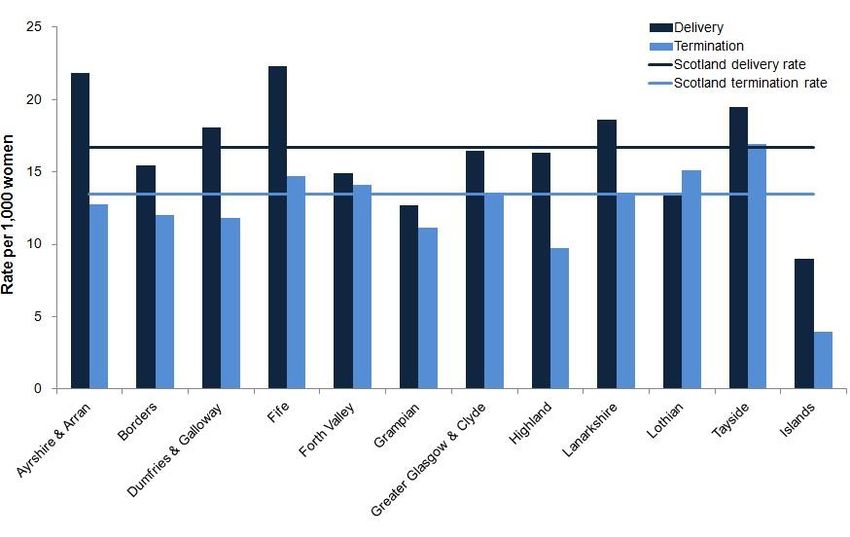
Information Services Division

Main Points
For women aged under 20 years:

•   Teenage pregnancy rates in Scotland are at their lowest level since reporting began in
    1994. Rates decreased for the tenth consecutive year from 31.7 per 1,000 women in
    2016 to 30.2 in 2017.

•   In 2017 NHS Grampian recorded the lowest overall rate of teenage pregnancy while NHS
    Fife recorded the highest (23.8 and 37.0 per 1,000 women respectively).

•   The absolute gap in teenage pregnancy rates between the most and least deprived areas
    is narrowing. While rates have reduced across all levels of deprivation in recent years,
    rates in the most deprived areas have fallen more.

•   Deliveries are more common than terminations, but delivery rates have fallen faster than
    termination rates. In 2017 the percentage of teenage pregnancies that ended in
    termination was the highest since reporting began (45%).

•   Teenagers from the most deprived areas are more likely to deliver than to terminate their
    pregnancy. In contrast, teenagers from the least deprived areas are more likely to
    terminate than to deliver. This difference in outcome of pregnancy between the most and
    least deprived has not changed in recent years.

                                             4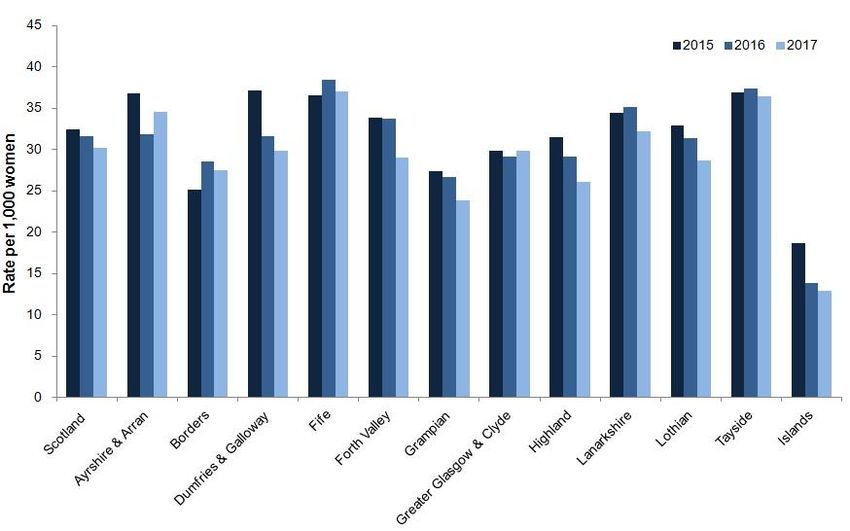
Information Services Division

Results and Commentary
Teenage pregnancy by age group at conception

Throughout this publication, unless stated otherwise, ‘teenage pregnancy’ refers to the
conception itself regardless of whether the woman went on to deliver or terminate. Rates are
presented per 1,000 women for each of the respective age groups (under 16, under 18 and
under 20). Text commentary provided in this report refers to the mainland NHS Boards only,
and not the combined Islands Board.

Between 1994 and 2007 teenage pregnancy rates varied but were generally much higher
than they are at present. The trend of decreasing rates of teenage pregnancy in Scotland
continued for the tenth consecutive year in 2017, with decreases observed since 2007.
Numbers and rates of teenage pregnancy are currently at the lowest recorded level since
reporting began.

          Figure 1: Teenage pregnancy by age group at conception, 1994-2017

Since 2007, rates per 1,000 in the under 20 age group have fallen by almost a half (from 57.7
to 30.2 in 2017). Similarly, rates for under 18s and under 16s decreased by more than 60%
and almost 70% respectively.

In terms of the actual number of teenage pregnancies, the total (under 20 age group)
decreased from 9,362 in 2007 to 4,276 in 2017. Of the 4,276 in 2017, under 16s accounted
for just 4.5%, with the majority of pregnancies (69%) among those aged 18 and 19.

For further information see Table 1.

                                             5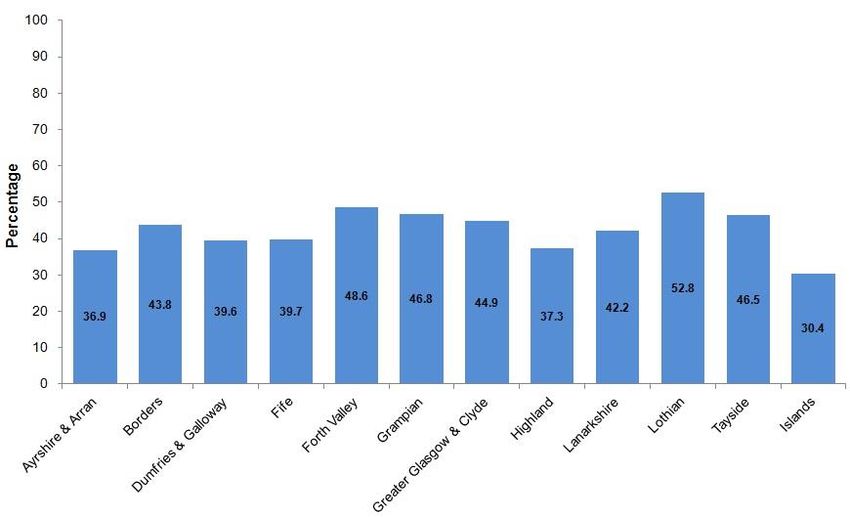
Information Services Division

Teenage pregnancy by NHS Board of residence

Rates of teenage pregnancy vary across the different NHS Board areas in Scotland.
However, over the last decade all NHS Board areas have seen a reduction in the numbers
and rates of teenage pregnancy. The largest reduction was observed in NHS Dumfries &
Galloway where rates dropped by more than a half (53%), from 63.2 per 1,000 in 2008 to
29.9 in 2017.

More recently, in the three year period between 2015 and 2017 there has been a general
downward trend in rates for most NHS Boards in Scotland.

                        Figure 2: Teenage pregnancy by NHS Board, 2015-2017

Includes all pregnancies in women aged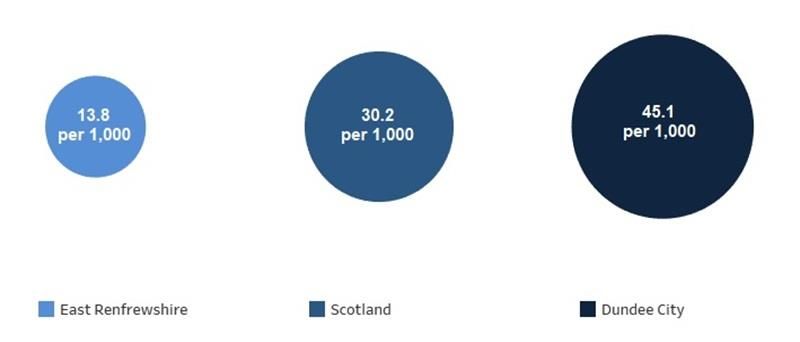
Information Services Division

Teenage pregnancy by council area of residence

As per ISD's Statistical Disclosure Control Protocol, data for the under 16 and under 18 age
groups at council area have been aggregated into three year periods to increase the
robustness of the data and lessen the possibility of patient disclosure.

Since 1996, Scotland has been divided into 32 areas designated as 'council areas' (also
known as ‘local authorities’). Due to the smaller area sizes and fewer cases in each area,
there can be more variability from year to year when looking at council area geographies as
opposed to NHS Board areas or Scotland as a whole.

Over the last decade, all council areas reported a reduction in the numbers and rates of
teenage pregnancy. The largest decrease was observed in Clackmannanshire where rates
fell from 80.3 per 1,000 in 2008 to 35.9 in 2017.

In 2017, East Renfrewshire had the lowest rate of all council areas (13.8) for the second year
running, while Dundee City had the highest (45.1) for the third year running, despite
observing a large decrease between 2016 and 2017.

Figure 3: Teenage pregnancy rates (lowest & highest) in mainland council areas, 2017

Includes all pregnancies in women aged
Information Services Division

Teenage pregnancy by outcome

Outcome of pregnancy by age
Typically, women in the youngest age group (under 16) are more likely to have a termination
than a delivery while women in the older age groups are more likely to have a delivery than a
termination.

For the period reported (1994-2017) termination rates for both the under 20 and under 18
age groups have remained lower than delivery rates, although the gap between delivery and
termination rates narrowed, and was at its lowest in 2017.

In contrast, termination rates for under 16s have remained higher than delivery rates since
2002. There have been slight fluctuations but this difference has also generally been
narrowing in recent years.

 Figure 4a: Teenage pregnancy by outcome and age group at conception, 1994-2017

Between 2016 and 2017, all age groups saw both delivery rates and termination rates
decrease.

In 2017 the delivery rate in Scotland for the under 20 age group was 16.7 and the termination
rate was 13.4 per 1,000. The delivery rate saw the larger decrease, dropping from 18.1 while
the termination rate only fell slightly, from 13.5.

Under 18s had a delivery rate of 8.5 and a termination rate of 7.8 compared to 10.0 and 8.9
the year prior. Likewise, under 16s had a delivery rate of 1.0 and a termination rate of 1.4
compared to 1.4 and 1.7 per 1,000.

                                              8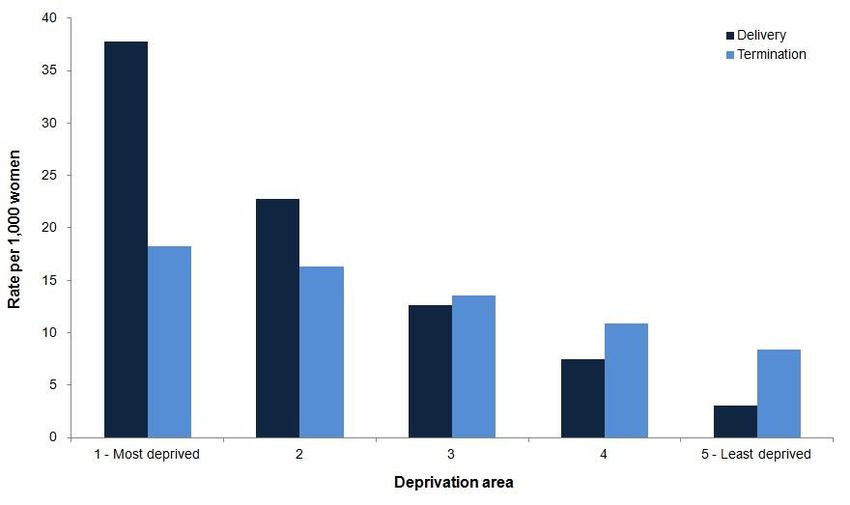
Information Services Division

Outcome of pregnancy over time
As noted above and illustrated in Figure 4a, the difference between termination and delivery
rates has narrowed since reporting began.

While numbers and rates of both termination and delivery have decreased since 1994,
delivery rates have fallen faster. As a result the percentage of teenage pregnancies that
result in termination rather than delivery has increased gradually over time.

             Figure 4b: Teenage pregnancy resulting in termination (%), 1994-2017

Includes all pregnancies in women aged
Information Services Division
Outcome of pregnancy by NHS Board of residence
Similar to the overall rate of teenage pregnancy, delivery and termination rates vary between
the different NHS Board areas in Scotland. It has been noted that all NHS Board areas have
seen a reduction in teenage pregnancy rate over the last decade and this applies not only to
the overall rate but to both termination and delivery.
Between 2008 and 2017 the largest decrease in delivery rate was observed in NHS Dumfries
& Galloway, falling from 42.9 to 18.0 per 1,000. Meanwhile, the largest decrease in
termination rate was observed in NHS Fife, falling from 25.2 to 14.7.
Figure 5a: Teenage pregnancy by outcome and NHS Board, 2017
Includes all pregnancies in women agedInformation Services Division
necessarily suggestive of an increased likelihood of termination (once pregnant) compared to
NHS Grampian. Rather it shows a higher rate of termination which is a reflection of there
being more teenage pregnancies in NHS Fife to begin with. There were more terminations
because there were more pregnancies.
Figure 5b shows that in fact when comparing the outcome of teenage pregnancy in NHS Fife
to NHS Grampian, a smaller percentage of pregnancies actually resulted in termination.
Figure 5b: Teenage pregnancy resulting in termination (%) by NHS Board, 2017
Includes all pregnancies in women agedInformation Services Division
Teenage pregnancy by deprivation
Deprivation and pregnancy
There is a strong correlation between deprivation and teenage pregnancy, with rates of
teenage pregnancy higher in more materially deprived areas. Deprivation is calculated using
the Scottish Index of Multiple Deprivation (SIMD), an area-based measurement of multiple
deprivation. Areas are divided into five groups, each consisting of approximately 20% of the
population, with decreasing levels of deprivation in each. More information on SIMD is
available in the appendix.
Teenage pregnancy rates have decreased in recent years and this has occurred across all
levels of deprivation. For the ten year period reported, teenage pregnancy rates in both the
most and least deprived areas were at their highest in 2008, and at their lowest in 2017.
Since 2008, the rate for under 20s living in the most deprived areas decreased from 93.7 to
56.0 per 1,000 in 2017. Meanwhile, the rate fell from 23.4 to 11.5 for those living in the least
deprived areas.
In 2017 the teenage pregnancy rate in Scotland was 30.2 per 1,000; however, rates varied
depending on where a woman lived. Those living in the areas of highest deprivation had
pregnancy rates almost five times higher than those in the least deprived areas (56.0
compared to 11.5 per 1,000).
Figure 6: Teenage pregnancy by deprivation area, 2008-2017
Includes all pregnancies in women agedInformation Services Division
between the most and least deprived. However, percentage falls were larger in the least
deprived areas.
In the most recent year (between 2016 and 2017) the teenage pregnancy rate in the most
deprived areas dropped from 58.9 to 56.0 per 1,000 while the least deprived areas saw rates
fall from 11.7 to 11.5. Similar patterns were observed for the under 18s.
13Information Services Division
Deprivation and outcome of pregnancy
In addition to the likelihood of teenage pregnancy occurring in the first place, deprivation is
also a factor in regards to the outcome (delivery or termination) of pregnancy.
The most deprived areas had 12 times the rate of delivery compared to the least deprived
areas (37.8 compared to 3.1 per 1,000) and more than double the rate of termination of
pregnancy (18.3 compared to 8.4). This pattern is mirrored in the under 18 age group.
Figure 7a: Teenage pregnancy by deprivation area and outcome, 2017
Includes all pregnancies in women agedInformation Services Division
Deprivation and outcome of pregnancy: 10 year comparison
The proportion of women choosing to terminate rather than deliver has increased across all
levels of deprivation.
Comparing 2008 to 2017, the percentage of women choosing to terminate their pregnancy in
the most deprived areas saw a small increase, rising from 30% to 33%. Women in the least
deprived areas also saw an increase in the percentage of pregnancies terminated, rising from
68% to 73%.
Figure 7b: Teenage pregnancy resulting in termination (%) by deprivation area,
2008 & 2017
Includes all pregnancies in women agedInformation Services Division
Teenage pregnancy in Scotland compared to England & Wales
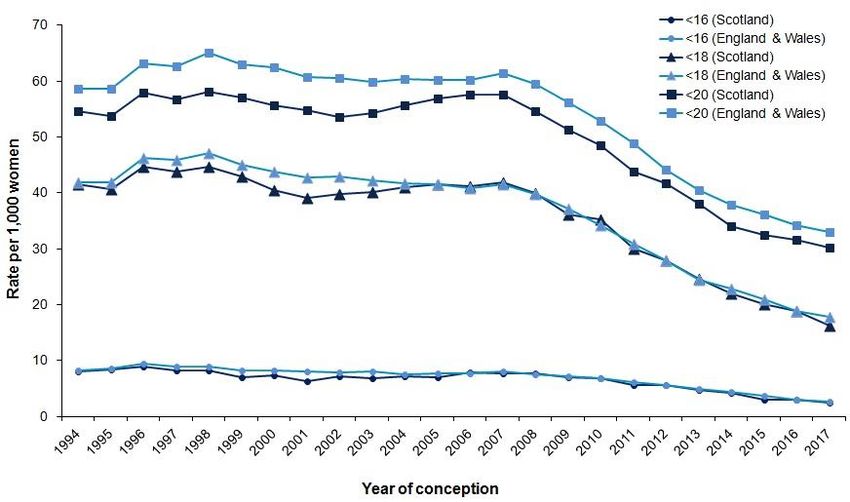
Figure 8 shows the different teenage pregnancy rates in each age group, comparing those
for Scotland against those in England & Wales.
Figure 8: Teenage pregnancy in Scotland compared to England & Wales, 1994-2017
Source: Office of National Statistics (ONS).
Teenage pregnancy rates across all three age groups in both Scotland and England & Wales
have followed a very similar declining pattern between 1994 and 2017.
In 2017, both saw rates decrease for the tenth consecutive year. Scotland had an overall
teenage pregnancy rate of 30.2 per 1,000, while England & Wales had a rate of 33.0.
For further information see Table 8.
16Information Services Division
Glossary
Conception The term ‘at conception’ used in this publication refers to when a
woman conceived, not when she delivered or terminated.
Delivery Refers to a single pregnancy producing one or more live or
stillbirths.
Deprivation area Scottish Index of Multiple Deprivation (SIMD) quintiles, also known
as deprivation areas. Each area consists of approximately 20% of
the population living in Scotland. They are ordered from 1 (most
deprived) to 5 (least deprived).
Gestation The process or period of developing inside the womb between
conception and birth.
Islands Board NHS Orkney, NHS Shetland and NHS Western Isles.
Mainland Boards NHS Boards in Scotland excluding the three Island NHS Boards;
Orkney, Shetland and Western Isles.
Maternity A pregnancy which results in the delivery of one or more live and/or
stillbirth.
Outcome In the context of this publication, the ‘outcome’ of a pregnancy can
be a delivery or a termination. Pregnancy statistics included in this
publication do not include miscarriages or illegal terminations.
Pregnancy Pregnancies include maternities and terminations sourced from
abortion notifications and birth registrations.
Stillbirth A child which had issued forth from its mother on or after the 24th
week of pregnancy and which did not breathe or show any other
sign of life.
SIMD The SIMD has seven domains (income, employment, education,
housing, health, crime and geographical access). These are
combined into an overall index to pick out areas with concentrations
of multiple deprivation.
Termination Refers to a therapeutic termination of pregnancy notified in
accordance with the Abortion (Scotland) Regulations 1991.
17Information Services Division
List of Tables
File name File and size
1. Teenage Pregnancy: Scotland Excel 40 Kb
2. Teenage Pregnancy: NHS Board Excel 40 Kb
3. Teenage Pregnancy: council area Excel 100 Kb
4. Teenage Pregnancy by age group and outcome: Scotland Excel 40 kb
5. Teenage Pregnancy by age group and outcome: NHS Board Excel 40 kb
6. Teenage Pregnancy by age group and deprivation: NHS Board Excel 80 kb
7. Teenage Pregnancy by age group, outcome and deprivation: Scotland Excel 50 kb
8. Teenage Pregnancy by age group: Scotland compared to England & Wales Excel 40 kb
18Information Services Division
Contact
Duncan McMaster
Information Analyst
0141 282 2081
nss.isdmaternity@nhs.net
Stuart Wrigglesworth
Senior Information Analyst
0131 275 7128
nss.isdmaternity@nhs.net
Further Information
Further Information can be found on the ISD website.
Information Services Division publishes a wide range of information on births, pregnancy and
sexual health. Further information can be found on the Maternity and Births and Sexual
Health pages.
Interactive visual content can be accessed in the Teenage Pregnancy Dashboard.
Information is presented over time, by deprivation area, maternal age group and outcome of
pregnancy.
The next release of this publication will be July 2020.
Rate this publication
Please provide feedback on this publication to help us improve our services.
19Information Services Division
Appendices
A1a – Background Information
Sources
The source data are (i) registrations of live and stillbirths from the National Records of
Scotland (NRS) with multiple births counted as one event, and (ii) the number of legal
abortions notified to the Chief Medical Officer (Scotland) in accordance with the Abortion
(Scotland) Regulations 1991. These statistics do not include pregnancies which resulted in
miscarriage or illegal termination.
All terminations performed in Scotland are legally required to be notified to the Chief Medical
Officer in Scotland. For every termination, a notification of abortion form must be completed.
Likewise any birth, live or still, which occurs in Scotland must be registered within 21 days by
the Registrar of Births, Deaths and Marriages.
The data presented are based on year of conception and age at conception. The date of
conception for each pregnancy is calculated from the recorded gestation minus 14 days for
stillbirths and terminations. The correction is because the length of gestation is traditionally
measured from the first day of the last menstrual period, and it is assumed that conception
starts two weeks after this date. For live births, as gestation is not available from birth
registrations, the date of conception is presumed to be 38 weeks before birth.
Disclosure and small numbers
Where statistics provide information on small numbers of individuals, ISD have a duty under
the Data Protection Act, to avoid directly or indirectly revealing any personal details.
Suppression of small numbers has been applied throughout these data in line with ISD's
Statistical Disclosure Control Protocol in order to protect patient confidentiality. These are
shown in the publication tables as asterisks. In addition, some secondary suppression may
be required to prevent the calculation of suppressed data.
Data are presented for Scotland, NHS Board and council area geographies. However, data
for the under 16 and under 18 age groups at council area level have been aggregated (three
year periods) to increase the robustness of the data and lessen the possibility of small
numbers. Likewise, the number of teenage pregnancies in NHS Shetland, NHS Orkney and
NHS Western Isles are now very small therefore the three have been combined into the
single category of ‘Islands Board’.
Populations used for calculating rates
The 2017 mid-year population estimates for Scotland, Health Board and council area have
been used in this publication. This report also includes rates by deprivation area, which are
based on small area population estimates.
Population figures based on updates of Census data are used to calculate rates per 1,000
women for each of the age groups presented (under 16, under 18 and under 20). For the
under 20 age group rates, all conceptions in women under 20 are included as the numerator
but only the 15-19 age group population figures are used as the denominator. This is
because less than 2% of under 20 conceptions are to girls aged under 15 and including the
younger age groups in the base population may produce misleading results. The same
principle applies for the under 18 and under 16 rates, which use females aged 15-17 and 13-
20Information Services Division
15 respectively. This methodology is also used by ONS which allows for comparisons with
England & Wales.
Scottish Index of Multiple Deprivation (SIMD)
There have been SIMD releases in 2004, 2006, 2009, 2012 and 2016. This report uses the
most appropriate SIMD for each year. Data for 2008 to 2009 use SIMD2009; years 2010 to
2013 use SIMD2012 and years 2014 onwards use SIMD2016.
Further information on SIMD is available in the Glossary and online:
http://www.isdscotland.org/Products-and-Services/GPD-Support/Deprivation/SIMD/
Geographies
This publication presents data by NHS Board and council area geographies. There are 31
Health and Social Care Partnerships (HSCP) in Scotland. They share the same boundaries
as the 32 council areas, except that Stirling and Clackmannanshire have merged to form the
one HSCP.
Council area NHS Board Council area NHS Board
East Ayrshire Argyll & Bute
Highland
North Ayrshire Ayrshire & Arran Highland
South Ayrshire North Lanarkshire
Lanarkshire
Scottish Borders Borders South Lanarkshire
Dumfries &
Galloway Dumfries & Galloway East Lothian
Fife Fife Edinburgh City Lothian
Clackmannanshire Midlothian
Falkirk Forth Valley West Lothian
Stirling Orkney Islands Orkney
Aberdeen City Shetland Islands Shetland
Aberdeenshire Grampian Angus
Moray Dundee City Tayside
East
Dunbartonshire Perth & Kinross
East Renfrewshire Na h-Eileanan Siar Western Isles
Glasgow City Greater Glasgow &
Inverclyde Clyde
Renfrewshire
West
Dunbartonshire
21Information Services Division
A1b – Methodology
Method of deriving information adopted from 2007
Introduction
Prior to the October 2007 update, there were substantial differences between Scotland and
England & Wales in the ways in which teenage pregnancy rates were calculated. These
differences meant that the data were not directly comparable. In the past this has lead to
misreporting and misinterpretation.
Background
Description of the methodology used by ISD prior to the 2007 update:
• Scottish data used to include miscarriages derived from SMR01, although a table
excluding miscarriages was included in some publications. Miscarriages increased the
level of teenage pregnancy by approximately 6% for the 13-15 age group and
approximately 8% for the 16-19 group (and the 13-19 group overall).
• SMR02 submissions were used to derive the number of births and stillbirths. This
allowed the actual gestation at birth to be used, which is important as more than 10%
of babies are born either three weeks or more before their due date, or more than one
week after it. This advantage was offset by the fact that approximately 2% of births are
not recorded on SMR02 and there can be delays or incompleteness of SMR02
returns.
• The termination data were derived from SMR01 and SMR02 returns rather than
notifications of legal abortions.
• The data were usually presented in specific age bands (13-15, 16-19, and 13-19) with
both numerator and denominator within these bands.
• The data were usually presented by financial year rather than calendar year.
• The Scottish data were presented by date of the measured event rather than the date
of conception. Thus a woman who conceived in 2003 and had her baby in 2004 would
be included in the data for 2004 in Scotland, but 2003 in England & Wales.
Approach since 2007 update
As far as possible we have emulated the approach used in England & Wales (see
https://www.ons.gov.uk/peoplepopulationandcommunity/birthsdeathsandmarriages/conceptio
nandfertilityrates/qmis/conceptionstatisticsqmi). Registration data are obtained from the NRS
for live and stillbirths. These are processed to ensure that multiple births are treated as a
single conception. For all live births, the date of conception is calculated as being 38 weeks
prior to the date of delivery. For stillbirths, the recorded gestation in weeks is used, and two
weeks are subtracted from this number to produce the estimated time between conception
and birth. This number is used to derive the likely conception date. For the very small
numbers of stillbirths in which the gestation is not recorded, 32 weeks is assumed. The
completeness and accuracy of the termination data is assessed, and the gestation is used to
calculate the date of conception. For the small number of cases where gestation is missing,
nine weeks is assumed. Although this approach is not absolutely identical to the approach
used in England & Wales it is considered to be as close as practicable and satisfactory for
direct comparisons. The numerators and denominators are derived in the same way as those
used in England & Wales.
Comparative Information
A comparison of teenage pregnancy rates in Scotland and those in England & Wales is
available in Table 8.
22Information Services Division
Appendix 2 – Publication Metadata
Metadata Description
Indicator
Publication Teenage Pregnancy.
title
Description Update of annual statistical information on teenage pregnancies in Scotland.
Theme Health and Social Care.
Topic Maternity and pregnancy services.
Format PDF report, Excel workbooks and interactive dashboard.
Data source(s) NRS birth registrations and notifications (to the Chief Medical Officer for Scotland) of
abortions performed under the Abortion (Scotland) Regulations 1991.
Date that data April 2019.
are acquired
Release date 02 July 2019.
Frequency Annual.
Timeframe of Delays not expected. NRS birth registrations are finalised and provided to ISD while
data and termination data is published by ISD prior to the release of teenage pregnancy
timeliness statistics.
Continuity of Reports data from 1994.
data
Revisions Data are considered final. Receipt of late abortion notifications may be received after
statement publication, with figures then being revised in the next annual report update.
Revisions N/A
relevant to this
publication
Concepts and See Glossary
definitions
Relevance Making information publicly available for planning, epidemiology, provision of
and key uses services and comparative information.
of the
statistics
Accuracy Abortion notification information on forms is clerically checked and also validated at
data entry and NRS birth registrations data are not supplied to ISD until considered
final.
Completeness Considered complete. There may be a very small number of late abortion notification
forms received. Data are then revised at following year's update.
Comparability Scottish data are directly comparable with data for England & Wales.
See appendix A1b.
Accessibility It is the policy of ISD Scotland to make its websites and products accessible
according to published guidelines.
Coherence Teenage Pregnancy tables and charts are accessible via the ISD website at
and clarity http://www.isdscotland.org/Health-Topics/Sexual-Health/Teenage-Pregnancy/
Value type Numbers and crude rates are presented.
and unit of
measurement
Disclosure The ISD protocol on Statistical Disclosure Protocol is followed.
Official National Statistics.
Statistics
designation
UK Statistics Assessed by UK Statistics Authority.
Authority https://www.statisticsauthority.gov.uk/publications-list/?type=assessment-report
Assessment (Assessment Report 110).
Last published July 2018.
23Information Services Division
Next July 2020.
published
Date of first First published in this format in June 2008.
publication
Help email nss.isdmaternity@nhs.net
Date form June 2019.
completed
24Information Services Division
Appendix 3 – Early access details
Pre-Release Access
Under terms of the "Pre-Release Access to Official Statistics (Scotland) Order 2008", ISD is
obliged to publish information on those receiving Pre-Release Access ("Pre-Release Access"
refers to statistics in their final form prior to publication). The standard maximum Pre-Release
Access is five working days. Shown below are details of those receiving standard Pre-
Release Access.
Standard Pre-Release Access:
Scottish Government Health Department
NHS Board Chief Executives
NHS Board Communication leads
25Information Services Division
Appendix 4 – ISD and Official Statistics
About ISD
Scotland has some of the best health service data in the world combining high quality, consistency,
national coverage and the ability to link data to allow patient based analysis and follow up.
Information Services Division (ISD) is a business operating unit of NHS National Services
Scotland and has been in existence for over 40 years. We are an essential support service to
NHSScotland and the Scottish Government and others, responsive to the needs of
NHSScotland as the delivery of health and social care evolves.
Purpose: To deliver effective national and specialist intelligence services to improve the
health and wellbeing of people in Scotland.
Mission: Better Information, Better Decisions, Better Health
Vision: To be a valued partner in improving health and wellbeing in Scotland by providing a
world class intelligence service.
Official Statistics
Information Services Division (ISD) is the principal and authoritative source of statistics on
health and care services in Scotland. ISD is designated by legislation as a producer of
‘Official Statistics’. Our official statistics publications are produced to a high professional
standard and comply with the Code of Practice for Official Statistics. The Code of Practice is
produced and monitored by the UK Statistics Authority which is independent of Government.
Under the Code of Practice, the format, content and timing of statistics publications are the
responsibility of professional staff working within ISD.
ISD’s statistical publications are currently classified as one of the following:
• National Statistics (ie assessed by the UK Statistics Authority as complying with the Code
of Practice)
• National Statistics (ie legacy, still to be assessed by the UK Statistics Authority)
• Official Statistics (ie still to be assessed by the UK Statistics Authority)
• Other (not Official Statistics)
Further information on ISD’s statistics, including compliance with the Code of Practice for
Official Statistics, and on the UK Statistics Authority, is available on the ISD website.
26You can also read


