Thousands of palm trees are dying from a new disease - Phys.org
←
→
Page content transcription
If your browser does not render page correctly, please read the page content below
Thousands of palm trees are dying from a
new disease
15 July 2019, by Elizabeth Djinis, Tampa Bay Times

                                                      different types of trees.

                                                      When Thomas first moved to the area about six
                                                      years ago to attend the University of Tampa, he felt
                                                      that the state's identity was interwoven with palm
                                                      trees.

                                                      But soon, he noticed: some were dying. He
                                                      watched as the once-flowering palms withered into
                                                      ravaged shells.

                                                      Thomas told people about it. They just rolled their
                                                      eyes.

                                                      "They get tired of me talking about it," he said.
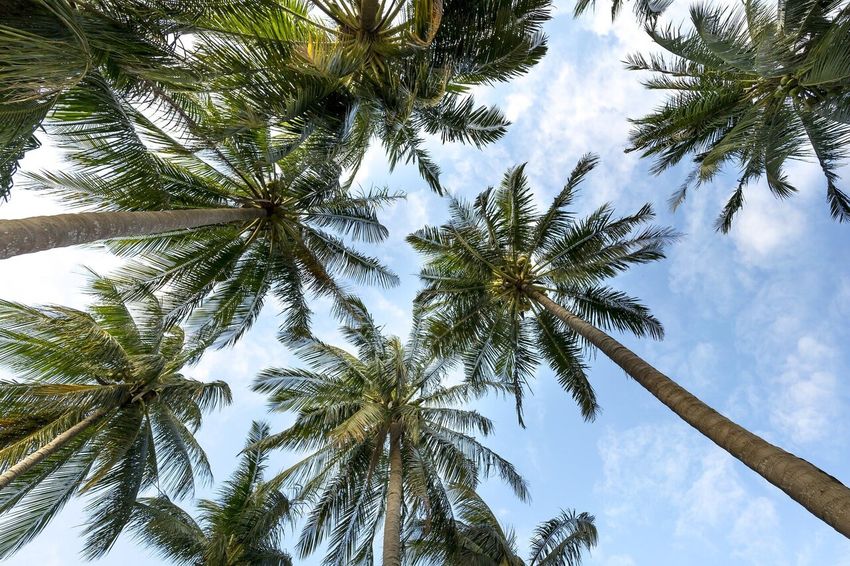
Credit: CC0 Public Domain
                                                      So Thomas came to Florida Wonders.

                                                      "I have steadily noticed an increase in the amount
The section of Tampa's Bayshore Boulevard that        of dead or dying palm trees, many of them in the
winds around the Hillsborough Bay is lined on         city or right along highways," Thomas wrote to the
either side by one of Florida's most iconic plants,   Times in late May. "They sit for months as eyesores
the palm tree.                                        before being removed and sometimes replaced."

Some are tall and spindly, necks so long and thin it He ended his email with a plea for someone to
seems impossible they could support an entire        recognize these dying trees.
head. Others have verdant green limbs that stretch
around their short trunks.                           "Has anyone else noticed the rise of dead palm
                                                     trees?" he wrote. "Sadly, no one I know seems to
Among a canvas of lush palms, a few trees stand notice."
out. Their fronds are a sickly light brown.
                                                     Thomas is right: Something is killing Florida's palm
Local forester Richard Bailey offers a prophetic     trees.
warning: These palm trees are dying. So are many
more around the Tampa Bay area and throughout The disease that afflicts these trees, lethal
Florida.                                             bronzing, has a name similar to the color it turns
                                                     diseased leaves, a brown that slowly morphs onto
Just as worrisome: There is no cure for the disease each leaf until the whole tree dies.
that ails them.
                                                     The first characterized case of lethal bronzing
Samuel Thomas spent his childhood looking at         occurred in Texas in 2002, according to Brian
trees. Growing up in a rural part of Virginia, he    Bahder, an assistant professor of insect vector
spent many days walking through the forest with      ecology with the University of Florida's Institute of
his grandfather and learning to identify the many    Food and Agricultural Sciences extension. But it

                                                                                                     1/4
wasn't until 2006 that the disease was first identified leaves. There is no chance of a tree surviving once
in Florida.                                              the spear leaf, or the youngest leaf of a palm tree,
                                                         gets diseased.
The disease starts with a tiny insect. The aptly
named plant hoppers feed on the tree's sap and           It takes four to five months from acquiring lethal
inject their saliva into its tissue through their        bronzing until death, Bahder said. There's no
"needlelike mouths," Bahder said. When a                 treatment.
planthopper feeds on an infected tree, they become
a carrier of the disease.                                "Lethal bronzing is different than lethal yellowing at
                                                         the molecular level," Bahder said. "It always kills
Once a planthopper feeds on a healthy tree, the          the palm when it gets into it."
disease is instantly transferred. And just like that, a
quick feeding process turns a healthy tree into a        How many trees have died since lethal bronzing
sick one.                                                descended on Florida's palm populations? It's hard
                                                         to quantify, Bahder said.
Scientists first noticed a disease consistent with
lethal bronzing after an onset of dying palm trees       "I've heard some growers have lost full stands of
cropped up in Texas in the 1980s, Bahder said.           palms and that runs them in the millions of dollars
Florida was already accustomed to lethal yellowing, of loss," he said.
a palm disease that originated in Jamaica and
spread throughout the Caribbean. That disease            But he estimated that "tens of thousands" of trees
lingered in South Florida, primarily affecting the       in Florida have been affected at this point.
Florida Keys and Miami-Dade, but it largely stayed
there, mostly affecting coconuts.                        Right now, there is one solution: Pump unafflicted
                                                         trees full of an antibiotic, oxytetracycline, which can
Yet these trees in Texas looked different. When          be used to treat acne and rosacea in humans,
scientists tested them in 2002, they found the           every three to four months.
bacteria was not the same as lethal yellowing. At
that time, the disease was named Texas Phoenix The problem with that solution is it's expensive and
Palm Decline because it was thought to only affect not permanent. To get a forester like Richard Bailey
Phoenix or date palms in Texas.                          to inject your trees, it's $50 per palm four times a
                                                         year. If you have more than one palm, you're
By 2006, scientists found that the disease had           quickly spending hundreds of dollars simply to
spread to other parts of the country, including          prevent your trees from getting a disease they may
Florida, where it was centered in Hillsborough           never get.
County. Since then, lethal bronzing has trickled to
31 counties in Florida as far north as Duval and as Could there be a cure? Earlier studies of lethal
far south as Broward.                                    bronzing found that pumping liters of "really pure"
                                                         antibiotic into palms was enough to subvert the
Scientists are still trying to determine how the         effects of lethal bronzing. But it's not a surefire
disease migrated to Florida. But they do know that solution.
it was first seen in Hillsborough.
                                                         "I think it's possible," Bahder said. "We just need
"Tampa is kind of ground zero for this infection,"       the money and the time."
Bahder said.
                                                         Richard Bailey is the kind of man who can look at a
When a tree is infected with lethal bronzing, the        tree, point to its branches and immediately spout off
symptoms start slowly. First, the tree will drop its     its Latin name.
fruit prematurely. If there are flowers on the tree,
those will slowly die, eventually browning the oldest "Phoenix roebelenii," he says quickly, pointing to a

                                                                                                        2/4
short palm that curves out of the ground, its brown, Muecke said.
spiked edges breaking off into sloping green
leaves. "Pygmy date palm." When Bailey first saw a tree infected with what he
thinks was lethal bronzing years ago, he knew it
Bailey spends his days going from house to house was something serious.
and inspecting trees. It's almost as if he can
diagnose on sight. Although tests from the lab indicated the tree had a
more common ailment, Bailey wasn't convinced.
On a recent day, Bailey was at Tampa resident
Norman de Lapouyade's house, traveling through a Since then, he has seen lethal bronzing take down
backyard that could rival a tropical forest. De his clients' trees, his neighborhood's trees and
Lapouyade asked Bailey to look at three trees in trees that line one of Tampa's most luxurious
the back that are near death. streets. Because the disease isn't carried from tree
to tree but from insect to insect, there's a
While he was there, de Lapouyade asked for randomness to it that makes it hard to combat.
Bailey's opinion on this tree or that. Bailey had one
recommendation: Plant a diverse variety of species. "It's a terrible disease," Bailey said. "It'll take one
He pointed out an areca palm. here and one over there and come back and grab
one or two and then it won't bother you for a year or
"This is a good alternative," he said. two and it'll come get another one. It doesn't move
in a big wave and kill everything as it goes—it's even
Bailey considers himself a preacher of a particular worse."
type of gospel: how to ward off lethal bronzing.
Bailey has even seen the death of trees he's
"That's my story," he said. "I don't see us ever injected with preventative antibiotics.
curing this disease. It's here and it's probably going
to be here to stay. So how do we manage it?" "It breaks my heart," he said.
The city of Tampa has the same problem. They He develops a relationship with his customers and
currently spend about $9,000 to inoculate 300 trees takes it hard when he loses a tree.
every four months. Next year, the city will have to
invest more money into the program, said Eric "Their palms become like mine," he said. "They're
Muecke, an urban forestry manager with the city of my babies, too."
Tampa's Parks and Recreation department.
When he lost a recent palm tree at a client's house
Muecke calls inoculating trees a "proactive" move on Harbour Island, he came home from work with a
on the city's part. Once symptoms of lethal bronzing sullen look on his face. Bailey's wife didn't even
appear, he says, the tree has only a 10% shot of have to guess what upset him.
surviving.
"Another one of your palms die?" she said.
In the last three years, the city has planted about
140 palm trees per year, he said. But as more The answer was, of course, yes.
types of palms fall prey to lethal bronzing, Muecke
said, it's difficult to sustain a population of the trees ©2019 Tampa Bay Times (St. Petersburg, Fla.)
Floridians expect in their back yards. Distributed by Tribune Content Agency, LLC.
"We have to lean toward diversity when it comes to
replacement because the diversity of our tree
population is what makes it resilient to things like
insects, diseases, even coming back after storms,"
3/4APA citation: Thousands of palm trees are dying from a new disease (2019, July 15) retrieved 30 July
2019 from https://phys.org/news/2019-07-thousands-palm-trees-dying-disease.html
This document is subject to copyright. Apart from any fair dealing for the purpose of private study or research, no
part may be reproduced without the written permission. The content is provided for information purposes only.
4/4
Powered by TCPDF (www.tcpdf.org)You can also read


