UNDER THE SPOTLIGHT CHINESE BANKS' RISKY AGRIBUSINESS PORTFOLIO - June 2021 - Global Witness
←
→
Page content transcription
If your browser does not render page correctly, please read the page content below

UNDER THE SPOTLIGHT
CHINESE BANKS' RISKY
AGRIBUSINESS PORTFOLIO
 June 2021
China is one of the world's largest consumers of agricultural commodities
such as soy and palm oil that drive deforestation globally. But it isn’t just
Chinese consumption of these commodities that is helping fuel forest
destruction. Global Witness's new analysis sheds a spotlight on the often-
overlooked role of Chinese banks as some of the biggest global financiers
of deforestation

From January 2013 to April 2020, Chinese banks
and investors provided over 22.5bn USD to major        RECOMMENDATIONS
companies producing and trading commodities –
                                                       > The Chinese banking regulator needs to
pulp and paper, rubber, timber, palm oil, soy and
                                                         ensure that banks are taking account of the
beef - at high risk of driving deforestation. There
                                                         environmental impact of the companies they
are clear warning signs that Chinese financiers
                                                         finance, including via regulations such as the
currently have inadequate safeguarding in place
                                                         China’s law on commercial banks, to require
to address risks associated with deforestation.
                                                         the sector to check their clients' environmental
The production of commodities such as palm oil,          and social credentials and the impacts and
soy and beef is widely documented to drive               risks of their operations and supply chains. The
deforestation in the world's climate critical            regulator must also explicitly require banks to
tropical forests, which are often also the planet's      refrain from financing deforestation.
most biodiverse areas, and home to indigenous
                                                       > Chinese banks should commit to ending their
people. Forests are also home to more than 80
                                                         support for companies involved in
per cent of all terrestrial species, and encroaching
                                                         deforestation and undertake rigorous checks
upon them may risk the spread of further
                                                         on the companies which are operating in
zoonotic diseases - such as Covid 19 - that pass
                                                         sectors or regions where there is a high risk of
from animals to humans.
                                                         deforestation to ensure they are not
Promises made by companies around the world              associated with deforestation.
to eliminate deforestation from their supply
chains by 2020 have proved meaningless as many
failed to deliver on the pledges.

China itself has made bold commitments to
become carbon neutral by 2060 and is hosting a
UN biodiversity summit in 2021. To make these
commitments effective, China’s banking
regulator needs to ensure Chinese banks do not
continue financing agribusinesses that
exacerbate the climate crisis and biodiversity
loss.

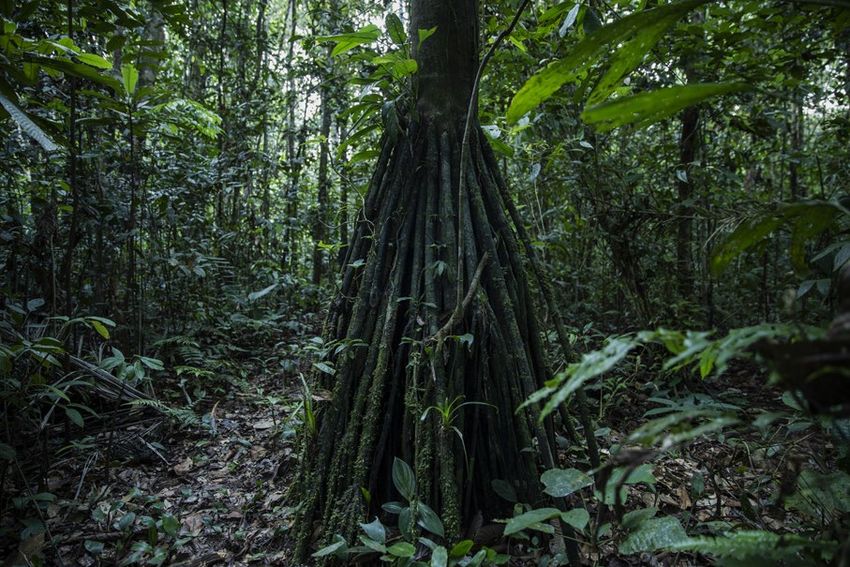
                                                       Irresponsible businesses including financial institutions are
                                                       driving the destruction of climate-critical tropical forests. Lalo de
                                                       Almeida/Panos/Global Witness

GLOBAL WITNESS JUNE 2021                                           Under the spotlight: Chinese banks' risky agribusiness portfolio   1
SO HOW SIGNIFICANT IS CHINESE                         THE ROLE OF MAJOR CHINESE
FINANCING GLOBALLY?                                   COMMERCIAL BANKS
The total financing provided by Chinese financial     China is in a unique position to reduce its finance
institutions places China as the sixth largest        sector’s global deforestation footprint quickly
financier in the world for major companies            and effectively, as just a handful of Chinese banks
producing and trading forest-risk commodities.        provided a significant share of the financing for
                                                      major companies producing and trading forest-
Our analysis is based on public data produced by
                                                      risk commodities.
Forest and Finance, an initiative by a coalition of
campaign and research organisations. According        The data shows that 67% of the Chinese financing
to the data, Chinese banks and investors              was provided by Chinese companies that
provided over 22.5bn USD loans and                    primarily operate as commercial banks. Although
underwriting from January 2013 to April 2020 to       it has been widely reported that commodities
major companies producing and trading forest-         such as palm oil, soy and beef drive deforestation
risk commodities. The data also shows that,           and biodiversity loss globally, these Chinese
overall, financial institutions based in Brazil,      banks appear unconcerned as they provided
Malaysia, the US and Indonesia, countries which       billions to support the companies involved in the
are all major producers of such commodities,          production and trade of such commodities.
provided the largest amount of financing.
                                                      Just five of the biggest Chinese commercial
However, if we exclude financiers based in
                                                      banks 1 provided 10.25bn USD over more than
producer countries, China ranks the second
                                                      seven years from 2013, which accounts for 45% of
largest financier worldwide, just after Japan.
                                                      all the financing provided by Chinese financial
                                                      institutions. These banks dominate China's retail
                                                      banking landscape and have become some of the
                                                      world's largest banks in recent years. The
                                                      Industrial and Commercial Bank of China and
                                                      Bank of China are the biggest financiers. Each

GLOBAL WITNESS JUNE 2021                                      Under the spotlight: Chinese banks' risky agribusiness portfolio   2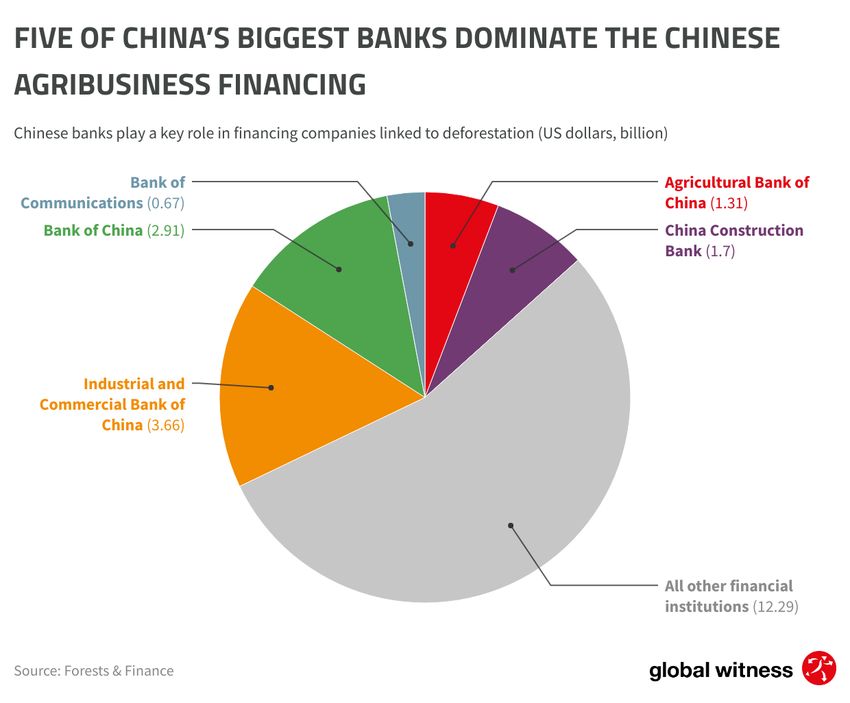
respectively provided 3.66bn USD and 2.91bn         We chose to focus on the palm oil, soy and beef
USD of financing for major companies producing      sectors because these three commodities have
and trading forest-risk commodities between         led to the most forest being replaced from 2001
January 2013 to April 2020.                         to 2015 according to the World Resource
                                                    Institute, an organization that monitors global
The Industrial and Commercial Bank of China and
                                                    tree cover loss. A recent report by Forest and
Bank of China are also among the worst
                                                    Finance, finds that about 29% of the analysed
performing banks worldwide in a ranking created
                                                    Chinese financing provided from 2016 to 2020
by Forest 500 which assesses the deforestation
                                                    went to companies producing and trading these
policies of the 500 most influential companies
                                                    three commodities, and 64% went to supply
and financial institutions in forest-risk
                                                    chains of rubber, pulp and paper.
commodity supply chains. In the 2020
assessment, they both scored 0 out of 100, the
lowest possible score for any bank assessed
against indicators in four categories.              Palm oil, soy and beef have led to
Our closer examination below of the companies       the most forest being replaced from
that received billions from the Chinese banks for   2001 to 2015.
producing and trading palm oil, soy and beef,       According to the World Resource
further demonstrates that Chinese banks have        Institute’s analysis, 2021
done little or no due diligence to ensure their
money is not fuelling environmental and social
damage.
GLOBAL WITNESS JUNE 2021                                    Under the spotlight: Chinese banks' risky agribusiness portfolio   3
WARNING SIGNS IN THE PALM OIL Julong, which have been linked to palm oil
concessions in Indonesia. As of January 2021,
SECTOR neither company had adopted a no-deforestation
policy, according to tracking initiatives. A report
From January 2013 to April 2020, Chinese banks by financial analyst Chain Reaction Research
funneled 3.2bn USD worth of loans and earlier this year found that Tianjin Julong's
underwriting services into the palm oil sector, the supply chains have been linked to deforestation,
analysis suggests. This is a sector that after forest fires, and community rights breaches since
decades of exposure and scrutiny is still often 2010. The company’s membership of the
associated with environmental and social harm. Roundtable on Sustainable Palm Oil was
terminated in 2016 due to reporting failures.
Palm oil continues to drive extensive
deforestation, not only in traditional major Another major company financed by Chinese
producing countries, like Indonesia and Malaysia, banks is Wilmar, the world's largest palm oil
but also in new frontiers like Papua New Guinea trader. Since 2007, the investigative group
and West African countries including Cameroon. Greenpeace has released a series of reports
exposing Wilmar’s role in forest destruction. In
In this period, the Forest and Finance data show
2018, Greenpeace alleged that Wilmar was still
Chinese banks provided 2.1bn USD to a single
linked to forest destruction in Indonesia almost
company for its palm oil operations – COFCO
five years after committing to end deforestation
(which stands for China Oil and Foodstuffs
in its supply chains. In 2019, Greenpeace stopped
Corporation), China's largest agricultural
engaging with the company’s joint deforestation-
processing and trading company.
monitoring platform, due to concerns about
As COFCO doesn't produce its own palm oil, the Wilmar’s failure to follow through on its
only way of ensuring this oil is not associated environmental promises.
with deforestation or human rights abuses would
Chinese banks have also provided 31.8mn USD of
be to monitor its suppliers and to exclude those
financing to two US agribusiness giants ADM and
which present environmental and social risks.
Bunge for their palm oil operations, according to
COFCO International, the group’s international
the Forests and Finance analysis. In 2020, Global
trading arm, requires suppliers to avoid
Witness revealed that ADM and Bunge sourced
deforestation in its supplier code of conduct. It
from Indonesian palm oil mills that had been
appears however that COFCO may not be putting
accused of violating local community land rights,
this policy into practice.
including seizing community-owned land,
Our analysis reveals that 77 processing facilities attacking community members, and causing
which had been suspended by palm oil giant serious environmental degradation.
Unilever for non-compliance with its sourcing
The Forest and Finance database listed 28 palm
policies 2 were still listed as COFCO suppliers in
oil groups that received financing from Chinese
2019. This is based on the latest disclosures from
banks. Nine of these firms are among a list
Unilever (September 2020) and COFCO (in 2019).
compiled by Greenpeace of the palm oil groups
It is concerning that COFCO has failed to exclude
most closely linked to the 2019 Indonesian forest
suppliers that have been in breach of Unilever’s
fire crisis, with the highest number of fire
sourcing policy dating back as far as 2010, and
hotspots in their own concessions or in
therefore could be guilty of deforestation.
concessions linked to them. Some of the
Chinese banks are also supporting other major Indonesian fires were reportedly started in order
Chinese companies including ZTE and Tianjin to clear land for plantations, a practice common
GLOBAL WITNESS JUNE 2021 Under the spotlight: Chinese banks' risky agribusiness portfolio 4in tropical forests around the world. The fire and Chinese banks should be concerned too. For one,
ensuing haze had a profoundly damaging impact deforestation has an impact on regional water
on public health and the climate. Greenpeace cycles and climate. Any degradation in growing
estimates that land around 40 times the size of conditions in Brazil could therefore threaten
Hong Kong burned between 2015 and 2019 in China's food security, as it is by far the biggest
Indonesia. consumer of Brazilian soy and beef.
HOW IS CHINESE FINANCING The environmental group Mighty Earth has
published a tracker of ten major soy traders and
LINKED TO DEFORESTATION IN meatpackers using satellite imagery of
deforestation and land clearance. It ranked the
BRAZIL? companies based on the extent, severity, and
response to the clearance in their Brazilian
The rate of deforestation in Brazil has surged to
supply chains. According to the latest monitoring
its highest level in over a decade. A leading
data, the five companies 3 that received the most
Brazilian scientist has warned that the Amazon
financing from Chinese banks for soy and beef
rainforest could disappear unless immediate
operations in Brazil were all found by Mighty
action is taken to reverse deforestation.
Earth to be exposed to deforestation and land
Deforestation in Brazil is largely driven by the
clearance. Combined together, these five
production of soya beans and beef. The loss of
companies were found to be linked to 161,018
the precious Amazon ecosystem in Brazil has
hectares of forest clearance since October 2017.
regional and global implications for us and for
the planet's health.
The world's climate critical tropical forests are often also the planet's most biodiverse areas, and home to indigenous people. Lalo de
Almeida/Panos/Global Witness
GLOBAL WITNESS JUNE 2021 Under the spotlight: Chinese banks' risky agribusiness portfolio 5COFCO, the company that received the vast Chinese banks should commit to ending their
majority of the financing from the Chinese banks support for companies involved in deforestation
in the Brazilian soy and beef sectors, ranked the and undertake rigorous checks on the companies
sixth worst deforester out of ten in Mighty Earth’s which are operating in sectors or regions where
latest analysis. As mentioned above, COFCO’s there is a high risk of deforestation to ensure they
international arm requires suppliers to avoid are not associated with deforestation.
deforestation. However, Mighty Earth's latest
What role can the banking regulator play?
tracker recorded 21,498 hectares of forest
clearance by suppliers linked to COFCO since China is well-placed to achieve deforestation-free
October 2017, most of which it described as financing quickly, as a large portion of its
“possibly illegal” due to the likelihood that it had financing of forest-risk commodities is provided
taken place in reserves and preservation areas. by a small number of Chinese banks. The Chinese
banking regulator needs to ensure that banks are
JBS, the biggest meat producer in the world,
taking account of the environmental impact of
received funds from China Construction Bank,
the companies they finance, including via
despite the company’s poor environmental track
regulations to require the sector to check their
record and a number of published exposés on its
clients' environmental and social credentials and
links to environmental and biodiversity
the impacts and risks of their operations and
destruction in the Brazilian Amazon. Global
supply chains. The regulator must also explicitly
Witness recently revealed how between 2017 and
require banks to refrain from financing
2019, JBS bought cattle from at least 327 ranches
deforestation.
in the Amazon in which deforestation occurred.
Other institutions have also raised red flags about A proposed revision of the Chinese law for
JBS. For example, analysts at the global banking commercial banks provides a crucial opportunity
giant HSBC criticised JBS’s environmental to act on this agenda. Global Witness would like
record, citing concerns about deforestation in its to see the revised law explicitly require the
beef supply chains. The investment fund of banking sector not to finance companies linked
Norges Bank, Norway’s central bank and Nordea to deforestation, or other types of environmental
Asset Management, the investment arm of destruction and social damage. These
northern Europe’s largest financial services requirements could be transformative in
group, have both dropped JBS from their achieving China's green ambitions. The law
portfolios, respectively citing concerns about the should build on requirements set out in several
risk of JBS being responsible for corruption and guidelines issued by the Chinese government in
JBS’s link to deforestation. recent years. For example, the Green Credit
Guidelines (2012) require financial institutions to
What should Chinese banks do about carry out due diligence, including for
deforestation risks? environmental and social risks; and the 2017
Guidance from a national banking regulator sets
Unless Chinese financiers undertake more out further requirements for Chinese banks to
rigorous checks on the companies they fund “strengthen environmental and social risk
which are engaged in high-risk sectors often management” when exposed to risks outside
associated with deforestation, they could be China.
fueling global forest destruction and contributing
to biodiversity loss and climate change. Banks can be a force for change and will be
crucial to supporting the transformation needed
So, what should the banks do? for China to achieve its 2060 carbon neutrality
GLOBAL WITNESS JUNE 2021 Under the spotlight: Chinese banks' risky agribusiness portfolio 6goal. The question is if and how quickly China will introduce mandatory requirements to steer its banking sector away from financing deforestation. Such action could deliver real results in China's quest to curb biodiversity loss and significantly contribute to the global fight to halt the climate crisis. Company responses We wrote to some of the companies named in the report but didn’t get a response. This document compiles previous responses made by companies named in the report. GLOBAL WITNESS JUNE 2021 Under the spotlight: Chinese banks' risky agribusiness portfolio 7
ENDNOTES
1
  These are the biggest five banks by assets, including the    3
                                                                 The five companies are COFCO, Cargill, Bunge, ADM,
Industrial and Commercial Bank of China, Bank of China,        LDC. The Brazil Agriculture Finance Program was
Bank of Communications, Agricultural Bank of China and         excluded as it is a programme that subsidises multiple
China Construction Bank Ltd.                                   companies. Please refer to Forest and Finance’s
                                                               explanation on the programme
2
  Unilever and COFCO’ policies differ as Unilever’s bans all   here:https://forestsandfinance.org/faq/09-what-is-the-
deforestation activity while COFCO International’s merely      brazil-agriculture-finance-program/
states that deforestation should be avoided.

GLOBAL WITNESS JUNE 2021                                                Under the spotlight: Chinese banks' risky agribusiness portfolio   8
You can also read


