Vocational specialisation stream within the VCE - Overview - Engage ...
←
→
Page content transcription
If your browser does not render page correctly, please read the page content below

Vocational specialisation
stream within the VCE
Overview

Overview

    Senior secondary reform: Setting every Victorian student
    up for the future
    We want every Victorian student’s senior secondary experience to be a positive,
    enjoyable and rewarding one.

    Senior secondary education is about developing and realising every student’s potential. Our
    Victorian Certificate of Education (VCE) is world class and the Victorian Certificate of Applied
    Learning (VCAL) has provided a steppingstone to great jobs in growing industries.

    Young people are living through a global pandemic, and Victoria’s economy is rapidly changing.
    We need to ensure students build the skills and capabilities to thrive in further education and
    training, move into a rewarding career and live a great life.

    Within senior secondary education, vocational and applied learning builds critical and creative
    thinking, communication skills, teamwork and collaboration, curiosity and innovation. It
    provides students with real-world knowledge, including about the workplace, and practical and
    transferrable skills.

    In 2019, the Victorian Government commissioned John Firth, the former CEO of the Victorian
    Curriculum and Assessment Authority (VCAA), to conduct a review into vocational and applied
    learning pathways in senior secondary schooling (Firth Review). The Firth Review found that
    we need to do more to make vocational and applied learning in schools high quality, highly
    regarded, relevant to the needs of students and employers, and available to all.

    The Firth Review recommendations provide a roadmap for reform, building on the Victorian
    Government’s historic investment of $315.5 million in senior secondary schooling reforms
    since 2018.

    The Victorian Government is working to ensure senior secondary students receive a great
    education, learn about the world of work and develop strong life skills, so they can make
    informed choices about further study, jobs and their futures. This will enable young people to
    contribute to, and, benefit from, the growth in the Victorian economy and prepare them for active
    and fulfilling lives in the community.

©VCAA 2021 Vocational specialisation stream within the VCE overview                                     1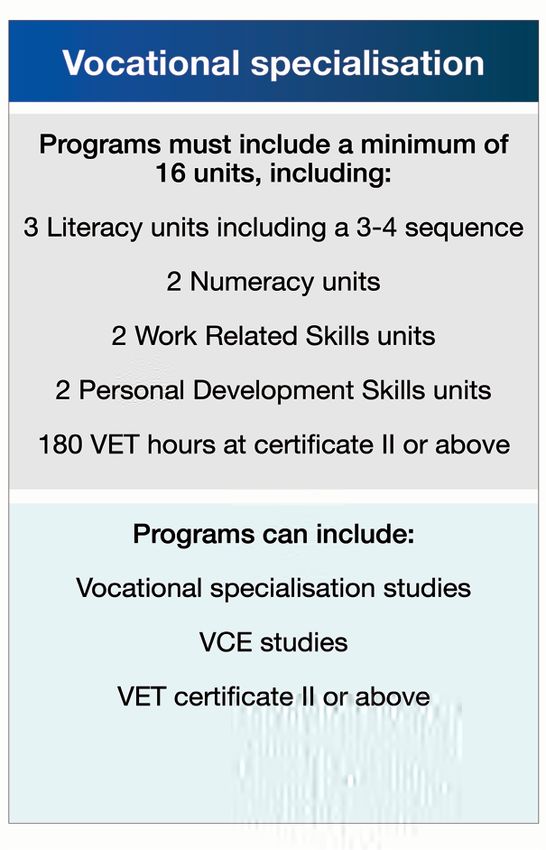
A single senior secondary certificate incorporating
    VCAL into VCE
    Victoria is moving to a new integrated senior secondary certificate that will bring together our two senior
    secondary certificates, the VCE and VCAL. This will give all students the learning opportunities
    to develop the skills and capabilities needed to succeed in further education, work and life.

    From 2023, a vocational specialisation stream within the VCE will replace the existing VCAL at
    the Intermediate and Senior levels.

    We will maintain the world standard excellence of our VCE, and the traditional subjects as
    we know them will continue to be regularly updated to ensure they maintain their quality and
    standards. We will build on the best elements of VCAL, including the flexibility to provide senior
    secondary students with an education that is engaging, based in real life, and delivers in-
    demand skills for the future world of work.

    The vocational specialisation stream within the VCE will provide a more robust and detailed
    curriculum to enable more consistent delivery of high quality. It will be accompanied by support
    materials for teachers that will inspire educational excellence and ensure consistent standards
    and outcomes for students. There will be a diverse range of assessment strategies to ensure
    the highest quality learning. All senior secondary students will receive an enhanced statement of
    results, recognised by training providers, universities and employers.

    Students will be able to enrol in the vocational specialisation stream within the VCE from 2023.
    This will replace the existing VCAL at the Intermediate and Senior levels, as we move towards a
    single integrated senior secondary certificate by 2025.

    DET and the VCAA will closely with schools and their communities to implement these changes,
    giving families plenty of notice to help students make the best decision for their VCE pathway.

    New course overview
    The new vocational specialisation stream is designed to be completed over a minimum of two
    years and will include studies in literacy, numeracy, personal development skills (PDS), work
    related skills (WRS), and units from Vocational Education and Training (VET) qualifications.

    Students will have access to rigorous curriculum and workplace experiences and will
    progressively build their knowledge and skills through structured Unit 1–4 studies.

    Like the VCE, it is proposed that students enrolled in the vocational specialisation stream will
    need to satisfactorily complete a minimum of 16 units to obtain the certificate.

    The 16 units will be made up of:

       •   three Literacy units, including Units 3 and 4

       •   two Numeracy units

       •   two PDS units to develop essential capabilities such as teamwork, communication
           and leadership

       •   two WRS units to make sure students learn their rights and responsibilities as they enter
           the workforce

       •   180 hours of VET at Certificate II level or above to build the technical skills needed for
           their future career path.

    For more information about the certificate structure and components, refer to the Vocational
    Specialisation Stream within the VCE Discussion Paper on the Engage Victoria website.

©VCAA 2021 Vocational specialisation stream within the VCE overview                                               2
Assessment and reporting
The assessment of student achievement in Units 1–4 will be school based, with graded
assessment included. There will be no external examinations for the studies within the
vocational specialisation stream, other than those that already exist in VCE or VCE VET scored
programs. Schools and teachers will be supported by VCAA-developed assessment tools,
professional learning programs and an enhanced quality assurance program.
Enhanced Statement of Results
All students who complete, or partially complete, the vocational specialisation stream within the
VCE will receive an enhanced Statement of Results. This will acknowledge their full range of
achievements including information on individual studies undertaken, outcomes achieved and
completed micro-credentials. The enhanced Statement of Results will be recognised by training
providers, universities and employers.
Have your say
The Firth Review has provided a clear roadmap for the changes we need to make to improve
senior secondary schooling in Victoria. We need your help to implement these reforms.
Through the Senior Secondary Pathways Reform site on Engage Victoria, we want you to have
your say on the transformation of senior secondary schooling for Victorian students.
We will be seeking input on a wide range of topics, including:
• The design and delivery of vocational specialisation stream within the VCE and the
foundation pathways certificate
• Ensuring all Victorian students have access to high quality VET courses aligned with their
strengths and interest and to industry growth areas
• Understanding what support schools need to more easily provide excellent vocational and
applied learning experiences to their students
• Understanding the workforce implications of new certificate designs and delivery models
• High quality and well supported school-based apprenticeships and traineeships for more
students across Victorian schools and senior secondary education providers.
Discussion papers, draft certificate designs and curriculum study designs will be uploaded in
stages to allow stakeholders and community members time to comment and provide feedback
on the various design pieces and implementation proposals.
We will be providing further updates on these changes through the Department of Education
and Training website, and detailed updates for educators will be available through the Victorian
Curriculum Assessment Authority website.
You can also speak to your local school’s careers advisor or VCAL coordinator to learn more, or
contact us directly at pathways.reform@education.vic.gov.au
©VCAA 2021 Vocational specialisation stream within the VCE overview 3Discussion questions
1. What opportunities or challenges do you see with the introduction of the vocational
specialisation stream in the VCE?
2. What do you see as the most important skills for students to obtain in their final years of
secondary schooling? (Top three)
• Technical job skills
• Professionalism
• Work-readiness skills
• Leadership skills
• Team-building skills
• Research skills
• Communication skills
3. What should the vocational specialisation stream within the VCE be called?
• Vocational Specialisation
• Vocational Major
• Other (please specify): ____________
Certificate overview – satisfactory completion requirements
©VCAA 2021 Vocational specialisation stream within the VCE overview 4Appendix A: Comparative overview
The following table provides a comparison of the proposed vocational specialisation stream within the
VCE with the current Intermediate and Senior VCAL.
Design Vocational specialisation stream in the Intermediate and Senior VCAL (current)
elements VCE (proposed)
Certificate The certificate will be designed to be The VCAL is designed to accommodate
timeframe completed over a minimum of two flexible entry and exit points.
years. Students can enter Intermediate or
Rolling enrolments will be supported. Senior VCAL at a time that best suits
There will be no time limit for the their learning needs, abilities and
completion of units. interests. Intermediate and Senior
VCAL provide parameters for a range of
student abilities and interests and offer
a clear progression for knowledge, skills
and attributes.
Minimum Satisfactory completion of 16 units, Satisfactory completion of 90 hours of
requirements which must include: VET and a minimum of 10 credits, six at
• three Literacy units or three units the award level or above including:
from the VCE English group, • one Literacy skills strand credit
including a Unit 3–4 sequence (at the award level or above)
• two Numeracy units or two units • one Numeracy skills strand credit
from the VCE Mathematics group • one WRS strand credit
• two PDS units • one PDS strand credit (at the
• two WRS units award level or above)
• 180 hours of VET at Certificate II • one Industry Specific Skills
level or above. strand credit (90 hours of VET.
Students will be required to complete a For VCAL Senior, this must be at
minimum of eight units at Unit 3–4 level. Certificate II level or above).
Curriculum • four units of Literacy • two units of Literacy
offerings • four units of Numeracy • two units of Numeracy
• four units of PDS • two units of WRS
• four units of WRS • two units of PDS
Additional units will be developed in the • Industry Specific Skills credits
future in areas such as Digital Literacy. • one unit of Portfolio
Units from VCE studies where schools/ Enhancement and Presentation
providers have authorisation to deliver (Senior only)
may be used towards meeting the • one unit of Skills for Further
16-unit requirement. Study (Senior only).
©VCAA 2021 Vocational specialisation stream within the VCE overview 5Design Vocational specialisation stream in the Intermediate and Senior VCAL (current)
elements VCE (proposed)
Unit duration Each unit will comprise of 50 hours of Intermediate and Senior VCAL each
formal learning and up to 50 hours of have a nominal duration of 1000 hours,
informal learning. which typically is a mix of class time
For VET, each unit will comprise 90 and independent learning. However, the
hours of completed units of competency. nominal hours (including both scheduled
and unscheduled contact hours) may
vary when considering the specific
needs of each student.
Unit All units may be undertaken separately All units may be undertaken separately
sequence or as a sequence, except for Literacy or as a sequence.
which must be undertaken as a Unit 3–4
sequence.
Satisfactory All units will include specific key The award of satisfactory completion
completion knowledge and key skills that will for a unit is based on the teacher’s
be required for each area of study. observations that the student has
There will also be a series of learning demonstrated achievement of the set of
outcomes that students will need outcomes specified for the unit.
to demonstrate achievement to Demonstration of achievement and
satisfactorily complete the unit. satisfactory completion of learning
Demonstration of achievement and outcomes are determined by evidence
satisfactory completion of learning gained through the assessment of a
outcomes will be determined range of learning activities and tasks.
by evidence gained through the Teachers must develop courses that
assessment of a range of learning provide appropriate opportunities for
activities and tasks. students to demonstrate satisfactory
Assisted by the VCAA, teachers achievement of outcomes.
will develop courses that provide
appropriate opportunities for students to
demonstrate satisfactory achievement
of outcomes.
The decision about satisfactory
completion of a unit will be distinct from
the assessment of levels of achievement,
where this may be an option.
Assessment Assessment in all units will be school Competency based assessment is used
of levels of based and supported by an assessment to determine a student’s achievement of
achievement rubrics, a professional learning program a learning outcome. Students must be
and a revised quality assurance observed to demonstrate achievement
program which will include external of a learning outcome on more than one
validation. occasion and in different contexts for a
Graded assessment for Units 3 and 4 S outcome at unit level.
will be rolled out in 2023 in preparation Procedures for the assessment of
for broader implementation in 2025. levels of achievement are a matter for
There will be no external examinations school decision based on the examples
for studies in the vocational provided in supporting material from the
specialisation stream, other than those VCAA.
that already exist in VCE VET scored
programs.
©VCAA 2021 Vocational specialisation stream within the VCE overview 6You can also read


