Weak blues Family Lycaenidae Subfamily Polyommatinae Tribe Polyommatini - Oskar Brattström - Nigerian butterflies - Oskar Brattström
←
→
Page content transcription
If your browser does not render page correctly, please read the page content below
Oskar Brattström - Nigerian butterflies
          Click here to email the author

       weak blues
                                       Version 1.0

          Family Lycaenidae
      Subfamily Polyommatinae
         Tribe Polyommatini

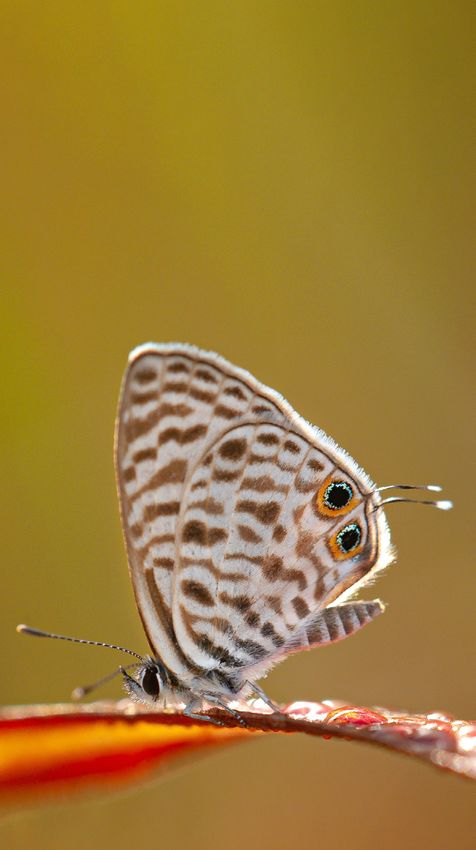
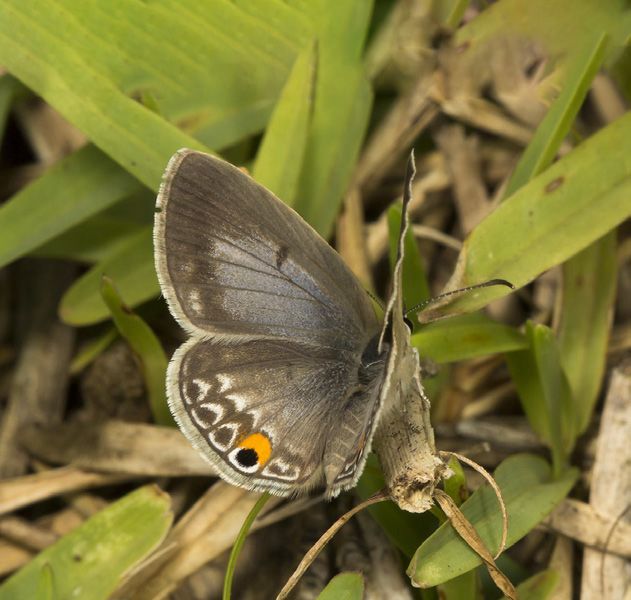
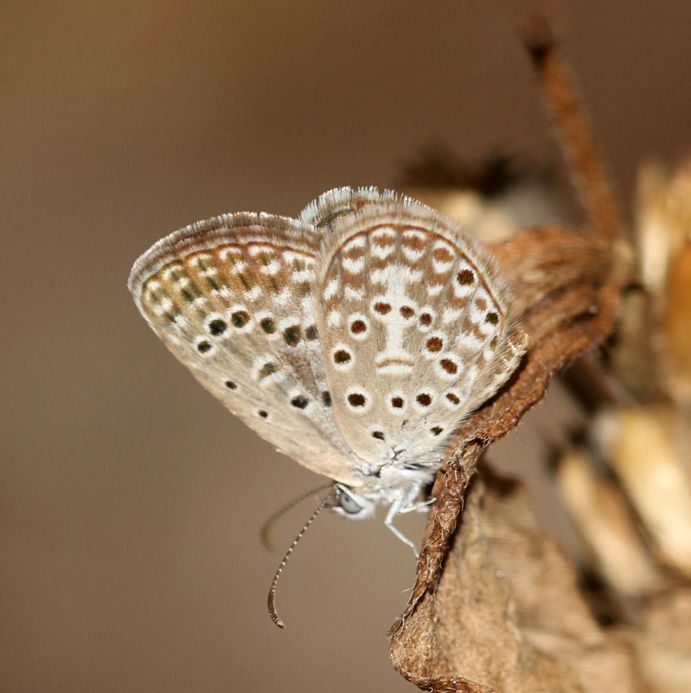
Zebra Blue
(Leptotes sp.)
                                              oskar brattström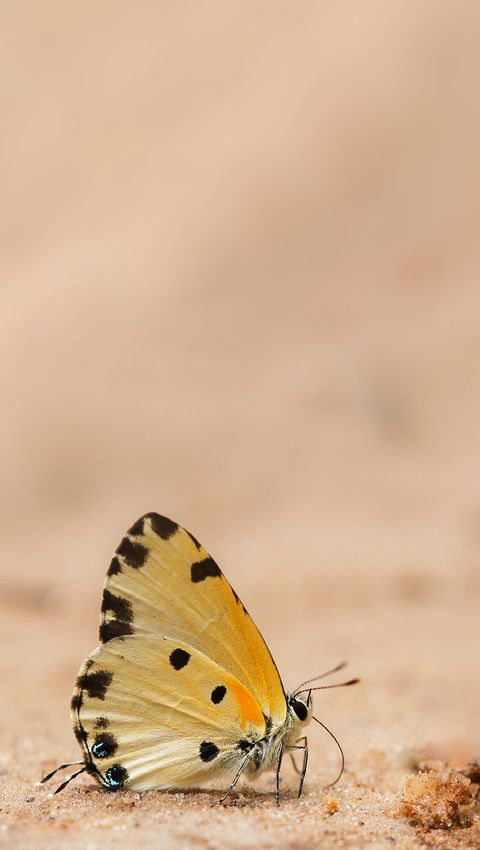
UPDATED ON 10th OF JANUARY, 2021

 Identification of subfamilies and tribes
The subfamily Polyommatinae can be separated
from the somewhat similar subfamily Theclinae
by looking at the tornal end of the hindwing. In
Theclinae, there is always a more or less pronounced
tornal lobe (see red arrow on image below on the
left), while the hindwing tornus is more evenly
rounded in Polyommatinae. Theclinae species are
usually tailed, sometimes with tails as long as the
hindwing, but they can also be completely tailless.
                                  thomas desloges (all photos in box below)

  Theclinae                 Polyommatinae

       tornal        Lycaenesthini          Polyommatini
         lobe
                     (Ciliate Blues)        (Weak Blues)

There are two related groups within Polyommatinae:
the Ciliate Blues (Tribe Lycaenesthini) and the
Weak Blues (Tribe Polyommatini). They can
generally be told apart by looking at the small
hindwing tails. In the Ciliate Blues, there are
usually three short tails on the hindwing, formed
by elongated hairs at the wing edge. Weak Blues
are often completely tailless, or have either one or
two tails per wing. When they have tails, these are
usually longer than those found in the Ciliate Blues.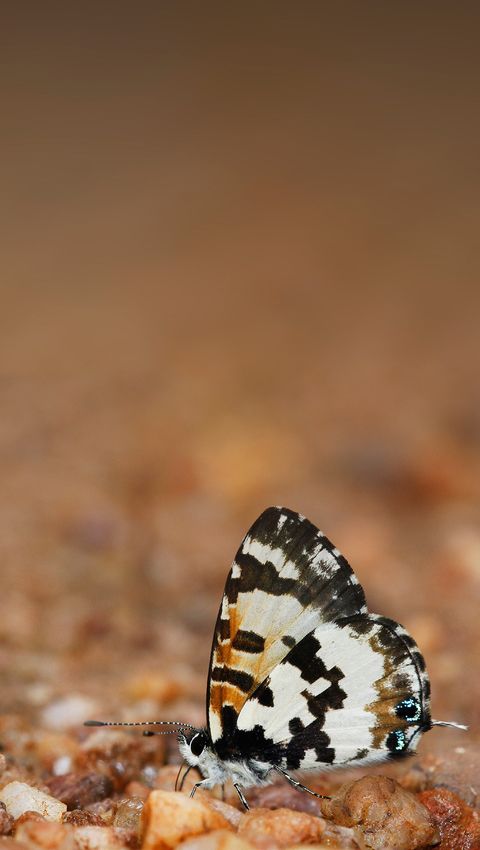
UPDATED ON 10th OF JANUARY, 2021

      weak blues
         Family Lycaenidae
     Subfamily Polyommatinae
        Tribe Polyommatini
Weak Blues (Tribe Polyommatini) are typically small
butterflies, and about 70 species are known to
occur in Nigeria. Males are frequently blue on the
dorsal surface, with some dark markings. Females
tend to have more pronounced dark markings than
the males of the same species. However, there are
many exceptions, and many species are black,
white and brown. Their ventral patterns usually
have multiple small dark spots, and these can
merge together, forming bands. Most Nigerian
species can be identified in the field, but some
genera are very tricky and not discussed at species
level in this version of the field guide. The host-
plants are normally from the family Fabacae, and
most Polyommatini species have some links to
ants during their early life-
stages. In some cases, the
larvae mimic the scents used
by the ants in order to get
adopted by a colony. They
will then feed on the ant
larvae once they are inside                            ian lawson

the nest!

     Click here to submit your comments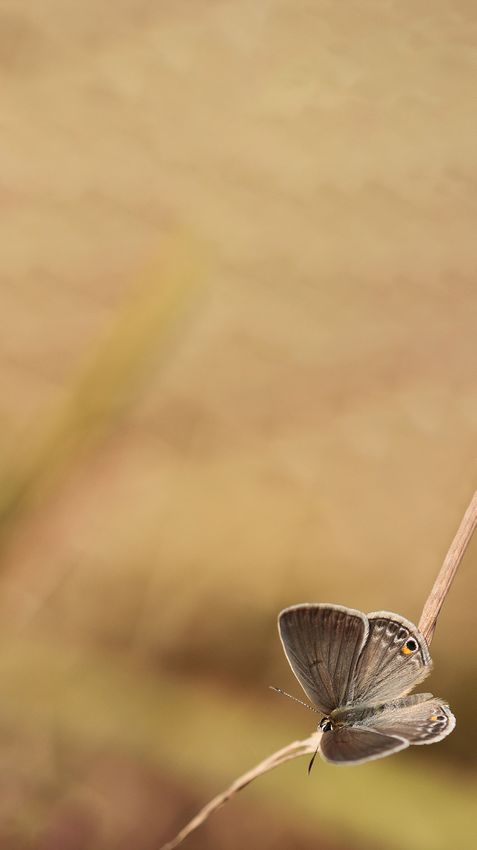
UPDATED ON 10th OF JANUARY, 2021

   ACKNOWLEDGEMENTS
The author would like to thank Nadia Van Gordon who
proofread all the text sections, Jon Baker who read
through the final draft and provided many valuable
comments, all the photographers who provided the
photos, without whom a project such as this would
be almost impossible, all the early field testers who
helped me work out technical issues, Steve Collins
and the African Butterfly Research Institute (ABRI)
for all the support over the years, A.P. Leventis
Ornithological Research Institute (APLORI) for their
incredible work to promote biodiversity in Nigeria,
the Nigerian Bird Atlas Project for leading the way
on Nigerian Citizen Science, and Ulf Ottosson for his
constant enthusiasm and dedication to conservation.

This project is dedicated to the memory of Dr. Torben
B. Larsen. Without his early support I would probably
never have begun my work with Nigerian butterflies.

                                                            ian lawson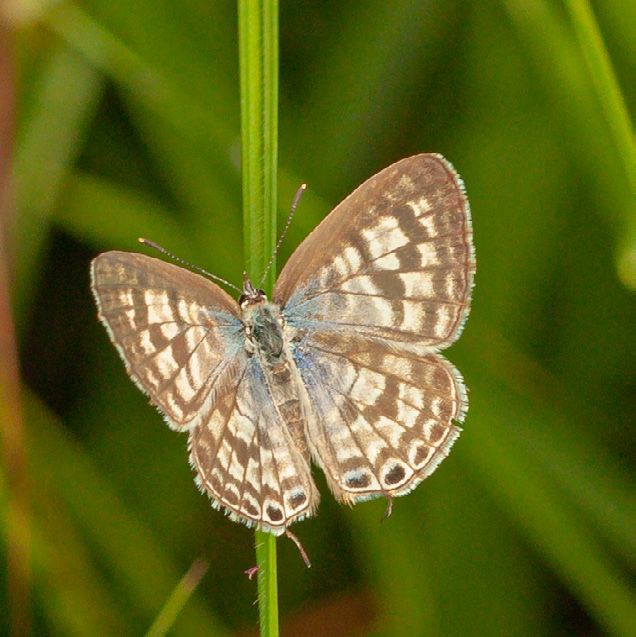
PHOTOGRAPHERS

All photos are used with the permission of the
photographers or have been published online under
a Creative Commons license allowing reuse for non-
commercial purposes. Images from the following
photographers are used in this chapter: Adedotun
Ajibade, Steve Ball, Ian Andreas Bennetsen Boe,
Elaine Bester, Joey Bom, Oskar Brattström, Kate
Braun, Peter Bygate, Paul Cools, Andrew Deacon,
Mahomed Desai, Thomas Desloges, Geoff Dobbs,
Laurens Erasmus, Youssef Hisham Elhahas, Martin
Grimm, Regine Hakenbeck, Adrian Hoskins, Eric
Hunt, Torben Larsen, Ian Lawson, Mattia Menchetti,
Karen Nichols, Vojtek Pavel, Ferran Pestaña,
Mike Plagens, Tony Rebelo, Szabolcs Sáfián,
simondenis142857@inaturalist.org, Atilla Steiner,
William Stephens, Lauren Steyn, Charl Strydom,
tiluchi@inaturalist.org, toshimasaiida@inaturalist.
org, tsuchan@inaturalist.org, Rainer Wendt, John
Wilkinson, Mark Williams,
Steve Woodhall,
Bart Wursten, and
Alexey Yakolev.

                                                 ian lawson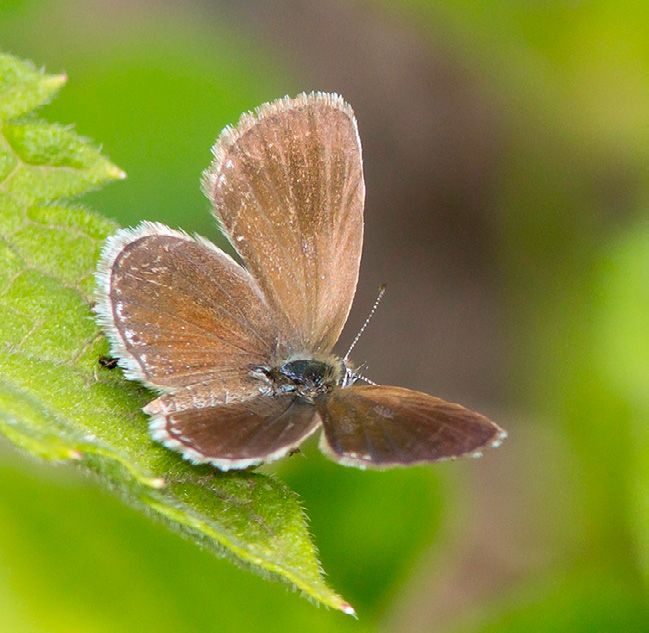
UPDATED ON 10th OF JANUARY, 2021

   weak blues
       Family Lycaenidae
   Subfamily Polyommatinae
      Tribe Polyommatini
    INCLUDED GENERA
        (CLICKABLE LINKS)

Pseudonacaduba     Thermoniphas
   Lampides          Oboronia
 Uranothauma          Azanus
   Cacyreus            Zizina
   Leptotes           Zizeeria
   Tuxentius           Zizula
   Tarucus            Chilades
   Actizera           Freyeria
 Eicochrysops
  Cupidopsis
  Euchrysops
Lepidochrysops
                                                 ian lawson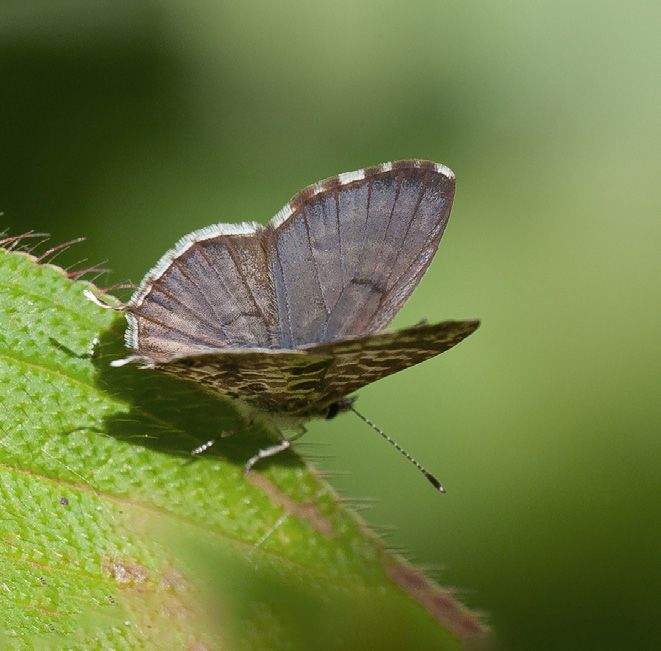
UPDATED ON 10th OF JANUARY, 2021

    weak blues (polyommatini – polyommatinae)

 Pseudonacaduba aethiops (Mabille, 1877)
 Dark African Line Blue
Pseudonacaduba sichela sichela (Wallengren, 1857)
African Line Blue

In these two species, the ventral markings are more
or less identical and consist of fine light streaks
forming irregular bands on a homogeneous grey
background. On the hindwing there are two small
tornal spots (usually without any orange crown),
but no tails. The two species of Line Blues can only
be accurately separated by looking at the dorsal
surfaces. Both sexes of the Dark African Line Blue
(Pseudonacaduba aethiops) are blackish brown
(male are usually slightly darker), while there is
always some degree of blue scaling in the African
Line Blue (P. sichela). Females                 thomas desloges

have blue scaling at the base of
all four wings, while the smaller
males are deep violet all over the
                                                               ♂
dorsal surface of the wings.          P. aethiops
           thomas desloges
                                                  oskar brattström

                             uniform pattern
                             with tiny black
                         ♂   tornal spots

                        ♀
     P. sichela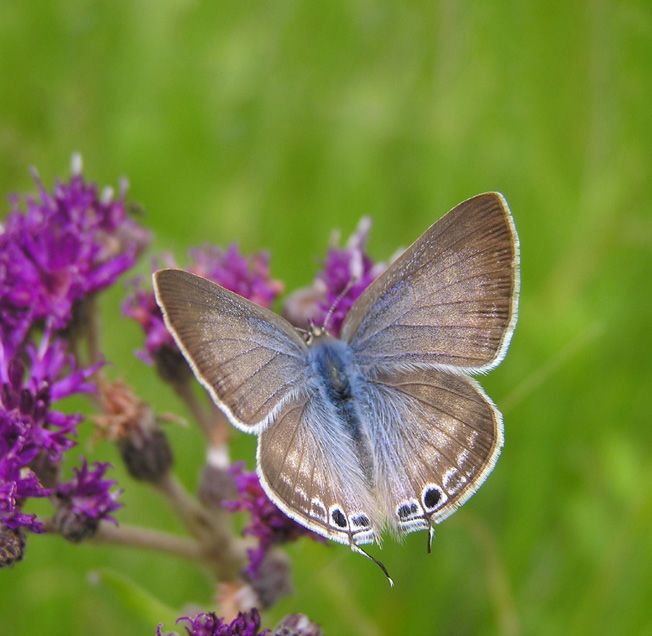
UPDATED ON 10th OF JANUARY, 2021

         weak blues (polyommatini – polyommatinae)

 Lampides boeticus (Linnaeus, 1767)
 Pea Blue

The Pea Blue (Lampides boeticus) is an extremely
widespread butterly found all over Africa, southern
Europe, the Middle East, most of the Oriental
Region and parts of Australia. The species is highly
migratory, constantly tracking suitable breeding
conditions, and on most locations it can only be
found at specific times of the year. The Jos Plateau
has been suggested as one of few places in West
Africa where the species could potentially be
found all year round. The broad white band close
to the ventral margin of                                        oskar brattström

the hindwing is a reliable
character for identification.
Dorsally, the male is almost
uniformly violet blue, apart
from the tornal spots. The
female has a more varied
greyish-brown colouring
with some blue scales.           broad white band
                                                  on hindwing edge
 toshimasaiida (inaturalist.org username)                          charl strydom

uniformly blue                                more darker
except black                                  patterns
tornal
spots

                                            ♂ ♀
UPDATED ON 10th OF JANUARY, 2021

        weak blues (polyommatini – polyommatinae)

 Uranothauma falkensteini (Dewitz, 1879)
 Lowland Branded Blue

The genus Uranothauma has six species in Nigeria,
of which four are only found on the Obudu and
Mambilla Plateaux. The males of most species
have distinctive androconial scales on the dorsal
forewings (see image on lower left) that help to
separate the species, but females are more similar
to each other. The ventral patterns are species-
specific and similar in both sexes. In lowland
forests, only two species exists; The distinct Pied
Blue (U. cyara) and the appropriately named
Lowland Branded Blue (U. falkensteini). The
latter is similar to some
                                                            ♀
                                                                          thomas desloges

of the highland species
(and they fly together at
intermediate altitudes).
Males are often found
mudpuddling in large
numbers, but females
are only seen rarely.
 simondenis142857(inaturalist.org username)                                  bart wursten

dark androconial streaks                          two bars in
           between all                            forewing
              forewing                            cell
                   veins

                                              ♂
UPDATED ON 10th OF JANUARY, 2021

        weak blues (polyommatini – polyommatinae)

 Uranothauma frederikkae frederikkae Libert, 1993
 Cameroon Branded Blue
 Uranothauma nubifer nubifer (Trimen, 1895)
 Black-heart Branded Blue
In Nigeria, these species are only found on the
Obudu and Mambilla Plateaux. Males can be told
apart by the differently shaped dark forewing
androconial patches (see red arrows). The female
Cameroon Branded Blue (U. frederikkae) is similar
to the Lowland Branded Blue (U. falkensteini), but
has three (instead of two) dark                           mike plagens

bars in the ventral forewing cell.
The female of the Black-heart
                                                                ♂
Branded Blue (U. nubifer) lacks
the white dorsal patches found
in other Uranothauma females.
                                                       steve woodhall
 torben larsen

                              ♂                                 ♀
 szabolcs sáfián                                       szabolcs sáfián

                   three bars in   two bars in
                      forewing     forewing
                            cell   cell

             U. frederikkae              U. nubifer
UPDATED ON 10th OF JANUARY, 2021
weak blues (polyommatini – polyommatinae)
Uranothauma antinorii bamendanus Libert, 1993
Antinori’s Branded Blue
Uranothauma heritsia heritsia (Hewitson, [1876])
Light Branded Blue
In Nigeria, these species are only found on the
Obudu Plateau. Both have a pure black and white
ventral pattern, while similar Uranothauma species
also have more lighter brown spots. The male
of Antinori’s Branded Blue (U. antinorii) has a
shiny blue dorsal colour, without any androconial
patches, while the female looks similar dorsally
to both U. falkensteini and U. frederikkae. The
Dorsal surface of both sexes of the Light Branded
Blue (U. heritsia) look similar to thomas desloges
the Pied Blue (U. cyara), but the
species do not co-occur as the
latter is a lowland species.
♂
szabolcs sáfián
♂
♀
bart wursten szabolcs sáfián
U. antinorii U. heritsiaUPDATED ON 10th OF JANUARY, 2021
weak blues (polyommatini – polyommatinae)
Uranothauma cyara cyara (Hewitson, 1876)
Uranothauma cyara stactalla (Karsch, 1895)
Pied Blue
The Pied blue (Uranothauma cyara) is a fairly
common lowland species. In Nigeria, the nominate
subspecies cyara is only found in the Oban Hills
area (set specimens show the similar subspecies
tenuimarginata). Moving west through the forest
zone, it gradually transitions into the subspecies
stactalla (images to the left), with more ventral
black markings. Dorsally, the species looks similar to
the Light Branded Blue (U. heritsia), but the ventral
pattern is highly distinct because of its orange base.
Males have shiny blackish-blue dorsal forewings,
while females are purely black and white. thomas desloges
rainer wendt
♂
♂
ian lawson
♂
♂
♀UPDATED ON 10th OF JANUARY, 2021
weak blues (polyommatini – polyommatinae)
Cacyreus lingeus (Stoll, 1782)
Common Bush Blue
The Bush Blues (Cacyreus) have three Nigerian
representatives, all with a highly distinctive ventral
pattern that should make confusion with other genera
impossible. As the name implies, the Common Bush
Blue (Cacyreus lingeus) is always the most common of
the three, and is normally found in transition habitats
between savannah and forests. The Alternative
Bush Blue (Cacyreus virilis) is more of a true savannah
species, and the Bright Bush Blue (Cacyreus
audeoudi), is more linked to forests. The species can
be separated by the angle of the middle costal spot
on the ventral hindwing. In ian lawson
Cacyreus lingeus, this spot
points towards the tornal
end of the wing (upper
right image). The male
is dull blue on the dorsal
side, while the female has
a darker border and often spot angled
pronounced white spotting. towards tornal end
oskar brattström oskar brattström
♀♂UPDATED ON 10th OF JANUARY, 2021
weak blues (polyommatini – polyommatinae)
Cacyreus virilis (Stempffer, 1936)
Alternative Bush Blue
lauren steyn
Compared to the Common
Bush Blues (C. lingeus), the
ventral hindwing costal spot
of the Alternative Bush Blue
(C. virilis) is angled inwards,
pointing towards the inner spot angled inwards
wing margin. On the dorsal steve ball
side males are almost
identical, but females of C.
♂
virilis tend to lack white spots.
The species is generally rare
in West Africa, but can be
common on the Jos Plateau.
Cacyreus audeoudi (Stempffer, 1936)
Bright Bush Blue
Amongst Nigerian Cacyreus, the Bright Bush Blue
(Cacyreus audeoudi) male has the strongest blue
colour, and the female has more karen nichols
pronounced white spotting.
The ventral surface is strongly
contrasting with a darker base
colour than other Cacyreus. The
ventral hindwing costal spot is
angled more outwards. This
♂
♂
karen nichols
species is linked to forests.
thomas desloges
spot
♀ angled outwardsUPDATED ON 10th OF JANUARY, 2021
weak blues (polyommatini – polyommatinae)
Leptotes pirithous (Linnaeus, 1767)
Leptotes babaulti (Stempffer, 1935)
Leptotes jeanneli (Stempffer, 1935)
Leptotes brevidentatus (Tite, 1958)
Zebra Blues
The ventral pattern of oskar brattström
characteristic ventral
all Leptotes species is pattern
distinctive and sets them
apart from similar genera.
The four species on this
page cannot be separated
in the field and are called
the ‘Leptotes pirithous
complex‘. The females
can only be separated ferran pestaña
with genetic data, but
males can be identified
♂
with genitalia dissections.
The distinctive valves are
shown below. L. pirithous
is normally the most
common of the species.
The Beautiful Zebra
Blue (Leptotes pulchra) oskar bratttström
is similar, but can be
separated from the others
♀
by wing patterns.
L. pirithous L. jeanneli
L. babualti L. brevidentatusUPDATED ON 10th OF JANUARY, 2021
weak blues (polyommatini – polyommatinae)
Leptotes pulchra (Murray, 1874)
Beautiful Zebra Blue
steve woodhall
In Nigeria this is the only lower spot mereged
with band
Zebra Blue (Leptotes)
that can be identified by
wing patterns alone. Both
sexes have a longer band
on the ventral forewing
that includes a spot that is
separated from the band
in all of the four species Leptotes pulchra
of the Leptotes pirithous bart wursten
complex. This spot is also lower spot
free
visible on the dorsal side in
the females. The Beautiful
Zebra Blue (Leptotes
pulchra) is generally linked
to swampy habitats, and
tends to be both local and
rare in West Africa. L. pirithous - complex
♂ ♀ ♀
Leptotes pulchra L. pirithous-complex
thomas desloges
(all set specimens) (Spot merged) (Spot free)UPDATED ON 10th OF JANUARY, 2021
weak blues (polyommatini – polyommatinae)
Tuxentius cretosus nodieri (Oberthür, 1883)
Savannah Pied Pierrot
Tuxentius carana carana (Hewitson, 1876)
Tuxentius carana kontu (Karsch, 1893)
Forest Pied Pierrot
Tuxentius margaritaceus (Sharpe, 1892)
Mountain Pied Pierrot
As the names imply, these species have different
habitat choices, and in Nigeria that means they
can generally be separated by location alone.
The Savannah Pied Pierrot (Tuxentius cretosus)
is normally found in Sudan Savannah and has more
merged dark ventral markings. The Forest Pied
Pierrot (T. carana) is a common forest butterfly
and has better separated ventral spots. The
Mountain Pied Pierrot mattia menchetti
(T. margaritaceus) is small black
spots merged
found on the Obudu into bands
and Mambilla Plateaux.
It is the only Nigerian
Tuxentius species with a
black spot at the end of
the ventral hindwing cell.
Tuxentius cretosus
bart wursten ian andreas bennetsen boe
small black most small
spot at spots stay
end of separated
cell
Tuxentius margaritaceus Tuxentius caranaUPDATED ON 10th OF JANUARY, 2021
weak blues (polyommatini – polyommatinae)
Genus Tarucus – Blue Pierrots
The Blue Pierrots (Tarucus) is a group of quite
similar butterflies, which are hard to accurately
identify to species level in the field. They all have
a highly distinctive black william stephens
and white pattern on
the ventral side with
♂
small greenish metallic-
looking marginal spots
on the hindwing. Males
are light blue on the
dorsal side, while females
have more varied and atilla steiner
spotted markings. They
are adapted to very dry ♀
habitats and five species
can be found in northern
Nigeria, often flying in
mixed swarms close to
their Zizyphus hostplants.
paul cools geoff dobbs
Tarucus theophrastus Tarucus rosaceaUPDATED ON 10th OF JANUARY, 2021
weak blues (polyommatini – polyommatinae)
Actizera lucida (Trimen, 1883)
Rayed Blue
Both sexes of the Rayed Blue (Actizera lucida)
have a distinct white line stretching from the end
of the cell on the ventral hindwing out to the
margin. There is no other species in West Africa
with such a line, making identification very easy.
The male is dull violet with dark borders on the
dorsal side. The hindwing border is sometimes
made up of small dots, rather than an intact line.
The female is generally brown on the dorsal side,
but can sometimes have martin grimm
violet basal scaling. The distinctive
white line
species is usually linked
to wet grasslands and
appears to be very rare
in West Africa. It most
likely has small local
populations and there
are records from a few
sites in southern Nigeria.
♀♂
steve woodhall steve woodhallUPDATED ON 10th OF JANUARY, 2021
weak blues (polyommatini – polyommatinae)
Eicochrysops hippocrates (Fabricius, 1793)
White-tipped Cupid
Eicochrysops dudgeoni Riley, 1929
Dudgeon’s Cupid
The male White-tipped Cupid (Eicochrysops
hippocrates) has distinct white tips on the dorsal
forewings. The female lacks the white tips, but has
steel-blue scaling at the base of both wings. The
ventral pattern is light, with just a few markings,
making it quite distinctive. Both sexes are tailed.
Dudgeon’s Cupid (E. martin grimm
dudgeoni) is a tiny ♂ white
wing tips
species, and lacks any
basal markings on the
ventral side. It is also
untailed. The single
tornal spot is crowned
with red. The male martin grimm
dorsal surface is dark
blue, with a broad black
♀
margin while the female
is dark brown, with a
clear red tornal spot.
oskar brattström
broad
black ♂ kate braun
margin
single no basal
red crown markings
Eicochrysops dudgeoni Eicochrysops hippocratesUPDATED ON 10th OF JANUARY, 2021
weak blues (polyommatini – polyommatinae)
Cupidopsis cissus cissus (Godart, 1824)
Meadow Blue
Cupidopsis jobates mauritanica Riley, 1932
Tailed Meadow Blue
The two species in this small genus are similar to
Euchrysops and Lepidochrysops, but both of the
Cupidopsis species generally have smaller and
darker ventral spots. The two species are similar,
but can easily be told apart as C. jobates has a
tailed hindwing. It is also smaller and has more
extensive red markings. Females of both species
have more black and red markings compared to
the males. C. cissus is mainly found in Guinea
Savannah, while C. jobates is linked to Sudan
Savannah, but both species are quite ecologically
tolerant and overlap at many locations.
oskar brattström bart wursten
darkened forewing darkened
spots forewing
spots
untailed
hindwing tail
lourens erasmus
♂ ♂
bart wursten tony rebelo
♀
Cupidopsis cissus Cupidopsis jobatesUPDATED ON 10th OF JANUARY, 2021
weak blues (polyommatini – polyommatinae)
Euchrysops malathana (Boisduval, 1833)
Smoky Bean Cupid
The Cupids (Euchrysops) is a genus of medium
sized Weak Blues, with eleven species known from
Nigeria. Just like the much larger Giant Cupids
(Lepidochrysops), only a few of the ventral spots
tend to be black, compared to the similar Meadow
Blues (Cupidopsis). The Smoky Bean Cupid (E.
malathana) is the most common member of the
genus. The hindwing is untailed and has a single
well-developed orange crown above the tornal
spot, visible on both sides of the wing. The male is
silky brown-grey on the dorsal side, while the female
has dark blue basal votjek pavel
single large
scaling on all wings. The tornal
ventral pattern is similar crown
to that of the much rarer
Ashen Smoky Cupid
(E. subpallida), but this
species has a much less
developed orange tornal
crown.
mahomed desai steve woodhall
♂ ♀
untailedUPDATED ON 10th OF JANUARY, 2021
weak blues (polyommatini – polyommatinae)
Euchrysops subpallida Bethune-Baker, 1923
Ashen Smoky Cupid
The ventral surface of this rare species is similar
to the Smoky Bean Cupid (E. malathana), but
with a less developed orange steve woodhall
hindwing crown. The dorsal tiny tornal
crown
surface is darker in both sexes
compared to similar species.
In Nigeria, it is recorded from
Kaduna, Jos and Gashaka-
Gumpti. The closest known
population is in eastern DRC!
♂ ♀
mark williams
Euchrysops reducta Hultstaert, 1924
Jackson’s Cupid
This is quite a small species, patchily distributed
in mainly Guinea Savannah habitats across West
Africa. Compared to similar species, most of the
ventral forewing spots are heavily darkened.
tsuchan (inaturalist.org username) szabolchs sáfián
darkened forewing spots
♀ ♂UPDATED ON 10th OF JANUARY, 2021
weak blues (polyommatini – polyommatinae)
Euchrysops osiris (Hopffer, 1855)
African Cupid
Euchrysops barkeri (Trimen, 1893)
Barker’s Cupid
These two species can be told apart from the similar
Smoky Bean Cupid (E. malathana) as they both
have hindwing tails. Both are broadly distributed
savannah species, but the African Cupid (E. osiris)
is much more common than Barker’s Cupid (E.
barkeri). They can be told apart by the number of
black tornal spots on both sides of the hindwing;
two in E. osiris, but only one in E. barkeri.
steve woodhall (all images below)
♂ ♂
thomas desloges
steve woodhall (both images below)
two black
spots ♀ ♀ single black
spot
Euchrysops osiris Euchrysops barkeriUPDATED ON 10th OF JANUARY, 2021
weak blues (polyommatini – polyommatinae)
Genus Lepidochrysops – Giant Cupids
The Giant Cupids (Lepidochrysops) is one of the
most complex of all African butterfly genera with
over 130 known species, of which seven occur
in Nigeria. Many species are rare and highly
localised, but a few are adrian hoskins
quite widespread and
reasonably common. They
are similar to the Cupids
(Euchrysops), but as the
name implies, the Giant
Cupids are considerably
larger. They are hard to
identify without specialist Lepidochrysops quassi
literature and therefore regine hakenbeck
not treated in detail in this
guide. The pictures will still
give a general idea of their
mophology. The species in
the lower row do not occur
in Nigeria, but are shown
to give a better idea of the
variation within this genus.
Lepidochrysops polydialecta
alexey yakovlev rainer wendt
Lepidochrysops glauca Lepidochrysops labeensisUPDATED ON 10th OF JANUARY, 2021
weak blues (polyommatini – polyommatinae)
Thermoniphas micylus (Cramer, 1780)
Common Chalk Blue
Thermoniphas togara (Plötz, 1880)
Bright Chalk Blue
Thermoniphas alberici (Dufrane, 1950)
Alberic’s Chalk Blue
The Chalk Blues (Thermoniphas) is a small genus of
similar looking forest species with lightly coloured
ventral wings. T. micylus is found all over southern
Nigeria, but the other two species are limited to the
south-east. Males can be identified to species level
by the amount of white around the dorsal hindwing
marginal spots. Females are instead told apart
by the pattern at the edge of adrian hoskins
their dorsal forewings. A rare
fourth species, the Smoky
Chalk Blue (T. fumosa) is
known from the south-east. It
differs from the others as the
male lacks any blue colouring,
and the female is white.
thomas desloges
♂
♀
T. micylus T. togara T. albericiUPDATED ON 10th OF JANUARY, 2021
weak blues (polyommatini – polyommatinae)
Oboronia punctatus (Dewitz, 1879)
Common Ginger White
The Ginger Whites (Oboronia) are all quite similar,
but a few clear characters make it possible to
separate them from each other. They are all tightly
linked to their foodplants, Spiral Gingers (Costus),
and can be found in small swarms around these
plants in forest habitats. The Common Ginger
White (O. punctatus) differs from all other Nigerian
species by having a complete black margin along
the forewing costa. There is a small hindwing tail.
regine hakenbeck
thomas desloges
complete hindwing
black tailed
costal
border
Oboronia pseudopunctatus (Strand, 1912)
Light Ginger White
The Light Ginger White (O. pseudopunctatus)
is similar to the Common Ginger White (O.
punctatus), but the dark forewing costal margin is
broken up by the white bart wursten
ground-colour. This can costal margin
broken up
hindwing
tailed
even be seen ventrally, by the
as the wings are almost white
translucent. The Un-
tailed Ginger White
(O. ornata) is similar, but
lacks the hindwing tail.UPDATED ON 10th OF JANUARY, 2021
weak blues (polyommatini – polyommatinae)
Oboronia guessfeldti (Dewitz, 1879)
Güssfeldt’s Ginger White
Güssfeldt’s Ginger White (Oboronia guessfeldti)
stands out from all other Oboronia species by
having a small yellow rainer wendt
hindwing
patch at the base of is tailed
the ventral hindwing. It
also lacks the black spot
found on the ventral
hindwing costa in all
the other species. The
hindwing has a small tail. yellow hindwing base
Oboronia ornata ornata (Mabille, 1890)
Untailed Ginger White
As the name implies, the Untailed
eric hunt
Ginger White (Oboronia ornata) lacks
a hindwing tail making identification
easy. It is usually the most common
Nigerian Oboronia species and just
like the other species it is tightly linked
to its hostplants (Costus), that can be
identified by their distinctive flowers. costus
adedotun ajibade peter bygate
black costal spot no hindwing tailweak blues (polyommatini – polyommatinae)
Azanus ubaldus (Cramer, 1782)
Desert Babul Blue
Azanus jesous (Guérin-Méneville, 1849)
African Babul Blue
Azanus moriqua (Wallengren, 1857)
Black-Bordered Babul Blue
Azanus mirza (Plötz, 1880)
Pale Babul Blue
Azanus natalensis (Trimen & Bowker, 1887)
Natal Babul Blue
The Babul Blues (Azanus)
bart wursten
are all quite small butterflies,
and the males can often be
found mudpuddling in large
numbers. They typically sit
with their wings closed, and
therefore the identification key andrew deacon
uses their ventral patterns, as
they are easily seen in the field. ♂
Six species occur in Nigeria, but
the White-Banded Babul Blue
(A. isis) is treated on a separate
page. Most species have broad elaine bester
ecological tolerances, but are
generally linked with savannah ♀
habitats. A. ubaldus is the best
adapted to dry areas, while A.
mirza and A. isis are frequently
found in open forest habitats.
Scroll down for ID key! Azanus jesous
Identification key for Babul Blues
1. Azanus ubaldus has two paul cools
clear dark spots on the
ventral forewing costa
(in rare cases only one).
These are generally
missing in the other
species, but sometimes
a single tiny spot can be dark spots on
forewing costa
present in those as well.
Azanus ubaldus
2. Azanus jesous has a darker ground colour
on the ventral wing oskar brattström
surfaces than the other many spots
merge into
three species below. bands
Many of the spots and
bands are also lighter
compared to the other
species, where they are
almost black.
Azanus jesous
tiluchi (inaturalist.org username)
3. In Azanus natalensis, a forewing band has
small tooth points out a small
tooth
from the dark apical
band on the forewing,
in the direction of the
wing margin. This is
not found in any other
Azanus species.
Azanus natalensis
4. The last two species can be separated by
looking at the upper of the two tornal spots
on the hindwing. Azanus mirza has a small
orange crown next to this spot, while Azanus
moriqua has no such orange marking.
rainer wendt john wilkinson
tornal spot has a tornal spot lacks
small orange crown an orange crown
Azanus mirza Azanus moriquaUPDATED ON 10th OF JANUARY, 2021
weak blues (polyommatini – polyommatinae)
Azanus isis (Drury, 1773)
White-Banded Babul Blue
Ventrally, the White-banded Babul Blue (Azanus
isis) is similar to the Pied Pierrots (Tuxentius),
but the black markings form broader continuous
bands. The male has a shiny blue overlay over the
dorsal black and white pattern. The female pattern
is similar, but lacks any of the blue overlay.
reiner wendt (both images of this species)
♂ ♂
thomas desloges
Zizina otis antanossa (Mabille,1877)
Dark Grass Blue
♂
This is the first of three small,
similar, and widely distributed
savannah species that all lack
any orange spots. They can all
be identified by their ventral
♀
patterns. Both sexes of the mahomed desai
Dark Grass Blue (Zizina no costal forewing
spots
otis) are dark brown, often
with basal blue scaling.
Compared to similar
species, the Dark Grass
Blue (Z. otis) has fewer
ventral forewing spots. ♀ ♂UPDATED ON 10th OF JANUARY, 2021
weak blues (polyommatini – polyommatinae)
thomas desloges
Zizeeria knysna knysna (Trimen, 1862)
African Grass Blue
♂
This small species is found in a
range of habitats across Africa.
The male has a dull violet-blue
dorsal colour, with broad brown
margins. In contrast, the female
♀
is dark brown, sometimes martin grimm
with blue basal scaling. single forewing
costal spot
The ventral pattern helps
set it apart from the forewing
cell spot
similar Dark Grass Blue
(Zizina otis) and the Tiny
Grass Blue (Zizula hylax).
Zizula hylax (Fabricius, 1775)
thomas desloges
Tiny Grass Blue
This tiny species is often found
♂
in small swarms above short
grass, together with the two
preceding species. The male
is blue on the dorsal side, with ♀
broad dark margins. The female oskar brattström
is dark brown, sometimes two costal
with blue basal scaling. spots
As opposed to similar
species, both sexes have an
additional dark spot on the
ventral forewing costa and
also lack a spot in the celll.UPDATED ON 10th OF JANUARY, 2021
weak blues (polyommatini – polyommatinae)
Chilades eleusis (Demaison, 1888)
Sky-blue Cupid
Freyeria trochylus (Freyer, [1844])
Brown Grass Jewel
These two tiny butterflies are easy to identify, but
still easy to overlook. The Sky-blue Cupid (Chilades
eleusis) is found in Sahel and Sudan Savannah. The
male has a unique light-blue dorsal colour. The
female is dark brown with a variable amount of
blue basal scaling. The ventral surface is similar to
Euchrysops species, but these are all larger. The
Brown Grass Jewel (Freyeria trochylus) is found in
most types of savannah habitats. It has three small
tornal spots on both sides of the hindwing with a
large fused orange crown. The dorsal side has a
warm brown colour in both sexes. steve woodhall
geoff dobbs
♂ unique
sky-blue
lacks
tail
colour
youssef hisham elhahas joey bom
♀
hindwing fused tornal
tail present crowns on both sides
Chilades eleusis Freyeria trochylusYou can also read


