2014 ISLAMIC BANKING IN OMAN - TODAY & THE WAY FORWARD - Muhammad Arsalan 4/23/2014
←
→
Page content transcription
If your browser does not render page correctly, please read the page content below

2014

ISLAMIC BANKING IN OMAN – TODAY & THE
WAY FORWARD

                            Muhammad Arsalan

                            4/23/2014
Intentionally left blank

2
Contents
3                                                                         CONTENTS

4                                                                  LIST OF TABLES

4                                                                    LIST OF BOXES

5                                                                          GLOSSARY

6                                                      LIST OF ABBREVIATIONS

7                                                          EXECUTIVE SUMMARY

9                                                                  INTRODUCTION

9                                                      GROWTH STORY INTACT

10                      OMAN BANKING SECTOR–DYNAMICS & DRIVERS

11   ISLAMIC BANKING IN OMAN – FORECASTS, OUTLOOK AND REALITIES

12                          ISLAMIC BANKING IN OMAN: START-TO-DATE

14                                                    Reviewing Deposits Side-Products-

14                Income Determination & Profit Distribution Practices- Market Discipline

15                                                              Reviewing the Asset Side

17                                                     STRATEGIC DIMENSIONS

17                                                    Is it more than a Three Horse Race?

17                                                    The Sacrosanct Shariah Compliance

18                              Principled Stand – Islamic Banking Regulatory Framework

18                                                      Trade Based Products Structures

19                              Islamic Banking Windows: Efficiencies or Cannibalization?

20                            The 60-40 Strategy – Islamic Banks to Benchmark the Scales

21                                   The Big opportunity In the Small Enterprise Segment

22                                                                    Earnings Dynamics

22                                                                 Optimizing the Capital

23                                                                     CONCLUSION

3

List of Tables
................................
              .........
                  11                                 Projections on the Islamic Banking Industry Size quantified in terms of Assets

                   13
                   ....    Bank – wise details of Assets, Equity, Deposits, Financing, Profitability and Deposit Rates Disclosures

           ...........
                 16                Retail or corporate financing side products along with their underlying Islamic Finance Contract

                   20 A review of convention banks, Segment-wise breakup of asset and deposit, yields and capital adequacy

                                                                                                          List of Boxes

               1 …………………………………………………………………….……………………………….…Recent Regulatory Directives – CBO
               2 ………………………………………………………………………..……………………….……………………….Meehaq, the Maverick!
               3………………………….………………………………………………………….Dispersion of Product Weights- Does it Matter?

               4……………………………..……..………..…….…….Investment Deposits Accounts –Distributing Net or Gross Profit?

               5………………………………….……………….…….………………………………..Maisarah – Breaking the Murabaha Mould

               6…………………………………..............Shariah Compliance for Murabaha – Trade Transaction in Letter & Spirit

               7……………………………………..……….….….………………………………………….Non Existent Salam & Istisna Products

               8……………………………………………..……..….…………….Capital Adequacy Standards: Tailored to Islamic Banks

               4
Glossary

5

List of Abbreviations

6
Executive Summary

The fledgling yet vibrant Islamic Banking industry in Oman, has lately been attracting a lot of attention for
its vigorous legislative, regulatory and market developments. Right from the time, when in 2011 a Royal
Decree was issued to incorporate Islamic Financial System, which paved way for the promulgation of
regulatory framework, and subsequent realization of 2 Independent Banks and Six window operations
operating in the Monarchy - a lot has been written on the prospects and the promise that Islamic Banking
in Oman has got to offer. Presently, almost all of the eight Islamic Banking Institutions (IBIs) in Oman have
completed an year of operation, and account for a signifcant 3.24% (OMR 745 Bn) of the overall Banking
Assets in the country. This stipulates the need to factually assess the performance of IBI’s against the
visualized goals, to identify prospects, gaps, challenges and impediments and align the strategy to address
them.

“Islamic Banking in Oman: Present State & The Way Forward ” (the paper) take a descriptive and
exploratory approach to encompass the progress of Islamic Banking in Oman in the backdrop of the
dynamics of local economy and the overall Banking Industry. An objective, as well as a strategic review of
the Banking Industry is carried out to identify the the opportunity pockets and challenges for the nascent
faith based format of Banking.

In the first section, the paper describes the overall economic scene and its growth dynamics. The following
section, presents an illustrustation to define the structure of Omani Banking Industry with a thorough
segment wise breakup of asset and liabilities, advance to deposit ratio, leverage, capital adequacy,
spreads and efficiencies. In its effort to relate the expectations and realities, a cross-section interpretive
analysis of the future projections by Moody’s, Ernst & Young and Arqaam Capital is carried out, to develop
their grounding in the present facts. In a later section titled ‘The Sixty-Forty Strategy’, an insightful
discussion on strategic implications and recommendation, based on the circuitous and interdependent
relationship of deposit and asset mix, Capital Adequacy and the overall efficiency of a bank is also
presented. The benchmarks of the existing conventional banking industry, would enable Islamic Banks to
sway their strategic goals, while they follow their respective organic growth. As an indicative yardstick, it
can serve as an overarching frame to avoid any major deviations in shape costly deposit mix or lower-
than-the-optimum credit portfolio.

7
The value of the paper is driven by the comprehensive and exhaustive presentation of Financial
information, product analysis, profit rates, balance sheet and revenue structures, followed by intuitive
analysis to elaborate the strategic and operational dimension of all the eight IBI’s operating in Oman. A
detailed ‘compare and contrast’ commentary, on the deposit and financing side products being offered,
their underlying shariah contracts is being presented. In all its rigor, the paper not only explores the
progress of overall Islamic Banking industry, but also highlights the performance and distinctive features
of Individual IBI. “Islamic Banking Regulatory Framework” (IBRF) issued by the Central Bank, is maintained
as a pivotal reference through out the paper, to examine the operations and offerings of the IBIs and
underscore the key driver of performance, innovations and probable limitations.

In the conclusive section of “Strategic Dimensions”, the paper seeks to outline strategic insights (and
perhaps future directions) based on competitive positioning, success drivers, product innovations,
operational limitations for the manager of Omani IBIs. In its intuitive pursuit, the study also portends
practical intricacies in Shariah Compliance, Deposit Pool Management and asset liability management,
that IBIs in Oman would come across. The strategic dimensions presented are backed by cases,
constructs, propositions and artifacts driven from domestic banking industry or Islamic Banking
experience in other jurisdiction. The paper in its pragmatic approach, quotes and elaborate the anomalous
growth and the daring business model of Meethaq, the principled stance of the regulator, the product
innovation of Maisarah, the opportunity in the SME segment, Shariah Compliant structures to exploit
trade intensive and specially non-oil trade in Oman’s economy. Shortly, the reader would surely find this
paper useful in developing a perspective of Islamic Banking Industry in its independent capacity, as well as
a subset of the broader Financial Intermediation scene in Oman.

8

Introduction
Oman has been one of recent entrants into Islamic Banking and Finance scene, with a well established
regulatory framework roll out and a nascent industry players comprising of two Independent Islamic Bank
(IIB) and 5 Islamic Banking (IBW). Ever since the Royal Decree adjusting the banking law to allow the
shariah compliant format of banking was announced, competition has been seen tough among the local
banks themselves. Apart from the two fully integrated Islamic banks -- Bank Nizwa and Al izz bank -- the
country's biggest commercial banks have also set up their own Islamic banking windows which iclude Bank
Muscat’s         Meethaq,          National          Bank         of         Oman’s           -       Muzn.
Bank of Sohar’s - Sohar Islamic, BankDhofar’s Maisarah, Ahlibank – Hilal Islamic and Oman Arab Bank’s -
Yusr have been announced. A lot has been written on the prospects, potential and promise of Islamic
Banking in this GCC Country, with analysts generally optimistic on the overall growth of the industry both
in terms absolute Islamic Assets as well as market share.
Oman has been classified as an oil-rich economy, heavily dependent on the dwindling oil resources, which
sourced around 80% of its revenue in 2012 (S&P, Dec 2013). Thus, aligned with its regional peers Oman's
economy and external position stands exposed to commodity prices. However the government has been
framing all sorts of initiatives to diversify into non-oil economy (tourism and mining primarily) by means of
high investment supported by higher public and private consumption.
Oman is a youthful Muslim monarchy with strong faith driven population as benchmarked by World Banks
realist index of 97%. The official numbers for the population is 2.78 Mn (World Bank, 2011)

                                                                       Growth Story Intact
The Sultanate’ favorable demographics (60 % of the population is between the age of 15 to 45 years)
coupled with a pro growth and employment backdrop, augur well for the fortunes of the financial sector.
The GDP growth during 2000 to 2012 has averaged around 5.6%. Recent government regulations raising
minimum wages and expanding employment amongst the masses have also been supportive of
consumption and the deposit base of the nation’s banks. This has also translated positively into a 10% YOY
growth in banking Assets to surpass OMR 23 Bn mark.
In recent years, a recovery in the prices of crude oil and production coincided to enable supportive
government expenditure and an accommodative monetary policy portending well for growth in the
country and its banks. Expectations of a continuing expansionary fiscal policy to sustain the current
momentum in growth, provide an optimistic outlook for the medium term future. Obvious risks include a

9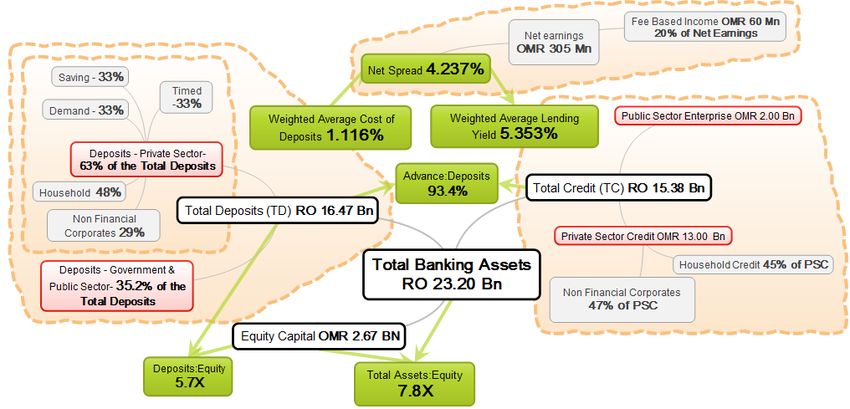
substantial fall in oil prices. However, years of fiscal prudence have yielded adequate reserves to ensure
continued pro-growth initiatives remain unhampered, even in the event of a mild fiscal deficit.
The Eighth Five-Year Development Plan (2011-15) emphasizes a large public investment program. Non-oil
activities are expected to grow by an annual rate of 6 percent at constant prices, according to the CBO,
and private sector involvement through domestic and foreign private investment is expected to
complement government spending. With estimates for the future dwarfing the past activity, USD 50
billion is projected to be spent over the next 10 years, of which USD 28 billion is expected to be awarded
between 2013 and 2015 driving growth and the resultant credit off-take in the nation.

                                Oman Banking Sector–Dynamics & Drivers
Prima facie, Oman has a thriving, efficient and stable financial intermediation system, with a high Advance
to deposit ratio and is deeply rooted into private retail and corporate sector. Around 63% of the deposit is
raised from the private sector, which is re-channeled to the private sector to an even higher level of 84%
in shape of credit outlay. The illustration below describes the breakup and distribution of the nation’s
Banking Industry.

Structure of Oman Banking Industry – Equity, Leverage, Breakup of Financing and Deposit Activity & Efficiency
[Data is sourced from CBO’s Annual Report 2012 and Monthly Report February 2014]

The total Banking assets in Oman are around OMR 23.20 Bn with a breakup of an equity of OMR 2.67 and
deposits of OMR 16.47 Bn(CBO Annual Report 2012 & Monthly Report February 2014). Total credit of
OMR Rs 15.38 Bn turns it into 93% Advance to Deposit Ratio (ADR) banking sector. More encouraging is
the fact that OMR 13Bn (out of OMR 15 Bn) is channeled into private sector. Albiet a small population,
households (despite being a small population) contribute heavily on both on the deposits and asset side.

10
Box-1
Recent Regulatory Directives – CBO
A lot of useful insights can be drawn to identify opportunity The central bank has been actively tweaking the
reigns of the Banking industry, to ensure stability
pockets, potential challenges and discrepancies by modeling it and efficiency of the financial system. A summary of
against the existing banking industry’s norms. directives by Central Bank of Oman (CBO) are as
follows:
Islamic Banking in Oman – Action/Directives Detail
Ceiling on Personal Loan Decreased from
Pricing 8.5% to 7%
Forecasts, Outlook and Realities Minimum SME Lending for
banks set at
5%
Overall Portfolio Capping on Decreased to 35%
A lot has been touted and perhaps speculated about the Personal Loan from 40%
Islamic Banking and markets appetite based on regional Capping on Housing Portfolio Increased to 15%
Relaxed from 10%
market growth stories (e.g. Qatar, KSA, UAE etc). These
projections are broadly, based on cognitive reveries, heuristics and optimism driven by broad
generalizations and the growth stories from the past - Without much reference to the dynamics of the
local banking industry, regulatory paradigm and balance sheet structures.
To quote a few, Moody’s reports are optimistic for Islamic Banking in the Oman making a ballpark
projection in its ability to grab six to eight per cent share of system assets within the next three to five
years. Quantifying this verdict by Moody’s, Islamic Banking assets should reach around OMR 3 Bn mark,
assuming 10% YOY growth of overall Banking assets, 8% penetration of Islamic Banking in a period of 5
years. Ernst & Young’s on the other hand settles-in with a conservative stance, and see it surmounting
USD 6.00 Bn (OMR 2.3 Bn) in a matter of few years. Arqaam Capital Research, which is a Dubai based
outfit foresee turns out with the most optimistic, professing that by 2017 IBI would generate around 15
per cent of all loans by 2017.
Table 1: Projections on the Islamic Banking Industry Size quantified in terms of Assets
Research Origin Claimed Estimates – Projection * IB Industry Asset size
(Bn OMR)
Ernst and Young Islamic Banking to reach USD 6 Bn in next few years. [Assuming 5 years i.e. 2018] 2.3
Moodys IBI to grab six to eight per cent share of system assets within the next three to 3.00
five years i.e 2018. [Assuming 8% share in 5 years]
Arqaam Capital Islamic financial institutions as a whole will generate around 15 per cent of all loans IB Credit = 3.35
by 2017. IB Total Assets = 5.05
* The quantification of the broad estimates by various research companies has been based on Oman Banking Industry-wide norms such as
Leverage of 8x, ADR of 93%, YOY growth of 10% etc.
A careful factual review of the footings and projected growth of Islamic Banking Industry based on ground
fact, Industry dynamics and consumer profile appears to be non-existant. This study reviews the present
11Box-2
Meethaq, the Maverick!
state of Islamic Banks (mostly operational for 1 to 4
Bank Muscat’s window Meethaq (with a meager capital of
20.00 Mn) has been very quick to inflate its balance sheet to quarters), tries to model the growth and progress against
leverage over 10X against the overall industry norm of 8X
the industry benchmarks, with due weightage to the
leverage. Interestingly, this steep growth is primarily
attributed to its inherited musharaka (retail housing) Islamic Banking specifities.
portfolio amounting to OMR 168 Mn which later has grown
up to a level of OMR 280.66 Mn as of Dec 2013. The asset side Islamic Banking in Oman:
is dominated by long-term musharaka portfolio (referred
above), on the other hand the unusual growth in deposit built
up on the balance sheet is mainly comprising of deposits from Start-to-Date
Banks and Financial Institutions which contribute OMR 134
Mn whereas the remaining OMR 66 Mn have been driven from Oman Islamic Banking industry, with an initial equity
the government sector. With over 7 branches, the bank has
not been able to mobilize any significant retail or private
base of OMR 348.5 Bn and a branch network of 32
sector deposits till Dec 2013. Branches representing two Independent Islamic Bank
This idiosyncratic and perhaps artificial balance sheet
and Six Islamic Banking windows has managed to grab a
structure makes it a difficult situation for the asset-liability
maturity profile to manage, wherein 65% of the assets are noticable 3.24% share of the overall Banking assets.
over 5 years maturity, which is alarmingly funded by a very
Interestingly, the Islamic Banking industry is operating at
low maturity deposit. This eventually leads to Asset Liability
mismatches, as reported on their balance sheets. an Advance-to-Deposit ration of over 129%, which is well
However, given the monopolistic penetration and legacy that above the overall banking industry average of 93%.
its parent bank enjoys with over 38% of the market share,
shouldn’t be posing much of a trouble to tweak the matter. These advances, predominantly are retail and real estate
Moreover, the high yield (6.3%) that this retail musharaka
centric, but would hopefully rationalize as the Industry
asset, keep its affordable for the bank to manage its liquidity
even through interbank markets wherein it can engage takes on the momentum. The progress should be viewed
relatively low cost liquidity, while keeping its spreads intact.
in the backdrop of the embryonic phase, that Oman
The uniqueness of Meethaq doesn’t ends here, when the bank
being smart enough, recognized the troubles ahead and Banking industry is going through.
unveiled it’s yet another out-of-the-box strategy. Instead of The Islamic Asset base of OMR 745 Mn is largely
going for aggressive deposit mobilization to rationalize its
deposit mix, the bank opted for an altogether distinctive route. dominated by Meethaq (IBW of Bank Muscat) with 40%
In an extra-ordinary Board meeting held recently, the board
share. But this may not come as a surprise as Bank
announced the setup of OMR 500 Mn SUKUK program for
Meethaq. This can be viewed as an innovative business Model, Muscat happens to claim equally dominant share (38%)
where the bank instead maintaining saving and term deposit
accounts can use a flexible sukuk structure to fund its assets. of the overall banking assets as well. As of December
2014, not much can be seen on the core banking
Albeit, all of its break through innovation, the Bank is not
losing sight of the core banking business lines. The bank activities in shape of retail deposits mobilization or
intends to expand its branch network to 15 branches to
private sector lending. Nevertheless, the stage is all set
ensure its outreach to consumer base
for the get-set-go thrust, with all sorts products
launched, branches functioning, IT infrastructure and Human resource in place. The table below , takes a
micro view of the bank-wise core activity, by presenting financial statements data on equity, deposits &
financing breakup and number of branches as measure of physical outreach. Additionally, this table also
12elaborate on the deposit profit management practices by presenting profit-sharing ratio, absolute profit
rates offered, deposit product weights assigned and most interestingly %age dispersion of the weights
across various deposit product.
Table 2: Bank-wise details of Assets, Equity, Deposits, Financing, Profitability and Deposit Rates Disclosures
NIZWA ALIZZ MEETHAQ SOHAR MUZN HILAL Al Yusr MAISARAH Total
NATURE Independent Window
Bank Bank Sohar National Al Ahli Oman Bank
Muscat Bank Bank of Islamic Arab Dhofar
Oman Bank Bank
Equity (OMR - Mn) 150 100 26 10 15 25 10 12.5 348.5
Initiated on Dec '13 Sept13 Jan '13 Apr '13 Jan '13 Dec 13 Jul '13 March '13
Deposit Base (OMR in Mn) rounded for whole numbers
As of Dec ‘13 Dec‘13 Dec ‘13 Dec ‘13 Sept ‘13 Dec ‘13 Sept ‘13 Sept ‘13
Current 13 0.5 4.6 3.7 1.4 5.5 NA 1.968 30.668
Savings/Timed 6.9 0.6 Saving: 10.4 15.6 15.1 4.0 NA 264.6
Term: 212.0
Financing Assets (OMR in Mn) rounded for whole numbers
Consumer 12.0 0.5 275.61 9.5 8.3 36 0.2 10.092 352.202
Commercial 3.703 5.1 20.4 29.203
Total Assets (OMR in Mn) rounded for whole number * (assumed as sum of equity and deposits, incase of data unavailibility)
170 100 298.3 52 25.1 75.2 10* 14.4* 745
Profits (OMR in Mn) rounded to one decimal place
(2.405) (3.232) 6.2 (0.65) (0.6) (0.3) (0.5) (1.3) (2.787)
Profit sharing Ratio Bank:Depositor
50:50 NA 80:20 70:30 NA NA NA NA
Number of Branches
7 2 7 3 2 7 2 2 32
Product Participation Weights [1 Month to 12 Month ]
a) 1M 45 NA 0.3 0.14 NA NA NA NA NA
b) 12M 70 NA 2.0 0.21 NA NA NA NA NA
Absolute Rates Offered
*1M 0.42 NA 0.15 NA NA NA NA NA -
12M 0.95 NA 1 NA NA NA NA NA -
% Dispersion = (b-a)/a x100
56% NA 567% 50% - - - - -
*For simplification 1M versus 12M weightages have been taken, ignoring the volume based categorization. Table - 2
13Reviewing Deposits Side-Products-
Most of the innovation has been seen on the deposit side, and very rightly so as it takes deposits for banks
to lend and earn profits. Almost all of the IBBs and windows have well defined call, timed, remunerative
and non-remunerative deposit products, bundled with
other benefits aligned to the targeted customer base. Box-3
Dispersion of Product Weights- Does it
Broadly, deposits are mobilized on the underlying contract
matter?
of Qardh (for Current Account) and Mudaraba (for savings
The product-wise weights is a bank’s management
and terms deposits). discretionary tool, and can be craftfully used to tune
in the deposit profit rate profile. As a thumb rule
Income Determination & Profit higher tenor/volume deposit classes gets the
higher weightages, translating in to higher profit
Distribution Practices- Market rates. In effect, the spread of the weights from the
normal saving account vis-à-vis higher term/volume
Discipline account, can be indicative of the bank’s inclination
for longer term/higher volume depositor. However,
Meethaq and Nizwa have taken the lead, with well irrationally high dispersion leads to a
disadvantaged commoner which is somewhat
articulated and properly disclosed Profit sharing ratio,
viewed to be incoherent to the Shariah Ideals.
product wise weightages and respective yields across Similar instances of unreasonable weightages have
been addressed in Pakistan by the Central Bank
various time-volume based slabs. Nizwa Bank and Meethaq directive which says “The maximum weightage to
presentation and disclosure of profit distribution the Mudaraba based deposit of any nature, tenor
and amount shall not exceed 3 times of the
management has been extremely transparent and regularly 1
weightages assigned to saving deposits” . It is
worth highlighting here that for Meethaq this
updated, with monthly disclosures along with the reporting
spread multiple is as high as 6.7x. The dispersion of
of profit sharing ratio (PSR). In terms of PSR, Meethaq seeks weights (as presented in the table above) of 567%
against its peers (Sohar Islamic and Nizwa Bank)
the highest Mudarib’s share i.e. up to 80% of the income. average of 50%, might cause some concern to the
Commendably, Meethaq took a step further towards the bank and its depositor. This is evident from the
uncompetitive profit rate of 0.15% offered by
transparency by publishing the participation weightages Meethaq being hugely dwarfed by Nizwa Bank in the
1 Month Term Deposit category.
assigned to the banks equity contributed to the Mudaraba
Pool along with balances in Profit Equalization Reserves. Except of Nizwa, Meethaq and Sohar, none of the
Islamic banking operations have had formal disclosures of deposit products related disclosure on their
website, not even the basic profit sharing ratio, despite of the fact that almost all of them have mobilized
mudaraba based deposits as reflected on their balance sheets.
In contrast to many regional jurisdictions, and in compliance with AAOIFI and CBO’s IBRF, the Investors
Account Holder Equity has been reported separately between the liabilities and shareholder equity,
instead of being reported as a mere liability, considering its Profit Loss sharing of the underlying mudaraba
contract.
14Box-4
Investment Deposits Accounts –Distributing
Net or Gross Profit? Tieing up with Takaful Services to bundle Bancatakaful
CBO’s IBRF has adapted Gross income method as a standard products and provide Takaful coverage for consumer
for income determination and profit distribution to Investment base has also been picking up lately in Oman Islamic
Account holder. However, there is another (AAOIFI defined)
income distribution method called Net income method, Banking scene. Meethaq, being the first Islamic Banking
wherein the net income including the fee based income,
Operation in the sultanate which packaged a
adjusted for management overheads is subjected to profit
distribution to depositor. This method may have been a viable Bancatakful product suite on its offerings. Recently,
choice, especially for an emerging market, like that of Oman
with scarce liquidity management venues and a developing Maisarah has also announced its collaboration with Al-
lending book. Both the methods come with their own inherent Madina Takaful to offer Bancatakaful services.
trade-offs. Nevertheless, this option might have added to the
sustainability and stability of the nascent Islamic Banking Reviewing the Asset Side
Industry in the region. As a trade-off, Displaced commercial
risk, could have been a concern, which arises when the bank Broadly, the asset side products have been design for
isn’t able to offer market competitive returns.
retail and SME/Corporate clientele, wherein Vehicle
Implications
Trade-offs of including fee based income versus Finance, Home Finance, Credit Cards, Personal Finance
Management Overheads is a strategic balance to strike, are offered for the retail segment. Corporate/SME
however the method of ‘Gross income method’ has been
prevalent across all major Islamic Banking Jurisdiction, and segment on the other hand, comprises of trade,
rationalizes the choice of CBO.
working capital and term/project finance. A deeper
Nevertheless, it is important to note here that the generally in-
loss Islamic Banks/windows in Oman, with almost no fee analysis of the product offerings reveals that the
based income streams and relatively higher overheads on
their Profit and Loss Statement. This situation turns in to a
overall industry seems to have general consensus over
relatively disadvantaged equity shareholder with negative the product structures and their respective underlying
EPS, in comparison to an earning Investment Account
Holder. Further, it would be based on a fairness principle on shariah contract; i.e. Murabaha for Vehicle Finance &
the depositor as well as the Banks.
Working Capital Finance & Ijarah for term financing to
the corporates. Conversely, the case of Home finance is
somewhat diversified with Banks employing Murabaha, Ijarah, Diminishing Musharaka, Istisna and even
Sale - Lease Back. Interestingly, Personal Financing has only been Box-5
on the shelves of Nizwa Bank and Alizz Islamic Bank offered on Maisarah – Breaking the
Murabaha Mould
the basis Murabaha and Ijarah. It is only Meethaq and Alizz which
Bank Dhofar’s Maisarah, though haven’t been
are offering Credit Cards, on the basis of Ujrah and Murabaha,
on top of it, in terms of numbers with 2
claiming it to be interest component, but with not much details branches and equity of OMR 12.5 Mn,
nevertheless have been amongst the few, not
of the product processflows. Meethaq Bank retained its only in Oman but across the world, who have
eccentricity by offerings Home Financing solution, with an been able to break the Murabaha Mould.
Maisarah, boasting of its inclination for the
underlying contract based on Diminishing Musharaka, against the ideals of Islamic Finance has launched
Mudarabah (equity based profit loss sharing
model) based Working capital financing
solution for its commercial banking product
suite.
15prevalent norm of employing Ijarah/Forward Ijarah for housing finance as adapted by the rest of the
Industry players.
The table below would present an overview of retail or corporate financing side products, on the
showcase of all the Islamic Banking operations in Oman.
Retail Finance Products SME / Corporate Financing Products
Car Home Personal Credit Working Infrastru Long Term Treasury
Finance Finance Financing/ Card Capital cture – Project
Financing Finance Finance
NIZWA Ijarah/ Ijarah/Muraba NO* NO NO NO NO
Murabaha ha
Murabaha
ALIZZ Murabaha Ijarah Services Murabaha Murabaha IMB/Forw Sale & Lease Waad-
Ijaraha/ /IMB Ijarah Back /DM Forward
Murabaha Contract
Meethaq Murabaha Diminishing NO Ujrah Murabaha Ijarah DM ND
Musharaka
Maisarah NWA*** NWA NWA NWA Musharaka* NWA NWA NWA
(Press release)
Sohar ND Ijarah/ NWA NO NWA NWA NWA NWA
Murabaha
[Press
Release]
Yusr Murabaha/ DM NO NO Murabaha Ijarah NO NO
Ijarah
Al-Ahli Murabaha Murabaha/I NO NO ND ND ND ND
MB/DM/Istis
na
Muzn Murabaha IMB/ Sale NO NO Murabaha IMB /
and Lease Forward
Back for Ijarah/
Conversion Sale-
Leaseback
Table 3: Retail or corporate financing side products along with their underlying Islamic Finance Contract
*NO - Product Not Offered
** ND - Product offered on the Bank’s Website/press, but underlying Shariah contract Not Disclosed
*** NWA - No website available
DM- Diminishing Musharaka , IMB – Ijarah Muntahia Bi Tamlik
16Strategic Dimensions
Now, that the stage is all set for the almost all of the eight Islamic Banking players, the next few years are
going to be critical in shaping up the industry scene. There are a lot of strategic dimension to it including
the legacy of the existing banks (operating through windows), regulatory stance, product innovation,
targeting of niche segments, cross selling or Banking the unbanked and most importantly the Shariah
governance and assurance.
Would it be Windows or the Independent Banks that are going to thrive? Varying opinion prevail on this,
with some weighing more to windows having the inherent advantage of infrastructure, penetration and
scale efficiencies. Whereas, others perceive it to be a three horse race, with Nizwa, Alizz and Meethaq
leading the market share.
Is it more than a Three Horse Race?
Dubai-based Arqaam Capital Research predicts that Bank Muscat will have 36 per cent of the country’s
Islamic banking market by 2017, followed by Nizwa with 33 per cent and Alizz with 23 per cent. This is
an interesting claim on the face of it, as Meethaq has the lowest equity of OMR 26 Mn against OMR 150
Mn of Nizwa and OMR 100 Mn of Alizz. However the present state of affair, validates the lofty assertions
on Meethaq made by the research company. Arqaam further suggested that remaining 8 percent shall be
shared by Sohar, Maisarah and Muzn, with no mention of Oman Arab Bank’s Yusr. It would be premature
to drive any generalization about the market shares of the Eight
Box-6
players, given the vigor and enthusiasm that have been exhibited Shariah Compliance for Murabaha –
by them. However, in the longer term it would be the shariah Trade Transaction in Letter & Spirit
compliance, product innovation and the service level that would CBO’s IBRF stipulates that the invoice issued
by the supplier will be in the name of the
create the difference. Licensee i.e. Islamic Bank, as the commodity
would be purchased by an agent on behalf of
The Sacrosanct Shariah Compliance the Licensee"
Islamic Banking is a fresh endeavor in Oman, creating its early The compliance of this clause may not be
difficult in case house hold financing (car,
impressions on the consumer base. The regulator has taken a house etc), however this is going to be a
stringent, yet principled instance on Shariah Compliance (most challenge in case of SME and Commercial
Lending, wherein mass procurement of raw
prominent being the use of tawaruq and commodity murabaha), material is being financed by the bank. As a
matter of recurring business practice, invoices
and now is the turn of Industry to follow. It would be the first
are usually raised in the name of the customer
mover, in the right direction that is going to turn the tables. A (eventual buyer) and are practically not
possible to be raised in favor of the bank (The
review of prior research, establishes the fact that ‘Shariah same challenge was faced by Pakistan, while
its compliance drive for AAOIFI and has been
documented as an exception).
17Compliance’ is one of the key purchase reasons of Islamic Banks consumer base. Islamic Banks should
ensure a meticulous Shariah governance framework vis-à-vis brand image and ensure income cleansing to
charity funds with all its due presentation as stipulated by AAOIFI and CBO’s IBRF.
Principled Stand – Islamic Banking Regulatory Framework
CBO’s IBRF commendably is a comprehensive and a principled framework, which has integrated the best
practices and standards from AAOIFI and IFSB etc. A review of the regional regulatory frameworks that
have been in the business for decades, would further endorse IBRF’s fullness. Paying full heed to Shariah
governance, has recently announced formation of National Shariah Board serving as a supervisor and
point of reference, to the boards of individual Islamic banks.
Despite of all hue and cry and concerted lobbying efforts, the regulator stood firm by its fundamental
stance against the alleged use of commodity murabaha and tawaruq for Short Term Liquidity
management. However, the Central Bank being cognizant of the dearth of liquidity management venues
(except for Interbank Wakalah arrangement) has relaxed ceilings of foreign placements to the Islamic
banks. Besides, the Central Bank is also keen to issue Government Sukuks which may also add up to the
options for liquidity management for the local Islamic Banks. Islamic Banks and windows have somewhat
sorted out the matter of liquidity management by domestic and offshore interbank wakalah
arrangements as reflected on the balance sheets as well.
Trade Based Products Structures
Oman is a thriving trade economy with overall trade accounting for 103% of the GDP. Export account for
OMR 20.05 Bn, whereas Imports amounts to OMR 11.01 Bn. It is worth noting here that, around 30% of
the total exports comprises of Non-oil (OMR 3.6 Bn) and re-exports (OMR 2.5 Bn). Besides the large Oil
portion, Oman exports comprises of Mineral (OMR 422 Mn), Base Metals (OMR 671 Mn) and interestingly
Box-7 OMR 175 Mn was from live cattle.
In addition to the mainstream Oil based Trade, Islamic Bank can
Non Existent Salam & Istisna
Products strike in to the Non-oil trade and re-export segment. Islamic
Financing contracts inherently are suited to be applied on trade
Surprisingly, none of the Islamic Lenders in transaction. Oman with its huge volumes of documented trade ,
Oman have offered Corporate Financing
products based on Salam or Istisna. It is worth posses an opportunity for Islamic Banks to structure trade financing
mentioning here that Salam and Istisna transaction on the basis of Murabaha, Salam and Istisna.
Financing is a widely adapted debt based
financing contract across various Islamic Re-exports transaction can also be structured either on the basis of
Banking Jurisdictions, and has been authorized
Murabaha finance to the trader, or back to back Murabaha for the
by the CBO’s IBRF.
18buy side and salam/Istisna for processing and export transaction. Parallel Salam and Istisna may also be structured where the Islamic Bank can capitalize on its independent role as a buyer and seller. Rather then sticking only to the basic Murabaha, a whole suite of shariah compliant trade financing solutions, to cater the needs of Packing, Pre and Post shipment Export Financing and even bill discounting, can be effectively commissioned - In the most compliant manner, and in complete coherence with the covenants of documentary credits. Further, forward covers to hedge currency risk can also be offered to the customer on Waad contract. Wholesale and Retail Trade segment which contributes around OMR 2.2 Bn or 7.3% of the GDP is another potential sector, that Islamic Banks can delve in to is. With sale based product structures Islamic Banks are fully poised to penetrate in to this segment, by offering supply chain financing solution to this segment. It is worth highlighting here that, majority of the trade is sourced in or destined to the neighbouring countries such as India, China, KSA, UAE, with GCC countries accounting for a major share of the trade. Thus, it can be trade sector which can potentially integrate and magnify Oman’s Islamic Banking Scene in to the wider ambit of a Halal Economy. Islamic Banking Windows: Efficiencies or Cannibalization? While, it is generally believed that Islamic windows of existing conve ntional banks will likely be well placed to capture market share, given their ability to leverage much of the existing infrastructure, employees, partly common back office and the brand of the parent franchise – In my personal experience, windows virtually have a limited playfield, with the existing large scale corporates and even the High networth individuals being earmarked as a NO-GO area, if they are already working with their conventional parent bank. Window's endeavors to bid a competitive proposition to penetrate in to the market, is viewed as invasive and tantamounts to cannibalization. There appears to be tacit agreement amongst the C-level management to not to compete from within. For example, one can foresee Bank Muscat's Meetaq experiencing a very limited market, as its parent Bank being the market leader with 38% of the overall market share. It must have been on board with almost all of the large accounts, and might have been graded as a strategic bank by most of the Large scale business enterprises them, owing to its penetration, access, services and scale. This would leave its window ‘Meethaq” with a limited market to dwell-in and may hamper its progress. On the brighter side, it may also turn in to a blessing-in-disguise, with windows pursuing the unbanked and underbanked segments, thus complementing the financial inclusion and broader diversification objectives of the sultanate. 19
The 60-40 Strategy – Islamic Banks to Benchmark the Scales
Interestingly, an unweighted mean of the major industry players approximates a 60:40 CASA: Term
deposit breakup to be a prevalent norm. Similarly, a 60:40 on the Corporate: Retail Credit portfolio mix
has also been observed in the industry. The table below furnishes a sector-wise breakup of asset and
deposit in addition to yield and capital adequacy measures.
Table 4:A review of convention banks, Segment-wise breakup of asset and deposit, yields and capital adequacy
                                       Industry            Bank           Bank          Bank       National Bank of   Al-Ahli
                                       Averages            Muscat         Dhofar        Sohar      Oman               Bank
                                       (Unweighted)
Deposit              CASA (% of              42.0               64            39            38           46              23
Distribution         total)
(% of total)
                     Term (% of              58.0               36            61            62           54              77
                     total)
Loan Distribution    Corporate               58.2               61            59            67           51              53

                     Retail                  41.8               39            41            33           49              47

Returns              ROE %                   14.5              14.3          13.7           14.7         13.9           15.8
                     ROA %                    1.7              1.8            1.7           1.5          1.5             2.1
Assets:Equity                                 8.2              7.14           7.3           9.6          9.3             7.7

RWA:Asset %                                 100.2%              93           101            95           109             103
Fee Income: Net Income %                     51.4               59            36            45           72              45

*Stats sourced from Oman Arab Bank Investment Management Group Report as of October 2013.

The variables in the table above are highly interdependent; the deposit mix versus the credit mix defines
the spread, which subsequently sets the yield. The credit mix along with the overall leverage drives the
capital adequacy, which eventually lay down the overall risk appetite of the bank. As apparent in the
example of National Bank of Oman (NBO) wherein the Risk Weighted assets (RWA) is significantly higher
than the industry averages, probably due to greater share of the retail lending on the asset side.

The 60-40 benchmark may enable Islamic Banks to sway their strategic goals, while they follow their
respective organic growth. As an indicative yardstick, it can be an overarching frame to avoid any major
deviations in shape costly deposit mix or lower-than-the-optimum credit portfolio.
Moreover, the overall industry is leveraged around 8 times the equity, which can be used to make a
ballpark estimate of the future industry size to be around OMR 2,700 Mn at the present equity levels of
OMR 334 Mn. The size of around OMR 3 Bn (or 8% of the Banking Assets share in 5 years) is also coherent
with the earlier estimates made on the basis of Moody’s and E&Y expectations.

20
The Big opportunity In the Small Enterprise Segment
Around 91,000 SMEs are known to operate in Oman contributing 13.8% to the GDP. The regulator
recognizing the significance of has directed to lend to SME for at least 5% of their aggregate Advances.
On the conventional banking front, Bank Muscat apparently has the most established, well-staffed and
branded as “Al-Wathbah-” product suite on offer for SME including working capital, equipment, Point-of-
sale receivables, contract and Trade Financing products. Box-8
MoCI’s SME Loan Guarantee
Meethaq, with its legacy of SME/ Transaction banking, and with its Program – Does it Work for Islamic
Banks?
fast growing deposit base, it is apparently very well positioned to
Ministry of Commerce and Industry (MOCI) is
exploit the SME potential on the Shariah compliant modes as well. operating a Loan-Guarantee program with
Oman Arab Bank and Bank Muscat as its
For an emergent Islamic Banking, SME segment is especially channel partners, wherein 50% of loan
amount is guaranteed and bank’s earn 6% on
suitable as it offers smaller per party risk exposures topped by
the remainder 50% of the loan, turning it in to
higher yield, and thus furnishes a well diversified and fragmented a 3% subsidized loan to SME obligor. Shariah
Compliant products can be structured for
portfolio.
such subsidized financing by Islamic Banks in
Oman (as has been rolled-out in other
Moreover, Islamic Banking can provide a reasonable thrust to the jurisdiction, for example Islamic Export
Refinance Scheme is offered in Pakistan to
Country’s vision towards a lower oil dependency and diversification extend subsidized funding to preferred Export
sector. This is achieved by means of
towards non-oil GDP. With Private sector Credit almost half the
Musharaka Pool between the State Bank of
GDP, 96% Muslim population - Islamic Banking is fully poised to Pakistan and the channel Bank, which
subsequently extend the financing to the
mobilize financial inclusion of the faith driven SME segments, and borrower through Shariah Compliant mode of
subsequent growth of the unorthodox and perhaps ignored Murabaha, Istisna or Salam. This would
enable Islamic Bank to penetrate swiftly in to
business sectors such fisheries and agriculture. a large base of SME segments, by offering
partly guaranteed financing on a very
attractive pricing.
The SME's segment generally is graded as relatively more faith
driven and have been considered sizably unbanked in Oman (Bank Muscat, SME Presentation 2012).
Furthermore, the purpose driven and asset backed nature of Shariah compliant products, makes it good fit
for Islamic Banks to penetrate in to this segment. For the Islamic Lender, the trade based nature of
working capital financing, provides an opportunity of referral marketing. The bank through its existing
clientele tends to get introduced to either its Supplier (Murabaha) or Buyer (Salam/Istisna). Besides, this
segment also offers cross sell opportunities including, payroll accounts, personal financing bundled for
the staffing etc.
21Earnings Dynamics
Banking Sector in Oman reportedly enjoy a handsome spread of around 4.2% with weighted average cost
of deposits of 1.177 and whereas the corresponding lending yields 5.4%. The higher spread may be
attributable of to a lucrative deposit distribution, with one third of zero cost deposit and a similar fraction
in low cost saving account. On the asset side, over 45% of the credit flows to the highly rewarding
household portfolio. Though the regulator has been careful on rationalizing the household credit portfolio
by capping the consumer portfolio overall pricing and diverting the
flow to House loan from general personal lending products. Box-9
Capital Adequacy Standards:
It is evident that Oman’s banking industry is heavily reliant on the
Tailored to Islamic Banks
fee based income averaging around 50% of the net income.
The IBRF underscores the Central Bank's
Despite of all its peculiarities, the existing tried and tested creditable recognition of the unique risk
structural norms of the conventional counterpart, offers a lot to profile of Islamic Bank, and its directives for
Capital Adequacy tailored to be consistent
learn for the Islamic Banks. with Basel as well as IFSB's guidelines. The
IFSB’s pragmatic approach to incorporate the
In view of the above, Islamic Banks should be targeting fee based Profit loss sharing nature of the Investment
account holder funds, with a certain degree of
income, by pushing cross sell initiatives, customer oriented service Displaced Commercial Risk (as measured by
the variable 'Alpha'), would ease out the
levels to route highest ancillary business through its counters.
capital adequacy requirement (CAR). The
Technology services and conventional commission and processing 'Alpha' is supposedly set on supervisory
discretion and Oman's IBRF has taken a
fee based income as apparently is going to be a critical factor in moderate path (as compared to regional
the overall efficiency of IB industry in Oman. jurisdiction) by fixing it to 0.3). It is pertinent
to mention here that Alpha oscillate in
Optimizing the Capital between 0 to 1 range with Alpha=1 implying
an Investment Deposits to behave like a fixed
A critical review of the risk weighted assets (RWA) as a percentage return and capital guaranteed deposit and
Alpha=0 refers to a perfect Profit Loss sharing
of the actual assets reveals that higher credit portfolio outlay to
Mudaraba based investment.
the retail segment leads to greater RWA and thus pressures the
Implications
capital adequacy of the Bank. It is the same reason that makes As referred earlier, the easing out of the CAR,
bigger Banks like Bank Muscat and Bank Sohar with retail would supposedly have direct and positive
impact on the overall efficiency of the Islamic
portfolio in 30 to 40% band enjoy relaxed capital adequacy ratio Banks, as it enable better allocation of the
expensive capital in to profitable venues.
owing to lesser RWA. On a broad-brush basis, IBs in Oman should
Central Banks of Oman (CBO) posed Alpha of
be capping retail/house hold lending to 40 to 45% levels to 30% optimizes/relaxes its capital adequacy
(with a floor requirement of 12% as set out in
optimize their risk adjusted yield and overall risk appetite. IBRF), and thus better risk adjusted returns
and risk appetite.
In the backdrop of such balanced CAR
regulations, IB’s managements are expected
to carry out smart and efficient allocation of
the capital for an optimum risk adjusted
22 return on the overall portfolio.Conclusion With eight IBIs and their 32 branches, as asset base of OMR 745.00 Mn, Equity of 349.00 Mn, Deposits of 295.00 Mn and Advances of 381.00 Mn in their very first year of operation, it would be safe to claim that Islamic Banking Industry has taken off, and taken off well. The journey from here onwards would surely depend much on IBIs striking the right balance, based on many factors including niche marketing, product innovation, market segment identification, capital and yield optimization, regulatory and Shariah governance. This paper has envisaged a pragmatic and action-oriented outlook of Islamic Banking Industry in Oman, with a solid grounding in facts. An individual as well cross sectional examination of the IBIs is presented, to review its convergence with the overall financial scene, and derive strategic imperatives. This study features the ideas for product innovation for SME and trade segments, trends and gaps in financing products, anomalies in investment deposit profit management, and implications of regulatory directives pertinent to IBIs in Oman. Moreover, prevailing industry norms, products, deposit and financing mix, profitability drivers have also been deliberated. Indeed it is going to be the right move, in the right direction that would certainly take Omani Banking Industry to newer heights. 23
Islamic Banking
in Oman
Today and the Way Forward

                            A SPECIAL REPORT
OMAN
Above: Mosaic detailing in the Sultan Qaboos Grand Mosque, Muscat, Oman (Philip Lange). Cover: Entrance to the Sultan Qaboos Grand Mosque (Ivan Pavlov).
In this first of a two-part special, Muhammad Omani banking law to allow the Shari’ah-compliant
format of banking was announced, competition has
Arsalan Aqeeq reviews the progress of Islamic been seen tough among the local banks.
finance in Oman since inception in 2011. Apart from the two fully integrated Islamic
banks – Bank Nizwa and al izz bank – the country’s
I
leading commercial banks have also set up their
n 2011 a Royal Decree was issued to establish own Islamic banking windows, including:
an Islamic financial system, which paved the • alhilal Islamic ahlibank
way for the promulgation of a regulatory • Maisarah Bank Dhofar
framework, and the subsequent establishment • Meethaq Bank Muscat
of two independent banks and six window operations • Muzn National Bank of Oman
in the Sultanate. • Sohar Islamic Bank Sohar
The Sultanate of Oman is one of the recent • Yusr Oman Arab Bank
entrants into the Islamic banking and finance scene, Much has been written on the prospects, potential
with a well-established regulatory framework roll- and promise of Islamic Banking in this GCC country,
out and nascent industry players comprising of two with analysts generally optimistic on the prospects
independent Islamic banks and six Islamic banking for the overall growth of the industry both in terms
windows. Since the Royal Decree adjusting the of absolute Islamic assets as well as market share.
cont. overleaf
www.cpifinancial.net ISSUE 85 | Islamic Business & Finance 21OMAN
cont. from pg 21
oil prices. However, years of fiscal prudence have
yielded adequate reserves to ensure continued pro-
The fledgling yet vibrant Islamic banking industry in Oman has been growth initiatives remain unhampered, even in the
attracting a lot of attention for its vigorous legislative, regulatory and event of a mild fiscal deficit.
market developments. Presently, almost all of the eight Islamic banking The Eighth Five-Year Development Plan (2011-
institutions (IBIs) in Oman have completed a year of operations, and 15) emphasises a large public investment programme.
account for a significant 3.24 per cent (OMR 745 billion) of the overall Non-oil activities are expected to grow by an annual
banking assets in the country.
rate of six per cent at constant prices, according to
This two-part research paper takes a descriptive and exploratory
the Central Bank of Oman (CBO), and private sector
approach to encompass the progress of Islamic banking in Oman
against the backdrop of the dynamics of the local economy and the involvement through domestic and foreign private
overall banking industry. An objective, as well as a strategic review of investment is expected to complement government
the banking industry is carried out to identify the opportunities and spending. With estimates for the future dwarfing past
challenges facing the nascent faith-based format of banking. activity, $50 billion is projected to be spent over the
next 10 years, of which $28 billion is expected to be
awarded between 2013 and 2015, driving growth
Oman has been classified as an oil-rich economy, and the resultant credit off-take in the nation.
heavily dependent on dwindling oil resources,
which were responsible for around 80 per cent of BANKING SECTOR DYNAMICS & DRIVER
its revenue in 2012 (S&P, December 2013). Thus, Prima facie, Oman has a thriving, efficient and
aligned with its regional peers, Oman’s economy
and external position are exposed to commodity
$50 billion stable financial intermediation system, with a high
advance-to-deposit ratio and is deeply rooted into
prices. However, the Government has been framing is projected the private retail and corporate sectors. Around
a variety of initiatives to diversify the non-oil to be spent 63 per cent of deposits are raised from the private
economy (tourism and mining primarily) by means
of high investment supported by higher public and
over the next sector, which is re-channelled to the private sector
to an even higher level of 84 per cent in shape of
private consumption. 10 years, of credit outlay.
Oman is a youthful Muslim monarchy with which $28 Total banking assets in Oman are around OMR
a faith-driven population of some 2.78 million
(World Bank, 2011).
billion is 23.20 billion with a breakup of equity of OMR 2.67
billion and deposits of OMR 16.47 billion. Total
expected to credit of OMR 15.38 billion turns it into a 93 per cent
GROWTH STORY INTACT be awarded advances-to-deposits ratio (ADR) for the banking sector.
The Sultanate’s favourable demographics (60
per cent of the population is between the ages of
between More encouraging is the fact that OMR 13 billion (out
of OMR 15 billion) is channelled into private sector.
15 to 45 years) coupled with a pro-growth and 2013 and Albeit a small population, households contribute heavily
employment backdrop, augur well for the fortunes 2015, driving on both on the deposits and asset side.
of the financial sector. Oman’s GDP growth during
2000-2012 averaged around 5.6 per cent. Recent
growth and A number of useful insights may be drawn to
identify opportunity pockets, potential challenges
government regulations raising minimum wages and the resultant and discrepancies by modelling against the existing
expanding employment have also been supportive credit off- banking industry’s norms.
of consumption and the deposit base of the nation’s
banks. This has also translated positively into a 10
take in the ISLAMIC BANKING – FORECASTS AND REALITIES
per cent year-on-year growth in banking assets to nation A lot has been touted about Islamic banking and
surpass the OMR 23 billion mark. the Omani market’s appetite based on growth
In recent years, the strength of the crude oil stories elsewhere in the GCC (e.g. Qatar, KSA,
price and rising production have coincided to UAE etc.). These projections are, broadly, based
enable supportive government expenditure and on cognitive reveries, heuristics and optimism
an accommodative monetary policy portending driven by broad generalisations with but little
well for growth in the country and of its banks. reference to the dynamics of the local banking
Expectations of a continuing expansionary fiscal industry, regulatory paradigm and balance
policy to sustain the current momentum in growth sheet structures.
provide an optimistic outlook for the medium-term To quote a few, Moody’s reports are optimistic
future. Obvious risks include a substantial fall in for Islamic Banking in Oman, making a ballpark
22 Islamic Business & Finance | ISSUE 85 www.cpifinancial.netOMAN
FIGURE 1: Structure of Oman’s Banking Industry: Equity, Leverage, Financing and Deposit Activity
Free Based Income OMR 60 m
Net earnings 20% of Net Earnings
OMR 305 m
Net Spread 4.237%
Saving -33%
Time
-33%
Demand -33%
Weighted Average Cost of Weighted Average Lending Public Sector Enterprise OMR 2.00 bn
Deposits 1.116% Yield 5.353%
Deposits - Private Sector
63%
Advance: Deposits
Household 48% 93.4% Total Credit (TC) OMR 15.38 bn
Total Deposits (TD) OMR 16.47 bn
Non Financial
Corporates 29% Private Sector Credit OMR 13.00 bn
Total Banking Assets Household Credit 45%
Deposits - Government & OMR 23.20 bn
Public Sector - 35.2% Non Financial Corporates
47%
Equity Capital OMR 2.67 bn
Deposits: Equity Total Assets: Equity
5.7% 7.8%
Data Sources: CBO Annual Report 2012, Monthly Report February 2014
projection in its ability to grab six to eight per cent RECENT REGULATORY DIRECTIVES
share of system assets within the next three to five
years. Quantifying this verdict by Moody’s, Islamic The CBO has been actively tweaking the reins of the banking industry to
ensure stability and the efficiency of the financial system. A summary of
banking assets should reach around OMR 3 billion,
recent CBO directives shows:
assuming 10 per cent YOY growth of overall banking
assets, eight per cent penetration of Islamic banking Action/Directive Detail
in a period of five years. EY (previously Ernst &
Young) holds to a more conservative stance, and cut from 8.5 per cent to seven
Ceiling on Personal Loan Pricing
sees Islamic banking surmounting $6.00 billion per cent
(OMR 2.3 billion) in a matter of few years. Arqaam Minimum SME lending for banks set at: five per cent
Capital, a Dubai-based investment bank, offers the
most optimistic forecast, suggesting that by 2017 cut from 40 per cent to
Overall portfolio cap on Personal Loans
Islamic banking in Oman would account for around 35 per cent
15 per cent of all loans by 2017.
increased to 15 per cent from
A careful factual review of the foundation and Cap on Housing portfolio relaxed
10 per cent
projected growth of Islamic Banking Industry
based on industry dynamics and consumer profiles
appears to be non-existent. This study reviews
Oman’s Islamic banks (mostly operational for Islamic banking assets should reach
one to four quarters) and endeavours to model around OMR 3 billion, assuming
growth and progress against established industry
benchmarks, with due weighting to the specifics
10 per cent YOY growth of overall
of Islamic banking. banking assets
cont. on pg 24
cont. overleaf
www.cpifinancial.net ISSUE 85 | Islamic Business & Finance 23You can also read


